Country: England

  • The Diary Of A Nobody (1892)

    The Diary Of A Nobody (1892)

    INTRODUCTION

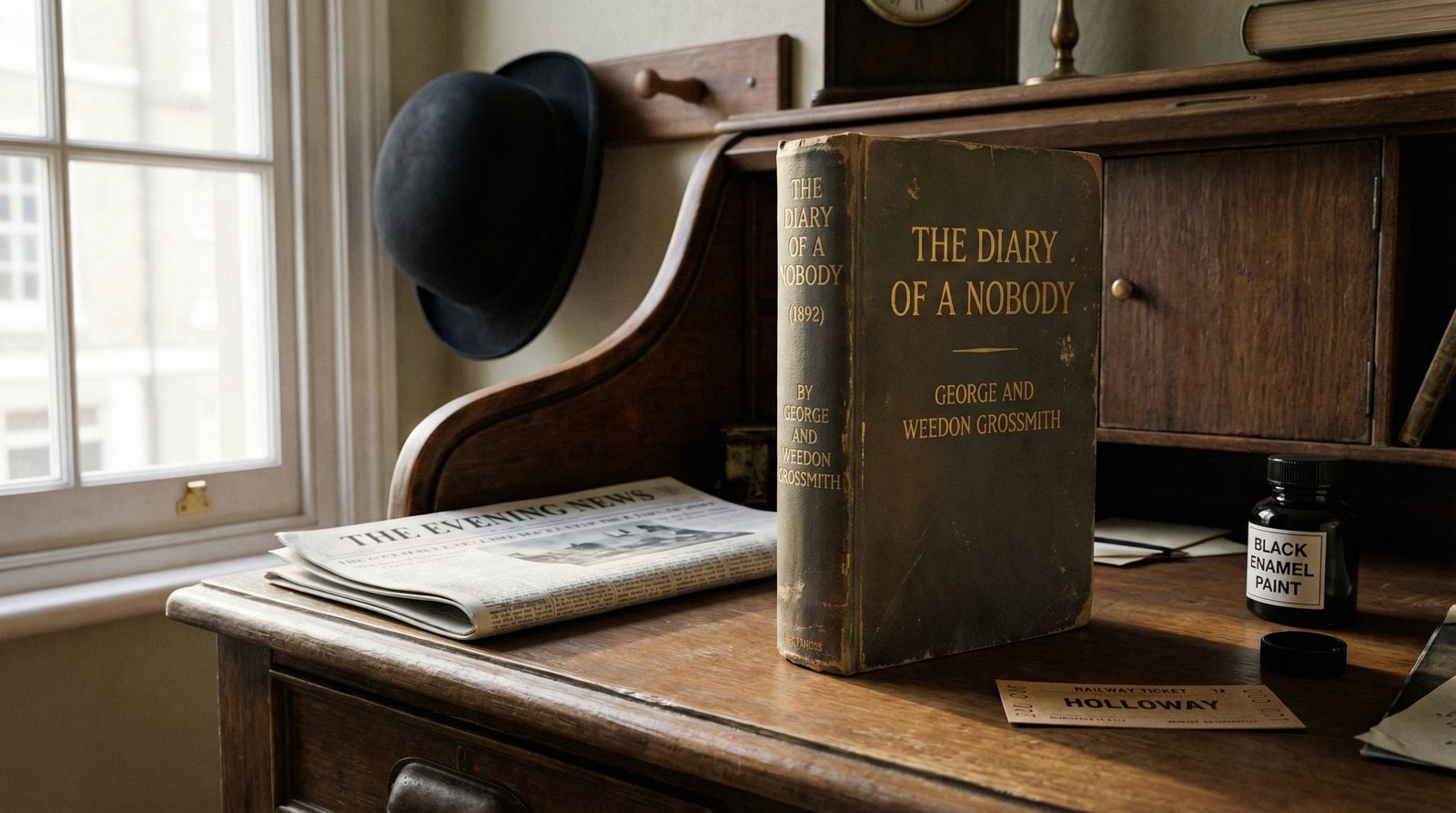
    The Diary Of A Nobody (1892) by George Grossmith and Weedon Grossmith
    Comic fiction · 220 pages · England


    The Diary Of A Nobody is a small book about small things and the very large feelings they provoke. Set in late-Victorian London, it follows Charles Pooter, a clerk whose life revolves around whitewashed walls, dinner parties, and the constant fear of social humiliation. Social pretension runs through every page: Pooter’s world is a stage on which he is always slightly under-rehearsed.

    What makes the book endure is its feel of tender embarrassment. We’re invited to laugh at Pooter’s pomposity, but also to wince in recognition as he fusses over etiquette, taste, and being noticed “properly.” The joke is not that he is ridiculous and we are not. The joke is that his anxieties about status and correctness are uncomfortably familiar, even now.

    PLOT & THEMES

    The “plot” is deliberately uneventful. Pooter moves into The Laurels in Holloway with his wife Carrie, commutes to the City, and records a year or so of minor mishaps: bruised pride, bungled hospitality, office humiliations, and domestic “improvements” that go wrong. Everyday triviality is the structure. Trifles are treated with the solemnity of epic events, which is the core joke of the self-important everyman: Pooter believes his life is worthy of print not because it is extraordinary, but because it is his.

    Social pretension threads through everything. Pooter obsesses over his standing with Mr. Perkupp at the office and with neighbors and acquaintances at home. He treats invitations as honors and mild slights as scandals. Into this fragile respectability crashes his son Lupin, whose speculative schemes, theatrical enthusiasms, and disregard for propriety make it clear the next generation is already moving faster than Pooter can manage.

    The book refuses heroic transformation. After financial mishaps, social fiascos, and the famous garden-party chaos, life simply resumes. Pooter remains at The Laurels, still commuting, still worrying about boots and manners. The anti-climactic ending is the point: the middle-class dream here is not ascent, but dogged continuity — the ability to keep going while quietly feeling ridiculous.

    In its quiet way, the book anticipates later portraits of ordinary life where embarrassment becomes the engine of story and the day itself becomes the plot.

    PROSE & NARRATIVE STRUCTURE

    The core technique is faux-naive first person. Pooter believes he is writing a sober, dignified record; the Grossmiths arrange his sentences so that self-importance constantly undercuts itself. The comedy lives in the gap between what Pooter thinks he is saying and what the reader hears. The diary form stays rigid: dated entries, small domestic updates, and officious “I wrote a letter” declarations that make every minor incident sound like public history.

    The language is plain office-clerk English, but the timing is surgical. Setups are buried in throwaway lines with payoffs chapters later. Running refrains — especially repeat visitors and repeated social irritants — create a domestic chorus. Catchphrases and habitual actions build rhythm that mimics real diary-keeping, so the narrative feels authentically shapeless while being meticulously composed.

    The result is a parody of Victorian self-documentation that never has to announce itself as parody. Pooter’s sincerity is protected even while it’s being used as the blade.
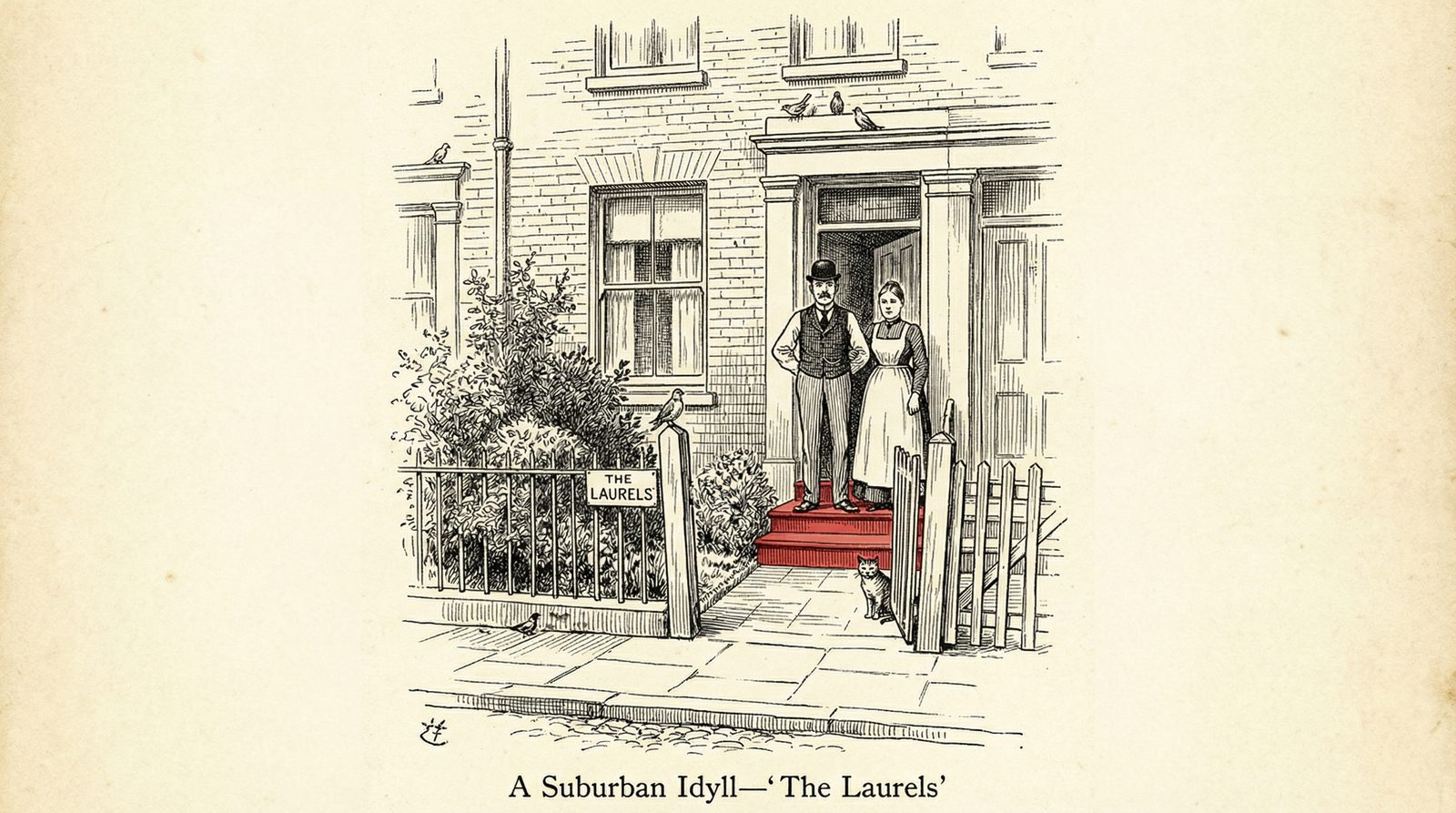
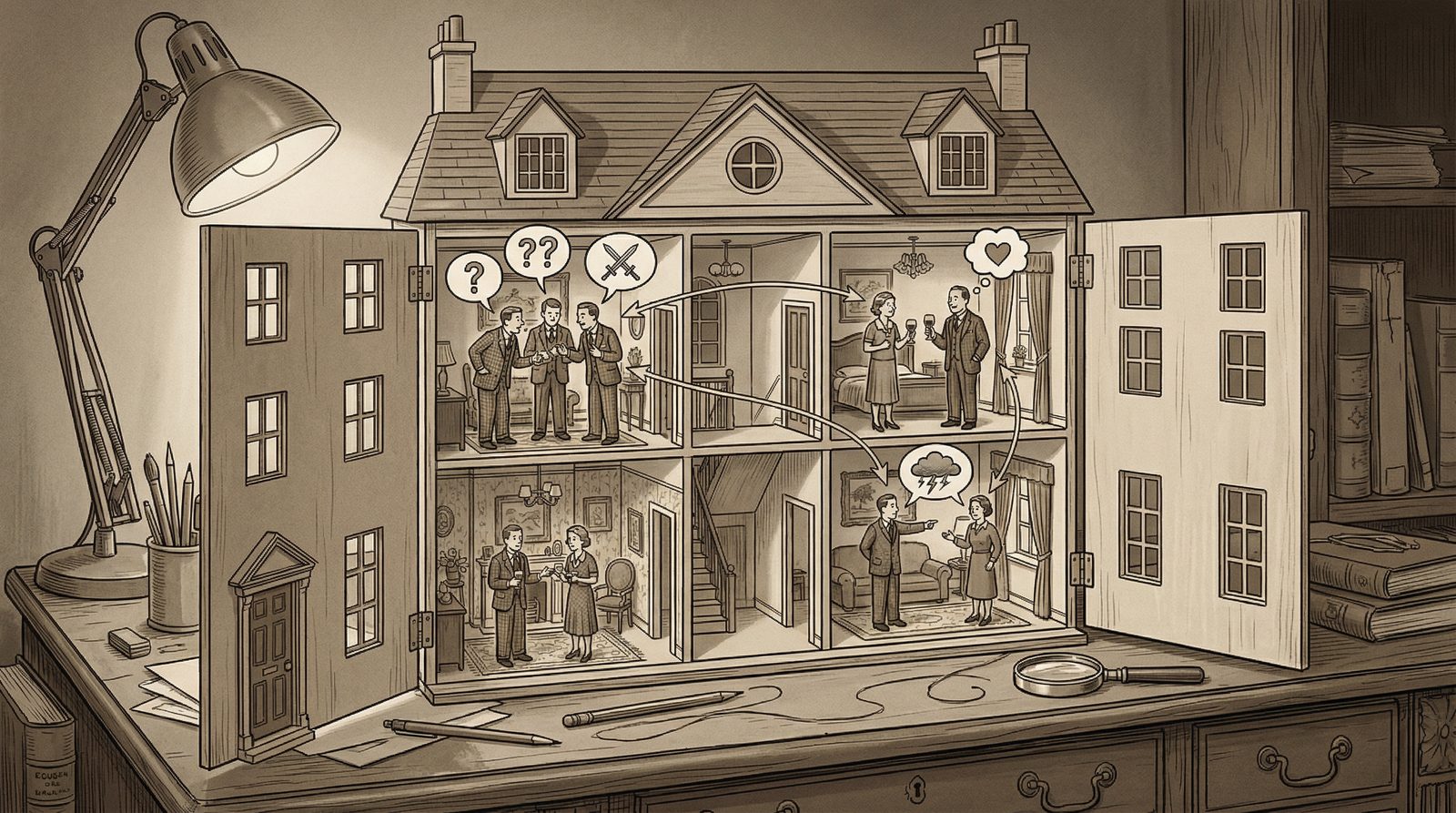
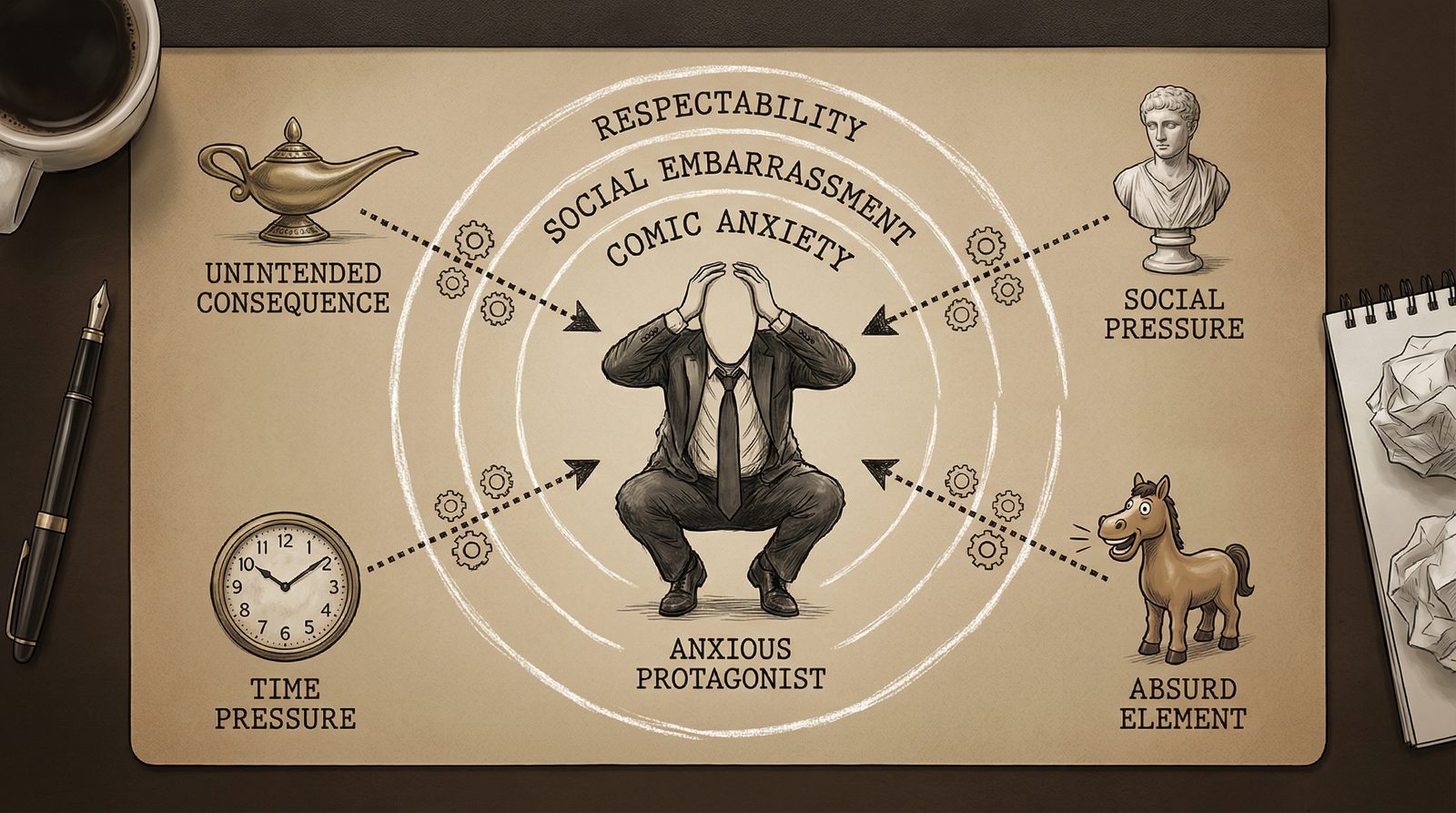
    Conceptual editorial illustration inspired by 'The Diary Of A Nobody (1892)'

    CHARACTERS & INTERIORITY

    Pooter is an archetypal petty-bourgeois striver: not cruel, not stupid, but painfully sensitive to status. His interiority is revealed through what he records and what he refuses to name. He rarely admits anger, yet the diary is full of small sulks displaced into etiquette and fussing. Mortification becomes his primary emotion, managed through rules.

    Carrie is more than a patient-wife cliché. She is practical, often right, and quietly amused by her husband. Lupin is the modern son, a figure of speed and risk, revealing how quickly the cultural ground is shifting under Pooter’s careful propriety. Minor figures recur with economical precision, gaining weight through repetition and Pooter’s prickly reactions rather than through psychological depth.

    The emotional life lies in tiny frictions: social psychology conducted with teacups, calling cards, and the dread of being judged.

    LEGACY & RECEPTION

    Originally serialized in Punch, the book began as episodic satire of lower-middle-class London. Over time it became a touchstone of English comic fiction because it perfected straight-faced mortification: the recording of humiliation as if it were official history. Its influence runs through later diary-format comedy and modern cringe-based humor, not through plot innovations but through tonal precision.

    Adaptations often try to impose a cleaner arc. The novel refuses that shape. Its stubborn ordinariness has gradually shifted its status from topical satire to something closer to a preserved social voice: a class that rarely left monuments to itself leaving one anyway, by accident, through comedy.

    IS IT WORTH READING?

    If you need sweeping plot or high drama, this may feel slow. Its pleasures are miniature. But if you’re interested in how ordinary people imagined themselves in late-19th-century England, or in how comedy can be built out of pure embarrassment without cruelty, it’s essential. You may start by laughing at Pooter and end by feeling oddly protective of him, which is the book’s slyest achievement.
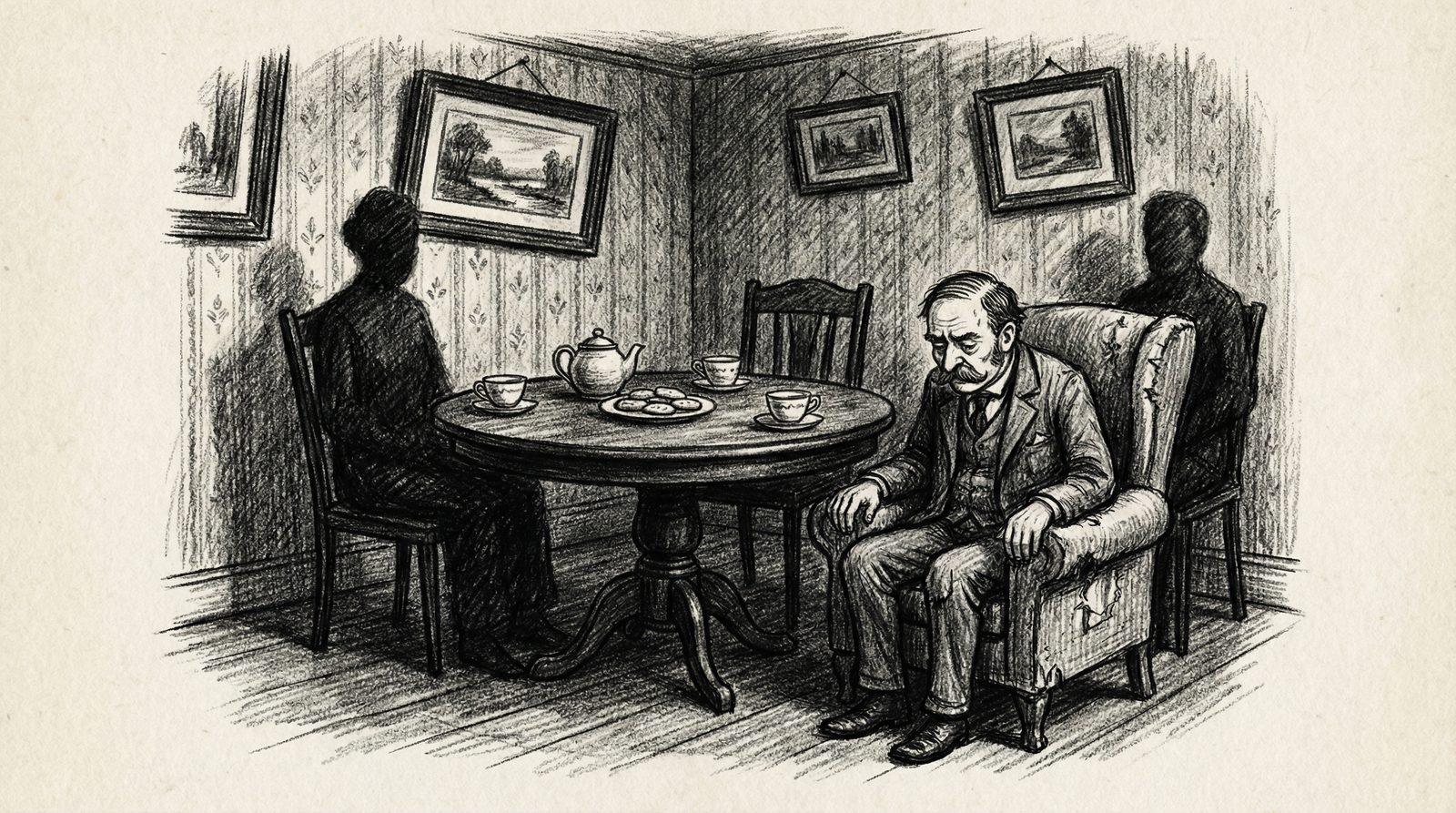
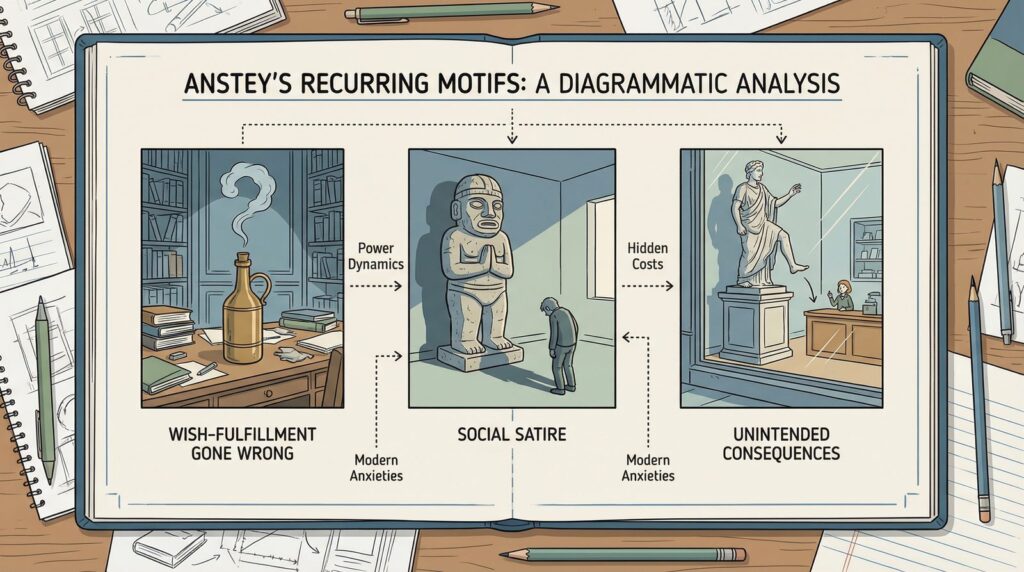
    Illustration of a core idea or motif from 'The Diary Of A Nobody (1892)'

    TRIVIA & AUTHOR FACTS

    George Grossmith was a celebrated comic performer associated with the Savoy Theatre, and Weedon Grossmith was an actor and illustrator. Weedon’s drawings accompanied the original publication and helped fix Pooter’s world in readers’ minds. Many details are rooted in real suburban London geography and the rhythms of commuter life.

    The book’s “nobody” status is carefully crafted. The Grossmiths knew exactly how much ordinariness to put on the page, and exactly how to time the embarrassment so it lands as tenderness rather than cruelty.

    SIMILAR BOOKS

    If you enjoy this, you may prefer other books that treat everyday life as serious comic material and use the ordinary as an engine for precision embarrassment rather than big plot. The closest neighbors tend to share its affection for blundering, its diary-like immediacy, and its social anxiety as comedy fuel.

    DISCOVERABILITY & LINKS

  • Evelyn Waugh

    Evelyn Waugh

    ORIGINS & BACKGROUND

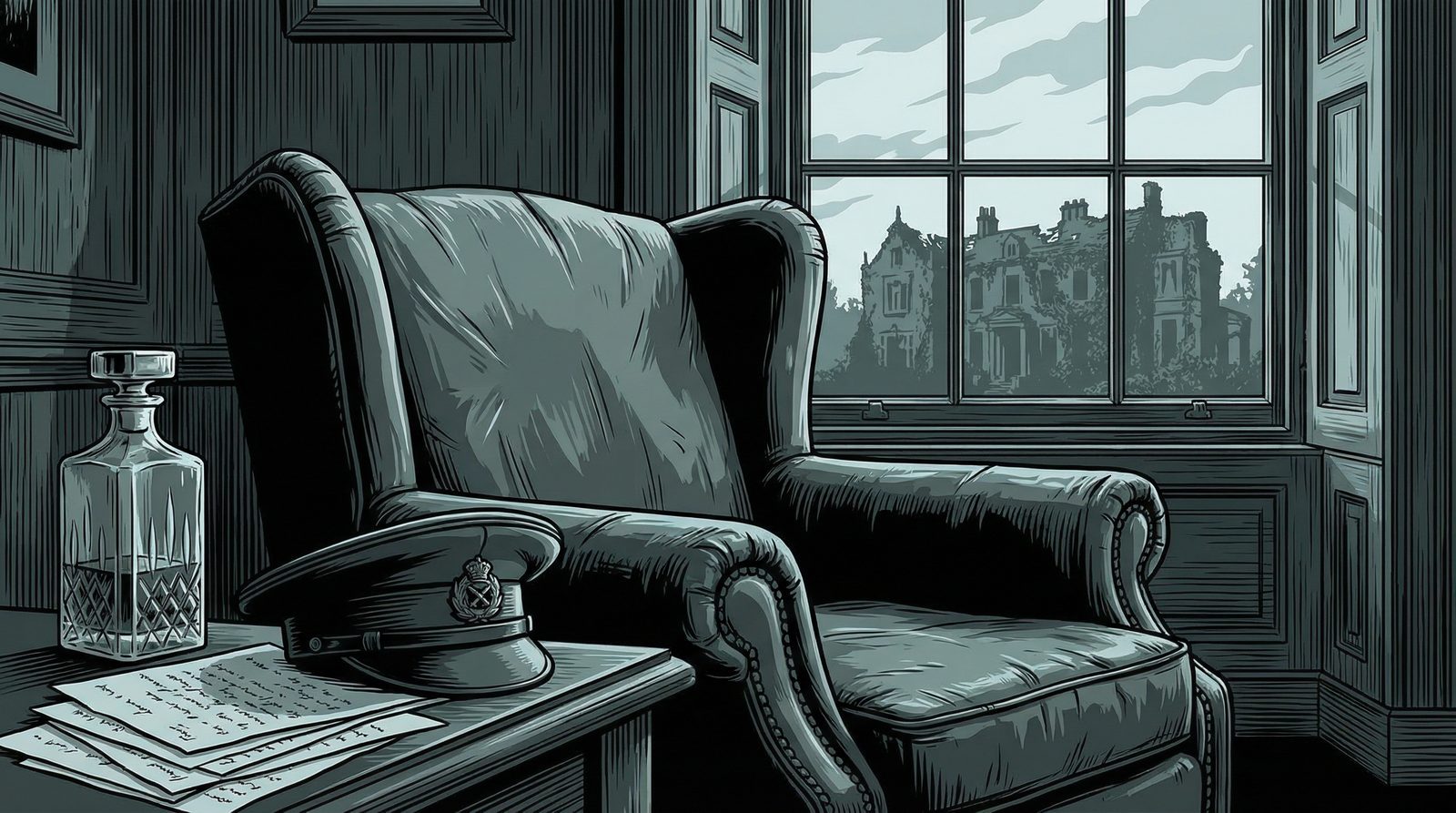
    Evelyn Waugh is one of the central English novelists of the twentieth century, best known for comic and satirical fiction and for his uneasy fascination with the English upper classes. Born into a literary family in England, he grew up with a keen awareness of class, culture, and the gap between public respectability and private chaos. That early sense of social performance runs through his work, where almost every character is acting a part in some larger, often ridiculous, pageant.

    His adult life took him through art school, journalism, and military service, and he moved through bohemian circles before converting to Roman Catholicism. That conversion matters for his fiction: beneath the bright surface of social comedy there is a persistent concern with spiritual emptiness, guilt, and the possibility of grace. The tension between worldly status and moral failure becomes one of his deepest preoccupations.

    Waugh wrote during the interwar and postwar decades, watching the apparent solidity of the English class system decay under the pressure of war, modernity, and mass culture. He shares with P. G. Wodehouse and Nancy Mitford an obsession with aristocratic manners, but where Wodehouse tends toward pure farce, Waugh mixes cruelty, melancholy, and religious anxiety into his comedy of manners.

    Editorial illustration inspired by 'Evelyn Waugh'

    THEMES & MOTIFS

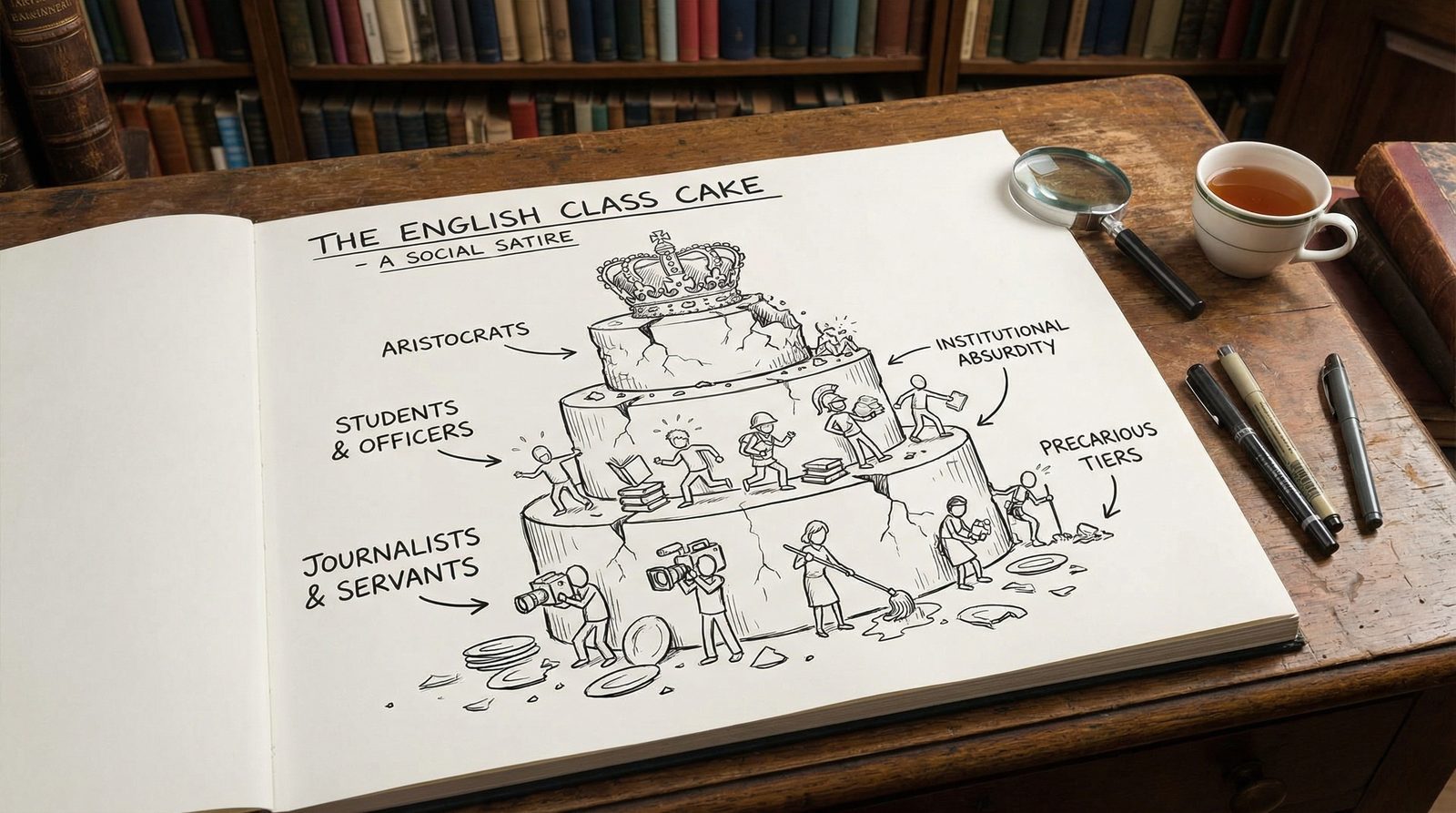
    A core engine in Waugh’s fiction is social satire. He returns again and again to the spectacle of class performance, exposing brittle rituals, casual cruelty, and deep insecurity. Parties, country houses, schools, regiments, and newsrooms become stages for petty power plays where everyone is desperate to be seen as someone they are not.

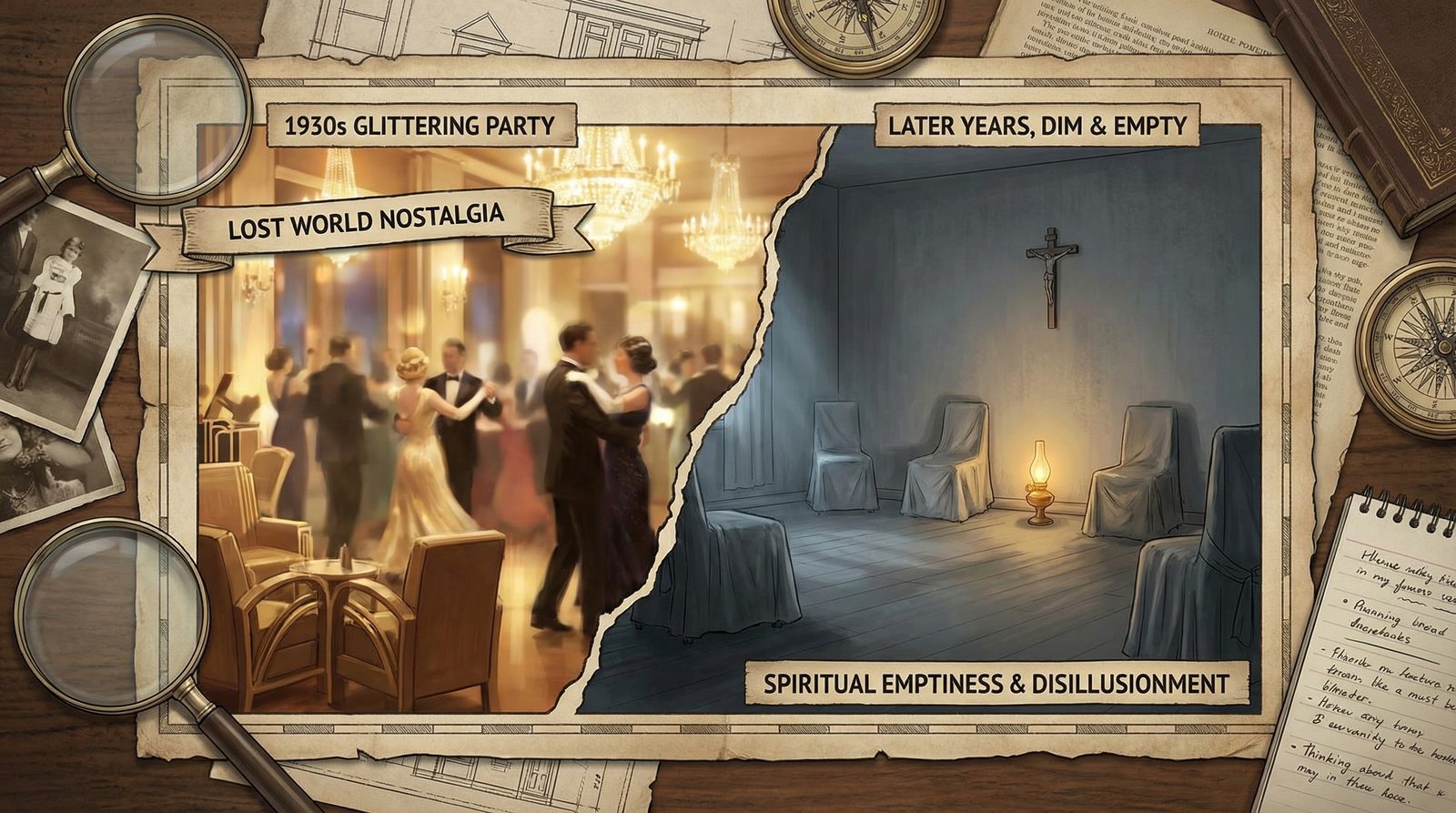
    Running alongside the comedy is a persistent spiritual unease. Characters chase pleasure, status, or distraction, but the world they inhabit feels morally exhausted. Even when religion is not foregrounded, the novels carry a background hum of judgment, emptiness, and the longing for meaning that cannot be satisfied by taste, money, or social position.

    Waugh also delights in institutional absurdity. Schools, the press, the military, and polite society are shown as machines that keep operating regardless of competence or consequence. The humor comes from the collision between official seriousness and private farce, with characters chewed up by systems that pretend to be orderly while functioning as chaos.

    Relationships in his work are often brittle. Friendships, marriages, and romances are shaped by money, class, and self-interest as much as by affection. That emotional harshness feeds his broader disillusionment with modernity. Progress does not bring happiness; it brings new ways to be distracted, manipulated, or hollowed out.

    Symbolic illustration inspired by 'Evelyn Waugh'

    STYLE & VOICE

    Waugh’s style is marked by sharp wit and precise, economical prose. He favors clean sentences, brisk pacing, and dialogue that can turn from polite to savage in a single line. Scenes that begin as light comedy often edge into cruelty or sadness without any change in narrative voice, which allows the reader to laugh while feeling the floor quietly drop out beneath the joke.

    His narrative structures are tightly organized, built around set pieces that escalate toward social or emotional collapse. Waugh is acutely attentive to how people signal class and status through speech and gesture. Compared with the buoyant, consequence-free worlds of Wodehouse, his comedy has an astringent quality: it is funny, but it rarely feels safe.

    At the same time, he can shift into an elegiac register when describing houses, landscapes, or memories of the past. That contrast—between brittle satire and sudden lyricism—reinforces his themes of nostalgia, decline, and moral longing, even when the surface plot looks like farce.

    KEY WORKS & LEGACY

    Waugh’s reputation rests on a body of novels that helped define twentieth-century English satire. Decline And Fall (1928) is an early classic of institutional comedy, built around an innocent protagonist fed into corrupt systems that smile while they destroy. His later work broadened that satirical intelligence into more explicitly elegiac territory, turning the decline of a world into a central subject rather than just a background condition.

    Waugh’s influence is especially strong in how later novelists handle class performance, institutional chaos, and the strange intimacy between comedy and despair. He remains a key reference point for writers who want satire that is formally controlled but morally sharp.

  • Nancy Mitford

    Nancy Mitford

    ORIGINS & BACKGROUND

    Nancy Mitford wrote about a world she knew from the inside. She was one of the famous Mitford sisters, raised in an aristocratic family where wit was a survival tool and conversation a competitive sport. That background fed directly into the comedy, cruelty, and tenderness of her fiction. Her best-known novels, The Pursuit Of Love and Love In A Cold Climate, draw on her own experience of country houses, London seasons, and the uneasy shift from inherited privilege toward modern uncertainty.

    Although she also wrote biographies and essays, Mitford is most often encountered as a comic novelist of manners. She is frequently grouped with P. G. Wodehouse and Evelyn Waugh, but her focus is more domestic and emotionally intimate. Where Wodehouse builds farce and Waugh leans toward savage satire, Mitford centers romantic longing, family dynamics, and the private costs of social expectation.

    Much of her adult life was spent in France, and that expatriate distance sharpened her eye for English oddities. From abroad, the rituals of the upper classes looked both glamorous and faintly ridiculous. Balls, hunting parties, and country house weekends appear in her fiction not as exotic spectacle but as familiar furniture, increasingly out of step with the changing world around them.

    The Second World War and the decline of the old aristocratic order form an unspoken backdrop to her comedies. Characters cling to inherited structures even as those structures hollow out. This tension between nostalgia and disillusionment runs through her work and is rooted in her own biography: she loved the charm of that world, but saw clearly its emotional negligence and casual cruelty.

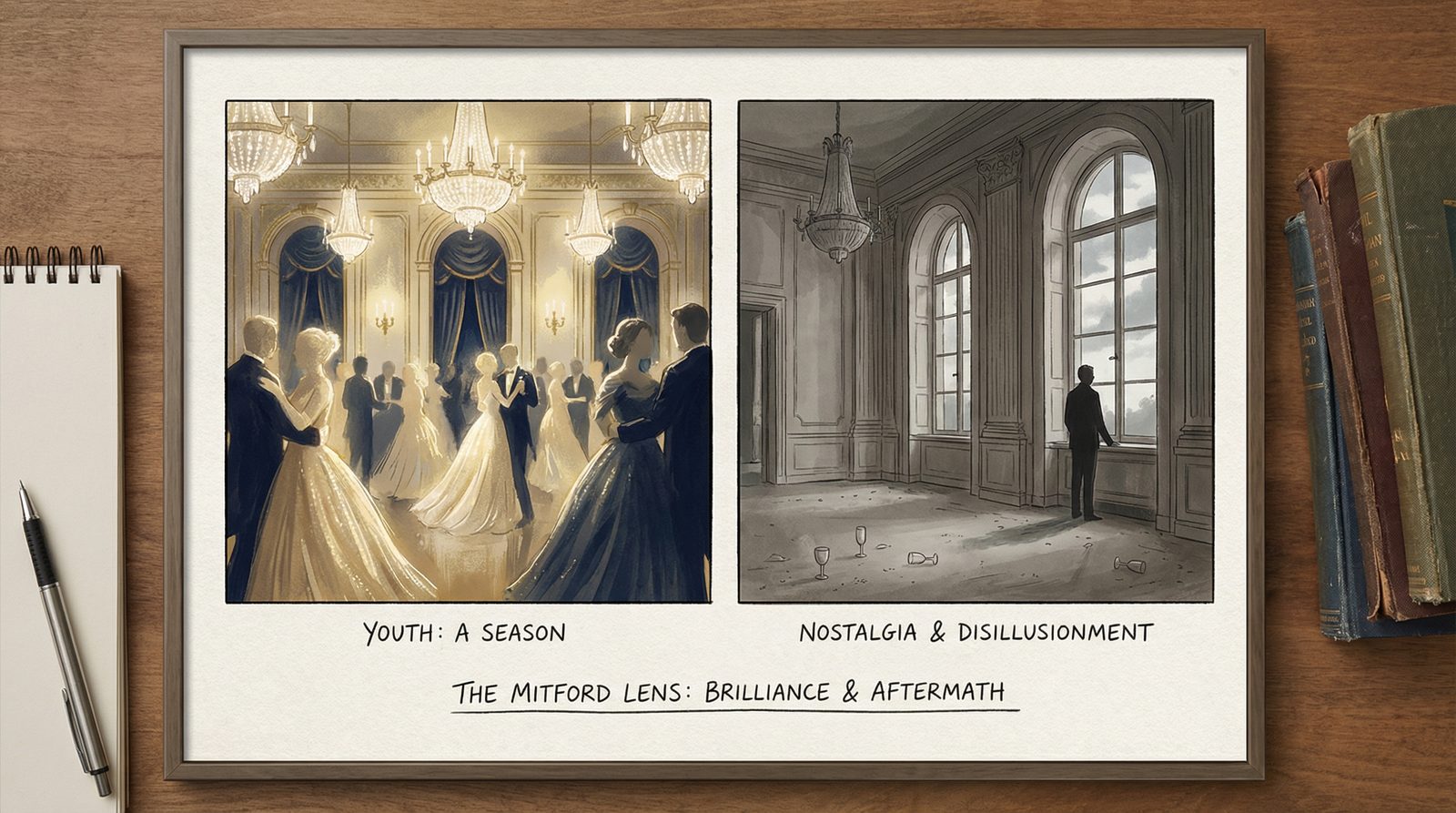
    Editorial illustration inspired by 'Nancy Mitford'

    THEMES & MOTIFS

    Mitford’s novels are rooted in Country House Comedy, but with a distinctly feminine and emotional center. She exposes the absurdities of aristocratic life while remaining attentive to the inner lives of women navigating romance, marriage, and limited choices. Her satire is affectionate but unsparing: privilege provides comfort, but rarely happiness.

    Romantic idealism collides repeatedly with social reality. Her heroines long for great love, only to discover that marriage often brings boredom, compromise, or disillusionment. In The Pursuit Of Love, this cycle becomes the emotional spine of the novel, as passion gives way to reality and youth proves fleeting.

    Family functions as both refuge and trap. Mitford’s fictional families are sprawling, eccentric, and often hilarious, but they also impose emotional constraints. Affection is expressed through teasing rather than tenderness, producing characters who are socially fluent but privately starved for stability.

    Throughout her work, youth is treated as a brief, intense season. Adolescence and early adulthood are full of hope and misjudgment, shadowed by the knowledge that history is closing in. War and social change hover just offstage, lending her comedies a faintly elegiac tone beneath the jokes and gossip.

    Symbolic illustration inspired by 'Nancy Mitford'

    STYLE & VOICE

    Mitford’s style is deceptively light. Her prose is conversational, brisk, and rich with dry observation, giving the impression of effortlessness while remaining sharply controlled. She favors dialogue and understatement, allowing emotional pain to surface indirectly through irony and casual asides.

    The narrative voice in The Pursuit Of Love and Love In A Cold Climate belongs to a witty observer who is both inside the family circle and slightly removed from it. This perspective allows Mitford to combine intimacy with critique, sustaining satire without cruelty.

    Compared with P. G. Wodehouse, her comedy is less farcical and more psychologically grounded. Compared with Evelyn Waugh, her irony is less savage and more forgiving. Even when she writes about disappointment or emotional neglect, she cushions the blow with wit and restraint.

    KEY WORKS & LEGACY

    The Pursuit Of Love (1945) is the novel most closely associated with Nancy Mitford. It follows a young woman from an eccentric aristocratic family as she searches for love through a series of unsuitable attachments. The book crystallizes Mitford’s blend of social satire, romantic disillusionment, and sharp observation.

    Love In A Cold Climate (1949) revisits the same world from a different angle, deepening its portrait of marriage as social contract and emotional compromise. Together, the two novels form a loose diptych that captures the decline of an old order through intimate, comic scenes.

    Mitford’s legacy lies in how she combined light tone with serious insight. She showed that comedy of manners could register historical change, emotional loss, and gendered constraint without abandoning charm. Later writers of family sagas and social comedy continue to draw on her balance of wit, affection, and clear-eyed critique.

  • Alan Watts

    Alan Watts

    ORIGINS & BACKGROUND

    Alan Watts is best known as a bridge figure, a British-born writer and speaker who helped popularize Asian thought for Western audiences in the mid-twentieth century. He was raised in England with a mix of Anglican Christianity and a sharp curiosity about the wider world, which led him early toward Buddhist and Hindu texts. Eventually he moved to the United States, studied theology, and served as an Episcopal priest before leaving the church to focus on a more fluid Eastwest Philosophical Synthesis.

    What matters for his work is less the institutional path and more the way he stood at a cultural crossroads. He wrote and lectured at a time when Western readers were just beginning to take Zen Buddhism, Taoism, and Vedanta seriously. Rather than presenting them as exotic systems, he treated them as practical lenses for everyday life. His training in Christian theology gave him a sharp sense of how religious language can clarify, distort, and control, and he used that insight to cut through dogma on all sides.

    Watts was less interested in constructing a tight philosophical system than in describing how ideas feel from the inside. His biography feeds directly into this approach: a restless mover between countries, institutions, and traditions, he turned his own life into an experiment in living without clinging too tightly to any one identity.

    Editorial illustration inspired by 'Alan Watts'

    THEMES & MOTIFS

    A central theme in Watts’s work is the illusion of a separate self. Again and again he returns to the idea that the “I” we defend is a mental construct, a useful convention that becomes painful when we treat it as something solid. For Watts, the self is more like a pattern in motion than a hard object, and much of our anxiety comes from trying to freeze that motion into certainty and control.

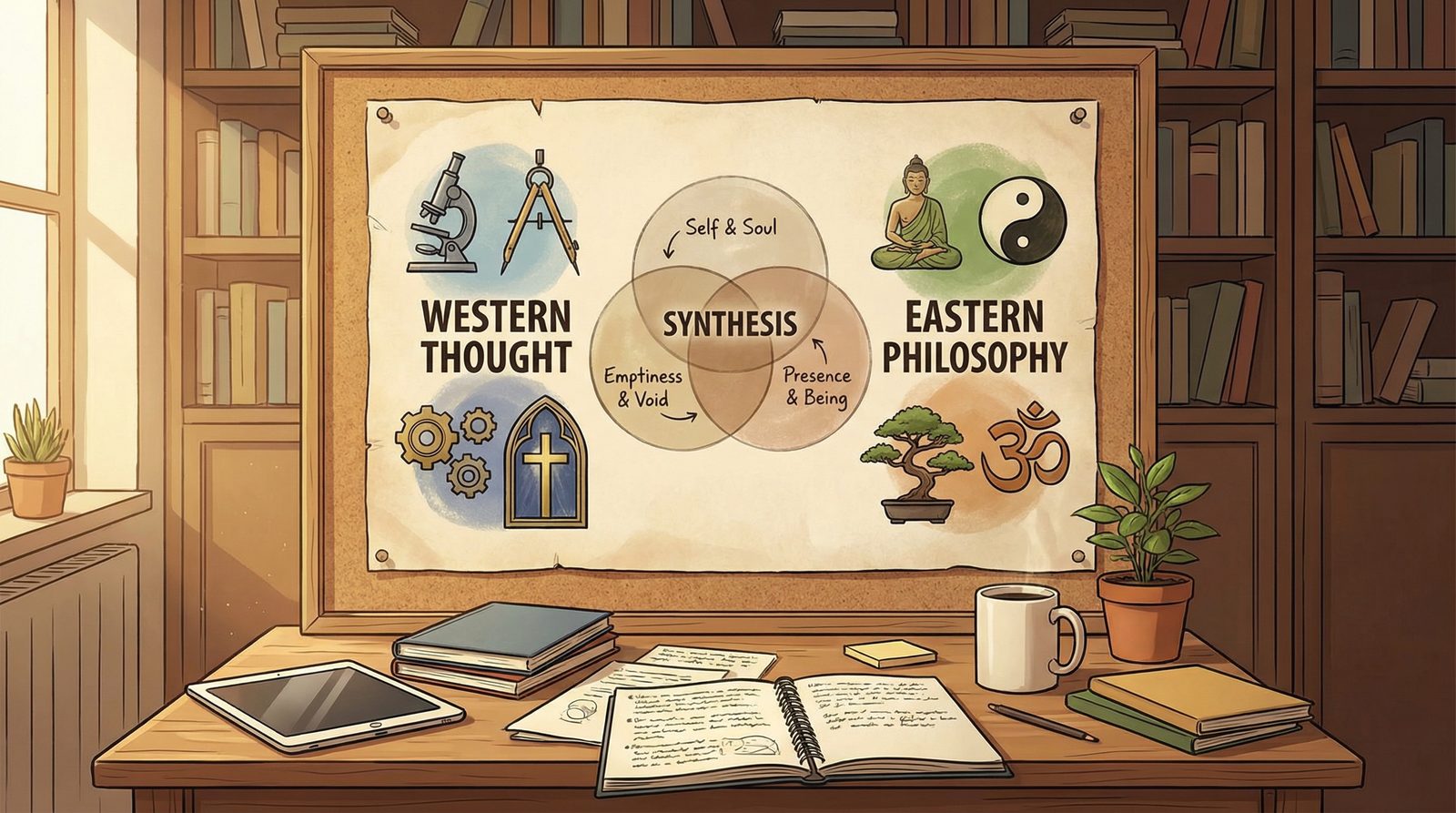
    Another recurring motif is Eastwest Philosophical Synthesis. He places Zen, Taoism, and Hinduism alongside Western psychology, science, and Christian imagery, not to flatten them into one bland system but to show how each tradition reveals a different blind spot. The synthesis is less about agreement than about creative friction, where unfamiliar language opens new ways of seeing familiar problems.

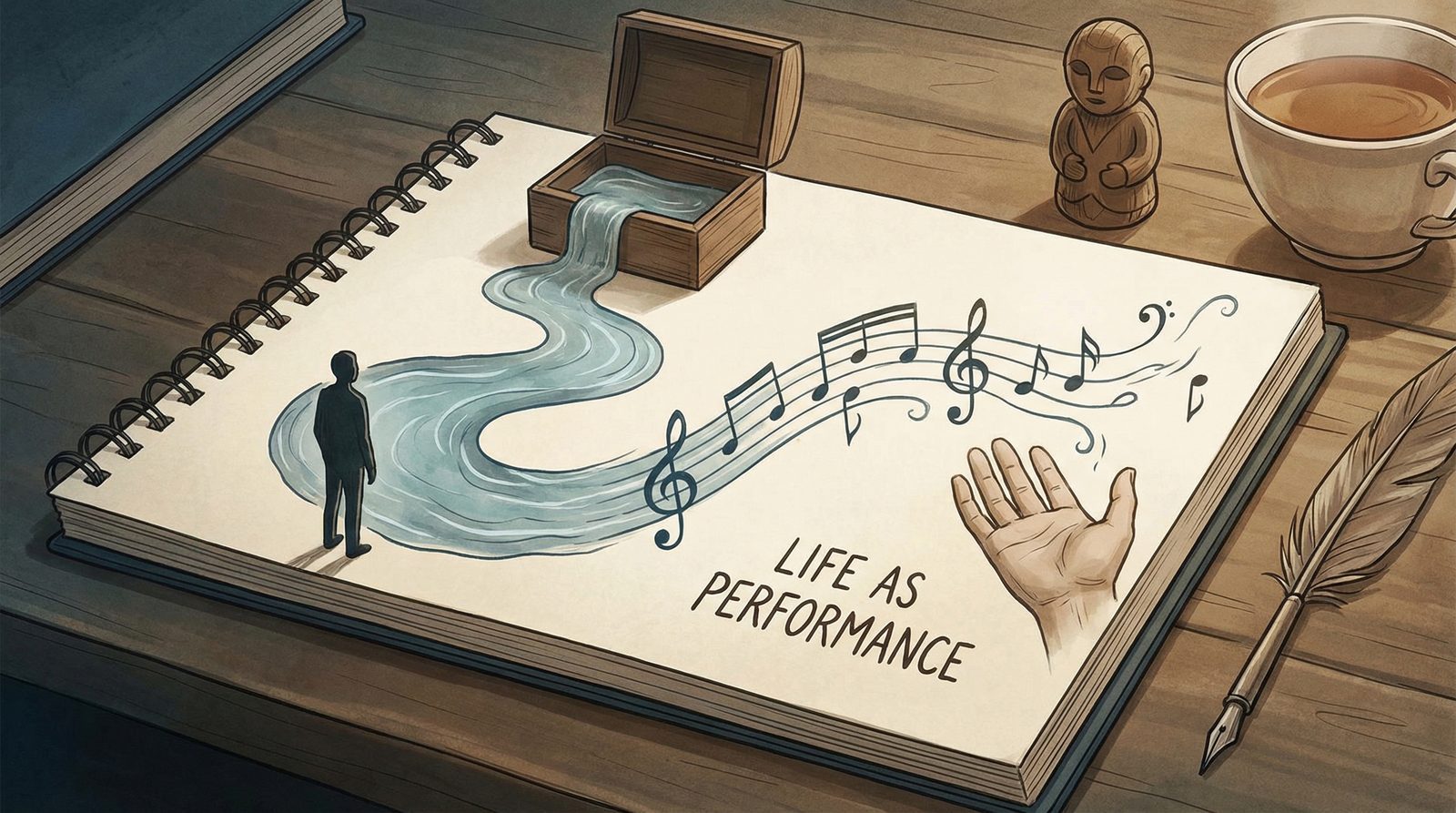
    Watts is also preoccupied with the tension between control and surrender. He returns to images of water, music, and dance to suggest that life works better when approached as a performance rather than a problem to be solved. This places him in useful contrast with more strictly instructional works like Zen Mind, Beginner’s Mind, where discipline and practice are emphasized more than play and improvisation.

    Finally, he explores insecurity and groundlessness directly. In The Wisdom Of Insecurity, Watts argues that the demand for absolute certainty is itself a generator of suffering. Rather than promising stable answers, he invites the reader to become more intimate with change, ambiguity, and the passing nature of experience. That willingness to sit with not-knowing is one of the signatures of his voice.

    Symbolic illustration inspired by 'Alan Watts'

    STYLE & VOICE

    Watts writes and speaks in a conversational, sometimes mischievous tone. His style is closer to a late-night talk than to formal philosophy. He uses jokes, parables, and sudden shifts in perspective to loosen the reader’s grip on familiar assumptions. Rather than building dense chains of argument, he circles a topic from multiple angles until something clicks at the level of intuition.

    There is a musical quality to his pacing. He often begins with something concrete and ordinary, widens the frame to cosmic scale, then drops back into the personal. This rhythm mirrors his themes about the unity of self and world, moving the reader between the intimate and the vast without insisting on a final “system.”

    Compared with more austere Zen teachers or more systematic writers, Watts is comfortable with contradiction and unresolved tension. He will often present two opposing views and then suggest that both are partial, inviting the listener to feel their way into a third position that cannot be neatly stated. The tone is playful, sometimes irreverent, but underneath is a steady seriousness about suffering, compassion, and seeing the world with fresh eyes.

    KEY WORKS & LEGACY

    Because so much of Watts’s influence came through lectures and radio broadcasts, his key works are as much spoken as written. Collections of his talks continue to circulate, shaping how English-speaking audiences encounter ideas like non-duality, impermanence, and the limits of the ego. His writing helped make these concepts feel close to everyday life rather than locked in monasteries.

    His legacy is not a single doctrine but a set of habits: questioning the solidity of the self, treating synthesis as a living conversation rather than a museum display, and approaching spiritual practice with a mix of seriousness and humor. For many readers and listeners, Watts was the first voice that made spiritual life feel exploratory rather than rule-bound, and that permission continues to ripple through modern writing on consciousness, psychology, and attention.

  • Country House Comedy

    Country House Comedy

    DEFINITION & CORE IDEA

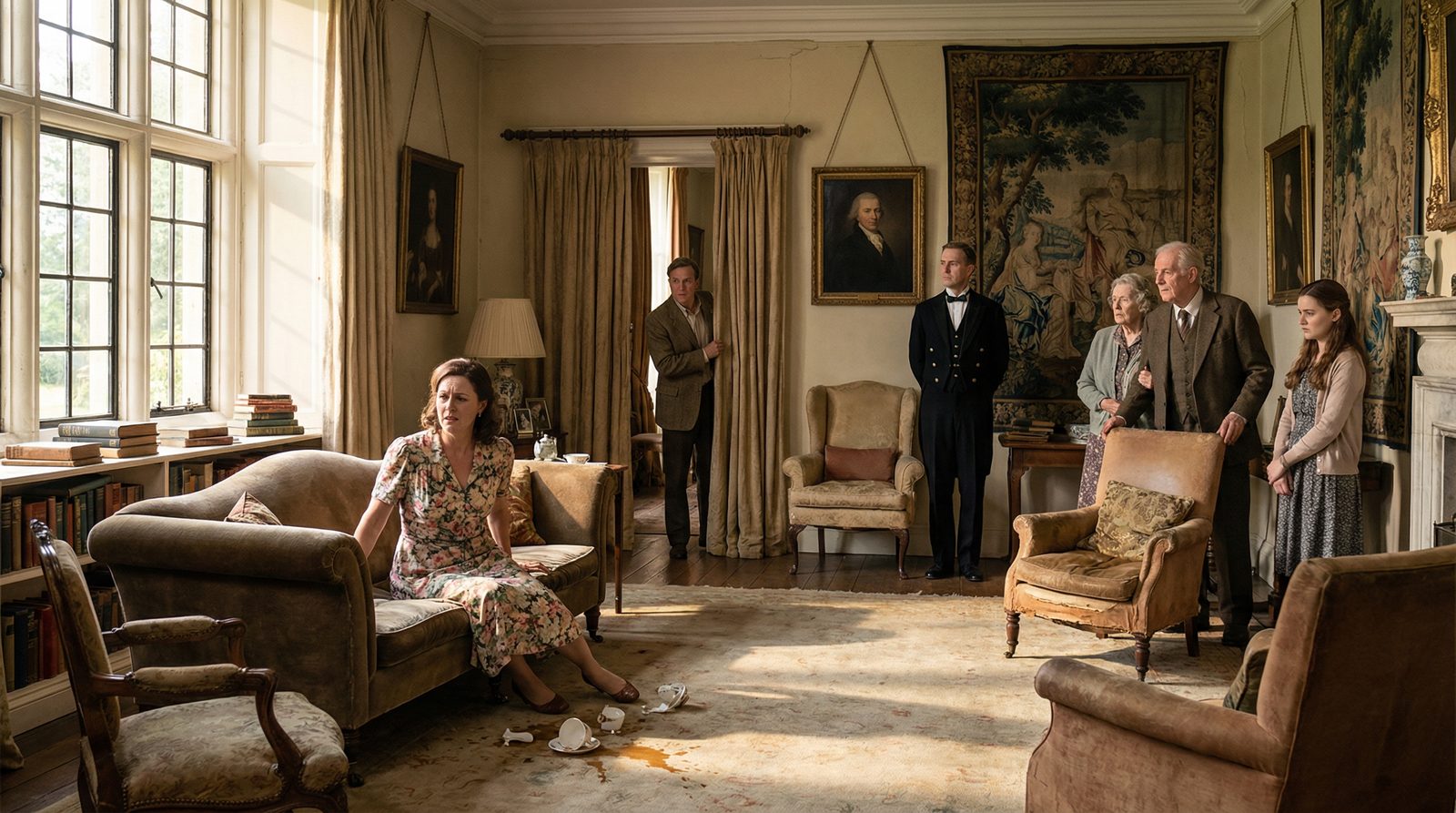
    Country House Comedy is a comic motif where most of the action unfolds in and around a large rural estate packed with guests, servants, and secrets. The house functions as a social arena, trapping everyone together long enough for romantic tangles, class clashes, and elaborate misunderstandings to bloom. The setting promises peace and refinement. What it delivers instead is controlled social chaos.

    Writers use Country House Comedy because it creates a contained world full of built-in tension. City and country collide the moment visitors arrive from town. Old money and new money share the same drawing rooms. Servants observe the performance from the margins, often seeing more than anyone upstairs realizes. The estate’s routines and boundaries force repeated contact between people who would rather avoid each other, which is exactly what comedy needs.

    The motif appears cleanly in the work of P. G. Wodehouse, who uses the stately home as a pressure system for farce. In Leave It To Psmith, a house-party weekend becomes a knot of imposture, theft, and romantic interference, with every attempt at dignity immediately undercut by escalation. At its core, Country House Comedy punctures pretension by forcing refined people to behave irrationally while still trying to look respectable.


    HOW IT WORKS IN STORIES

    Country House Comedy usually begins with an invitation. Guests arrive at the estate for a weekend party, a family gathering, or some supposedly “dignified” social occasion. The host expects order. The reader can feel the collision course immediately. By concentrating a mixed group in one place, the story creates a social laboratory where etiquette becomes a trap rather than a stabilizer.

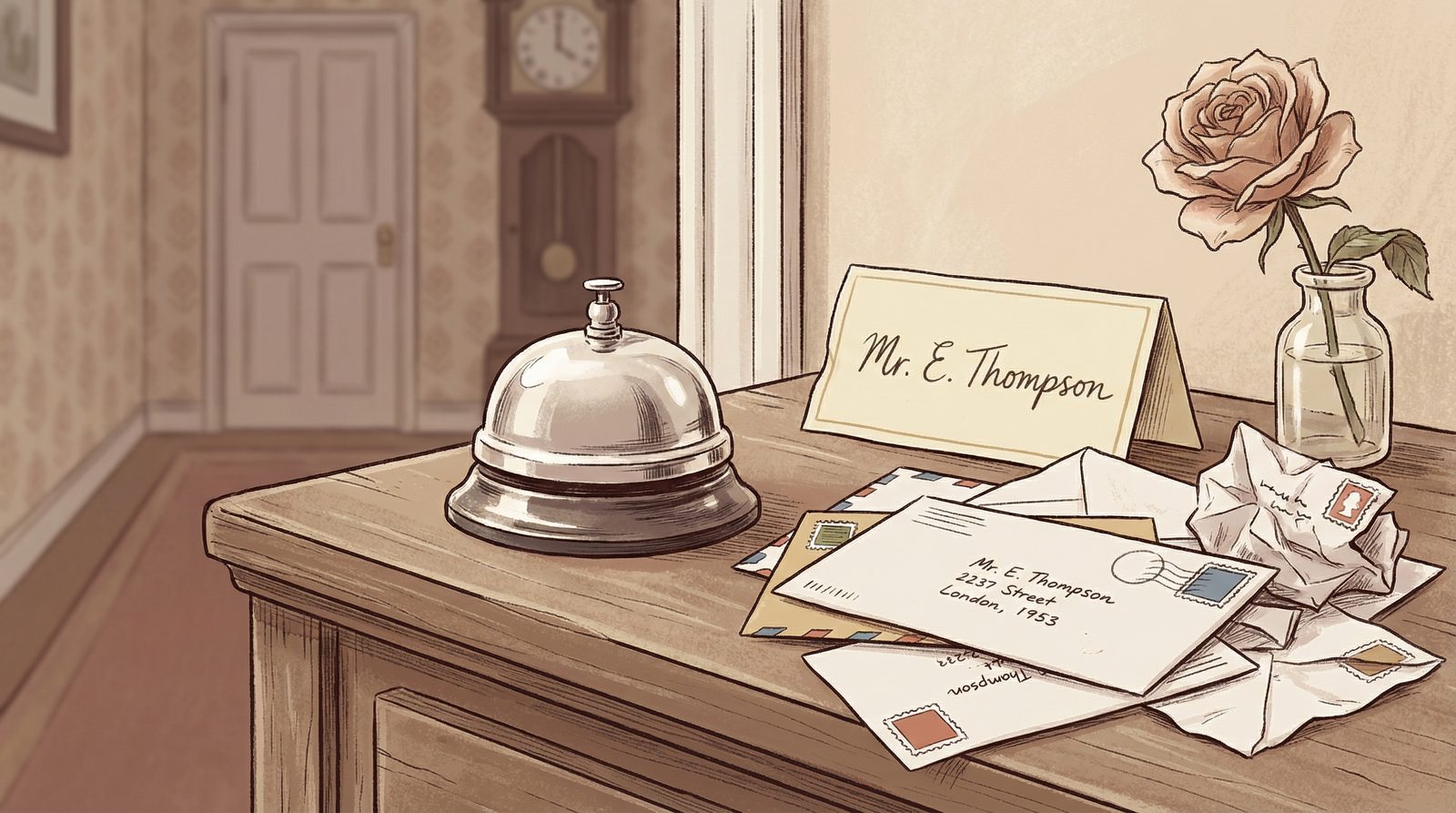
    The cast is designed for friction. There is often a protagonist who cannot speak plainly about what they want, an authority figure who polices the rules of the house, and at least one person whose identity or intentions are not what they seem. Mistaken identity is an especially efficient engine here, because it forces politeness to do the dirty work: once you have greeted the wrong person as the right person, you must keep the lie alive to preserve “good form.” In Leave It To Psmith, Wodehouse turns that logic into momentum, using the house party to keep thieves, romantics, and impostors in the same orbit long enough for small deceptions to become full-scale farce.

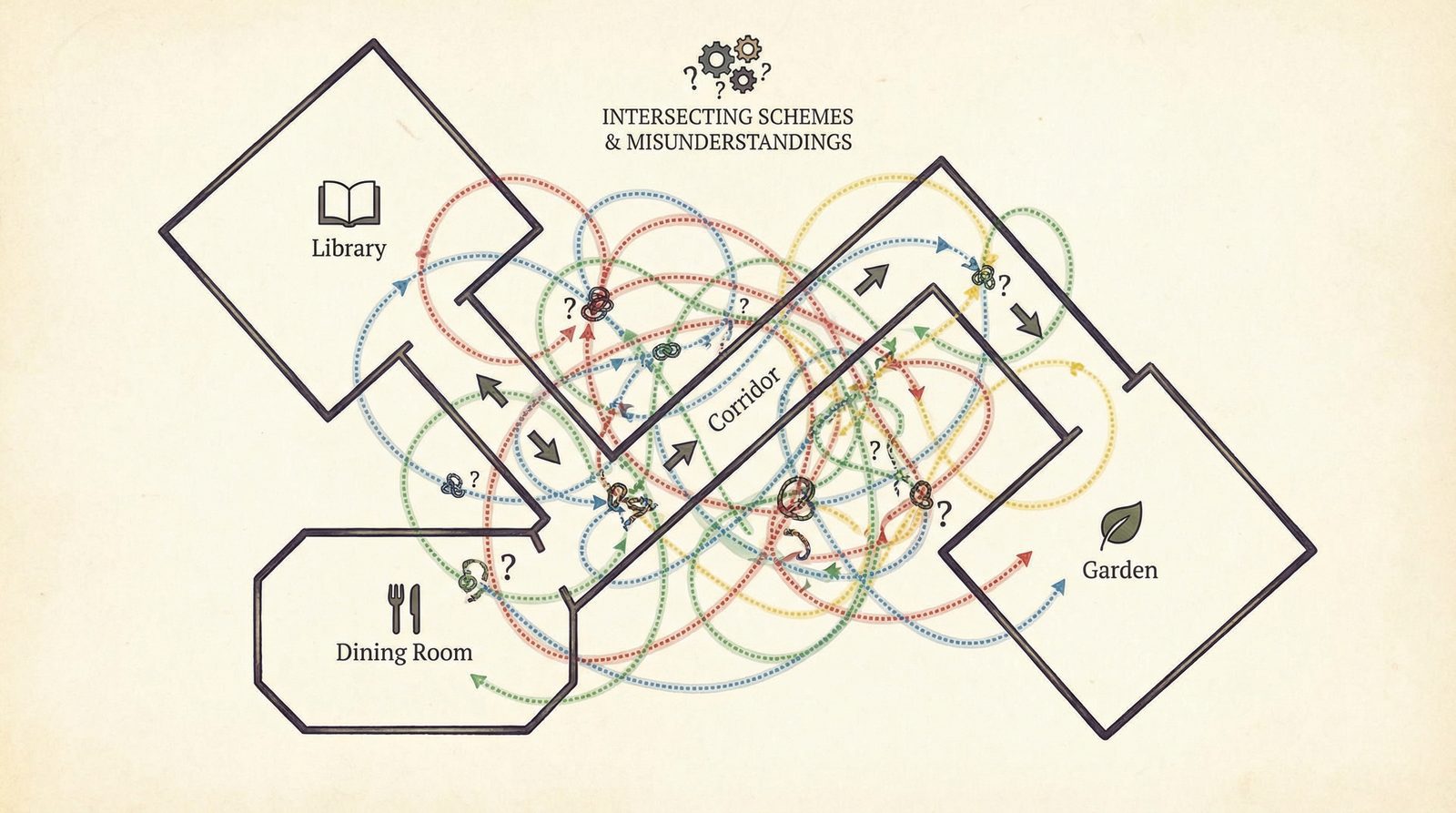
    The building’s layout becomes part of the plot machine. Gardens invite overheard confessions and badly timed proposals. Libraries and sitting rooms host “private” conversations that are never fully private. Bedrooms, corridors, and staircases generate midnight traffic, near-misses, and people hiding in plain sight. Meals and formal events act as recurring pressure points, forcing enemies and co-conspirators to sit politely side by side while chaos continues underneath the tablecloth.

    Timing is the fuel. Country House Comedy thrives on near-misses: someone exits a room seconds before the person they most need to avoid enters; a letter lands in the wrong hands; a disguise nearly fails in the hallway. Because nobody can simply leave, small lies snowball fast. A harmless excuse meant to avoid embarrassment can, within a day, require a coordinated performance involving half the guest list. The story usually ends with an “untying” sequence where secrets spill, motives surface, and the social order re-forms into a new set of alliances and pairings.


    Editorial illustration inspired by 'Country House Comedy'

    EMOTIONAL EFFECT ON THE READER

    Country House Comedy feels like being invited to a party where you are safely invisible. You get to roam the corridors, listen at doors, and watch everyone make fools of themselves without being the one who has to recover socially afterward. Even when characters are panicking, the tone stays light because the stakes remain survivable: reputations wobble, plans collapse, but nobody is truly ruined.

    The reading pleasure often comes as a mix of anticipation and relief. Anticipation, because you can see the collisions lining up: the misplaced letter, the wrong person entering at the wrong moment, the lie that is one step from exposure. Relief, because the genre promises a soft landing. The fun is watching embarrassment expand to its maximum size without tipping into real harm.

    There is also a comforting sense of containment. The estate becomes a sealed bubble where modern noise drops away and the primary “disasters” are social. The reader gets a holiday from consequence, watching wit, timing, and luck restore order just enough for the story to close cleanly.


    Symbolic illustration inspired by 'Country House Comedy'

    VARIATIONS & RELATED MOTIFS

    Country House Comedy has a few reliable variations. One leans toward romance, using the weekend as a matchmaking machine where jealousy, misread signals, and misdirected messages push the “correct” couples into place. Another emphasizes farce, where the plot is driven by impostors, stolen objects, and rapid entrances and exits that feel almost theatrical.

    It also overlaps with broader social satire, where the comedy comes from watching manners and hierarchy fail under pressure. In these versions, the laughs are not only about who ends up in the wrong room, but about how hard people work to maintain status while behaving absurdly. The servant perspective often sharpens that satire, because the people with the least social power may have the clearest view of what is actually happening.

    The motif intersects naturally with comic misunderstandings and farce, mistaken identity logic, and fish-out-of-water dynamics, because the setting intensifies every mismatch. A person who does not understand the rules of the house will break them by accident, and everyone else will scramble to repair the damage without admitting anything is wrong. That scramble is the comedy.

  • Thomas Anstey Guthrie

    Thomas Anstey Guthrie

    ORIGINS & BACKGROUND

    Thomas Anstey Guthrie, who published under the pen name F. Anstey, was a late Victorian and Edwardian humorist who made the respectable English middle class his favorite target. Trained as a lawyer and steeped in the habits and anxieties of the professional classes, he brought a sharp insider’s eye to the comic disasters he inflicted on his characters. That legal precision helps explain why his plots remain cleanly constructed even when the surface is pure farce.

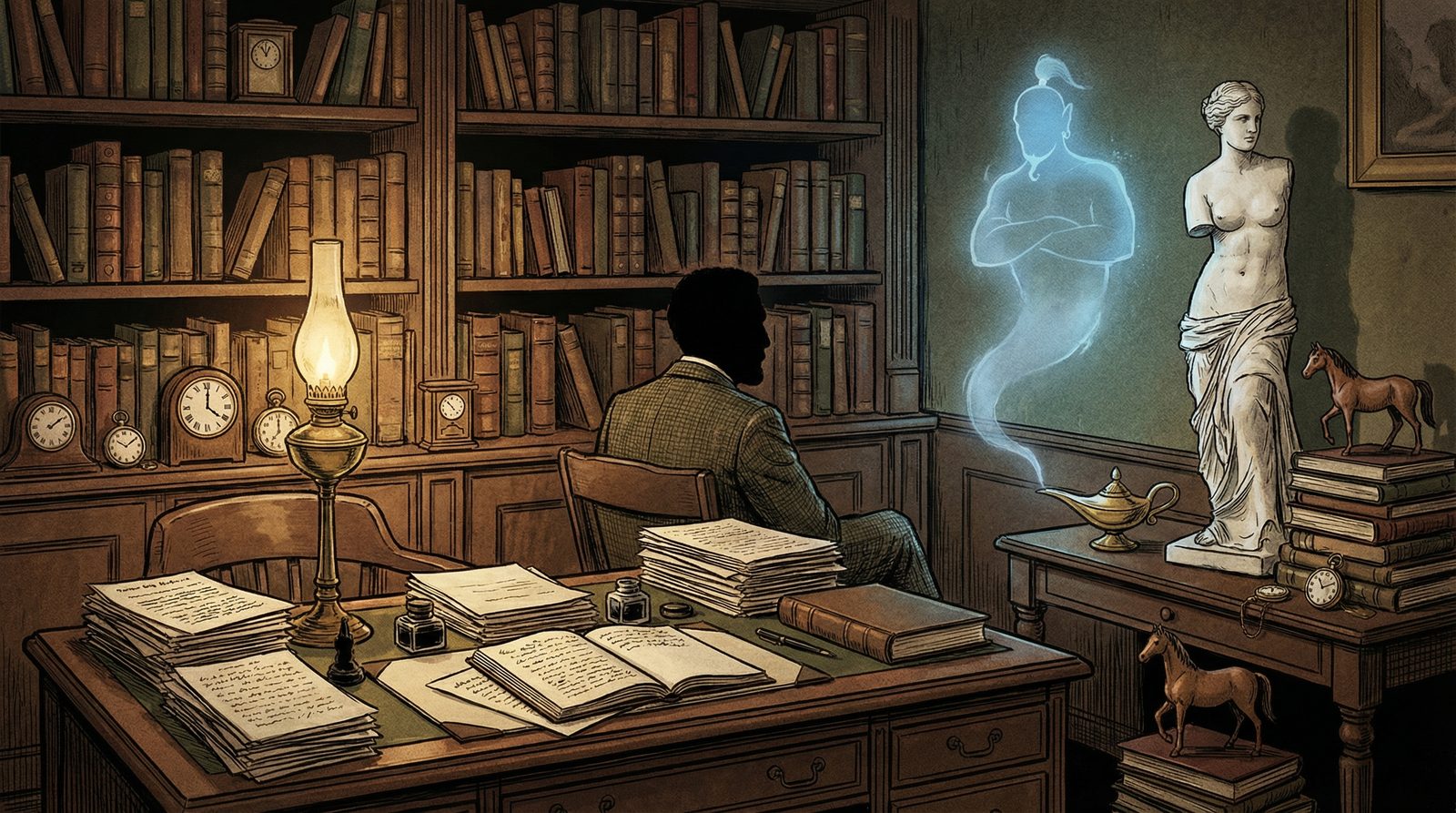
    Working in the same broad comic-fantastical territory that would later nourish writers like E. Nesbit, Guthrie specialized in taking a solidly realistic setting and dropping one impossible element into it. A statue comes to life, a genie appears, a wish is granted too literally, or time itself becomes a ledger. The fabric of polite life immediately starts to fray, and the characters’ fear of embarrassment becomes the real engine of the story.

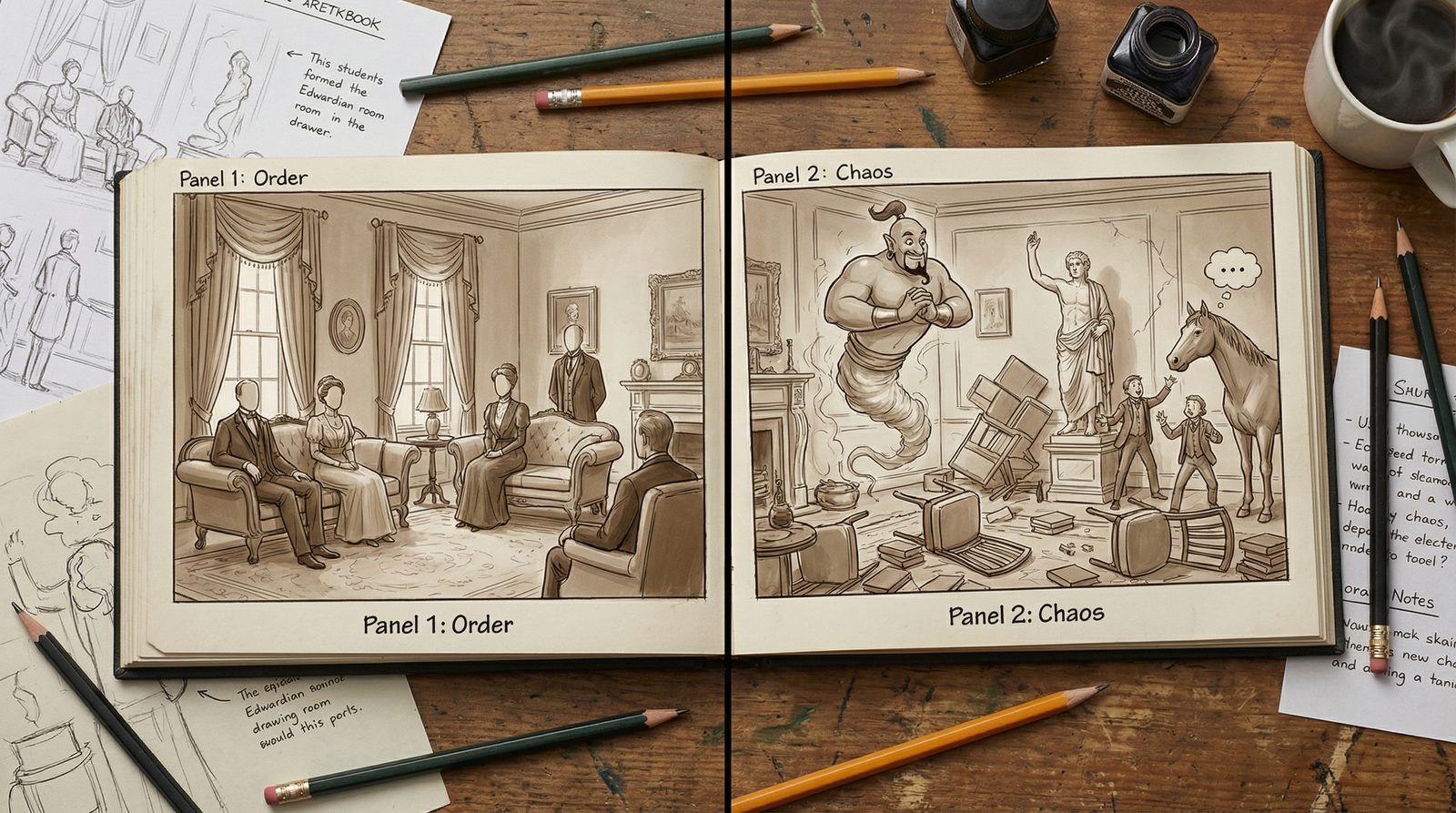
    Editorial illustration inspired by Thomas Anstey Guthrie

    Although his name is less widely known now, he was a familiar presence in comic fiction in his own day, and several works were adapted for the stage and later for film. His best-known stories circulate in the cultural space between light domestic comedy and fantasy disruption, with a dry satirical edge that keeps the laughter slightly uneasy.

    THEMES & MOTIFS

    If there is one recurring pattern in Guthrie’s work, it is the way supernatural help becomes a social catastrophe. He repeatedly stages stories where the impossible enters an ordinary life and exposes how brittle respectability really is. The magic is rarely malevolent. It is simply indifferent to manners, timing, and the quiet codes that keep middle-class life from collapsing into scandal.

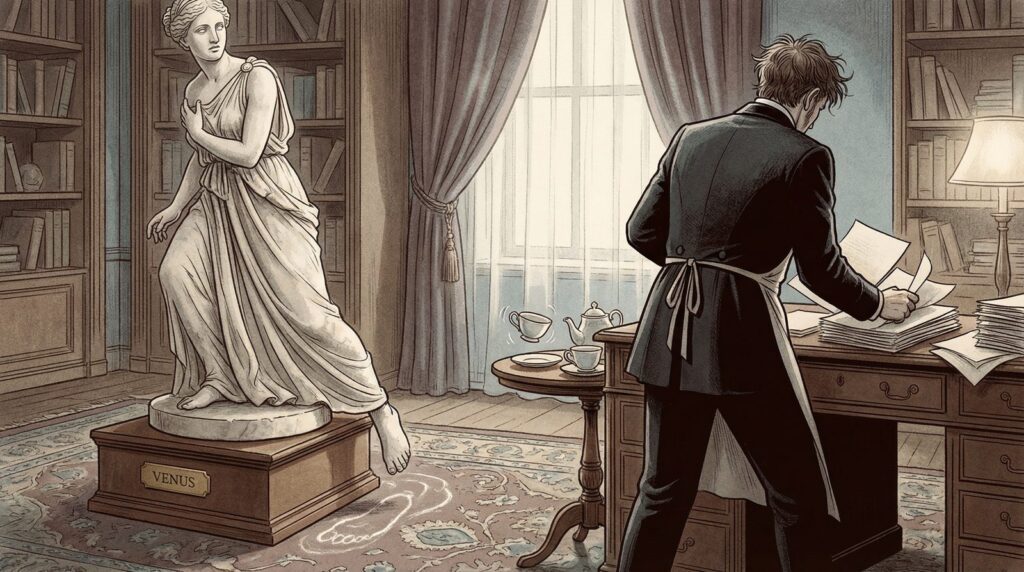
    In The Brass Bottle, a long-imprisoned genie brings the wrong kind of assistance, escalating embarrassment and destroying reputations. In The Tinted Venus, a goddess steps off a pedestal and turns romantic fantasy into social panic. Across these books, “wish-fulfillment” is treated as an experiment that reveals what people actually want, and how badly they handle getting it.

    Symbolic illustration inspired by 'F Anstey'

    He also returns to the idea that modern life is already absurdly procedural, and the supernatural simply makes that procedure visible. In Tourmalin’s Time Cheques, time becomes bureaucratically administered debt, and a person can mortgage their future with a signature. Even when the premise is playful, the underlying anxiety is serious: ordinary life is a set of obligations, and a small twist can expose how fragile the whole structure is.

    Finally, Guthrie’s work often turns on role reversal as moral stress test. In Vice Versa, a father and son swap bodies and are forced to experience powerlessness from the inside. The comedy is real, but the point is sharper: empathy arrives only after humiliation breaks the illusion of authority.

    STYLE & VOICE

    Guthrie’s style balances lightness with a lawyer’s sense of structure. His prose tends toward clear, unshowy sentences, laced with dry asides and understatements that reward attentive reading. He is less interested in lush description than in setting a premise quickly and then following its comic implications as far as they will go.

    Structurally, he favors escalating farce. A single magical intrusion or misunderstanding in the opening chapters ripples outward into layers of social embarrassment. Invitations go wrong, reputations wobble, engagements are imperiled, and the characters’ frantic improvisations only deepen the mess. Readers can usually see the machinery at work, which makes the eventual resolution feel earned even when it relies on a final twist.

    Symbolic illustration inspired by Thomas Anstey Guthrie

    Compared with writers whose magic opens into wonder, Guthrie’s fantasy acts more like a stress test. The stories ask what happens when the impossible walks into an ordinary life and refuses to leave. The answer, rendered with wry control, is comic catharsis that exposes the pressures and pretensions of the world it is satirizing.

    KEY WORKS & LEGACY

    The Brass Bottle (1900) is his most widely recognized comic fantasy: an ancient genie unleashed into a world of mortgages and dinner parties, where every “helpful” intervention creates a new disaster. The Tinted Venus (1885) explores similar territory through romantic fantasy, with a goddess coming to life and exposing how fragile respectability is when desire is made literal.

    Editorial illustration inspired by 'F Anstey'

    A Fallen Idol (1886) pushes further into satire of belief and misplaced reverence, while Tourmalin’s Time Cheques (1891) extends his comic logic into bureaucratic time debt. Vice Versa (1882) remains the foundational body-swap story that later generations would repeatedly reinvent.

    In the larger landscape of English comic fantasy, Guthrie forms a bridge between Victorian satire and later comic modernity. His legacy persists wherever a small magical twist is used to expose the fragile nature of everyday life, and where laughter is sharpened by discomfort rather than softened into reassurance.

  • E Nesbit

    E Nesbit

    ORIGINS & BACKGROUND

    E. Nesbit, born Edith Nesbit in 1858, grew up in a world that was supposed to be stable and respectable but in practice was full of financial anxiety, illness, and constant moves. That gap between the official story of middle-class security and the messy reality of family life runs straight through her fiction. She lived in late Victorian and Edwardian England, wrote to support her household, and was deeply involved in socialist politics, which sharpened her awareness of class and money in everyday life.

    Before Nesbit, much English children’s literature leaned toward moral tales and tidy allegory. She shifted the center of gravity by putting recognizably modern children at the heart of her stories, and by letting magic crash into ordinary suburban or holiday life rather than sending children off to distant fairy kingdoms. Her London and her countryside are places where wonder and hardship coexist, and where children notice practical details—fares, food, servants, shopkeepers—because those details shape what is possible.

    Her literary friendships and circles mattered too. She overlaps in spirit with writers like Thomas Anstey Guthrie, who also enjoyed using the impossible to stress-test respectability, and she shares with P. G. Wodehouse a dry observational humor about social muddle. Where she differs is her focus on children as fully real people: impulsive, selfish, brave, loyal, and often more perceptive than the adults around them.

    THEMES & MOTIFS

    The most obvious pattern in Nesbit’s fantasy is the way magic behaves like an unhelpful guest rather than a benevolent gift. In Five Children And It (1902), the Psammead grants wishes that go wrong in very specific, practical ways: sudden wealth triggers suspicion, beauty makes the children unrecognizable to their own servants, and childish wording produces literal consequences nobody intended. The humor is real, but the structure is moral: desire has consequences, and “getting what you want” often reveals that you did not understand your own wish.

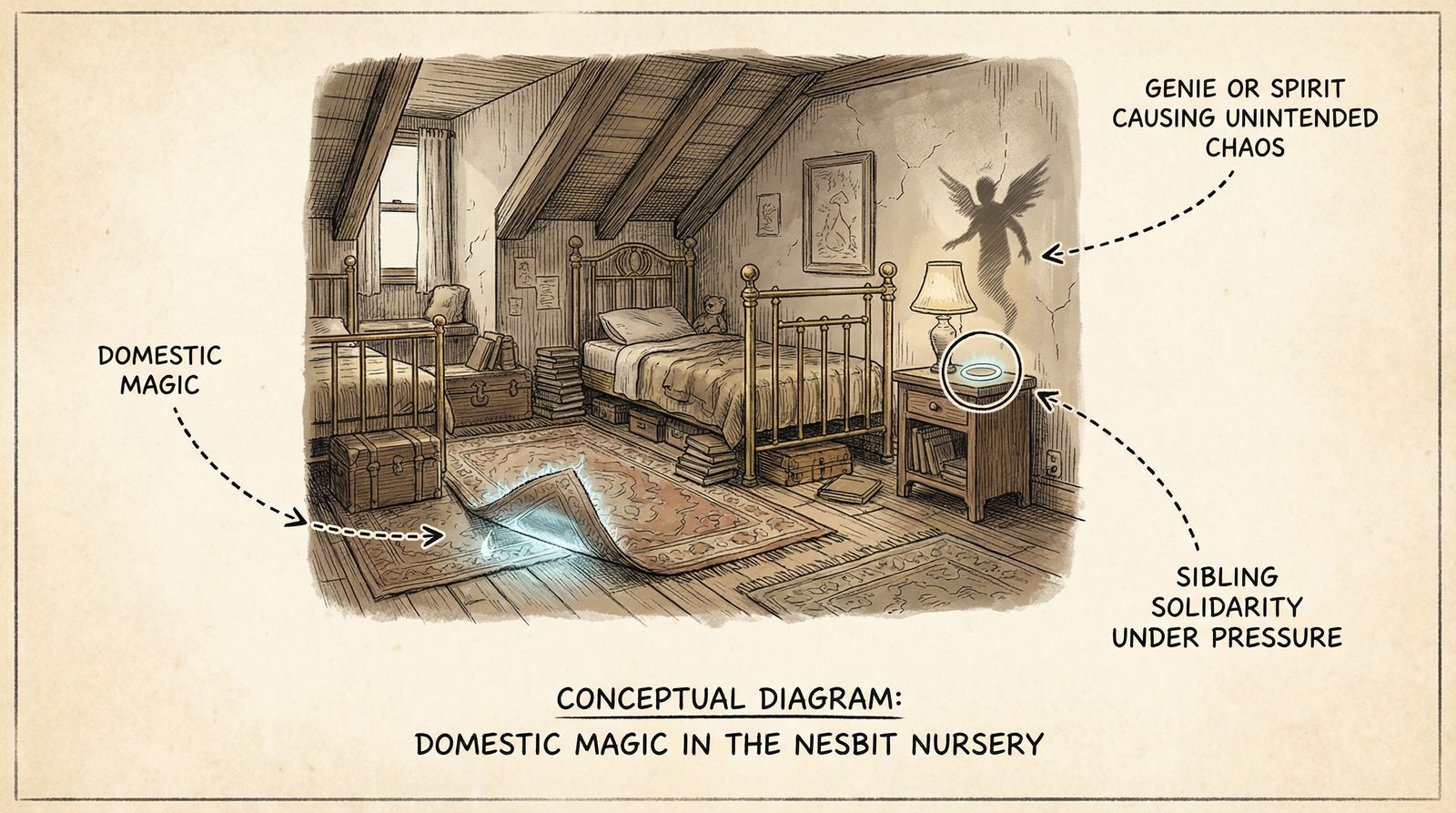
    She is also a master of domestic magic. Instead of enchanted forests, she gives us nurseries, attics, gardens, railway cuttings, beaches, and rented houses suddenly invaded by the impossible. The everyday setting matters because it keeps the fantasy tethered to ordinary obligations. Children still have to get home before dark, avoid being caught by adults, and deal with the social world of servants, neighbors, and shopkeepers.

    Sibling solidarity under pressure is another constant. Her groups of brothers and sisters bicker, form alliances, stage coups, and shift loyalties, but when magic creates a crisis they improvise together. Parents are often absent, distracted, or simply unable to see what is happening, which forces children to negotiate fear, guilt, and responsibility among themselves.

    Class awareness runs quietly beneath the comedy. Wishes and magical accidents expose how rigid social boundaries can be, and how odd it feels to cross them without preparation. Nesbit’s socialism never turns her stories into tracts, but it shapes moments where children notice poverty, unfairness, or the arbitrariness of adult authority. Even when the tone is playful, there is often an undertow of embarrassment and ethical consequence.

    Finally, Nesbit likes the tension between rational explanation and lingering mystery. Her characters try to systematize the magic, treating strange creatures and objects like machines that can be managed. The rules never quite hold. That slippage is part of her effect: the world remains slightly unstable, and the children’s growing maturity comes from learning to live with that instability rather than mastering it.

    Editorial illustration inspired by E. Nesbit

    STYLE & VOICE

    Nesbit’s style is conversational, ironic, and conspiratorial, as if an older, slightly mischievous friend were telling you about some children she once knew. She often addresses the reader directly, comments on the story’s construction, and gently mocks both adult pomposity and childish self-importance. This narrative voice keeps the tone light even when the stakes are high, and it invites readers to notice the gap between what characters think they are doing and what is actually happening.

    Her pacing alternates between chaotic set pieces and quieter interludes. A wish goes wrong, a crisis erupts, and then there is a scramble to repair the damage, followed by an evening scene where the children argue over blame and meaning. That rhythm allows her to balance comedy of errors with emotional beats about shame, fear, courage, and loyalty.

    In terms of language, Nesbit is clear and brisk rather than ornate. She uses specific material details—food, clothing, household objects—to anchor the fantasy. She respects children’s intelligence and capacity for mischief, and she rarely smooths away the awkwardness of their mistakes. The result is playful without being indulgent, and moral without being preachy.

    KEY WORKS & LEGACY

    Five Children And It (1902) (1902) is often an entry point into Nesbit’s work. The Psammead grants daily wishes that spiral into trouble, establishing her most durable pattern: magic interpreted literally, consequences arriving fast, and children forced to learn responsibility in the middle of farce.

    The Phoenix And The Carpet continues with the same children and deepens the sense that magic can be both exhilarating and exhausting. The Enchanted Castle stands slightly apart with a more dreamlike, sometimes eerie atmosphere: living statues, a magic ring, and holiday freedom that turns unexpectedly unsettling.

    Her influence on later children’s fantasy is extensive. Writers who place ordinary children in contact with the supernatural, and who treat the domestic world as a legitimate stage for enchantment, are working in territory she helped define. She sits at a hinge point between Victorian moral tales and modern fantasy that treats children as complex people rather than symbols.