
Country: Germany

  • Spiritual Awakening

    Spiritual Awakening

    DEFINITION & CORE IDEA

    Spiritual Awakening is the motif where a character’s interpretive frame breaks and re-forms. The person who could previously live on routine, status, or habit begins to perceive meaning, pattern, or selfhood differently. The story treats this shift as real change, not a cosmetic mood swing. What matters is not adopting a label or joining a religion, but the reorganization of attention, value, and identity.

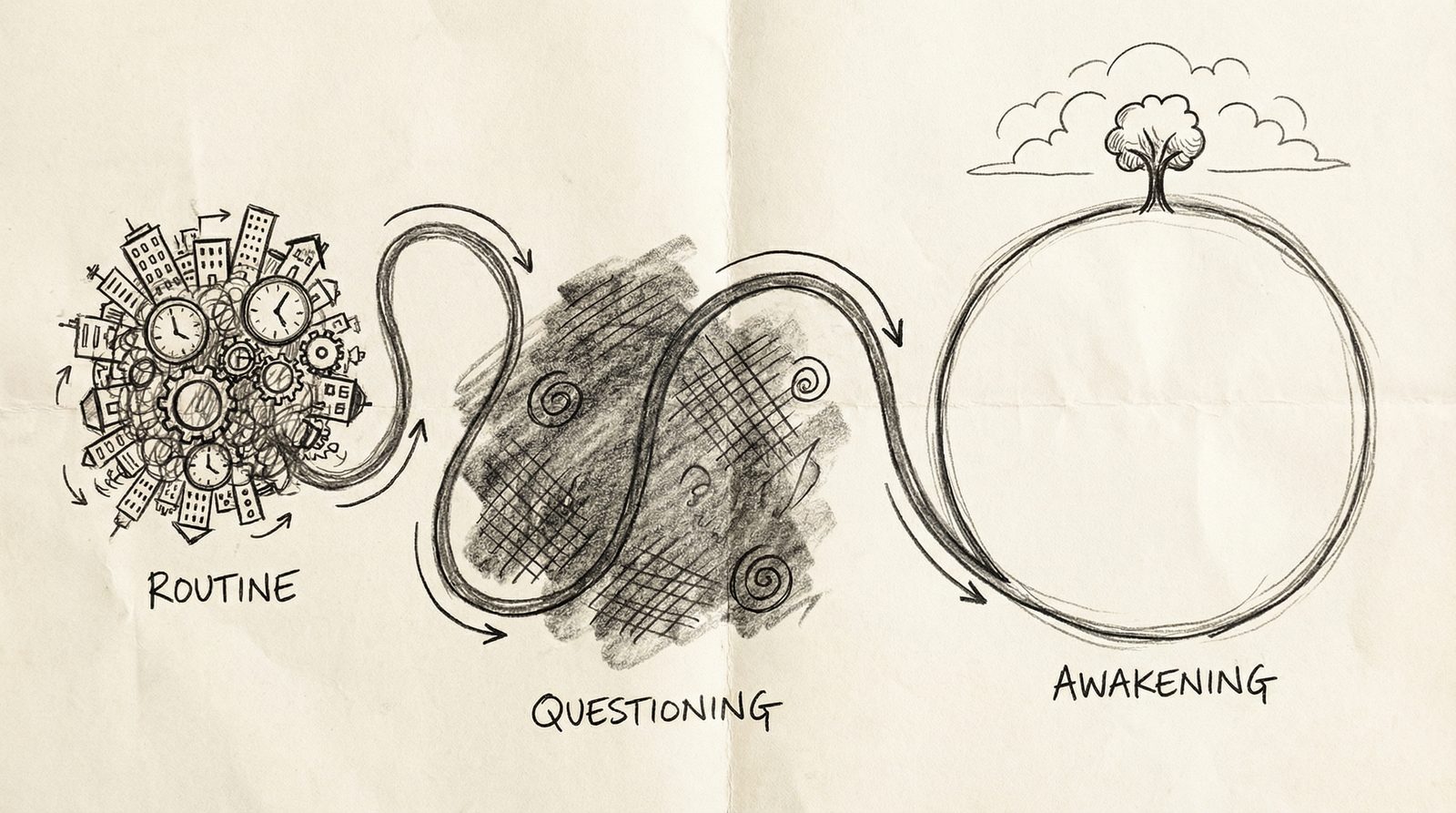
    In awakening narratives, the protagonist often begins inside a life that “works” externally but fails internally. They may chase achievement, romance, or control and discover it does not answer the underlying question of purpose. The plot then follows the conversion process: a new vocabulary for reality appears, the character tests it, and their old identity starts to fail under the new pressure.

    Books such as The Celestine Prophecy, The Tenth Insight, The Alchemist, Way Of The Peaceful Warrior, and Siddhartha are classic examples. The “event” is internal: perception shifts, and that shift changes what the same world means.


    HOW IT WORKS IN STORIES

    Spiritual Awakening usually begins with an existential breach. The character feels restless, stuck, or out of place in a life that looks fine from the outside. A promotion feels hollow, a relationship stops fitting, or a loss cracks certainty. The important point is structural: the old worldview stops functioning as a complete explanation.

    Next, a threshold event provides a new interpretive system. This can be a guide figure, a text, a vision, or a sequence of “coincidences” that the character begins to treat as communication. In The Celestine Prophecy and The Tenth Insight, the engine is sequential insights delivered through encounters that mix guidance with risk. In The Alchemist, a dream and a meeting function as permission to leave the old life and treat omens as navigational data. In Way Of The Peaceful Warrior, a teacher figure reframes discipline and attention as a daily practice rather than an abstract belief.

    The middle phase is testing and attrition. The character tries new practices, interpretations, and choices, then pays the cost of inconsistency. Old identities fall away faster than new ones stabilize. A “dark night” phase is common: the character feels more lost than before because certainty has collapsed but insight is still incomplete.

    Resolution is usually a return to ordinary life with a changed relationship to it. Work, love, and struggle remain, but they are held inside a wider frame. The story closes when the character can sustain the new perception without needing constant signs or external validation.

    Editorial illustration inspired by 'Spiritual Awakening'

    EMOTIONAL EFFECT ON THE READER

    This motif is built to feel personal. The reader is invited to project their own restlessness onto the protagonist’s shift, using the character as a safe container for questions about meaning, purpose, and identity.

    It often produces a “synchronicity high” in the reading experience. The plot rewards attention by making small events feel linked: a conversation, a symbol, or a coincidence lands as guidance rather than noise. That can feel reassuring, because it implies the world is readable.

    The cost is loss. Awakening narratives usually require the character to abandon a comforting interpretation of their life. Relationships strain, identity becomes unstable, and certainty is traded for a framework that is truer but harder to live inside.

    When the motif works, the after-effect is practical rather than sentimental. The reader finishes with heightened awareness of attention itself: what they ignore, what they treat as “just life,” and what patterns they might be using to avoid change.


    Symbolic illustration inspired by 'Spiritual Awakening'

    VARIATIONS & RELATED MOTIFS

    Spiritual Awakening appears in several common variations. The solitary seeker version follows a character cycling through teachers and lifestyles until a stable insight forms, as in Siddhartha. The reluctant mystic version forces awakening through crisis or loss, where the character resists the new frame until resistance becomes impossible. Another variation frames awakening as part of a larger system of human evolution, expanding the personal shift into a collective one, as in the Redfield sequence.

    The motif also has practical variants, where the new awareness is tested in daily routine rather than on mountaintops. Here, the story cares less about visions and more about whether the character can keep behaving differently when the world remains the same.

    This motif commonly overlaps with Synchronicity And Meaningful Coincidence, because meaning is delivered through “pattern recognition” in events. It also pairs naturally with Spiritual Pilgrimage and Inner Journey, where travel or reflection supplies the friction that forces change.

  • Inner Journey

    Inner Journey

    DEFINITION & CORE IDEA

    The Inner Journey motif is about a character whose most important travel happens inside their own mind and heart. The outside world can be busy, dangerous, or beautiful, but the core story is the shift in how this person understands themselves, other people, or reality itself. In Siddhartha, the river, the city, and the forest matter, but the real movement is the protagonist’s changing sense of identity and meaning.

    Writers use the Inner Journey to examine belief, self-concept, and value. The plot might involve travel, romance, work, or crisis, but events function as mirrors: the character encounters situations that reveal what they avoid, what they rationalize, and what they cannot keep pretending.

    This motif often includes reflection, doubt, and contradiction. A character may be pulled between comfort and risk, duty and desire, faith and skepticism. Works such as Zen And The Art Of Motorcycle Maintenance and Demian use daily life, travel, and relationships as the surface action while the real stakes remain internal: whether the character can become honest with themselves.


    HOW IT WORKS IN STORIES

    The Inner Journey usually starts with a fracture of self. The character feels that something is off: success feels empty, a relationship feels misaligned, grief breaks old habits, or a change exposes how little their previous identity can hold. This discomfort becomes the trigger for looking inward.

    Writers often pair the Inner Journey with an outer journey so the reader has concrete scenes to track. In Zen And The Art Of Motorcycle Maintenance, the road trip gives shape to a philosophical search. In Siddhartha, distinct stages of life function as stages of internal change. The external plot provides milestones, but the turning points happen in private moments where the character’s interpretation of the world shifts.

    Structurally, the Inner Journey often moves through cycles of hope, confusion, and partial clarity. The character tries on beliefs or identities, then discovers their limits. They may swing between extremes, such as total freedom and heavy responsibility, intense longing and cool detachment, spiritual devotion and cynical withdrawal. The story tracks how those opposites are integrated into something more stable.

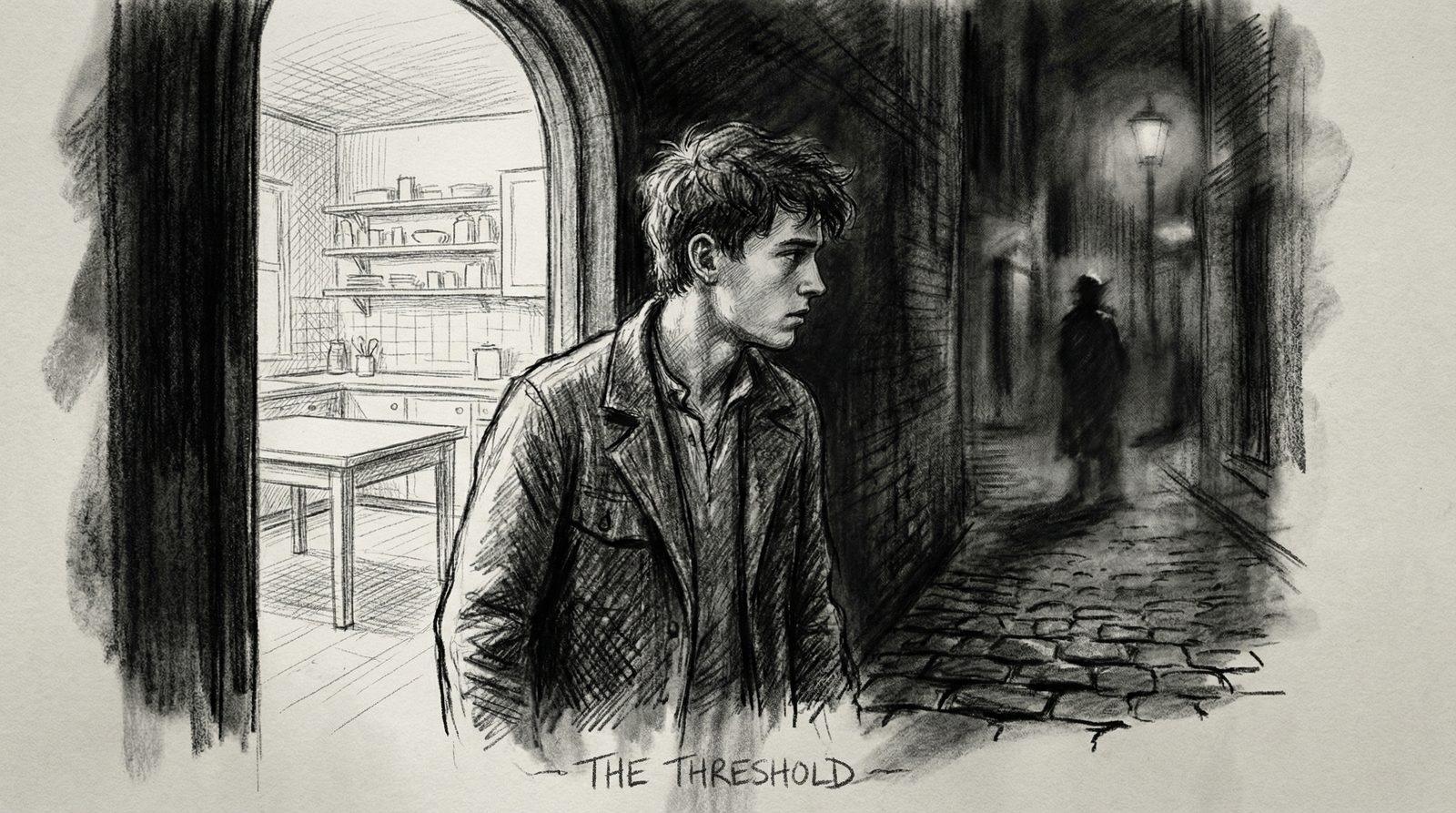
    Small details carry a lot of weight. A recurring object, repeated phrase, or familiar setting can show internal movement without a dramatic plot beat. The same kitchen table or street appears early and late, but it reads differently because the person looking at it has changed. The ending can be quiet, with no grand victory, yet the inner landscape is measurably transformed.


    Editorial illustration inspired by 'Inner Journey'

    EMOTIONAL EFFECT ON THE READER

    Inner Journey stories create recognition rather than suspense. The reader is invited into the space where the character stops lying to themselves. That can feel intimate and uncomfortable, because the questions the character cannot avoid are often questions the reader recognizes.

    The mood is often reflective. Even when events are dramatic, the narrative keeps returning to interpretation: what does this mean, and what does it reveal about who I am? The emotional intensity comes less from plot twists than from the slow accumulation of self-knowledge.

    These stories also create a specific kind of tension: the character may refuse closure. Instead of giving a clean answer, the narrative shows the cost of uncertainty and the cost of certainty, and asks the reader to sit with the same unresolved pressure.

    When the motif works, the after-effect is practical. The reader leaves with a sharper awareness of how a person’s internal frame can change what the same world means. The story does not just entertain; it reorients.


    Symbolic illustration inspired by 'Inner Journey'

    VARIATIONS & RELATED MOTIFS

    The Inner Journey appears in multiple genres. In coming-of-age stories, it is a search for identity and separation from inherited scripts. In spiritual narratives, the focus is on insight, faith, or a direct experience of the sacred. In midlife and late-life stories, the inner journey becomes reevaluation: regret, responsibility, and the attempt to make peace with the person one has been.

    Some versions are explicitly philosophical, using dialogue, essays, or long conversations to argue ideas. Others stay close to daily routine, showing inner change through small acts, habits, and repetitions. The pace can be slow and reflective, or tense, especially when the character’s developing self clashes with obligations and old roles.

    This motif often overlaps with Spiritual Awakening and Spiritual Pilgrimage, where external movement supplies the friction needed for internal change. It also pairs naturally with Intimacy as Healing, where a relationship becomes the mirror that forces honesty and makes transformation possible.

  • Siddhartha (1922)

    Siddhartha (1922)

    INTRODUCTION

    Siddhartha (1922) by Hermann Hesse
    Philosophical fiction · 134 pages · Germany / India


    Few twentieth-century novels feel as hushed and inward as Siddhartha. On the surface it is a slim parable about a Brahmin’s son wandering through an imagined ancient India. In practice it reads like a record of spiritual burnout: a man exhausting every available path until the very desire for instruction starts to feel like another trap.

    Hesse follows Siddhartha from the austerity of the Samanas to the scented rooms of Kamala and the counting-house of Kamaswami. The movement is cyclical rather than heroic. He leaves, he returns, he repeats, and each return costs him something. The book offers almost no how-to guidance. What it offers is a mood, the loneliness of walking at dusk, hearing a river in the distance, and suspecting that whatever answer you are chasing is already flowing past you, indifferent and eternal.

    PLOT & THEMES

    The plot is deliberately simple. Siddhartha, a gifted Brahmin youth, abandons his father’s house to join the wandering ascetics, the Samanas. After years of self-mortification he encounters Gotama, the historical Buddha, at Jetavana Grove. Siddhartha recognizes Gotama’s serenity, yet refuses to become his disciple. His reasoning is blunt: wisdom cannot be taught, only lived.

    This decision splits the story in two. Govinda chooses devotion and stays behind. Siddhartha chooses experience and turns toward the world. He learns sensuality and tenderness with Kamala, and the mechanics of ambition with Kamaswami. He becomes rich, bored, spiritually numb. The recurring dream of a dead songbird in Kamala’s golden cage captures the cost of this phase: the soul suffocating inside comfort.

    Eventually he flees, collapses beside a river, and considers suicide. Vasudeva the ferryman rescues him, and the river becomes the book’s true teacher. Siddhartha learns to listen to its many voices until they gather into one sound, one unity. The revelation is not ecstatic. It is quiet, almost ordinary. That is part of the book’s severity.

    Late in the novel, Kamala dies during a pilgrimage and Siddhartha becomes responsible for their son, who is angry, entitled, and desperate to escape the river life. When the boy steals the boat and disappears upstream, Siddhartha is forced to face attachment in its rawest form. The loss is not redeemed. It is simply endured. By the ending, when Govinda visits the older Siddhartha and touches his forehead, Govinda receives the vision: countless faces, lives, sins, loves, and deaths flowing together as one present moment. Siddhartha has become what he sought, not by collecting teachings, but by surrendering the need to stand outside life and judge it.

    PROSE & NARRATIVE STRUCTURE

    Formally, Siddhartha is a parable stitched from brief, titled chapters, each a station on the way. The structure is cyclical. The book opens with Siddhartha and Govinda together, and it ends with Govinda returning to Siddhartha, but with the roles quietly reversed. The looping design mirrors the river’s logic: repetition that is not stagnation, return that is not failure.

    The prose is incantatory in its simplicity. Hesse avoids rich description of India. Aside from a few concrete markers, banyan trees, a grove, a town of warehouses, the world remains lightly sketched, like a stage set for an inner drama. That spareness creates a sense of suspension, as if the story occurs outside ordinary clock time.

    The narrative voice stays close to Siddhartha’s consciousness without becoming stream-of-consciousness. Years can vanish in a paragraph, especially during his long sleep inside wealth and routine. By contrast, moments of crisis, the night by the river, the son’s escape, are rendered slowly, almost ritually. This pacing gives the novel its quiet emotional peaks: not big plot turns, but the internal sensation of something breaking and then settling into a new shape.

    Conceptual editorial illustration inspired by 'Siddhartha'

    CHARACTERS & INTERIORITY

    Siddhartha is written as the archetype of the seeker, and Hesse is unsparing about the arrogance baked into that stance. As a youth he judges his father’s rituals. Later he dismisses the Samanas and even Gotama’s teaching as something meant for other people. The novel treats this elitism as part of his flaw, not as spiritual superiority.

    Govinda functions as a counterweight: devoted, faithful, willing to follow. His return decades later frames one of the book’s central tensions, whether devotion or independence leads further. Kamala is not merely a symbol of temptation. She teaches Siddhartha how to be present with another person, how to listen, how to soften. The intimacy is practical, not sentimental, and it gives the novel one of its most human textures.

    Vasudeva is the book’s quiet center. He speaks little and listens deeply, modeling the possibility of learning without making a system. His withdrawal into the forest once Siddhartha has “heard” the river fully is one of the novel’s most moving gestures: the teacher stepping away so the student can simply be. Even minor figures, Siddhartha’s father waiting by the door, the son smashing bowls in rage, are drawn with just enough inner shading to feel like real mirrors rather than cardboard allegory.

    LEGACY & RECEPTION

    Published in 1922, Siddhartha found a modest audience in German and later became a cult favorite in the 1960s among Western readers disillusioned with institutional religion. Its fusion of Hindu and Buddhist imagery with a distinctly European crisis of individuality gave it unusual reach. Many readers approached it as a spiritual guide. Hesse treated it more like a poetic confession: an attempt to write his own divided temperament into a clear, mythic shape.

    Adaptations often fail because they try to externalize what is essentially inward. They linger on scenery or eroticize Kamala, while the novel keeps circling back to the stubborn, mostly wordless change in awareness. The ending is strikingly unspectacular. The fireworks occur inside Govinda’s perception. That quietness is why the book still matters. It insists that the decisive revolutions of a life may be invisible to everyone else.

    IS IT WORTH READING?

    Whether it is for you depends on your tolerance for quiet. There is almost no conventional suspense, and the aphorisms can feel naïve if you want rigorous philosophy. But read as a story of one person exhausting every available path, ritual, asceticism, pleasure, work, fatherhood, and still needing to sit by a river and listen, it has a durable power.

    If you are drawn to questions of meaning but allergic to sermons, this short novel is worth a slow afternoon. Its images linger: the bird in the cage, the river’s voice, the final touch on the forehead, and the strange relief of realizing that unity is not something you achieve. It is something you stop resisting.

    Illustration inspired by a core idea from 'Siddhartha'

    TRIVIA & AUTHOR FACTS

    Hermann Hesse was born in 1877 in Calw, Germany, into a family with missionary experience in India, which shaped his early fascination with Asian religions. He wrote Siddhartha after a period of personal crisis and psychoanalysis, and the novel’s focus on integration rather than escape reflects that background.

    Hesse read widely in translated Hindu and Buddhist texts, but he did not present the novel as scholarship. The geography is intentionally vague, a spiritualized India rather than a realistic travelogue. Gotama is clearly the historical Buddha, while other names and symbols drift freely across traditions without concern for strict chronology.

    Hesse received the Nobel Prize in Literature in 1946. He later expressed some bemusement at how Siddhartha was adopted by Western spiritual seekers as a guidebook. He saw it instead as a poetic exploration of a divided, searching self.

    SIMILAR BOOKS

    If you respond to this kind of inward spiritual searching, you might explore Demian, also by Hesse, for a more psychological initiation narrative. For a contemporary spiritual travelogue filtered through intellect, Zen and the Art of Motorcycle Maintenance offers a different kind of quest. And for a modern fable about omens and purpose, The Alchemist makes an instructive companion, especially in how differently it handles destiny and return.

    DISCOVERABILITY & LINKS

    DISCOVERABILITY & LINKS

  • Demian (1919)

    Demian (1919)

    INTRODUCTION

    Demian (1919) by Hermann Hesse
    Bildungsroman · 268 pages · Germany


    Demian is a quiet, unsettling book, one that feels less like a story than like waking up inside someone else’s conscience. Written at the end of World War I, it traces the inner life of Emil Sinclair as he moves from the “world of light” of his bourgeois childhood into a shadowed realm of guilt, desire, and self-recognition.

    The novel is not interested in plot fireworks. It is interested in fracture: the moment when inherited morality stops working and something unnamed begins to press from inside. Kitchens, classrooms, and church hymns coexist uneasily with alleyways, forbidden thoughts, and dreams that refuse to be decoded. The tone is restless and intimate, as if every page is leaning toward a transformation that cannot be safely named.

    PLOT & THEMES

    On paper, the plot is simple. Emil Sinclair grows up. In practice, this is a coming-of-age story stripped down to a spiritual case study. As a child in a respectable German town, Sinclair is blackmailed by the bully Franz Kromer after boasting about a minor crime. The lie cracks open the boundary between what Sinclair has been taught to call good and evil.

    Max Demian enters as an unsettling presence rather than a conventional rescuer. He dismantles Kromer’s power not through force but through psychological clarity. From that moment, Demian becomes a catalyst, pushing Sinclair away from inherited moral categories and toward an inner law he barely understands.

    The novel organizes itself around dualities. Sinclair moves between light and dark, spirit and flesh, obedience and rebellion. At boarding school he sinks into drinking and numb routine, then experiences a jolt of awakening through a dream of a bird breaking free from its egg. This image leads him to Demian’s mother, Frau Eva, whose house becomes a sanctuary for those drawn to a god who unites opposites rather than separating them.

    World War I remains mostly at the margins until it erupts at the end. Sinclair is wounded at the front and wakes in a field hospital to learn that Demian has been mortally injured. Demian appears one last time, perhaps in reality, perhaps as vision, and tells Sinclair that from now on he must find Demian within himself. The novel closes without consolation. The inner journey has been completed, but the world has been shattered.

    PROSE & NARRATIVE STRUCTURE

    The book is told in first-person retrospect. Sinclair narrates as an adult, looking back to locate the fault lines that ran under his youth. The prose is clear and restrained, punctured by moments of symbolic intensity: the smell of damp stone where Kromer corners him, the charged stillness of Pistorius’s organ loft, the recurring image of the hawk and the mark of Cain.

    Structurally, the novel advances in stages of consciousness rather than acts. Chapters function like psychological stations, each marking a shift in self-perception. External events often blur into interior states. Years pass quickly when Sinclair is spiritually asleep; moments of crisis expand and slow when something essential breaks or is recognized.

    Hesse keeps the focus narrow and vertical. There are no real subplots. Everything bends toward the same pressure point: the cost of becoming oneself in a world that demands conformity.

    Conceptual editorial illustration inspired by 'Demian'

    CHARACTERS & INTERIORITY

    Sinclair begins as a sheltered child who believes in the moral clarity of his parents’ world. What defines him is how quickly that certainty fractures. His interior life is obsessive and self-scrutinizing. Guilt, longing, and fascination churn long before they surface in action.

    Demian himself remains deliberately elusive. He shifts between schoolboy, prophet, and mirror. His interpretation of the Cain story reframes Sinclair’s sense of being marked as not cursed but set apart. Frau Eva embodies a vision of wholeness that Sinclair longs for, calm, inclusive, and indifferent to conventional morality.

    Minor figures are no less charged. Pistorius represents the danger of living only in symbols without fully entering the world. Kromer lingers as a reminder that darkness is not abstract. It has a voice, a smell, and a presence that can follow you into adulthood. Hesse allows these characters to blur into one another, as if they were facets of a single divided self.

    LEGACY & RECEPTION

    First published under a pseudonym, Demian spoke directly to readers emerging from the devastation of World War I. It offered neither patriotism nor consolation, but a language for inner dislocation. Its blend of psychological introspection and spiritual rebellion helped shape what would later be recognized as twentieth-century existential fiction.

    The novel’s refusal of a redemptive ending has been central to its endurance. Growing up here does not mean fitting in or finding peace. It means learning to recognize the mark that sets you apart and living with it. That idea has echoed through later portraits of alienated youth, from Hesse’s own later work to mid-century American fiction.

    IS IT WORTH READING?

    If you want a brisk plot or social panorama, this book will frustrate you. It is short, dense, and relentlessly interior. But if you are drawn to stories of adolescence as a spiritual earthquake, it remains one of the most honest accounts ever written.

    The language is accessible, the chapters compact, but the ideas linger. Hesse does not offer answers. He offers a vocabulary for the feeling that you do not quite belong to the world you were given, and that becoming yourself may require breaking something you were taught to protect.

    Illustration inspired by a core idea from 'Demian'

    TRIVIA & AUTHOR FACTS

    Hermann Hesse originally published the novel under the pseudonym “Emil Sinclair,” presenting it as the confession of an unknown young writer. Only later was his authorship revealed. The book draws heavily on Hesse’s engagement with Jungian psychology and his own period of analysis during the war years.

    The figure of Abraxas comes from Gnostic traditions, reshaped by Hesse to express the unity of opposing forces. Many images in the novel echo Hesse’s own childhood memories and recurring dreams. Demian marked a decisive turn in his career toward the introspective, spiritually questing works that would define his later reputation.

    SIMILAR BOOKS

    Readers who respond to this inward intensity may also turn to Siddhartha for a later, calmer spiritual journey, or Steppenwolf for a more fractured portrait of identity and rebellion. For a different cultural register of adolescent alienation, The Catcher in the Rye offers a similarly haunted voice without the explicit mysticism.

    DISCOVERABILITY & LINKS

  • Hermann Hesse

    Hermann Hesse

    ORIGINS & BACKGROUND

    Hermann Hesse was born in 1877 in the southwest of what is now Germany, into a family deeply shaped by Protestant Christianity and missionary work in India. That tension between strict European piety and the attraction of Asian philosophy would quietly inform his imagination throughout his life. As a young man, Hesse struggled with school, religious authority, and expectations of conformity, experiencing psychological crises and periods of institutional care that later fed his sensitivity to inner fracture and spiritual unrest.

    He lived through the collapse of the old European order, the First World War, and the rise of nationalism. During this period, Hesse chose self-exile in Switzerland, distancing himself from German militarism and public ideology. This withdrawal from collective identity mirrors the journeys of his characters, who often turn away from mass movements in favor of solitary searching and inward transformation.

    Across novels such as Demian, Siddhartha, and Steppenwolf, Hesse repeatedly reworks his own conflicts: the pull between bourgeois security and artistic risk, between Western rationalism and Eastern mysticism, between belonging and solitude. His fiction is driven by this personal restlessness, filtered through a quiet, reflective temperament that treats inner crisis as a serious philosophical condition rather than a flaw to be cured.

    Editorial illustration inspired by Hermann Hesse

    THEMES & MOTIFS

    Hesse returns again and again to the inner journey and the search for an authentic self. His protagonists are rarely satisfied with inherited identities. In novels like Demian and Steppenwolf, the central figures experience themselves as divided between a socially acceptable self and a darker, instinctive interior life. This division is not treated as pathology but as the necessary starting point for self-knowledge.

    Another persistent concern is spiritual awakening. Hesse’s characters move through belief systems, relationships, sensual experience, and renunciation, discovering that no single doctrine can replace lived understanding. Awakening in his work is slow, circular, and often painful, marked more by loss than by revelation.

    Hesse is also preoccupied with alienation and the modern individual’s sense of being out of step with their time. The figure of the outsider recurs in different forms: the sensitive schoolboy of Demian, the wandering seeker of Siddhartha, and the tormented intellectual of Steppenwolf. These characters are torn between the safety of bourgeois life and the frightening openness of a more instinctive or spiritual existence.

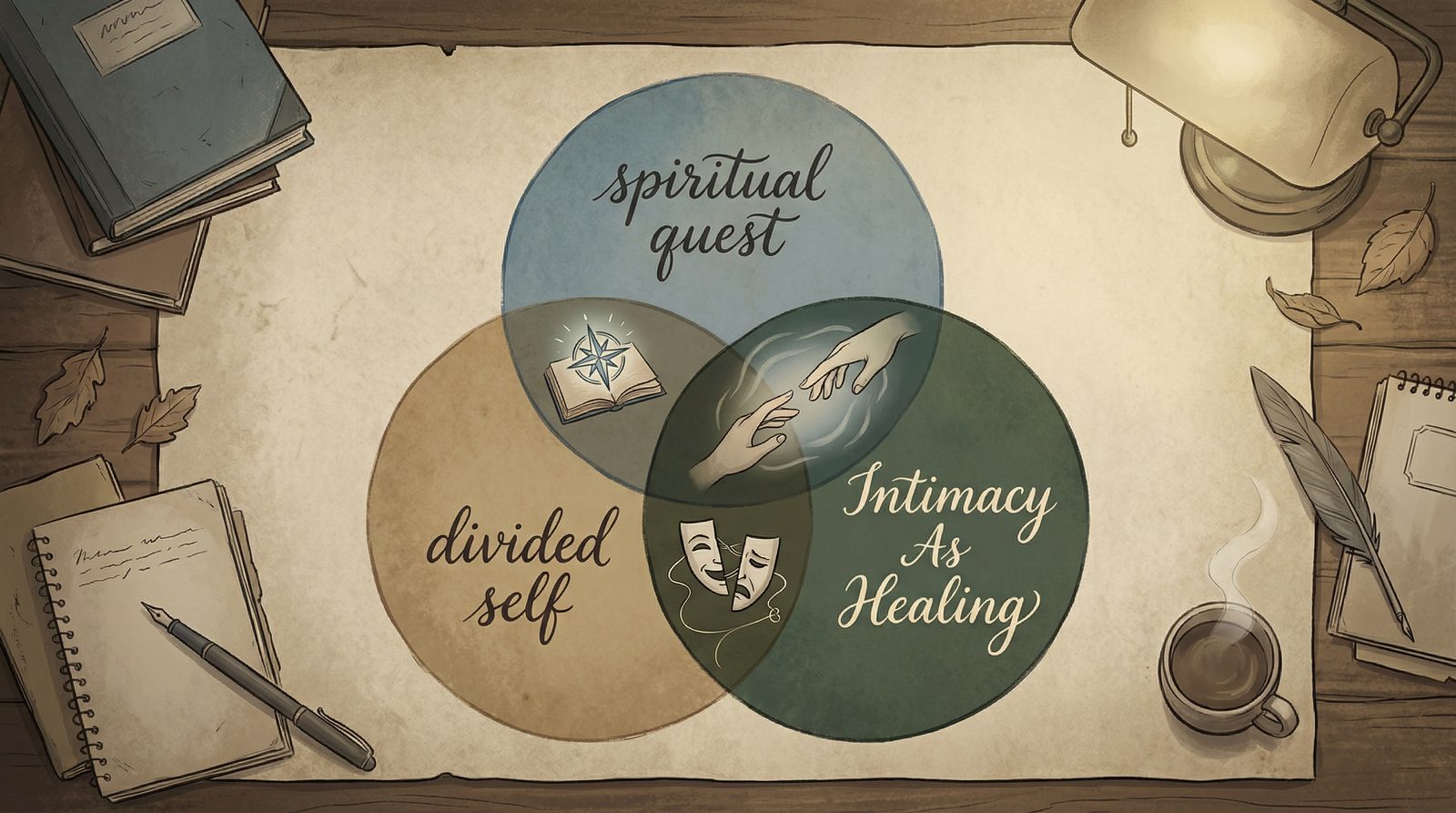
    Yet his novels are not purely about solitude. Hesse repeatedly suggests that Intimacy As Healing is essential to transformation. Encounters with mentors, lovers, and mirrors of the self become turning points, not because they resolve conflict, but because they make self-deception impossible. Connection in Hesse is demanding rather than comforting.

    Symbolic illustration inspired by Hermann Hesse

    STYLE & VOICE

    Hesse’s style is deceptively simple. His prose is clear, measured, and introspective, favoring first-person or close third-person narration that stays tightly aligned with a character’s inner state. Even when mythic or symbolic material appears, the tone remains calm and reflective rather than grandiose.

    Structurally, many of his novels follow a pattern of initiation. Characters depart from familiar life, pass through periods of breakdown or excess, and return with altered perception rather than clear solutions. Action is secondary to realization, and meaning is earned through endurance rather than triumph.

    Emotionally, Hesse balances melancholy and hope. He confronts despair, loneliness, and self-destruction with honesty, yet almost always leaves a narrow path toward meaning. That path usually involves accepting contradiction rather than resolving it, and allowing connection to soften isolation without erasing it.

    KEY WORKS & LEGACY

    Demian (1919) is a compact novel of inner rebellion, charting a young man’s awakening to moral ambiguity and personal responsibility. Guided by the enigmatic Demian, the narrator comes to see identity and belief as fluid rather than fixed.

    Siddhartha (1922) follows a seeker in ancient India as he moves through asceticism, sensuality, despair, and quiet wisdom. It remains Hesse’s clearest articulation of spiritual pilgrimage grounded in lived experience rather than doctrine.

    Steppenwolf (1927) presents a darker, fractured vision of the divided self through Harry Haller, an intellectual convinced he is split between human and animal natures. Through surreal encounters, the novel explores alienation, self-hatred, and the possibility of integration.

    Hesse’s legacy sits at the intersection of European modernism and spiritual literature. His work continues to speak to readers who feel estranged from conventional paths yet skeptical of easy transcendence, offering stories where change is slow, painful, and deeply personal.

  • Craftsmanship And Quality Of Work

    Craftsmanship And Quality Of Work

    DEFINITION & CORE IDEA

    “Craftsmanship And Quality Of Work” is the motif where the way a character performs their work becomes a direct expression of their inner life. It is not simply about employment or productivity. The focus is on care, precision, pride, and the satisfaction of doing something properly, even when no one is watching. Whether the task is tuning an engine, preparing a meal, writing software, or shaping wood, the work itself carries moral weight.

    Stories built around this motif slow down and pay attention to process. In Zen And The Art Of Motorcycle Maintenance: An Inquiry Into Values (1974), motorcycle maintenance becomes a way of examining “Quality” as something experienced rather than defined. In Lila: An Inquiry Into Morals (1991), that concern expands into ethics and social life, still grounded in the idea that values are revealed through attention and care.

    At its core, this motif treats work as a moral and emotional discipline. It asks where standards come from, how they are practiced, and what is lost when integrity collides with systems that reward speed, scale, or convenience.


    HOW IT WORKS IN STORIES

    Craftsmanship And Quality Of Work usually appears through the rhythms of daily labor. Writers linger on routines: opening a workspace each morning, laying out tools, repeating movements until they become instinctive, inspecting the final result with quiet seriousness. The story may not be overtly “about” the job, but the way the work is done reveals character more clearly than dialogue alone.

    Sometimes the work itself becomes the teacher. In Shop Class As Soulcraft: An Inquiry Into The Value Of Work (2009), written by Matthew B. Crawford, manual problem-solving is framed as intellectually demanding and ethically grounding. Stories echo this idea when characters develop patience, humility, or self-respect through repeated, concrete tasks. A flawed repair or failed attempt is not just a setback, but a test of standards.

    Conflict often enters when the surrounding world does not value quality in the same way. A supervisor pushes for speed over care, a system rewards shortcuts, or customers demand something cheap and disposable. The character must decide whether to compromise, resist, or walk away. That decision becomes a clear statement of identity.

    This motif allows writers to make abstract ideas tangible. In the work of Robert M. Pirsig, the road, the machine, and the act of maintenance become tools for thinking about attention, rationality, and lived experience. Meaning is not explained. It is encountered through effort, failure, and care.

    Even in intimate or domestic narratives, the motif shapes relationships. A parent teaching a child a careful technique, or a mentor guiding an apprentice, passes on more than skill. They transmit a way of engaging with the world that can become a form of trust or love.


    EMOTIONAL EFFECT ON THE READER

    Stories shaped by this motif often feel grounding. There is comfort in watching someone care deeply about what they are doing, especially in a culture that feels rushed and disposable. Attention to tools, textures, and small decisions can be quietly absorbing.

    At the same time, the motif can provoke sadness or anger. When care is dismissed or punished, the loss feels personal. Stories about disappearing skills or neglected standards often carry a sense of dignity under threat.

    For many readers, this motif turns inward. It encourages reflection on everyday effort and responsibility. The question it raises is simple but unsettling: where does quality still matter in your own life, and what does it cost to protect it?

    There is also intimacy in this focus. Watching a character work carefully is like watching them unguarded. Habits and rituals reveal who they are when performance drops away, making later choices feel heavier and more personal.


    VARIATIONS & RELATED MOTIFS

    Craftsmanship And Quality Of Work takes many forms. In some stories, it centers on manual trades. In others, the craft is intellectual or emotional, such as teaching, caregiving, or programming. What unites them is the same pattern: the character treats their work as something deserving of attention, and their sense of self is bound to doing it properly.

    A common variation is the “lost craft” narrative, where older ways of working are disappearing. Another focuses on the collision between personal standards and impersonal systems, where care is labeled inefficient or excessive.

    This motif often pairs with Eastwest Philosophical Synthesis. In Pirsig’s writing, the road and the act of maintenance bridge Western analysis and Eastern presence. In Crawford’s work, the workshop becomes a site of moral clarity. Different settings, the same question: how should attention be lived?

    Across its variations, the motif returns to a single concern: when people invest genuine care in their work, how does that shape who they become?