
Country: India

  • Synchronicity And Meaningful Coincidence

    Synchronicity And Meaningful Coincidence

    DEFINITION & CORE IDEA

    Synchronicity And Meaningful Coincidence is the motif where events align with a precision that feels narratively excessive if everything is truly random. A stranger says the exact phrase the protagonist has been circling internally. A missed train leads to the only meeting that matters. The same symbol appears across unrelated places and moments. The story does not need to prove the supernatural; what matters is that the character experiences these alignments as communication rather than noise.

    In stories built around this motif, coincidence becomes information. The protagonist begins to treat timing, repetition, and interruption as meaningful data rather than background chaos. The explanation may vary — fate, God, a hidden order, the unconscious mind — but structurally the coincidences function the same way: they influence choice. Once the character starts acting as if meaning is real, the story has crossed its threshold.

    This logic is explicit in The Celestine Prophecy, where sequential encounters operate as instructions disguised as chance. In The Tenth Insight, the same mechanism is expanded into a system, training characters to read coincidence as guidance rather than accident. The Alchemist reframes this dynamic more quietly: dreams, omens, and chance meetings grant permission to abandon a stable life in favor of a meaningful one. In Way Of The Peaceful Warrior, coincidence is less mystical and more instructional, nudging attention back to discipline, presence, and embodied awareness.


    HOW IT WORKS IN STORIES

    Synchronicity usually enters a story quietly. The protagonist notices something small and easily dismissible: a repeated number, a perfectly timed interruption, an overheard sentence that lands too close to home. Early scenes preserve plausible deniability so the reader can remain skeptical without breaking immersion.

    The engine activates when coincidences begin to cluster. One coincidence is texture; several in close succession create pressure. These clusters tend to appear at decision points, moments when the protagonist is stuck between options or close to abandoning a path. In narratives like The Celestine Prophecy, each encounter functions as a breadcrumb that must be followed or consciously rejected. In The Alchemist, ignoring omens does not trigger punishment, but it stalls the story, draining momentum until attention realigns.

    Effective uses of this motif always impose cost. Following a “sign” risks embarrassment, loss of stability, or the appearance of irrationality. The character must accept the possibility of being wrong, foolish, or delusional. This risk is essential. Without it, synchronicity collapses into wish fulfillment. The choice to trust coincidence must feel dangerous enough to matter.

    Resolution typically arrives in one of two forms. In affirming narratives, the character learns to live inside a world where meaning does not need constant confirmation. In more ambiguous stories — as in I Origins — coincidences remain interpretable rather than proven, and the payoff is psychological. What changes is not the universe, but the character’s relationship to uncertainty.


    Editorial illustration inspired by 'Synchronicity And Meaningful Coincidence'

    EMOTIONAL EFFECT ON THE READER

    This motif is designed to feel intimate. The reader becomes a co-interpreter, scanning scenes for repetition, echo, and timing. When an early detail reappears in a charged moment, it produces a quiet jolt of recognition, as if the story is rewarding attention.

    At its most comforting, synchronicity offers relief from randomness. Detours feel purposeful. Delays feel protective. In books like The Alchemist, this reassurance is central to the reading experience, allowing setbacks to be reinterpreted as alignment rather than failure. The world feels readable, and the reader is invited to believe that attention itself has value.

    The same mechanics can also generate unease. Too many coincidences create the sense of being watched or guided too forcefully. In more psychological versions of the motif, the reader begins to question whether meaning is emerging organically or being imposed as a defense against chaos. That tension between enchantment and suspicion keeps the motif from becoming sentimental.

    When the motif works, the after-effect is practical. The reader finishes with heightened awareness of how easily meaning can arise once repetition and timing are framed as communication — and how much depends on where attention is placed.


    Symbolic illustration inspired by 'Synchronicity And Meaningful Coincidence'

    VARIATIONS & RELATED MOTIFS

    Synchronicity And Meaningful Coincidence appears in several recognizable variations. The spiritual guidance version treats coincidence as instruction, rewarding trust and punishing inattention. Romantic and literary versions soften the logic into serendipity, where repeated encounters transform chance into inevitability. Philosophical variants retain the pattern but refuse explanation, letting the reader decide whether meaning is discovered or constructed.

    A darker variation reframes synchronicity as a trap. Here, pattern recognition becomes exploitable, and “signs” function as lures rather than help. The story’s tension comes from uncertainty: is the universe speaking, is someone engineering the coincidences, or is the protagonist assembling meaning to avoid confronting randomness?

    This motif naturally overlaps with Spiritual Awakening, where heightened attention makes coincidence feel louder and more personal. It also pairs with Spiritual Pilgrimage and Inner Journey, where movement and reflection create the friction that makes “signs” feel necessary. When coincidence is framed as destiny language, it often converges with Personal Legend And Destiny.

  • Spiritual Awakening

    Spiritual Awakening

    DEFINITION & CORE IDEA

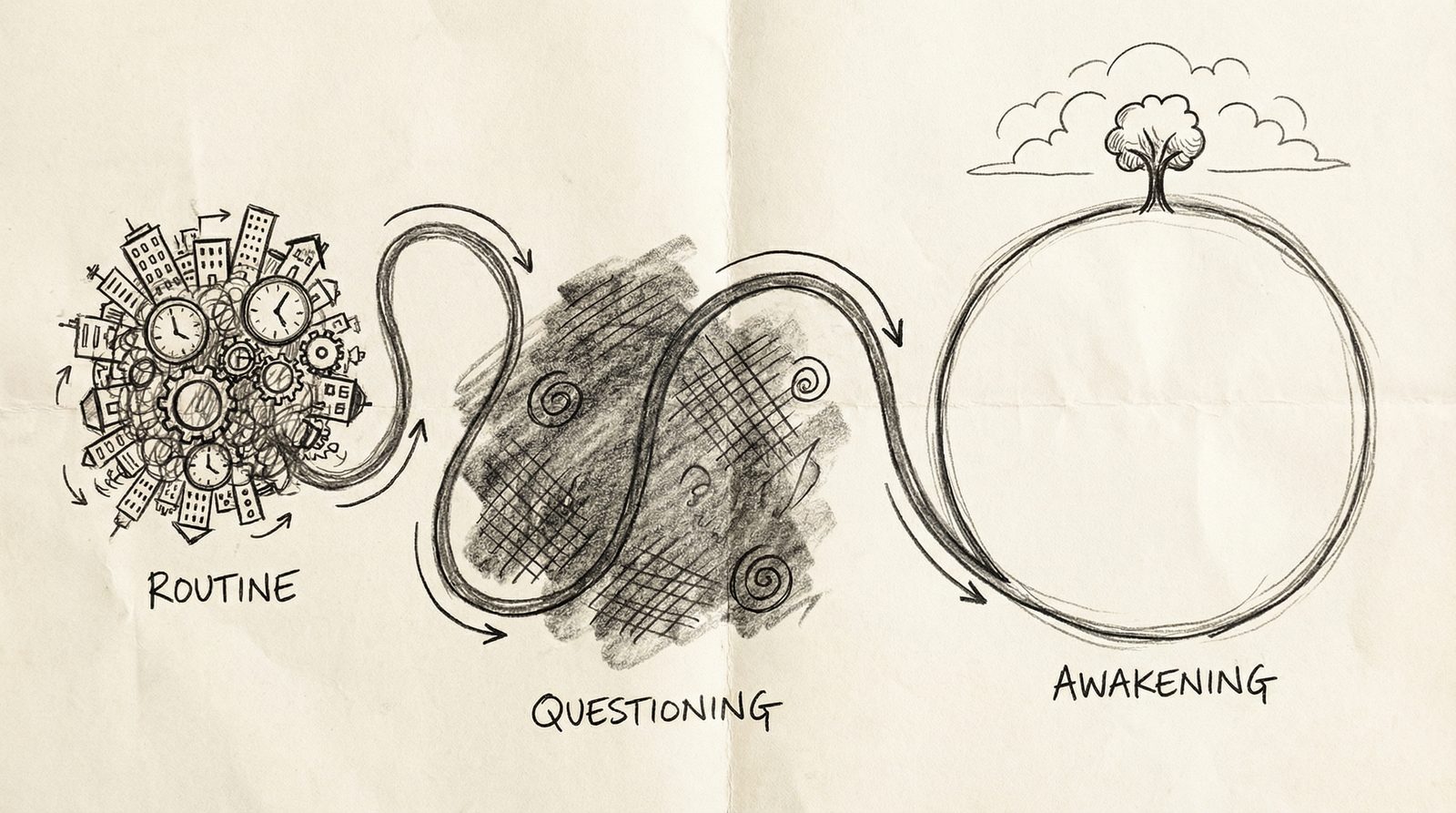
    Spiritual Awakening is the motif where a character’s interpretive frame breaks and re-forms. The person who could previously live on routine, status, or habit begins to perceive meaning, pattern, or selfhood differently. The story treats this shift as real change, not a cosmetic mood swing. What matters is not adopting a label or joining a religion, but the reorganization of attention, value, and identity.

    In awakening narratives, the protagonist often begins inside a life that “works” externally but fails internally. They may chase achievement, romance, or control and discover it does not answer the underlying question of purpose. The plot then follows the conversion process: a new vocabulary for reality appears, the character tests it, and their old identity starts to fail under the new pressure.

    Books such as The Celestine Prophecy, The Tenth Insight, The Alchemist, Way Of The Peaceful Warrior, and Siddhartha are classic examples. The “event” is internal: perception shifts, and that shift changes what the same world means.


    HOW IT WORKS IN STORIES

    Spiritual Awakening usually begins with an existential breach. The character feels restless, stuck, or out of place in a life that looks fine from the outside. A promotion feels hollow, a relationship stops fitting, or a loss cracks certainty. The important point is structural: the old worldview stops functioning as a complete explanation.

    Next, a threshold event provides a new interpretive system. This can be a guide figure, a text, a vision, or a sequence of “coincidences” that the character begins to treat as communication. In The Celestine Prophecy and The Tenth Insight, the engine is sequential insights delivered through encounters that mix guidance with risk. In The Alchemist, a dream and a meeting function as permission to leave the old life and treat omens as navigational data. In Way Of The Peaceful Warrior, a teacher figure reframes discipline and attention as a daily practice rather than an abstract belief.

    The middle phase is testing and attrition. The character tries new practices, interpretations, and choices, then pays the cost of inconsistency. Old identities fall away faster than new ones stabilize. A “dark night” phase is common: the character feels more lost than before because certainty has collapsed but insight is still incomplete.

    Resolution is usually a return to ordinary life with a changed relationship to it. Work, love, and struggle remain, but they are held inside a wider frame. The story closes when the character can sustain the new perception without needing constant signs or external validation.


    Editorial illustration inspired by 'Spiritual Awakening'

    EMOTIONAL EFFECT ON THE READER

    This motif is built to feel personal. The reader is invited to project their own restlessness onto the protagonist’s shift, using the character as a safe container for questions about meaning, purpose, and identity.

    It often produces a “synchronicity high” in the reading experience. The plot rewards attention by making small events feel linked: a conversation, a symbol, or a coincidence lands as guidance rather than noise. That can feel reassuring, because it implies the world is readable.

    The cost is loss. Awakening narratives usually require the character to abandon a comforting interpretation of their life. Relationships strain, identity becomes unstable, and certainty is traded for a framework that is truer but harder to live inside.

    When the motif works, the after-effect is practical rather than sentimental. The reader finishes with heightened awareness of attention itself: what they ignore, what they treat as “just life,” and what patterns they might be using to avoid change.


    Symbolic illustration inspired by 'Spiritual Awakening'

    VARIATIONS & RELATED MOTIFS

    Spiritual Awakening appears in several common variations. The solitary seeker version follows a character cycling through teachers and lifestyles until a stable insight forms, as in Siddhartha. The reluctant mystic version forces awakening through crisis or loss, where the character resists the new frame until resistance becomes impossible. Another variation frames awakening as part of a larger system of human evolution, expanding the personal shift into a collective one, as in the Redfield sequence.

    The motif also has practical variants, where the new awareness is tested in daily routine rather than on mountaintops. Here, the story cares less about visions and more about whether the character can keep behaving differently when the world remains the same.

    This motif commonly overlaps with Synchronicity And Meaningful Coincidence, because meaning is delivered through “pattern recognition” in events. It also pairs naturally with Spiritual Pilgrimage and Inner Journey, where travel or reflection supplies the friction that forces change.

  • Inner Journey

    Inner Journey

    DEFINITION & CORE IDEA

    The Inner Journey motif is about a character whose most important travel happens inside their own mind and heart. The outside world can be busy, dangerous, or beautiful, but the core story is the shift in how this person understands themselves, other people, or reality itself. In Siddhartha, the river, the city, and the forest matter, but the real movement is the protagonist’s changing sense of identity and meaning.

    Writers use the Inner Journey to examine belief, self-concept, and value. The plot might involve travel, romance, work, or crisis, but events function as mirrors: the character encounters situations that reveal what they avoid, what they rationalize, and what they cannot keep pretending.

    This motif often includes reflection, doubt, and contradiction. A character may be pulled between comfort and risk, duty and desire, faith and skepticism. Works such as Zen And The Art Of Motorcycle Maintenance and Demian use daily life, travel, and relationships as the surface action while the real stakes remain internal: whether the character can become honest with themselves.


    HOW IT WORKS IN STORIES

    The Inner Journey usually starts with a fracture of self. The character feels that something is off: success feels empty, a relationship feels misaligned, grief breaks old habits, or a change exposes how little their previous identity can hold. This discomfort becomes the trigger for looking inward.

    Writers often pair the Inner Journey with an outer journey so the reader has concrete scenes to track. In Zen And The Art Of Motorcycle Maintenance, the road trip gives shape to a philosophical search. In Siddhartha, distinct stages of life function as stages of internal change. The external plot provides milestones, but the turning points happen in private moments where the character’s interpretation of the world shifts.

    Structurally, the Inner Journey often moves through cycles of hope, confusion, and partial clarity. The character tries on beliefs or identities, then discovers their limits. They may swing between extremes, such as total freedom and heavy responsibility, intense longing and cool detachment, spiritual devotion and cynical withdrawal. The story tracks how those opposites are integrated into something more stable.

    Small details carry a lot of weight. A recurring object, repeated phrase, or familiar setting can show internal movement without a dramatic plot beat. The same kitchen table or street appears early and late, but it reads differently because the person looking at it has changed. The ending can be quiet, with no grand victory, yet the inner landscape is measurably transformed.


    Editorial illustration inspired by 'Inner Journey'

    EMOTIONAL EFFECT ON THE READER

    Inner Journey stories create recognition rather than suspense. The reader is invited into the space where the character stops lying to themselves. That can feel intimate and uncomfortable, because the questions the character cannot avoid are often questions the reader recognizes.

    The mood is often reflective. Even when events are dramatic, the narrative keeps returning to interpretation: what does this mean, and what does it reveal about who I am? The emotional intensity comes less from plot twists than from the slow accumulation of self-knowledge.

    These stories also create a specific kind of tension: the character may refuse closure. Instead of giving a clean answer, the narrative shows the cost of uncertainty and the cost of certainty, and asks the reader to sit with the same unresolved pressure.

    When the motif works, the after-effect is practical. The reader leaves with a sharper awareness of how a person’s internal frame can change what the same world means. The story does not just entertain; it reorients.


    Symbolic illustration inspired by 'Inner Journey'

    VARIATIONS & RELATED MOTIFS

    The Inner Journey appears in multiple genres. In coming-of-age stories, it is a search for identity and separation from inherited scripts. In spiritual narratives, the focus is on insight, faith, or a direct experience of the sacred. In midlife and late-life stories, the inner journey becomes reevaluation: regret, responsibility, and the attempt to make peace with the person one has been.

    Some versions are explicitly philosophical, using dialogue, essays, or long conversations to argue ideas. Others stay close to daily routine, showing inner change through small acts, habits, and repetitions. The pace can be slow and reflective, or tense, especially when the character’s developing self clashes with obligations and old roles.

    This motif often overlaps with Spiritual Awakening and Spiritual Pilgrimage, where external movement supplies the friction needed for internal change. It also pairs naturally with Intimacy as Healing, where a relationship becomes the mirror that forces honesty and makes transformation possible.

  • Personal Legend And Destiny

    Personal Legend And Destiny

    DEFINITION & CORE IDEA

    Personal Legend And Destiny is the motif where a character believes there is a specific path, mission, or role that is uniquely theirs. It is not ordinary ambition. The calling is treated as a teleological claim: the character’s life has a “correct” direction, and the plot measures whether they recognize it and commit when commitment demands sacrifice.

    In The Alchemist, Paulo Coelho makes the idea explicit, turning “Personal Legend” into a named rule of the story’s world. The same structure appears in quieter forms as well. A character is pulled toward a vocation, an art, or a responsibility they cannot fully explain, and every attempt to live safely produces restlessness rather than relief.

    Writers use this motif to give everyday choices narrative gravity. Changing jobs, leaving home, or refusing a stable life becomes more than preference. It becomes alignment or refusal. The story is the argument between the calling and everything that pressures the character to compromise, delay, or shrink it into something acceptable.


    HOW IT WORKS IN STORIES

    The motif usually begins with restlessness. The character feels out of place. Their job, hometown, and relationships feel deadening or ill-fitting. This discomfort is treated as signal, not mood. The story often externalizes it through signs, recurring dreams, prophecies, or chance encounters that the character reads as communication rather than coincidence.

    Then comes the call to action. A letter arrives, a stranger offers an opportunity, or a crisis forces a choice. Saying yes usually means leaving comfort and social approval behind. Saying no may preserve stability in the short term, but the narrative increases the cost of refusal until staying becomes its own form of loss.

    As the character moves toward the calling, they meet helpers and tempters. Mentors, spiritual guides, and friends validate the direction and offer methods. Opposing them are institutions and relationships that reward safety. The motif thrives on the tug-of-war between the mythic pressure to pursue the irrational calling and the social pressure to remain “reasonable.”

    Structurally, this motif often maps onto a journey. Sometimes that journey is literal travel; sometimes it is an inner program of practice, work, or discipline. The character advances, loses faith, is tempted to accept a smaller dream, and then faces a point of no return where compromise becomes a defining choice.

    By the end, the story usually resolves through alignment or refusal. Either the character commits to the calling and accepts the cost, or they choose safety and live with the residue of what was not attempted. The motif’s claim is not that destiny is guaranteed. It is that destiny demands a decision.


    Editorial illustration inspired by 'Personal Legend And Destiny'

    EMOTIONAL EFFECT ON THE READER

    This motif targets the fear of insignificance. It offers a counter-claim: that a specific life can have a readable direction. The reader is invited to measure their own choices against the character’s willingness to commit.

    The unease comes from sunk cost. The story forces a private inventory of missed exits and deferred risks. Even optimistic versions create pressure because they imply that safety is not neutral; it is a decision with consequences.

    When the character chooses alignment, the reader often feels relief mixed with grief for what was sacrificed. When the character refuses, the emotion is quieter and sharper: the sense of a life narrowing, not through tragedy, but through avoidance.


    Symbolic illustration inspired by 'Personal Legend And Destiny'

    VARIATIONS & RELATED MOTIFS

    In allegorical or spiritual stories, the calling is framed as a cosmic assignment, and coincidence is treated as guidance. In grounded fiction, the same structure is reframed as authenticity without supernatural endorsement, with the “signs” replaced by pattern recognition and self-knowledge.

    One variation treats destiny as burden. The character is named “chosen” early, and the conflict becomes whether the script is theirs or someone else’s. Another variation delays recognition until late life, where the calling is discovered after years of compromise, turning the motif into a reckoning rather than a quest.

    This motif often overlaps with Spiritual Pilgrimage and Synchronicity and Meaningful Coincidence, since both motifs rely on the idea that events can be read as communication. It also pairs naturally with coming-of-age and redemption arcs, where the calling functions as a test of identity.

    In darker uses, the “destiny” can be misread or weaponized. The character follows the wrong calling, or a true calling arrives too late to be lived cleanly. The story then becomes a warning about interpretation rather than a promise about fulfillment.

  • Spiritual Pilgrimage

    Spiritual Pilgrimage

    DEFINITION & CORE IDEA

    A Spiritual Pilgrimage is a journey narrative where the stated destination is secondary to internal change. The protagonist may travel to a sacred site, follow a prophecy, or chase a promised revelation, but the journey functions as a structured sequence of tests designed to produce belief change, moral recalibration, or a new self-concept. The road is not backdrop. It is the mechanism.

    Stories like The Pilgrimage, The Alchemist, Siddhartha, and The Celestine Prophecy use travel as a didactic structure. Encounters are not random. Each guide, stranger, or obstacle is positioned to challenge a specific assumption and force a decision. The motif is built to convert movement into meaning through repeated, concrete choices.

    At its core, a Spiritual Pilgrimage treats geography as allegory. Terrain and logistics mirror internal states. A detour becomes a correction, a delay becomes a test of attachment, and reaching the destination often reveals that the “goal” was a sustaining pretext for transformation. The real arrival is a changed interpretive frame, not a point on a map.


    HOW IT WORKS IN STORIES

    The trigger is usually a sense of lack. The protagonist begins with spiritual numbness, restlessness, grief, or moral confusion. A call to travel appears, and the character steps away from familiar structures into uncertainty. This transition matters because the motif requires removal from the old context before the belief system can be tested.

    The journey then unfolds as iterative lessons. In The Pilgrimage and The Alchemist, the road is populated with omens, mentors, and small reversals that challenge the hero’s assumptions about success and failure. In Siddhartha, the river functions as a persistent teacher, reshaping the protagonist’s understanding of time, suffering, and enlightenment. The Celestine Prophecy builds its arc around sequential “insights” delivered through encounters that mix guidance with threat.

    Obstacles are rarely only physical. Hunger, fatigue, getting lost, and missed connections work on two tracks at once: logistics and revelation. A storm can be a crisis of faith. A wrong turn can be a confrontation with ego. Temptations to stop often arrive as comfort—safety, certainty, and social approval—so continuing becomes a deliberate act of change rather than mere endurance.

    The end state is usually “quiet arrival.” The protagonist may return home with altered perception, or reach the destination and discover it matters less than the internal shift already achieved. The motif closes by demonstrating integration: a new interpretive frame that changes how the character reads the same world.

    Writers use Spiritual Pilgrimage because it keeps philosophy grounded in events. Instead of abstract debate, the story forces ideas to survive contact with heat, fear, hunger, misunderstanding, and human inconsistency. The road supplies friction. Friction produces the change.


    Editorial illustration inspired by 'Spiritual Pilgrimage'

    EMOTIONAL EFFECT ON THE READER

    This motif invites projection. The reader maps personal uncertainty onto the pilgrim’s movement, using the journey as a safe container for questions about meaning, faith, and purpose.

    The emotional arc typically moves through three phases. First, resistance or naivety, where the pilgrim overestimates the literal goal. Second, a “dark night” phase, where the journey fails to deliver easy answers and the protagonist confronts doubt, fatigue, and disillusionment. Third, integration, where relief arrives not through conquest but through acceptance and clarity.

    Even in optimistic versions, the motif carries a controlled unease. It implies that comfort and certainty are often incompatible with change. In harsher variants, the pilgrimage can feel like attrition, where the lesson is not illumination but endurance. In either case, the payoff is the same: the reader finishes with a sharper sense of what the character is willing to become.


    Symbolic illustration inspired by 'Spiritual Pilgrimage'

    VARIATIONS & RELATED MOTIFS

    A Spiritual Pilgrimage can be overtly religious, centered on shrines, relics, or monasteries, or it can be framed as a secular search for meaning. Some stories emphasize discipline and deprivation, where the road is a controlled program of hardship. Others emphasize interpretation, where coincidences, symbols, and mentors form a readable pattern across the landscape.

    One common variation is the reluctant pilgrim, dragged into travel by circumstance and changed despite resistance. Another is the failed pilgrimage, where the character reaches the physical goal but refuses the internal shift, producing a bitter or ironic ending. Group pilgrimages expand the motif into social dynamics, using the shared road to expose competing belief systems.

    This motif often overlaps with Personal Legend And Destiny, where the journey outward is tied to the idea that each person has a unique path they are meant to recognize and commit to. It also connects naturally to motifs about mentors and guides, prophetic dreams, and the idea that “home” must be left in order to be understood.

    It can also be questioned or subverted. Some stories show how easily tourism can be mistaken for transformation, or how spiritual language can become a substitute for the harder work of change. Even then, the structural tension remains: the road tests what the character believes, and what they are willing to become.

  • Siddhartha (1922)

    Siddhartha (1922)

    INTRODUCTION

    Siddhartha (1922) by Hermann Hesse
    Philosophical fiction · 134 pages · Germany / India


    Few twentieth-century novels feel as hushed and inward as Siddhartha. On the surface it is a slim parable about a Brahmin’s son wandering through an imagined ancient India. In practice it reads like a record of spiritual burnout: a man exhausting every available path until the very desire for instruction starts to feel like another trap.

    Hesse follows Siddhartha from the austerity of the Samanas to the scented rooms of Kamala and the counting-house of Kamaswami. The movement is cyclical rather than heroic. He leaves, he returns, he repeats, and each return costs him something. The book offers almost no how-to guidance. What it offers is a mood, the loneliness of walking at dusk, hearing a river in the distance, and suspecting that whatever answer you are chasing is already flowing past you, indifferent and eternal.

    PLOT & THEMES

    The plot is deliberately simple. Siddhartha, a gifted Brahmin youth, abandons his father’s house to join the wandering ascetics, the Samanas. After years of self-mortification he encounters Gotama, the historical Buddha, at Jetavana Grove. Siddhartha recognizes Gotama’s serenity, yet refuses to become his disciple. His reasoning is blunt: wisdom cannot be taught, only lived.

    This decision splits the story in two. Govinda chooses devotion and stays behind. Siddhartha chooses experience and turns toward the world. He learns sensuality and tenderness with Kamala, and the mechanics of ambition with Kamaswami. He becomes rich, bored, spiritually numb. The recurring dream of a dead songbird in Kamala’s golden cage captures the cost of this phase: the soul suffocating inside comfort.

    Eventually he flees, collapses beside a river, and considers suicide. Vasudeva the ferryman rescues him, and the river becomes the book’s true teacher. Siddhartha learns to listen to its many voices until they gather into one sound, one unity. The revelation is not ecstatic. It is quiet, almost ordinary. That is part of the book’s severity.

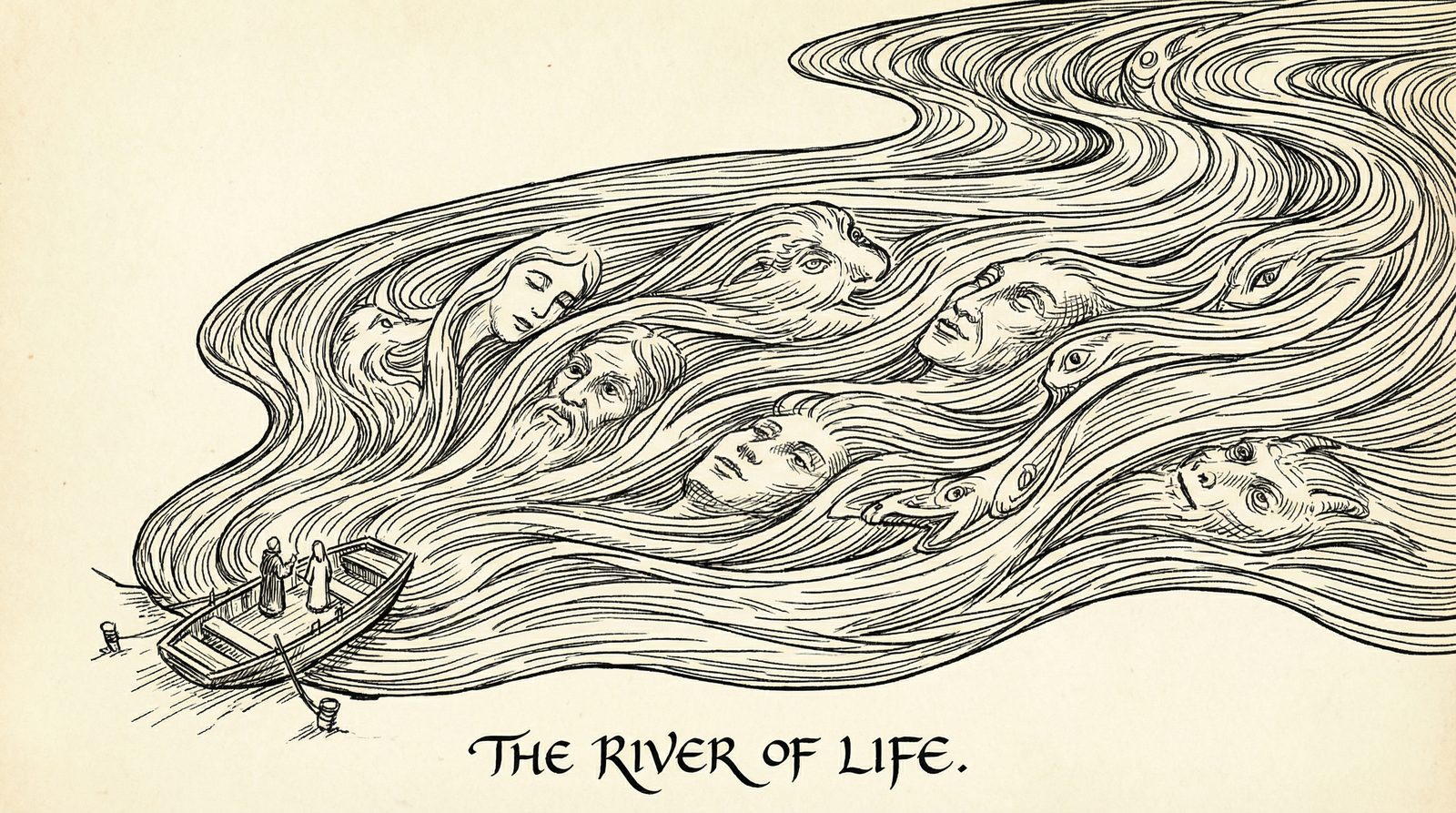
    Late in the novel, Kamala dies during a pilgrimage and Siddhartha becomes responsible for their son, who is angry, entitled, and desperate to escape the river life. When the boy steals the boat and disappears upstream, Siddhartha is forced to face attachment in its rawest form. The loss is not redeemed. It is simply endured. By the ending, when Govinda visits the older Siddhartha and touches his forehead, Govinda receives the vision: countless faces, lives, sins, loves, and deaths flowing together as one present moment. Siddhartha has become what he sought, not by collecting teachings, but by surrendering the need to stand outside life and judge it.

    PROSE & NARRATIVE STRUCTURE

    Formally, Siddhartha is a parable stitched from brief, titled chapters, each a station on the way. The structure is cyclical. The book opens with Siddhartha and Govinda together, and it ends with Govinda returning to Siddhartha, but with the roles quietly reversed. The looping design mirrors the river’s logic: repetition that is not stagnation, return that is not failure.

    The prose is incantatory in its simplicity. Hesse avoids rich description of India. Aside from a few concrete markers, banyan trees, a grove, a town of warehouses, the world remains lightly sketched, like a stage set for an inner drama. That spareness creates a sense of suspension, as if the story occurs outside ordinary clock time.

    The narrative voice stays close to Siddhartha’s consciousness without becoming stream-of-consciousness. Years can vanish in a paragraph, especially during his long sleep inside wealth and routine. By contrast, moments of crisis, the night by the river, the son’s escape, are rendered slowly, almost ritually. This pacing gives the novel its quiet emotional peaks: not big plot turns, but the internal sensation of something breaking and then settling into a new shape.

    Conceptual editorial illustration inspired by 'Siddhartha'

    CHARACTERS & INTERIORITY

    Siddhartha is written as the archetype of the seeker, and Hesse is unsparing about the arrogance baked into that stance. As a youth he judges his father’s rituals. Later he dismisses the Samanas and even Gotama’s teaching as something meant for other people. The novel treats this elitism as part of his flaw, not as spiritual superiority.

    Govinda functions as a counterweight: devoted, faithful, willing to follow. His return decades later frames one of the book’s central tensions, whether devotion or independence leads further. Kamala is not merely a symbol of temptation. She teaches Siddhartha how to be present with another person, how to listen, how to soften. The intimacy is practical, not sentimental, and it gives the novel one of its most human textures.

    Vasudeva is the book’s quiet center. He speaks little and listens deeply, modeling the possibility of learning without making a system. His withdrawal into the forest once Siddhartha has “heard” the river fully is one of the novel’s most moving gestures: the teacher stepping away so the student can simply be. Even minor figures, Siddhartha’s father waiting by the door, the son smashing bowls in rage, are drawn with just enough inner shading to feel like real mirrors rather than cardboard allegory.

    LEGACY & RECEPTION

    Published in 1922, Siddhartha found a modest audience in German and later became a cult favorite in the 1960s among Western readers disillusioned with institutional religion. Its fusion of Hindu and Buddhist imagery with a distinctly European crisis of individuality gave it unusual reach. Many readers approached it as a spiritual guide. Hesse treated it more like a poetic confession: an attempt to write his own divided temperament into a clear, mythic shape.

    Adaptations often fail because they try to externalize what is essentially inward. They linger on scenery or eroticize Kamala, while the novel keeps circling back to the stubborn, mostly wordless change in awareness. The ending is strikingly unspectacular. The fireworks occur inside Govinda’s perception. That quietness is why the book still matters. It insists that the decisive revolutions of a life may be invisible to everyone else.

    IS IT WORTH READING?

    Whether it is for you depends on your tolerance for quiet. There is almost no conventional suspense, and the aphorisms can feel naïve if you want rigorous philosophy. But read as a story of one person exhausting every available path, ritual, asceticism, pleasure, work, fatherhood, and still needing to sit by a river and listen, it has a durable power.

    If you are drawn to questions of meaning but allergic to sermons, this short novel is worth a slow afternoon. Its images linger: the bird in the cage, the river’s voice, the final touch on the forehead, and the strange relief of realizing that unity is not something you achieve. It is something you stop resisting.

    Illustration inspired by a core idea from 'Siddhartha'

    TRIVIA & AUTHOR FACTS

    Hermann Hesse was born in 1877 in Calw, Germany, into a family with missionary experience in India, which shaped his early fascination with Asian religions. He wrote Siddhartha after a period of personal crisis and psychoanalysis, and the novel’s focus on integration rather than escape reflects that background.

    Hesse read widely in translated Hindu and Buddhist texts, but he did not present the novel as scholarship. The geography is intentionally vague, a spiritualized India rather than a realistic travelogue. Gotama is clearly the historical Buddha, while other names and symbols drift freely across traditions without concern for strict chronology.

    Hesse received the Nobel Prize in Literature in 1946. He later expressed some bemusement at how Siddhartha was adopted by Western spiritual seekers as a guidebook. He saw it instead as a poetic exploration of a divided, searching self.

    SIMILAR BOOKS

    If you respond to this kind of inward spiritual searching, you might explore Demian, also by Hesse, for a more psychological initiation narrative. For a contemporary spiritual travelogue filtered through intellect, Zen and the Art of Motorcycle Maintenance offers a different kind of quest. And for a modern fable about omens and purpose, The Alchemist makes an instructive companion, especially in how differently it handles destiny and return.

    DISCOVERABILITY & LINKS

    DISCOVERABILITY & LINKS

  • Eastwest Philosophical Synthesis

    Eastwest Philosophical Synthesis

    DEFINITION & CORE IDEA

    East-West Philosophical Synthesis is a motif in which Eastern and Western ideas about life, morality, and meaning are brought into direct conversation and gradually woven together. Instead of treating East and West as fixed or exotic opposites, stories using this motif allow characters to test Buddhist detachment against capitalist ambition, Confucian duty against individual freedom, or Western rationalism against mystical insight. The point is not that one side wins, but that both are altered through sustained contact.

    In practice, East-West Philosophical Synthesis often appears when a character moves between cultures, studies within a foreign tradition, or grows up inside a mixed philosophical inheritance. They might try to apply meditation and non-attachment to modern work pressure, or use Western psychology to interpret karma, desire, and rebirth. The narrative becomes a kind of laboratory where everyday problems like love, family, work, and grief are approached using tools drawn from more than one civilizational story about what humans are and what they owe each other.

    This motif is especially visible in modern spiritual literature that seeks to translate non-Western traditions into a language accessible to contemporary readers. In Zen and the Art of Motorcycle Maintenance: An Inquiry Into Values, Robert M. Pirsig uses the act of motorcycle maintenance as a bridge between Eastern ideas of presence and Western rational analysis. Quality becomes not a technical metric but a lived experience, discovered through attention rather than theory.

    Editorial illustration inspired by 'Eastwest Philosophical Synthesis'

    HOW IT WORKS IN STORIES

    East-West Philosophical Synthesis usually begins with contact, and early scenes often highlight misunderstanding. A Western-trained professional dismisses traditional practices as superstition. A spiritual teacher views Western self-focus as indulgent. A child of immigrants is told to follow their heart at school while being expected to honor the family at home.

    The story then develops situations where neither a purely Eastern nor a purely Western response feels sufficient. A character raised on individualism may find relief in ideas of interdependence and community. Someone taught to suppress desire for the sake of harmony may discover that Western concepts of boundaries and selfhood provide tools for resistance. Tensions such as fate versus free will, duty versus authenticity, and mind versus body are reopened through lived consequence.

    Over time, the motif shifts from argument to experiment. Characters begin trying hybrid approaches, often clumsily. The synthesis is rarely elegant. It involves compromise, partial misunderstanding, and moments of recognition where a character realizes they have simplified a deep tradition into something more convenient than true.

    Some stories lean toward philosophical rigor, as in the inward journeys of Hermann Hesse. Others move toward accessible spiritual narrative. In Way of the Peaceful Warrior, Eastern ideas of discipline and presence are filtered through a distinctly Western self-help structure, emphasizing personal transformation over metaphysical coherence.

    Symbolic illustration inspired by 'Eastwest Philosophical Synthesis'
    Symbolic illustration inspired by ‘Eastwest Philosophical Synthesis’

    EMOTIONAL EFFECT ON THE READER

    Reading a story shaped by East-West Philosophical Synthesis often feels like sitting in on a long, intimate conversation about how to live. There is pleasure in seeing familiar ideas reframed, where spiritual concepts become practical tools and everyday decisions become moral experiments.

    The motif can also be unsettling. It invites readers to notice how much of their moral intuition is inherited rather than chosen. When characters sincerely try practices drawn from outside their native culture, the reader is asked to imagine doing the same, feeling both curiosity and resistance.

    At its most effective, the motif produces a sense of widened possibility. Cultures are not treated as sealed containers but as living systems capable of dialogue and change. Even when the synthesis fails or remains incomplete, the effort itself carries meaning.


    VARIATIONS & RELATED MOTIFS

    East-West Philosophical Synthesis appears in several distinct modes. In literary fiction, it often takes the form of a demanding inner journey, as in Siddhartha and Demian, where spiritual insight must be earned through suffering and self-confrontation. In popular spiritual fiction, the synthesis becomes more approachable but also more ambiguous.

    In The Celestine Prophecy and The Tenth Insight, James Redfield presents a New Age-inflected synthesis, where Eastern concepts of energy and synchronicity are adapted to Western narrative expectations of clarity, progress, and personal destiny. The result is less philosophically rigorous than Pirsig or Hesse, but emotionally accessible to a broad audience.

    Across these variations, the core remains the same. East-West Philosophical Synthesis is about what happens when different civilizational accounts of meaning, duty, and selfhood are forced to coexist within a single human life.

  • A Fallen Idol (1886)

    A Fallen Idol (1886)

    INTRODUCTION

    A Fallen Idol (1886) by F. Anstey (Thomas Anstey Guthrie)
    Psychological fiction · United Kingdom


    A Fallen Idol begins like a drawing-room curiosity and steadily curdles into something colder. At first glance it looks like a fashionable Victorian entertainment, a touch of occult glamour enlivening polite society. Beneath that surface, Anstey is conducting a pointed examination of belief, imposture, and the damage done when spiritual hunger collides with social ambition.

    The supernatural element is unmistakable, but it is never allowed to dominate the book in the way a conventional horror story might. Instead, the idol operates as a crooked mirror, reflecting vanity, cowardice, and moral compromise back at the people who claim to revere it. The prevailing mood is unease rather than terror. Anstey is less interested in demons than in how quickly ordinary people betray themselves when mystery becomes fashionable.

    PLOT & THEMES

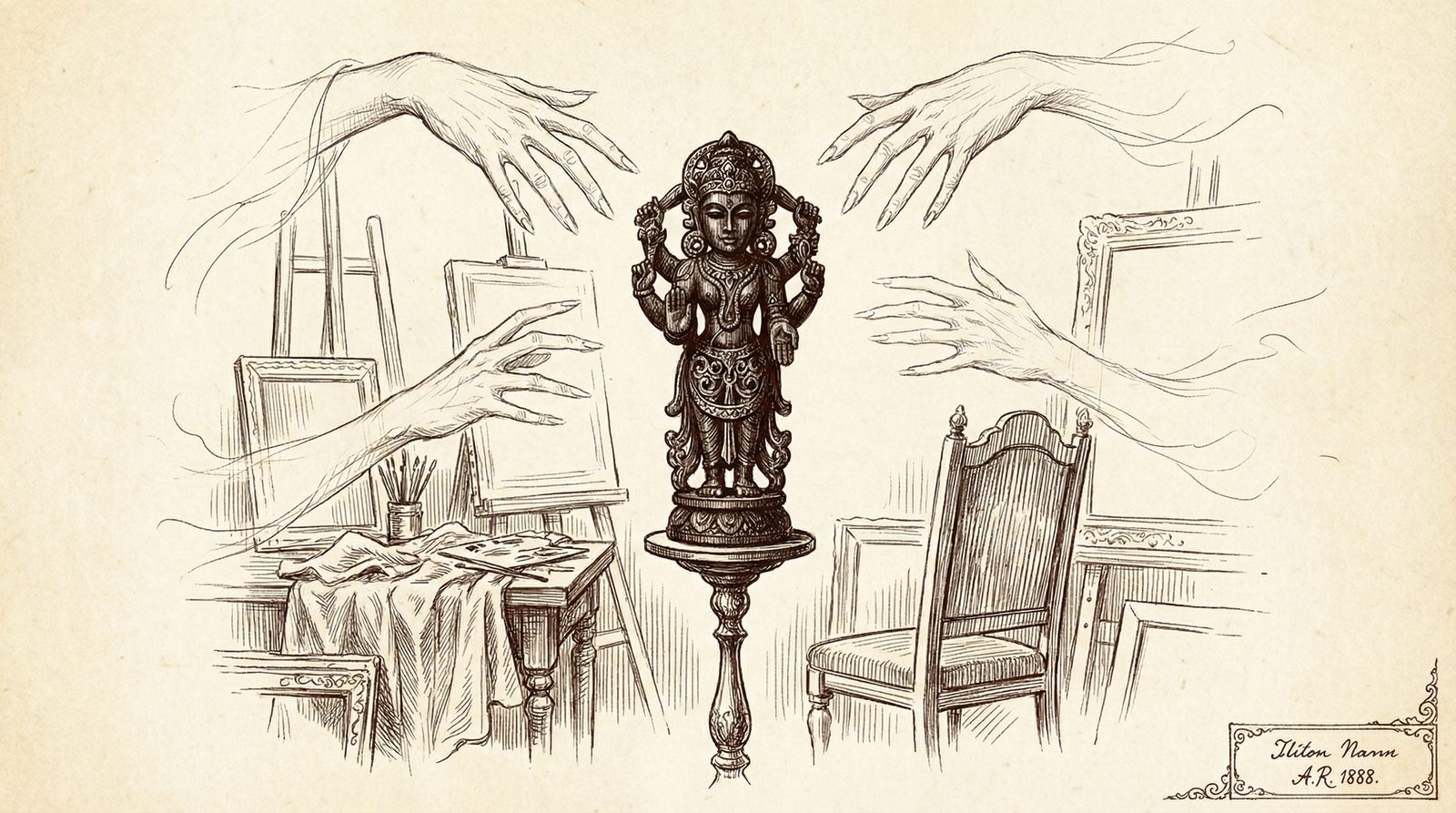
    The story opens in colonial India, where the young barrister Harold Caffyn acquires a strange idol after a violent scene at a temple in Bhowanipore. The circumstances are murky, a worshipper is killed, and whispers of a curse follow the object. Harold brings the idol back to London, where it finds its way into the studio of the painter Mark Ashburn.

    From there, the idol works slowly and indirectly. Mark’s portraits, especially his painting of the charming Dolly Tredwell, begin to attract attention that feels unearned and unsettling. A circle of fashionable spiritualists gathers around the studio, led by the solemn Mrs. Fothergill and the excitable Miss Tyrell, eager to believe that something ancient and powerful is at work.

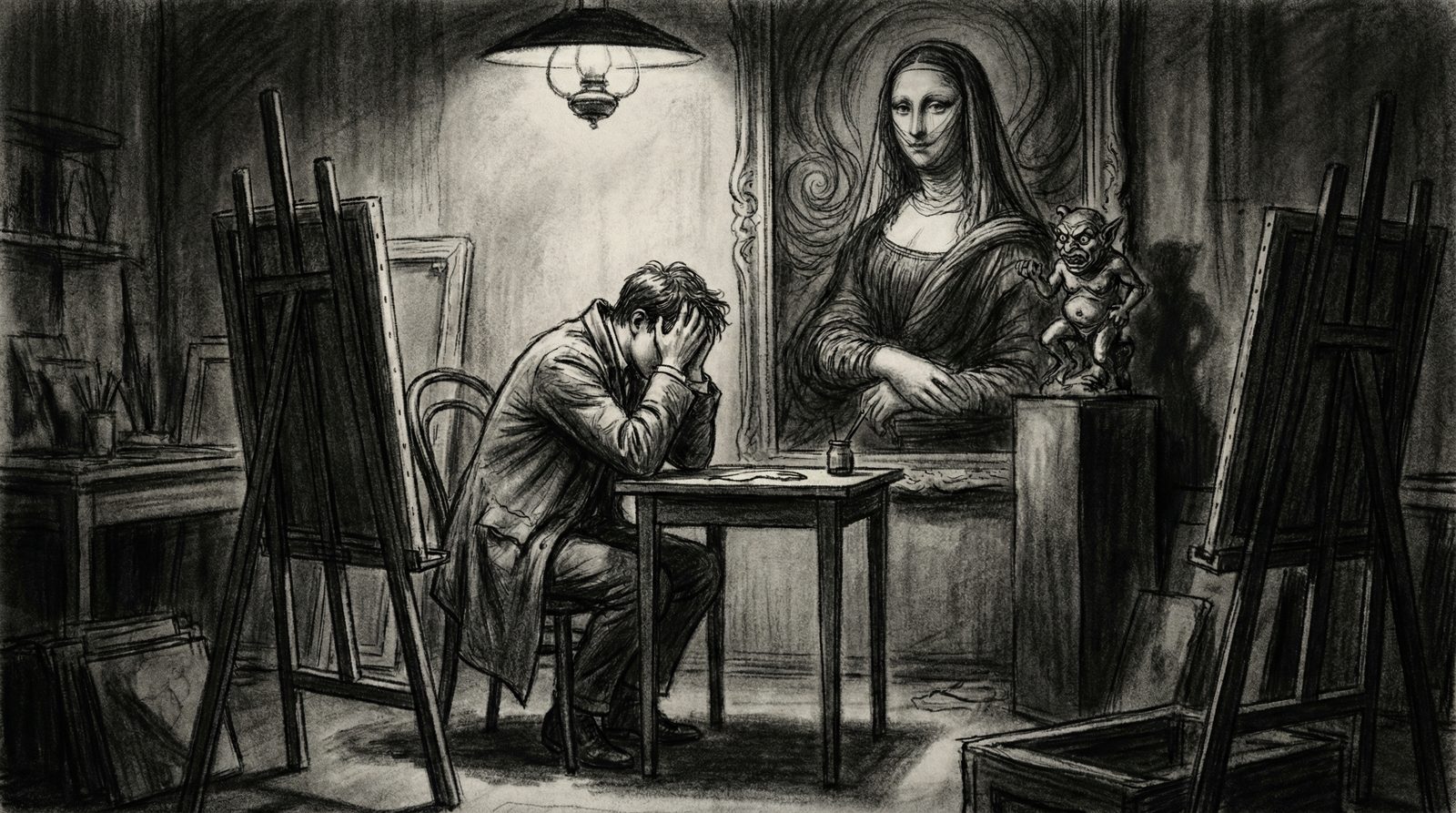
    The novel combines the cursed-object tradition with social imposture. Harold, who knows more about the idol’s bloody history than he admits, manipulates its reputation to his advantage, nudging Mark into becoming a reluctant medium. The séances staged in the dim studio become performances of projection. The sitters see what they want to see, while Mark feels himself hollowed out by a role he never meant to play.

    A colonial undercurrent runs through the book, recalling earlier stories of stolen relics such as The Moonstone. The idol is treated as both exotic curiosity and drawing-room entertainment, stripped of context and consequence until the damage is already done. When exposure finally looms, Harold recklessly handles the idol to prove it harmless. The result is disaster rather than vindication.

    The ending is bleakly ironic. Mark survives physically but not ethically. He burns the painting that brought him acclaim, abandons the séances, and returns the idol to a museum, where it is neutralized behind glass and catalog numbers. No one is cleansed of guilt. Reputations remain bruised. The harm lingers quietly, unresolved.

    PROSE & NARRATIVE STRUCTURE

    Anstey writes with a lightness that disguises how carefully the novel is engineered. Free indirect discourse allows the narrative to drift between Mark’s self-doubt, Harold’s cynical calculation, and the eager credulity of the spiritualist circle without heavy-handed transitions.

    Dialogue does much of the work. Characters expose themselves through polished evasions, nervous enthusiasm, and pious certainty. The narrator’s occasional asides sharpen the satire, particularly when séances are squeezed between tea and supper, or when moral outrage coexists comfortably with voyeuristic curiosity.

    Structurally, the novel alternates between scenes of social comedy and increasingly claustrophobic séances in Mark’s studio. Each sitting raises the stakes: gossip spreads, reputations wobble, and belief hardens into expectation. Notably, the idol itself rarely acts in any overt way. Its power lies in what people are willing to do in its presence.

    Conceptual editorial illustration inspired by 'A Fallen Idol'

    CHARACTERS & INTERIORITY

    Mark Ashburn is a reluctant medium, not by conviction but by weakness. He is decent, talented, and insecure enough to be swayed. His interior monologue reveals how easily vanity disguises itself as generosity. During the séances he repeatedly tells himself that he is only humoring others, even as he profits from their belief.

    Harold Caffyn feels strikingly modern. He half believes his own deceptions and treats danger as something to be managed theatrically. Moments of genuine fear break through his composure, but his instinct is always to convert panic into control.

    Dolly Tredwell and the surrounding social figures are sketched with less depth, yet Anstey allows flashes of private disillusionment to surface. In particular, Dolly’s overheard humiliation after a disastrous séance reminds the reader how easily a young woman’s reputation becomes collateral damage in fashionable folly.

    LEGACY & RECEPTION

    A Fallen Idol never matched the popularity of Anstey’s comic successes, and it is often treated as a minor occult curiosity. Victorian reviewers were divided, intrigued by the ingenuity of the séance scenes but unsettled by the novel’s refusal to clarify whether the idol was truly supernatural or merely a catalyst for fraud and hysteria.

    That ambiguity has aged well. The book now reads as a bridge between moralized ghost stories and later psychological hauntings. Its final image, the idol inert in a museum case while the characters quietly absorb their shame, feels unexpectedly modern in its skepticism toward spectacle and belief.

    IS IT WORTH READING?

    If you prefer supernatural fiction that unsettles through psychology rather than shocks, this novel is worth your attention. It moves at a Victorian pace, heavy with conversation and social maneuvering, but the unease accumulates steadily.

    The séances are disturbing not because of what appears, but because of what people are willing to believe. Readers interested in spiritualism, colonial guilt, and the performance of belief will find the novel sharp and quietly corrosive.

    Illustration inspired by a core idea from 'A Fallen Idol'

    TRIVIA & AUTHOR FACTS

    F. Anstey was the pen name of Thomas Anstey Guthrie, a barrister-turned-writer whose legal training shows in the careful sequencing of cause and consequence throughout the novel. The early Indian chapters draw on contemporary travel writing, though filtered through satire.

    Anstey attended real séances in London, and his fascination with spiritualism and fraud informs the novel’s tone. The museum ending reflects his interest in how institutions neutralize danger by classification, turning objects of fear into labeled curiosities.

    SIMILAR BOOKS

    Readers interested in supernatural objects with moral weight may also enjoy The Moonstone for its colonial relic and social fallout, or The Turn of the Screw for a later, more psychological ambiguity. For Victorian skepticism toward spiritual fashion, the earnest writings of Arthur Conan Doyle on séances offer a revealing real-world counterpoint to Anstey’s fiction.

    DISCOVERABILITY & LINKS