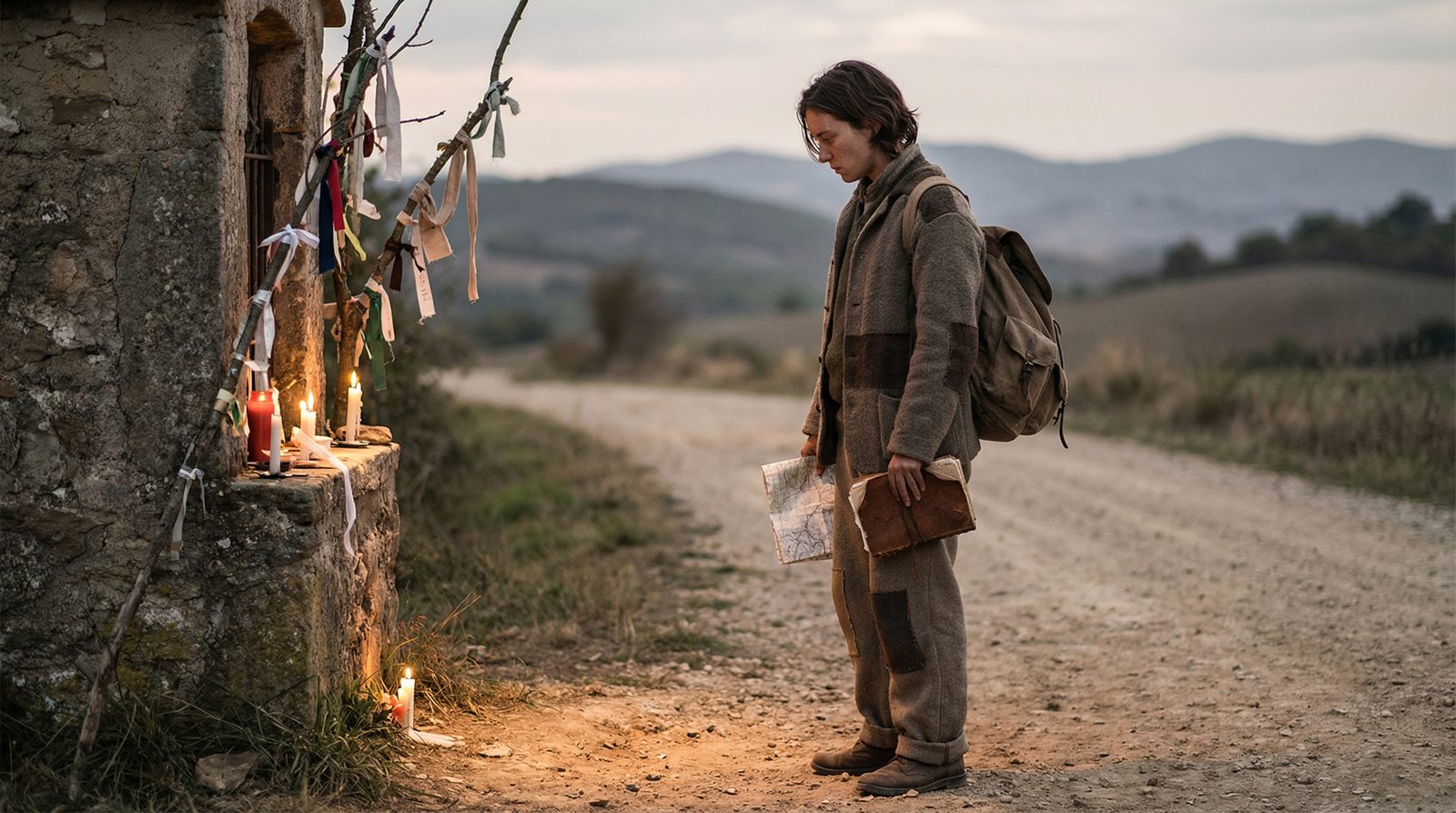
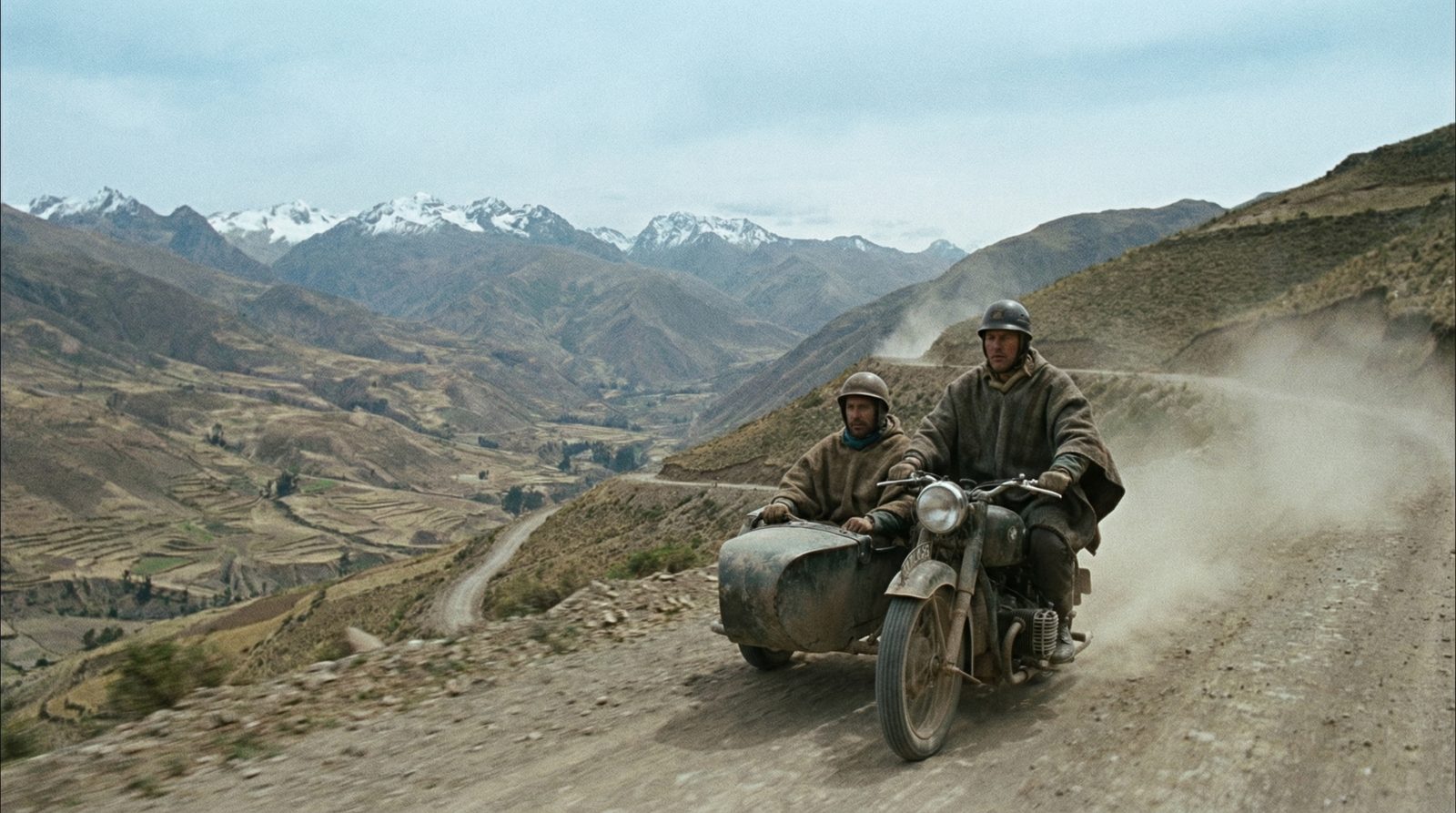
Country: Peru

  • The Motorcycle Diaries (2004)

    The Motorcycle Diaries (2004)

    The Motorcycle Diaries (2004), directed by Walter Salles. Road Movie · 126 minutes · Argentina / Brazil / Chile / Peru / United States.


    INTRODUCTION

    The Motorcycle Diaries is a Road Movie that feels quietly revolutionary in its modesty. Rather than racing through the milestones of a famous life, it lingers on formative moments before myth hardens into ideology. Walter Salles follows a 23-year-old Ernesto Guevara in 1952, long before he becomes “Che,” tracing a journey across South America that reshapes his sense of responsibility and belonging.

    The film belongs to the coming-of-age tradition, but the coming-of-age is political as much as personal. By the time the credits roll, nothing “historic” has happened in conventional biopic terms. Yet everything has shifted internally. The mood is contemplative, melancholic, and grounded in physical travel rather than rhetoric.

    PLOT & THEMES

    The story follows Ernesto Guevara, a middle-class Argentine medical student, and his friend Alberto Granado as they set off on a ramshackle motorcycle trip across South America. What begins as youthful adventure quickly becomes a lesson in limits. The motorcycle breaks down, money disappears, and the pair are forced into closer contact with people living far outside their social bubble.

    As they travel through Argentina, Chile, and Peru, the tone shifts from comic misadventure to moral confrontation. Encounters with exploited miners, Indigenous communities, and patients at a leper colony expose Ernesto to structural injustice he cannot ignore. Travel becomes transformation, not through spectacle but through accumulation: each border crossed introduces a new ethical tension.

    Illness and bodies play a central role. Ernesto’s asthma and his medical training keep politics anchored in physical vulnerability. Inequality is not discussed abstractly; it is breathed, touched, and treated. The film resists cathartic conversion scenes, favoring gradual awakening. By the river crossing at the leper colony, Ernesto’s decision to swim across becomes a physical declaration of solidarity rather than a speech.

    CINEMATIC TECHNIQUE & AESTHETICS

    Walter Salles relies on naturalistic lighting and extensive location shooting to ground the film in lived geography rather than postcard imagery. Landscapes dwarf the protagonists, reinforcing humility and disorientation. Long takes allow discomfort to settle, particularly during encounters with marginalized communities.

    Handheld camera work during travel sequences gives the journey a tactile instability. The bike rattles, the frame shudders, and progress feels provisional. By contrast, scenes at the leper colony use steadier compositions and visual symmetry, as if the film itself slows down to observe rather than roam.

    Sound design favors ambient noise — engines, wind, water — with Gustavo Santaolalla’s score entering quietly, like memory rather than commentary. Voiceover drawn from Guevara’s diary is used sparingly and often complicates what we see. The final montage of faces anchors the film’s politics in lived human presence rather than ideology.
    Editorial illustration inspired by 'The Motorcycle Diaries (2004)'

    CHARACTERS & PERFORMANCE

    Gael García Bernal plays Ernesto as a restrained Idealist rather than a charismatic firebrand. He is awkward, asthmatic, observant — more listener than speaker. Bernal emphasizes hesitation and internal pressure, letting the awakening register through silence and posture rather than declarations.

    Rodrigo de la Serna’s Alberto Granado provides contrast as a Trickster figure: charming, opportunistic, and emotionally open. Their dynamic balances gravity with warmth. Friendship becomes the film’s emotional vehicle for political realization.

    Supporting characters appear briefly but leave lasting impressions. They function less as individualized arcs and more as lived evidence of inequality. The restrained performances avoid sentimentality, keeping the film from drifting into didacticism.

    CONTEXT & LEGACY

    Released in the early 2000s, The Motorcycle Diaries arrived when Che Guevara’s image had become globally commodified. By focusing on his pre-revolutionary years, the film sidesteps later controversies and instead explores the formation of conscience. Its legacy lies not in political instruction but in showing how empathy precedes ideology.

    Within Latin American cinema, it stands as a key example of the socially conscious Road Movie, using movement to expose class and racial divides. Internationally, it remains a touchstone for films that treat political awakening as a slow, embodied process rather than a single decisive moment.

    IS IT WORTH WATCHING?

    Yes — especially if you prefer character-driven journeys over conventional biopics. The film rewards patience, attention, and openness. It is less interested in answers than in formation.

    Viewers expecting a full account of Che Guevara’s later politics may find it incomplete. As a portrait of an inner shift — from individual adventure to continental awareness — it remains quietly powerful.


  • Synchronicity And Meaningful Coincidence

    Synchronicity And Meaningful Coincidence

    DEFINITION & CORE IDEA

    Synchronicity And Meaningful Coincidence is the motif where events align with a precision that feels narratively excessive if everything is truly random. A stranger says the exact phrase the protagonist has been circling internally. A missed train leads to the only meeting that matters. The same symbol appears across unrelated places and moments. The story does not need to prove the supernatural; what matters is that the character experiences these alignments as communication rather than noise.

    In stories built around this motif, coincidence becomes information. The protagonist begins to treat timing, repetition, and interruption as meaningful data rather than background chaos. The explanation may vary — fate, God, a hidden order, the unconscious mind — but structurally the coincidences function the same way: they influence choice. Once the character starts acting as if meaning is real, the story has crossed its threshold.

    This logic is explicit in The Celestine Prophecy, where sequential encounters operate as instructions disguised as chance. In The Tenth Insight, the same mechanism is expanded into a system, training characters to read coincidence as guidance rather than accident. The Alchemist reframes this dynamic more quietly: dreams, omens, and chance meetings grant permission to abandon a stable life in favor of a meaningful one. In Way Of The Peaceful Warrior, coincidence is less mystical and more instructional, nudging attention back to discipline, presence, and embodied awareness.


    HOW IT WORKS IN STORIES

    Synchronicity usually enters a story quietly. The protagonist notices something small and easily dismissible: a repeated number, a perfectly timed interruption, an overheard sentence that lands too close to home. Early scenes preserve plausible deniability so the reader can remain skeptical without breaking immersion.

    The engine activates when coincidences begin to cluster. One coincidence is texture; several in close succession create pressure. These clusters tend to appear at decision points, moments when the protagonist is stuck between options or close to abandoning a path. In narratives like The Celestine Prophecy, each encounter functions as a breadcrumb that must be followed or consciously rejected. In The Alchemist, ignoring omens does not trigger punishment, but it stalls the story, draining momentum until attention realigns.

    Effective uses of this motif always impose cost. Following a “sign” risks embarrassment, loss of stability, or the appearance of irrationality. The character must accept the possibility of being wrong, foolish, or delusional. This risk is essential. Without it, synchronicity collapses into wish fulfillment. The choice to trust coincidence must feel dangerous enough to matter.

    Resolution typically arrives in one of two forms. In affirming narratives, the character learns to live inside a world where meaning does not need constant confirmation. In more ambiguous stories — as in I Origins — coincidences remain interpretable rather than proven, and the payoff is psychological. What changes is not the universe, but the character’s relationship to uncertainty.


    Editorial illustration inspired by 'Synchronicity And Meaningful Coincidence'

    EMOTIONAL EFFECT ON THE READER

    This motif is designed to feel intimate. The reader becomes a co-interpreter, scanning scenes for repetition, echo, and timing. When an early detail reappears in a charged moment, it produces a quiet jolt of recognition, as if the story is rewarding attention.

    At its most comforting, synchronicity offers relief from randomness. Detours feel purposeful. Delays feel protective. In books like The Alchemist, this reassurance is central to the reading experience, allowing setbacks to be reinterpreted as alignment rather than failure. The world feels readable, and the reader is invited to believe that attention itself has value.

    The same mechanics can also generate unease. Too many coincidences create the sense of being watched or guided too forcefully. In more psychological versions of the motif, the reader begins to question whether meaning is emerging organically or being imposed as a defense against chaos. That tension between enchantment and suspicion keeps the motif from becoming sentimental.

    When the motif works, the after-effect is practical. The reader finishes with heightened awareness of how easily meaning can arise once repetition and timing are framed as communication — and how much depends on where attention is placed.


    Symbolic illustration inspired by 'Synchronicity And Meaningful Coincidence'

    VARIATIONS & RELATED MOTIFS

    Synchronicity And Meaningful Coincidence appears in several recognizable variations. The spiritual guidance version treats coincidence as instruction, rewarding trust and punishing inattention. Romantic and literary versions soften the logic into serendipity, where repeated encounters transform chance into inevitability. Philosophical variants retain the pattern but refuse explanation, letting the reader decide whether meaning is discovered or constructed.

    A darker variation reframes synchronicity as a trap. Here, pattern recognition becomes exploitable, and “signs” function as lures rather than help. The story’s tension comes from uncertainty: is the universe speaking, is someone engineering the coincidences, or is the protagonist assembling meaning to avoid confronting randomness?

    This motif naturally overlaps with Spiritual Awakening, where heightened attention makes coincidence feel louder and more personal. It also pairs with Spiritual Pilgrimage and Inner Journey, where movement and reflection create the friction that makes “signs” feel necessary. When coincidence is framed as destiny language, it often converges with Personal Legend And Destiny.

  • Spiritual Pilgrimage

    Spiritual Pilgrimage

    DEFINITION & CORE IDEA

    A Spiritual Pilgrimage is a journey narrative where the stated destination is secondary to internal change. The protagonist may travel to a sacred site, follow a prophecy, or chase a promised revelation, but the journey functions as a structured sequence of tests designed to produce belief change, moral recalibration, or a new self-concept. The road is not backdrop. It is the mechanism.

    Stories like The Pilgrimage, The Alchemist, Siddhartha, and The Celestine Prophecy use travel as a didactic structure. Encounters are not random. Each guide, stranger, or obstacle is positioned to challenge a specific assumption and force a decision. The motif is built to convert movement into meaning through repeated, concrete choices.

    At its core, a Spiritual Pilgrimage treats geography as allegory. Terrain and logistics mirror internal states. A detour becomes a correction, a delay becomes a test of attachment, and reaching the destination often reveals that the “goal” was a sustaining pretext for transformation. The real arrival is a changed interpretive frame, not a point on a map.


    HOW IT WORKS IN STORIES

    The trigger is usually a sense of lack. The protagonist begins with spiritual numbness, restlessness, grief, or moral confusion. A call to travel appears, and the character steps away from familiar structures into uncertainty. This transition matters because the motif requires removal from the old context before the belief system can be tested.

    The journey then unfolds as iterative lessons. In The Pilgrimage and The Alchemist, the road is populated with omens, mentors, and small reversals that challenge the hero’s assumptions about success and failure. In Siddhartha, the river functions as a persistent teacher, reshaping the protagonist’s understanding of time, suffering, and enlightenment. The Celestine Prophecy builds its arc around sequential “insights” delivered through encounters that mix guidance with threat.

    Obstacles are rarely only physical. Hunger, fatigue, getting lost, and missed connections work on two tracks at once: logistics and revelation. A storm can be a crisis of faith. A wrong turn can be a confrontation with ego. Temptations to stop often arrive as comfort—safety, certainty, and social approval—so continuing becomes a deliberate act of change rather than mere endurance.

    The end state is usually “quiet arrival.” The protagonist may return home with altered perception, or reach the destination and discover it matters less than the internal shift already achieved. The motif closes by demonstrating integration: a new interpretive frame that changes how the character reads the same world.

    Writers use Spiritual Pilgrimage because it keeps philosophy grounded in events. Instead of abstract debate, the story forces ideas to survive contact with heat, fear, hunger, misunderstanding, and human inconsistency. The road supplies friction. Friction produces the change.


    Editorial illustration inspired by 'Spiritual Pilgrimage'

    EMOTIONAL EFFECT ON THE READER

    This motif invites projection. The reader maps personal uncertainty onto the pilgrim’s movement, using the journey as a safe container for questions about meaning, faith, and purpose.

    The emotional arc typically moves through three phases. First, resistance or naivety, where the pilgrim overestimates the literal goal. Second, a “dark night” phase, where the journey fails to deliver easy answers and the protagonist confronts doubt, fatigue, and disillusionment. Third, integration, where relief arrives not through conquest but through acceptance and clarity.

    Even in optimistic versions, the motif carries a controlled unease. It implies that comfort and certainty are often incompatible with change. In harsher variants, the pilgrimage can feel like attrition, where the lesson is not illumination but endurance. In either case, the payoff is the same: the reader finishes with a sharper sense of what the character is willing to become.


    Symbolic illustration inspired by 'Spiritual Pilgrimage'

    VARIATIONS & RELATED MOTIFS

    A Spiritual Pilgrimage can be overtly religious, centered on shrines, relics, or monasteries, or it can be framed as a secular search for meaning. Some stories emphasize discipline and deprivation, where the road is a controlled program of hardship. Others emphasize interpretation, where coincidences, symbols, and mentors form a readable pattern across the landscape.

    One common variation is the reluctant pilgrim, dragged into travel by circumstance and changed despite resistance. Another is the failed pilgrimage, where the character reaches the physical goal but refuses the internal shift, producing a bitter or ironic ending. Group pilgrimages expand the motif into social dynamics, using the shared road to expose competing belief systems.

    This motif often overlaps with Personal Legend And Destiny, where the journey outward is tied to the idea that each person has a unique path they are meant to recognize and commit to. It also connects naturally to motifs about mentors and guides, prophetic dreams, and the idea that “home” must be left in order to be understood.

    It can also be questioned or subverted. Some stories show how easily tourism can be mistaken for transformation, or how spiritual language can become a substitute for the harder work of change. Even then, the structural tension remains: the road tests what the character believes, and what they are willing to become.

  • The Celestine Prophecy (1993)

    The Celestine Prophecy (1993)

    INTRODUCTION

    The Celestine Prophecy (1993) by James Redfield
    Spiritual fiction · 20th Century · United States / Peru


    The Celestine Prophecy arrived in the mid-1990s like a photocopied scripture passed from hand to hand, carrying the promise that everyday life concealed a deeper pattern of meaning. It barely disguises its intentions. This is a novel that wants to instruct, not merely entertain. Yet that lack of irony is part of its peculiar magnetism.

    Set largely in Peru but steeped in American New Age yearning, the book follows an unnamed narrator who drifts from encounter to encounter, repeatedly meeting people who seem to have been waiting for him. The tone is earnest to the point of vulnerability. At times it feels naïve, even awkward. But it is also charged with a restless hope that private dissatisfaction might be a signal of collective transformation.

    As spiritual fiction, the novel sits between adventure story and instructional text. Ancient manuscripts, meaningful coincidence, and invisible energy fields are not narrative ornaments here. They are the argument. Human consciousness itself is framed as the final frontier of the late twentieth century.

    PLOT & THEMES

    The plot unfolds as both a physical journey through Peru and a structured ascent through nine spiritual insights. Nudged by a former teacher, the narrator travels to Lima after hearing rumors of a mysterious manuscript discovered near the ruins of an ancient settlement. Almost immediately, he is warned that the Catholic Church views the document as dangerous.

    From that moment on, the story follows the logic of the chosen seeker. The narrator repeatedly meets exactly the right person at exactly the right moment. Each encounter introduces a new insight, reframing the nature of history, psychology, and human interaction.

    The early insights teach that modern restlessness is not a personal failure but an evolutionary pressure. Later chapters introduce the idea of visible energy fields surrounding living beings, dramatized in scenes where attention itself appears to nourish plants or destabilize human interactions. At the Celestine ruins, competing belief systems are rendered as clashing energetic forces rather than ideological disagreements.

    Redfield weaves in psychological material through the concept of “control dramas”: patterns like the Intimidator, Interrogator, Aloof type, and Poor Me. These strategies, learned in childhood, are presented as unconscious attempts to steal energy from others. Family arguments and strained relationships become laboratories for spiritual diagnosis.

    The later insights grow more radical. Humanity is imagined as learning to consciously exchange energy, extending life and eventually transcending physical death altogether. Unlike the film adaptation, the novel ends without triumph. The manuscript is suppressed, Father Sanchez is arrested, and the narrator leaves Peru committed to living the insights quietly in ordinary life, waiting for a tenth insight to emerge elsewhere.

    As spiritual fiction, the book occupies an uneasy space between allegory and manual. Its ambition is unmistakable: to use narrative itself as a technology for belief change.

    PROSE & NARRATIVE STRUCTURE

    The novel is told in plain first-person prose, almost aggressively stripped of ornament. Sentences explain more than they evoke. Characters rarely act without also clarifying the spiritual meaning of their actions. This flattens suspense but reinforces the book’s instructional purpose.

    Structurally, the book is modular. Each chapter introduces a new insight through a new character or setting: Father Sanchez in a Lima church, Dobson at the Viciente estate, Marjorie and her children in a mountain refuge, Sarah at a scientific research compound. The repetition is deliberate. Learning here happens through accumulation, not surprise.

    Occasional sensory details appear, humid jungle air, stone corridors, flickering candlelight, but they function as brief pauses between extended dialogues about spiritual evolution. Even moments of danger, including the narrator’s imprisonment, exist mainly to usher in the next teaching.

    Formally, the book resembles a self-help text wearing the clothes of an adventure novel. Whether that feels inspiring or tedious depends entirely on how receptive the reader is to the insights themselves.

    CHARACTERS & INTERIORITY

    The unnamed narrator functions less as a character than as an archetypal pilgrim. His background is deliberately vague. He exists primarily as a vessel for the reader’s curiosity and doubt.

    Supporting figures are similarly schematic. Father Sanchez represents institutional religion under threat. Wil plays the role of the seasoned guide, always one insight ahead. Charlene embodies skepticism slowly dissolving into openness. Even minor characters exist to demonstrate specific psychological patterns rather than to develop inner lives.

    Interior experience is reported rather than dramatized. Moments of awakening are described intellectually, not viscerally. Yet there is an odd honesty in this clumsiness. The characters constantly articulate their fears of being wrong, arrested, or deluded. That insecurity mirrors the reader’s own ambivalence about embracing such a totalizing worldview.

    LEGACY & RECEPTION

    The Celestine Prophecy was an unlikely cultural phenomenon. Initially self-published, it climbed bestseller lists and spawned sequels, workshops, and discussion groups. Critics often dismissed its prose as wooden and its ideas as recycled mysticism. Readers, however, embraced its promise of meaning in an era marked by spiritual drift.

    The book helped normalize the idea that a novel could function as spiritual instruction. Its insistence that insight must be lived rather than archived allowed readers to extend the story into their own lives. That open-endedness explains why it lingered in personal libraries and study circles long after its mainstream visibility faded.

    IS IT WORTH READING?

    As a novel, it is undeniably clumsy. As a cultural artifact, it remains fascinating. Readers interested in how New Age spirituality crystallized into narrative form during the 1990s will find it revealing. It rewards a skeptical but open posture: reading with a pencil in hand, questioning its claims, and occasionally feeling an unsettling resonance when coincidence and meaning begin to rhyme with personal experience.

    TRIVIA & AUTHOR FACTS

    James Redfield self-published the novel and distributed copies through independent bookstores before it was picked up by a major publisher. His background in counseling and interest in Eastern philosophy shaped the book’s blend of psychology and spirituality.

    The manuscript and its nine insights are entirely fictional. Redfield has stated that they are a synthesis of various spiritual traditions rather than a rediscovered ancient text.

    SIMILAR BOOKS

    Readers drawn to its blend of spiritual seeking and narrative instruction may also explore The Alchemist (1988) by Paulo Coelho, Hermann Hesse’s Siddhartha (1922), or Dan Millman’s Way of the Peaceful Warrior (1980).

    DISCOVERABILITY & LINKS

    Related works: The Tenth Insight, The Alchemist, Way of the Peaceful Warrior

    DISCOVERABILITY & LINKS