
Feel: Contemplative

  • Shop Class As Soulcraft An Inquiry Into The Value Of Work (2010)

    Shop Class As Soulcraft An Inquiry Into The Value Of Work (2010)

    INTRODUCTION

    Shop Class As Soulcraft An Inquiry Into The Value Of Work (2010) by Matthew B. Crawford
    Nonfiction · United States


    Shop Class As Soulcraft is a philosophical memoir written with grease under its fingernails. Moving between a Washington, D.C. think tank and a Richmond motorcycle shop, Matthew B. Crawford asks why so much 21st-century work feels hollow even as it grows more “knowledge-based.” Hands-on problem solving anchors the argument: the feel of a stuck bolt giving way, the sound of an engine catching after a rebuild, the clarity of cause and effect when a machine either starts or doesn’t.

    Crawford is a trained political philosopher, but his authority here comes from the bench. He treats manual competence as a way to restore agency and attention in a culture that often treats workers—whether in cubicles or service bays—as interchangeable parts. The book’s tone is quietly defiant: it refuses to romanticize the trades while insisting that contact with material reality can train judgment in ways abstract workplaces often cannot.

    PLOT & THEMES

    This is nonfiction, so the “plot” is the arc of Crawford’s working life and thinking. He moves from a PhD in political philosophy to a job producing policy materials in Washington, then into running a motorcycle repair shop. That biographical line frames his core themes: disillusionment with abstraction, the dignity of competence, and the moral importance of work that produces visible consequences.

    Crawford dissects workplaces that hide real cause and effect. In the policy world, outcomes can be shaped by institutional incentives and funding rather than truth. In the shop, the stakes are concrete: tracing an electrical fault, diagnosing a misfire, and submitting to what the machine will allow. Resistance—stubborn fasteners, brittle wiring, unreliable systems—becomes a moral category. It trains patience, humility, and attention because reality pushes back.

    The book ends without a grand solution. Crawford remains inside constraints: customers, liability, finances, computerized diagnostics. The point is not escape from the market, but a life built around problems he can see and touch, and a cultivated skepticism toward any job that divorces responsibility from consequences.

    PROSE & NARRATIVE STRUCTURE

    Crawford structures the book as a braided essay, alternating between philosophical reflection and concrete shop anecdotes. Theory is repeatedly punctured by case study: a discussion of alienation slides into a story about a seized engine; a critique of managerial “knowledge” meets the stubborn truth of a stripped bolt. This interleaving keeps the argument grounded.

    The prose is plainspoken but precise. Sentences often begin in the register of the shop manual and end in the seminar room. Sensory detail is treated as cognition: listening to exhaust pulses, feeling torque through a wrench, noticing the small asymmetry that points to the true problem. The book builds force through returning images rather than linear escalation.

    First-person honesty is part of the method. Crawford admits vanity, status anxiety, misjudgments, and the cost of getting things wrong. The argument never floats free of the bench vise and service manual. It is theory built around parts diagrams rather than ideology.
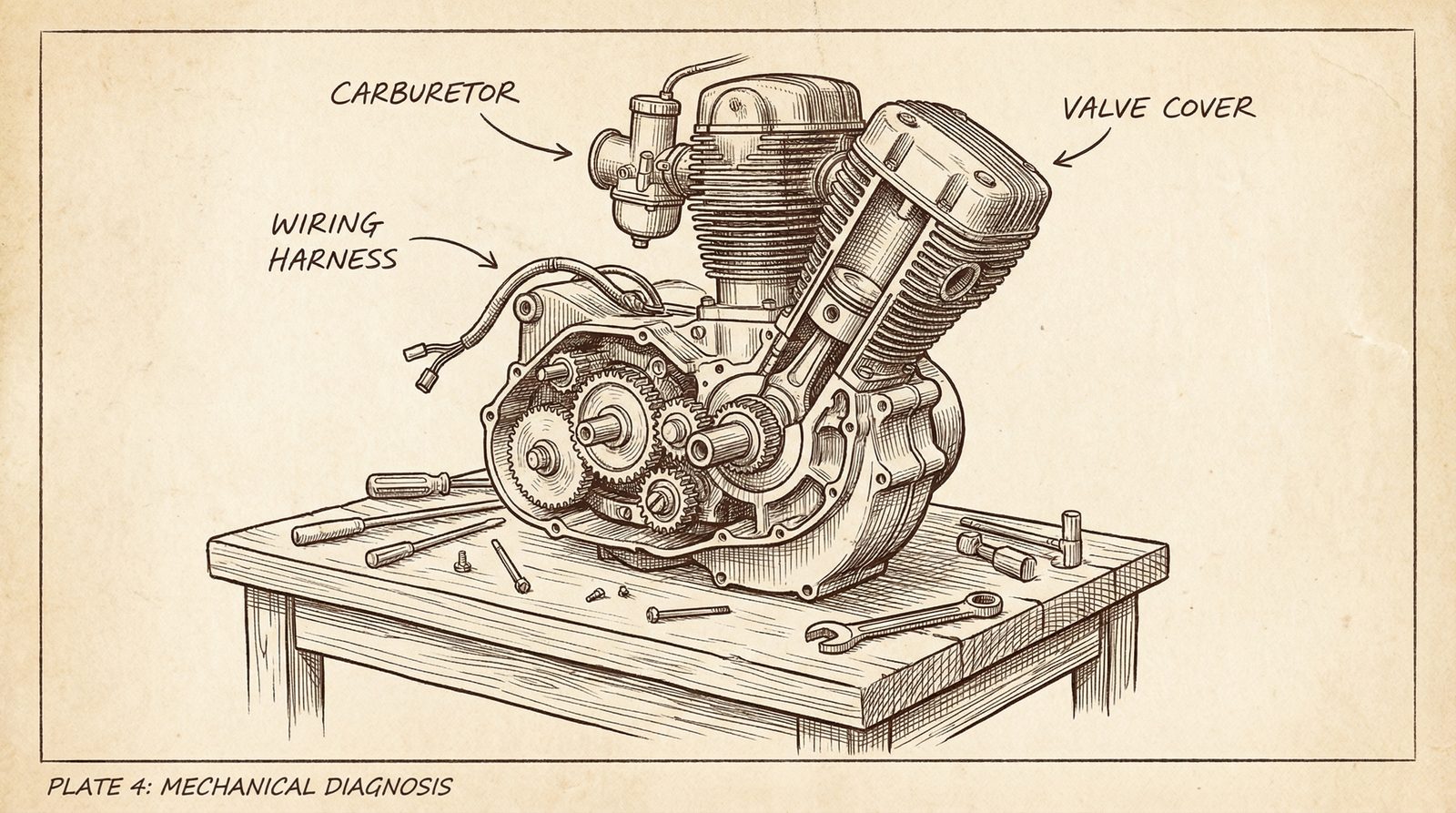
    Conceptual editorial illustration inspired by 'Shop Class As Soulcraft An Inquiry Into The Value Of Work (2010)'

    CHARACTERS & INTERIORITY

    Though nonfiction, the book is full of vivid figures. Crawford himself is a philosopher-mechanic who refuses the idea that thinking belongs only to office work. Former colleagues in policy settings appear as foils, representing work that is socially “high status” but structurally detached from consequence. Customers drift through as sketches: people whose livelihoods depend on a machine starting tomorrow morning.

    Crawford’s interiority is unsparing. He records fear of having “downshifted” in status and the anxiety of slow business cycles, but also the quiet satisfaction of solving problems no one else could touch. Earned authority—knowing a machine well enough to predict its behavior—becomes a more durable identity than titles ever were.

    Secondary presences include older mechanics and mentors who carry a “vanishing guild” ethos: small rituals of the trade, bench discipline, returning fasteners to their holes, keeping an internal map of a disassembled engine. Through them, Crawford sketches a culture where things are still fixable, even as sealed devices and disposable design try to make that culture obsolete.

    LEGACY & RECEPTION

    Published in 2010, Shop Class As Soulcraft landed in the wake of the financial crisis, when many readers were newly suspicious of prestige work that produced little they could point to. The book was widely reviewed and argued over. It was praised for clarity and attacked for appearing to idealize forms of work not equally available to all. Even critics, however, often recognized the sharpness of its central claim: that responsibility requires feedback.

    The book has become a durable reference point in debates about vocational education, the decline of shop class, and the cultural status of “the trades.” Its legacy lies in its stubborn particularity. Crawford does not offer a program; he offers a lens that keeps resurfacing whenever people ask whether modern work leaves room for agency, skill, and pride.

    IS IT WORTH READING?

    If you have ever stared at a screen and wondered what, exactly, you are producing, this book will hit a nerve. Crawford refuses easy consolation about either office work or manual work. The philosophy is serious but readable, and the argument is carried by concrete scenes of diagnosis, failure, and repair. It’s worth reading not because it offers career advice, but because it asks what kind of attention your life’s work deserves.
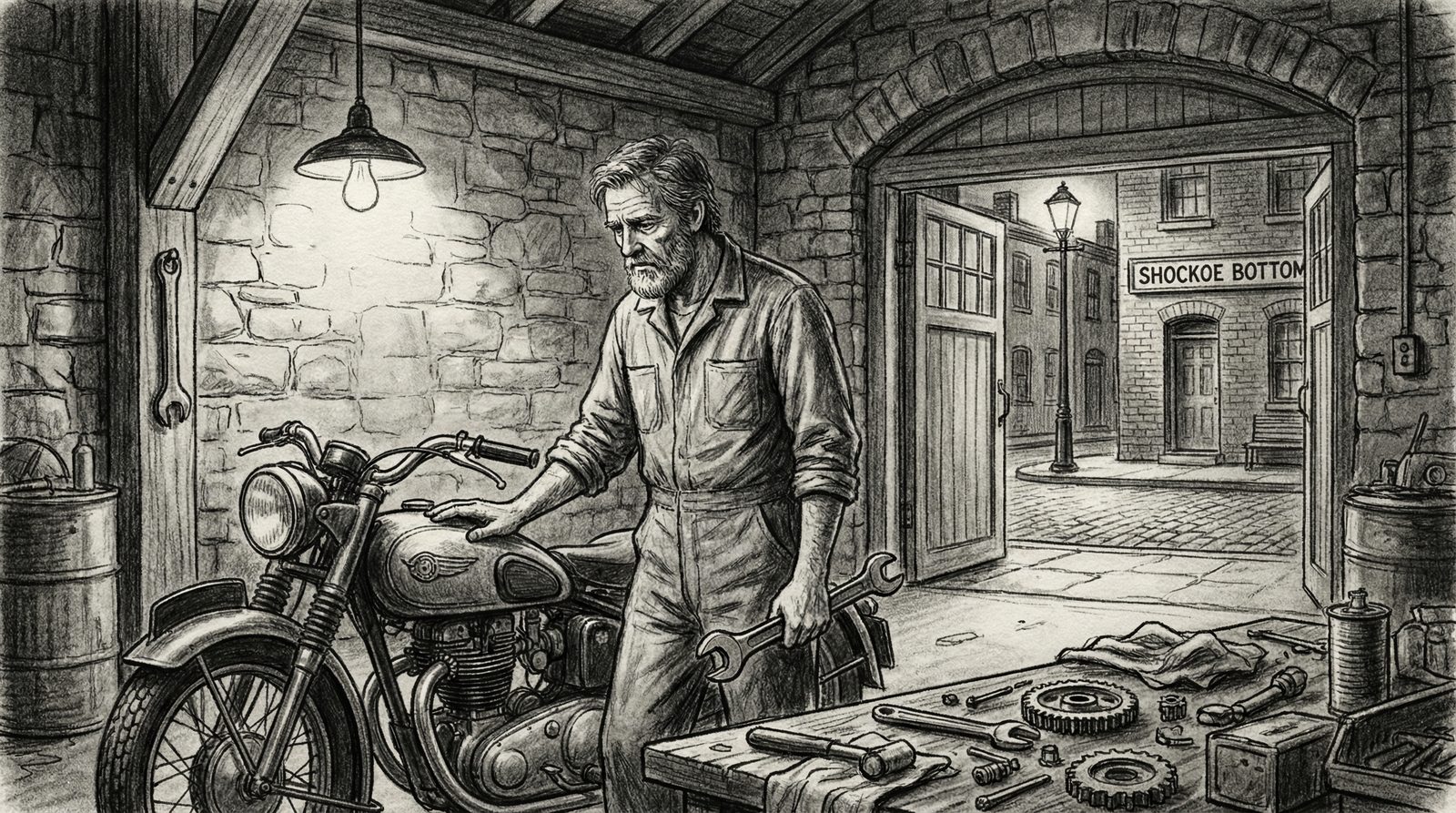
    Illustration of a core idea or motif from 'Shop Class As Soulcraft An Inquiry Into The Value Of Work (2010)'

    TRIVIA & AUTHOR FACTS

    Matthew B. Crawford holds a PhD in political philosophy from the University of Chicago. Before opening his Richmond motorcycle shop, he worked at a Washington, D.C. think tank producing policy materials, an experience that directly fuels his critique of abstraction-heavy work. His shop, Shockoe Moto, is named for the Shockoe Bottom neighborhood where it operates.

    Many of the book’s most memorable episodes come from day-to-day shop work: diagnosing intermittent failures, dealing with parts mistakes, and navigating the mismatch between customers’ expectations and mechanical reality. The book’s credibility comes from this friction: it stays close to the bench even when it reaches toward political philosophy.

    SIMILAR BOOKS

    If this book speaks to you, look for other works that treat work as moral and intellectual practice. The strongest neighbors tend to share Crawford’s insistence that “thinking” is not confined to the office and that good work is a way of being answerable to the world.

    DISCOVERABILITY & LINKS

  • Athletic Discipline As Spiritual Practice

    Athletic Discipline As Spiritual Practice

    DEFINITION & CORE IDEA

    Athletic Discipline As Spiritual Practice is a motif where physical training becomes a method of inner change. A character may begin by chasing medals, approval, or bodily perfection, but the story steadily redirects the goal away from external victory. Repetition and pain function as meditative practice rather than punishment, reshaping attention, ego, and self-understanding through the body.

    Writers use this motif to argue that insight does not require a monastery. It can emerge at dawn, under fluorescent lights, through breath control, posture, balance, and endurance. The body becomes a closed system the character can actually work with. By mastering effort inside that finite space, the character develops a template for meeting uncertainty outside it.

    Dan Millman’s Way Of The Peaceful Warrior stands near the center of this motif because the mentor figure reframes training as awareness rather than achievement. Drills are not abandoned, but their meaning changes. What matters is not the score, but what collapses and what remains when the character can no longer hide behind performance.


    HOW IT WORKS IN STORIES

    Stories built on this motif often begin with a narrow definition of progress. The character believes effort produces results in a straight line. Training sequences follow familiar sports beats because the worldview is still mechanical: more work equals more worth.

    The pivot arrives when the body stops cooperating with the ego. Injury, exhaustion, or humiliation exposes the limits of willpower. A mentor, breakdown, or enforced pause introduces a consequence-driven question: who are you when success is unavailable, and what social or internal hierarchy collapses when that identity fails?

    Narrative tension is resolved through physical sensation rather than dialogue. Training is shown in close detail: breath, soreness, boredom, micro-adjustments, the mental noise that surfaces once distraction is stripped away. When the character tries to dominate the process, they become brittle. When they commit to the process without bargaining, the first shift is practical: staying present inside discomfort without turning it into self-punishment.

    By the middle of the story, the competition may still exist, but it no longer functions as the climax. The decisive moment is a choice: leaving a destructive coach, accepting limits without collapse, or returning to training after crisis with a different internal metric. External outcomes matter less than whether the character can remain steady under pressure.

    By the end, the discipline generalizes. The character faces grief, conflict, or uncertainty the way they face a long session: one breath, one repetition, one return to form. In some stories this logic is explicit through martial traditions that frame training as “the way.” In others it remains secular. Either way, training becomes a usable philosophy rather than a machine for validation.


    Editorial illustration inspired by 'Athletic Discipline As Spiritual Practice'

    EMOTIONAL EFFECT ON THE READER

    This motif often leaves readers both energized and calm. There is satisfaction in routine, effort, and incremental mastery, paired with a quieter pleasure: watching mental noise recede as attention narrows to the present task.

    Readers who have trained seriously tend to feel recognized. The motif validates the private hours that never appear on highlight reels. It frames repetition and boredom as meaningful labor, not wasted time, especially when insight arrives through failure rather than applause.

    For other readers, the motif functions as invitation. It suggests meaning does not require ideal conditions. One can begin with breath, posture, and effort. That promise is reassuring precisely because it is ordinary and sustainable.

    There is also a melancholy edge. After the event ends and the crowd disperses, the character still has to live inside their body and choices. The story often closes in that integration space, where discipline must survive everyday life without the scaffolding of competition.


    Symbolic illustration inspired by 'Athletic Discipline As Spiritual Practice'

    VARIATIONS & RELATED MOTIFS

    This motif appears in several stable variations. One emphasizes mentorship: a coach uses paradoxes, chores, or repetitive drills to dismantle status-hunger and redirect attention. Another emphasizes solitude, following athletes who train alone or recover in isolation, where boredom and fear become the primary teachers.

    The motif overlaps naturally with Awakening Through Physical Injury, where pain or limitation forces a reassessment of purpose. It also aligns with Spiritual Awakening and Inner Journey, because insight is earned through repetition rather than revelation.

  • Spiritual Awakening

    Spiritual Awakening

    DEFINITION & CORE IDEA

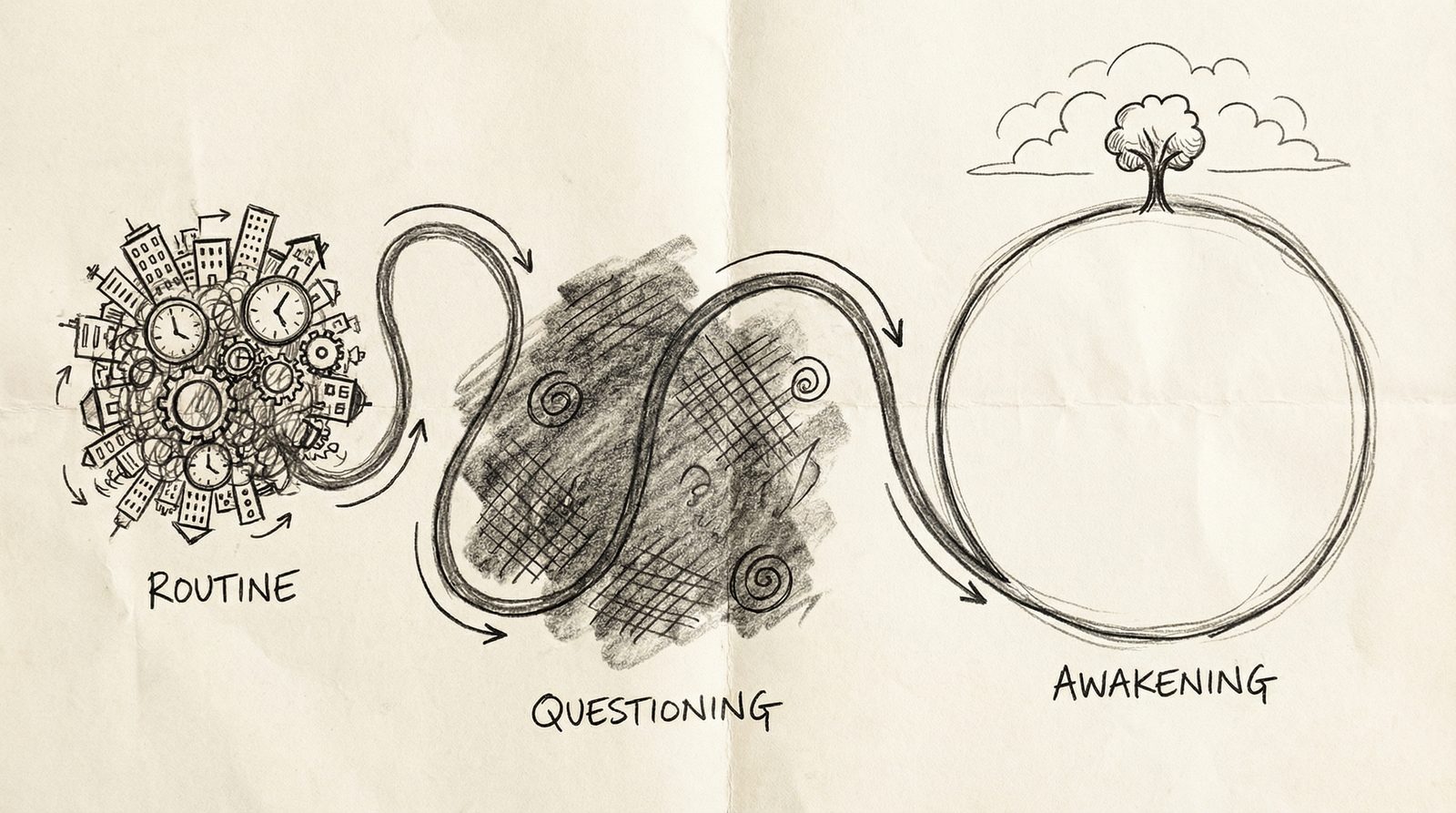
    Spiritual Awakening is the motif where a character’s interpretive frame breaks and re-forms. The person who could previously live on routine, status, or habit begins to perceive meaning, pattern, or selfhood differently. The story treats this shift as real change, not a cosmetic mood swing. What matters is not adopting a label or joining a religion, but the reorganization of attention, value, and identity.

    In awakening narratives, the protagonist often begins inside a life that “works” externally but fails internally. They may chase achievement, romance, or control and discover it does not answer the underlying question of purpose. The plot then follows the conversion process: a new vocabulary for reality appears, the character tests it, and their old identity starts to fail under the new pressure.

    Books such as The Celestine Prophecy, The Tenth Insight, The Alchemist, Way Of The Peaceful Warrior, and Siddhartha are classic examples. The “event” is internal: perception shifts, and that shift changes what the same world means.


    HOW IT WORKS IN STORIES

    Spiritual Awakening usually begins with an existential breach. The character feels restless, stuck, or out of place in a life that looks fine from the outside. A promotion feels hollow, a relationship stops fitting, or a loss cracks certainty. The important point is structural: the old worldview stops functioning as a complete explanation.

    Next, a threshold event provides a new interpretive system. This can be a guide figure, a text, a vision, or a sequence of “coincidences” that the character begins to treat as communication. In The Celestine Prophecy and The Tenth Insight, the engine is sequential insights delivered through encounters that mix guidance with risk. In The Alchemist, a dream and a meeting function as permission to leave the old life and treat omens as navigational data. In Way Of The Peaceful Warrior, a teacher figure reframes discipline and attention as a daily practice rather than an abstract belief.

    The middle phase is testing and attrition. The character tries new practices, interpretations, and choices, then pays the cost of inconsistency. Old identities fall away faster than new ones stabilize. A “dark night” phase is common: the character feels more lost than before because certainty has collapsed but insight is still incomplete.

    Resolution is usually a return to ordinary life with a changed relationship to it. Work, love, and struggle remain, but they are held inside a wider frame. The story closes when the character can sustain the new perception without needing constant signs or external validation.


    Editorial illustration inspired by 'Spiritual Awakening'

    EMOTIONAL EFFECT ON THE READER

    This motif is built to feel personal. The reader is invited to project their own restlessness onto the protagonist’s shift, using the character as a safe container for questions about meaning, purpose, and identity.

    It often produces a “synchronicity high” in the reading experience. The plot rewards attention by making small events feel linked: a conversation, a symbol, or a coincidence lands as guidance rather than noise. That can feel reassuring, because it implies the world is readable.

    The cost is loss. Awakening narratives usually require the character to abandon a comforting interpretation of their life. Relationships strain, identity becomes unstable, and certainty is traded for a framework that is truer but harder to live inside.

    When the motif works, the after-effect is practical rather than sentimental. The reader finishes with heightened awareness of attention itself: what they ignore, what they treat as “just life,” and what patterns they might be using to avoid change.


    Symbolic illustration inspired by 'Spiritual Awakening'

    VARIATIONS & RELATED MOTIFS

    Spiritual Awakening appears in several common variations. The solitary seeker version follows a character cycling through teachers and lifestyles until a stable insight forms, as in Siddhartha. The reluctant mystic version forces awakening through crisis or loss, where the character resists the new frame until resistance becomes impossible. Another variation frames awakening as part of a larger system of human evolution, expanding the personal shift into a collective one, as in the Redfield sequence.

    The motif also has practical variants, where the new awareness is tested in daily routine rather than on mountaintops. Here, the story cares less about visions and more about whether the character can keep behaving differently when the world remains the same.

    This motif commonly overlaps with Synchronicity And Meaningful Coincidence, because meaning is delivered through “pattern recognition” in events. It also pairs naturally with Spiritual Pilgrimage and Inner Journey, where travel or reflection supplies the friction that forces change.

  • Inner Journey

    Inner Journey

    DEFINITION & CORE IDEA

    The Inner Journey motif is about a character whose most important travel happens inside their own mind and heart. The outside world can be busy, dangerous, or beautiful, but the core story is the shift in how this person understands themselves, other people, or reality itself. In Siddhartha, the river, the city, and the forest matter, but the real movement is the protagonist’s changing sense of identity and meaning.

    Writers use the Inner Journey to examine belief, self-concept, and value. The plot might involve travel, romance, work, or crisis, but events function as mirrors: the character encounters situations that reveal what they avoid, what they rationalize, and what they cannot keep pretending.

    This motif often includes reflection, doubt, and contradiction. A character may be pulled between comfort and risk, duty and desire, faith and skepticism. Works such as Zen And The Art Of Motorcycle Maintenance and Demian use daily life, travel, and relationships as the surface action while the real stakes remain internal: whether the character can become honest with themselves.


    HOW IT WORKS IN STORIES

    The Inner Journey usually starts with a fracture of self. The character feels that something is off: success feels empty, a relationship feels misaligned, grief breaks old habits, or a change exposes how little their previous identity can hold. This discomfort becomes the trigger for looking inward.

    Writers often pair the Inner Journey with an outer journey so the reader has concrete scenes to track. In Zen And The Art Of Motorcycle Maintenance, the road trip gives shape to a philosophical search. In Siddhartha, distinct stages of life function as stages of internal change. The external plot provides milestones, but the turning points happen in private moments where the character’s interpretation of the world shifts.

    Structurally, the Inner Journey often moves through cycles of hope, confusion, and partial clarity. The character tries on beliefs or identities, then discovers their limits. They may swing between extremes, such as total freedom and heavy responsibility, intense longing and cool detachment, spiritual devotion and cynical withdrawal. The story tracks how those opposites are integrated into something more stable.

    Small details carry a lot of weight. A recurring object, repeated phrase, or familiar setting can show internal movement without a dramatic plot beat. The same kitchen table or street appears early and late, but it reads differently because the person looking at it has changed. The ending can be quiet, with no grand victory, yet the inner landscape is measurably transformed.


    Editorial illustration inspired by 'Inner Journey'

    EMOTIONAL EFFECT ON THE READER

    Inner Journey stories create recognition rather than suspense. The reader is invited into the space where the character stops lying to themselves. That can feel intimate and uncomfortable, because the questions the character cannot avoid are often questions the reader recognizes.

    The mood is often reflective. Even when events are dramatic, the narrative keeps returning to interpretation: what does this mean, and what does it reveal about who I am? The emotional intensity comes less from plot twists than from the slow accumulation of self-knowledge.

    These stories also create a specific kind of tension: the character may refuse closure. Instead of giving a clean answer, the narrative shows the cost of uncertainty and the cost of certainty, and asks the reader to sit with the same unresolved pressure.

    When the motif works, the after-effect is practical. The reader leaves with a sharper awareness of how a person’s internal frame can change what the same world means. The story does not just entertain; it reorients.


    Symbolic illustration inspired by 'Inner Journey'

    VARIATIONS & RELATED MOTIFS

    The Inner Journey appears in multiple genres. In coming-of-age stories, it is a search for identity and separation from inherited scripts. In spiritual narratives, the focus is on insight, faith, or a direct experience of the sacred. In midlife and late-life stories, the inner journey becomes reevaluation: regret, responsibility, and the attempt to make peace with the person one has been.

    Some versions are explicitly philosophical, using dialogue, essays, or long conversations to argue ideas. Others stay close to daily routine, showing inner change through small acts, habits, and repetitions. The pace can be slow and reflective, or tense, especially when the character’s developing self clashes with obligations and old roles.

    This motif often overlaps with Spiritual Awakening and Spiritual Pilgrimage, where external movement supplies the friction needed for internal change. It also pairs naturally with Intimacy as Healing, where a relationship becomes the mirror that forces honesty and makes transformation possible.

  • Personal Legend And Destiny

    Personal Legend And Destiny

    DEFINITION & CORE IDEA

    Personal Legend And Destiny is the motif where a character believes there is a specific path, mission, or role that is uniquely theirs. It is not ordinary ambition. The calling is treated as a teleological claim: the character’s life has a “correct” direction, and the plot measures whether they recognize it and commit when commitment demands sacrifice.

    In The Alchemist, Paulo Coelho makes the idea explicit, turning “Personal Legend” into a named rule of the story’s world. The same structure appears in quieter forms as well. A character is pulled toward a vocation, an art, or a responsibility they cannot fully explain, and every attempt to live safely produces restlessness rather than relief.

    Writers use this motif to give everyday choices narrative gravity. Changing jobs, leaving home, or refusing a stable life becomes more than preference. It becomes alignment or refusal. The story is the argument between the calling and everything that pressures the character to compromise, delay, or shrink it into something acceptable.


    HOW IT WORKS IN STORIES

    The motif usually begins with restlessness. The character feels out of place. Their job, hometown, and relationships feel deadening or ill-fitting. This discomfort is treated as signal, not mood. The story often externalizes it through signs, recurring dreams, prophecies, or chance encounters that the character reads as communication rather than coincidence.

    Then comes the call to action. A letter arrives, a stranger offers an opportunity, or a crisis forces a choice. Saying yes usually means leaving comfort and social approval behind. Saying no may preserve stability in the short term, but the narrative increases the cost of refusal until staying becomes its own form of loss.

    As the character moves toward the calling, they meet helpers and tempters. Mentors, spiritual guides, and friends validate the direction and offer methods. Opposing them are institutions and relationships that reward safety. The motif thrives on the tug-of-war between the mythic pressure to pursue the irrational calling and the social pressure to remain “reasonable.”

    Structurally, this motif often maps onto a journey. Sometimes that journey is literal travel; sometimes it is an inner program of practice, work, or discipline. The character advances, loses faith, is tempted to accept a smaller dream, and then faces a point of no return where compromise becomes a defining choice.

    By the end, the story usually resolves through alignment or refusal. Either the character commits to the calling and accepts the cost, or they choose safety and live with the residue of what was not attempted. The motif’s claim is not that destiny is guaranteed. It is that destiny demands a decision.


    Editorial illustration inspired by 'Personal Legend And Destiny'

    EMOTIONAL EFFECT ON THE READER

    This motif targets the fear of insignificance. It offers a counter-claim: that a specific life can have a readable direction. The reader is invited to measure their own choices against the character’s willingness to commit.

    The unease comes from sunk cost. The story forces a private inventory of missed exits and deferred risks. Even optimistic versions create pressure because they imply that safety is not neutral; it is a decision with consequences.

    When the character chooses alignment, the reader often feels relief mixed with grief for what was sacrificed. When the character refuses, the emotion is quieter and sharper: the sense of a life narrowing, not through tragedy, but through avoidance.


    Symbolic illustration inspired by 'Personal Legend And Destiny'

    VARIATIONS & RELATED MOTIFS

    In allegorical or spiritual stories, the calling is framed as a cosmic assignment, and coincidence is treated as guidance. In grounded fiction, the same structure is reframed as authenticity without supernatural endorsement, with the “signs” replaced by pattern recognition and self-knowledge.

    One variation treats destiny as burden. The character is named “chosen” early, and the conflict becomes whether the script is theirs or someone else’s. Another variation delays recognition until late life, where the calling is discovered after years of compromise, turning the motif into a reckoning rather than a quest.

    This motif often overlaps with Spiritual Pilgrimage and Synchronicity and Meaningful Coincidence, since both motifs rely on the idea that events can be read as communication. It also pairs naturally with coming-of-age and redemption arcs, where the calling functions as a test of identity.

    In darker uses, the “destiny” can be misread or weaponized. The character follows the wrong calling, or a true calling arrives too late to be lived cleanly. The story then becomes a warning about interpretation rather than a promise about fulfillment.

  • Spiritual Pilgrimage

    Spiritual Pilgrimage

    DEFINITION & CORE IDEA

    A Spiritual Pilgrimage is a journey narrative where the stated destination is secondary to internal change. The protagonist may travel to a sacred site, follow a prophecy, or chase a promised revelation, but the journey functions as a structured sequence of tests designed to produce belief change, moral recalibration, or a new self-concept. The road is not backdrop. It is the mechanism.

    Stories like The Pilgrimage, The Alchemist, Siddhartha, and The Celestine Prophecy use travel as a didactic structure. Encounters are not random. Each guide, stranger, or obstacle is positioned to challenge a specific assumption and force a decision. The motif is built to convert movement into meaning through repeated, concrete choices.

    At its core, a Spiritual Pilgrimage treats geography as allegory. Terrain and logistics mirror internal states. A detour becomes a correction, a delay becomes a test of attachment, and reaching the destination often reveals that the “goal” was a sustaining pretext for transformation. The real arrival is a changed interpretive frame, not a point on a map.


    HOW IT WORKS IN STORIES

    The trigger is usually a sense of lack. The protagonist begins with spiritual numbness, restlessness, grief, or moral confusion. A call to travel appears, and the character steps away from familiar structures into uncertainty. This transition matters because the motif requires removal from the old context before the belief system can be tested.

    The journey then unfolds as iterative lessons. In The Pilgrimage and The Alchemist, the road is populated with omens, mentors, and small reversals that challenge the hero’s assumptions about success and failure. In Siddhartha, the river functions as a persistent teacher, reshaping the protagonist’s understanding of time, suffering, and enlightenment. The Celestine Prophecy builds its arc around sequential “insights” delivered through encounters that mix guidance with threat.

    Obstacles are rarely only physical. Hunger, fatigue, getting lost, and missed connections work on two tracks at once: logistics and revelation. A storm can be a crisis of faith. A wrong turn can be a confrontation with ego. Temptations to stop often arrive as comfort—safety, certainty, and social approval—so continuing becomes a deliberate act of change rather than mere endurance.

    The end state is usually “quiet arrival.” The protagonist may return home with altered perception, or reach the destination and discover it matters less than the internal shift already achieved. The motif closes by demonstrating integration: a new interpretive frame that changes how the character reads the same world.

    Writers use Spiritual Pilgrimage because it keeps philosophy grounded in events. Instead of abstract debate, the story forces ideas to survive contact with heat, fear, hunger, misunderstanding, and human inconsistency. The road supplies friction. Friction produces the change.


    Editorial illustration inspired by 'Spiritual Pilgrimage'

    EMOTIONAL EFFECT ON THE READER

    This motif invites projection. The reader maps personal uncertainty onto the pilgrim’s movement, using the journey as a safe container for questions about meaning, faith, and purpose.

    The emotional arc typically moves through three phases. First, resistance or naivety, where the pilgrim overestimates the literal goal. Second, a “dark night” phase, where the journey fails to deliver easy answers and the protagonist confronts doubt, fatigue, and disillusionment. Third, integration, where relief arrives not through conquest but through acceptance and clarity.

    Even in optimistic versions, the motif carries a controlled unease. It implies that comfort and certainty are often incompatible with change. In harsher variants, the pilgrimage can feel like attrition, where the lesson is not illumination but endurance. In either case, the payoff is the same: the reader finishes with a sharper sense of what the character is willing to become.


    Symbolic illustration inspired by 'Spiritual Pilgrimage'

    VARIATIONS & RELATED MOTIFS

    A Spiritual Pilgrimage can be overtly religious, centered on shrines, relics, or monasteries, or it can be framed as a secular search for meaning. Some stories emphasize discipline and deprivation, where the road is a controlled program of hardship. Others emphasize interpretation, where coincidences, symbols, and mentors form a readable pattern across the landscape.

    One common variation is the reluctant pilgrim, dragged into travel by circumstance and changed despite resistance. Another is the failed pilgrimage, where the character reaches the physical goal but refuses the internal shift, producing a bitter or ironic ending. Group pilgrimages expand the motif into social dynamics, using the shared road to expose competing belief systems.

    This motif often overlaps with Personal Legend And Destiny, where the journey outward is tied to the idea that each person has a unique path they are meant to recognize and commit to. It also connects naturally to motifs about mentors and guides, prophetic dreams, and the idea that “home” must be left in order to be understood.

    It can also be questioned or subverted. Some stories show how easily tourism can be mistaken for transformation, or how spiritual language can become a substitute for the harder work of change. Even then, the structural tension remains: the road tests what the character believes, and what they are willing to become.

  • Eastwest Philosophical Synthesis

    Eastwest Philosophical Synthesis

    DEFINITION & CORE IDEA

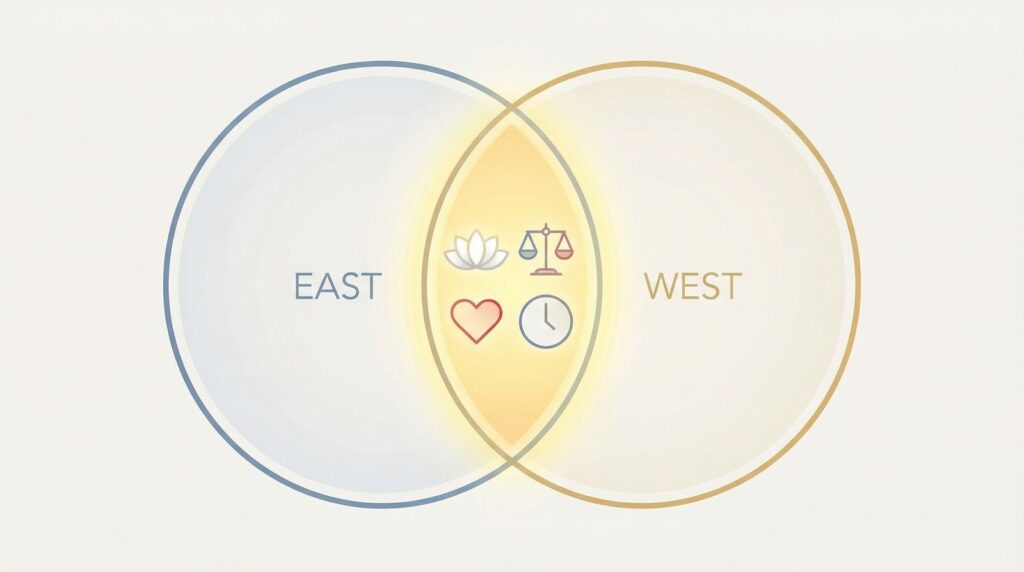
    East-West Philosophical Synthesis is a motif in which Eastern and Western ideas about life, morality, and meaning are brought into direct conversation and gradually woven together. Instead of treating East and West as fixed or exotic opposites, stories using this motif allow characters to test Buddhist detachment against capitalist ambition, Confucian duty against individual freedom, or Western rationalism against mystical insight. The point is not that one side wins, but that both are altered through sustained contact.

    In practice, East-West Philosophical Synthesis often appears when a character moves between cultures, studies within a foreign tradition, or grows up inside a mixed philosophical inheritance. They might try to apply meditation and non-attachment to modern work pressure, or use Western psychology to interpret karma, desire, and rebirth. The narrative becomes a kind of laboratory where everyday problems like love, family, work, and grief are approached using tools drawn from more than one civilizational story about what humans are and what they owe each other.

    This motif is especially visible in modern spiritual literature that seeks to translate non-Western traditions into a language accessible to contemporary readers. In Zen and the Art of Motorcycle Maintenance: An Inquiry Into Values, Robert M. Pirsig uses the act of motorcycle maintenance as a bridge between Eastern ideas of presence and Western rational analysis. Quality becomes not a technical metric but a lived experience, discovered through attention rather than theory.

    Editorial illustration inspired by 'Eastwest Philosophical Synthesis'

    HOW IT WORKS IN STORIES

    East-West Philosophical Synthesis usually begins with contact, and early scenes often highlight misunderstanding. A Western-trained professional dismisses traditional practices as superstition. A spiritual teacher views Western self-focus as indulgent. A child of immigrants is told to follow their heart at school while being expected to honor the family at home.

    The story then develops situations where neither a purely Eastern nor a purely Western response feels sufficient. A character raised on individualism may find relief in ideas of interdependence and community. Someone taught to suppress desire for the sake of harmony may discover that Western concepts of boundaries and selfhood provide tools for resistance. Tensions such as fate versus free will, duty versus authenticity, and mind versus body are reopened through lived consequence.

    Over time, the motif shifts from argument to experiment. Characters begin trying hybrid approaches, often clumsily. The synthesis is rarely elegant. It involves compromise, partial misunderstanding, and moments of recognition where a character realizes they have simplified a deep tradition into something more convenient than true.

    Some stories lean toward philosophical rigor, as in the inward journeys of Hermann Hesse. Others move toward accessible spiritual narrative. In Way of the Peaceful Warrior, Eastern ideas of discipline and presence are filtered through a distinctly Western self-help structure, emphasizing personal transformation over metaphysical coherence.

    Symbolic illustration inspired by 'Eastwest Philosophical Synthesis'
    Symbolic illustration inspired by ‘Eastwest Philosophical Synthesis’

    EMOTIONAL EFFECT ON THE READER

    Reading a story shaped by East-West Philosophical Synthesis often feels like sitting in on a long, intimate conversation about how to live. There is pleasure in seeing familiar ideas reframed, where spiritual concepts become practical tools and everyday decisions become moral experiments.

    The motif can also be unsettling. It invites readers to notice how much of their moral intuition is inherited rather than chosen. When characters sincerely try practices drawn from outside their native culture, the reader is asked to imagine doing the same, feeling both curiosity and resistance.

    At its most effective, the motif produces a sense of widened possibility. Cultures are not treated as sealed containers but as living systems capable of dialogue and change. Even when the synthesis fails or remains incomplete, the effort itself carries meaning.


    VARIATIONS & RELATED MOTIFS

    East-West Philosophical Synthesis appears in several distinct modes. In literary fiction, it often takes the form of a demanding inner journey, as in Siddhartha and Demian, where spiritual insight must be earned through suffering and self-confrontation. In popular spiritual fiction, the synthesis becomes more approachable but also more ambiguous.

    In The Celestine Prophecy and The Tenth Insight, James Redfield presents a New Age-inflected synthesis, where Eastern concepts of energy and synchronicity are adapted to Western narrative expectations of clarity, progress, and personal destiny. The result is less philosophically rigorous than Pirsig or Hesse, but emotionally accessible to a broad audience.

    Across these variations, the core remains the same. East-West Philosophical Synthesis is about what happens when different civilizational accounts of meaning, duty, and selfhood are forced to coexist within a single human life.

  • The Tenth Insight (1996)

    The Tenth Insight (1996)

    INTRODUCTION

    The Tenth Insight (1996) by James Redfield
    Spiritual fiction · 236 pages · United States


    The Tenth Insight arrives as both sequel and escalation. Where The Celestine Prophecy moved through Peruvian jungle myth and social tension, this book shifts into a colder, more haunted register. Much of it unfolds in a remote Appalachian valley where fog, ruined cabins, and forgotten logging roads create a mood of unfinished business.

    The emotional tone is hushed urgency. The novel insists that private choices carry historical weight, that a personal awakening can brush against war memory, corporate greed, and environmental collapse. Redfield is not subtle about his intention. This is not conventional fiction so much as a spiritual field report disguised as an adventure story. It asks the reader to treat intuition as seriously as physical survival.

    PLOT & THEMES

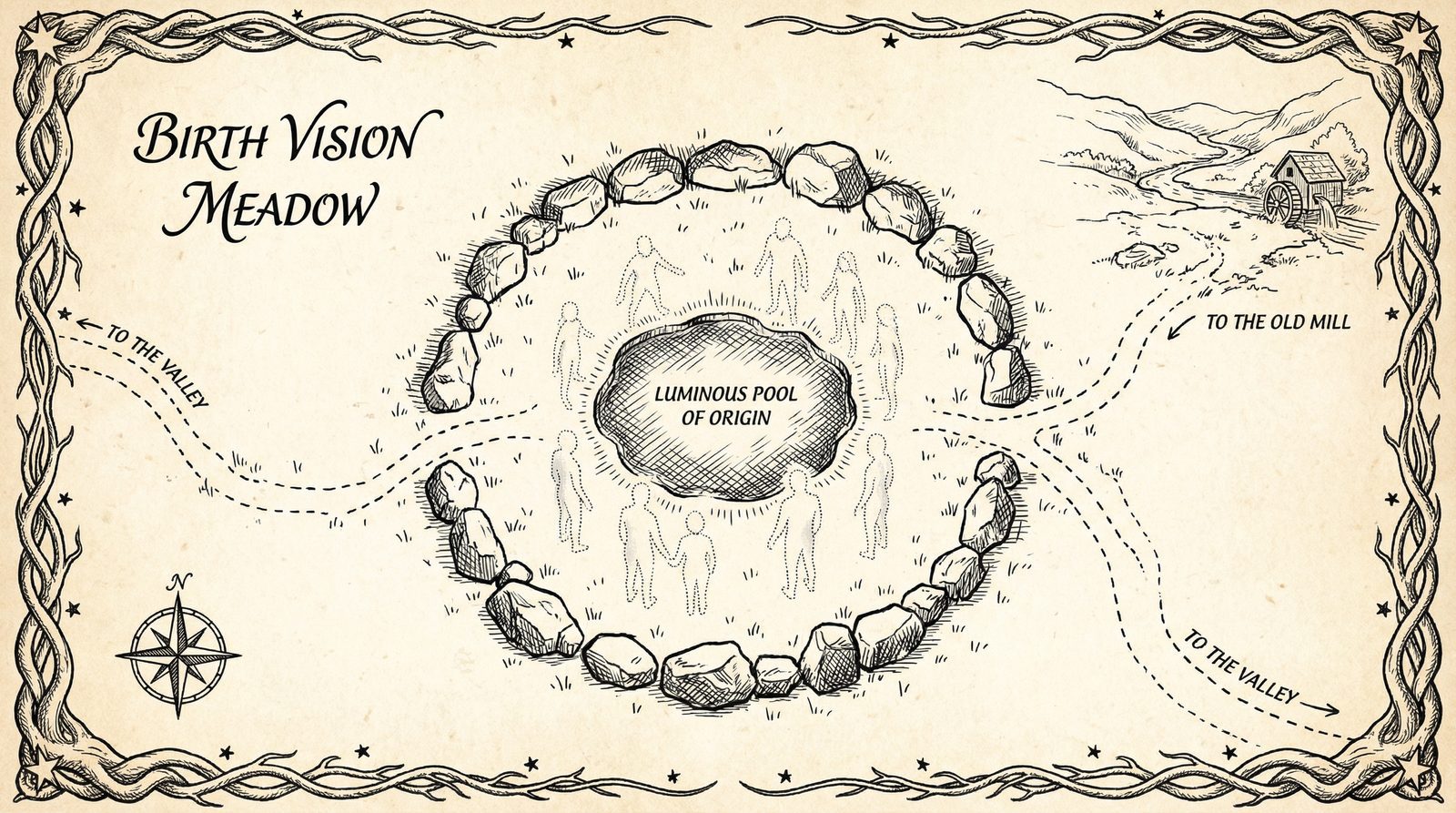
    The story begins when the unnamed narrator returns to the valley from the earlier book, searching for his missing friend Charlene. The setting is presented as a liminal zone where physical and spiritual realities overlap. He encounters Feyman, a young boy with fragmented memories of a pre-birth vision, and Wil, a bitter war veteran trapped in a kind of spiritual numbness.

    The quest structure is straightforward. The narrator follows clues through the valley, meets guides who clarify the metaphysics, and repeatedly crosses into altered states where memory and spirit become tangible. What matters is less the suspense than the framework the book builds: life is not random, suffering is not meaningless, and fear distorts the intentions we supposedly chose before we arrived.

    The central idea is the “birth vision”: the notion that souls choose parents, challenges, and historical eras before incarnation. Through life reviews and glimpses of an afterlife dimension, the narrator witnesses souls preparing for their lives and then watching how those intentions are warped by anxiety, resentment, and control dramas once embodied. The metaphysics are explicit. Redfield wants the reader to see personal psychology and social crisis as part of the same energetic chain.

    That chain is anchored to something concrete. The valley is threatened by an energy project tied to corporate interests, linking spiritual stakes to environmental activism. The climax is not an abstract “ascension” but a confrontation with fear itself. Charlene is found at the edge of leaving life behind, and the resolution hinges on recommitment: choosing to stay incarnate, to keep working inside the imperfect world rather than escaping it.

    Like the earlier book, the novel suggests humanity is on a threshold. But it refuses a clean apocalypse or a clean salvation. The future remains open. The point is practice, not fireworks.

    PROSE & NARRATIVE STRUCTURE

    Redfield’s prose is functional and deliberately geared toward instruction. Action scenes often pause so a guide figure can explain the mechanics of synchronicity, soul memory, and the energetic consequences of fear. It can feel schematic, but the clarity matches the book’s purpose. It wants to be applied, not merely admired.

    Structurally, the novel alternates between physical movement through the valley and excursions into an afterlife dimension. Transitions are triggered by attention and bodily sensation: a chill, pressure in the forehead, a sudden pull toward a memory. These shifts are abrupt on the page, yet they are designed to normalize the book’s premise that boundaries between worlds are thin.

    The most effective passages are the panoramic “world vision” sequences, where the narrator sees human history as a field shaped by collective intention. Industry, war, and ecological collapse are framed as outcomes of accumulated fear. Whether you accept that claim or not, the structure briefly clicks into place. The metaphysical scenes are not escapist fantasies. They are Redfield’s way of forcing moral responsibility onto the reader.

    When the language lands, it does so through simple sensory hooks: light rising from the valley floor, resentment described as a sticky grey aura, trauma replaying like a looped film. The book’s strongest instinct is always the same: abstract belief must be given a texture you can picture.

    Conceptual editorial illustration inspired by 'The Tenth Insight'

    CHARACTERS & INTERIORITY

    Characterization is intentionally archetypal. The narrator is defined less by biography than by openness to guidance. Charlene is the resistant seeker, intellectually skeptical but intuitively sensitive. Wil embodies unresolved war trauma, a man whose fear and guilt have hardened into a spiritual paralysis.

    The minor characters do much of the emotional work. Feyman’s insistence that he chose his troubled father gives the metaphysics a raw edge, because it drags the theory into the realm of family pain. Several figures who first appear as obstacles or officials gradually reveal their own half-conscious connection to the valley’s larger pattern.

    Interior life is mostly handled through shared visions rather than subtle psychological shading. When the narrator is pulled into another person’s memory, we are literally inside their fear. This can flatten nuance, with trauma sometimes “resolved” quickly by a single insight. Still, the method is consistent with the book’s claim that consciousness is not private property. The emotional through-line is fear turning into responsibility, and responsibility turning into recommitment.

    LEGACY & RECEPTION

    Published after the runaway success of The Celestine Prophecy, this sequel appealed most to readers who wanted more cosmology and less jungle chase. Some embraced the expansion into pre-birth planning, soul groups, and collective intention. Others found the didactic dialogue heavy and the characters too thin to carry the metaphysical weight.

    Its most durable contribution is the popularization of the “birth vision” idea and its linkage to social change. The book frames environmental activism and historical responsibility as spiritual tasks, not political hobbies. Whether one reads that as inspiring or simplistic, it explains why the novel has stayed alive as a hopeful myth: not transcendence as escape, but awakening as a reason to stay.

    IS IT WORTH READING?

    It is worth reading if you are open to narrative as a vehicle for metaphysical speculation. As a novel, it is uneven. As a framework, it is unusually coherent for the genre. The Appalachian setting gives the ideas physical grounding, and the war memory material adds a darker emotional register than the first book.

    If you want deep character realism, look elsewhere. If you want a story that asks, with complete seriousness, why you might have chosen this life, this era, and these fears, the book still has force.

    Illustration inspired by a core idea from 'The Tenth Insight'

    TRIVIA & AUTHOR FACTS

    Redfield wrote this novel after the unexpected commercial success of his earlier spiritual adventure, leaning more openly into his background in counseling and his interest in both Eastern and Western mysticism. Many of the concepts here, especially soul groups and pre-birth planning, were also discussed in workshops and reader circles around the first book.

    Some editions include the subtitle “Holding the Vision,” which reflects the book’s emphasis on collective focus as a driver of outcomes. The “control drama” concept introduced earlier returns in expanded form, pushed into an explicitly spiritual dimension where fear takes on a more literal, confrontable shape.

    SIMILAR BOOKS

    If this blend of spiritual instruction and story appeals to you, consider Siddhartha for a more literary meditation on awakening, Jonathan Livingston Seagull for a compressed fable of self-mastery, or The Alchemist for a symbolic, parable-style exploration of omens and purpose. Each treats inner experience as a force that shapes outward life, even when their tones and ambitions differ.

    DISCOVERABILITY & LINKS

  • Craftsmanship And Quality Of Work

    Craftsmanship And Quality Of Work

    DEFINITION & CORE IDEA

    “Craftsmanship And Quality Of Work” is the motif where the way a character performs their work becomes a direct expression of their inner life. It is not simply about employment or productivity. The focus is on care, precision, pride, and the satisfaction of doing something properly, even when no one is watching. Whether the task is tuning an engine, preparing a meal, writing software, or shaping wood, the work itself carries moral weight.

    Stories built around this motif slow down and pay attention to process. In Zen And The Art Of Motorcycle Maintenance: An Inquiry Into Values (1974), motorcycle maintenance becomes a way of examining “Quality” as something experienced rather than defined. In Lila: An Inquiry Into Morals (1991), that concern expands into ethics and social life, still grounded in the idea that values are revealed through attention and care.

    At its core, this motif treats work as a moral and emotional discipline. It asks where standards come from, how they are practiced, and what is lost when integrity collides with systems that reward speed, scale, or convenience.


    HOW IT WORKS IN STORIES

    Craftsmanship And Quality Of Work usually appears through the rhythms of daily labor. Writers linger on routines: opening a workspace each morning, laying out tools, repeating movements until they become instinctive, inspecting the final result with quiet seriousness. The story may not be overtly “about” the job, but the way the work is done reveals character more clearly than dialogue alone.

    Sometimes the work itself becomes the teacher. In Shop Class As Soulcraft: An Inquiry Into The Value Of Work (2009), written by Matthew B. Crawford, manual problem-solving is framed as intellectually demanding and ethically grounding. Stories echo this idea when characters develop patience, humility, or self-respect through repeated, concrete tasks. A flawed repair or failed attempt is not just a setback, but a test of standards.

    Conflict often enters when the surrounding world does not value quality in the same way. A supervisor pushes for speed over care, a system rewards shortcuts, or customers demand something cheap and disposable. The character must decide whether to compromise, resist, or walk away. That decision becomes a clear statement of identity.

    This motif allows writers to make abstract ideas tangible. In the work of Robert M. Pirsig, the road, the machine, and the act of maintenance become tools for thinking about attention, rationality, and lived experience. Meaning is not explained. It is encountered through effort, failure, and care.

    Even in intimate or domestic narratives, the motif shapes relationships. A parent teaching a child a careful technique, or a mentor guiding an apprentice, passes on more than skill. They transmit a way of engaging with the world that can become a form of trust or love.


    EMOTIONAL EFFECT ON THE READER

    Stories shaped by this motif often feel grounding. There is comfort in watching someone care deeply about what they are doing, especially in a culture that feels rushed and disposable. Attention to tools, textures, and small decisions can be quietly absorbing.

    At the same time, the motif can provoke sadness or anger. When care is dismissed or punished, the loss feels personal. Stories about disappearing skills or neglected standards often carry a sense of dignity under threat.

    For many readers, this motif turns inward. It encourages reflection on everyday effort and responsibility. The question it raises is simple but unsettling: where does quality still matter in your own life, and what does it cost to protect it?

    There is also intimacy in this focus. Watching a character work carefully is like watching them unguarded. Habits and rituals reveal who they are when performance drops away, making later choices feel heavier and more personal.


    VARIATIONS & RELATED MOTIFS

    Craftsmanship And Quality Of Work takes many forms. In some stories, it centers on manual trades. In others, the craft is intellectual or emotional, such as teaching, caregiving, or programming. What unites them is the same pattern: the character treats their work as something deserving of attention, and their sense of self is bound to doing it properly.

    A common variation is the “lost craft” narrative, where older ways of working are disappearing. Another focuses on the collision between personal standards and impersonal systems, where care is labeled inefficient or excessive.

    This motif often pairs with Eastwest Philosophical Synthesis. In Pirsig’s writing, the road and the act of maintenance bridge Western analysis and Eastern presence. In Crawford’s work, the workshop becomes a site of moral clarity. Different settings, the same question: how should attention be lived?

    Across its variations, the motif returns to a single concern: when people invest genuine care in their work, how does that shape who they become?

  • Infrastructure as Memory

    Infrastructure as Memory

    Infrastructure as Memory is the idea that pipes, databases, URL structures, and file formats remember things long after people forget them. The web is often described as ephemeral, but its infrastructure quietly preserves whole eras in its seams and error logs.

    When we rebooted AllReaders, we discovered this firsthand. Our revived server started receiving traffic shaped by old .asp URLs, legacy TopicIDs, and ancient hyperlinks buried in catalogues. The living memory of past readers and reviewers had faded, but the infrastructure still knew where they had been.

    What this motif captures

    This motif looks past the visible interface — the homepage, the logo, the modern CSS — and focuses on what survives under the surface. Infrastructure as Memory is about:

    • Database schemas that encode old taxonomies and assumptions.
    • Hard-coded links that point to vanished systems.
    • API responses, log files, and backups that preserve forgotten interactions.
    • Legacy code paths that still fire for obscure edge cases.

    It overlaps heavily with Digital Ghosts, but zooms out: instead of focusing on one person’s lingering presence, it treats the entire infrastructure as a layered historical record.

    Infrastructure as Memory inline concept image

    How it shows up in stories and systems

    In books and films, Infrastructure as Memory appears when:

    • Old archives or databases reveal patterns nobody alive remembered.
    • Maintenance workers, librarians, or sysadmins become historians by accident.
    • Forgotten city plans, network maps, or backend logs explain a present-day mystery.
    • A character “reads” a system (subway lines, drainage tunnels, server racks) the way others read a library.

    On the web, you see it in:

    • Obsolete URLs still embedded in code and external sites.
    • Legacy field names in APIs that reference long-dead products.
    • Log formats that haven’t changed in decades because too many tools depend on them.
    • Old genre labels and internal TopicIDs that shape how search works even after the UI moves on.

    In AllReaders’ case, our old TopicIDs and reviewer profile paths still live inside library records and publisher feeds. They are part of how mid-list fiction from the 2000s is remembered, even when the visible pages are gone or replaced by tributes like our Harriet Klausner essay.

    Infrastructure as Memory inline diagram image

    Why it matters for AllReaders

    We treat Infrastructure as Memory as both a motif for books and a design principle for the site. It shapes questions like:

    • Which legacy URLs should we preserve or redirect with care?
    • How do we document our own schemas so future editors can understand why they exist?
    • Which old structures deserve a “plaque” explaining what they used to do?

    When we add this motif to a book or creator page, we’re signaling that infrastructure — not just characters and plot — plays a key role in how memory works in that story. It’s especially relevant for archives, libraries, bureaucracies, and any narrative where the past is discovered through systems, not just through people talking.

    Related motifs