
Feel: Meditative

  • Easy Rider (2012)

    Easy Rider (2012)

    Easy Rider (2012) directed by James Benning. Experimental · 97 minutes · United States.


    INTRODUCTION

    James Benning’s Easy Rider (2012) is not a remake so much as a séance. He revisits locations associated with Dennis Hopper’s 1969 Easy Rider, strips away the bikers, the drugs, the road-movie chatter, and leaves only landscapes and ambient sound. The result feels patient, haunted, and quietly confrontational. Where the original surfed countercultural velocity, Benning lingers on what remains after the dream drains away.

    The film sits somewhere between gallery installation and cinema, asking viewers to meet it halfway and supply memory as context. If Hopper’s film was about forward motion, this one is about staying put and listening. The American West appears as both a physical place and a faded idea. It becomes a road movie without a road, an anti-spectacle about looking, duration, and the afterlife of myth.

    PLOT & THEMES

    There is almost no plot in Easy Rider (2012). The “story” is a sequence of fixed shots filmed at or near locations connected to the 1969 film’s itinerary. Where Hopper followed charismatic outsiders on a doomed cross-country trip, Benning removes character and incident but keeps the route as an invisible skeleton. The narrative becomes whatever the viewer remembers, projects, or resists.

    The core themes are memory, the American Dream, and the erosion of counterculture. By revisiting these sites decades later, Benning invites us to measure the distance between a 1960s fantasy of freedom and a present shaped by highways, strip malls, and fenced-off land. The “open road” is no longer pure symbol. It’s infrastructure, habit, and noise.

    Another strong motif is ghostly absence. Benning never shows the 1969 Easy Rider directly, yet its ghosts hover over every frame. The film functions like a palimpsest: we see the present landscape while mentally overlaying earlier scenes and cultural memory. The mood is meditative rather than nostalgic, with a faint ache underneath the calm surfaces. It’s less about rebellion than about what rebellion leaves behind.

    CINEMATIC TECHNIQUE & AESTHETICS

    Formally, Easy Rider (2012) is built from long takes and static framing. Each location is held for an extended duration with the camera locked off. This durational approach forces a different rhythm of attention. Instead of cutting to guide the viewer, Benning lets small details emerge over time: a shift in light, a passing car, wind in scrub, or the slow realization that “nothing happening” is the point.

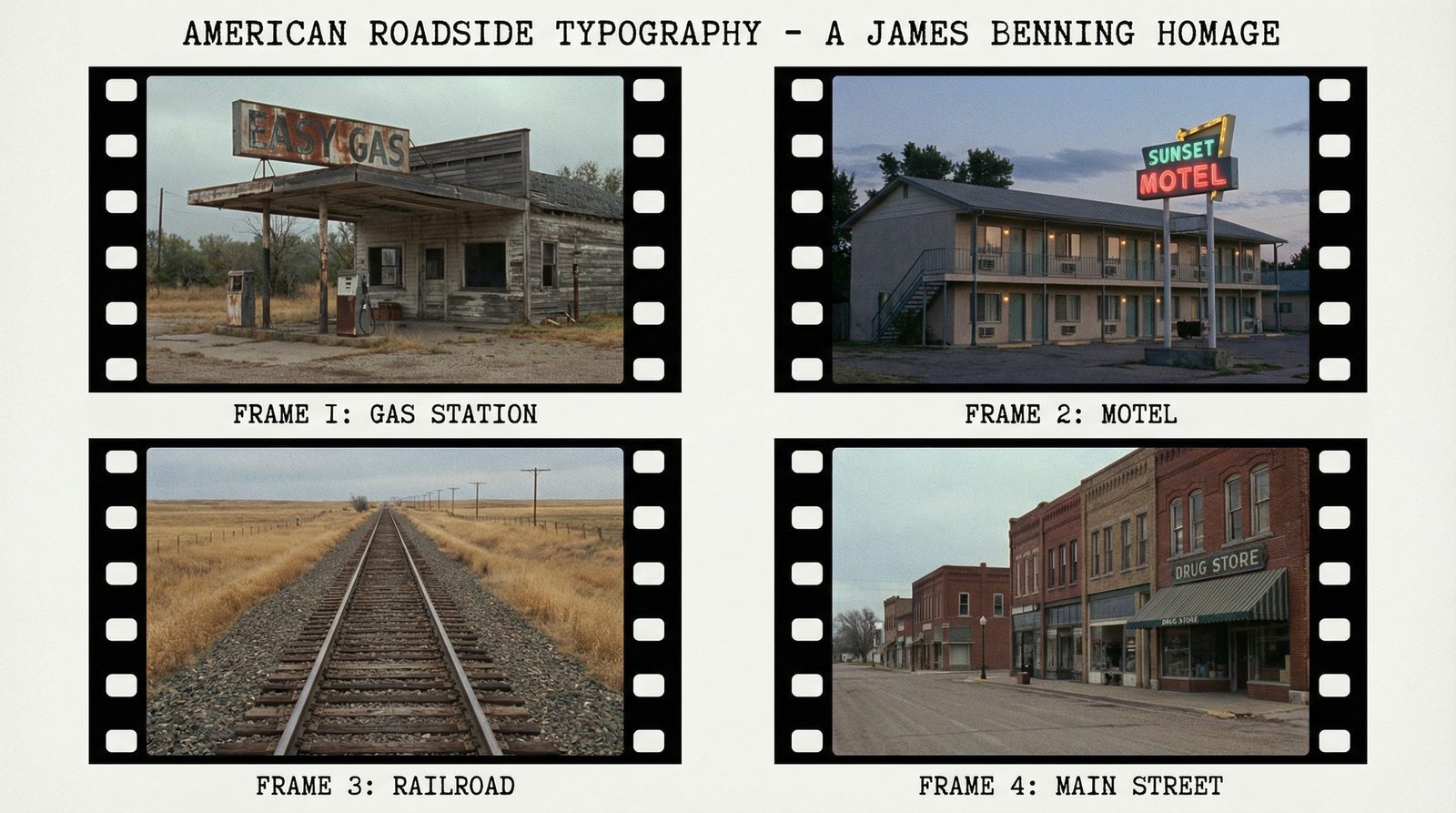
    Benning’s static compositions are deceptively simple. Roads bisect frames, power lines draw grids, and horizons settle into a mathematical calm. The lack of camera movement creates a contemplative feel, encouraging the viewer to scan the image and notice texture. The film is rigorous about place: the image does not exist to serve narrative; narrative is something the viewer manufactures while looking.

    Sound design is crucial. Ambient sound replaces dialogue and score. We hear engines, birds, distant traffic, sometimes a near-oppressive quiet. This observational soundscape anchors images in real time and refuses romanticization. Benning’s refusal of conventional coverage—no close-ups, no reverse shots, no explanatory montage—underscores his interest in duration and environment rather than character psychology.
    Editorial illustration inspired by 'Easy Rider (2012)'

    CHARACTERS & PERFORMANCE

    There are no conventional characters in Easy Rider (2012). The landscapes take on the role of a kind of landscape-as-character presence: gas stations, highways, rural fields, small-town streets. In the absence of actors, the viewer projects personality and history onto space. The film banks on cultural memory of road mythology to fill in the blanks.

    When humans appear, they are incidental. They are not framed as protagonists or even supporting players, only as elements of the environment moving through public space. The “performance” happens in the viewer’s mind, in the act of remembering and in noticing the gap between then and now. The film’s emotional temperature depends on how strongly you feel that gap.

    CONTEXT & LEGACY

    Easy Rider (2012) sits within James Benning’s long project of filming American landscapes with forensic patience. It also participates in a broader current of experimental re-visitation, where cinema interrogates its own myths by returning to places rather than re-staging scenes. Benning’s choice of Easy Rider as a source text is telling: the 1969 film crystallized a dream of American freedom tied to mobility and rebellion. Benning returns to the locations decades later to measure what that dream looks like as infrastructure.

    The film’s legacy is mostly art-house and academic rather than mainstream. It functions as a reference point in discussions of landscape cinema, structural film, and the afterlife of counterculture. Its radical gesture is simple: record a place long enough that the viewer can no longer pretend it’s just a background.

    IS IT WORTH WATCHING?

    Whether Easy Rider (2012) is worth your time depends on your tolerance for minimalism. If you come expecting narrative propulsion and soundtrack-driven momentum, this will feel austere, even alienating. There is almost no dialogue, no character arc, and no conventional story payoff.

    If you are interested in experimental film, landscape studies, or the way cinema remembers and erases, it can be quietly rewarding. The film offers a sustained opportunity to think about attention: what happens when a movie refuses to entertain you into meaning and instead asks you to construct it.

    Symbolic illustration inspired by 'Easy Rider (2012)'

    TRIVIA & PRODUCTION NOTES

    Benning is known for meticulous preparation, and Easy Rider (2012) fits that pattern. He tracked down locations tied to the earlier film and revisited them with a stripped-down production method designed to preserve real light and real time. What would be a throwaway establishing shot in another movie becomes an entire scene here.

    The film’s structure is shaped by durational choices rather than plot beats. Weather, light, and incidental human movement become the “action.” The approach links this film to Benning’s broader landscape work, where the drama is not who wins or dies, but what remains visible when you stop rushing.

    SIMILAR FILMS

    If Easy Rider (2012) works for you, you may enjoy other films built around duration, place, and the viewer’s attention rather than narrative closure. Pairing this film with the 1969 Easy Rider also makes a potent double feature: one riding through the myth of the American West, the other sitting with its lingering traces.

    DISCOVERABILITY & LINKS

  • Robert M Pirsig

    Robert M Pirsig

    ORIGINS & BACKGROUND

    Robert M Pirsig is best known as a writer who used the American road as a moving classroom, blending narrative with philosophy without locking either into academic form. Trained in both science and philosophy, and deeply influenced by Asian thought, he became a kind of outsider teacher, less interested in institutional debate than in how ideas hold up inside ordinary life. His work unfolds in garages, classrooms, and small towns rather than ivory towers, which keeps his questions about value and meaning close to the ground.

    What matters most about his background is not a list of institutions, but the way he bridged technical know-how with spiritual restlessness. He wrote about motorcycles, boats, and repair not as hobbies but as gateways into a larger inquiry about how to live well in a technological society. This interest in Craftsmanship And Quality Of Work reflects a lifetime of moving between intellectual abstraction and hands-on problem solving.

    Pirsig’s books arrived in a cultural moment when readers were drawn to road narratives as symbols of freedom, but he pushed the form beyond rebellion. Instead of celebrating escape, he examined responsibility, attention, and care. His work sits in conversation with figures like Alan Watts, who helped popularize Eastern philosophy in the West, and later writers like Matthew B Crawford, whose Shop Class As Soulcraft An Inquiry Into The Value Of Work echoes Pirsig’s respect for manual skill and moral seriousness. Across his career, Pirsig kept returning to the question of what “quality” means in a fragmented, distracted age.

    Editorial illustration inspired by 'Robert M Pirsig'

    THEMES & MOTIFS

    A central through-line in Pirsig’s work is Eastwest Philosophical Synthesis. He brings together classical Western logic, with its love of definitions and categories, and Buddhist or Taoist attention to direct experience. Rather than choosing sides, he lets these traditions argue inside the same narrative, using travel and conversation to test them against real conditions. The synthesis is not decorative; it is the main tool he uses to ask what counts as a good life.

    Another core motif is Craftsmanship And Quality Of Work. For Pirsig, tightening a bolt or diagnosing an engine is never just technical labor. It becomes a moral exercise in patience, presence, and respect for the material world. This connects directly to Crawford’s defense of skilled work in Shop Class As Soulcraft, where competence is treated as an ethical stance against a culture of distraction and abstraction.

    Pirsig also returns to the tension between rationality and breakdown, analysis and fragility. His narratives circle the fear that thinking can fracture the self if it loses contact with lived experience. This is where his work feels more haunted than the popularized “Zen” surface suggests. He is interested in attention, but also in what happens when attention becomes obsessive or unmoored.

    Throughout his work, travel is less about sightseeing than about testing ideas in motion. The road and the river become laboratories for inquiry. That is why the recurring threads remain consistent: Eastwest Philosophical Synthesis as method, craftsmanship as moral practice, and an insistence that “quality” has to be lived, not merely defined.

    Symbolic illustration inspired by 'Robert M Pirsig'

    STYLE & VOICE

    Pirsig writes in a hybrid form that drifts between memoir, travelogue, and philosophical essay. His style is patient and discursive. Scenes of riding or repair are interrupted by long reflections on metaphysics, then folded back into the narrative with an emphasis on lived consequence rather than pure abstraction. The pacing can feel meditative, but it is also methodical, as if the prose itself is committed to doing careful work.

    His voice is intimate and analytical at the same time. He lets readers into doubt, breakdown, and revision, which gives the philosophical material emotional weight. Instead of presenting a finished system, he invites the reader into a working process where ideas are tested, stressed, and re-evaluated. That workshop quality mirrors his commitment to craft: an idea has to “run” in experience, not merely sound convincing.

    Structurally, Pirsig favors braided narratives. External travel unfolds alongside internal monologue and abstract argument, with each layer illuminating the others. Readers who enjoy the reflective, conversational style of Alan Watts will recognize a similar willingness to think out loud, but Pirsig’s prose is denser, more technical, and more anchored in the concrete realities of machines, weather, and maintenance.

    KEY WORKS & LEGACY

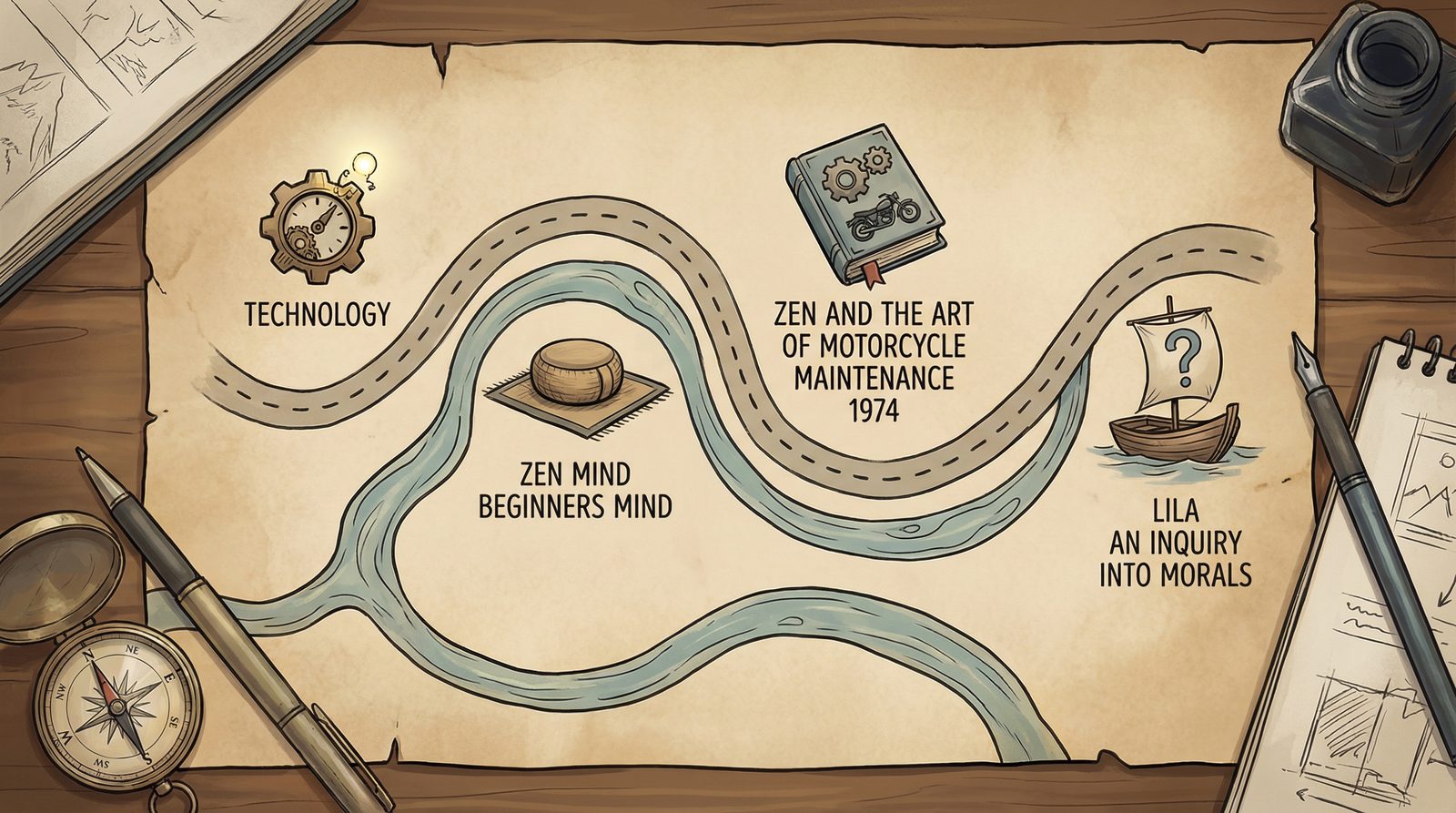
    Pirsig’s reputation rests primarily on Zen And The Art Of Motorcycle Maintenance (1974), a book that became a touchstone for readers who wanted philosophy without leaving the open road. A father-and-son motorcycle trip becomes the frame for exploring his evolving notion of quality, his critique of narrow rationalism, and his attempt at Eastwest Philosophical Synthesis. The scenes of tuning engines and navigating back roads anchor abstraction in the tactile world of craft.

    He later extended that inquiry in Lila: An Inquiry Into Morals (1991), shifting from motorcycles to a boat journey and from personal crisis to a broader examination of social and moral patterns. Where Zen And The Art Of Motorcycle Maintenance centers on individual quality, Lila pushes toward a more systematic account of how values evolve in communities. Together, the books form a two-part exploration of how metaphysics might grow out of everyday experience.

    Pirsig’s legacy can be felt in modern defenses of hands-on skill and moral seriousness, including Crawford’s Shop Class As Soulcraft. He remains a key figure in conversations about how to reconcile technology with inner life, and his distinctive contribution is to treat the garage, the road, and the workshop as legitimate philosophical sites. For readers drawn to craft, attention, and the lived texture of ideas, his work offers a slow, rigorous argument that value is something you practice.

  • Awakening Through Physical Injury

    Awakening Through Physical Injury

    DEFINITION & CORE IDEA

    Awakening Through Physical Injury is a motif where a character’s body breaks before their worldview does. A fall, crash, illness, or sudden accident rips them out of normal momentum. In the forced stillness that follows, they start to question who they are, what matters, and what they have been avoiding. The pain is real and the rehab is real, but the story is less about the wound itself than about what the wound exposes.

    Writers use this motif to make inner change non-negotiable. Instead of a vague decision to “do better,” the character hits a physical limit that cannot be argued with. The injury becomes a hard boundary: the old life is no longer fully available. That constraint forces a re-evaluation of identity, purpose, and the stories the character used to justify their pace.

    In Way Of The Peaceful Warrior, Dan Millman uses injury as a catalyst for a deeper kind of training. Recovery becomes more than repair. It becomes confrontation: with ego, with impatience, with the need to be exceptional, and with the fear of being ordinary. The body is not just a problem to solve. It becomes the teacher that strips away illusions the character could previously outrun.

    This motif sits at the intersection of the physical and the spiritual. Muscles, bones, and nerves become the language through which a character confronts fear, regret, or emptiness. The core idea is simple: when your body can no longer carry the life you built on autopilot, you are forced to build a different kind of life from the inside out.


    HOW IT WORKS IN STORIES

    Awakening Through Physical Injury usually begins with a disruption that cannot be re-framed as “just a bad day.” A car accident, a fall, a collapse during training, or a medical crisis snaps the character out of routine. In stories connected to identity and performance, the injury does double damage: it interrupts the body and also interrupts the self-image built on capability.

    The middle of the story slows down, because recovery slows everything. Hospital rooms, physical therapy sessions, sleepless nights, and repetitive home days create enforced attention. The character cycles through anger, grief, boredom, and denial before the deeper work begins. Supporting figures may appear as stabilizers — a nurse, coach, friend, or mentor — but the pressure comes from the same place: the character cannot distract themselves with their old velocity.

    Writers often use rehab as a mirror. Each exercise, setback, and small victory corresponds to an internal struggle. Learning to walk again, accepting new limits, or rebuilding strength becomes a visible proxy for rebuilding identity. The character may discover practices that were impossible before injury: patience, presence, humility, and a more honest relationship with need.

    By the final act, the story forces a choice about identity attrition. The character can cling to the past, trying to force their old life back into place, or they can accept that the injury has changed the terms. Sometimes they return to their sport or work with a new relationship to effort. Sometimes they leave it behind. Either way, resolution is less about “fixing” the body and more about integrating what the injury made impossible to ignore.


    Editorial illustration inspired by 'Awakening Through Physical Injury'

    EMOTIONAL EFFECT ON THE READER

    Stories built around Awakening Through Physical Injury often feel intensely vulnerable. Pain, dependence, and fear are hard to romanticize, which makes the emotional stakes immediate. Even if a reader has never had a serious injury, the basic experience lands: the terror of losing control over the one vehicle you live inside.

    The reading experience usually carries a mix of discomfort and hope. Early sections can feel claustrophobic as the character fights the new reality and resents their own limits. As the story shifts from resistance to attention, that tension loosens into a steadier feeling: growth is possible, but only on terms the character did not choose.

    For readers who have lived through illness, disability, burnout, or forced pause, the motif can feel deeply validating. It reframes stoppage as a turning point rather than a personal failure. In a narrative like Way Of The Peaceful Warrior, the emotional payoff comes when the character’s value finally detaches from performance. The injury becomes a strange kind of clarity: the reader closes the story with sharper awareness of limits and, often, a softer attitude toward them.


    Symbolic illustration inspired by 'Awakening Through Physical Injury'

    VARIATIONS & RELATED MOTIFS

    Awakening Through Physical Injury can take many forms. In some stories, the injury is dramatic and public, such as a catastrophic sports accident. In others, it is quiet and private, unfolding as illness, chronic pain, or a slow breakdown that finally forces the character to stop. The scale matters less than the effect: the character is pushed into confrontation with themselves.

    One common variation is explicitly connected to discipline. When the protagonist is an athlete or high performer, the injury destroys not only mobility but identity. That overlap is why this motif pairs naturally with Athletic Discipline As Spiritual Practice, where training becomes a path to awareness only after the old “win at any cost” logic fails.

    Another variation frames the awakening as a broader reorientation rather than a single insight. The character does not become “enlightened.” They become more honest about what they were using movement, work, or achievement to avoid. This is where the motif connects to Spiritual Awakening and Inner Journey, because the real outcome is a different relationship to self, time, and control.

    Across these variations, the most resonant stories avoid treating injury as moral punishment or a convenient plot device. They treat it as a real constraint with real grief attached, and they let the awakening emerge from what the character is forced to learn when control is no longer available.

  • The Alchemist (1988)

    The Alchemist (1988)

    INTRODUCTION

    The Alchemist (1988) by Paulo Coelho
    Philosophical fiction · 166 pages · Spain / Egypt


    The Alchemist has been quoted on posters, mugs, and social feeds so relentlessly that it is easy to forget there is a small, quietly odd novel beneath the slogans. On the surface, it reads like a simple fable about following your dreams. Underneath, it is more fragile and ambivalent than its reputation suggests.

    Set in a loosely sketched, almost timeless world, the book follows a young Andalusian shepherd who trades pastoral safety for the uncertainty of travel across North Africa. The images linger: a boy sleeping in a ruined church beneath a sycamore tree, the repeated language of omens, the idea of a “Personal Legend” that both comforts and unsettles. Strip away the inspirational framing, and what remains is a story about restlessness, loss, and the uneasy cost of believing that life has a single, discoverable meaning.

    PLOT & THEMES

    The plot is deliberately spare. Santiago, a shepherd from Andalusia, dreams twice of treasure buried near the Egyptian pyramids. A strange old man calling himself Melchizedek, king of Salem, urges him to pursue the dream, speaking of Personal Legends and asking for a tenth of the treasure in advance. The encounter feels less like divine revelation than a streetwise push toward risk.

    Santiago sells his sheep, crosses to Tangier, and is immediately robbed. This early loss establishes one of the book’s central patterns: progress is inseparable from disorientation. Working for a crystal merchant overlooking the marketplace, Santiago learns how fear of change can slowly fossilize a life. The merchant’s unrealized pilgrimage to Mecca becomes a quiet warning about dreams postponed until they no longer feel possible.

    As Santiago joins a caravan crossing the Sahara, the novel widens. The Englishman obsessed with alchemical texts introduces the tension between book knowledge and lived experience. War between desert tribes, Santiago’s time at the Al-Fayoum oasis, and his love for Fatima sharpen the central question: when does commitment to a path become an excuse to avoid attachment, and when does attachment become a reason to stop seeking?

    The Alchemist himself appears late, more riddle than person. He insists that the oft-quoted idea that “the universe conspires” only holds if one is willing to risk everything. The ending is bluntly circular. Santiago learns that the treasure was buried back in Spain, at the very church where his journey began. The irony is not softened. The novel insists that the journey was necessary, even if the destination never moved.

    PROSE & NARRATIVE STRUCTURE

    Coelho’s prose is famously spare, closer to parable than to realist fiction. The narration moves in clean, declarative sentences that summarize inner change rather than dramatize it. This can feel hypnotic or thin, depending on the reader’s patience for abstraction.

    The structure is linear and episodic. Each location functions as a moral vignette: the church, the port of Tarifa, the crystal shop, the caravan, the oasis, the desert. Symbolic objects recur with near-ritual regularity: the Urim and Thummim stones, the hawks at Al-Fayoum, the desert itself as a listening presence. The repetition of phrases like “Personal Legend,” “Soul of the World,” and “Maktub” creates a chant-like rhythm that is central to the book’s effect.

    Formally, the novel takes few risks. Its power, when it works, comes from compression rather than complexity. It is designed to be read quickly and remembered vaguely, carried more as an atmosphere than as a sequence of scenes.

    Conceptual editorial illustration inspired by 'The Alchemist'

    CHARACTERS & INTERIORITY

    Santiago is not written as a psychologically complex figure. He functions as a clean archetype: open, curious, and capable of doubt without becoming paralyzed by it. His small attachments, his sheep, the memory of a merchant’s daughter, his fear when he first sees the sea, provide just enough texture to anchor the fable.

    The supporting figures operate as embodiments of choice. The crystal merchant represents resignation disguised as prudence. Fatima embodies a love that insists seeking and commitment need not cancel each other out. The Alchemist himself acts as a pressure point, forcing Santiago to risk annihilation rather than settle for symbolic understanding.

    Interior life is conveyed through parable rather than introspection. Feelings are named, not excavated. Yet moments of loss and fear, especially after the robbery in Tangier and during the desert ordeal, cut through the abstraction. The simplicity is intentional. The book asks the reader to project their own doubts into the spaces left open.

    LEGACY & RECEPTION

    Since its publication, The Alchemist has become one of the most translated and commercially successful novels of the late twentieth century. It sits alongside works like Jonathan Livingston Seagull as a foundational text of modern spiritual fiction. Critical response has been sharply divided, with some praising its mythic clarity and others dismissing it as aphoristic mysticism.

    The novel’s language of Personal Legends and cosmic conspiracy has seeped deeply into popular culture. Its endurance lies not in literary innovation but in its ability to function as a mirror. Readers return to it at different moments of life and read different instructions into the same slender story.

    IS IT WORTH READING?

    If you are looking for dense characterization or stylistic experimentation, this will feel thin. If you approach it as a modern fable, a compressed meditation on risk, desire, and return, it can still resonate. Reading it now is also an act of reclamation, separating the novel from its motivational afterlife.

    The lingering question it leaves is not inspirational but quietly unsettling: what would you have to give up to find out whether the life you imagine is actually yours?

    Illustration inspired by a core idea from 'The Alchemist'

    TRIVIA & AUTHOR FACTS

    Paulo Coelho wrote the novel quickly, later describing the process as intuitive rather than planned. It was initially a commercial failure in Brazil, and its first publisher dropped it. Only after being taken on by another house did it begin its gradual rise to global success.

    The book synthesizes Coelho’s long-standing interests in pilgrimage, omens, and Western esoteric traditions. Despite the title, its use of alchemy is symbolic rather than historical, drawing more from myth and metaphor than from chemical practice.

    SIMILAR BOOKS

    Readers drawn to this style of allegorical journey may also explore Siddhartha by Hermann Hesse, Jonathan Livingston Seagull by Richard Bach, or Shusaku Endo’s Silence, which offers a far harsher meditation on faith and failure. Each examines what is gained and lost when belief becomes a guiding structure.

    DISCOVERABILITY & LINKS

    DISCOVERABILITY & LINKS

  • Craftsmanship And Quality Of Work

    Craftsmanship And Quality Of Work

    DEFINITION & CORE IDEA

    “Craftsmanship And Quality Of Work” is the motif where the way a character performs their work becomes a direct expression of their inner life. It is not simply about employment or productivity. The focus is on care, precision, pride, and the satisfaction of doing something properly, even when no one is watching. Whether the task is tuning an engine, preparing a meal, writing software, or shaping wood, the work itself carries moral weight.

    Stories built around this motif slow down and pay attention to process. In Zen And The Art Of Motorcycle Maintenance: An Inquiry Into Values (1974), motorcycle maintenance becomes a way of examining “Quality” as something experienced rather than defined. In Lila: An Inquiry Into Morals (1991), that concern expands into ethics and social life, still grounded in the idea that values are revealed through attention and care.

    At its core, this motif treats work as a moral and emotional discipline. It asks where standards come from, how they are practiced, and what is lost when integrity collides with systems that reward speed, scale, or convenience.


    HOW IT WORKS IN STORIES

    Craftsmanship And Quality Of Work usually appears through the rhythms of daily labor. Writers linger on routines: opening a workspace each morning, laying out tools, repeating movements until they become instinctive, inspecting the final result with quiet seriousness. The story may not be overtly “about” the job, but the way the work is done reveals character more clearly than dialogue alone.

    Sometimes the work itself becomes the teacher. In Shop Class As Soulcraft: An Inquiry Into The Value Of Work (2009), written by Matthew B. Crawford, manual problem-solving is framed as intellectually demanding and ethically grounding. Stories echo this idea when characters develop patience, humility, or self-respect through repeated, concrete tasks. A flawed repair or failed attempt is not just a setback, but a test of standards.

    Conflict often enters when the surrounding world does not value quality in the same way. A supervisor pushes for speed over care, a system rewards shortcuts, or customers demand something cheap and disposable. The character must decide whether to compromise, resist, or walk away. That decision becomes a clear statement of identity.

    This motif allows writers to make abstract ideas tangible. In the work of Robert M. Pirsig, the road, the machine, and the act of maintenance become tools for thinking about attention, rationality, and lived experience. Meaning is not explained. It is encountered through effort, failure, and care.

    Even in intimate or domestic narratives, the motif shapes relationships. A parent teaching a child a careful technique, or a mentor guiding an apprentice, passes on more than skill. They transmit a way of engaging with the world that can become a form of trust or love.


    EMOTIONAL EFFECT ON THE READER

    Stories shaped by this motif often feel grounding. There is comfort in watching someone care deeply about what they are doing, especially in a culture that feels rushed and disposable. Attention to tools, textures, and small decisions can be quietly absorbing.

    At the same time, the motif can provoke sadness or anger. When care is dismissed or punished, the loss feels personal. Stories about disappearing skills or neglected standards often carry a sense of dignity under threat.

    For many readers, this motif turns inward. It encourages reflection on everyday effort and responsibility. The question it raises is simple but unsettling: where does quality still matter in your own life, and what does it cost to protect it?

    There is also intimacy in this focus. Watching a character work carefully is like watching them unguarded. Habits and rituals reveal who they are when performance drops away, making later choices feel heavier and more personal.


    VARIATIONS & RELATED MOTIFS

    Craftsmanship And Quality Of Work takes many forms. In some stories, it centers on manual trades. In others, the craft is intellectual or emotional, such as teaching, caregiving, or programming. What unites them is the same pattern: the character treats their work as something deserving of attention, and their sense of self is bound to doing it properly.

    A common variation is the “lost craft” narrative, where older ways of working are disappearing. Another focuses on the collision between personal standards and impersonal systems, where care is labeled inefficient or excessive.

    This motif often pairs with Eastwest Philosophical Synthesis. In Pirsig’s writing, the road and the act of maintenance bridge Western analysis and Eastern presence. In Crawford’s work, the workshop becomes a site of moral clarity. Different settings, the same question: how should attention be lived?

    Across its variations, the motif returns to a single concern: when people invest genuine care in their work, how does that shape who they become?