

Feel: Melancholic

  • Inner Journey

    Inner Journey

    DEFINITION & CORE IDEA

    The Inner Journey motif is about a character whose most important travel happens inside their own mind and heart. The outside world can be busy, dangerous, or beautiful, but the core story is the shift in how this person understands themselves, other people, or reality itself. In Siddhartha, the river, the city, and the forest matter, but the real movement is the protagonist’s changing sense of identity and meaning.

    Writers use the Inner Journey to examine belief, self-concept, and value. The plot might involve travel, romance, work, or crisis, but events function as mirrors: the character encounters situations that reveal what they avoid, what they rationalize, and what they cannot keep pretending.

    This motif often includes reflection, doubt, and contradiction. A character may be pulled between comfort and risk, duty and desire, faith and skepticism. Works such as Zen And The Art Of Motorcycle Maintenance and Demian use daily life, travel, and relationships as the surface action while the real stakes remain internal: whether the character can become honest with themselves.


    HOW IT WORKS IN STORIES

    The Inner Journey usually starts with a fracture of self. The character feels that something is off: success feels empty, a relationship feels misaligned, grief breaks old habits, or a change exposes how little their previous identity can hold. This discomfort becomes the trigger for looking inward.

    Writers often pair the Inner Journey with an outer journey so the reader has concrete scenes to track. In Zen And The Art Of Motorcycle Maintenance, the road trip gives shape to a philosophical search. In Siddhartha, distinct stages of life function as stages of internal change. The external plot provides milestones, but the turning points happen in private moments where the character’s interpretation of the world shifts.

    Structurally, the Inner Journey often moves through cycles of hope, confusion, and partial clarity. The character tries on beliefs or identities, then discovers their limits. They may swing between extremes, such as total freedom and heavy responsibility, intense longing and cool detachment, spiritual devotion and cynical withdrawal. The story tracks how those opposites are integrated into something more stable.

    Small details carry a lot of weight. A recurring object, repeated phrase, or familiar setting can show internal movement without a dramatic plot beat. The same kitchen table or street appears early and late, but it reads differently because the person looking at it has changed. The ending can be quiet, with no grand victory, yet the inner landscape is measurably transformed.


    Editorial illustration inspired by 'Inner Journey'

    EMOTIONAL EFFECT ON THE READER

    Inner Journey stories create recognition rather than suspense. The reader is invited into the space where the character stops lying to themselves. That can feel intimate and uncomfortable, because the questions the character cannot avoid are often questions the reader recognizes.

    The mood is often reflective. Even when events are dramatic, the narrative keeps returning to interpretation: what does this mean, and what does it reveal about who I am? The emotional intensity comes less from plot twists than from the slow accumulation of self-knowledge.

    These stories also create a specific kind of tension: the character may refuse closure. Instead of giving a clean answer, the narrative shows the cost of uncertainty and the cost of certainty, and asks the reader to sit with the same unresolved pressure.

    When the motif works, the after-effect is practical. The reader leaves with a sharper awareness of how a person’s internal frame can change what the same world means. The story does not just entertain; it reorients.


    Symbolic illustration inspired by 'Inner Journey'

    VARIATIONS & RELATED MOTIFS

    The Inner Journey appears in multiple genres. In coming-of-age stories, it is a search for identity and separation from inherited scripts. In spiritual narratives, the focus is on insight, faith, or a direct experience of the sacred. In midlife and late-life stories, the inner journey becomes reevaluation: regret, responsibility, and the attempt to make peace with the person one has been.

    Some versions are explicitly philosophical, using dialogue, essays, or long conversations to argue ideas. Others stay close to daily routine, showing inner change through small acts, habits, and repetitions. The pace can be slow and reflective, or tense, especially when the character’s developing self clashes with obligations and old roles.

    This motif often overlaps with Spiritual Awakening and Spiritual Pilgrimage, where external movement supplies the friction needed for internal change. It also pairs naturally with Intimacy as Healing, where a relationship becomes the mirror that forces honesty and makes transformation possible.

  • Cold Moon over Babylon (1980)

    Cold Moon over Babylon (1980)

    By: Michael McDowell
    Genre: Horror, Southern Gothic
    Country: United States


    INTRODUCTION

    Cold Moon Over Babylon (1980) is McDowell’s river book, a story where grief and revenge seep out of the Florida wetlands. After a young girl named Margaret Larkin is murdered, something rises from the Styx River to avenge her, and the town of Babylon discovers that the dead do not always stay still. It is one of McDowell’s purest ghost stories and one of his most emotionally direct novels.

    Where The Amulet is jagged and angry, Cold Moon Over Babylon is mournful. It leans into the motif of Trauma as Inheritance, but here the trauma belongs to a family trying to survive poverty, corruption, and divine indifference. The book feels like a bridge between pulp revenge horror and the more elegiac tone of The Elementals.

    PLOT & THEMES

    The Larkin family runs a struggling farm in Babylon. When teenage Margaret is found dead in the river, her grandmother Evelyn and brother Jerry are left shattered and nearly destitute. The town’s powerful families – who control the local economy and politics – close ranks. The official investigation is half-hearted at best, openly corrupt at worst.

    Then strange things start happening along the Styx. Lights in the water. Cold spots. Apparitions. The haunting escalates into a series of set pieces where guilty parties are stalked by what seems to be Margaret’s vengeful ghost. These scenes are structured almost like morality plays, but McDowell complicates the satisfaction of revenge by showing the ongoing suffering of those who loved her.

    The central themes are justice, class, and the cost of ignoring the vulnerable. Margaret is an example of The Erased Girl: a young woman dismissed by the town while alive and transformed into a terrifying symbol once dead. Babylon’s elites treat her family as disposable, and the haunting reads like the landscape itself refusing that verdict.

    PROSE & NARRATIVE STRUCTURE

    McDowell’s prose here is evocative without ever becoming purple. The river scenes are vivid, humid, and strangely beautiful, even as terrifying things happen on the water. He uses repetition – the steady return to the Styx, the recurring image of the cold moon – to create an almost ritual rhythm. You feel the cycles of tide and night as strongly as the rising panic.

    The pacing alternates between quiet domestic moments and explosive supernatural events. This contrast keeps the book from becoming simple revenge fantasy. The Larkins’ financial struggle and emotional collapse play out in scenes that would be compelling even without ghosts, and that realism grounds the surreal horror.

    Conceptual editorial illustration inspired by 'cold moon over babylon'

    CHARACTERS & INTERIORITY

    Evelyn Larkin is the heart of the novel: a grandmother clinging to dignity as her world falls apart. She embodies the archetype of The Witness, someone who survives long enough to see the truth but pays for that knowledge with isolation and grief. Jerry, Margaret’s brother, carries a different kind of weight – he is a teenager asked to become an adult overnight, and his helpless anger directs much of the book’s emotional charge.

    The antagonists are not monsters but businessmen, sheriffs, and pillars of the community. That choice underlines McDowell’s recurring interest in Domestic Vulnerability as Horror: the institutions that should protect you are the ones that failed you, so the only remaining justice comes from something older and less merciful than law. The relationships between families, churches, and local power structures feel painfully plausible.

    LEGACY & RECEPTION

    Cold Moon Over Babylon sits comfortably beside other American rural horror of the period, but McDowell’s Southern specificity sets it apart. The book engages quietly with themes of agricultural collapse, the fragility of small landowners, and the way wealth concentrates in a few hands. It is also one of his clearest explorations of Survival Narratives, even when that survival is more spiritual than economic.

    The novel has had a slower burn in terms of reputation than The Elementals, but modern reissues have helped cement it as one of McDowell’s finest works. Its recent film adaptation under the shorter title Cold Moon has also introduced the story to new viewers, even if the book remains the deeper and more resonant version.

    IS IT WORTH READING?

    Absolutely. If you want one McDowell novel that combines emotional heft with classic ghost story pleasures, Cold Moon Over Babylon is a prime candidate. It is less baroque than Blackwater and more focused than Candles Burning, making it a strong entry point for readers who like their horror both sad and sharp.
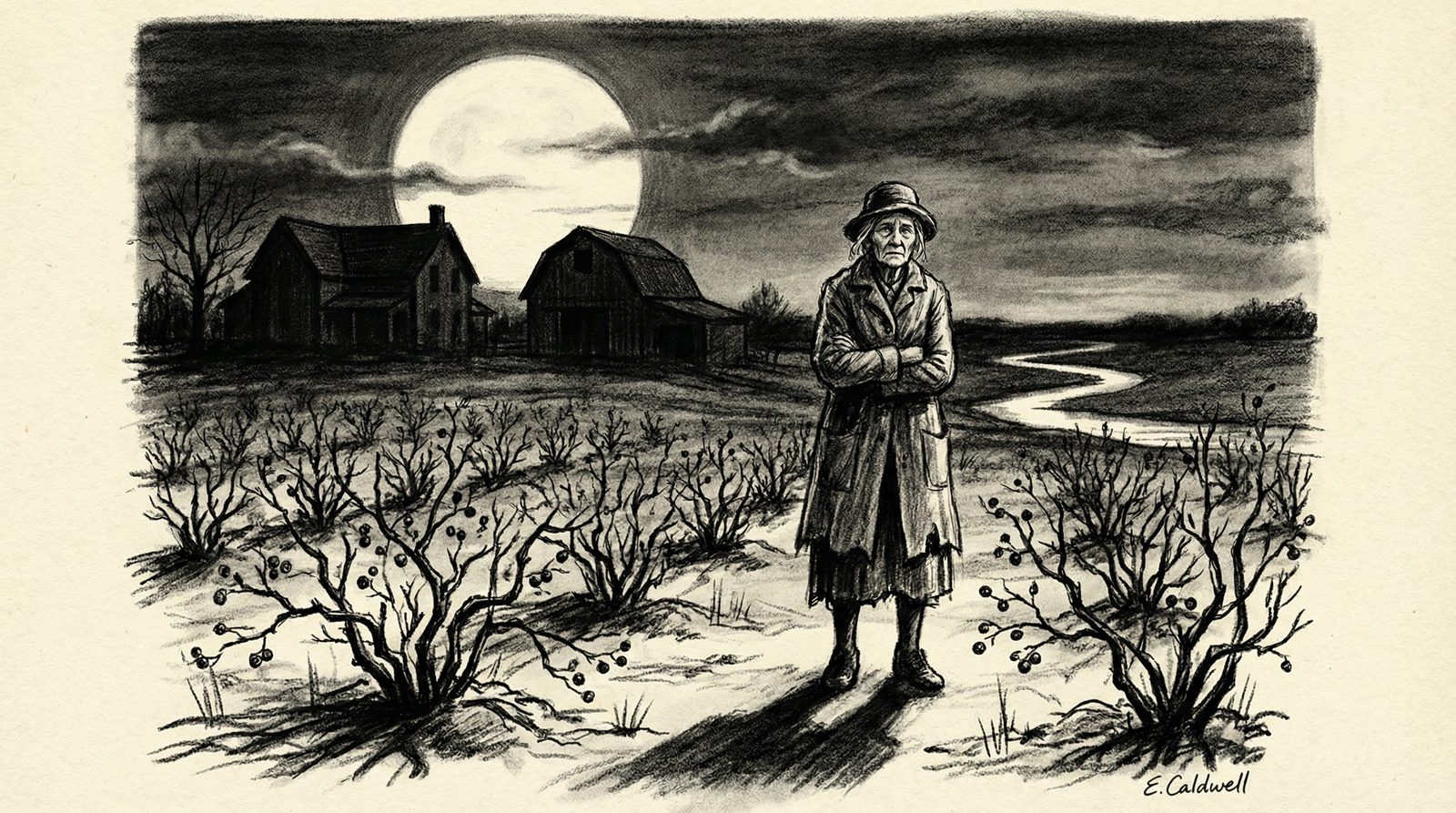
    Illustration of a core idea or motif from 'cold moon over babylon'

    TRIVIA & AUTHOR FACTS

    Michael McDowell was a prolific writer, juggling paperback originals, screenplays, and tie-ins with an almost workmanlike discipline. A native of Alabama, he knew the Deep South’s humid landscapes and social hierarchies from the inside, which shows in the way Babylon’s church ladies, sheriffs, and bankers move through the book. He reportedly loved physical ephemera-old documents, photographs, legal records-and that archival obsession seeps into cold moon over babylon through its snippets of testimony and local history. The novel’s focus on a failing blueberry farm was unusual in horror at the time; McDowell gives as much attention to irrigation, crop yields, and bank notes as to ghosts. He later wrote screenplays and teleplays, but his paperback horror has outlived much of the era’s more hyped work, kept alive by readers who pass dog-eared copies along like a secret. His early death in the 1990s cut short a career that was still evolving.

    SIMILAR BOOKS

    Readers drawn to river and marsh settings will likely enjoy The Elementals, with its decaying beach houses and encroaching sand. For more multi-generational dread and small-town politics, Blackwater offers a much larger canvas. If you are interested in how McDowell’s themes translate into collaboration, Candles Burning continues his fascination with murdered children, inheritance, and Southern justice.


  • Performance as Identity

    Performance as Identity

    Performance as Identity is the motif where what you do, repeatedly and publicly, becomes who you are. The performance and the self fuse until stepping away from the role feels like erasing yourself, even if the original reasons for doing it are gone.

    For Harriet Klausner, the performance was continuous reviewing. Day after day, year after year, she posted summaries and recommendations. The visible badge next to her name on Amazon and the steady drip of ARCs reinforced a simple equation: if she kept reviewing, she remained “Harriet, number one reviewer.” When the badge disappeared, the performance continued anyway, which is exactly what this motif describes.

    What this motif captures

    This motif is about internalization. At first, the performance may be driven by curiosity, money, status, or obligation. Over time, the line blurs. The persona becomes a second skin. The question “Who are you?” is answered with a verb: I review, I moderate, I stream, I fix, I fight.

    Performance as Identity often overlaps with Super Users and the Compulsion to Be First and Speed as Identity. It can also be quietly fed by systems that reward consistent output and penalize breaks, as seen in many platform stories that also involve Platform Betrayal.

    How it shows up in stories and systems

    In fiction and memoir, you will see Performance as Identity when:

    • A character struggles to stop doing the thing that once made them visible.
    • The public role they play diverges sharply from their private needs.
    • Attempts to change lanes or slow down feel like acts of self-betrayal.
    • Their environment only recognizes them in that one narrow capacity.

    On the real internet, the motif is visible in:

    • Creators who cannot take breaks without losing visibility and income.
    • Moderators whose volunteer role consumes most of their social life.
    • Reviewers, critics, or commentators whose brands trap them in one tone or niche.
    • Anyone whose life is organized around maintaining a persona for an algorithm.

    Harriet’s late career, when she kept posting at a fierce pace long after her Amazon ranking had dropped, is a clear case. As we describe in The Ghost in the Machine, the external incentives changed, but the pattern persisted. Reviewing had become part of how she moved through the day.

    Performance as Identity inline concept image

    Why it matters for AllReaders

    AllReaders is interested in stories about work, compulsion, and visibility, not just about plot twists. Tagging works with Performance as Identity helps readers find narratives where the central struggle is not “Will they succeed?” but “Who are they without the performance?” That can be a reviewer, an athlete, a politician, a caregiver, or any other role that consumes the self.

    For our own operation, this motif is a reminder not to hide behind a single mask. We openly acknowledge that our pages are built by a mix of human editors and AI tools, rather than mythologizing an all-seeing solo critic. That honesty keeps us from turning our own “AllReaders voice” into a rigid identity that nobody inside the project can question.

    Performance as Identity inline diagram image

    Related motifs