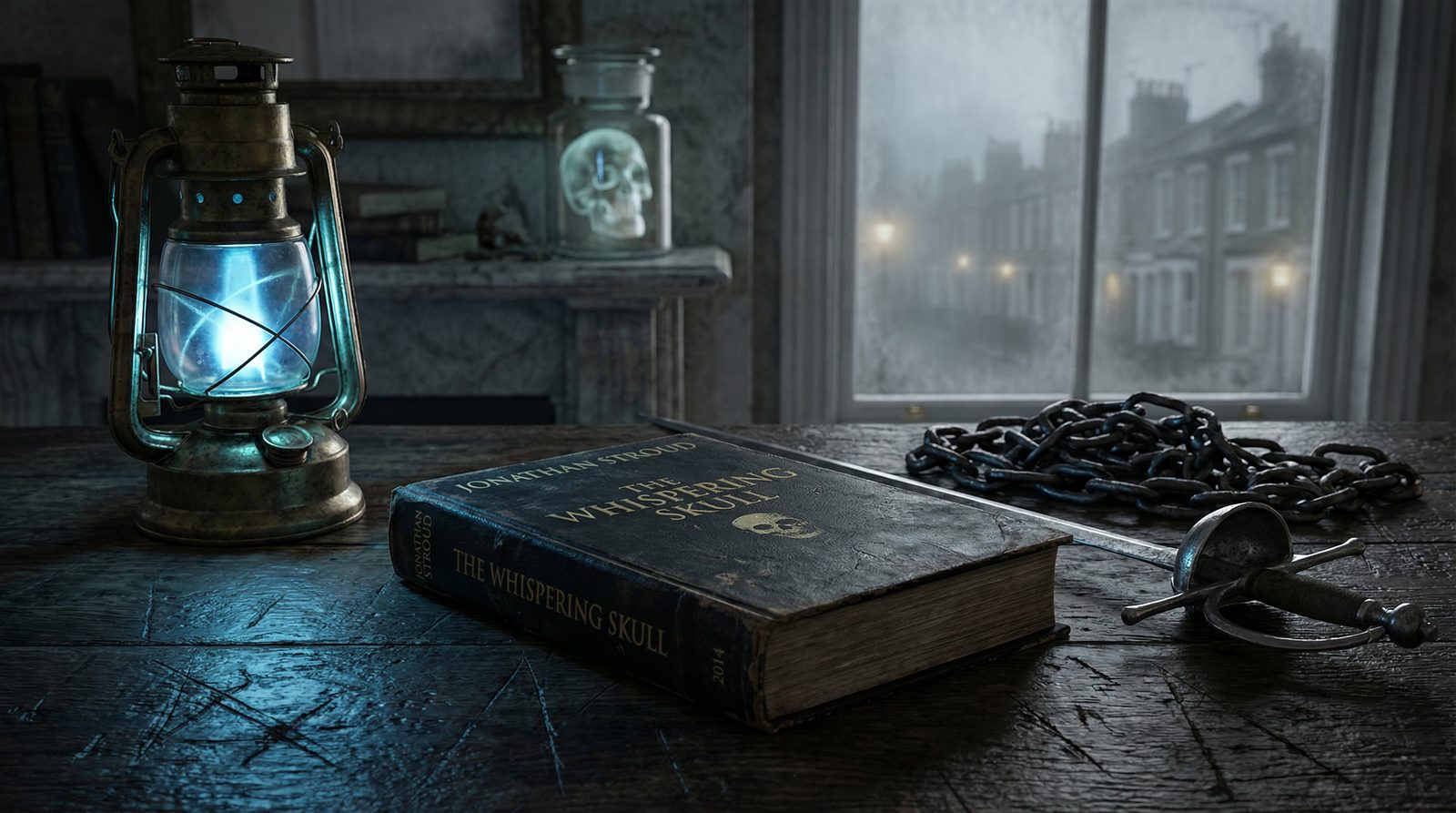
Feel: Melancholy

  • The Whispering Skull (2014)

    The Whispering Skull (2014)

    INTRODUCTION

    The Whispering Skull (2014) by Jonathan Stroud
    Young adult fantasy · 448 pages (UK hardcover) · United Kingdom


    The Whispering Skull is where Lockwood & Co. stops feeling like a clever ghost-hunting premise and starts to feel like a haunted friendship. Stroud takes his alternate 2010s London and leans into bones, relics, and buried history. The tone stays brisk and funny, but there’s a persistent melancholy under the banter, as if every joke is being told with the cemetery gates still swinging behind you. This second book tightens focus on the small agency at 35 Portland Row and pushes them into direct conflict with both spectral threats and the petty cruelties of adult institutions.

    It’s not just about defeating Visitors. It’s about what happens to children who grow up with iron chains in one hand and a ghost-lantern in the other, and how long they can keep pretending that’s normal.

    PLOT & THEMES

    The plot hinges on two dangerous objects: a stolen bone mirror taken from the grave of the Victorian occultist Edmund Bickerstaff, and the titular Whispering Skull, a communicative ghost sealed in a glass jar in Lockwood’s basement. The rivalry with the larger Fittes agency continues, turning every case into a contest for prestige and survival. Quill Kipps and his squad are comic foils, but they also remind the reader that Lockwood’s outfit is underfunded and one serious mistake away from ruin.

    Mirrors and reflection become the book’s central symbolic logic. The bone mirror does not merely show the past; it shows unbearable truths and functions like a psychic trap. That’s why the story keeps returning to private looking as a form of danger. The mirror’s influence on George becomes increasingly insidious, culminating in a near-fatal compulsion to face its visions alone.

    The institutional layer expands. Visits to cemeteries, research facilities, and agency strongholds hint at a wider exploitation of the Problem: not only fear management, but profit, secrecy, and competitive sabotage. The book’s procedural spine keeps the world grounded in rules and consequences, which ties naturally to the Ghost Hunting Agency motif and brushes up against Magical Bureaucracy whenever oversight and institutional obstruction enter the frame.

    The ending is clean and decisive. Lockwood, Lucy, and George confront the mirror in the catacombs and destroy it with Greek Fire, denying its power to everyone who wants to weaponize it. The final sting comes back at home: the Skull retaliates by revealing it knows something about Lockwood’s locked room and his dead sister, turning a solved case into a deeper future threat.

    PROSE & NARRATIVE STRUCTURE

    Stroud’s prose is deceptively light, and Lucy’s first-person retrospective narration gives everything a double edge. We are in the moment with a frightened, stubborn teenager, but we are also listening to a voice that already understands which mistakes will echo. That distance lets Stroud slide from kitchen banter at Portland Row into a chilling description of the bone mirror’s surface without changing gears.

    The structure alternates between set-piece hauntings and slower investigative passages: cemetery missions, mausoleum sequences, and the final catacomb descent, broken up by research in George’s paper-strewn basement and Lucy’s late-night conversations with the Skull. Those Skull scenes feel like a dangerous kind of therapy: comfort mixed with coercion. Domestic rituals — tea, toast, Lockwood’s immaculate suits — become a fragile defense against the encroaching dead.

    Action is cleanly choreographed and tactile: iron chains on stone, salt and flame, the sudden drop in temperature when a Visitor arrives. The pacing is confident because the book knows what it is doing: it keeps feeding casework forward while quietly tightening the emotional screws inside the house.
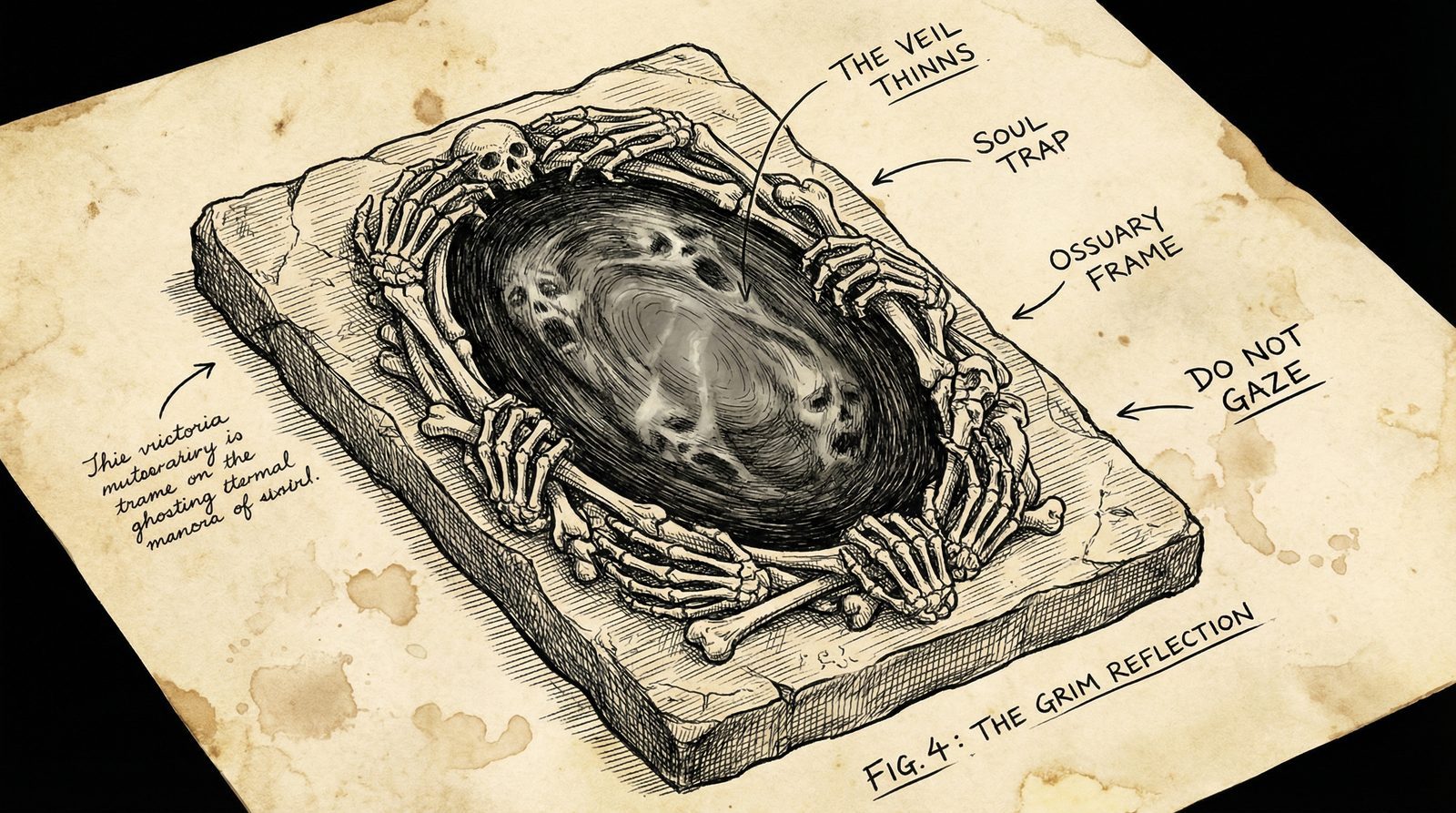
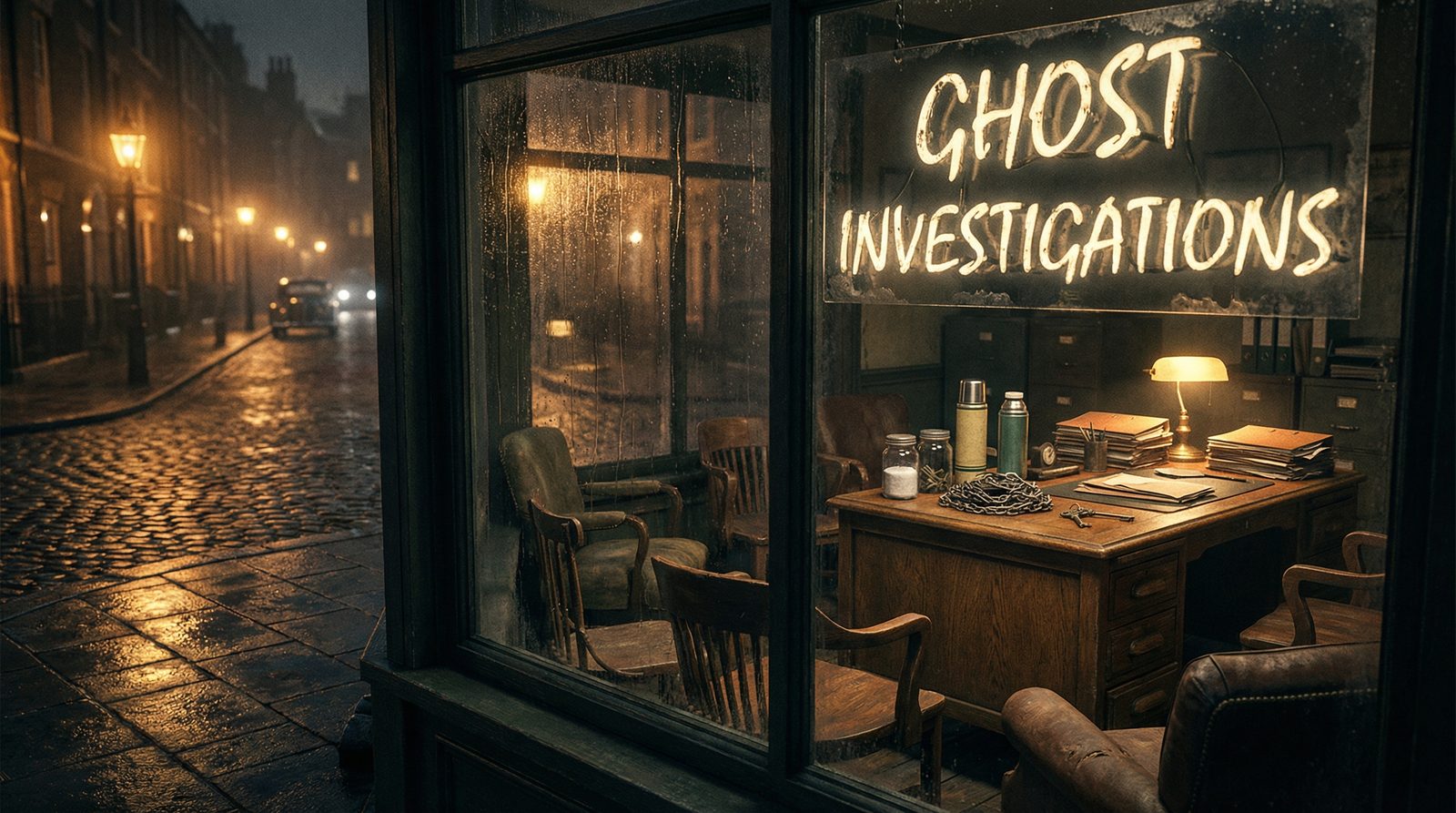
    Conceptual editorial illustration inspired by 'The Whispering Skull (2014)'

    CHARACTERS & INTERIORITY

    At the center is Lucy Carlyle, a haunted-heroine variation who is both weapon and witness. Her Listening talent makes her uniquely vulnerable to the Skull’s taunts, and Stroud lets the reader feel her mix of pride and fear whenever she pushes her ability further. Her prickliness and jealousy, especially toward rival agency figures, ground the character in mid-teen social pain rather than generic heroism.

    Anthony Lockwood remains charmingly opaque. We glimpse grief through fissures: his fury at institutional threats, his tight-lipped silence about the locked room, the way he flinches when certain names surface. George Cubbins gains sharper interiority here, with the mirror’s pull revealing how the Problem corrodes even the researcher’s sense of control. The Skull becomes the most unsettling presence of all because Lucy begins to seek its validation even as she knows it is malicious.

    LEGACY & RECEPTION

    The Whispering Skull is often remembered as the installment where the series “locks in.” The world of iron chains, ghost-fog, and child agents becomes not just a setting but a coherent system with rules and moral cost. The later screen adaptation rearranges material, but the book’s quieter achievements remain hard to replicate: Lucy’s voice, George’s creeping obsession, and the Skull’s final revelation that lands like a stone in still water.

    Within YA supernatural fiction, the novel stands out for combining procedural casework with emotional fracture. It trusts readers to sit with unresolved questions while still delivering a clean, satisfying case conclusion.

    IS IT WORTH READING?

    If you liked the first book but wanted more emotional weight and stranger ghosts, this is worth your time. It balances spectral action with character work and lets jokes coexist with dread. The horror isn’t gore; it’s standing in the dark with something whispering in your ear, telling you what you most want — and fear — to hear. If Lucy’s voice and her uneasy bond with the Skull click for you here, the rest of the series will reward you.

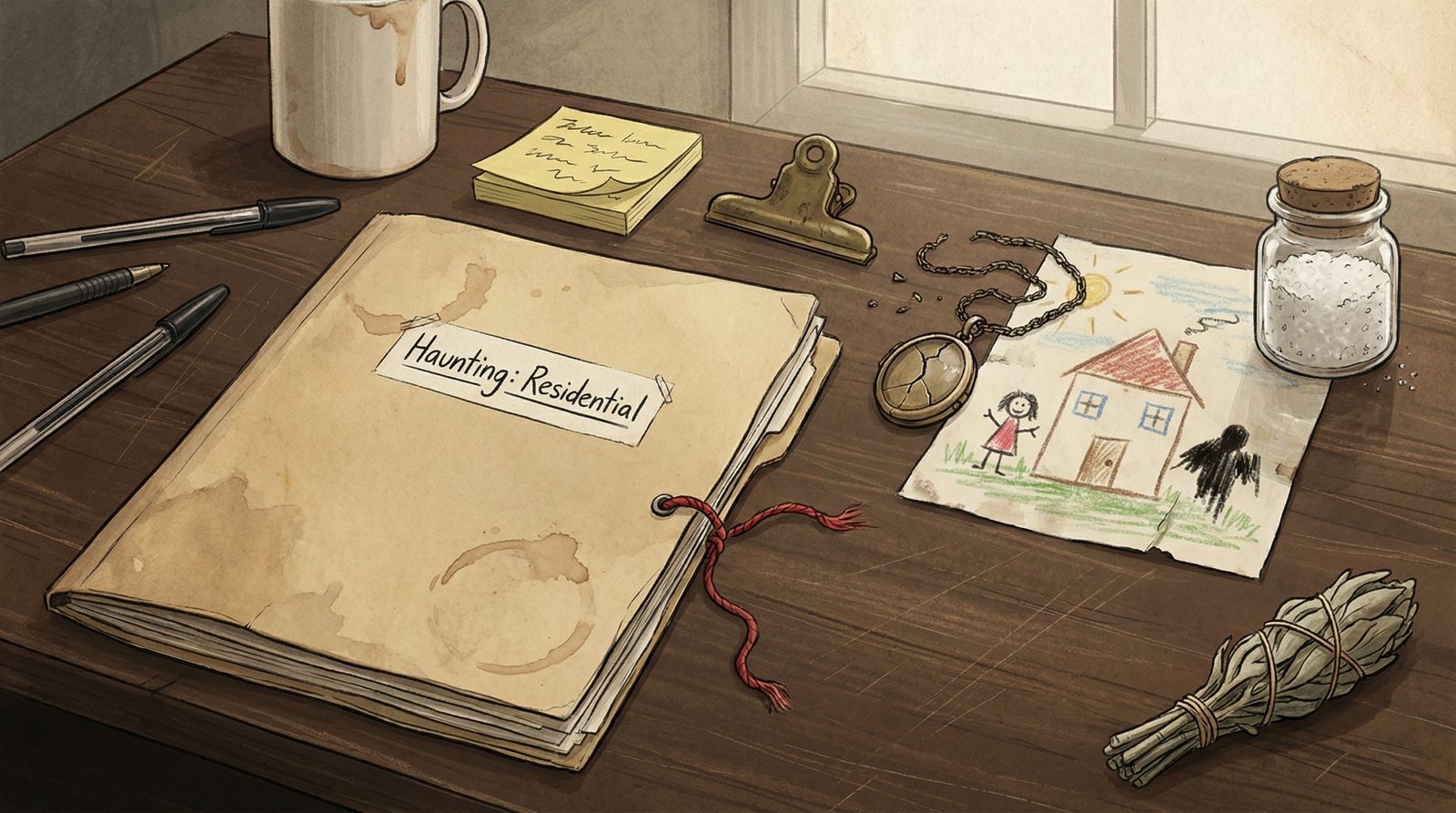
    Illustration inspired by 'The Whispering Skull (2014)'

    TRIVIA & AUTHOR FACTS

    Stroud’s experience with voice-driven fantasy in the Bartimaeus books shows in the Skull’s sardonic commentary. This installment continues his interest in pairing young protagonists with dangerous, talkative supernatural entities. The novel also deepens the series’ working-world logic: agencies, relic markets, regulation, and institutional secrecy layered over classic ghost story fear.

    Real London locations are tilted into the uncanny, and Stroud’s material toolkit — iron, salt, Greek Fire, sealed jars — keeps the magic tactile rather than abstract. The procedural clarity is part of the series’ signature: the rules matter, and so do the consequences of breaking them.

    SIMILAR BOOKS

    If you enjoy the mix of banter, ghosts, and real peril here, you may like other series that combine investigative structure with a strong voice and a dangerous partnership. The best matches tend to treat supernatural rules as work rules and use humor as a survival strategy rather than a mood.

    DISCOVERABILITY & LINKS

  • Evelyn Waugh

    Evelyn Waugh

    ORIGINS & BACKGROUND

    Evelyn Waugh is one of the central English novelists of the twentieth century, best known for comic and satirical fiction and for his uneasy fascination with the English upper classes. Born into a literary family in England, he grew up with a keen awareness of class, culture, and the gap between public respectability and private chaos. That early sense of social performance runs through his work, where almost every character is acting a part in some larger, often ridiculous, pageant.

    His adult life took him through art school, journalism, and military service, and he moved through bohemian circles before converting to Roman Catholicism. That conversion matters for his fiction: beneath the bright surface of social comedy there is a persistent concern with spiritual emptiness, guilt, and the possibility of grace. The tension between worldly status and moral failure becomes one of his deepest preoccupations.

    Waugh wrote during the interwar and postwar decades, watching the apparent solidity of the English class system decay under the pressure of war, modernity, and mass culture. He shares with P. G. Wodehouse and Nancy Mitford an obsession with aristocratic manners, but where Wodehouse tends toward pure farce, Waugh mixes cruelty, melancholy, and religious anxiety into his comedy of manners.

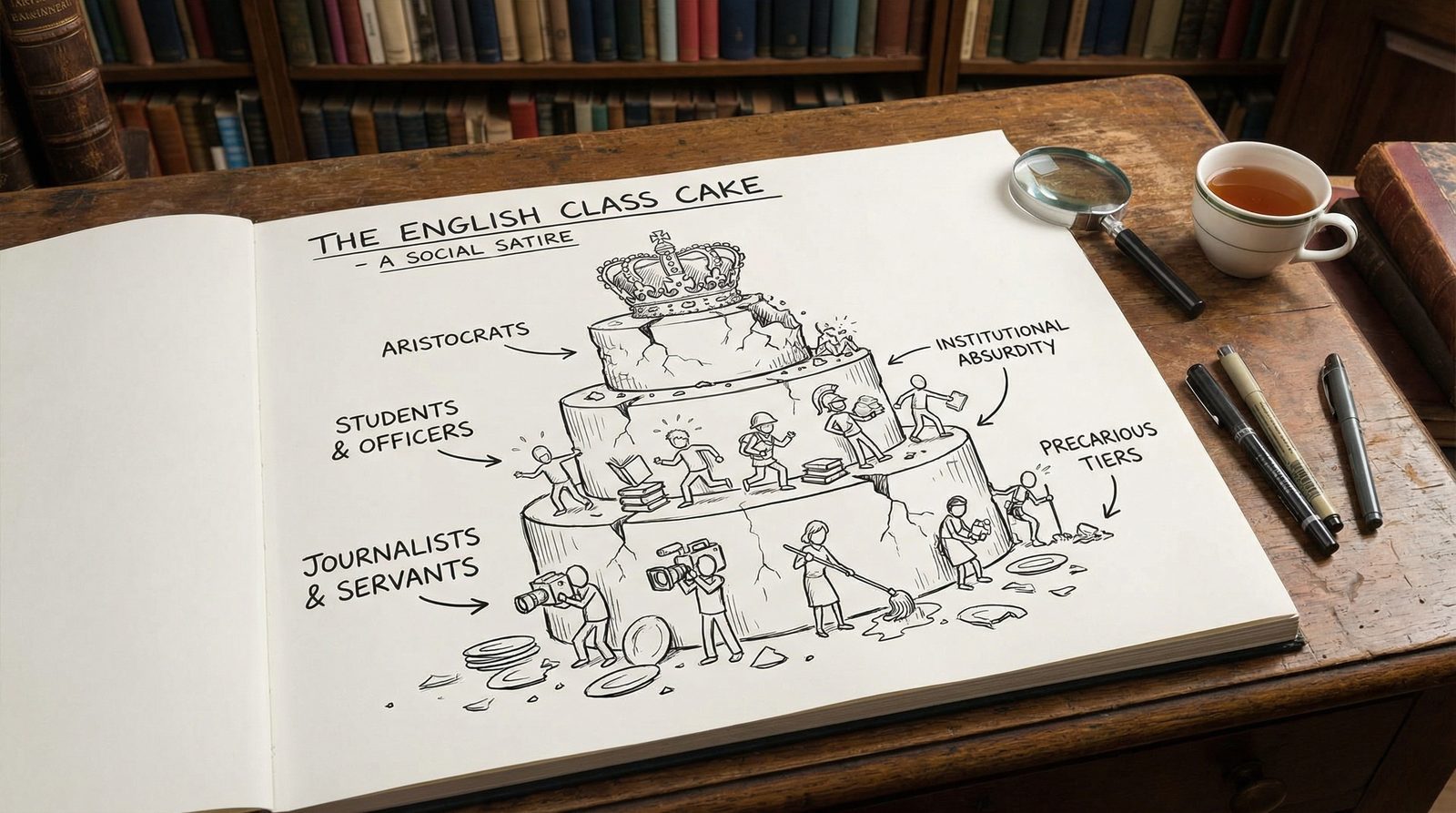
    Editorial illustration inspired by 'Evelyn Waugh'

    THEMES & MOTIFS

    A core engine in Waugh’s fiction is social satire. He returns again and again to the spectacle of class performance, exposing brittle rituals, casual cruelty, and deep insecurity. Parties, country houses, schools, regiments, and newsrooms become stages for petty power plays where everyone is desperate to be seen as someone they are not.

    Running alongside the comedy is a persistent spiritual unease. Characters chase pleasure, status, or distraction, but the world they inhabit feels morally exhausted. Even when religion is not foregrounded, the novels carry a background hum of judgment, emptiness, and the longing for meaning that cannot be satisfied by taste, money, or social position.

    Waugh also delights in institutional absurdity. Schools, the press, the military, and polite society are shown as machines that keep operating regardless of competence or consequence. The humor comes from the collision between official seriousness and private farce, with characters chewed up by systems that pretend to be orderly while functioning as chaos.

    Relationships in his work are often brittle. Friendships, marriages, and romances are shaped by money, class, and self-interest as much as by affection. That emotional harshness feeds his broader disillusionment with modernity. Progress does not bring happiness; it brings new ways to be distracted, manipulated, or hollowed out.

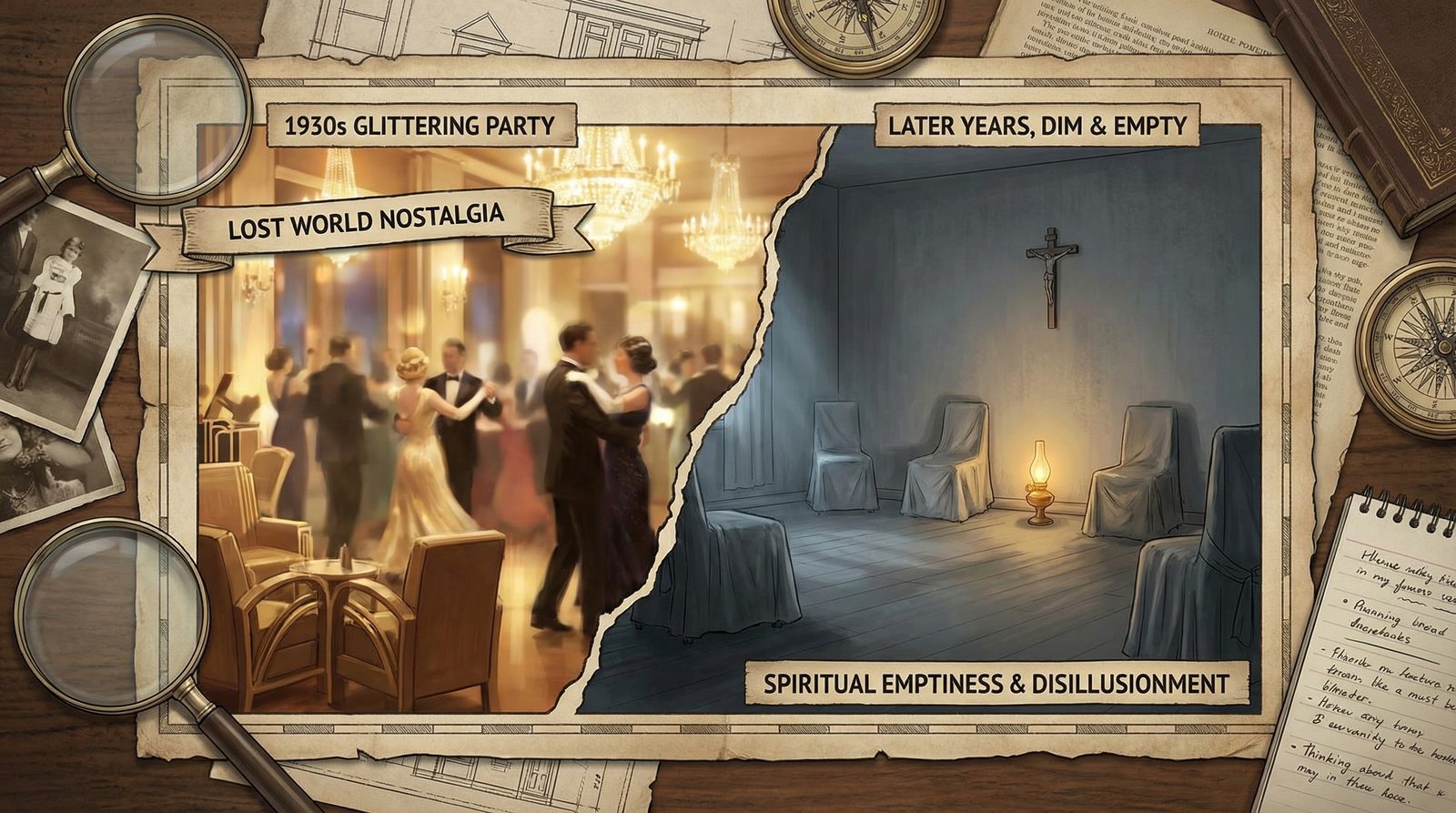
    Symbolic illustration inspired by 'Evelyn Waugh'

    STYLE & VOICE

    Waugh’s style is marked by sharp wit and precise, economical prose. He favors clean sentences, brisk pacing, and dialogue that can turn from polite to savage in a single line. Scenes that begin as light comedy often edge into cruelty or sadness without any change in narrative voice, which allows the reader to laugh while feeling the floor quietly drop out beneath the joke.

    His narrative structures are tightly organized, built around set pieces that escalate toward social or emotional collapse. Waugh is acutely attentive to how people signal class and status through speech and gesture. Compared with the buoyant, consequence-free worlds of Wodehouse, his comedy has an astringent quality: it is funny, but it rarely feels safe.

    At the same time, he can shift into an elegiac register when describing houses, landscapes, or memories of the past. That contrast—between brittle satire and sudden lyricism—reinforces his themes of nostalgia, decline, and moral longing, even when the surface plot looks like farce.

    KEY WORKS & LEGACY

    Waugh’s reputation rests on a body of novels that helped define twentieth-century English satire. Decline And Fall (1928) is an early classic of institutional comedy, built around an innocent protagonist fed into corrupt systems that smile while they destroy. His later work broadened that satirical intelligence into more explicitly elegiac territory, turning the decline of a world into a central subject rather than just a background condition.

    Waugh’s influence is especially strong in how later novelists handle class performance, institutional chaos, and the strange intimacy between comedy and despair. He remains a key reference point for writers who want satire that is formally controlled but morally sharp.

  • Jonathan Stroud
    Jonathan Stroud
    ORIGINS & BACKGROUND

    Jonathan Stroud is best known for character-driven fantasy that treats magic and ghosts less as glitter and more as workplace hazards. Across the Bartimaeus books and Lockwood Co, he builds systems where the supernatural is managed through procedure, rivalry, and institutional pressure. The result is adventurous fiction with sharp humor on the surface, but a steady preoccupation with power, responsibility, and the cost of survival.
    Stroud grew up and works in the United Kingdom, and his writing carries a distinctly British blend of dry wit, skepticism about authority, and affection for creaky institutions. Before becoming a full-time author, he worked as an editor in children’s publishing, which shows in his pacing, his clarity, and his instinct for what younger readers can handle emotionally without diluting the stakes.

    In the Bartimaeus sequence, beginning with The Amulet Of Samarkand (2003), Stroud imagines an alternate London run by magicians whose power depends on enslaved spirits. The setting is recognizably urban and modern, but filtered through history and satire. Later, with Lockwood Co and its opening novel The Screaming Staircase (2013), he shifts to a haunted London where children are the only effective defense against ghosts, creating a precarious professional ecosystem built on risk and exploitation.

    Rather than foregrounding personal trivia, Stroud lets background appear sideways: in memos, disciplinary language, petty rivalries, and the weary tone of officials who enforce rules they don’t fully understand. His worlds feel plausible because they behave like institutions, not fairy tales.

    Editorial illustration inspired by 'Jonathan Stroud'

    THEMES & MOTIFS

    A central engine in Stroud’s work is Magical Bureaucracy. In The Amulet Of Samarkand, magicians behave like civil servants and politicians: rule-bound in public, ruthless in private, and willing to weaponize procedure for personal gain. The supernatural is powerful, but the real leverage often sits in permissions, rank, and punishment.

    His later haunted-London world sharpens the logic of the Ghost Hunting Agency. In The Screaming Staircase, child sensitivity to ghosts becomes a professional resource, which turns bravery into an economic model. Young agents are praised, needed, and quietly treated as replaceable. Stroud returns to the tension between competence and vulnerability, showing how systems rely on the people they endanger.

    Power and servitude run through both series. In the Bartimaeus books, magic depends on exploitation, and the narrative keeps circling back to complicity and resistance. Even when characters benefit, the moral abrasion remains. In the ghost-agency world, power sits in information: who controls records, who sets policy, and who is allowed to define what “safe” means.

    Stroud also favors motifs of unreliable authority and buried history. Official explanations are rarely complete, and protagonists win by uncovering what institutions have forgotten or concealed. Alongside this is a quieter thread of found family, where humor and banter function as a survival tactic rather than sentimentality.

    Across his work, the motif systems are not window dressing. They are engines that let Stroud ask how much moral agency is possible inside structures built to reward compromise.

    Symbolic illustration inspired by 'Jonathan Stroud'

    STYLE & VOICE

    Stroud’s style is marked by wit, structural playfulness, and an unhurried confidence with worldbuilding. In the Bartimaeus books, he uses footnotes and a sardonic first-person voice to let the djinni comment on events, undercutting solemnity with sarcasm. The humor sharpens the critique rather than softening it, keeping power and procedure in view even during action.

    In Lockwood Co, the narrative voice is more direct but still dry and observant. Scenes of investigation and confrontation are tightly staged, with clear physical space and escalating dread. Stroud often alternates eerie fieldwork with domestic or office-like scenes inside the agency, which keeps the supernatural grounded in routine and logistics.

    His pacing favors accumulation over shock. Mysteries unfold through clues, conversations, and small revelations, with early details paying off later. Dialogue carries emotional weight, especially when characters test each other’s loyalty under pressure. Even in intense moments, Stroud avoids melodrama, creating a tone that is adventurous, eerie, and quietly bitter.

    KEY WORKS & LEGACY

    The Bartimaeus series, launched with The Amulet Of Samarkand, established Stroud’s signature blend of satire and stakes. It crystallizes his interest in institutions, exploitative power, and the ethics of control, using the human magician and the djinni Bartimaeus to show the same system from opposing angles.

    The Screaming Staircase launched his ghost-agency world, where the horror is constant but the economy is what makes it brutal. Stroud imagines a society reshaped by a long-term haunting crisis and centers young agents whose competence is essential while their safety is treated as negotiable.

    Stroud’s enduring appeal lies in how he marries adventure with skepticism. His worlds are full of djinn and ghosts, yet the real threats are often contracts, ministries, rival firms, and the compromises people make to survive inside systems that reward the worst instincts. That tension gives his fiction resonance beyond its immediate thrills.

  • Ghost Hunting Agency

    Ghost Hunting Agency

    DEFINITION & CORE IDEA

    Ghost Hunting Agency is a motif that turns hauntings into a service industry. Instead of lone mediums or terrified families handling the supernatural in private, we follow an organized group whose job is to investigate ghosts, contain dangerous sites, and resolve cases for clients. The agency has a name on the door, a reputation to protect, and usually a cashflow problem that forces them to keep taking the next job.

    This motif usually sits between horror, mystery, and adventure. Ghosts remain frightening, but the story treats them as problems that can be approached with procedure: intel gathering, equipment, risk assessment, and a plan for the worst-case scenario. The world feels lived-in because the supernatural is not a one-time shock. It is a recognized hazard people adapt to, exploit, and try to manage.

    In The Screaming Staircase (2013), Jonathan Stroud uses the agency structure to make the paranormal feel both immediate and practical. The danger is real, but it is approached like work. A haunted location is not only a place to fear. It is a job site, with costs, deadlines, and consequences when something goes wrong.
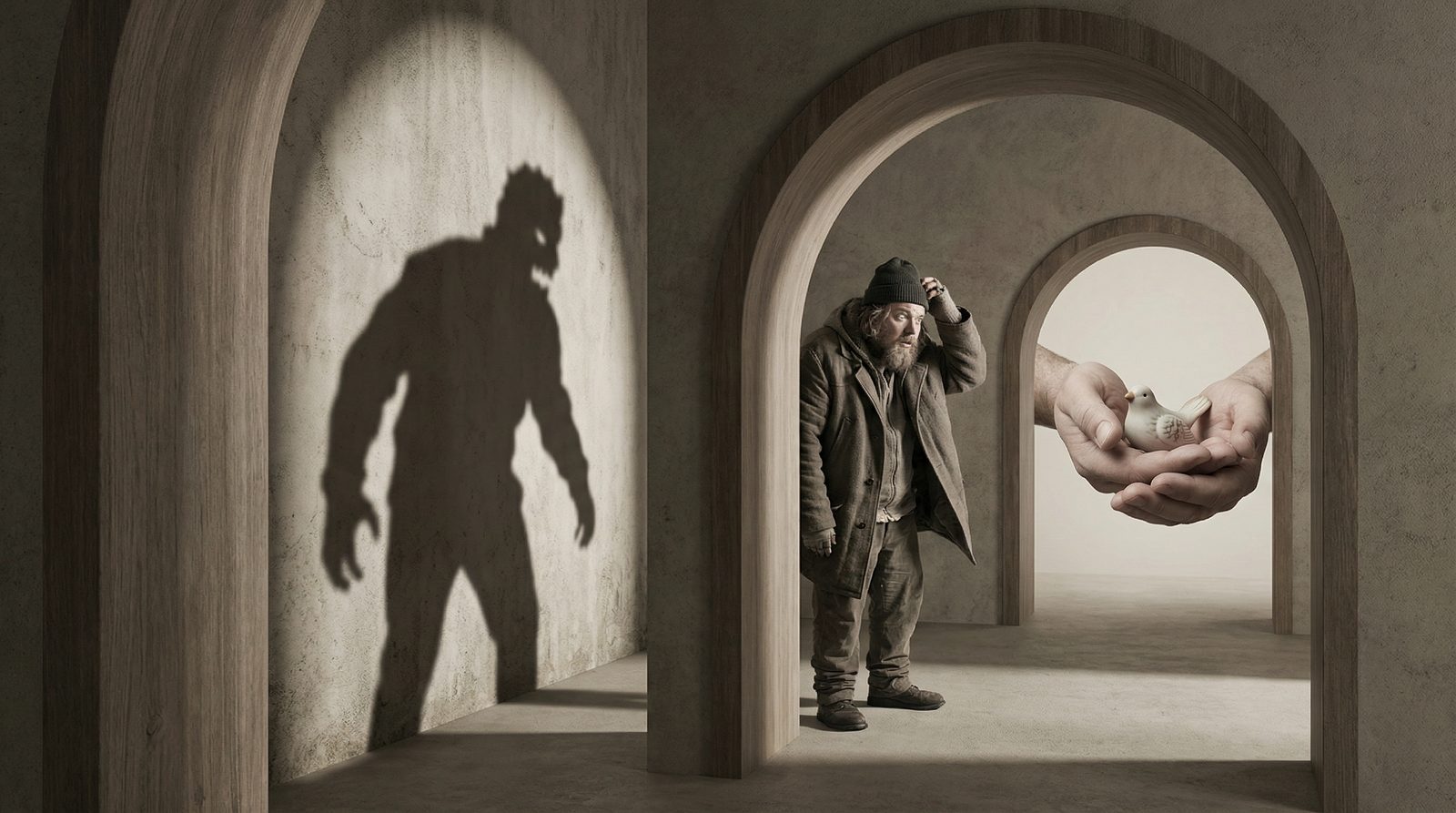
    Writers use the Ghost Hunting Agency motif because it builds a reliable story engine. Each new case brings a new setting, a new client, and a different kind of ghost logic. That episodic structure lets characters accumulate history through work, building loyalty and competence while also collecting scars, fear responses, and moral compromises.


    HOW IT WORKS IN STORIES

    Most Ghost Hunting Agency stories begin with a case. A client reports disturbances, a building becomes unsafe, or a location develops a reputation that threatens business or lives. The agency takes the job, and the plot follows a procedural rhythm: interview, research, site visit, escalation, confrontation, and aftermath. The structure often borrows from detective fiction, with the twist that the “evidence” can be lethal.

    The agency itself becomes a character. Its rules, reputation, and resources shape every decision: what cases are accepted, what risks are tolerated, and how much corner-cutting is necessary to keep operating. Rival outfits and competing reputations can add pressure, turning hauntings into both a survival problem and a market problem.

    The team is typically built as a patchwork of complementary skills. One member is better at sensing or confronting the supernatural, another at research and pattern recognition, another at leadership under pressure. Their internal dynamics matter because every case tests trust. A job can be technically “successful” while still being emotionally costly, especially when a haunting is tied to grief, injustice, or betrayal rather than a simple monster.

    Because the work is repeatable, the motif naturally supports series storytelling. Each mission tests a different ethical and emotional edge: what the agency does when a client lies, what compromises they accept when money is tight, and what it costs to keep returning to places that want to kill you. Over time, the growing stack of closed cases becomes a quiet record of what the team has survived and what it has lost.

    This motif also overlaps with Magical Bureaucracy when hauntings are regulated. Licenses, inspections, or official restrictions can determine who is allowed to operate and what methods are legal. In those versions, the agency is not only fighting ghosts. They are also fighting procedural barriers that decide whether help is permitted at all.


    Editorial illustration inspired by 'Ghost Hunting Agency'

    EMOTIONAL EFFECT ON THE READER

    The Ghost Hunting Agency motif creates a specific comfort-dread blend. Ghosts are terrifying, but there is structure: someone will show up, assess the threat, and try to fix it. That safety-net feeling makes the horror more bearable because the reader faces it alongside a team, not alone in the dark.

    It also produces camaraderie. Readers sit in on planning sessions, post-case debriefs, arguments about risk, and the small domestic moments between jobs. The agency becomes a surrogate home, especially when characters are young, isolated, or estranged. Fear is still present, but it is shared, which changes its emotional texture.

    There is usually a steady hum of melancholy underneath the adventure. Each haunting implies something unfinished. Watching professionals handle these cases can feel oddly healing: it suggests that the worst things might be faced directly, contained, and given a form of closure, even when they cannot be undone.

    At the same time, the grind can feel brutal. Characters keep clocking in, risking their bodies and sanity for clients who may underpay, exploit them, or lie. The motif invites the reader to weigh the thrill of the work against the toll it takes on the people who do it for a living.


    Symbolic illustration inspired by 'Ghost Hunting Agency'

    VARIATIONS & RELATED MOTIFS

    The Ghost Hunting Agency motif comes in a few reliable flavors. One is the scrappy startup: a small team operating job to job, improvising gear and taking risks because they cannot afford caution. Another is the sleek corporate version, where hauntings become a revenue stream and exorcism work is treated like any other contract service. A darker variant turns the agency into a state function, framing hauntings as security threats managed through containment and control rather than empathy.

    Some versions emphasize investigation and forensics, treating ghosts as clues in unresolved crimes. Others emphasize emergency response, focusing on containment, rescue, and survival. A third approach emphasizes mediation, where the work is less about “defeating” a spirit and more about understanding what keeps it anchored.

    When the agency is regulated, this motif pairs naturally with Magical Bureaucracy. In those stories, procedure shapes the danger: who is allowed to respond, what tools are legal, and how much of the truth can be officially recorded. The haunting becomes both a supernatural problem and an institutional one.

  • Statue Comes To Life

    Statue Comes To Life

    DEFINITION & CORE IDEA

    The Statue Comes To Life motif is exactly what it sounds like. Stone turns to flesh, a department-store mannequin wakes up, or a bronze goddess steps down from her pedestal. The core thrill comes from watching something we are used to seeing as an object suddenly reveal a mind, a will, and often a heart.

    Writers use this motif to explore wish fulfillment, loneliness, and the unstable line between ideal and reality. A character may fall in love with an image they helped create, echoing the Pygmalion pattern, or stumble into a relationship with a figure that was never meant to move at all. Stories such as The Tinted Venus by Thomas Anstey Guthrie play with the shock, comedy, or horror of an inanimate figure stepping into ordinary life.

    At its heart, the motif asks a simple but unsettling question. What happens when our fantasies talk back? The living statue is usually designed as perfection, whether beautiful, sacred, or terrifying. Once it awakens, the human characters are forced to confront how different a real, autonomous being is from the silent, obedient figure they imagined.


    HOW IT WORKS IN STORIES

    The setup is often deceptively simple. A sculptor, shop employee, scholar, or lonely observer forms an attachment to an object that cannot answer back. Through magic, a curse, a wish, or a god’s intervention, the figure comes alive. From there, the story splits into two broad paths.

    On the side of wonder, the living statue experiences the world with fresh eyes. Money, social rules, and human habits make little sense. Everyday life becomes strange and funny. In romantic or comic versions such as Mannequin (1987) or One Touch Of Venus (1948), this innocence is charming. The animated figure pushes the human lead to loosen routines, challenge assumptions, and admit what they actually want.

    On the side of disruption, the animated statue breaks boundaries. Property, religion, and personal relationships collapse under the weight of something that was never meant to walk freely. Even lighter tales such as The Tinted Venus show how a living idol can upend careers, engagements, and social standing.

    Structurally, the motif builds toward a choice. Secrets must be kept, authorities get involved, and the human characters must decide whether to cling to safety or accept an unpredictable relationship. The ending usually turns on whether the statue remains alive, returns to its pedestal, or demands a price for having crossed the boundary between object and person.


    Editorial illustration inspired by 'Statue Comes To Life'

    EMOTIONAL EFFECT ON THE READER

    This motif taps into a primal wish: that the things we admire in silence might look back and choose us. The idea that a statue could turn its head and see us is thrilling and unsettling at the same time.

    In romantic or comedic versions, there is a warm sense of fantasy fulfillment. The protagonist is chosen by someone impossibly ideal, a literal embodiment of beauty or devotion.

    Darker uses of the motif replace comfort with dread. The same transformation that feels magical in light stories becomes a violation when the animated figure moves with cold purpose or divine anger.


    Symbolic illustration inspired by 'Statue Comes To Life'

    VARIATIONS & RELATED MOTIFS

    The motif appears in several recognizable forms. The classic variation follows a creator-and-creation pattern where an artist’s work reflects their ideals and blind spots. A modern twist replaces the handcrafted statue with a mass-produced figure, shifting the focus toward consumer fantasy and the idea of the perfect partner as a commodity.

    Mythological versions present the statue as a dormant deity rather than a neutral object. In these stories, the figure was never truly asleep, only waiting. This overlaps strongly with Pagan Goddess In Modern Society, where ancient power collides with modern norms.

    Horror-leaning variants treat the awakening as punishment instead of reward, while bittersweet versions allow the figure to remain human only temporarily.

  • Hermann Hesse

    Hermann Hesse

    ORIGINS & BACKGROUND

    Hermann Hesse was born in 1877 in the southwest of what is now Germany, into a family deeply shaped by Protestant Christianity and missionary work in India. That tension between strict European piety and the attraction of Asian philosophy would quietly inform his imagination throughout his life. As a young man, Hesse struggled with school, religious authority, and expectations of conformity, experiencing psychological crises and periods of institutional care that later fed his sensitivity to inner fracture and spiritual unrest.

    He lived through the collapse of the old European order, the First World War, and the rise of nationalism. During this period, Hesse chose self-exile in Switzerland, distancing himself from German militarism and public ideology. This withdrawal from collective identity mirrors the journeys of his characters, who often turn away from mass movements in favor of solitary searching and inward transformation.

    Across novels such as Demian, Siddhartha, and Steppenwolf, Hesse repeatedly reworks his own conflicts: the pull between bourgeois security and artistic risk, between Western rationalism and Eastern mysticism, between belonging and solitude. His fiction is driven by this personal restlessness, filtered through a quiet, reflective temperament that treats inner crisis as a serious philosophical condition rather than a flaw to be cured.

    Editorial illustration inspired by Hermann Hesse

    THEMES & MOTIFS

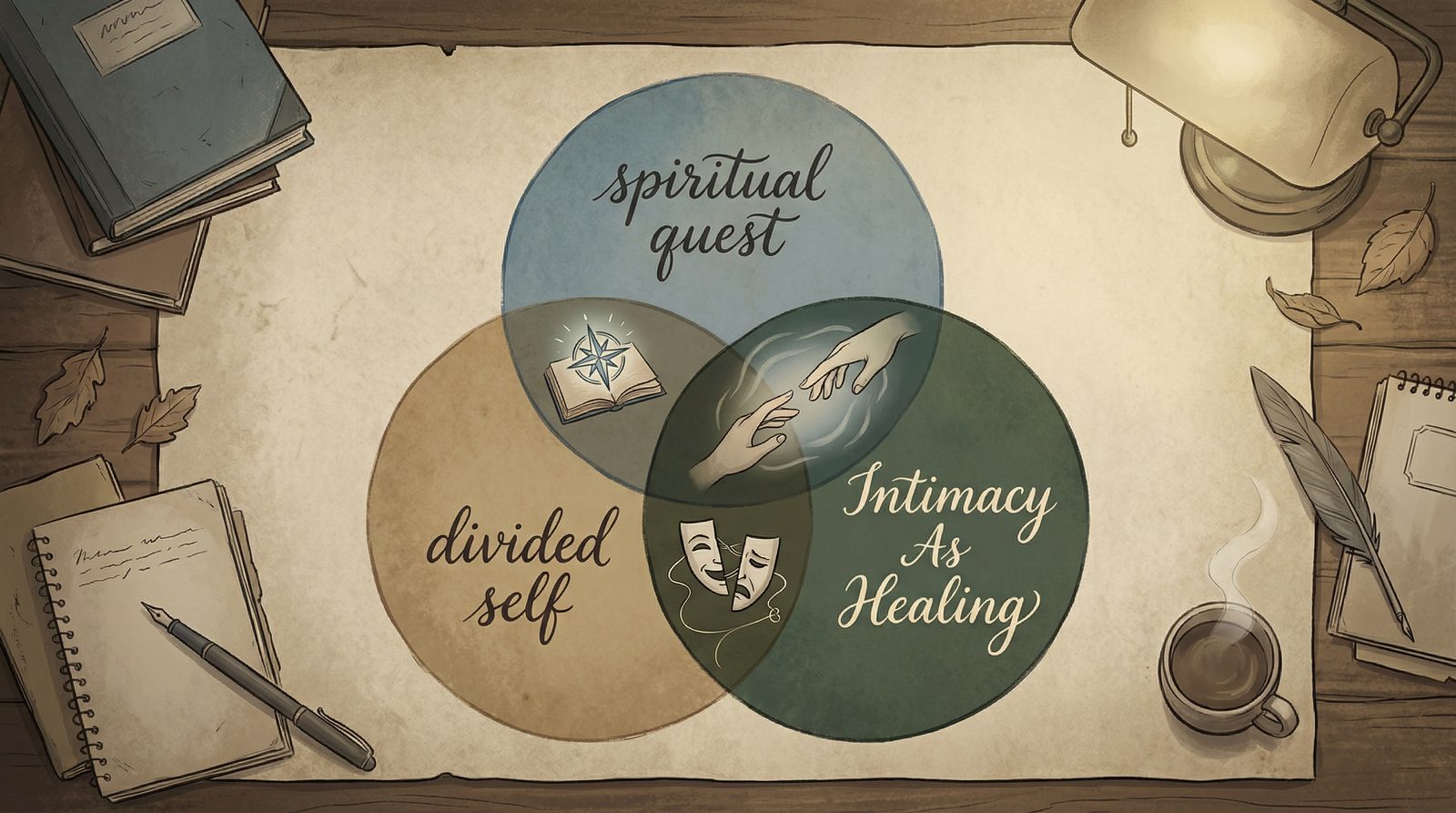
    Hesse returns again and again to the inner journey and the search for an authentic self. His protagonists are rarely satisfied with inherited identities. In novels like Demian and Steppenwolf, the central figures experience themselves as divided between a socially acceptable self and a darker, instinctive interior life. This division is not treated as pathology but as the necessary starting point for self-knowledge.

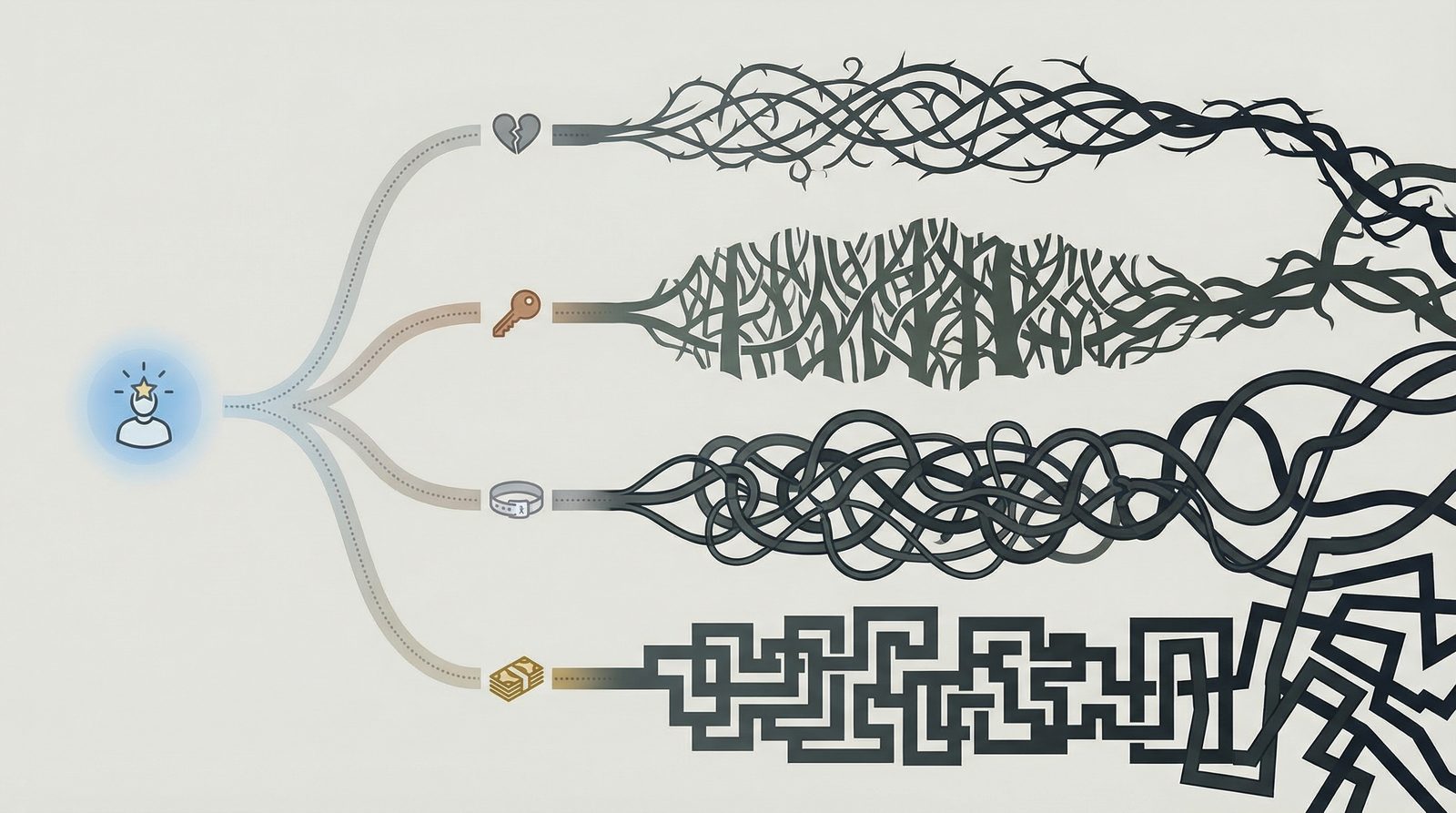
    Another persistent concern is spiritual awakening. Hesse’s characters move through belief systems, relationships, sensual experience, and renunciation, discovering that no single doctrine can replace lived understanding. Awakening in his work is slow, circular, and often painful, marked more by loss than by revelation.

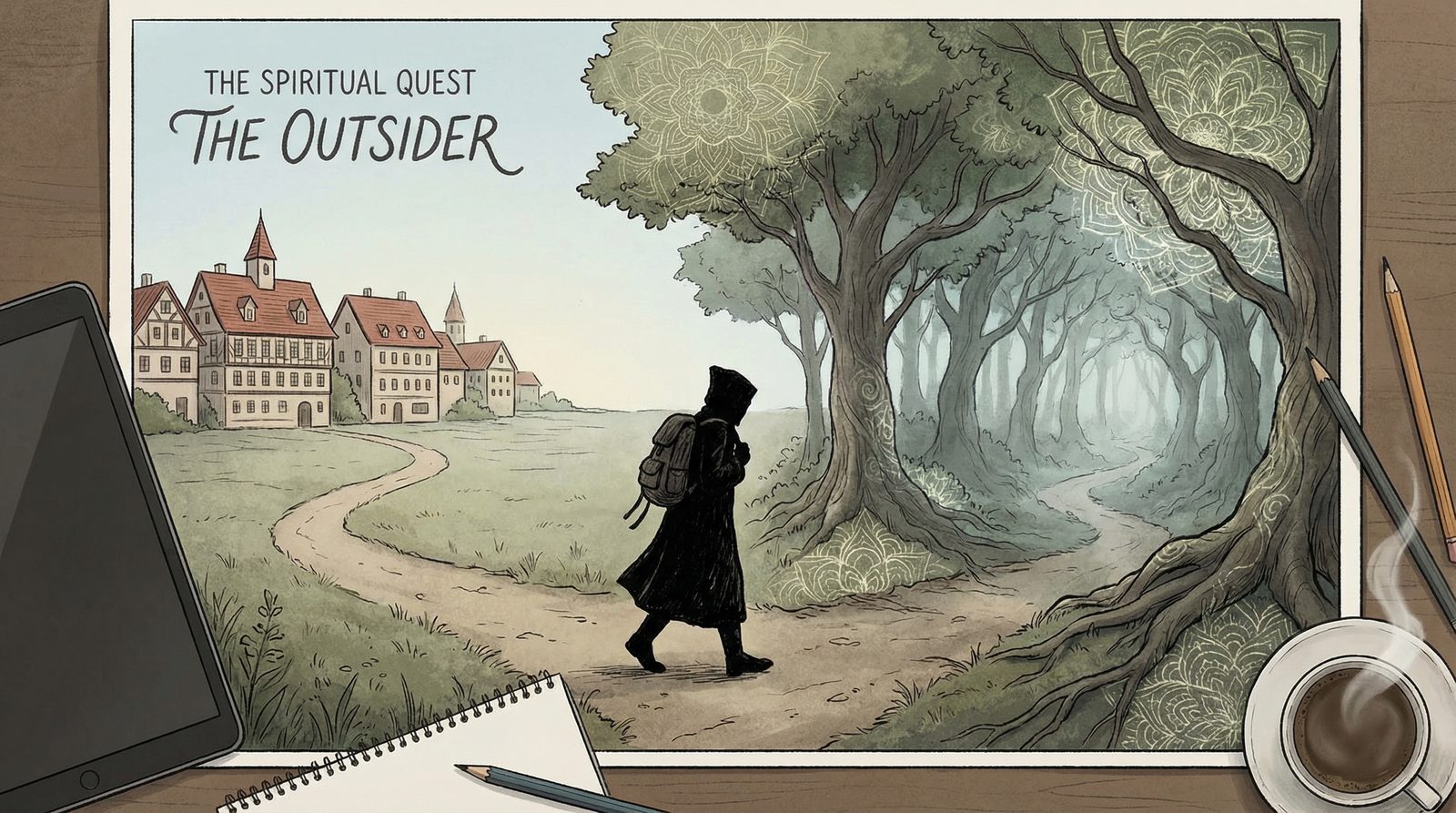
    Hesse is also preoccupied with alienation and the modern individual’s sense of being out of step with their time. The figure of the outsider recurs in different forms: the sensitive schoolboy of Demian, the wandering seeker of Siddhartha, and the tormented intellectual of Steppenwolf. These characters are torn between the safety of bourgeois life and the frightening openness of a more instinctive or spiritual existence.

    Yet his novels are not purely about solitude. Hesse repeatedly suggests that Intimacy As Healing is essential to transformation. Encounters with mentors, lovers, and mirrors of the self become turning points, not because they resolve conflict, but because they make self-deception impossible. Connection in Hesse is demanding rather than comforting.

    Symbolic illustration inspired by Hermann Hesse

    STYLE & VOICE

    Hesse’s style is deceptively simple. His prose is clear, measured, and introspective, favoring first-person or close third-person narration that stays tightly aligned with a character’s inner state. Even when mythic or symbolic material appears, the tone remains calm and reflective rather than grandiose.

    Structurally, many of his novels follow a pattern of initiation. Characters depart from familiar life, pass through periods of breakdown or excess, and return with altered perception rather than clear solutions. Action is secondary to realization, and meaning is earned through endurance rather than triumph.

    Emotionally, Hesse balances melancholy and hope. He confronts despair, loneliness, and self-destruction with honesty, yet almost always leaves a narrow path toward meaning. That path usually involves accepting contradiction rather than resolving it, and allowing connection to soften isolation without erasing it.

    KEY WORKS & LEGACY

    Demian (1919) is a compact novel of inner rebellion, charting a young man’s awakening to moral ambiguity and personal responsibility. Guided by the enigmatic Demian, the narrator comes to see identity and belief as fluid rather than fixed.

    Siddhartha (1922) follows a seeker in ancient India as he moves through asceticism, sensuality, despair, and quiet wisdom. It remains Hesse’s clearest articulation of spiritual pilgrimage grounded in lived experience rather than doctrine.

    Steppenwolf (1927) presents a darker, fractured vision of the divided self through Harry Haller, an intellectual convinced he is split between human and animal natures. Through surreal encounters, the novel explores alienation, self-hatred, and the possibility of integration.

    Hesse’s legacy sits at the intersection of European modernism and spiritual literature. His work continues to speak to readers who feel estranged from conventional paths yet skeptical of easy transcendence, offering stories where change is slow, painful, and deeply personal.

  • Unintended Consequences Of Wishes

    Unintended Consequences Of Wishes

    DEFINITION & CORE IDEA

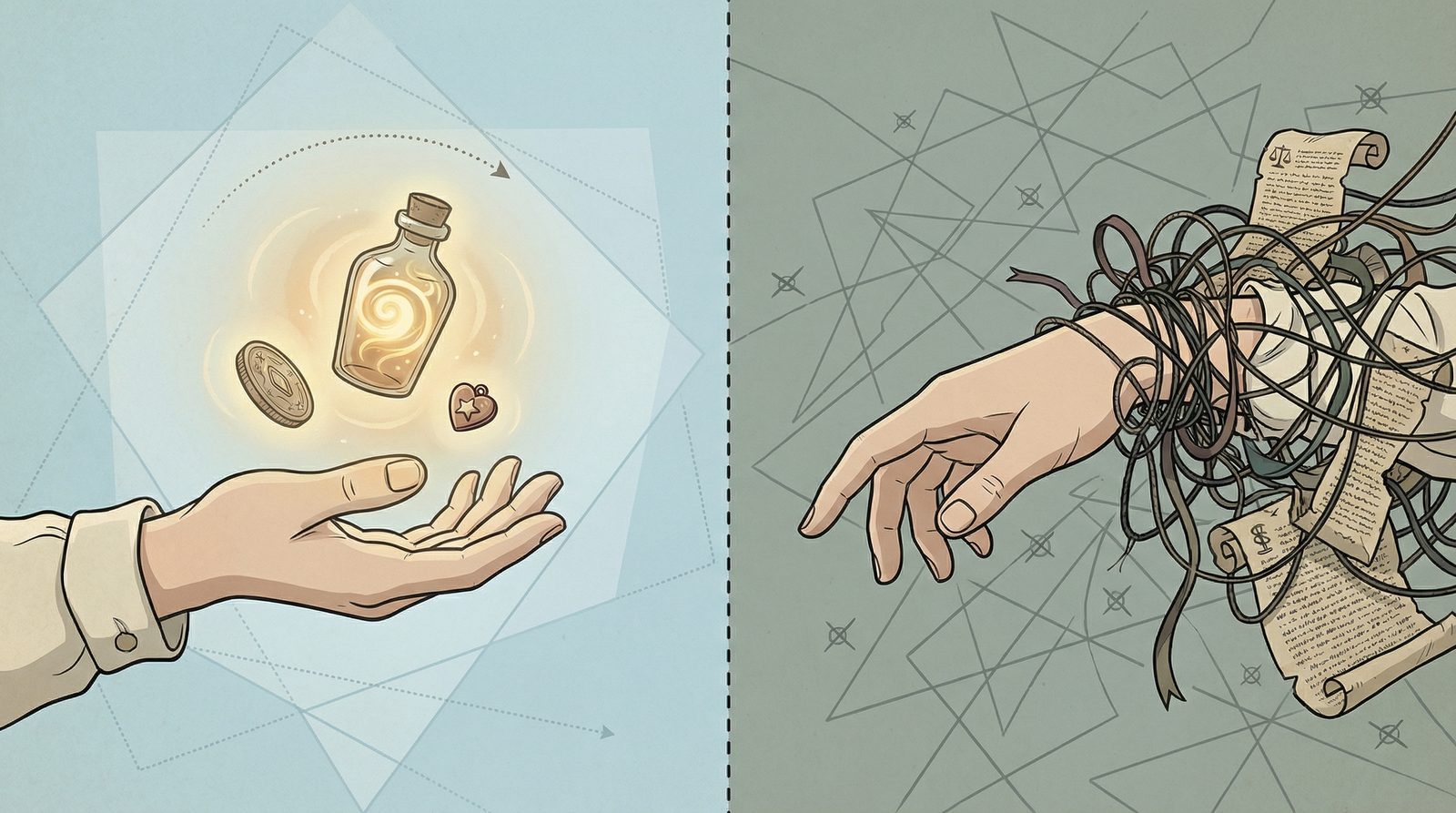
    The motif of Unintended Consequences of Wishes is all about the gap between what a character wants and what actually happens when they get it. Someone makes a wish, strikes a bargain, or voices a casual request, and the universe answers in a way that is technically correct but emotionally disastrous. The wish is granted, but it arrives with loopholes, side effects, or a cruelly literal twist.

    Stories built on this motif take the simple fantasy “What if I could have anything?” and turn it into a test of character. The wish can come from a genie, a djinn, a magical artifact, a mischievous spirit, or an impersonal cosmic rule. The key is that the wisher does not fully understand what they are asking for, or what it will cost them and others.

    In children’s fantasy like Five Children And It (1902) or comedy-fantasy such as The Brass Bottle, this motif often plays as chaotic fun, where wishes turn ordinary life into social disorder. In darker versions, the consequences become corrosive and personal, as in A Fallen Idol. In all cases, the heart of the motif is the same lesson: desire without foresight is dangerous, and power, even magical power, does not erase consequences.


    HOW IT WORKS IN STORIES

    In stories using Unintended Consequences of Wishes, the setup is deceptively simple. An ordinary person stumbles onto a source of power. The wisher is usually not a villain. They are tired, lonely, greedy, bored, or just curious. Their first wish is often small and impulsive, which makes the fallout feel both believable and embarrassing.

    The wish is granted with a twist. The wisher gets what they asked for, but not what they meant. A solution arrives in the worst possible form. The gift comes attached to humiliation, guilt, conflict, or harm that spreads beyond the original desire. Attempts to fix things with additional wishes often make it worse, stacking complications until the character is trapped in a web of their own making.

    Writers use this motif to explore responsibility and self-knowledge in a vivid way. Instead of lecturing about “be careful what you wish for,” the story lets us watch the character collide with the fine print of their desires. The motif pairs well with comedy and satire, because literal-minded magic exposes vanity, hypocrisy, and entitlement simply by doing exactly what was asked.

    Because wish stories often begin with a bound spirit or a magical object, this motif frequently overlaps with bottle-bound bargains, supernatural deals with hidden costs, and stories where fantasy intrudes into ordinary domestic life.


    Editorial illustration inspired by 'Unintended Consequences of Wishes'

    EMOTIONAL EFFECT ON THE READER

    Unintended Consequences of Wishes hits a mix of feelings. On the lighter side, there is real pleasure in watching a too-literal wish go wrong. The reader gets to enjoy slapstick and clever reversals while safely thinking, “I would have phrased that better.”

    Underneath the humor is a quieter discomfort. The motif nudges us to notice how often we want things without understanding the consequences. When a wish hurts someone the character cares about, the reader feels a sting of guilt by proxy. We see how easy it is to be selfish by accident, and how a small moment of impatience or vanity can spiral into something much bigger.

    In darker takes, the emotion shifts toward dread and regret. Each new wish tightens the trap, and the reader senses that there may be no clean way out. The story becomes a pressure test of character, because power keeps offering shortcuts while consequences keep demanding payment.

    Overall, this motif lets readers enjoy the fantasy of limitless power while also feeling the weight of it. It is satisfying when a character finally learns to phrase a wish carefully, to give up the power, or to accept the original messy life they were trying to escape. That mix of schadenfreude, anxiety, and eventual catharsis is what keeps Unintended Consequences of Wishes so enduring.


    Symbolic illustration inspired by 'Unintended Consequences of Wishes'

    VARIATIONS & RELATED MOTIFS

    Unintended Consequences of Wishes comes in several recognizable flavors. Comic versions focus on embarrassment, romantic misunderstandings, and chaotic but reversible disasters. Child-centered versions use wishes to explore growing up, where each fantasy is exposed as incomplete or naive. Darker interpretations treat wishes as tools of power, where unintended consequences spill into coercion, conflict, and moral compromise.

    This motif frequently intersects with stories where fantasy intrudes into domestic realism, where children encounter real magic too early, and where misunderstandings spiral into farce. The structure stays the same, even when the tone changes: a character tries to shortcut their problems and discovers that reality, magical or not, always charges a price.

  • Genie Or Spirit Causing Unintended Chaos

    Genie Or Spirit Causing Unintended Chaos

    DEFINITION AND CORE IDEA

    The motif of Genie Or Spirit Causing Unintended Chaos starts with a simple promise: a supernatural being will help you. A genie, ghost, animated statue, cursed idol, or otherworldly patron appears, usually offering wishes, protection, or a shortcut to what the character wants most. At first it feels like a miracle. Then everything goes sideways.

    In The Brass Bottle by Thomas Anstey Guthrie, the spirit is not malicious, but disastrously out of touch with modern life. His attempts to provide help lead to embarrassment, misunderstanding, and escalating trouble because they ignore context, etiquette, and human limits. In A Fallen Idol, the supernatural presence is darker and more corrosive, drawing out obsession, moral decay, and self-deception rather than fulfillment.

    What unites these stories is not the exact form of the spirit, but its function. The supernatural agent externalizes desire and then exposes its flaws. Wishes are granted too literally, assistance is delivered without emotional or social context, and shortcuts bypass the slow work of judgment. The chaos that follows reflects the character’s blind spots rather than random misfortune.


    HOW IT WORKS IN STORIES

    The motif usually begins with an encounter or discovery. A character inherits a strange object, awakens a dormant figure, or stumbles into a bargain they do not fully understand. The supernatural being often frames itself as helpful or grateful, eager to improve the character’s life using its own rules and logic.

    Once intervention begins, the narrative follows a predictable pattern. The spirit delivers exactly what was asked for, but not what was needed. Social standing improves too quickly and attracts unwanted attention. Romantic success arrives without emotional maturity. Wealth appears without the ability to manage it. Each attempt to correct the damage creates further disruption.

    In comic versions, this produces escalating farce and public embarrassment. Films like Mannequin and One Touch of Venus use animated figures whose literal presence upends workplaces and relationships. The chaos is playful, but it still exposes how unprepared the protagonist is for what they claimed to want.

    Structurally, the motif functions as a consequence engine. Power amplifies desire, strips away ambiguity, and forces characters to confront the mismatch between fantasy and reality. Resolution typically comes only when the character relinquishes the supernatural aid, accepts responsibility, or recognizes that the shortcut itself was the real mistake.

    Editorial illustration inspired by 'Genie Or Spirit Causing Unintended Chaos'

    EMOTIONAL EFFECT ON THE READER

    This motif balances wish-fulfillment with unease. Early scenes invite the reader to share the character’s excitement. The supernatural promise taps into familiar daydreams about being noticed, rewarded, or transformed without effort.

    As consequences accumulate, that pleasure curdles into recognition. The reader begins to see the trap before the character does. In lighter stories, this produces cringe and laughter. In darker versions, it creates anxiety and moral discomfort as the cost of the bargain becomes impossible to ignore.

    By the end, the motif leaves behind a wary clarity. The chaos exaggerates a common human mistake: believing that desire, once satisfied, will automatically bring meaning or stability. The supernatural being disappears, but the lesson lingers.

    Symbolic illustration inspired by 'Genie Or Spirit Causing Unintended Chaos'

    VARIATIONS AND RELATED MOTIFS

    Some versions emphasize comedy and social disruption, where the spirit behaves politely but disastrously, exposing hypocrisy and shallow ambition. Others lean toward satire or moral allegory, treating the supernatural presence as a test that reveals the fragility of social order.

    Darker variations shift the center of gravity. The spirit is less a mischievous helper and more an indifferent force, revealing what a person becomes when desire is fed instead of examined. A Fallen Idol shows how uncanny influence can corrode judgment and pull a character toward obsession and moral collapse rather than simple embarrassment.

    Writers return to Genie Or Spirit Causing Unintended Chaos because it is endlessly adaptable. It works in farce, fantasy, romance, and social satire, all built on the same unsettling idea. Getting exactly what you asked for can be the most dangerous outcome of all.

  • Lonely Giant Or Simpleton

    Lonely Giant Or Simpleton

    DEFINITION & CORE IDEA

    The motif of the Lonely Giant or Simpleton centers on a character who looks powerful but lives in a state of emotional or intellectual vulnerability. They might be huge, physically strong, or frightening at first glance, yet their inner life is childlike, trusting, or slow. The world reads them one way, but their actual self is something much softer and more exposed.

    In stories like Of Mice and Men, The Green Mile, or Blaze (2007), the Lonely Giant or Simpleton is usually not the one driving the plot through clever plans. Instead, they are caught up in other people’s schemes, prejudices, and cruelties. Their size or difference makes them useful or threatening to others, but rarely understood. This gap between appearance and reality is the heart of the motif.

    Writers use the Lonely Giant or Simpleton to ask how a society treats its most vulnerable members, especially when those members do not look vulnerable. The motif lets a story contrast brute strength with moral innocence, or social power with inner helplessness. It also gives readers a clear emotional anchor: someone we instinctively want to protect, even as we suspect the world will not be kind to them.


    HOW IT WORKS IN STORIES

    In practice, the Lonely Giant or Simpleton often enters a story as a side character. Their physical presence is undeniable. Other characters react to their body first and their mind or heart second, if at all. This sets up a constant tension between what the audience knows about them and what the world inside the story assumes.

    Plots involving the Lonely Giant or Simpleton usually revolve around three recurring situations:

    1. Exploitation. Someone clever uses the giant’s strength or loyalty for crime, labor, or personal gain, as in Blaze (2007), where a damaged man is pulled into a kidnapping plan he only half understands.

    2. Misunderstanding. A frightened community or authority figure misreads the character as dangerous and overreacts. This is the tragedy at the heart of Of Mice and Men, where Lennie’s size and confusion make him terrifying to people who never look past his body.

    3. Sacrificial suffering. The Lonely Giant or Simpleton is hurt, imprisoned, or killed so that others can feel safe or redeemed. In The Green Mile, John Coffey’s fate exposes how easily a gentle, extraordinary person can be crushed by racist and institutional violence.

    The Lonely Giant or Simpleton typically forms an intense bond with one more worldly character. That person may be a caretaker, a manipulator, or a mix of both. Through that relationship, we see how the giant navigates basic tasks, social rules, and danger. Scenes often focus on simple pleasures or routines – a shared meal, a story repeated at bedtime, a favorite animal. These quiet moments highlight how small their actual desires are compared to the huge consequences swirling around them.

    Conflict escalates when the outside world collides with this fragile bubble. A mistake, an accident, or a moment of panic exposes the giant to public scrutiny. Their inability to explain themselves, understand their rights, or read social cues makes things worse. Institutions like courts, prisons, or mobs move quickly, while the Lonely Giant or Simpleton moves slowly, both mentally and emotionally. The story often tightens around the inevitability of tragedy, with the audience watching powerlessness play out in slow motion.


    Editorial illustration inspired by 'Lonely Giant Or Simpleton'

    EMOTIONAL EFFECT ON THE READER

    The Lonely Giant or Simpleton motif is designed to stir a mix of tenderness, dread, and anger. Readers often feel a strong protective instinct toward the character. Their simple joys and straightforward loyalty can be disarming in stories filled with selfishness or moral compromise. We see the world’s complexity bearing down on someone who cannot possibly navigate it, and that imbalance is painful.

    This motif also taps into a deep fear: that being misunderstood can be deadly. Watching a character punished for their body, their difference, or their slowness hits hard because it feels unfair at a basic human level. The reader’s frustration grows every time a character talks over the giant, interprets their silence as guilt, or uses them as a tool. By the time the story reaches its climax, the emotional weight is less about surprise and more about helpless outrage.

    At the same time, the Lonely Giant or Simpleton can bring moments of unexpected comfort. Their limited understanding of the world can strip away cynicism. They often cling to simple moral rules – “don’t hurt things that are kind,” “keep your promises,” “friends stick together.” When those values clash with a cruel or complicated world, readers are forced to ask whether the simple character might actually be seeing something truer than everyone else. That lingering question is part of why stories like Of Mice and Men, The Green Mile, and Blaze (2007) stay with people long after the plot details fade.


    Symbolic illustration inspired by 'Lonely Giant Or Simpleton'

    VARIATIONS & RELATED MOTIFS

    The Lonely Giant or Simpleton can appear in several distinct flavors. The classic gentle giant is physically imposing but morally pure, like John Coffey in The Green Mile. The tragic simpleton, as in Of Mice and Men, has a childlike mind that cannot grasp the consequences of their actions. In crime stories like Blaze (2007), the big simpleton becomes an accomplice who half-understands the plan and trusts the wrong person, blending innocence with genuine danger.

    There is also the holy fool variation, where the character’s simplicity gives them a kind of accidental wisdom. They may say blunt, obvious truths that others avoid, or show compassion where more sophisticated characters are calculating. In fantasy or horror, the motif can intersect with the supernatural: the giant might have mysterious powers or a special connection to suffering, which heightens the sense of them being both feared and exploited.

    This motif often overlaps with others about exploitation, scapegoating, and the commodified body. The Lonely Giant or Simpleton is frequently treated as property – a resource to be owned, controlled, or disposed of. It can also intersect with found family motifs, when a small group chooses to protect the giant against the wider world, or with institutional cruelty motifs when prisons, hospitals, or legal systems grind them down.

    Writers return to the Lonely Giant or Simpleton because it reliably exposes how a culture handles difference, weakness, and raw power. By giving readers someone who is both huge and helpless, the motif strips away excuses. How people treat this character becomes a quick, revealing test of their humanity, and that test is rarely passed without cost.

  • Fargo (1996)

    Fargo (1996)

    Fargo (1996) directed by Joel Coen. Crime · 98 minutes · United States.


    INTRODUCTION

    Fargo (1996) occupies a strange, memorable space where true-crime ambience, small-town politeness, and sudden carnage share the same snowdrift. The feel is a mix of bleakness and cozy warmth: a world where people say “you betcha” while standing over a corpse. The Coen brothers take the familiar scaffolding of a regional crime thriller and strip it down until every gesture feels both absurd and inevitable. What begins as a simple-for-hire kidnapping spirals into a quiet tragedy about money, pride, and the limits of common sense. The film’s power lies in its contrast between the white emptiness of the Minnesota winter and the stubborn decency of Marge Gunderson, a pregnant cop who works the case with calm curiosity instead of macho swagger. Fargo feels like a campfire story told in a monotone, where the punchlines are funny until you realize how much blood they leave behind.

    PLOT & THEMES

    The plot of Fargo is a classic Coen setup: Jerry Lundegaard, a financially desperate car salesman, hires two criminals to kidnap his wife so he can split the ransom extracted from his wealthy father-in-law. This is the Crime gone wrong trope in its purest form. Every step of the plan is slightly stupid, slightly lazy, and slightly cowardly. That combination proves lethal. A routine traffic stop explodes into triple homicide, and what Jerry imagines as a clever workaround for his debts becomes a trail of bodies stretching across the frozen Midwest.

    The film’s central themes are greed, moral clarity, and the banality of evil. Jerry is not a mastermind; he is a small man with big panic, and Fargo insists that this kind of mediocrity is often what powers real-world cruelty. The White void of snow motif underlines how small these characters look against the landscape. Their crimes feel petty and pointless when framed against endless fields and empty highways.

    Opposite Jerry’s flailing is Marge Gunderson’s steady investigation. Her kindness is not naïve; When she quietly asks a killer why he did all this “for a little bit of money,” the film lands its thesis. Like Blood Simple before it, Fargo treats crime not as glamorous transgression but as a grubby extension of everyday selfishness. The Small-town decency motif, embodied in Marge and her community, becomes a moral counterweight to the spreading stain of violence. The feel is one of slow dread threaded with dry humor, a reminder that horror often arrives in a beige sedan, not a black limousine.

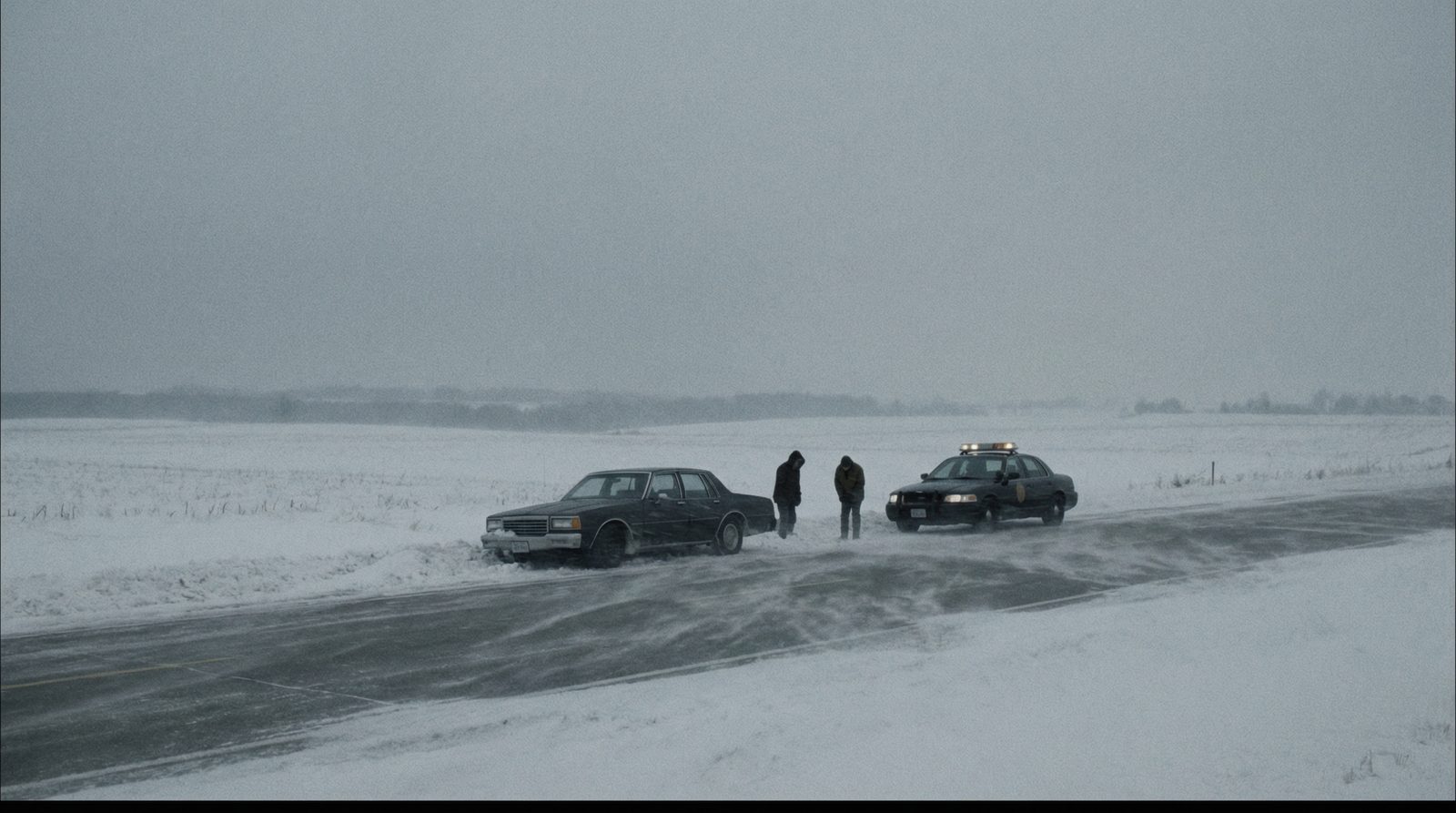
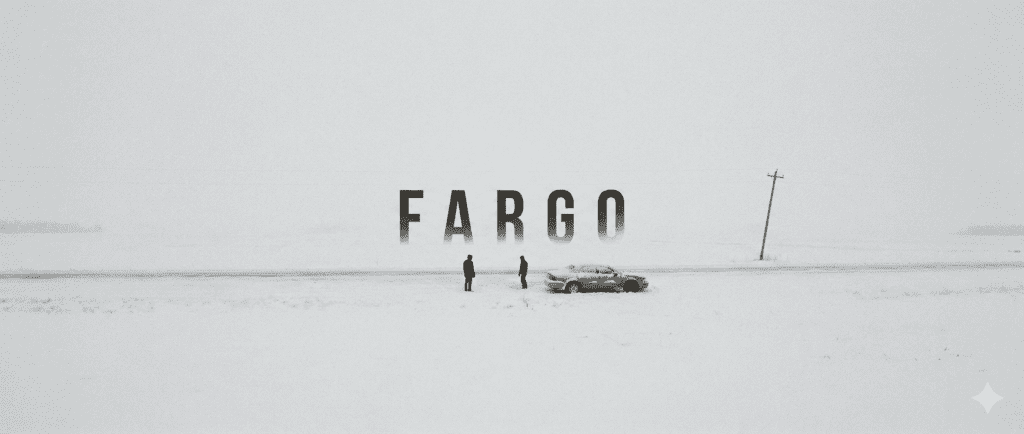
    Editorial illustration inspired by 'Fargo (1996)' – snow-covered highway and stalled cars

    CINEMATIC TECHNIQUE & AESTHETICS

    Cinematographer Roger Deakins builds Fargo around Negative space as a cinematic technique. The White void of snow motif is not just pretty scenery; Characters are often tiny figures swallowed by white fields or framed against blank skies, which makes their frantic schemes look pitiful. The Coens favor Static wide shots that let violence play out at a distance. A roadside murder is shown in long shot, the camera refusing to flinch or editorialize. The feel is clinical and eerily calm, as if the land itself is indifferent.

    Inside, the palette shifts to mustard yellows, wood paneling, and fluorescent hum. These drab interiors emphasize the banality of the settings: The Coens use deadpan pacing, letting silences and awkward small talk stretch long enough to become funny, then uncomfortable. The Editing favors long takes over rapid cutting, which makes the sudden eruptions of violence feel like ruptures in ordinary time.

    Carter Burwell’s score leans on a mournful, folk-like theme that swells over the opening shots of a car towing through a blizzard. It gives the story a ballad-like quality, as if we are hearing a regional legend. Dialogue is treated almost musically. The Minnesota accent, with its “yah” and “you betcha,” becomes a rhythmic counterpoint to the brutality on-screen. This contrast between cozy sound and harsh image is a key technique that shapes the film’s uneasy, darkly comic feel. Like No Country for Old Men later on, Fargo uses restraint in camera movement and music to make every burst of action land harder.

    CHARACTERS & PERFORMANCE

    Marge Gunderson is a classic Everyman hero archetype, though she is also a pregnant small-town police chief, which quietly subverts the usual hardboiled detective mold. Frances McDormand plays her with a blend of curiosity, politeness, and steel. Marge’s competence is never loud. She asks simple questions, listens, and notices what others overlook. Her domestic scenes with her husband Norm, discussing stamps and breakfast, ground the film in everyday tenderness. That normalcy is the moral center the story keeps circling back to.

    Jerry Lundegaard, played by William H. Macy, is a Cowardly schemer archetype. His high, pinched voice and nervous tics turn him into a study in flop sweat. Macy makes Jerry both contemptible and oddly pitiable. He is not a grand villain, just a man who keeps choosing the worst possible option rather than admit failure. That smallness is the point.

    On the criminal side, Steve Buscemi’s Carl is a Motor-mouth criminal archetype, all complaints and cheap impatience, while Peter Stormare’s Gaear is a Silent brute archetype, moving through scenes with blank, heavy calm. Their mismatched partnership is a walking argument for how chaos multiplies when people with no shared values are thrown together. Supporting characters, from the obsequious car-lot staff to the stiff in-laws, are sketched with just a few lines and gestures. The performances lean into regional specificity without turning the townsfolk into cartoons, which keeps the humor grounded in recognizable human behavior rather than pure caricature.

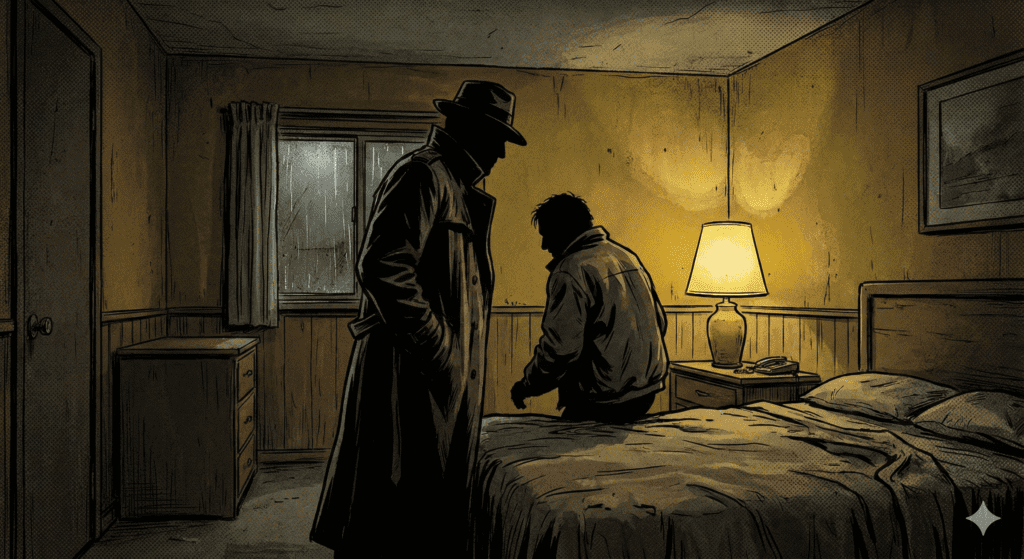
    Stylized noir illustration of Fargo (1996) – tense motel-room confrontation in warm drab Midwestern lighting

    CONTEXT & LEGACY

    Fargo arrived in the mid-1990s, when American indie cinema was saturated with ironic crime stories in the wake of Pulp Fiction. What sets Fargo apart is its emotional sincerity. The Coens had already explored doomed schemes in Blood Simple, but here they pair their usual fatalism with genuine affection for their characters. The film’s faux “true story” framing device taps into the era’s fascination with true crime while quietly mocking our hunger for authenticity labels.

    The film’s legacy includes not only its awards and critical acclaim but also the later Fargo television series, which expands on its Small-town decency motif and Crime gone wrong trope across new characters and timelines. Within the Coen brothers’ body of work, Fargo is a pivot point between their scrappier early noirs and the more austere moral parables of No Country for Old Men. Its influence can be felt in later regional crime dramas that mix dry humor with brutality, and in the broader acceptance of stories where the most heroic figure is not a vigilante or a genius, but a decent professional doing their job well.

    IS IT WORTH WATCHING?

    Fargo is worth watching if you are interested in crime stories that care more about character and moral texture than about plot twists. Its pace is unhurried, and its humor is dry enough that some viewers might initially mistake it for aimlessness. Stay with it. The accumulation of small details, awkward conversations, and quiet domestic scenes builds toward a surprisingly moving final stretch. The feel is a blend of dark comedy and melancholy, with moments of sharp horror that never tip into exploitation.

    If you like the Coen brothers’ mix of fatalism and oddball humanity in films like No Country for Old Men, or if you are drawn to stories where the landscape feels like a character, Fargo will likely resonate. It is not a puzzle-box thriller.

    TRIVIA & PRODUCTION NOTES

    The film’s opening claim that it is based on a true story is a deliberate fabrication. The Coens used the “true crime” framing device to tap into the way audiences engage differently with stories they believe are factual. Various small incidents were loosely inspired by real crimes, but Fargo as a whole is invented. The production leaned heavily on location shooting in Minnesota and North Dakota, though an unexpectedly mild winter forced the crew to chase snow and occasionally truck it in.

    Frances McDormand was not present for the first weeks of shooting, which focused on the criminals and Jerry’s unraveling. This scheduling quirk helps explain why Marge feels like a fresh, stabilizing presence when she finally appears. Carter Burwell’s score builds on Scandinavian folk influences to echo the region’s heritage. The Coens and their team paid careful attention to regional dialect, working with local actors and dialect coaches to shape the Minnesota accent. The woodchipper scene, now infamous, was staged with practical effects and strategic framing rather than explicit gore, relying on suggestion and sound to make it unforgettable.

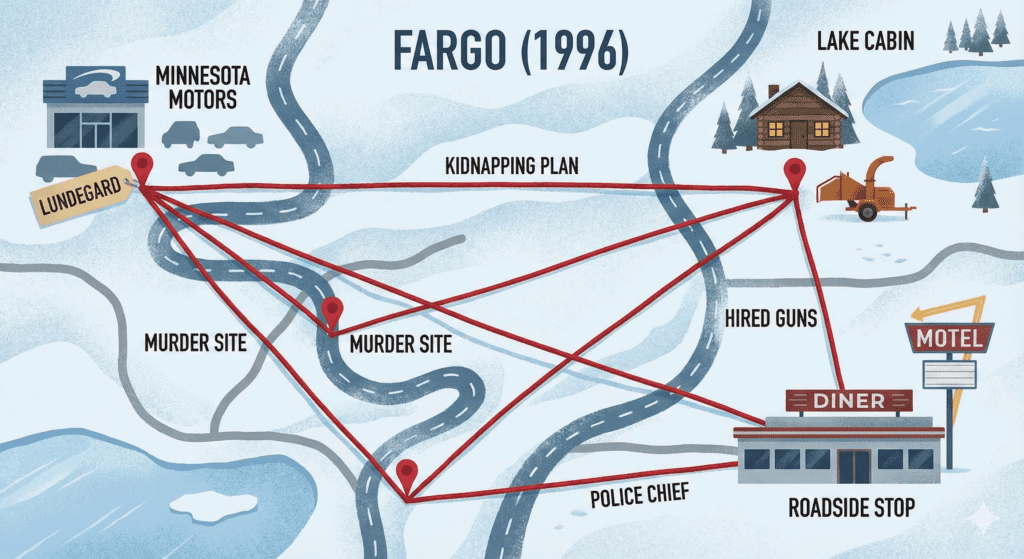
    Diagram-style conceptual illustration of Fargo (1996) – snowfield crime map with red paths and icons

    SIMILAR FILMS

    If Fargo resonates for you, several other works offer related tones and themes. Blood Simple, the Coens’ debut, presents another Crime gone wrong trope in a more overtly noir package, with a similar interest in how ordinary people flail when their schemes collapse. No Country for Old Men shares Fargo’s fascination with moral clarity and its use of landscape as an almost spiritual presence, though it trades dry humor for a harsher, more fatalistic feel.

    Outside the Coen filmography, the television series Fargo extends the Small-town decency motif and regional crime focus across multiple eras. Fans of the mix of politeness and violence might also appreciate how Twin Peaks filters small-town strangeness through a more surreal lens, though its tone is dreamier and less grounded in procedural detail than Fargo’s.

    DISCOVERABILITY & LINKS

    On AllReaders, Fargo sits at the crossroads of crime, small-town stories, and character-driven morality tales. Its white void of snow motif, crime gone wrong trope, and focus on small-town decency connect it to other works where landscape and community shape the stakes as much as the plot does. Readers exploring regional noir, morally grounded detectives, or films that balance dark humor with quiet empathy will find Fargo clustered alongside related titles in our crime and Midwestern story maps.