Genre: Comic fantasy

  • Magical Bureaucracy

    Magical Bureaucracy

    DEFINITION & CORE IDEA

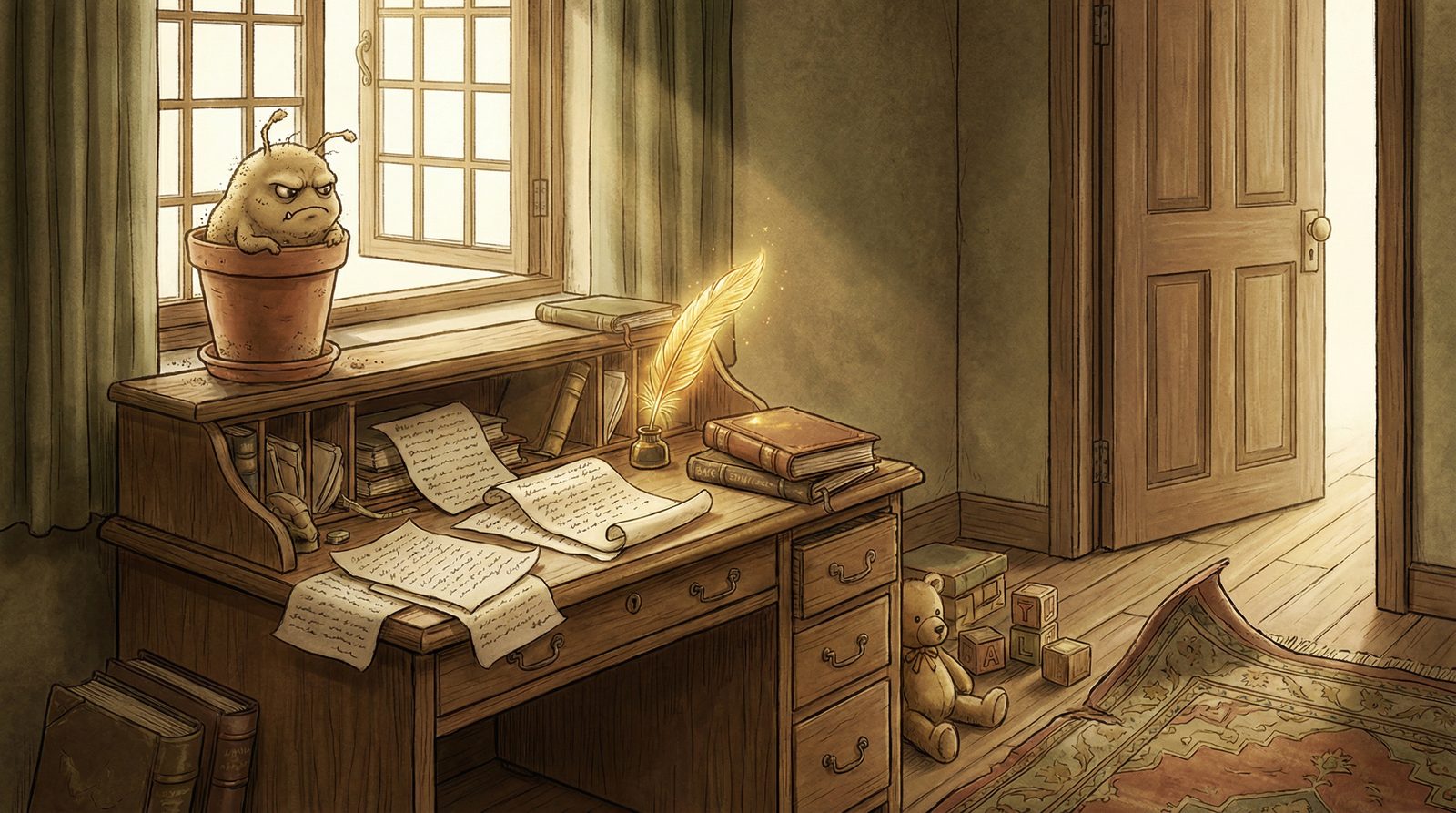
    Magical Bureaucracy is what happens when magic has paperwork. Instead of solitary wizards on mountaintops, you get departments, regulations, and people whose job title could plausibly include “Junior Undersecretary for Summonings.” Spells are licensed, entities are contracted, incidents are logged, and supernatural action comes with a form, a fee, or a committee attached to it.

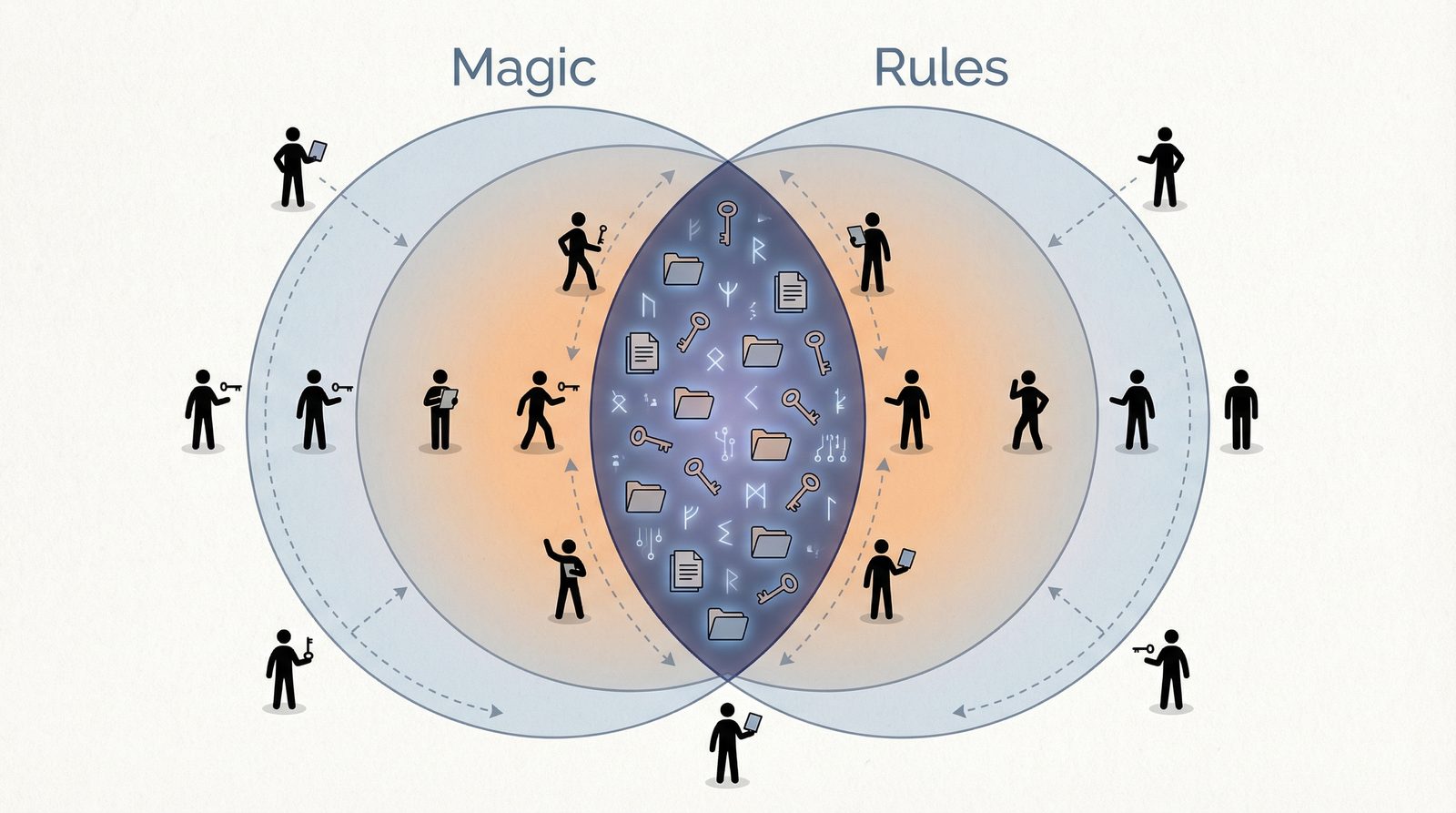
    Stories that use Magical Bureaucracy treat the supernatural as a system that can be managed, abused, or jammed, just like tax codes or zoning laws. The wonder still exists, but it is governed by procedure, permissions, and internal politics. Power shifts from “who has the strongest magic” to “who controls access, exceptions, enforcement, and administrative roadblocks.”

    In The Amulet Of Samarkand, Jonathan Stroud frames magic as a government instrument with rank, oversight, and punishment baked into its use. Summoning is spectacular, but it is also institutional. What makes the world tense is not only what a spirit can do, but what the system allows, denies, or quietly covers up.

    Writers use this motif to make magic feel grounded and frighteningly familiar. It lets them explore how institutions can turn the sublime into process, and how control can be exercised through procedure, inertia, and selective authorization. Magical Bureaucracy is less about the spell than about who gets to authorize it.


    HOW IT WORKS IN STORIES

    Magical Bureaucracy typically appears as an institution that claims to keep magic safe and orderly, but in practice exists to keep it controlled. There may be a Ministry, an Agency, a Council, or a Registry. Characters need licenses to cast, permits to summon, approvals to investigate, and signatures to move forward. Conflict often begins as a procedural barrier rather than a direct magical threat.

    The protagonist is frequently low-ranking: an apprentice, a junior functionary, or someone forced to operate inside rules they did not write. They learn that the dangerous parts of the system are not always the monsters. They are the clauses, the disciplinary processes, and the quiet power of officials who can make problems disappear by classifying them correctly.

    Because paperwork becomes a kind of spellcasting, information is a battleground. Case files can hide hazards in their wording. An outdated regulation can become leverage. A missing form can create real consequences. The plot generates tension through access: who can read what, who can authorize what, and who gets punished for doing the necessary thing without permission.

    The tone can swing from comic to sinister. In lighter versions, bureaucracy is absurdist friction: triplicate forms for impossible incidents, audits nobody survives, officials obsessed with protocol while reality burns. In darker versions, bureaucracy becomes a tool of oppression. It protects the powerful, disciplines the useful, and keeps risk concentrated among the people who actually do the dangerous work.

    By turning institutions into active forces, Magical Bureaucracy creates climaxes out of procedural inertia and policy exceptions. The hero may “win” not by casting the strongest spell, but by finding the one rule that breaks a contract, exposes a cover-up, or forces a truth into the open.


    Editorial illustration inspired by 'Magical Bureaucracy'

    EMOTIONAL EFFECT ON THE READER

    Magical Bureaucracy feels both funny and uncomfortably familiar. Readers recognize the frustration of waiting in line, filling out forms, and dealing with smug officials. That recognition sharpens when it happens in a world of demons, ghosts, and sorcerers. The gap between cosmic power and petty process can be hilarious, bitter, or both at once.

    It also creates claustrophobia. Rules are everywhere, written by people who rarely face the consequences themselves. When a character realizes that survival depends on a regulation they never knew existed, the reader feels the same mix of anxiety and anger that real-world systems can produce: the fear of the fine print.

    At the same time, the motif offers competence-catharsis. Watching a character outmaneuver a corrupt superior using procedure against procedure can be deeply satisfying. It reassures readers that knowledge, persistence, and tactical reading matter as much as raw magical talent.

    Depending on tone, the motif can feel cozy or dreadful. In softer versions, paperwork makes the world feel lived-in, with schedules, budgets, and office gossip attached to magic. In harsher versions, the motif implies that wonder is never safe from control. The emotional question shifts from “Can we cast the spell?” to “Who gets to decide whether we’re allowed?”

    Symbolic illustration inspired by 'Magical Bureaucracy'

    VARIATIONS & RELATED MOTIFS

    Magical Bureaucracy can take many forms. In some stories, it is a full-blown government apparatus where every spell is a matter of state. In others, it looks more like a professional guild or licensing board where credentials and enforcement define who can practice. There are also corporate versions where magic is controlled by contracts, patents, and policy compliance rather than bloodlines or prophecy.

    One common variation emphasizes enforcement: inspectors, disciplinary boards, and punishment systems that make bureaucracy feel like a second kind of magic. Another emphasizes the archive: record-keepers and administrators who control access to dangerous knowledge simply by controlling what is documented and who can read it.

    Even stories built around rebellion can run through this lens, when the real revolution is not only defeating a villain, but dismantling the procedural system that makes the villain’s power “legal.”

    Magic remains real, but access is controlled. The spell matters, but the stamp decides.

  • Vice Versa (1882)

    Vice Versa (1882)

    INTRODUCTION

    Vice Versa (1882) by F. Anstey
    Comic fantasy · 19th Century · Victorian Era · United Kingdom


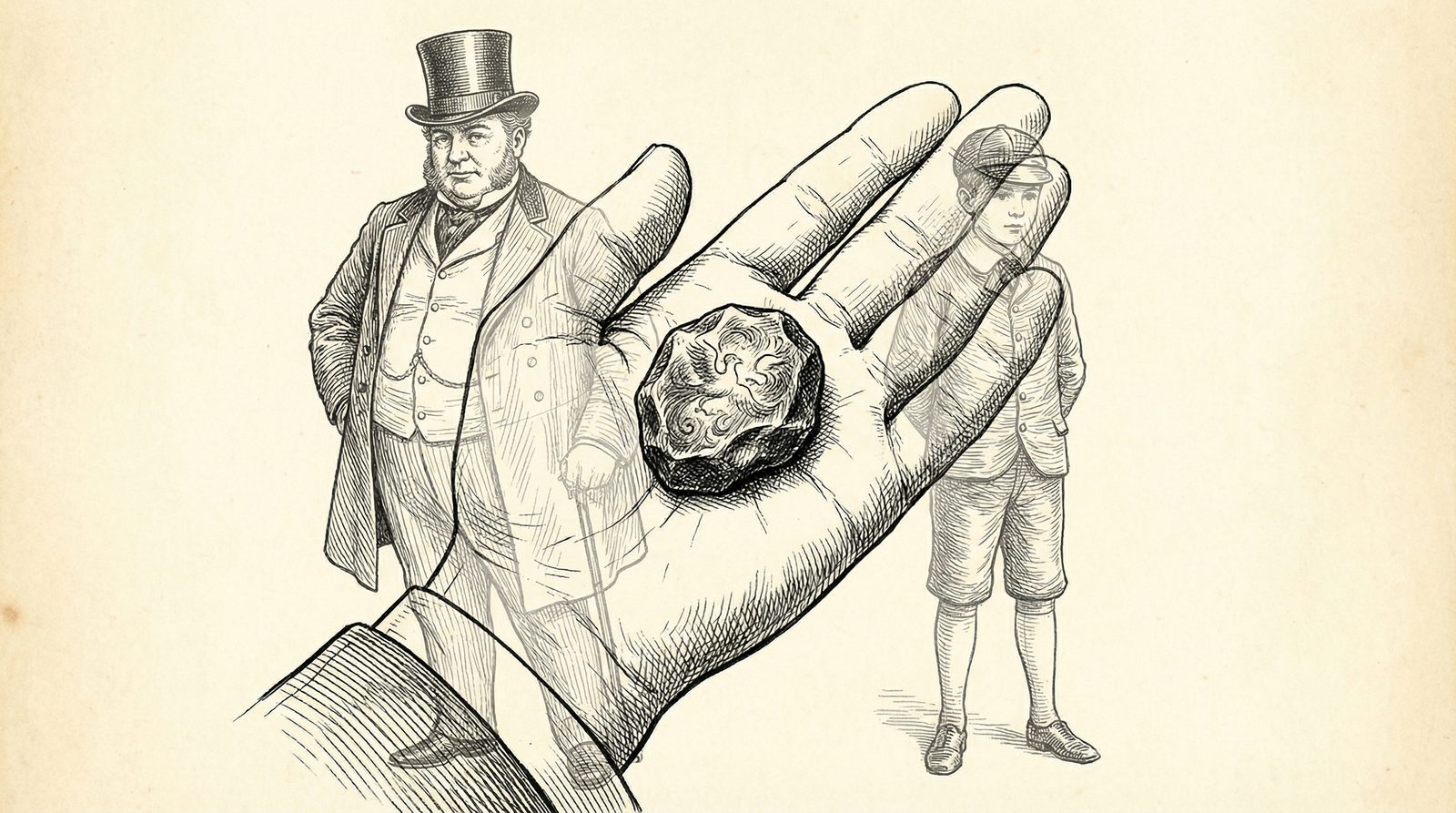
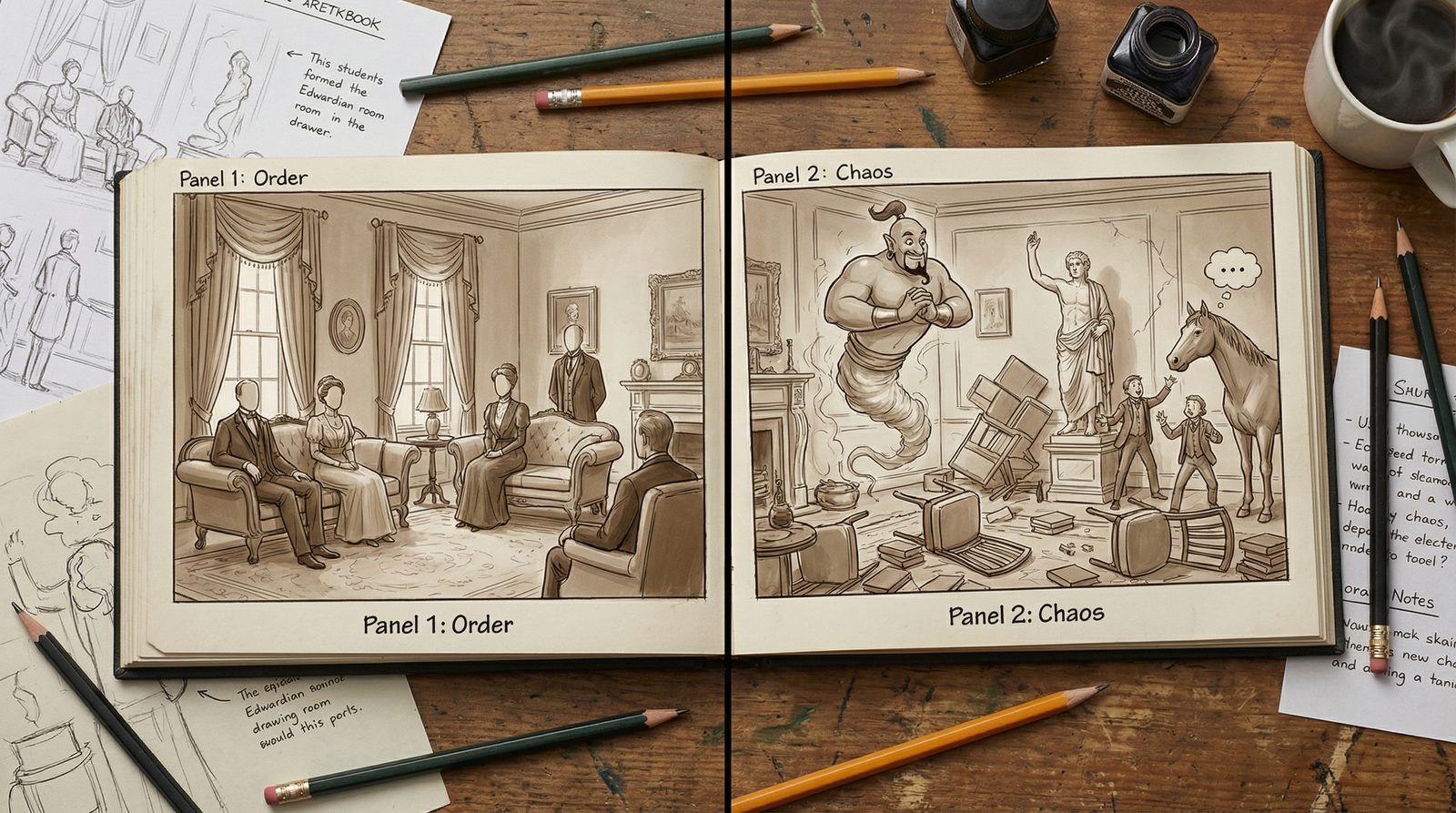
    Vice Versa (1882) begins with a wish and a stone, and very quickly becomes a quiet little nightmare. F. Anstey takes a familiar motif of wish-fulfilment and flips it into something sour, funny, and oddly tender. Paul Bultitude, a prosperous Victorian businessman, longs for the carefree life of his son Dick at Dr. Grimstone’s boarding school. A mysterious Garuda Stone grants the wish too literally, and father and son exchange bodies. What follows is not just farce, but a slow-burning feel of humiliation and uneasy recognition. Beneath the jokes about Latin primers and cane-wielding masters lies a sharp portrait of the Victorian obsession with discipline, respectability, and hierarchy. The magic is minimal, almost offhand. What Anstey really cares about is how people behave when stripped of their usual power, and whether empathy can survive a term at a place like Dr. Grimstone’s school in Kentish Town.

    PLOT & THEMES

    The central trope is the body swap: Paul Bultitude becomes his son Dick in appearance, while Dick is trapped in his father’s middle-aged body. This early example of Body Swap Comedy Between Generations uses the swap as a moral abrasion rather than a pure joke. Anstey wastes little time on mechanics. The Garuda Stone, brought back by the blustering Uncle Gregory from India, simply works. Then the novel settles into its real concern: role reversal as education.

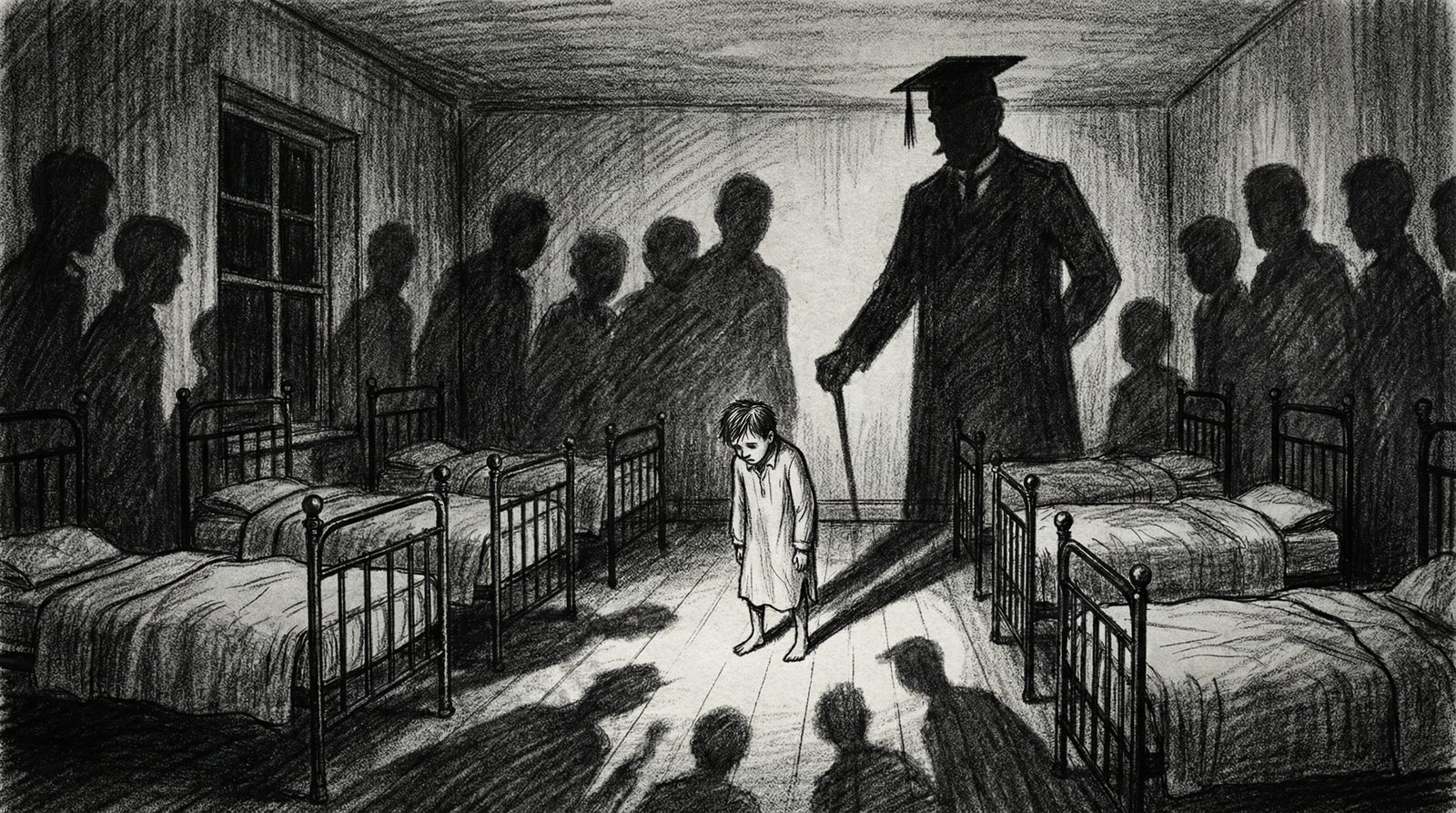
    Paul, now outwardly a schoolboy, is thrust into the brutal routines of Dr. Grimstone’s establishment. The headmaster’s son, the odious Augustus Grimstone, bullies him. Mr. Blinkhorn trembles and obeys. The boys enforce their own pecking order in the dingy playground and the icy dormitory. Scenes like Paul’s panic during the Latin viva voce in the schoolroom, or his miserable attempt to run away through the foggy streets of Kentish Town only to be dragged back, show how little his adult authority counts here. Meanwhile, Dick-as-Paul must bluff his way through business at the City office in Mincing Lane and endure the suffocating attentions of his father’s fiancée, the sentimental Miss Perrott.

    Anstey uses this double embarrassment to attack the hypocrisy of both generations. Parents sentimentalise school as character-building. Boys imagine business as leisurely and dignified. Both are wrong. Discipline is repeatedly framed as cruelty, especially in Grimstone’s pompous sermons about “moral fibre” just before he orders a flogging. Unlike lighter modern takes such as Freaky Friday, the book keeps its edges. The violence at school is not softened, and Paul’s cowardice is not made charming. By the ending, after a final confrontation in Grimstone’s study and another use of the Garuda Stone, the swap is reversed, but nothing is neatly fixed. Paul grudgingly promises to ease Dick’s life at school and abandon Miss Perrott. Dick agrees to behave better. The ending remains uneasy. They walk home through the London streets, outwardly restored and inwardly chastened, with the Stone shattered and its magic gone.

    PROSE & NARRATIVE STRUCTURE

    Anstey writes in a brisk, ironic third person, a narrative technique that allows him to slide between Paul’s pompous self-importance and Dick’s quicksilver anxiety without fully endorsing either. The narrator frequently undercuts Paul with sly asides, describing his “manly horror” of cold water as he faces the school’s tin baths, for instance, yet still lets us feel his genuine terror under Grimstone’s cane. The humour is dry rather than broad, built from overblown speeches and small physical miseries: cold tin baths, undercooked meals, aching muscles after drill, and the constant fear of public humiliation.

    Structurally, the novel is almost theatrical. It alternates set pieces at the school and in the Bultitude household, each chapter a stage with its own dominant authority figure: Grimstone in his study, Uncle Gregory booming in the drawing-room, the City clerk Tipping in the counting-house. This back-and-forth echoes mirrored lives. Every cruelty at school has its counterpart in the casual callousness of adult business and courtship. The pacing is tight. The Garuda Stone appears, works, and is destroyed without mythological fuss, keeping our attention on the social experiment rather than fantasy lore.

    There are occasional sentimental flourishes, especially in scenes with Paul’s young daughter Barbara, but they are quickly undercut by some practical detail or barbed remark. The prose is very much nineteenth-century middlebrow. It is comedy written with a straight face, which makes the cruelty of the school scenes land harder than any melodrama.

    Conceptual editorial illustration inspired by 'Vice Versa (1882)'

    CHARACTERS & INTERIORITY

    Paul Bultitude begins as the classic archetype of the pompous patriarch. Inside Dick’s body, however, he becomes something rarer in Victorian fiction: a grown man forced into genuine vulnerability. Anstey lets us feel his slow erosion. The first caning he treats as an outrage, but repetition grinds that indignation down into dread and, eventually, recognition. His internal monologue shifts from self-pity to a grudging, fearful respect for what Dick has endured.

    Dick, occupying his father’s body, is not idealised either. He revels in ordering servants about and nearly ruins Paul’s business dealings with a childish prank on the nervous clerk Tipping. His horror at Miss Perrott’s flirtations in the Bultitude drawing-room is played for comedy, but it also exposes how little control young people, and especially girls like Barbara, have within these domestic charades.

    Secondary figures are sketched with quick, telling strokes. Dr. Grimstone, with his booming platitudes and private cowardice, is less a villain than a man completely absorbed in his own authority. Mr. Blinkhorn, the underpaid usher, is a portrait of wasted intelligence, too timid to protect the boys he half-pities. Even Augustus Grimstone, the school bully, is shown at one point cramming desperately for an exam, hinting at fear behind his swagger. Interiority here is not lushly psychological, but it is precise. Anstey gives just enough inner flicker to complicate what could have been pure caricature.

    LEGACY & RECEPTION

    Vice Versa was a popular success in late Victorian Britain, and it has never quite vanished, even if it now lives in the shadow of later body-swap stories. Its mix of school-story realism and light fantasy helped pave the way for works that use the fantastic to expose social lies. Stage versions and screen adaptations have tended to soften the book’s harsher edges, often turning the ending into a more straightforward reconciliation. The novel itself leaves a residue of discomfort. Paul and Dick reverse the swap, the Garuda Stone is shattered, and they walk away with no guarantee that their resolutions will hold once the sting of pain fades.

    Critical reception has often filed the book under “juvenile,” but that is misleading. Adults were always the real target, and modern readers who come expecting harmless schoolboy japes may be surprised by how pointed the satire of business, courtship, and parenting remains. It is a minor classic of comic fantasy, but also an early critique of institutions Victorian Britain was most proud of.

    IS IT WORTH READING?

    If you have any interest in school stories, comic fantasy, or the underside of Victorian respectability, Vice Versa is absolutely worth your time. It is short, brisk, and far sharper than its premise suggests. The language is old-fashioned but not forbidding. Readers looking for elaborate world-building or lush romance will not find them here. What you get instead is a tight moral experiment: what happens when a comfortable man is dropped into the world he has always dismissed. The answer is funny, uncomfortable, and surprisingly moving, especially in the scenes between Paul and his daughter Barbara. It is a book that can be read quickly, but lingers in the mind whenever someone reminisces too fondly about the “good old days” of school.

    Illustration of a core idea or motif from 'Vice Versa (1882)'

    TRIVIA & AUTHOR FACTS

    “F. Anstey” was the pen name of Thomas Anstey Guthrie, a barrister-turned-writer who found far more success in comic fiction than in law. Vice Versa was his breakout hit, written when he was still in his twenties. The Garuda Stone reflects the era’s fascination with India as a source of mysterious power, filtered through the casual imperialism of a character like Uncle Gregory, who treats the artifact as a mere curio. Anstey’s long association with Punch magazine shows in the dry asides and caricatured authority figures.

    The school in Kentish Town is not named after a real institution, but its routines, cold baths, bread-and-butter breakfasts, compulsory Latin, mirror contemporary accounts of minor public schools. Anstey later revisited fantastical intrusions into everyday life in novels like The Brass Bottle, but he never again hit quite the same balance between magic and social observation that he achieved here. Vice Versa remains his most widely remembered work.

    SIMILAR BOOKS

    If you enjoy Vice Versa, you might seek out other works that mix light fantasy with social satire. The Wonderful Visit (1895) by H. G. Wells brings an angel into an English village to expose everyday hypocrisy. The Brass Bottle (1900) unleashes a genie into respectable middle-class life with chaotic results. For a harsher, more realistic look at school, Thomas Hughes’s Tom Brown’s Schooldays (1857) offers the earnest version of the same world Anstey mocks. All of these share an interest in how institutions, school, church, family, shape and sometimes warp the people inside them.

  • The Tinted Venus (1885)

    The Tinted Venus (1885)

    INTRODUCTION

    The Tinted Venus (1885) by F. Anstey
    Fantasy · United Kingdom


    The Tinted Venus is one of those sly Victorian fantasies that begins as a joke and ends with a faint ache. A humble barber’s assistant, a second-hand statue of Venus, and a careless wish, on the surface it is farce, plaster dust, and social misunderstanding. Underneath, the story keeps worrying at quieter questions: how easily people confuse beauty with goodness, and possession with love.

    The mood drifts between fizzy comic energy and a wistful unease, as if gaslit streets and shabby parlors are conspiring to expose every character’s vanity. This is not a mythological epic. It is domestic London life being invaded by divinity, and the invasion mostly produces embarrassment.

    PLOT & THEMES

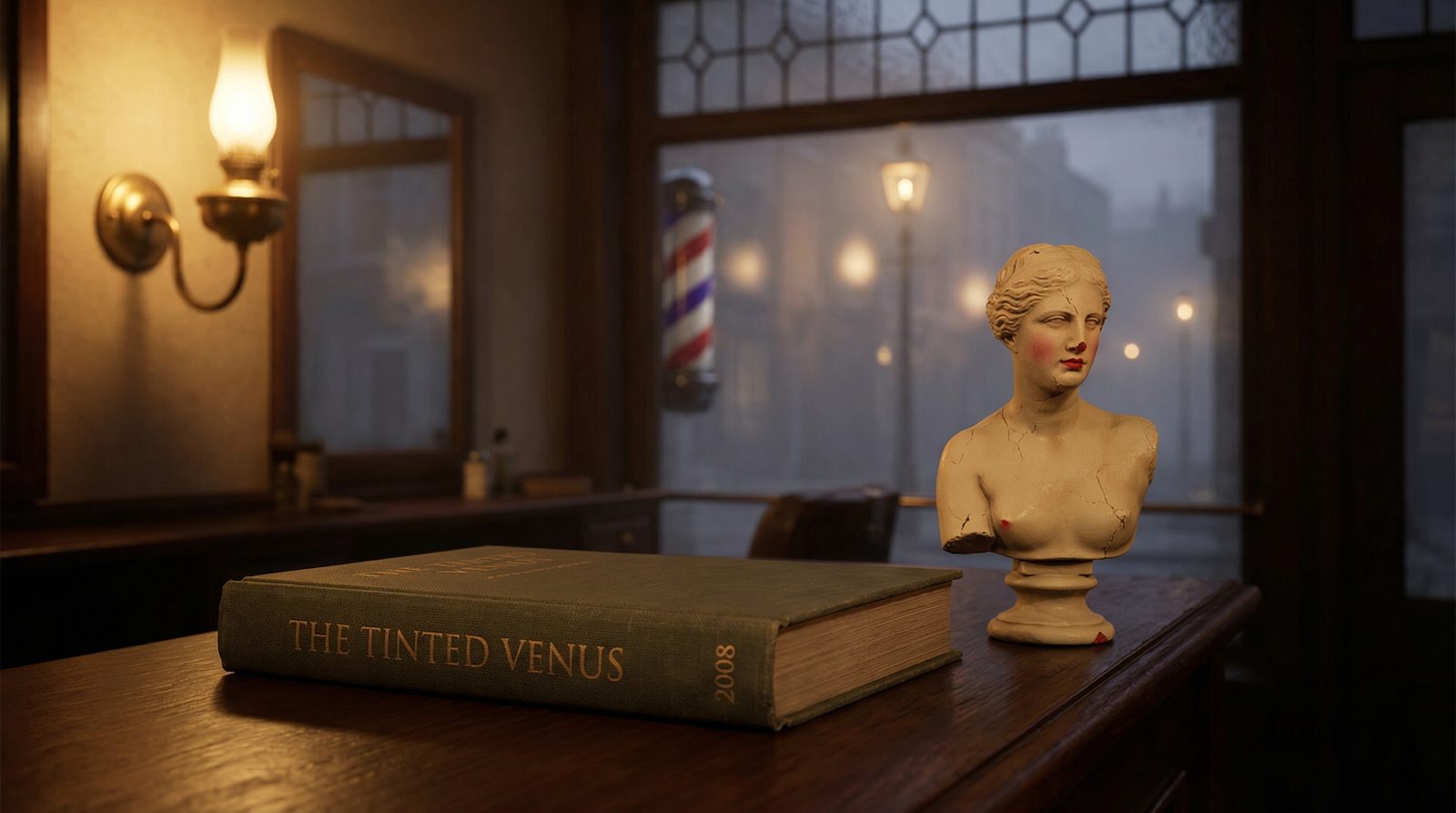
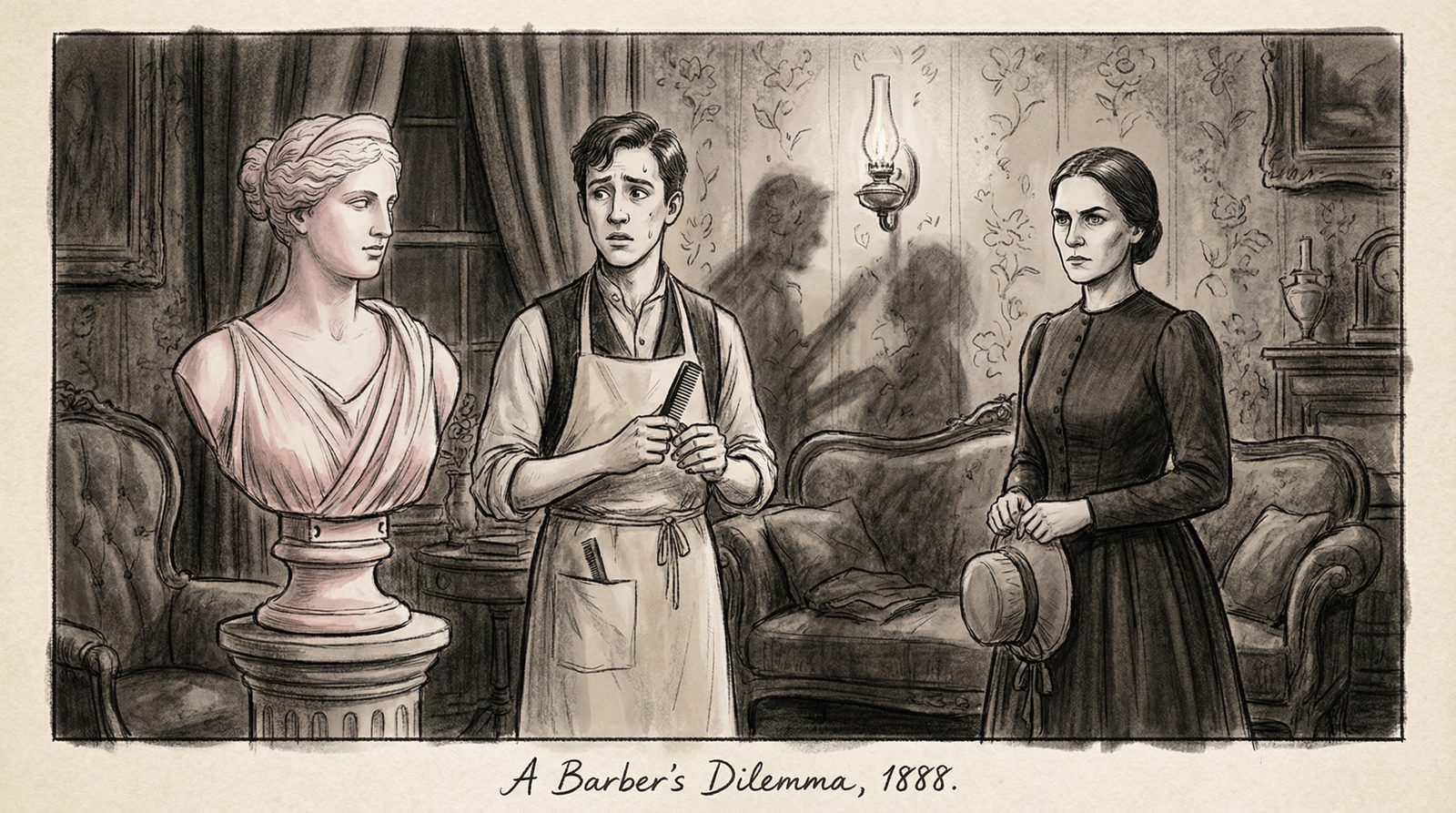
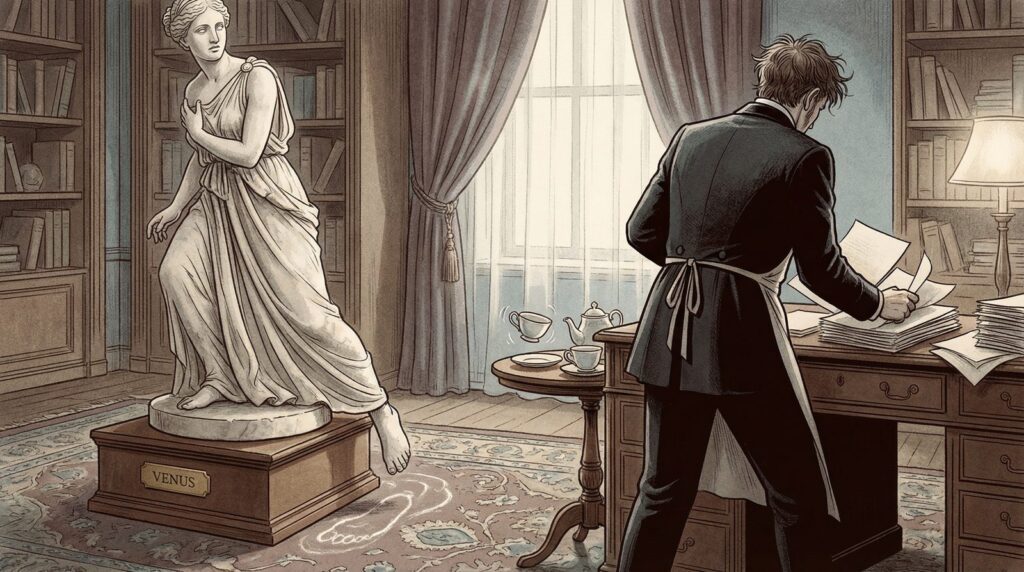
    The premise is simple. Frederick Pimm, a mild and slightly vain assistant at Mivers’s barber shop on Lupus Street, wins a cheap tinted plaster Venus in a raffle. In a fit of romantic self-pity he kisses the statue’s lips and jokes that he wishes for a more ideal love than his very real, very practical fiancée, Ada Parkinson. The statue warms. Venus steps down from her pedestal.

    What follows is not lush sensual fantasy. Anstey makes Venus inconveniently literal-minded. Her presence ruins Pimm’s work, scandalizes Mrs. Mivers, and detonates the Parkinson household’s moral respectability. The comedy comes from the mismatch between mythic expectation and middle-class routine: Venus treats London streets as if they were sacred processions, while everyone around her sees only indecency, madness, or fraud. Pimm’s frantic attempts to disguise her as a foreign cousin create the book’s best farce, the kind built from doors opening at the wrong moment and reputations collapsing in real time.

    The ending is more ambivalent than later stage treatments that smooth everything into romance. After a chaotic night in Kensington Gardens, with Venus insulted by the Albert Memorial and the new gods of modern industry, she recognizes that this age has no place for her. She returns to plaster, hardening in a small back parlor while Ada watches. Pimm ends the novel engaged to Ada again, but chastened. The magic does not grant him a perfect match. It strips away his fantasies and leaves him with ordinary love, unvarnished and uncompensated.

    Class aspiration runs beneath the supernatural premise. The statue itself is not marble, it is imitation, second-rate beauty bought cheaply and worshipped too eagerly. The novel uses that cheapness to sharpen its satire: not just of male vanity, but of a social world that wants art as status while panicking when “art” becomes alive and demanding.

    PROSE & NARRATIVE STRUCTURE

    Anstey writes in a lightly ironic third-person style, hovering close to Pimm’s anxious self-justifications while occasionally panning out to skewer the entire household. The sentences are brisk, the dialogue is full of social edge, and the tone carries amused exasperation. The narrator thinks Pimm is foolish, but never quite stops caring what the foolishness costs him.

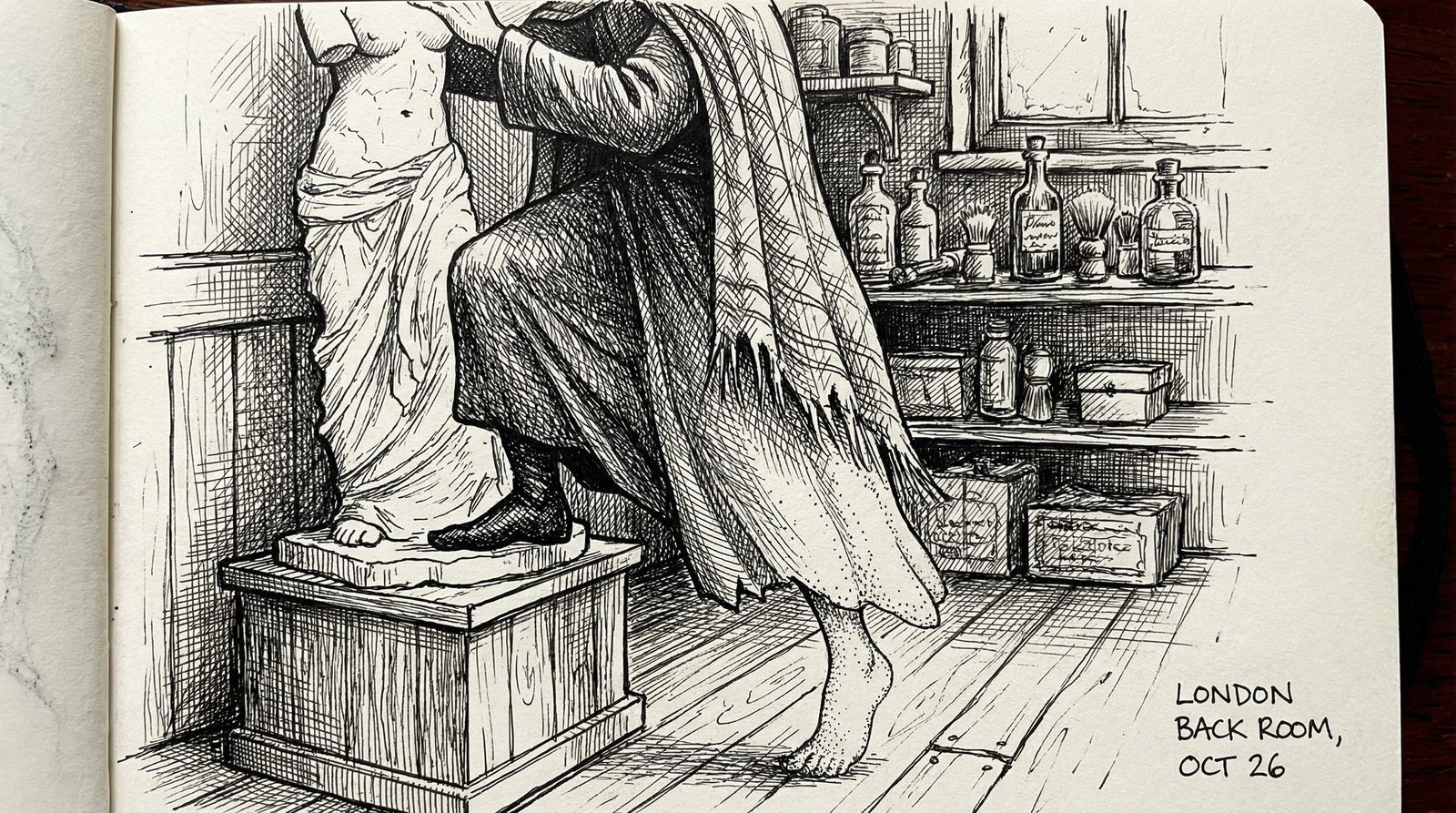
    The structure is almost theatrical. Early chapters feel like set pieces: the raffle, the cramped back room where Pimm hides Venus under a shawl, the disastrous visit with the Parkinson family, where Venus’s literal talk of altars and libations horrifies respectable guests. Stakes escalate socially rather than cosmically. Instead of battles between gods, we get whispered gossip in boarding-house corridors and reputations fraying under scrutiny.

    As the story advances, Anstey slows the farce just enough for tenderness to leak in. Venus’s gradual cooling, as devotion and fantasy withdraw, is described with surprising restraint. Comedy drains away line by line, and Pimm is left holding not an ideal but an object, and realizing how little his “ideal” ever understood him in return.

    Conceptual editorial illustration inspired by 'The Tinted Venus'

    CHARACTERS & INTERIORITY

    Pimm is a timid dreamer who wants romance without risk. His inner life is half vanity, half self-pity, and that is where the book’s cruelest jokes land. He is not wicked, merely weak, and the novel keeps asking what damage weakness can do when paired with sudden power.

    Venus is less a rounded interior consciousness than a force, but Anstey gives her enough presence to unsettle. She is not a fantasy girlfriend. She is a deity bewildered and offended by nineteenth-century London. Her pride is real. So is her confusion. Ada, meanwhile, avoids becoming a simple caricature of the shrewish fiancée. Her sharpness reads as self-protection, and her brief moment of pity as Venus returns to plaster deepens the emotional field.

    Side characters form a chorus of moral panic and prurient curiosity: Mrs. Mivers with her small tyrannies, the Parkinson household with its rigid respectability, the boarding-house gossips watching for scandal. Interior life belongs mostly to Pimm, but the way others misread him, as seducer, fool, or liar, completes the portrait of a man trapped between who he imagines himself to be and who the world insists he is.

    LEGACY & RECEPTION

    The Tinted Venus has never held canonical status, and many modern readers meet its premise through later adaptations that soften the ending into romance or winked redemption. The original novel is harsher. Pimm and Ada end together, but chastened, with the plaster Venus back in the corner as an object of faint dread rather than desire. The magic fixes nothing. It exposes everything.

    Among readers who seek out the text, it is appreciated as a sly interrogation of the Pygmalion fantasy, closer in spirit to darker Victorian preoccupations with beauty and projection than to the sunny romantic comedies it accidentally anticipates. Its modest scale has helped it age well: no grand Olympus, just Lupus Street, Clapham respectability, and Kensington Gardens as a stage for embarrassment and revelation. The satire of male vanity and middle-class hunger for “art” as status symbol still lands.

    IS IT WORTH READING?

    If you want a frothy fantasy where a statue comes to life and everyone ends blissfully paired off, this book will wrong-foot you. It is shorter, sharper, and more awkward than that. Its comedy is real, but so is its unease about what men project onto women, and what happens when the projection answers back.

    The prose is brisk enough that the period setting does not feel like homework, yet the story rewards slow attention to its quieter cruelties and small generosities. For readers interested in myth twisted into domestic farce, class-conscious fantasy, and flawed protagonists who do not receive neat moral absolution, it is very much worth the time.

    Illustration inspired by a core idea from 'The Tinted Venus'

    TRIVIA & AUTHOR FACTS

    “F. Anstey” was the pen name of Thomas Anstey Guthrie, a barrister-turned-humorist who built a career skewering middle-class pretensions. The Tinted Venus sits alongside his other fantasies of ordinary people colliding with the supernatural, but it is one of the tighter and more urban of his works.

    The statue is explicitly a cheap tinted plaster copy rather than marble, a detail that sharpens the satire about imitation, aspiration, and fakery. The Kensington Gardens sequence, with Venus offended by public monuments and national self-importance, shows Anstey’s eye for how civic spaces stage morality and taste. The novel quietly prefigures later psychological fantasies about art objects that refuse to stay inert, but it keeps its scale stubbornly domestic.

    SIMILAR BOOKS

    If this appeals, you might look toward other nineteenth-century fantasies that smuggle unease into comic premises. The Picture of Dorian Gray treats beauty as curse rather than blessing, while Pygmalion reworks the sculptor-and-creation fantasy into social satire. For more London-set supernatural mischief with a class-conscious edge, the comic supernatural tales of writers like Jerome K. Jerome and some of E. Nesbit’s adult stories make fitting companions.

    DISCOVERABILITY & LINKS

  • Thomas Anstey Guthrie

    Thomas Anstey Guthrie

    ORIGINS & BACKGROUND

    Thomas Anstey Guthrie, who published under the pen name F. Anstey, was a late Victorian and Edwardian humorist who made the respectable English middle class his favorite target. Trained as a lawyer and steeped in the habits and anxieties of the professional classes, he brought a sharp insider’s eye to the comic disasters he inflicted on his characters. That legal precision helps explain why his plots remain cleanly constructed even when the surface is pure farce.

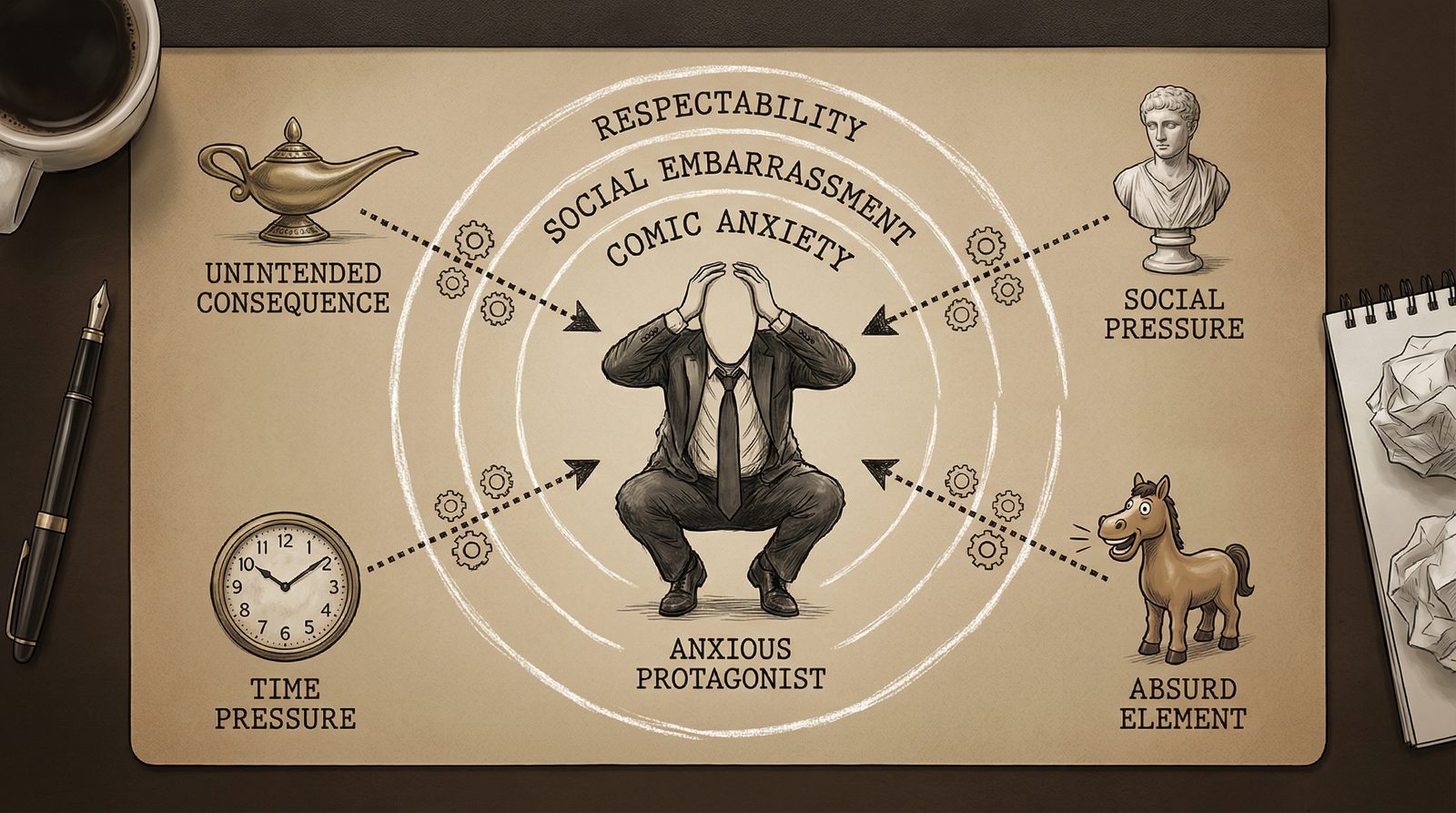
    Working in the same broad comic-fantastical territory that would later nourish writers like E. Nesbit, Guthrie specialized in taking a solidly realistic setting and dropping one impossible element into it. A statue comes to life, a genie appears, a wish is granted too literally, or time itself becomes a ledger. The fabric of polite life immediately starts to fray, and the characters’ fear of embarrassment becomes the real engine of the story.

    Editorial illustration inspired by Thomas Anstey Guthrie

    Although his name is less widely known now, he was a familiar presence in comic fiction in his own day, and several works were adapted for the stage and later for film. His best-known stories circulate in the cultural space between light domestic comedy and fantasy disruption, with a dry satirical edge that keeps the laughter slightly uneasy.

    THEMES & MOTIFS

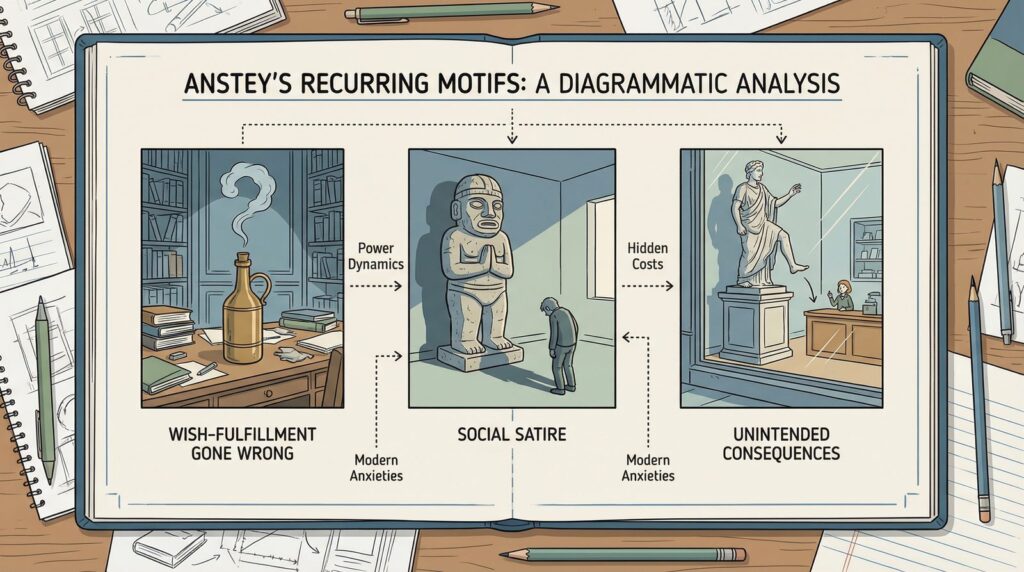
    If there is one recurring pattern in Guthrie’s work, it is the way supernatural help becomes a social catastrophe. He repeatedly stages stories where the impossible enters an ordinary life and exposes how brittle respectability really is. The magic is rarely malevolent. It is simply indifferent to manners, timing, and the quiet codes that keep middle-class life from collapsing into scandal.

    In The Brass Bottle, a long-imprisoned genie brings the wrong kind of assistance, escalating embarrassment and destroying reputations. In The Tinted Venus, a goddess steps off a pedestal and turns romantic fantasy into social panic. Across these books, “wish-fulfillment” is treated as an experiment that reveals what people actually want, and how badly they handle getting it.

    Symbolic illustration inspired by 'F Anstey'

    He also returns to the idea that modern life is already absurdly procedural, and the supernatural simply makes that procedure visible. In Tourmalin’s Time Cheques, time becomes bureaucratically administered debt, and a person can mortgage their future with a signature. Even when the premise is playful, the underlying anxiety is serious: ordinary life is a set of obligations, and a small twist can expose how fragile the whole structure is.

    Finally, Guthrie’s work often turns on role reversal as moral stress test. In Vice Versa, a father and son swap bodies and are forced to experience powerlessness from the inside. The comedy is real, but the point is sharper: empathy arrives only after humiliation breaks the illusion of authority.

    STYLE & VOICE

    Guthrie’s style balances lightness with a lawyer’s sense of structure. His prose tends toward clear, unshowy sentences, laced with dry asides and understatements that reward attentive reading. He is less interested in lush description than in setting a premise quickly and then following its comic implications as far as they will go.

    Structurally, he favors escalating farce. A single magical intrusion or misunderstanding in the opening chapters ripples outward into layers of social embarrassment. Invitations go wrong, reputations wobble, engagements are imperiled, and the characters’ frantic improvisations only deepen the mess. Readers can usually see the machinery at work, which makes the eventual resolution feel earned even when it relies on a final twist.

    Symbolic illustration inspired by Thomas Anstey Guthrie

    Compared with writers whose magic opens into wonder, Guthrie’s fantasy acts more like a stress test. The stories ask what happens when the impossible walks into an ordinary life and refuses to leave. The answer, rendered with wry control, is comic catharsis that exposes the pressures and pretensions of the world it is satirizing.

    KEY WORKS & LEGACY

    The Brass Bottle (1900) is his most widely recognized comic fantasy: an ancient genie unleashed into a world of mortgages and dinner parties, where every “helpful” intervention creates a new disaster. The Tinted Venus (1885) explores similar territory through romantic fantasy, with a goddess coming to life and exposing how fragile respectability is when desire is made literal.

    Editorial illustration inspired by 'F Anstey'

    A Fallen Idol (1886) pushes further into satire of belief and misplaced reverence, while Tourmalin’s Time Cheques (1891) extends his comic logic into bureaucratic time debt. Vice Versa (1882) remains the foundational body-swap story that later generations would repeatedly reinvent.

    In the larger landscape of English comic fantasy, Guthrie forms a bridge between Victorian satire and later comic modernity. His legacy persists wherever a small magical twist is used to expose the fragile nature of everyday life, and where laughter is sharpened by discomfort rather than softened into reassurance.

  • E Nesbit

    E Nesbit

    ORIGINS & BACKGROUND

    E. Nesbit, born Edith Nesbit in 1858, grew up in a world that was supposed to be stable and respectable but in practice was full of financial anxiety, illness, and constant moves. That gap between the official story of middle-class security and the messy reality of family life runs straight through her fiction. She lived in late Victorian and Edwardian England, wrote to support her household, and was deeply involved in socialist politics, which sharpened her awareness of class and money in everyday life.

    Before Nesbit, much English children’s literature leaned toward moral tales and tidy allegory. She shifted the center of gravity by putting recognizably modern children at the heart of her stories, and by letting magic crash into ordinary suburban or holiday life rather than sending children off to distant fairy kingdoms. Her London and her countryside are places where wonder and hardship coexist, and where children notice practical details—fares, food, servants, shopkeepers—because those details shape what is possible.

    Her literary friendships and circles mattered too. She overlaps in spirit with writers like Thomas Anstey Guthrie, who also enjoyed using the impossible to stress-test respectability, and she shares with P. G. Wodehouse a dry observational humor about social muddle. Where she differs is her focus on children as fully real people: impulsive, selfish, brave, loyal, and often more perceptive than the adults around them.

    THEMES & MOTIFS

    The most obvious pattern in Nesbit’s fantasy is the way magic behaves like an unhelpful guest rather than a benevolent gift. In Five Children And It (1902), the Psammead grants wishes that go wrong in very specific, practical ways: sudden wealth triggers suspicion, beauty makes the children unrecognizable to their own servants, and childish wording produces literal consequences nobody intended. The humor is real, but the structure is moral: desire has consequences, and “getting what you want” often reveals that you did not understand your own wish.

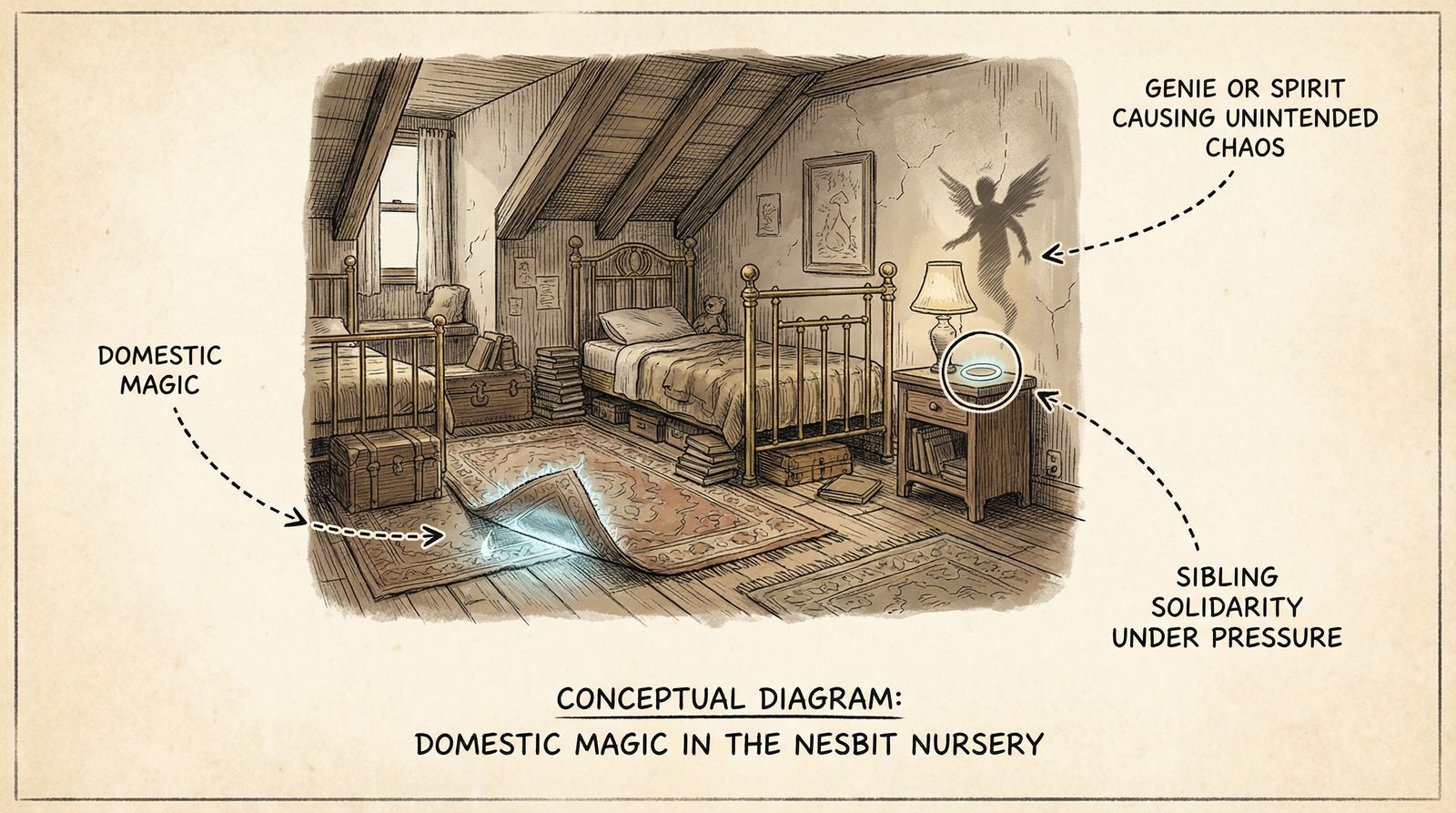
    She is also a master of domestic magic. Instead of enchanted forests, she gives us nurseries, attics, gardens, railway cuttings, beaches, and rented houses suddenly invaded by the impossible. The everyday setting matters because it keeps the fantasy tethered to ordinary obligations. Children still have to get home before dark, avoid being caught by adults, and deal with the social world of servants, neighbors, and shopkeepers.

    Sibling solidarity under pressure is another constant. Her groups of brothers and sisters bicker, form alliances, stage coups, and shift loyalties, but when magic creates a crisis they improvise together. Parents are often absent, distracted, or simply unable to see what is happening, which forces children to negotiate fear, guilt, and responsibility among themselves.

    Class awareness runs quietly beneath the comedy. Wishes and magical accidents expose how rigid social boundaries can be, and how odd it feels to cross them without preparation. Nesbit’s socialism never turns her stories into tracts, but it shapes moments where children notice poverty, unfairness, or the arbitrariness of adult authority. Even when the tone is playful, there is often an undertow of embarrassment and ethical consequence.

    Finally, Nesbit likes the tension between rational explanation and lingering mystery. Her characters try to systematize the magic, treating strange creatures and objects like machines that can be managed. The rules never quite hold. That slippage is part of her effect: the world remains slightly unstable, and the children’s growing maturity comes from learning to live with that instability rather than mastering it.

    Editorial illustration inspired by E. Nesbit

    STYLE & VOICE

    Nesbit’s style is conversational, ironic, and conspiratorial, as if an older, slightly mischievous friend were telling you about some children she once knew. She often addresses the reader directly, comments on the story’s construction, and gently mocks both adult pomposity and childish self-importance. This narrative voice keeps the tone light even when the stakes are high, and it invites readers to notice the gap between what characters think they are doing and what is actually happening.

    Her pacing alternates between chaotic set pieces and quieter interludes. A wish goes wrong, a crisis erupts, and then there is a scramble to repair the damage, followed by an evening scene where the children argue over blame and meaning. That rhythm allows her to balance comedy of errors with emotional beats about shame, fear, courage, and loyalty.

    In terms of language, Nesbit is clear and brisk rather than ornate. She uses specific material details—food, clothing, household objects—to anchor the fantasy. She respects children’s intelligence and capacity for mischief, and she rarely smooths away the awkwardness of their mistakes. The result is playful without being indulgent, and moral without being preachy.

    KEY WORKS & LEGACY

    Five Children And It (1902) (1902) is often an entry point into Nesbit’s work. The Psammead grants daily wishes that spiral into trouble, establishing her most durable pattern: magic interpreted literally, consequences arriving fast, and children forced to learn responsibility in the middle of farce.

    The Phoenix And The Carpet continues with the same children and deepens the sense that magic can be both exhilarating and exhausting. The Enchanted Castle stands slightly apart with a more dreamlike, sometimes eerie atmosphere: living statues, a magic ring, and holiday freedom that turns unexpectedly unsettling.

    Her influence on later children’s fantasy is extensive. Writers who place ordinary children in contact with the supernatural, and who treat the domestic world as a legitimate stage for enchantment, are working in territory she helped define. She sits at a hinge point between Victorian moral tales and modern fantasy that treats children as complex people rather than symbols.