
Genre: Coming-of-Age

  • The Motorcycle Diaries (2004)

    The Motorcycle Diaries (2004)

    The Motorcycle Diaries (2004), directed by Walter Salles. Road Movie · 126 minutes · Argentina / Brazil / Chile / Peru / United States.


    INTRODUCTION

    The Motorcycle Diaries is a Road Movie that feels quietly revolutionary in its modesty. Rather than racing through the milestones of a famous life, it lingers on formative moments before myth hardens into ideology. Walter Salles follows a 23-year-old Ernesto Guevara in 1952, long before he becomes “Che,” tracing a journey across South America that reshapes his sense of responsibility and belonging.

    The film belongs to the coming-of-age tradition, but the coming-of-age is political as much as personal. By the time the credits roll, nothing “historic” has happened in conventional biopic terms. Yet everything has shifted internally. The mood is contemplative, melancholic, and grounded in physical travel rather than rhetoric.

    PLOT & THEMES

    The story follows Ernesto Guevara, a middle-class Argentine medical student, and his friend Alberto Granado as they set off on a ramshackle motorcycle trip across South America. What begins as youthful adventure quickly becomes a lesson in limits. The motorcycle breaks down, money disappears, and the pair are forced into closer contact with people living far outside their social bubble.

    As they travel through Argentina, Chile, and Peru, the tone shifts from comic misadventure to moral confrontation. Encounters with exploited miners, Indigenous communities, and patients at a leper colony expose Ernesto to structural injustice he cannot ignore. Travel becomes transformation, not through spectacle but through accumulation: each border crossed introduces a new ethical tension.

    Illness and bodies play a central role. Ernesto’s asthma and his medical training keep politics anchored in physical vulnerability. Inequality is not discussed abstractly; it is breathed, touched, and treated. The film resists cathartic conversion scenes, favoring gradual awakening. By the river crossing at the leper colony, Ernesto’s decision to swim across becomes a physical declaration of solidarity rather than a speech.

    CINEMATIC TECHNIQUE & AESTHETICS

    Walter Salles relies on naturalistic lighting and extensive location shooting to ground the film in lived geography rather than postcard imagery. Landscapes dwarf the protagonists, reinforcing humility and disorientation. Long takes allow discomfort to settle, particularly during encounters with marginalized communities.

    Handheld camera work during travel sequences gives the journey a tactile instability. The bike rattles, the frame shudders, and progress feels provisional. By contrast, scenes at the leper colony use steadier compositions and visual symmetry, as if the film itself slows down to observe rather than roam.

    Sound design favors ambient noise — engines, wind, water — with Gustavo Santaolalla’s score entering quietly, like memory rather than commentary. Voiceover drawn from Guevara’s diary is used sparingly and often complicates what we see. The final montage of faces anchors the film’s politics in lived human presence rather than ideology.

    Editorial illustration inspired by 'The Motorcycle Diaries (2004)'

    CHARACTERS & PERFORMANCE

    Gael García Bernal plays Ernesto as a restrained Idealist rather than a charismatic firebrand. He is awkward, asthmatic, observant — more listener than speaker. Bernal emphasizes hesitation and internal pressure, letting the awakening register through silence and posture rather than declarations.

    Rodrigo de la Serna’s Alberto Granado provides contrast as a Trickster figure: charming, opportunistic, and emotionally open. Their dynamic balances gravity with warmth. Friendship becomes the film’s emotional vehicle for political realization.

    Supporting characters appear briefly but leave lasting impressions. They function less as individualized arcs and more as lived evidence of inequality. The restrained performances avoid sentimentality, keeping the film from drifting into didacticism.

    CONTEXT & LEGACY

    Released in the early 2000s, The Motorcycle Diaries arrived when Che Guevara’s image had become globally commodified. By focusing on his pre-revolutionary years, the film sidesteps later controversies and instead explores the formation of conscience. Its legacy lies not in political instruction but in showing how empathy precedes ideology.

    Within Latin American cinema, it stands as a key example of the socially conscious Road Movie, using movement to expose class and racial divides. Internationally, it remains a touchstone for films that treat political awakening as a slow, embodied process rather than a single decisive moment.

    IS IT WORTH WATCHING?

    Yes — especially if you prefer character-driven journeys over conventional biopics. The film rewards patience, attention, and openness. It is less interested in answers than in formation.

    Viewers expecting a full account of Che Guevara’s later politics may find it incomplete. As a portrait of an inner shift — from individual adventure to continental awareness — it remains quietly powerful.


  • Synchronicity And Meaningful Coincidence

    Synchronicity And Meaningful Coincidence

    DEFINITION & CORE IDEA

    Synchronicity And Meaningful Coincidence is the motif where events align with a precision that feels narratively excessive if everything is truly random. A stranger says the exact phrase the protagonist has been circling internally. A missed train leads to the only meeting that matters. The same symbol appears across unrelated places and moments. The story does not need to prove the supernatural; what matters is that the character experiences these alignments as communication rather than noise.

    In stories built around this motif, coincidence becomes information. The protagonist begins to treat timing, repetition, and interruption as meaningful data rather than background chaos. The explanation may vary — fate, God, a hidden order, the unconscious mind — but structurally the coincidences function the same way: they influence choice. Once the character starts acting as if meaning is real, the story has crossed its threshold.

    This logic is explicit in The Celestine Prophecy, where sequential encounters operate as instructions disguised as chance. In The Tenth Insight, the same mechanism is expanded into a system, training characters to read coincidence as guidance rather than accident. The Alchemist reframes this dynamic more quietly: dreams, omens, and chance meetings grant permission to abandon a stable life in favor of a meaningful one. In Way Of The Peaceful Warrior, coincidence is less mystical and more instructional, nudging attention back to discipline, presence, and embodied awareness.


    HOW IT WORKS IN STORIES

    Synchronicity usually enters a story quietly. The protagonist notices something small and easily dismissible: a repeated number, a perfectly timed interruption, an overheard sentence that lands too close to home. Early scenes preserve plausible deniability so the reader can remain skeptical without breaking immersion.

    The engine activates when coincidences begin to cluster. One coincidence is texture; several in close succession create pressure. These clusters tend to appear at decision points, moments when the protagonist is stuck between options or close to abandoning a path. In narratives like The Celestine Prophecy, each encounter functions as a breadcrumb that must be followed or consciously rejected. In The Alchemist, ignoring omens does not trigger punishment, but it stalls the story, draining momentum until attention realigns.

    Effective uses of this motif always impose cost. Following a “sign” risks embarrassment, loss of stability, or the appearance of irrationality. The character must accept the possibility of being wrong, foolish, or delusional. This risk is essential. Without it, synchronicity collapses into wish fulfillment. The choice to trust coincidence must feel dangerous enough to matter.

    Resolution typically arrives in one of two forms. In affirming narratives, the character learns to live inside a world where meaning does not need constant confirmation. In more ambiguous stories — as in I Origins — coincidences remain interpretable rather than proven, and the payoff is psychological. What changes is not the universe, but the character’s relationship to uncertainty.


    Editorial illustration inspired by 'Synchronicity And Meaningful Coincidence'

    EMOTIONAL EFFECT ON THE READER

    This motif is designed to feel intimate. The reader becomes a co-interpreter, scanning scenes for repetition, echo, and timing. When an early detail reappears in a charged moment, it produces a quiet jolt of recognition, as if the story is rewarding attention.

    At its most comforting, synchronicity offers relief from randomness. Detours feel purposeful. Delays feel protective. In books like The Alchemist, this reassurance is central to the reading experience, allowing setbacks to be reinterpreted as alignment rather than failure. The world feels readable, and the reader is invited to believe that attention itself has value.

    The same mechanics can also generate unease. Too many coincidences create the sense of being watched or guided too forcefully. In more psychological versions of the motif, the reader begins to question whether meaning is emerging organically or being imposed as a defense against chaos. That tension between enchantment and suspicion keeps the motif from becoming sentimental.

    When the motif works, the after-effect is practical. The reader finishes with heightened awareness of how easily meaning can arise once repetition and timing are framed as communication — and how much depends on where attention is placed.


    Symbolic illustration inspired by 'Synchronicity And Meaningful Coincidence'

    VARIATIONS & RELATED MOTIFS

    Synchronicity And Meaningful Coincidence appears in several recognizable variations. The spiritual guidance version treats coincidence as instruction, rewarding trust and punishing inattention. Romantic and literary versions soften the logic into serendipity, where repeated encounters transform chance into inevitability. Philosophical variants retain the pattern but refuse explanation, letting the reader decide whether meaning is discovered or constructed.

    A darker variation reframes synchronicity as a trap. Here, pattern recognition becomes exploitable, and “signs” function as lures rather than help. The story’s tension comes from uncertainty: is the universe speaking, is someone engineering the coincidences, or is the protagonist assembling meaning to avoid confronting randomness?

    This motif naturally overlaps with Spiritual Awakening, where heightened attention makes coincidence feel louder and more personal. It also pairs with Spiritual Pilgrimage and Inner Journey, where movement and reflection create the friction that makes “signs” feel necessary. When coincidence is framed as destiny language, it often converges with Personal Legend And Destiny.

  • Inner Journey

    Inner Journey

    DEFINITION & CORE IDEA

    The Inner Journey motif is about a character whose most important travel happens inside their own mind and heart. The outside world can be busy, dangerous, or beautiful, but the core story is the shift in how this person understands themselves, other people, or reality itself. In Siddhartha, the river, the city, and the forest matter, but the real movement is the protagonist’s changing sense of identity and meaning.

    Writers use the Inner Journey to examine belief, self-concept, and value. The plot might involve travel, romance, work, or crisis, but events function as mirrors: the character encounters situations that reveal what they avoid, what they rationalize, and what they cannot keep pretending.

    This motif often includes reflection, doubt, and contradiction. A character may be pulled between comfort and risk, duty and desire, faith and skepticism. Works such as Zen And The Art Of Motorcycle Maintenance and Demian use daily life, travel, and relationships as the surface action while the real stakes remain internal: whether the character can become honest with themselves.


    HOW IT WORKS IN STORIES

    The Inner Journey usually starts with a fracture of self. The character feels that something is off: success feels empty, a relationship feels misaligned, grief breaks old habits, or a change exposes how little their previous identity can hold. This discomfort becomes the trigger for looking inward.

    Writers often pair the Inner Journey with an outer journey so the reader has concrete scenes to track. In Zen And The Art Of Motorcycle Maintenance, the road trip gives shape to a philosophical search. In Siddhartha, distinct stages of life function as stages of internal change. The external plot provides milestones, but the turning points happen in private moments where the character’s interpretation of the world shifts.

    Structurally, the Inner Journey often moves through cycles of hope, confusion, and partial clarity. The character tries on beliefs or identities, then discovers their limits. They may swing between extremes, such as total freedom and heavy responsibility, intense longing and cool detachment, spiritual devotion and cynical withdrawal. The story tracks how those opposites are integrated into something more stable.

    Small details carry a lot of weight. A recurring object, repeated phrase, or familiar setting can show internal movement without a dramatic plot beat. The same kitchen table or street appears early and late, but it reads differently because the person looking at it has changed. The ending can be quiet, with no grand victory, yet the inner landscape is measurably transformed.


    Editorial illustration inspired by 'Inner Journey'

    EMOTIONAL EFFECT ON THE READER

    Inner Journey stories create recognition rather than suspense. The reader is invited into the space where the character stops lying to themselves. That can feel intimate and uncomfortable, because the questions the character cannot avoid are often questions the reader recognizes.

    The mood is often reflective. Even when events are dramatic, the narrative keeps returning to interpretation: what does this mean, and what does it reveal about who I am? The emotional intensity comes less from plot twists than from the slow accumulation of self-knowledge.

    These stories also create a specific kind of tension: the character may refuse closure. Instead of giving a clean answer, the narrative shows the cost of uncertainty and the cost of certainty, and asks the reader to sit with the same unresolved pressure.

    When the motif works, the after-effect is practical. The reader leaves with a sharper awareness of how a person’s internal frame can change what the same world means. The story does not just entertain; it reorients.


    Symbolic illustration inspired by 'Inner Journey'

    VARIATIONS & RELATED MOTIFS

    The Inner Journey appears in multiple genres. In coming-of-age stories, it is a search for identity and separation from inherited scripts. In spiritual narratives, the focus is on insight, faith, or a direct experience of the sacred. In midlife and late-life stories, the inner journey becomes reevaluation: regret, responsibility, and the attempt to make peace with the person one has been.

    Some versions are explicitly philosophical, using dialogue, essays, or long conversations to argue ideas. Others stay close to daily routine, showing inner change through small acts, habits, and repetitions. The pace can be slow and reflective, or tense, especially when the character’s developing self clashes with obligations and old roles.

    This motif often overlaps with Spiritual Awakening and Spiritual Pilgrimage, where external movement supplies the friction needed for internal change. It also pairs naturally with Intimacy as Healing, where a relationship becomes the mirror that forces honesty and makes transformation possible.

  • Craftsmanship And Quality Of Work

    Craftsmanship And Quality Of Work

    DEFINITION & CORE IDEA

    “Craftsmanship And Quality Of Work” is the motif where the way a character performs their work becomes a direct expression of their inner life. It is not simply about employment or productivity. The focus is on care, precision, pride, and the satisfaction of doing something properly, even when no one is watching. Whether the task is tuning an engine, preparing a meal, writing software, or shaping wood, the work itself carries moral weight.

    Stories built around this motif slow down and pay attention to process. In Zen And The Art Of Motorcycle Maintenance: An Inquiry Into Values (1974), motorcycle maintenance becomes a way of examining “Quality” as something experienced rather than defined. In Lila: An Inquiry Into Morals (1991), that concern expands into ethics and social life, still grounded in the idea that values are revealed through attention and care.

    At its core, this motif treats work as a moral and emotional discipline. It asks where standards come from, how they are practiced, and what is lost when integrity collides with systems that reward speed, scale, or convenience.


    HOW IT WORKS IN STORIES

    Craftsmanship And Quality Of Work usually appears through the rhythms of daily labor. Writers linger on routines: opening a workspace each morning, laying out tools, repeating movements until they become instinctive, inspecting the final result with quiet seriousness. The story may not be overtly “about” the job, but the way the work is done reveals character more clearly than dialogue alone.

    Sometimes the work itself becomes the teacher. In Shop Class As Soulcraft: An Inquiry Into The Value Of Work (2009), written by Matthew B. Crawford, manual problem-solving is framed as intellectually demanding and ethically grounding. Stories echo this idea when characters develop patience, humility, or self-respect through repeated, concrete tasks. A flawed repair or failed attempt is not just a setback, but a test of standards.

    Conflict often enters when the surrounding world does not value quality in the same way. A supervisor pushes for speed over care, a system rewards shortcuts, or customers demand something cheap and disposable. The character must decide whether to compromise, resist, or walk away. That decision becomes a clear statement of identity.

    This motif allows writers to make abstract ideas tangible. In the work of Robert M. Pirsig, the road, the machine, and the act of maintenance become tools for thinking about attention, rationality, and lived experience. Meaning is not explained. It is encountered through effort, failure, and care.

    Even in intimate or domestic narratives, the motif shapes relationships. A parent teaching a child a careful technique, or a mentor guiding an apprentice, passes on more than skill. They transmit a way of engaging with the world that can become a form of trust or love.


    EMOTIONAL EFFECT ON THE READER

    Stories shaped by this motif often feel grounding. There is comfort in watching someone care deeply about what they are doing, especially in a culture that feels rushed and disposable. Attention to tools, textures, and small decisions can be quietly absorbing.

    At the same time, the motif can provoke sadness or anger. When care is dismissed or punished, the loss feels personal. Stories about disappearing skills or neglected standards often carry a sense of dignity under threat.

    For many readers, this motif turns inward. It encourages reflection on everyday effort and responsibility. The question it raises is simple but unsettling: where does quality still matter in your own life, and what does it cost to protect it?

    There is also intimacy in this focus. Watching a character work carefully is like watching them unguarded. Habits and rituals reveal who they are when performance drops away, making later choices feel heavier and more personal.


    VARIATIONS & RELATED MOTIFS

    Craftsmanship And Quality Of Work takes many forms. In some stories, it centers on manual trades. In others, the craft is intellectual or emotional, such as teaching, caregiving, or programming. What unites them is the same pattern: the character treats their work as something deserving of attention, and their sense of self is bound to doing it properly.

    A common variation is the “lost craft” narrative, where older ways of working are disappearing. Another focuses on the collision between personal standards and impersonal systems, where care is labeled inefficient or excessive.

    This motif often pairs with Eastwest Philosophical Synthesis. In Pirsig’s writing, the road and the act of maintenance bridge Western analysis and Eastern presence. In Crawford’s work, the workshop becomes a site of moral clarity. Different settings, the same question: how should attention be lived?

    Across its variations, the motif returns to a single concern: when people invest genuine care in their work, how does that shape who they become?

  • Stephen King

    Stephen King

    ORIGINS & BACKGROUND

    Stephen King is one of the most widely read storytellers of the late 20th and early 21st centuries, and his work has shaped how popular culture imagines horror, suspense, and the supernatural. Born in 1947 in Portland, Maine, and raised largely in working-class New England, he has returned again and again to the textures of small-town life. That sense of place is not just scenery; it is the pressure cooker for his characters.

    His early success with “Carrie (1974)” and “The Shining (1977)” came from blending the supernatural with very ordinary pain. King has spoken and written about his own struggles with addiction, and you can feel that personal knowledge of self-destruction running through his work, especially in “The Shining (1977)” and “Doctor Sleep (2013)”. The line between the haunted house and the haunted mind is thin.

    Across decades and dozens of novels, collections, and novellas, King has moved beyond strict horror into fantasy, crime, and coming-of-age fiction, but he tends to keep the same emotional territory: ordinary people pushed into extraordinary situations where their buried fears and desires become literal. Whether he is writing about a killer clown in “It (1986)” or a prison friendship in “Rita Hayworth and Shawshank Redemption (1982)”, the focus is less on the monster and more on how people respond when their world stops making sense.

    Stephen King grew up in the postwar United States, in a culture saturated with pulp paperbacks, monster movies, and comic books. That mix of high anxiety and low-budget imagination fed directly into his fiction. His New England upbringing, especially in Maine, is crucial to his work. The recurring fictional town of Derry in “It (1986)” and Castle Rock in books like “Cujo (1981)” and “The Dead Zone (1979)” are composites of the places he knew. The small town becomes a laboratory for fear and for community.

    He began as a high school English teacher writing in the margins of his day, and that sense of the working writer never really left. Many of his protagonists are ordinary workers, teachers, writers, or kids, people who do not have special training to face the supernatural. This focus on everyday people deepens his motif of ordinary evil.

    King’s own life has been marked by brushes with mortality, including a near-fatal accident in 1999. That experience sharpened his interest in survival and recovery, visible in works like “Misery (1987)” and “11/22/63 (2011)”, where bodies and timelines are broken and then painfully mended. His long career also means readers have grown older alongside him, moving from the adolescent terror of “Carrie (1974)” to the reflective nostalgia and regret of stories like “The Body (1982)” and “Doctor Sleep (2013)”. The biography matters less as trivia than as a source of his recurring concerns with trauma, addiction, and the persistence of memory.

    Editorial illustration inspired by 'Stephen King'

    THEMES & MOTIFS

    At the heart of King’s work is the collision of ordinary life with supernatural horror. He returns again and again to the idea that the uncanny is never far from the surface of the everyday. A prom becomes a massacre in “Carrie (1974)”, a family vacation becomes a descent into madness in “The Shining (1977)”, and a childhood summer becomes a battleground with an ancient evil in “It (1986)”. This ordinary life meets supernatural horror dynamic lets him explore fear without abandoning realism.

    King is also preoccupied with small-town secrets. Towns like Derry and Castle Rock are full of buried crimes, shared silences, and generational guilt. In “It (1986)”, the town’s willingness to look away from violence feeds the creature that preys on children. This motif of small-town secrets links to his broader interest in generational trauma: “The Shining (1977)” and “Doctor Sleep (2013)” trace how alcoholism and violence ripple through a family across decades.

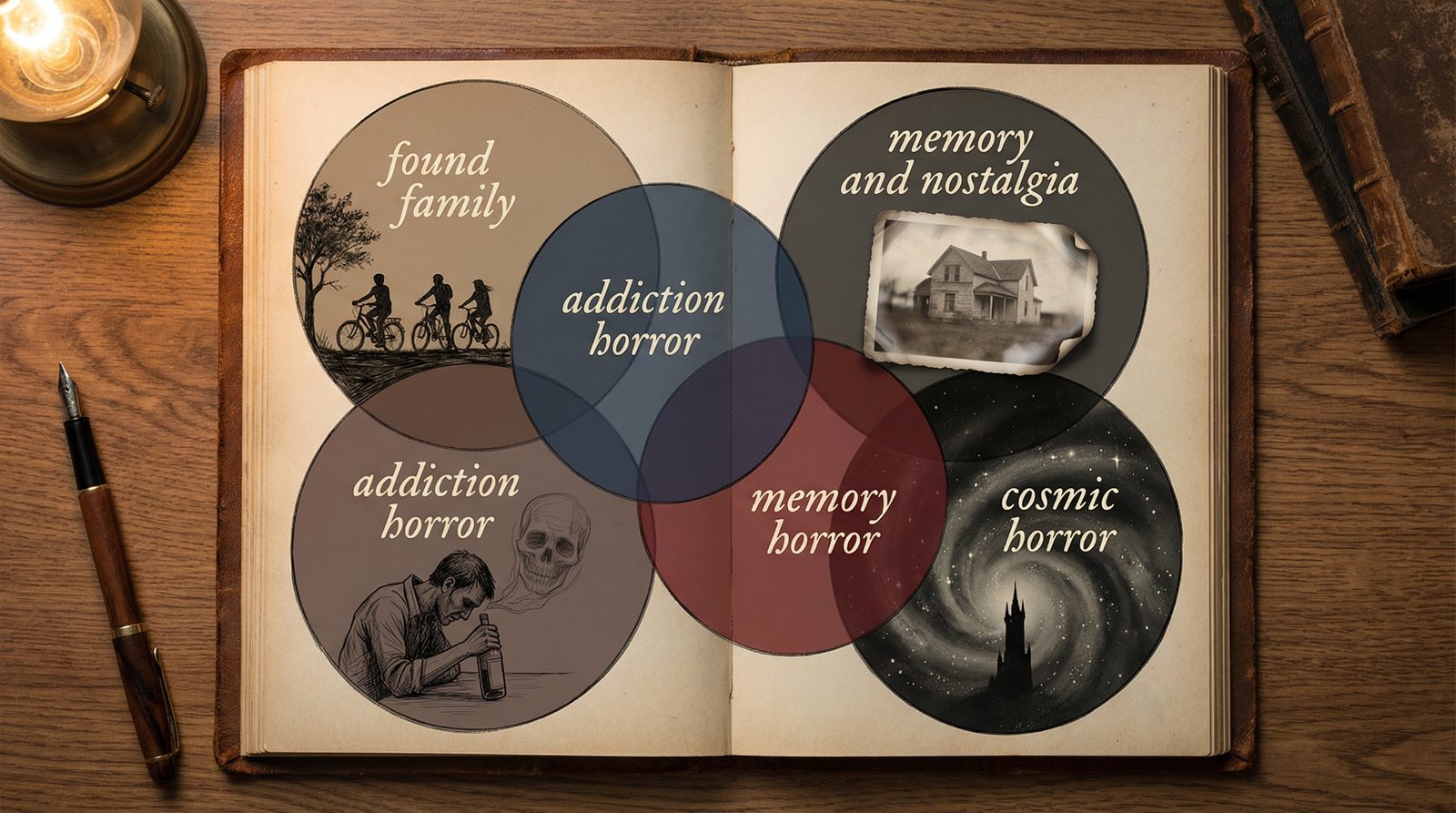
    Another persistent thread is found family. In “It (1986)”, the Losers’ Club is a group of misfits who become a chosen family to survive both bullying and a shapeshifting monster. In “Rita Hayworth and Shawshank Redemption (1982)”, friendship and solidarity inside prison are the only defenses against despair. These found family bonds are often the counterweight to evil, suggesting that connection is the only real magic people have.

    King is fascinated by addiction and redemption. Characters like Jack Torrance in “The Shining (1977)” and Danny Torrance in “Doctor Sleep (2013)” embody addiction horror, where the monster is as much the bottle as any ghost. The horror of losing control of oneself, of becoming a danger to the people you love, is one of his most unsettling themes. Alongside this runs a quieter focus on memory and nostalgia. Stories like “The Body (1982)” and “11/22/63 (2011)” treat the past as both a refuge and a trap, where childhood and history can never be fully recovered or fixed.

    Finally, King often uses cosmic horror, especially in “It (1986)” and “The Dark Tower (1982)”, to suggest that human struggles are set against vast, indifferent forces. Yet his tone rarely sinks into pure despair. Even when facing cosmic horror, his characters cling to compassion, humor, and stubborn courage, which gives his work a distinctive blend of dread and hope.

    Symbolic illustration inspired by 'Stephen King'

    STYLE & VOICE

    Stephen King’s style is conversational and plainspoken, closer to someone telling a long story at the kitchen table than to literary ornament. He favors a character-driven horror approach, spending pages on the rhythms of daily life before anything overtly frightening happens. That slow-burn suspense is part of his method. By the time the supernatural appears, readers feel they know the people it threatens.

    He often uses multiple perspectives and braided timelines. In “It (1986)”, the narrative jumps between the protagonists as children and as adults, creating a layered sense of memory and inevitability. In “The Stand (1978)”, he moves among a large ensemble cast scattered across a devastated America, building an epic scale from many intimate viewpoints. This ensemble storytelling lets him explore how different kinds of people respond to the same crisis.

    King’s prose is full of colloquial dialogue, brand names, and pop culture references. That realism can make the horror feel more intrusive, as if it is invading a recognizable world. He is also fond of interior monologue and sudden flashes of dark humor, which keep the tone from becoming monotonously bleak. Even in his grimmest stories, a joke or a stray thought will cut through the tension, reminding readers of the messiness of real minds under stress.

    Structurally, he often blends horror with coming-of-age arcs and crime or fantasy frameworks, as in “Misery (1987)” and “11/22/63 (2011)”. His endings can be divisive, sometimes abrupt or ambiguous, but that inconsistency is part of his risk-taking. Across genres, his voice remains recognizable.

    KEY WORKS & LEGACY

    Certain books have come to define Stephen King for many readers. “Carrie (1974)” announced his blend of high school cruelty and telekinetic horror. “The Shining (1977)” crystallized his obsession with addiction horror and the haunted family. “The Stand (1978)” showed his ability to stretch horror into post-apocalyptic epic, while “It (1986)” became a landmark of small-town secrets, generational trauma, and found family facing cosmic horror.

    His shorter work has also had an outsized impact. The novella “The Body (1982)” became the film “Stand by Me”, a touchstone for coming-of-age storytelling. “Rita Hayworth and Shawshank Redemption (1982)”, another novella in Different Seasons, turned into the film “The Shawshank Redemption” (1994), which many viewers think of less as horror than as a story of endurance and hope. “Misery (1987)” and “Doctor Sleep (2013)” continue his interest in the relationship between creators and fans, addiction, and the fragile process of recovery.

    King’s influence on horror and popular fiction is hard to overstate. He helped normalize the idea that horror could be mainstream, emotionally rich, and focused on character rather than just shock. His work sits alongside that of earlier figures in American horror and suspense, but he brought a distinctly late-20th-century sensibility.

    Beyond specific titles, his legacy includes the many writers and filmmakers who have taken cues from his character-driven horror and his mix of dread and hope. He showed that horror could be a flexible tool for exploring grief, guilt, and the possibility of redemption. Even readers who have never picked up one of his novels live in a culture shaped by his images of haunted hotels, killer clowns, and kids on bikes riding toward something they cannot yet name.


    DISCOVERABILITY & LINKS

    This creator page connects Stephen King to the wider Bachman–King network on AllReaders. Follow the links above to explore how his novels, pseudonymous works, and recurring motifs intertwine across horror, suspense, and character-driven storytelling.

  • One on One (1993)

    One on One (1993)

    By: Tabitha King
    Genre: Literary Fiction, Domestic Psychological Fiction
    Country: United States


    INTRODUCTION

    Tabitha King’s One on One begins with the feel of a familiar coming-of-age tale, but the story quickly deepens into something more charged. It follows Deanie Gauthier, a young basketball standout growing up in Nodd’s Ridge, a town where people pay close attention to the smallest details of each other’s lives. Deanie’s talent puts her in a strange position. She shines on the court, yet her intensity, confidence, and physical presence make her stand out in ways the town isn’t entirely comfortable with. What looks like a simple sports novel from the outside becomes a layered exploration of ambition, gender, class, and the uneasy pressure of being different in a place that prefers predictability.

    Revisiting the book through AllReaders means returning to a novel that mixes sport, desire, and a steady undercurrent of psychological unease. King portrays a girl who refuses to shrink, and that refusal gives the book its lasting power.


    PLOT & THEMES

    Deanie Gauthier is a gifted player in a town that doesn’t know how to celebrate a girl like her. She is strong, competitive, and unwilling to soften herself for anyone. Home offers little comfort. Her mother drifts in and out of relationships, and one boyfriend becomes a genuine threat. The basketball court turns into Deanie’s only place of order, the one part of her life where her skills give her some control.

    Her growing connection with Sam Styles complicates everything. Sam is one of the young men coaching in her orbit, and the relationship slips into territory neither of them fully understands. The imbalance between them is clear from the start, even though neither speaks it aloud. King handles these moments with restraint, relying on quiet details rather than dramatic turns. The unease fits closely with the motif Domestic Vulnerability as Horror, since the danger comes from ordinary people rather than anything supernatural.

    The people of Nodd’s Ridge help push the tension higher. They talk about Deanie constantly. They judge her talent, her body, her choices, and even her silences. She becomes the subject of opinions she never asked for. Under that scrutiny, she inches toward a point where she must decide whether to shape herself into something more acceptable or hold her ground and risk being isolated. The pressure echoes the motif Identity Collapse in Isolation, where a character’s inner life is squeezed by the expectations of the world around them.

    Conceptual editorial illustration inspired by 'one on one (1993)'

    STYLE & LANGUAGE

    King writes with clarity and restraint. Her style looks simple at first glance, but she uses it to capture emotional shifts with real precision. Much of the power comes from her dialogue. Characters rarely say exactly what they mean, yet the intent sits right beneath the surface, especially in conversations between Deanie and the adults who see her as something they want to shape.

    The pacing reflects the rhythm of teenage life. Ordinary days stretch out for chapters, then something unexpected happens and everything tightens. The basketball scenes carry a physical energy that feels grounded in lived experience. In contrast, the moments at home feel fragile, as if the walls could crumble with one wrong word.

    King’s blend of private thought and public scrutiny gives the novel its emotional tone. Even when Deanie stands in a crowded room, the writing often makes her feel alone. That loneliness becomes another pressure point that shapes the story.


    CHARACTERS & RELATIONSHIPS

    Deanie Gauthier is one of King’s most memorable protagonists. She is tough, self-reliant, and painfully aware of the ways adults fail the children in their care. Her aggression on the court is part shield, part survival strategy. King allows her to be angry, hopeful, reckless, and loyal without ever flattening her into a single trait.

    Sam Styles occupies a complicated place in Deanie’s story. King avoids turning him into a cartoon villain, but she also makes it clear how easily a young man in his position can misuse the influence he has over a girl who wants to be seen. His choices create much of the novel’s slow-building danger.

    The supporting cast widens the emotional landscape. Friends, teammates, teachers, and Deanie’s family all add texture to the town’s inner workings. Many of them reveal, in small ways, how a community can watch a girl closely while still failing to understand her.

    Illustration of a core idea or motif from 'one on one (1993)'

    CULTURAL CONTEXT & LEGACY

    Published in the early 1990s, One on One arrived during a period when fiction was increasingly interested in the overlap between teenage interiority and domestic realism. King approaches these themes with subtlety. She writes trauma without spectacle and desire without exploitation. The novel shares some thematic terrain with other members of the King family’s work, particularly the focus on small towns as both nurturing and suffocating spaces, but her voice remains distinct.

    Within the Nodd’s Ridge cycle, this book helps define the emotional range of the series. Characters weave in and out of multiple novels, creating a shared world that feels steady even when the people inside it struggle. That continuity gives the series its depth and provides long-term readers with a sense of connection across the books.


    IS IT WORTH READING?

    Readers who enjoy character-driven stories about resilience, vulnerability, and the pressures of small-town life will find a lot to admire in One on One. It is one of Tabitha King’s most immediate and emotionally grounded novels. Many readers who start here continue to Pearl or The Book of Reuben afterward, since the books complement one another and deepen the world of Nodd’s Ridge.


    SIMILAR BOOKS

    If you connect with the emotional intensity of One on One, several other novels may hit the same nerve. Tabitha King’s Survivor explores trauma and resilience from a different angle, while Pearl expands the Nodd’s Ridge setting through another protagonist’s eyes. Outside her work, Laurie Halse Anderson’s Catalyst dives into the pressures and expectations placed on young women, making it a strong thematic match.