DEFINITION & CORE IDEA
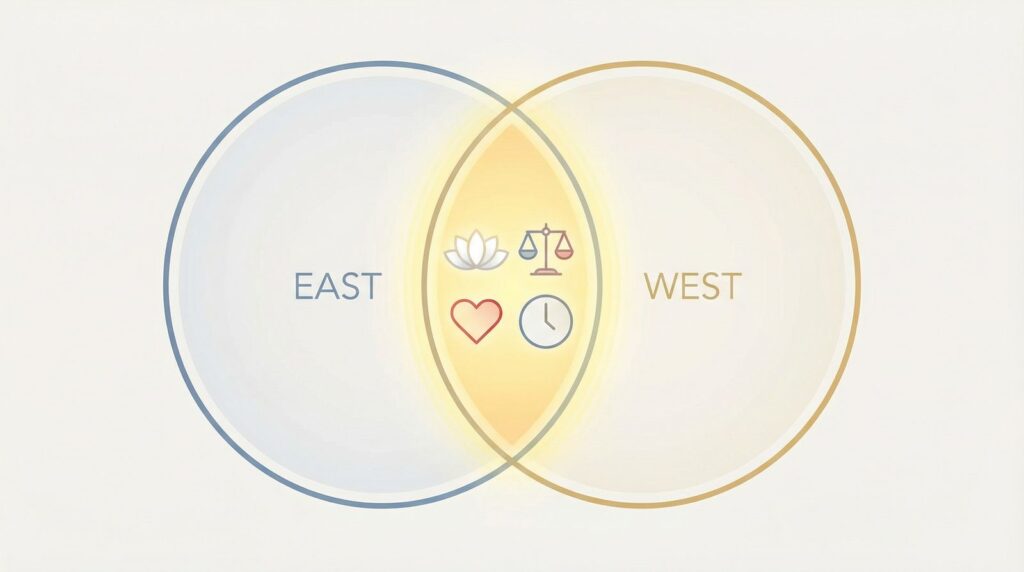
East-West Philosophical Synthesis is a motif in which Eastern and Western ideas about life, morality, and meaning are brought into direct conversation and gradually woven together. Instead of treating East and West as fixed or exotic opposites, stories using this motif allow characters to test Buddhist detachment against capitalist ambition, Confucian duty against individual freedom, or Western rationalism against mystical insight. The point is not that one side wins, but that both are altered through sustained contact.
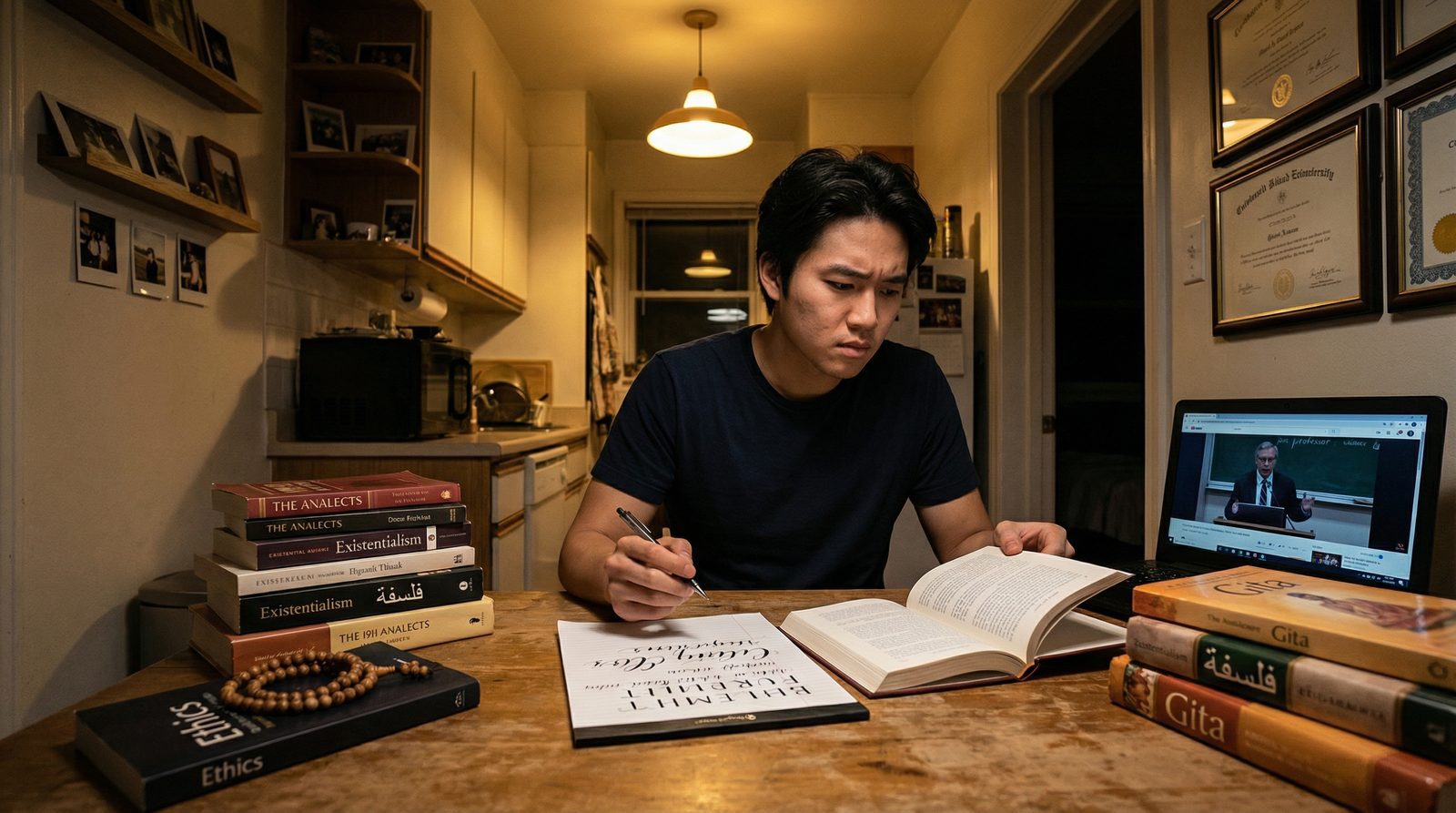
In practice, East-West Philosophical Synthesis often appears when a character moves between cultures, studies within a foreign tradition, or grows up inside a mixed philosophical inheritance. They might try to apply meditation and non-attachment to modern work pressure, or use Western psychology to interpret karma, desire, and rebirth. The narrative becomes a kind of laboratory where everyday problems like love, family, work, and grief are approached using tools drawn from more than one civilizational story about what humans are and what they owe each other.
This motif is especially visible in modern spiritual literature that seeks to translate non-Western traditions into a language accessible to contemporary readers. In Zen and the Art of Motorcycle Maintenance: An Inquiry Into Values, Robert M. Pirsig uses the act of motorcycle maintenance as a bridge between Eastern ideas of presence and Western rational analysis. Quality becomes not a technical metric but a lived experience, discovered through attention rather than theory.

HOW IT WORKS IN STORIES
East-West Philosophical Synthesis usually begins with contact, and early scenes often highlight misunderstanding. A Western-trained professional dismisses traditional practices as superstition. A spiritual teacher views Western self-focus as indulgent. A child of immigrants is told to follow their heart at school while being expected to honor the family at home.
The story then develops situations where neither a purely Eastern nor a purely Western response feels sufficient. A character raised on individualism may find relief in ideas of interdependence and community. Someone taught to suppress desire for the sake of harmony may discover that Western concepts of boundaries and selfhood provide tools for resistance. Tensions such as fate versus free will, duty versus authenticity, and mind versus body are reopened through lived consequence.
Over time, the motif shifts from argument to experiment. Characters begin trying hybrid approaches, often clumsily. The synthesis is rarely elegant. It involves compromise, partial misunderstanding, and moments of recognition where a character realizes they have simplified a deep tradition into something more convenient than true.
Some stories lean toward philosophical rigor, as in the inward journeys of Hermann Hesse. Others move toward accessible spiritual narrative. In Way of the Peaceful Warrior, Eastern ideas of discipline and presence are filtered through a distinctly Western self-help structure, emphasizing personal transformation over metaphysical coherence.
EMOTIONAL EFFECT ON THE READER
Reading a story shaped by East-West Philosophical Synthesis often feels like sitting in on a long, intimate conversation about how to live. There is pleasure in seeing familiar ideas reframed, where spiritual concepts become practical tools and everyday decisions become moral experiments.
The motif can also be unsettling. It invites readers to notice how much of their moral intuition is inherited rather than chosen. When characters sincerely try practices drawn from outside their native culture, the reader is asked to imagine doing the same, feeling both curiosity and resistance.
At its most effective, the motif produces a sense of widened possibility. Cultures are not treated as sealed containers but as living systems capable of dialogue and change. Even when the synthesis fails or remains incomplete, the effort itself carries meaning.
VARIATIONS & RELATED MOTIFS
East-West Philosophical Synthesis appears in several distinct modes. In literary fiction, it often takes the form of a demanding inner journey, as in Siddhartha and Demian, where spiritual insight must be earned through suffering and self-confrontation. In popular spiritual fiction, the synthesis becomes more approachable but also more ambiguous.
In The Celestine Prophecy and The Tenth Insight, James Redfield presents a New Age-inflected synthesis, where Eastern concepts of energy and synchronicity are adapted to Western narrative expectations of clarity, progress, and personal destiny. The result is less philosophically rigorous than Pirsig or Hesse, but emotionally accessible to a broad audience.
Across these variations, the core remains the same. East-West Philosophical Synthesis is about what happens when different civilizational accounts of meaning, duty, and selfhood are forced to coexist within a single human life.
Related books: Siddhartha, Demian, The Alchemist, The Pilgrimage, The Celestine Prophecy, The Tenth Insight, Way of the Peaceful Warrior, Zen and the Art of Motorcycle Maintenance
Related movies: The Celestine Prophecy
Related creators: Hermann Hesse, Paulo Coelho, James Redfield, Robert M. Pirsig
Related motifs: Spiritual Awakening, Spiritual Pilgrimage, Synchronicity and Meaningful Coincidence, Inner Journey, Personal Legend and Destiny, Intimacy as Healing