
Place: Africa

  • The Alchemist (1988)

    The Alchemist (1988)

    INTRODUCTION

    The Alchemist (1988) by Paulo Coelho
    Philosophical fiction · 166 pages · Spain / Egypt


    The Alchemist has been quoted on posters, mugs, and social feeds so relentlessly that it is easy to forget there is a small, quietly odd novel beneath the slogans. On the surface, it reads like a simple fable about following your dreams. Underneath, it is more fragile and ambivalent than its reputation suggests.

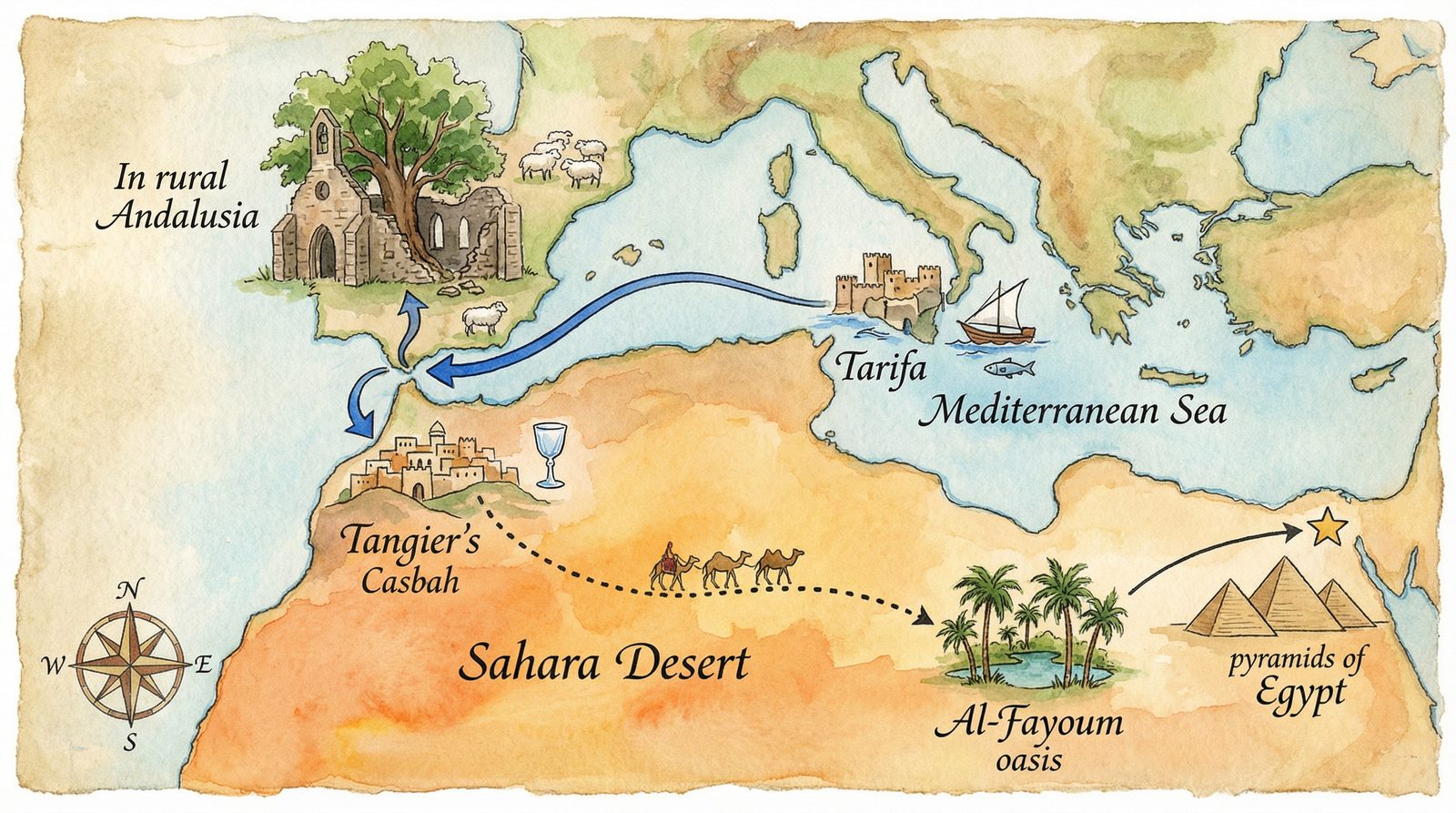
    Set in a loosely sketched, almost timeless world, the book follows a young Andalusian shepherd who trades pastoral safety for the uncertainty of travel across North Africa. The images linger: a boy sleeping in a ruined church beneath a sycamore tree, the repeated language of omens, the idea of a “Personal Legend” that both comforts and unsettles. Strip away the inspirational framing, and what remains is a story about restlessness, loss, and the uneasy cost of believing that life has a single, discoverable meaning.

    PLOT & THEMES

    The plot is deliberately spare. Santiago, a shepherd from Andalusia, dreams twice of treasure buried near the Egyptian pyramids. A strange old man calling himself Melchizedek, king of Salem, urges him to pursue the dream, speaking of Personal Legends and asking for a tenth of the treasure in advance. The encounter feels less like divine revelation than a streetwise push toward risk.

    Santiago sells his sheep, crosses to Tangier, and is immediately robbed. This early loss establishes one of the book’s central patterns: progress is inseparable from disorientation. Working for a crystal merchant overlooking the marketplace, Santiago learns how fear of change can slowly fossilize a life. The merchant’s unrealized pilgrimage to Mecca becomes a quiet warning about dreams postponed until they no longer feel possible.

    As Santiago joins a caravan crossing the Sahara, the novel widens. The Englishman obsessed with alchemical texts introduces the tension between book knowledge and lived experience. War between desert tribes, Santiago’s time at the Al-Fayoum oasis, and his love for Fatima sharpen the central question: when does commitment to a path become an excuse to avoid attachment, and when does attachment become a reason to stop seeking?

    The Alchemist himself appears late, more riddle than person. He insists that the oft-quoted idea that “the universe conspires” only holds if one is willing to risk everything. The ending is bluntly circular. Santiago learns that the treasure was buried back in Spain, at the very church where his journey began. The irony is not softened. The novel insists that the journey was necessary, even if the destination never moved.

    PROSE & NARRATIVE STRUCTURE

    Coelho’s prose is famously spare, closer to parable than to realist fiction. The narration moves in clean, declarative sentences that summarize inner change rather than dramatize it. This can feel hypnotic or thin, depending on the reader’s patience for abstraction.

    The structure is linear and episodic. Each location functions as a moral vignette: the church, the port of Tarifa, the crystal shop, the caravan, the oasis, the desert. Symbolic objects recur with near-ritual regularity: the Urim and Thummim stones, the hawks at Al-Fayoum, the desert itself as a listening presence. The repetition of phrases like “Personal Legend,” “Soul of the World,” and “Maktub” creates a chant-like rhythm that is central to the book’s effect.

    Formally, the novel takes few risks. Its power, when it works, comes from compression rather than complexity. It is designed to be read quickly and remembered vaguely, carried more as an atmosphere than as a sequence of scenes.
    Conceptual editorial illustration inspired by 'The Alchemist'

    CHARACTERS & INTERIORITY

    Santiago is not written as a psychologically complex figure. He functions as a clean archetype: open, curious, and capable of doubt without becoming paralyzed by it. His small attachments, his sheep, the memory of a merchant’s daughter, his fear when he first sees the sea, provide just enough texture to anchor the fable.

    The supporting figures operate as embodiments of choice. The crystal merchant represents resignation disguised as prudence. Fatima embodies a love that insists seeking and commitment need not cancel each other out. The Alchemist himself acts as a pressure point, forcing Santiago to risk annihilation rather than settle for symbolic understanding.

    Interior life is conveyed through parable rather than introspection. Feelings are named, not excavated. Yet moments of loss and fear, especially after the robbery in Tangier and during the desert ordeal, cut through the abstraction. The simplicity is intentional. The book asks the reader to project their own doubts into the spaces left open.

    LEGACY & RECEPTION

    Since its publication, The Alchemist has become one of the most translated and commercially successful novels of the late twentieth century. It sits alongside works like Jonathan Livingston Seagull as a foundational text of modern spiritual fiction. Critical response has been sharply divided, with some praising its mythic clarity and others dismissing it as aphoristic mysticism.

    The novel’s language of Personal Legends and cosmic conspiracy has seeped deeply into popular culture. Its endurance lies not in literary innovation but in its ability to function as a mirror. Readers return to it at different moments of life and read different instructions into the same slender story.

    IS IT WORTH READING?

    If you are looking for dense characterization or stylistic experimentation, this will feel thin. If you approach it as a modern fable, a compressed meditation on risk, desire, and return, it can still resonate. Reading it now is also an act of reclamation, separating the novel from its motivational afterlife.

    The lingering question it leaves is not inspirational but quietly unsettling: what would you have to give up to find out whether the life you imagine is actually yours?

    Illustration inspired by a core idea from 'The Alchemist'

    TRIVIA & AUTHOR FACTS

    Paulo Coelho wrote the novel quickly, later describing the process as intuitive rather than planned. It was initially a commercial failure in Brazil, and its first publisher dropped it. Only after being taken on by another house did it begin its gradual rise to global success.

    The book synthesizes Coelho’s long-standing interests in pilgrimage, omens, and Western esoteric traditions. Despite the title, its use of alchemy is symbolic rather than historical, drawing more from myth and metaphor than from chemical practice.

    SIMILAR BOOKS

    Readers drawn to this style of allegorical journey may also explore Siddhartha by Hermann Hesse, Jonathan Livingston Seagull by Richard Bach, or Shusaku Endo’s Silence, which offers a far harsher meditation on faith and failure. Each examines what is gained and lost when belief becomes a guiding structure.

    DISCOVERABILITY & LINKS

    DISCOVERABILITY & LINKS

  • Alice Walker

    Alice Walker

    Born 1944, Eatonton, Georgia, United States Genres: Literary Fiction, Poetry, Essay Era: Late 20th Century – 1980s

    INTRODUCTION

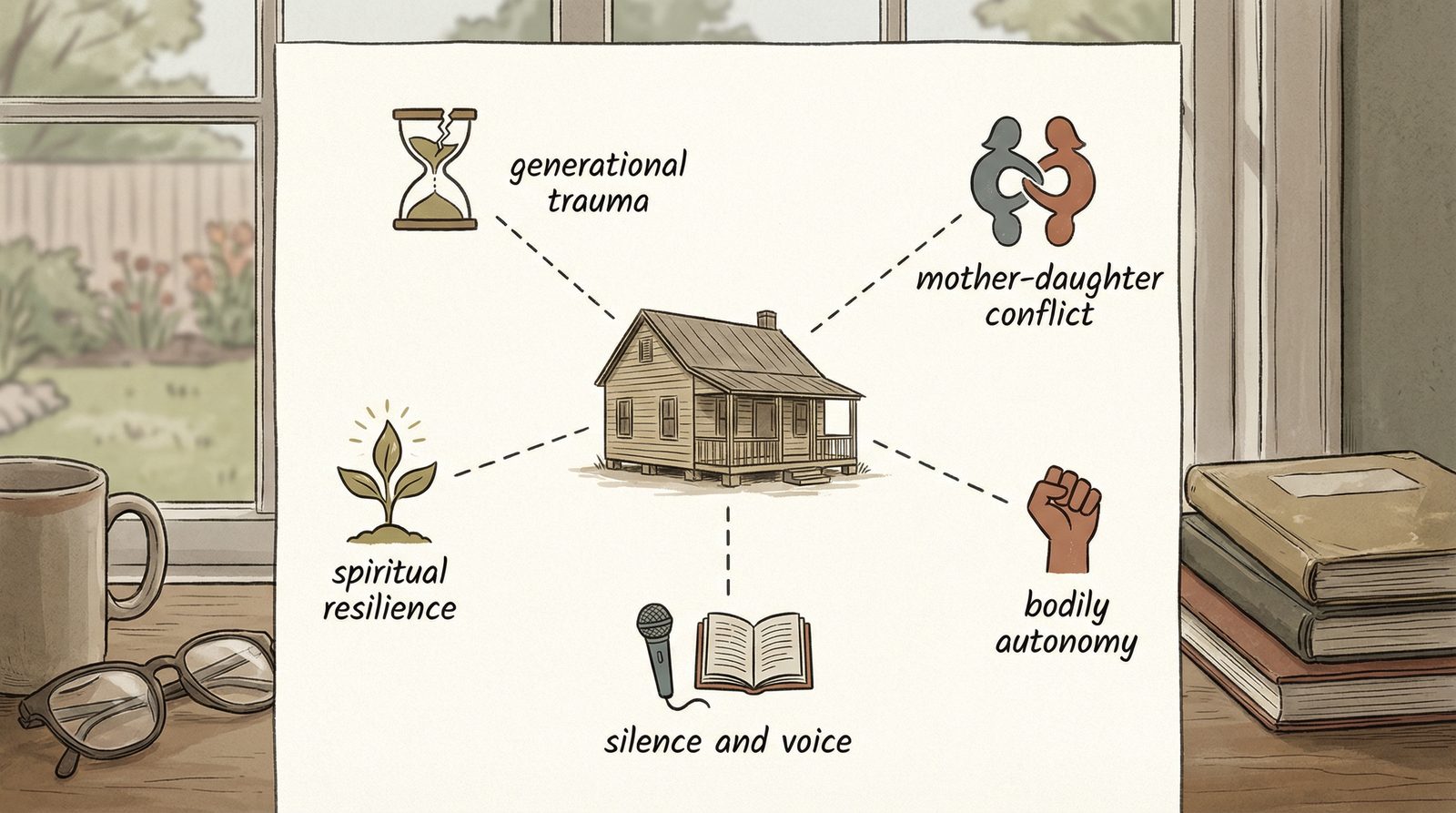
    Alice Walker writes with a steady, spiritual intelligence that feels rooted in the earth itself. Her work is shaped by Southern Black womanhood, political struggle, and a belief that the sacred can live inside ordinary lives. With The Color Purple, she placed working class Black women at the center of American literature and refused to soften their experiences. The novel’s emotional clarity reflects the motif of Trauma as Inheritance, while her characters show remarkable capacity for growth. Walker’s voice blends tenderness with ferocity. She insists on telling the truth even when the truth is uncomfortable.

    LIFE AND INFLUENCES

    Born in rural Georgia, Walker grew up in a sharecropping family where stories and faith were central. A childhood accident left her blind in one eye, a trauma that shaped her early sense of isolation and introspection. She attended Spelman College and later Sarah Lawrence, where the Civil Rights Movement deepened her political awareness. Her influences include Zora Neale Hurston, Black Southern folklore, womanist theology, and her own experience of racism and poverty. These threads appear throughout her work, aligning with motifs like Survival Narratives and Intimacy as Healing.
    Symbolic illustration inspired by 'Alice Walker'

    THEMES AND MOTIFS

    Walker returns again and again to themes of spiritual reclamation, domestic violence, sexuality, community, and the healing potential of female friendship. She coined the term “womanist” to describe a feminism grounded in Black women’s experiences. Her characters often move from silence to voice and from survival to rootedness. Many of her stories explore the double pull of harm and hope within families. This tension aligns with motifs such as Emotional Minimalism and Power as Proximity, where vulnerability and authority compete.

    STYLE AND VOICE

    Walker writes with clarity, gentleness, and rhythmic simplicity. Her voice is direct and grounded. She blends emotion with restraint. She favors intimate narration, lyrical fragments, and spiritual imagery. Even at her most political, the work feels lived in rather than theoretical. The dignity she grants her characters comes through language that honors their truth. She allows flaws, contradictions, and small moments to carry the story.

    KEY WORKS

    Walker has published poetry, essays, and additional novels, but The Color Purple remains the work most closely tied to her cultural legacy.

    RELATED ADAPTATIONS

    Walker’s most famous novel has inspired multiple major screen adaptations that carried Celie’s story to new audiences: • The Color Purple (1985) – Steven Spielberg’s dramatic adaptation, which brought the novel into mainstream cinema. • The Color Purple (2023) – A musical film adaptation that builds on the stage production and reimagines the story through song and choreography.

    CULTURAL LEGACY

    Alice Walker changed the shape of American literature. She expanded the canon to include the voices of Black Southern women whose stories had long been marginalized. Her work sparked debate, redefined womanist thought, and influenced writers across generations. The adaptations of The Color Purple in 1985 and 2023 further broadened its reach. Together with the original novel, they formed a multiform narrative that continues to shape how readers and viewers think about faith, gender, race, and freedom. Today, Walker’s influence stands beside figures like Toni Morrison and Zora Neale Hurston, whose work insists on truth over comfort and on healing over silence.
  • The Color Purple (1982)

    The Color Purple (1982)

    By: Alice Walker
    Genre: Epistolary Novel, Historical Fiction
    Country: United States


    INTRODUCTION

    The Color Purple is one of the most quietly powerful novels of the twentieth century. First published in 1982, it tells Celie’s story through letters written in her own unpolished voice. She writes to God because she has no one else to listen. The book begins in near silence and grows into a full song of survival. The early chapters lean into the motif of Silence as Survival, where withholding becomes a way to stay alive in a world that rarely offers safety.

    What makes the novel unforgettable is its transformation. Celie’s frightened voice becomes the voice of a woman reclaiming her own life.


    PLOT AND THEMES

    Celie’s story unfolds through letters addressed first to God and later to her sister Nettie. She grows up in rural Georgia, enduring sexual violence, forced marriage, and constant humiliation. Her husband, known only as Mister, uses her as labor and property. The plot moves slowly in action but widely in emotional scope. It traces Celie’s long shift from voicelessness to self-possession.

    The exchange of letters between Celie and Nettie becomes the novel’s emotional spine. Nettie’s letters from Africa widen the book’s sense of place and connect Celie’s private suffering to broader histories of displacement and oppression. This pattern aligns with the motif of Trauma as Inheritance, where pain is passed across families and continents.

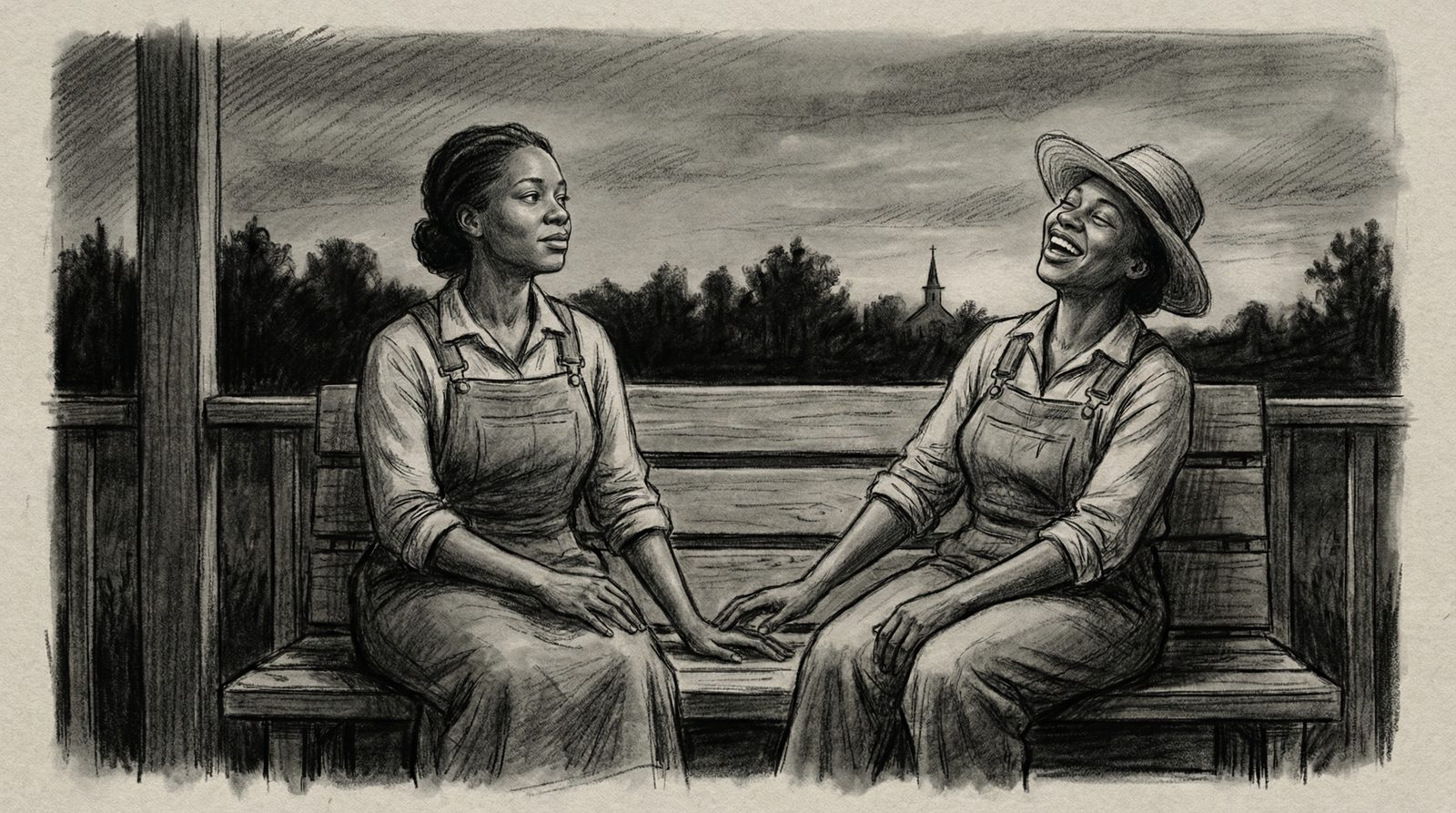
    The story also explores sisterhood, chosen family, and the sacredness of desire. Celie’s bond with Shug Avery becomes a turning point. Shug models a life of self-regard, sensuality, and spiritual independence. Through Shug, Celie learns that her body and voice belong to her. This shift reflects the motif of Intimacy as Healing, where affection becomes instruction.

    Conceptual editorial illustration inspired by 'the color purple'


    STYLE AND LANGUAGE

    The novel is written in Celie’s dialect, with spelling and grammar shaped by her limited formal education. What might seem simple becomes beautiful through sincerity. Alice Walker refuses to smooth or correct Celie’s voice. Instead, she lets the language carry emotional truth. This restraint is a form of Emotional Minimalism, where plain words carry enormous weight.

    The epistolary form gives the book its heart. Every letter feels like a prayer or confession. As Celie grows, the writing grows with her. Her vocabulary expands. Her confidence sharpens. The evolution of her syntax becomes its own proof of transformation.


    CHARACTERS AND RELATIONSHIPS

    Celie anchors the novel, but she is lifted forward by the women around her. Sofia’s defiance teaches her resistance. Shug Avery’s independence teaches her desire and spiritual agency. Nettie’s letters teach her about the world and about her own worth. Together, these women rewrite Celie’s understanding of freedom.

    The men are not reduced to caricatures. Mister is violent and controlling, yet his slow, partial redemption shows Walker’s belief in the possibility of change. Harpo and others reflect the pressures of a patriarchal world that harms them as well. These dynamics connect to the motif of Power as Proximity, where harm flows through inherited roles rather than pure malice.

    Celie’s relationships move the novel from brutality to connection. Each bond widens her sense of what a life can be.

    Illustration of a core idea or motif from 'the color purple'


    CULTURAL CONTEXT AND LEGACY

    When it was released, The Color Purple changed the landscape of American literature. It won both the Pulitzer Prize and National Book Award and sparked fierce debate. Some Black male critics accused Walker of betrayal for depicting domestic violence within Black families. The argument exposed the cultural tension the novel refuses to hide. Walker insisted on telling the truth about private pain rather than protecting public appearance.

    The story continued to evolve through adaptation. The 1985 film directed by Steven Spielberg brought Celie’s world to mainstream cinema, earning critical acclaim and introducing the story to millions who had never read the novel. The later 2023 film musical adaptation expanded the emotional palette even further, using music and movement to explore Celie’s interior life in ways unique to the stage and screen.

    The novel’s themes place it alongside Beloved (1987) and Their Eyes Were Watching God (1937) as a cornerstone of Black feminist literature. More than forty years later, its closing lines still feel revelatory. The book is an argument for joy as resistance.


    IS IT WORTH READING?

    Yes. The Color Purple is essential reading. It is unflinching, tender, and transformative. The brutality is difficult, but the beauty is sustaining. For readers interested in stories of trauma, faith, desire, and freedom, it remains one of the most important novels in American literature.


    SIMILAR BOOKS

    Beloved (1987)
    Their Eyes Were Watching God (1937)
    I Know Why the Caged Bird Sings (1969)
    The Bluest Eye (1970)


    RELATED ADAPTATIONS

    The Color Purple (1985)
    The Color Purple (2023)