
Place: Europe

  • P G Wodehouse

    P G Wodehouse

    ORIGINS & BACKGROUND

    P. G. Wodehouse is usually placed in the tradition of British comic fiction, a writer who seemed to live in an endlessly sunny version of early twentieth-century England even as the real world darkened around him. Educated in the English public school system and shaped by Edwardian social codes, he took the hierarchies, rituals, and anxieties of that world and turned them into raw material for farce. His long career stretched across both world wars and into the television age, yet the fictional universe of country houses and London clubs stayed almost eerily consistent.

    That consistency is part nostalgia and part artistic choice. Wodehouse carved out a comic enclave where the stakes are social rather than political. His characters worry about engagements, allowances, and formidable aunts instead of war or economic collapse. This selective focus has drawn criticism, but it also explains his lasting appeal: he offers a carefully constructed escape hatch from modernity.

    Although deeply English in setting and idiom, Wodehouse spent significant time in the United States, and that transatlantic life seeps into his work through Broadway plots, show-business subplots, and a brisk sense of pacing. His background gave him knowledge of British upper-class rituals, but his distance from them—both geographical and emotional—helped him see their absurdities clearly enough to turn them into sustained comedy of manners.

    Editorial illustration inspired by 'P G Wodehouse'

    THEMES & MOTIFS

    Wodehouse returns again and again to class comedy, where aristocrats, valets, impostors, and clubmen collide in misunderstandings that expose how arbitrary the whole structure is. In Right Ho, Jeeves and The Code Of The Woosters, the supposedly superior young aristocrat is helpless while the valet quietly runs the show. The joke is not only that the servant is clever, but that the hierarchy is inverted by competence.

    Romantic entanglements drive many plots. Engagements are formed, broken, and re-formed in a blur of misread letters and badly timed interventions. Love is less a grand passion than a source of comic pressure, forcing characters into elaborate schemes they are barely equipped to carry out.

    Social embarrassment is the engine that keeps those schemes accelerating. Wodehouse’s heroes live in fear of looking foolish in front of aunts, fiancées, or club acquaintances, and the narrative delights in stretching that embarrassment to its limit before offering relief. The rules of manners become both prison and playground, because every polite sentence is also a trap that must be navigated.

    Friendship and loyalty quietly anchor the chaos. However silly Bertie Wooster may be, his loyalty to friends and trust in Jeeves give the stories emotional ballast. In Leave It To Psmith, Wodehouse shifts the focus to a different kind of hero, but keeps the same moral architecture: wit, adaptability, and loyalty matter more than birth.
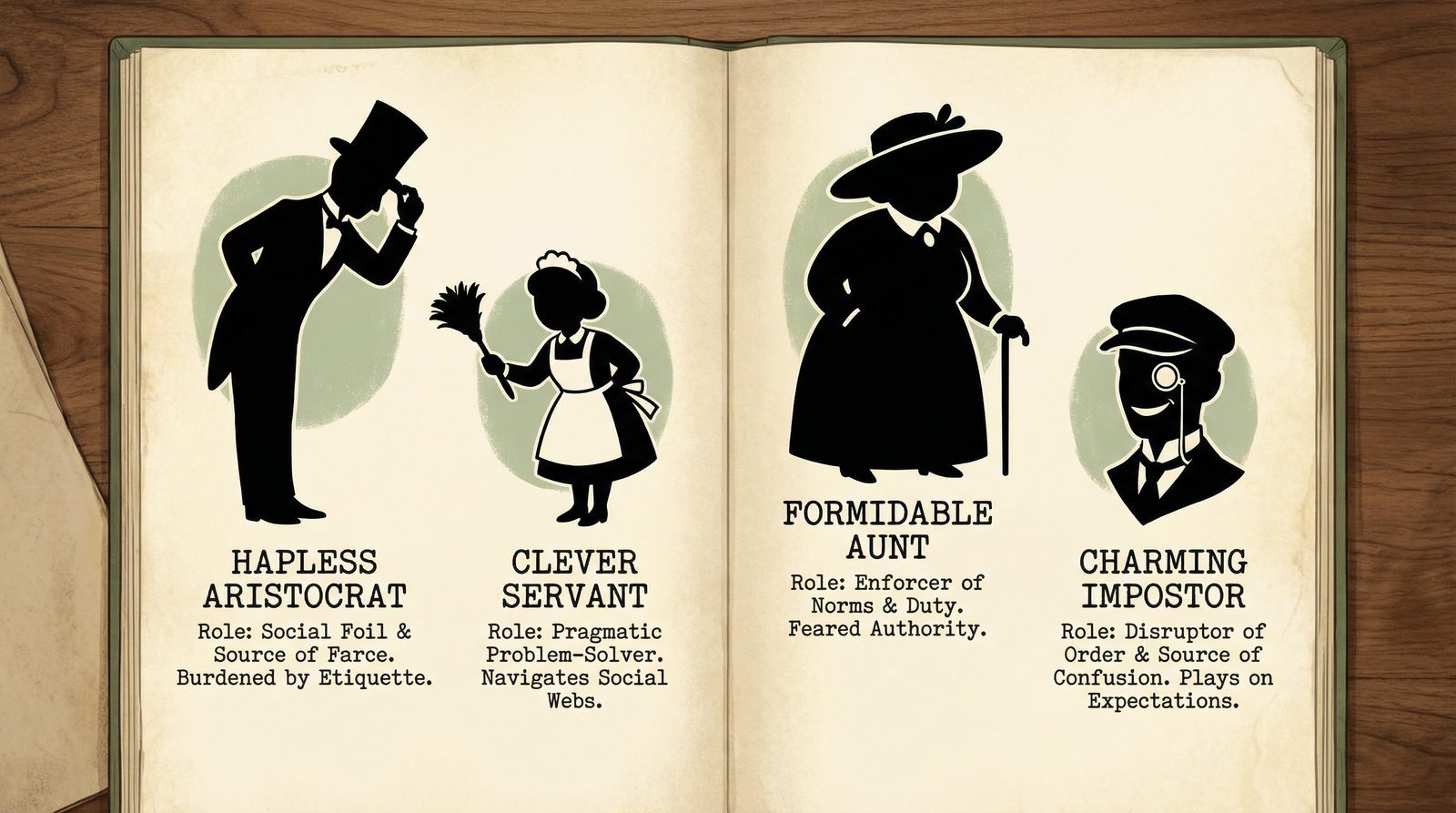
    Symbolic illustration inspired by 'P G Wodehouse'

    STYLE & VOICE

    Wodehouse’s style is defined by lightness, intricate plotting, and a highly mannered narrative voice. His tone is breezy and confiding, full of comic similes, playful exaggeration, and narrators who seem to share the joke with the reader. Even when the story is told in first person, the voice is a performance: slangy chatter becomes a vehicle for carefully timed punchlines and sentences that are far more controlled than they pretend to be.

    Pacing is brisk. Scenes unfold like stage farce, with doors opening and closing, people hiding, and information arriving at exactly the wrong moment. The structure relies on escalating complications: a simple promise or lie blossoms into a tangle of mistaken identities and conflicting obligations. Running gags and clear character tags keep the reader oriented even as the plot knots tighten.

    His comedy depends on rhythm as much as content. Wodehouse loves the long sentence that swerves at the last second into absurdity, or the formal phrase undercut by slang. This interplay of high and low diction mirrors the class comedy in the plots: aristocrats quote poetry while behaving like children, and servants speak with perfect correctness while engineering the rescue.

    KEY WORKS & LEGACY

    Right Ho, Jeeves is often an entry point for readers, crystallizing the relationship between the hapless Bertie Wooster and the unflappable Jeeves. The Code Of The Woosters pushes the same formula into even more elaborate farce, deepening the sense that friendship and loyalty are the only stable values in a world built on absurd rules.

    Leave It To Psmith shows how Wodehouse can transplant his comedy to new characters while keeping the same emotional architecture. The charming impostor Psmith navigates country house intrigue with verbal flair, underlining the theme that wit and adaptability matter more than pedigree.

    The Jeeves And Wooster (TV Series) brought this world to a late twentieth-century audience and confirmed how stylized and enclosed it always was. In the broader landscape of British comic writing about class and manners, Wodehouse is often discussed alongside Evelyn Waugh and Nancy Mitford, though he remains the most determinedly escapist. His legacy lies in proving that lightness can be a serious artistic choice, and that pure farce can be engineered with the precision of a clock.

  • Jonathan Stroud

    Jonathan Stroud

    ORIGINS & BACKGROUND

    Jonathan Stroud is best known for character-driven fantasy that treats magic and ghosts less as glitter and more as workplace hazards. Across the Bartimaeus books and Lockwood Co, he builds systems where the supernatural is managed through procedure, rivalry, and institutional pressure. The result is adventurous fiction with sharp humor on the surface, but a steady preoccupation with power, responsibility, and the cost of survival.

    Stroud grew up and works in the United Kingdom, and his writing carries a distinctly British blend of dry wit, skepticism about authority, and affection for creaky institutions. Before becoming a full-time author, he worked as an editor in children’s publishing, which shows in his pacing, his clarity, and his instinct for what younger readers can handle emotionally without diluting the stakes.

    In the Bartimaeus sequence, beginning with The Amulet Of Samarkand (2003), Stroud imagines an alternate London run by magicians whose power depends on enslaved spirits. The setting is recognizably urban and modern, but filtered through history and satire. Later, with Lockwood Co and its opening novel The Screaming Staircase (2013), he shifts to a haunted London where children are the only effective defense against ghosts, creating a precarious professional ecosystem built on risk and exploitation.

    Rather than foregrounding personal trivia, Stroud lets background appear sideways: in memos, disciplinary language, petty rivalries, and the weary tone of officials who enforce rules they don’t fully understand. His worlds feel plausible because they behave like institutions, not fairy tales.

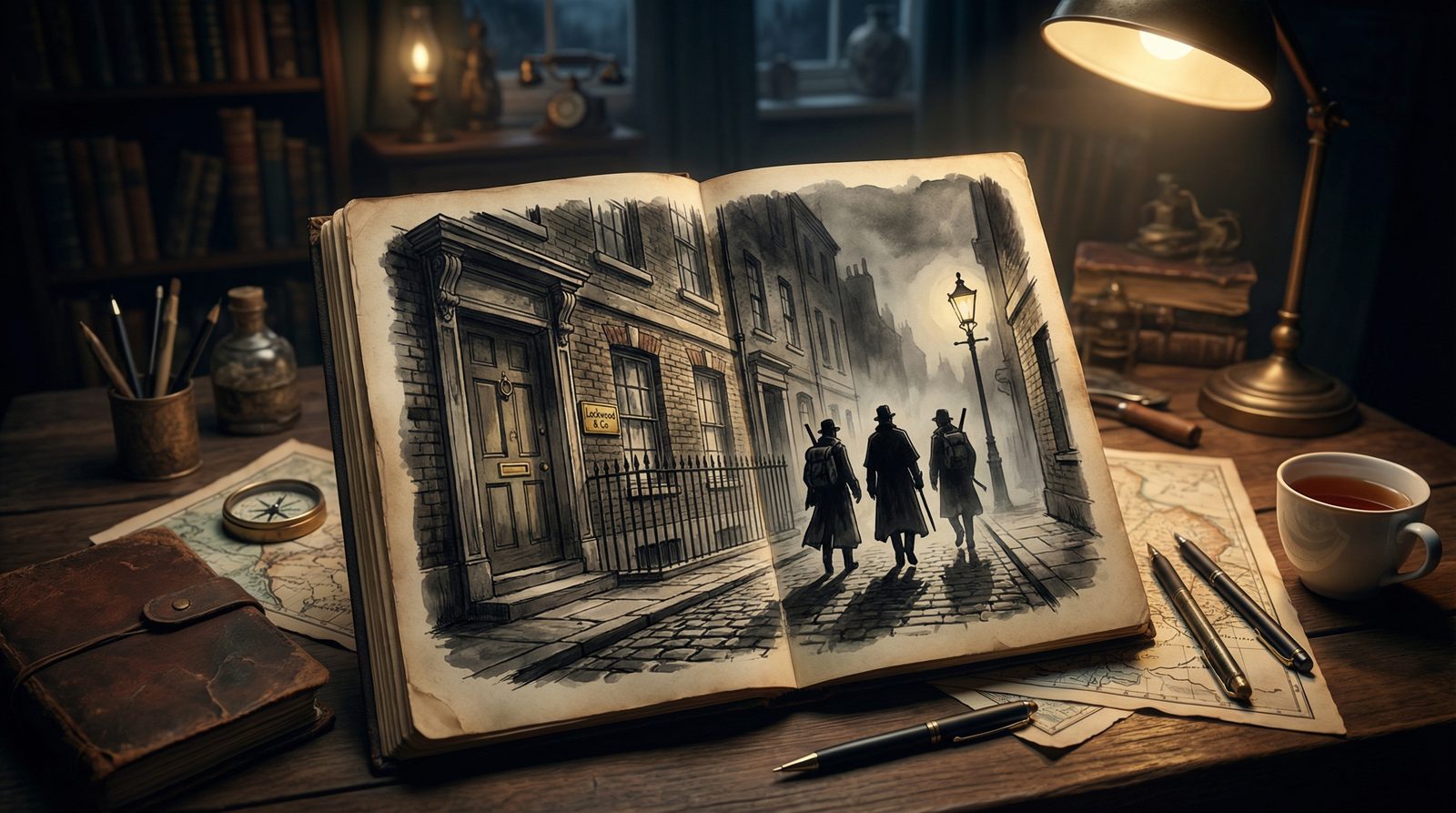
    Editorial illustration inspired by 'Jonathan Stroud'

    THEMES & MOTIFS

    A central engine in Stroud’s work is Magical Bureaucracy. In The Amulet Of Samarkand, magicians behave like civil servants and politicians: rule-bound in public, ruthless in private, and willing to weaponize procedure for personal gain. The supernatural is powerful, but the real leverage often sits in permissions, rank, and punishment.

    His later haunted-London world sharpens the logic of the Ghost Hunting Agency. In The Screaming Staircase, child sensitivity to ghosts becomes a professional resource, which turns bravery into an economic model. Young agents are praised, needed, and quietly treated as replaceable. Stroud returns to the tension between competence and vulnerability, showing how systems rely on the people they endanger.

    Power and servitude run through both series. In the Bartimaeus books, magic depends on exploitation, and the narrative keeps circling back to complicity and resistance. Even when characters benefit, the moral abrasion remains. In the ghost-agency world, power sits in information: who controls records, who sets policy, and who is allowed to define what “safe” means.

    Stroud also favors motifs of unreliable authority and buried history. Official explanations are rarely complete, and protagonists win by uncovering what institutions have forgotten or concealed. Alongside this is a quieter thread of found family, where humor and banter function as a survival tactic rather than sentimentality.

    Across his work, the motif systems are not window dressing. They are engines that let Stroud ask how much moral agency is possible inside structures built to reward compromise.

    Symbolic illustration inspired by 'Jonathan Stroud'

    STYLE & VOICE

    Stroud’s style is marked by wit, structural playfulness, and an unhurried confidence with worldbuilding. In the Bartimaeus books, he uses footnotes and a sardonic first-person voice to let the djinni comment on events, undercutting solemnity with sarcasm. The humor sharpens the critique rather than softening it, keeping power and procedure in view even during action.

    In Lockwood Co, the narrative voice is more direct but still dry and observant. Scenes of investigation and confrontation are tightly staged, with clear physical space and escalating dread. Stroud often alternates eerie fieldwork with domestic or office-like scenes inside the agency, which keeps the supernatural grounded in routine and logistics.

    His pacing favors accumulation over shock. Mysteries unfold through clues, conversations, and small revelations, with early details paying off later. Dialogue carries emotional weight, especially when characters test each other’s loyalty under pressure. Even in intense moments, Stroud avoids melodrama, creating a tone that is adventurous, eerie, and quietly bitter.

    KEY WORKS & LEGACY

    The Bartimaeus series, launched with The Amulet Of Samarkand, established Stroud’s signature blend of satire and stakes. It crystallizes his interest in institutions, exploitative power, and the ethics of control, using the human magician and the djinni Bartimaeus to show the same system from opposing angles.

    The Screaming Staircase launched his ghost-agency world, where the horror is constant but the economy is what makes it brutal. Stroud imagines a society reshaped by a long-term haunting crisis and centers young agents whose competence is essential while their safety is treated as negotiable.

    Stroud’s enduring appeal lies in how he marries adventure with skepticism. His worlds are full of djinn and ghosts, yet the real threats are often contracts, ministries, rival firms, and the compromises people make to survive inside systems that reward the worst instincts. That tension gives his fiction resonance beyond its immediate thrills.

  • The Alchemist (1988)

    The Alchemist (1988)

    INTRODUCTION

    The Alchemist (1988) by Paulo Coelho
    Philosophical fiction · 166 pages · Spain / Egypt


    The Alchemist has been quoted on posters, mugs, and social feeds so relentlessly that it is easy to forget there is a small, quietly odd novel beneath the slogans. On the surface, it reads like a simple fable about following your dreams. Underneath, it is more fragile and ambivalent than its reputation suggests.

    Set in a loosely sketched, almost timeless world, the book follows a young Andalusian shepherd who trades pastoral safety for the uncertainty of travel across North Africa. The images linger: a boy sleeping in a ruined church beneath a sycamore tree, the repeated language of omens, the idea of a “Personal Legend” that both comforts and unsettles. Strip away the inspirational framing, and what remains is a story about restlessness, loss, and the uneasy cost of believing that life has a single, discoverable meaning.

    PLOT & THEMES

    The plot is deliberately spare. Santiago, a shepherd from Andalusia, dreams twice of treasure buried near the Egyptian pyramids. A strange old man calling himself Melchizedek, king of Salem, urges him to pursue the dream, speaking of Personal Legends and asking for a tenth of the treasure in advance. The encounter feels less like divine revelation than a streetwise push toward risk.

    Santiago sells his sheep, crosses to Tangier, and is immediately robbed. This early loss establishes one of the book’s central patterns: progress is inseparable from disorientation. Working for a crystal merchant overlooking the marketplace, Santiago learns how fear of change can slowly fossilize a life. The merchant’s unrealized pilgrimage to Mecca becomes a quiet warning about dreams postponed until they no longer feel possible.

    As Santiago joins a caravan crossing the Sahara, the novel widens. The Englishman obsessed with alchemical texts introduces the tension between book knowledge and lived experience. War between desert tribes, Santiago’s time at the Al-Fayoum oasis, and his love for Fatima sharpen the central question: when does commitment to a path become an excuse to avoid attachment, and when does attachment become a reason to stop seeking?

    The Alchemist himself appears late, more riddle than person. He insists that the oft-quoted idea that “the universe conspires” only holds if one is willing to risk everything. The ending is bluntly circular. Santiago learns that the treasure was buried back in Spain, at the very church where his journey began. The irony is not softened. The novel insists that the journey was necessary, even if the destination never moved.

    PROSE & NARRATIVE STRUCTURE

    Coelho’s prose is famously spare, closer to parable than to realist fiction. The narration moves in clean, declarative sentences that summarize inner change rather than dramatize it. This can feel hypnotic or thin, depending on the reader’s patience for abstraction.

    The structure is linear and episodic. Each location functions as a moral vignette: the church, the port of Tarifa, the crystal shop, the caravan, the oasis, the desert. Symbolic objects recur with near-ritual regularity: the Urim and Thummim stones, the hawks at Al-Fayoum, the desert itself as a listening presence. The repetition of phrases like “Personal Legend,” “Soul of the World,” and “Maktub” creates a chant-like rhythm that is central to the book’s effect.

    Formally, the novel takes few risks. Its power, when it works, comes from compression rather than complexity. It is designed to be read quickly and remembered vaguely, carried more as an atmosphere than as a sequence of scenes.

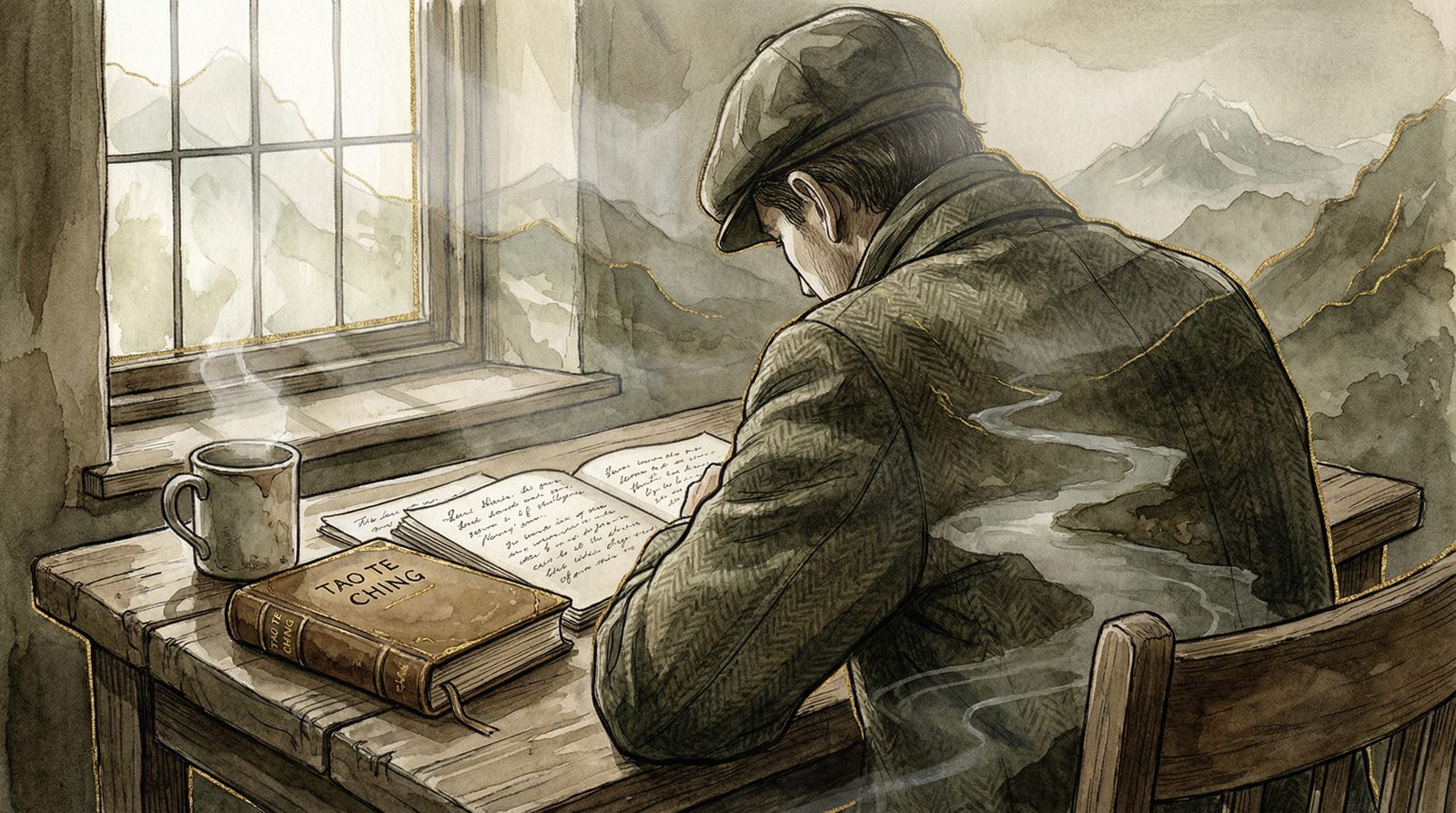
    Conceptual editorial illustration inspired by 'The Alchemist'

    CHARACTERS & INTERIORITY

    Santiago is not written as a psychologically complex figure. He functions as a clean archetype: open, curious, and capable of doubt without becoming paralyzed by it. His small attachments, his sheep, the memory of a merchant’s daughter, his fear when he first sees the sea, provide just enough texture to anchor the fable.

    The supporting figures operate as embodiments of choice. The crystal merchant represents resignation disguised as prudence. Fatima embodies a love that insists seeking and commitment need not cancel each other out. The Alchemist himself acts as a pressure point, forcing Santiago to risk annihilation rather than settle for symbolic understanding.

    Interior life is conveyed through parable rather than introspection. Feelings are named, not excavated. Yet moments of loss and fear, especially after the robbery in Tangier and during the desert ordeal, cut through the abstraction. The simplicity is intentional. The book asks the reader to project their own doubts into the spaces left open.

    LEGACY & RECEPTION

    Since its publication, The Alchemist has become one of the most translated and commercially successful novels of the late twentieth century. It sits alongside works like Jonathan Livingston Seagull as a foundational text of modern spiritual fiction. Critical response has been sharply divided, with some praising its mythic clarity and others dismissing it as aphoristic mysticism.

    The novel’s language of Personal Legends and cosmic conspiracy has seeped deeply into popular culture. Its endurance lies not in literary innovation but in its ability to function as a mirror. Readers return to it at different moments of life and read different instructions into the same slender story.

    IS IT WORTH READING?

    If you are looking for dense characterization or stylistic experimentation, this will feel thin. If you approach it as a modern fable, a compressed meditation on risk, desire, and return, it can still resonate. Reading it now is also an act of reclamation, separating the novel from its motivational afterlife.

    The lingering question it leaves is not inspirational but quietly unsettling: what would you have to give up to find out whether the life you imagine is actually yours?

    Illustration inspired by a core idea from 'The Alchemist'

    TRIVIA & AUTHOR FACTS

    Paulo Coelho wrote the novel quickly, later describing the process as intuitive rather than planned. It was initially a commercial failure in Brazil, and its first publisher dropped it. Only after being taken on by another house did it begin its gradual rise to global success.

    The book synthesizes Coelho’s long-standing interests in pilgrimage, omens, and Western esoteric traditions. Despite the title, its use of alchemy is symbolic rather than historical, drawing more from myth and metaphor than from chemical practice.

    SIMILAR BOOKS

    Readers drawn to this style of allegorical journey may also explore Siddhartha by Hermann Hesse, Jonathan Livingston Seagull by Richard Bach, or Shusaku Endo’s Silence, which offers a far harsher meditation on faith and failure. Each examines what is gained and lost when belief becomes a guiding structure.

    DISCOVERABILITY & LINKS

    DISCOVERABILITY & LINKS

  • Demian (1919)

    Demian (1919)

    INTRODUCTION

    Demian (1919) by Hermann Hesse
    Bildungsroman · 268 pages · Germany


    Demian is a quiet, unsettling book, one that feels less like a story than like waking up inside someone else’s conscience. Written at the end of World War I, it traces the inner life of Emil Sinclair as he moves from the “world of light” of his bourgeois childhood into a shadowed realm of guilt, desire, and self-recognition.

    The novel is not interested in plot fireworks. It is interested in fracture: the moment when inherited morality stops working and something unnamed begins to press from inside. Kitchens, classrooms, and church hymns coexist uneasily with alleyways, forbidden thoughts, and dreams that refuse to be decoded. The tone is restless and intimate, as if every page is leaning toward a transformation that cannot be safely named.

    PLOT & THEMES

    On paper, the plot is simple. Emil Sinclair grows up. In practice, this is a coming-of-age story stripped down to a spiritual case study. As a child in a respectable German town, Sinclair is blackmailed by the bully Franz Kromer after boasting about a minor crime. The lie cracks open the boundary between what Sinclair has been taught to call good and evil.

    Max Demian enters as an unsettling presence rather than a conventional rescuer. He dismantles Kromer’s power not through force but through psychological clarity. From that moment, Demian becomes a catalyst, pushing Sinclair away from inherited moral categories and toward an inner law he barely understands.

    The novel organizes itself around dualities. Sinclair moves between light and dark, spirit and flesh, obedience and rebellion. At boarding school he sinks into drinking and numb routine, then experiences a jolt of awakening through a dream of a bird breaking free from its egg. This image leads him to Demian’s mother, Frau Eva, whose house becomes a sanctuary for those drawn to a god who unites opposites rather than separating them.

    World War I remains mostly at the margins until it erupts at the end. Sinclair is wounded at the front and wakes in a field hospital to learn that Demian has been mortally injured. Demian appears one last time, perhaps in reality, perhaps as vision, and tells Sinclair that from now on he must find Demian within himself. The novel closes without consolation. The inner journey has been completed, but the world has been shattered.

    PROSE & NARRATIVE STRUCTURE

    The book is told in first-person retrospect. Sinclair narrates as an adult, looking back to locate the fault lines that ran under his youth. The prose is clear and restrained, punctured by moments of symbolic intensity: the smell of damp stone where Kromer corners him, the charged stillness of Pistorius’s organ loft, the recurring image of the hawk and the mark of Cain.

    Structurally, the novel advances in stages of consciousness rather than acts. Chapters function like psychological stations, each marking a shift in self-perception. External events often blur into interior states. Years pass quickly when Sinclair is spiritually asleep; moments of crisis expand and slow when something essential breaks or is recognized.

    Hesse keeps the focus narrow and vertical. There are no real subplots. Everything bends toward the same pressure point: the cost of becoming oneself in a world that demands conformity.

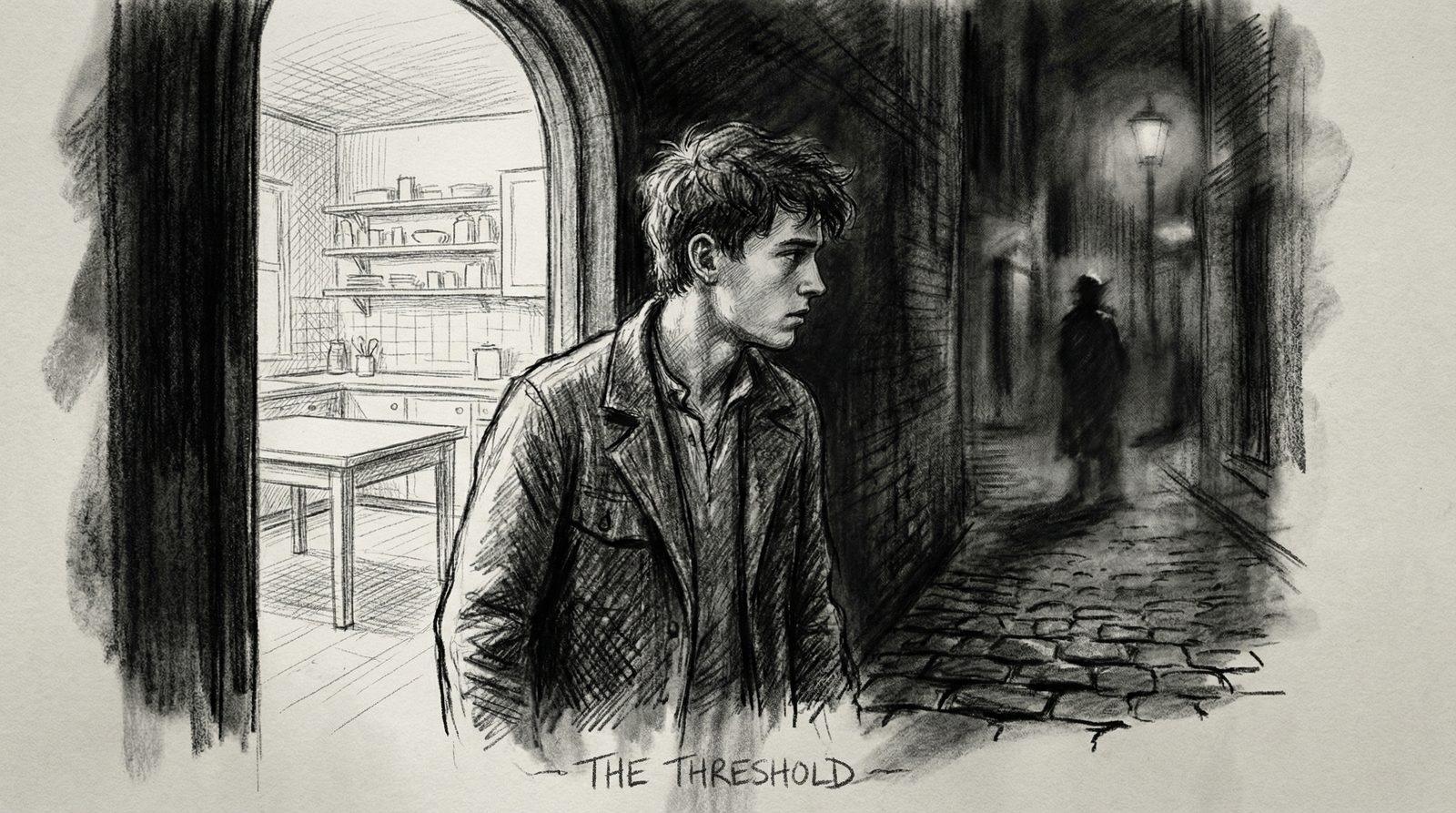
    Conceptual editorial illustration inspired by 'Demian'

    CHARACTERS & INTERIORITY

    Sinclair begins as a sheltered child who believes in the moral clarity of his parents’ world. What defines him is how quickly that certainty fractures. His interior life is obsessive and self-scrutinizing. Guilt, longing, and fascination churn long before they surface in action.

    Demian himself remains deliberately elusive. He shifts between schoolboy, prophet, and mirror. His interpretation of the Cain story reframes Sinclair’s sense of being marked as not cursed but set apart. Frau Eva embodies a vision of wholeness that Sinclair longs for, calm, inclusive, and indifferent to conventional morality.

    Minor figures are no less charged. Pistorius represents the danger of living only in symbols without fully entering the world. Kromer lingers as a reminder that darkness is not abstract. It has a voice, a smell, and a presence that can follow you into adulthood. Hesse allows these characters to blur into one another, as if they were facets of a single divided self.

    LEGACY & RECEPTION

    First published under a pseudonym, Demian spoke directly to readers emerging from the devastation of World War I. It offered neither patriotism nor consolation, but a language for inner dislocation. Its blend of psychological introspection and spiritual rebellion helped shape what would later be recognized as twentieth-century existential fiction.

    The novel’s refusal of a redemptive ending has been central to its endurance. Growing up here does not mean fitting in or finding peace. It means learning to recognize the mark that sets you apart and living with it. That idea has echoed through later portraits of alienated youth, from Hesse’s own later work to mid-century American fiction.

    IS IT WORTH READING?

    If you want a brisk plot or social panorama, this book will frustrate you. It is short, dense, and relentlessly interior. But if you are drawn to stories of adolescence as a spiritual earthquake, it remains one of the most honest accounts ever written.

    The language is accessible, the chapters compact, but the ideas linger. Hesse does not offer answers. He offers a vocabulary for the feeling that you do not quite belong to the world you were given, and that becoming yourself may require breaking something you were taught to protect.

    Illustration inspired by a core idea from 'Demian'

    TRIVIA & AUTHOR FACTS

    Hermann Hesse originally published the novel under the pseudonym “Emil Sinclair,” presenting it as the confession of an unknown young writer. Only later was his authorship revealed. The book draws heavily on Hesse’s engagement with Jungian psychology and his own period of analysis during the war years.

    The figure of Abraxas comes from Gnostic traditions, reshaped by Hesse to express the unity of opposing forces. Many images in the novel echo Hesse’s own childhood memories and recurring dreams. Demian marked a decisive turn in his career toward the introspective, spiritually questing works that would define his later reputation.

    SIMILAR BOOKS

    Readers who respond to this inward intensity may also turn to Siddhartha for a later, calmer spiritual journey, or Steppenwolf for a more fractured portrait of identity and rebellion. For a different cultural register of adolescent alienation, The Catcher in the Rye offers a similarly haunted voice without the explicit mysticism.

    DISCOVERABILITY & LINKS

  • Hermann Hesse

    Hermann Hesse

    ORIGINS & BACKGROUND

    Hermann Hesse was born in 1877 in the southwest of what is now Germany, into a family deeply shaped by Protestant Christianity and missionary work in India. That tension between strict European piety and the attraction of Asian philosophy would quietly inform his imagination throughout his life. As a young man, Hesse struggled with school, religious authority, and expectations of conformity, experiencing psychological crises and periods of institutional care that later fed his sensitivity to inner fracture and spiritual unrest.

    He lived through the collapse of the old European order, the First World War, and the rise of nationalism. During this period, Hesse chose self-exile in Switzerland, distancing himself from German militarism and public ideology. This withdrawal from collective identity mirrors the journeys of his characters, who often turn away from mass movements in favor of solitary searching and inward transformation.

    Across novels such as Demian, Siddhartha, and Steppenwolf, Hesse repeatedly reworks his own conflicts: the pull between bourgeois security and artistic risk, between Western rationalism and Eastern mysticism, between belonging and solitude. His fiction is driven by this personal restlessness, filtered through a quiet, reflective temperament that treats inner crisis as a serious philosophical condition rather than a flaw to be cured.

    Editorial illustration inspired by Hermann Hesse

    THEMES & MOTIFS

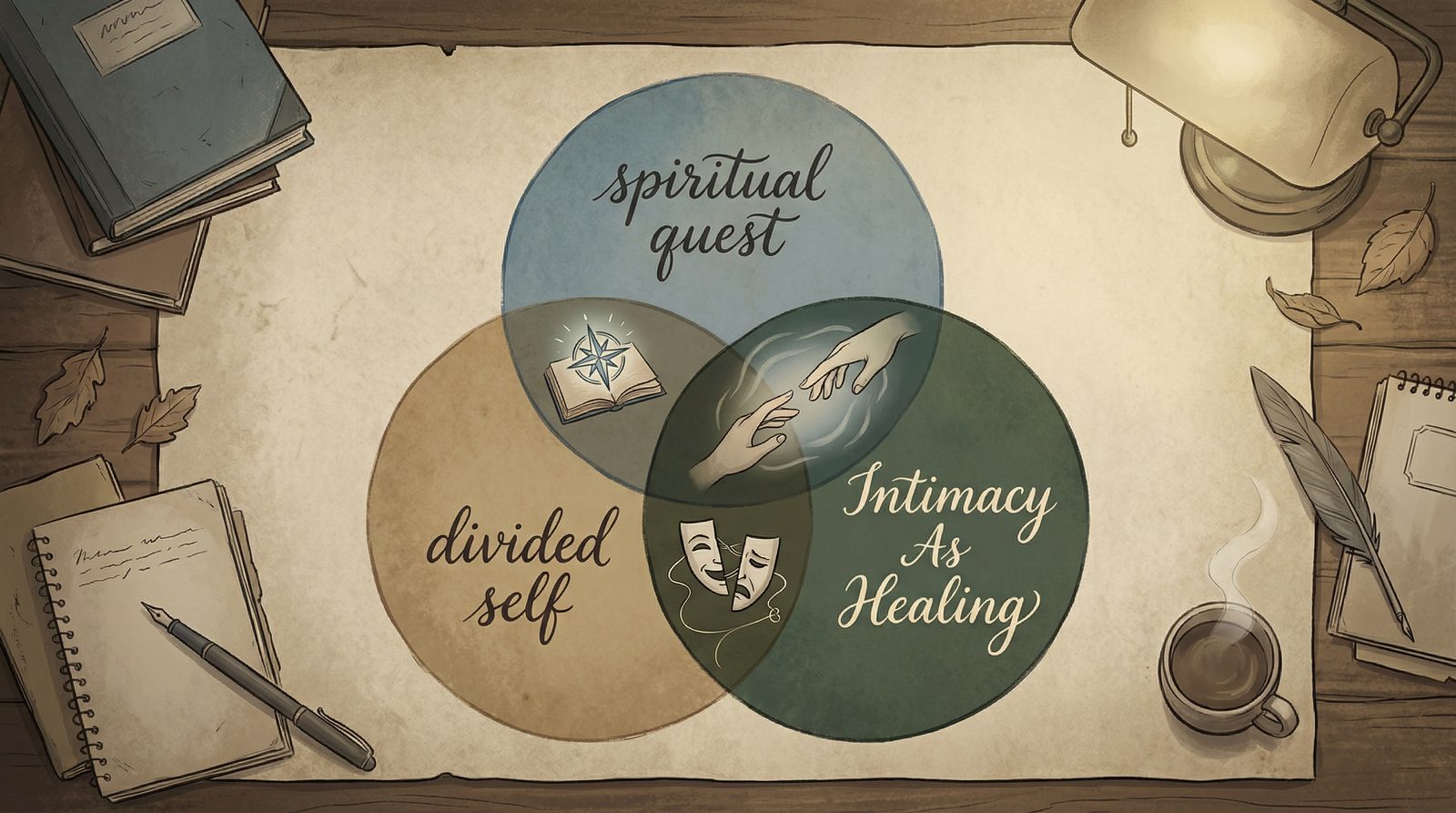
    Hesse returns again and again to the inner journey and the search for an authentic self. His protagonists are rarely satisfied with inherited identities. In novels like Demian and Steppenwolf, the central figures experience themselves as divided between a socially acceptable self and a darker, instinctive interior life. This division is not treated as pathology but as the necessary starting point for self-knowledge.

    Another persistent concern is spiritual awakening. Hesse’s characters move through belief systems, relationships, sensual experience, and renunciation, discovering that no single doctrine can replace lived understanding. Awakening in his work is slow, circular, and often painful, marked more by loss than by revelation.

    Hesse is also preoccupied with alienation and the modern individual’s sense of being out of step with their time. The figure of the outsider recurs in different forms: the sensitive schoolboy of Demian, the wandering seeker of Siddhartha, and the tormented intellectual of Steppenwolf. These characters are torn between the safety of bourgeois life and the frightening openness of a more instinctive or spiritual existence.

    Yet his novels are not purely about solitude. Hesse repeatedly suggests that Intimacy As Healing is essential to transformation. Encounters with mentors, lovers, and mirrors of the self become turning points, not because they resolve conflict, but because they make self-deception impossible. Connection in Hesse is demanding rather than comforting.

    Symbolic illustration inspired by Hermann Hesse

    STYLE & VOICE

    Hesse’s style is deceptively simple. His prose is clear, measured, and introspective, favoring first-person or close third-person narration that stays tightly aligned with a character’s inner state. Even when mythic or symbolic material appears, the tone remains calm and reflective rather than grandiose.

    Structurally, many of his novels follow a pattern of initiation. Characters depart from familiar life, pass through periods of breakdown or excess, and return with altered perception rather than clear solutions. Action is secondary to realization, and meaning is earned through endurance rather than triumph.

    Emotionally, Hesse balances melancholy and hope. He confronts despair, loneliness, and self-destruction with honesty, yet almost always leaves a narrow path toward meaning. That path usually involves accepting contradiction rather than resolving it, and allowing connection to soften isolation without erasing it.

    KEY WORKS & LEGACY

    Demian (1919) is a compact novel of inner rebellion, charting a young man’s awakening to moral ambiguity and personal responsibility. Guided by the enigmatic Demian, the narrator comes to see identity and belief as fluid rather than fixed.

    Siddhartha (1922) follows a seeker in ancient India as he moves through asceticism, sensuality, despair, and quiet wisdom. It remains Hesse’s clearest articulation of spiritual pilgrimage grounded in lived experience rather than doctrine.

    Steppenwolf (1927) presents a darker, fractured vision of the divided self through Harry Haller, an intellectual convinced he is split between human and animal natures. Through surreal encounters, the novel explores alienation, self-hatred, and the possibility of integration.

    Hesse’s legacy sits at the intersection of European modernism and spiritual literature. His work continues to speak to readers who feel estranged from conventional paths yet skeptical of easy transcendence, offering stories where change is slow, painful, and deeply personal.

  • Paulo Coelho

    Paulo Coelho

    ORIGINS & BACKGROUND

    Paulo Coelho is a Brazilian novelist whose books sit at the crossroads of spiritual fable and mainstream popular fiction. He is best known for The Alchemist, a short allegorical novel that became a global phenomenon and turned the idea of Personal Legend And Destiny into a kind of pop-spiritual shorthand. Coelho did not arrive as a young prodigy. Before publishing novels, he worked in theater, music, and journalism, and spent years searching for his own sense of purpose. That late and hard-won success shapes how he writes about faith, failure, and second chances.

    Coelho’s Brazilian background matters less as local realism and more as the starting point for a borderless spiritual quest. His characters drift through Spain, the Middle East, Europe, and symbolic landscapes that feel intentionally simplified so the emotional terrain stands out. Like Hermann Hesse, whose Siddhartha he openly echoes, Coelho uses parable-like storytelling to explore inner transformation rather than social detail. The biography that counts most in his fiction is the internal one: people stuck in comfortable lives, haunted by the sense that they have betrayed their own dreams, and pushed by chance encounters or mystical signs to reclaim their calling.

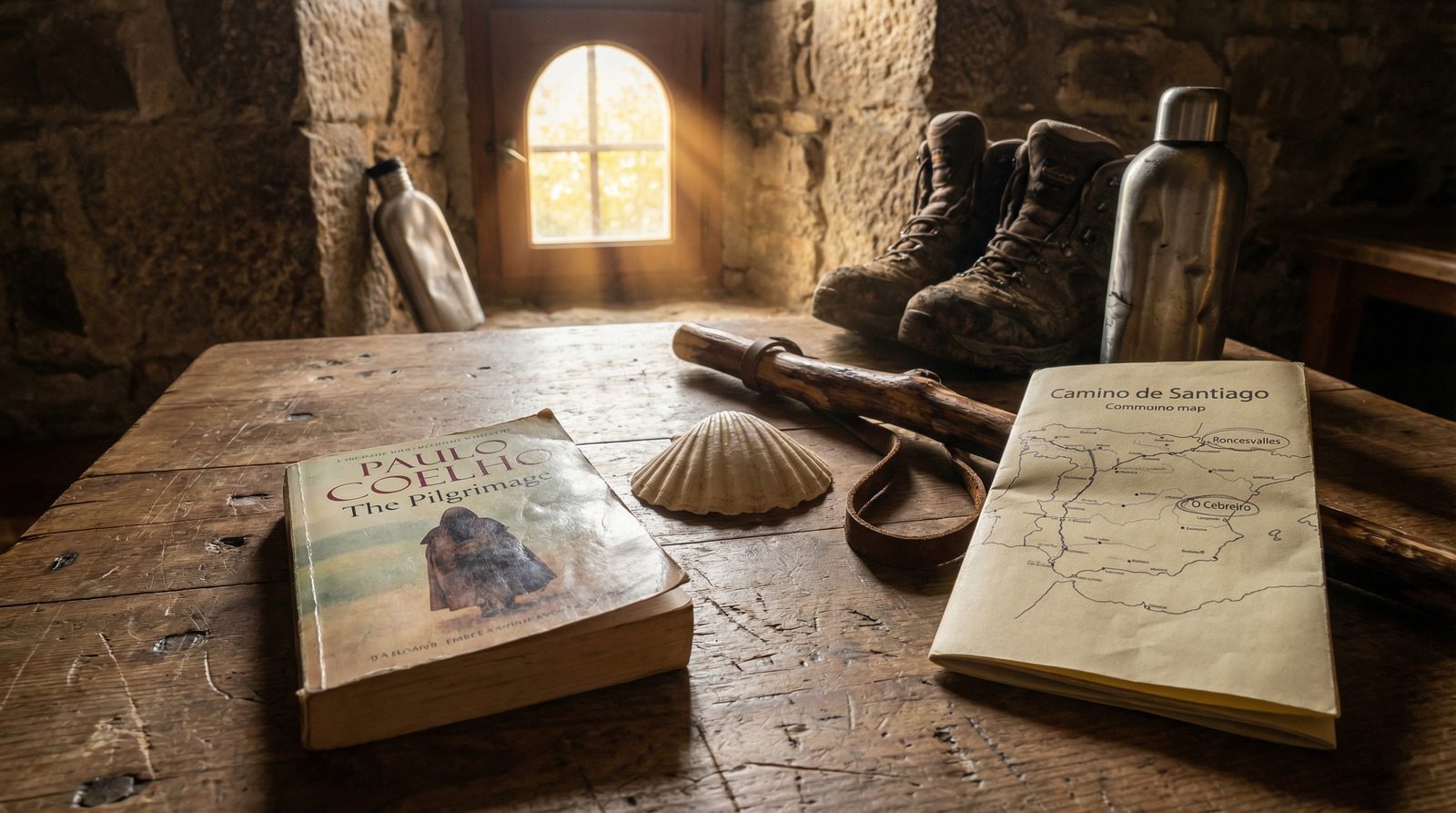
    A defining event in Coelho’s personal mythology is his walk on the Camino de Santiago in Spain, later fictionalized in The Pilgrimage. That journey gave him a durable narrative frame: outer travel as a mirror of inner change. His Catholic upbringing, later mixed with esoteric and New Age currents, feeds into a blend of mysticism, Christianity, and universalist spirituality. He is not a doctrinal writer. Instead, he treats religion as one language among many for describing fear, courage, and meaning.

    His breakthrough came after setbacks and modestly received early work. That experience of delayed recognition shapes his recurring sympathy for characters who feel they have missed their chance. Coelho writes as someone who has lived through failure and reinvention, and he returns again and again to the question of whether it is ever too late to pursue one’s Personal Legend And Destiny.

    Editorial illustration inspired by Paulo Coelho

    THEMES & MOTIFS

    The central thread running through Coelho’s work is Personal Legend And Destiny: the belief that each person has a unique path or calling, and that suffering often comes from refusing it. In The Alchemist, this appears as a shepherd’s desert journey that is really a test of courage and attention. In The Pilgrimage, it becomes a literal road walked step by step. Across his novels, the plot is often a thin veil over the same spiritual question: will the character move toward their calling, or talk themselves out of it?

    A second major motif is Spiritual Pilgrimage. Coelho’s characters travel through deserts, cities, and symbolic landscapes, but the geography is simplified so the emotional terrain stands out. The road is where mentors appear, tests arrive, and illusions are stripped away. Even when the setting is not literally a pilgrimage route, the movement is structured like one: departure, ordeal, and a changed return.

    He also returns to inner transformation through suffering. His protagonists often reach a breaking point: a numbing routine that suddenly feels unbearable, a relationship that exposes a deeper fear, or a moment of crisis that forces re-evaluation. Pain becomes a catalyst, not as heroic endurance, but as a confrontation with guilt, fear, and the stories people tell themselves about what is possible.

    There is a persistent belief in omens and meaningful coincidence. Characters read signs in repeated symbols, chance meetings, and the timing of events. The universe is treated as responsive to sincere desire. This can feel naïve or comforting depending on the reader, but it is central to Coelho’s spiritual realism. He portrays love as a force that can redirect a life, and solitude as the condition where one can finally hear what the heart wants.

    Symbolic illustration inspired by Paulo Coelho

    STYLE & VOICE

    Coelho’s style is deliberately simple, almost stripped down. Sentences are short, vocabulary is accessible, and plots unfold in clean, linear arcs. This simplicity is part of his method. He wants the reader’s attention on moral and emotional stakes rather than stylistic flourish. The voice is calm and reflective, often pausing for aphoristic statements that read like proverbs or journal entries. For some readers these lines feel like distilled wisdom; for others they feel blunt. Either way, they define his cadence.

    He favors allegorical storytelling and parable structure. Characters are less psychologically intricate individuals and more embodiments of questions such as: What do you fear losing? What do you secretly want? What excuse are you using to avoid change? Dialogue frequently functions as instruction, with guides explaining ideas about calling, fear, and faith. This gives his books a meditative pace even when the plot involves travel or danger.

    Emotionally, his work leans toward hopeful introspection. Dark subjects appear—especially in Veronika Decides To Die—but the narrative almost always bends toward renewal. The contemplative tone encourages readers to project their own experiences onto the story, which helps explain his broad appeal. Readers who respond to Hermann Hesse’s blend of narrative and philosophy in Siddhartha often find a more contemporary, streamlined version of that mix in Coelho’s work.

    KEY WORKS & LEGACY

    The Alchemist is the defining Coelho novel. Its story of a shepherd pursuing a dream across the desert crystallizes his core concerns with calling, pilgrimage, and the idea that the world responds when a person moves toward what they truly want. Because it is short and highly symbolic, it functions as an entry point into his worldview.

    The Pilgrimage is more explicitly autobiographical, recounting a trek along the Camino de Santiago and foregrounding spiritual practices and teacher-student dynamics. Veronika Decides To Die shifts to a psychiatric institution and asks what it means to be “normal” in a world that quietly crushes individuality. Brida follows a young woman drawn to initiation and magic, extending his interest in mystical apprenticeship and the tension between ordinary life and esoteric knowledge.

    Coelho’s legacy is less about formal innovation and more about accessibility. He helped popularize a kind of spiritual realism that sits between self-help and fiction, making questions of faith, purpose, and fear part of everyday reading. Whether one finds his work profound or simplistic, it has clearly shaped how contemporary readers talk about destiny, intuition, and the courage to change a life.

  • Brida (1990)

    Brida (1990)

    INTRODUCTION

    Brida (1990) by Paulo Coelho
    Spiritual fiction · novel-length (typically over 200 pages) · Brazil


    Brida is one of Paulo Coelho’s quieter novels. Set largely in Ireland in the late twentieth century, it follows a young woman who believes that learning magic might help her understand who she is, and whom she is meant to love. Coelho treats witchcraft not as gothic spectacle but as a vocabulary for anxiety, vocation, and longing.

    The tone is hushed and a little lonely. The novel often feels like walking alone through a forest at dusk and realizing you are being watched kindly, not hunted. It is a slight book in terms of plot, but it lingers because it treats ordinary decisions, career, romance, faith, as if they were rituals that change the structure of reality. For Brida, they are.

    PLOT & THEMES

    The plot is deliberately simple. Brida begins as an ordinary young woman living in Ireland who feels an unnamed lack. She seeks out a hermit known as the Magus and asks him to teach her the Tradition of the Sun. He senses that she is his soulmate, but withholds that knowledge, guiding her instead through solitude, discipline, and fear.

    In parallel, Brida studies the Tradition of the Moon with Wicca, a powerful practitioner who introduces her to trance, tarot, and the idea of reincarnation as a web of unfinished lessons. The novel’s chosen-student pattern is constantly complicated. Brida is “special” less because she has supernatural gifts than because she is willing to stay with discomfort long enough for it to become instruction.

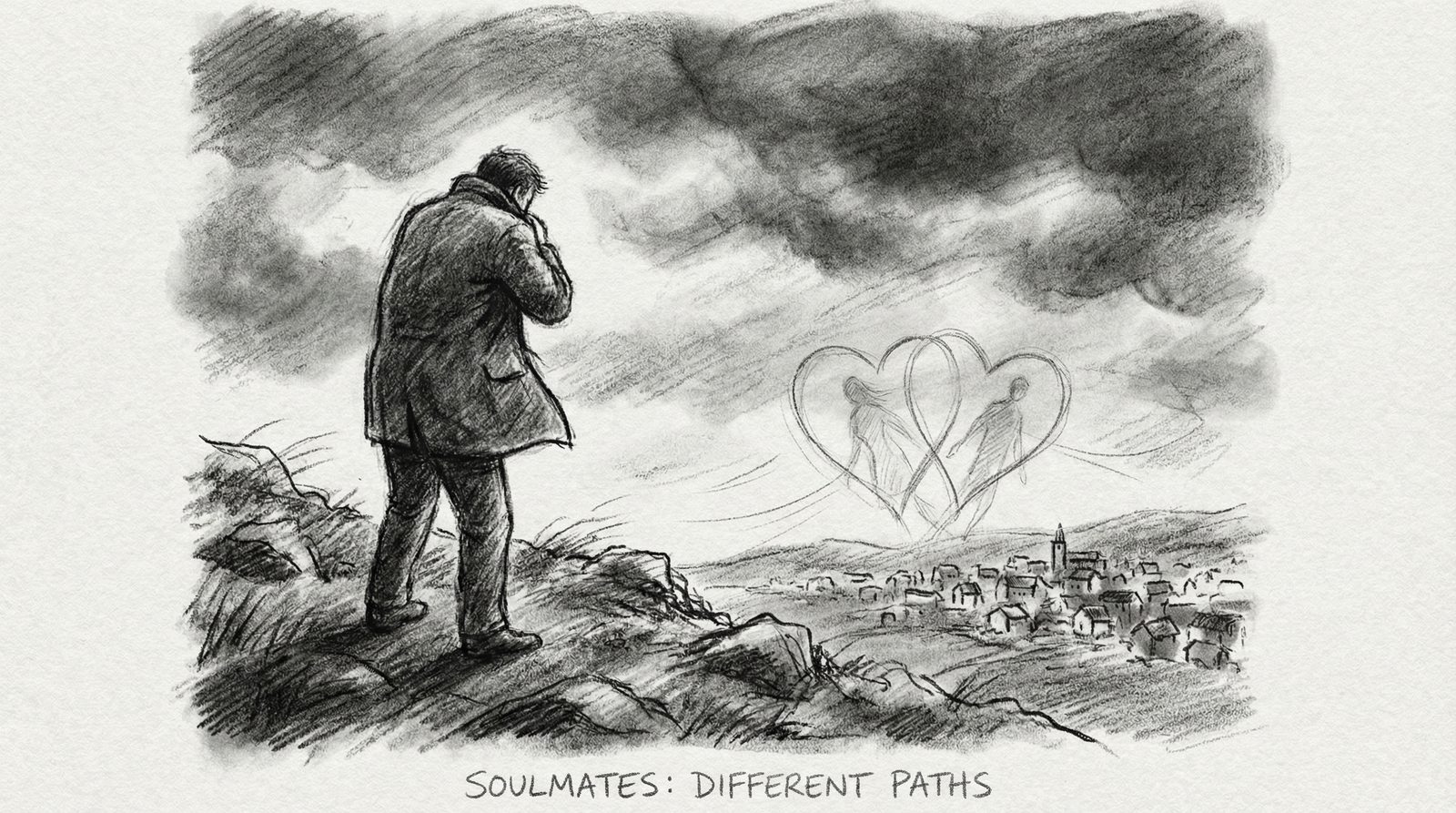
    Coelho builds much of the drama around the soulmate idea, both blessing and burden. Recognition can feel like destiny, but it can also destroy an existing life. This tension plays out between Brida and the Magus, and also in her domestic scenes with her boyfriend, Lorens, who offers a grounded future that does not require mystical completion.

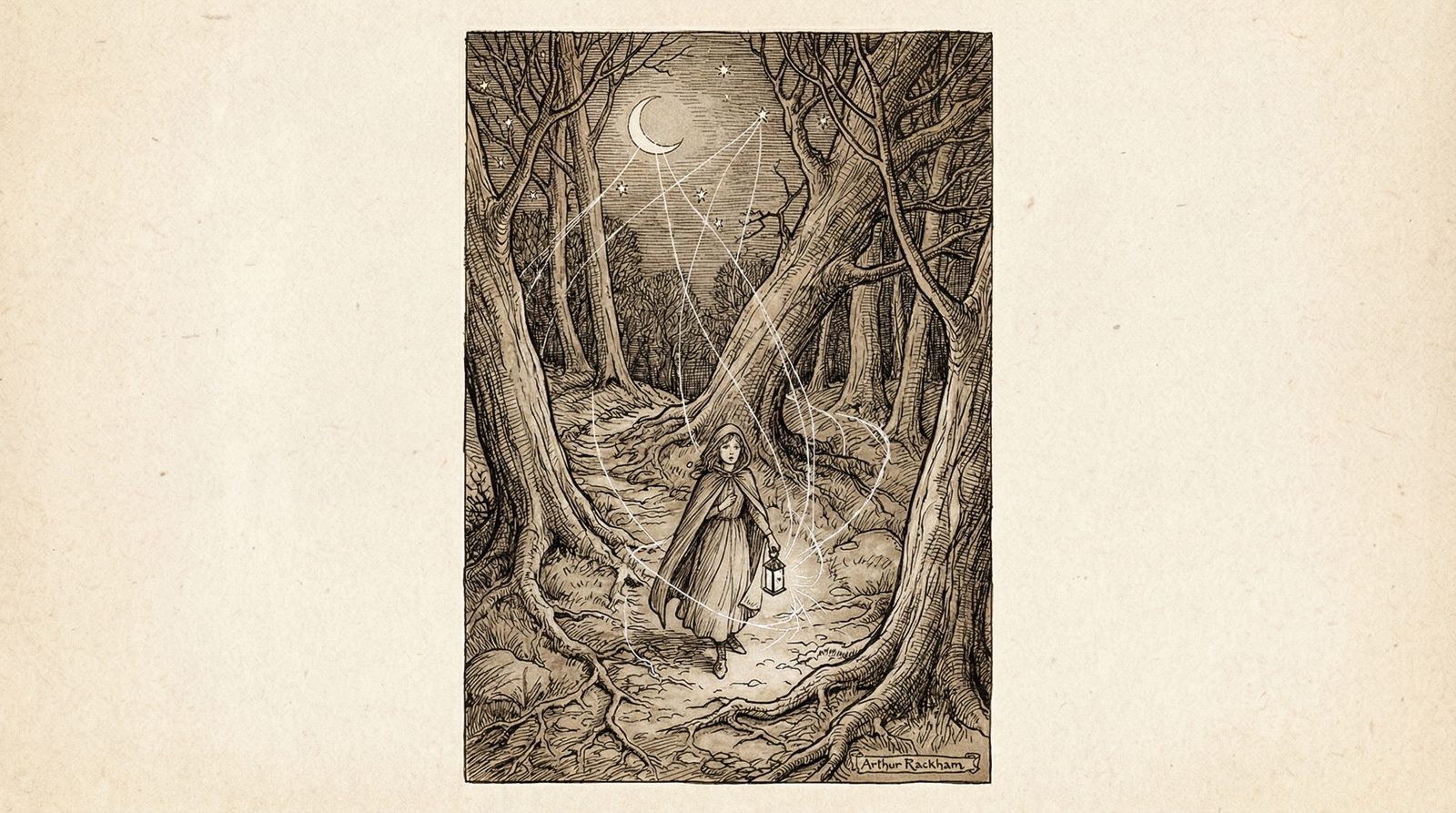
    A central sequence is Brida’s initiation in the forest, where she must walk alone at night and resist the urge to flee until the world’s “voice” becomes audible. Later, Wicca’s ritual in an abandoned church forces Brida to confront the cost of knowledge: she can glimpse other lives and hidden patterns, but she cannot force certainty. The ending is not parabolic. It is a decision. Brida recognizes the Magus as her soulmate, yet chooses to remain with Lorens, choosing a human, imperfect love over a destiny that feels absolute. The Magus releases her quietly, accepting that love sometimes means stepping aside.

    PROSE & NARRATIVE STRUCTURE

    The prose is stripped down and declarative. Coelho favors short sentences that sometimes read like fragments from a spiritual notebook. That simplicity can feel flat if you want lush description, but it suits the book’s mood of quiet searching.

    The narrative stays close to Brida while occasionally slipping into the Magus or Wicca, revealing how much they withhold from her. Structurally, the book moves through lessons and encounters: cafes with Lorens, visits to Wicca, solitary walks, the Sabbath on the hill. Each chapter feels like a small ritual with an intention. Coelho also pauses for brief explanatory passages on fear, faith, and practice. These moments can drift toward sermon, but they are usually short enough to feel like marginal notes rather than lectures.

    Symbolic objects recur with quiet insistence: tarot cards on a kitchen table, wine shared during initiation, the plain watch on Lorens’s wrist anchoring Brida to ordinary time. Coelho’s style is closer to a spiritual diary than to an elaborate occult system. The magic is kept deliberately human-scale, measured in hesitation, choice, and the aftertaste of a conversation.

    Conceptual editorial illustration inspired by 'Brida'

    CHARACTERS & INTERIORITY

    Brida is a seeker figure, but what saves her from abstraction is her ordinariness. She worries about work, about whether Lorens understands her, about looking foolish in front of Wicca’s circle. Her spiritual hunger never cancels her social awkwardness. Fear is her most consistent inner weather, fear of the forest, fear of choosing wrongly, fear of losing the life she already has.

    The Magus is written as a wounded mentor. His restraint is not aloofness so much as self-punishment, shaped by earlier failures and missed chances. Wicca, by contrast, is pragmatic and unembarrassed by power. Her scenes carry warmth and blunt clarity, undercutting the stereotype of the cold sorceress.

    Lorens might seem quieter than the other two teachers, but that is partly the point. He represents the life Brida already inhabits: shared meals, shared time, compromise, tenderness without cosmic fireworks. The emotional geometry between these three relationships is the book’s real drama, more than any ritual or spell.

    LEGACY & RECEPTION

    Brida has long lived in the shadow of Coelho’s more famous work, especially The Alchemist. It lacks that novel’s neat fable structure and global parable simplicity. Its focus on Western esoteric traditions, tarot, Wicca, reincarnation filtered through Irish landscapes, makes it more idiosyncratic and less easily packaged.

    Still, it has kept a steady following among readers drawn to spiritual apprenticeship rather than triumphant revelation. Its ending is central to its reputation. There is no miraculous reunion of soulmates, no cosmic reward for sacrifice. There is only the ache of choosing a life you can actually live, even when something in you insists another path is “meant.” That quiet refusal of fantasy closure is what gives the novel its sting.

    IS IT WORTH READING?

    Whether it is worth your time depends on what you want from the occult angle. If you are looking for intricate lore and elaborate worldbuilding, you will be frustrated. The magic here is more emotional than technical. But if you are interested in how spiritual longing collides with ordinary love, the novel can be surprisingly sharp.

    The prose is plain, sometimes blunt, yet certain scenes linger: the night walk in the forest, the quiet rituals, the final silent parting on the hill. It is a brief read, but not a light one, and it rewards readers willing to sit with ambiguity rather than tidy miracles.

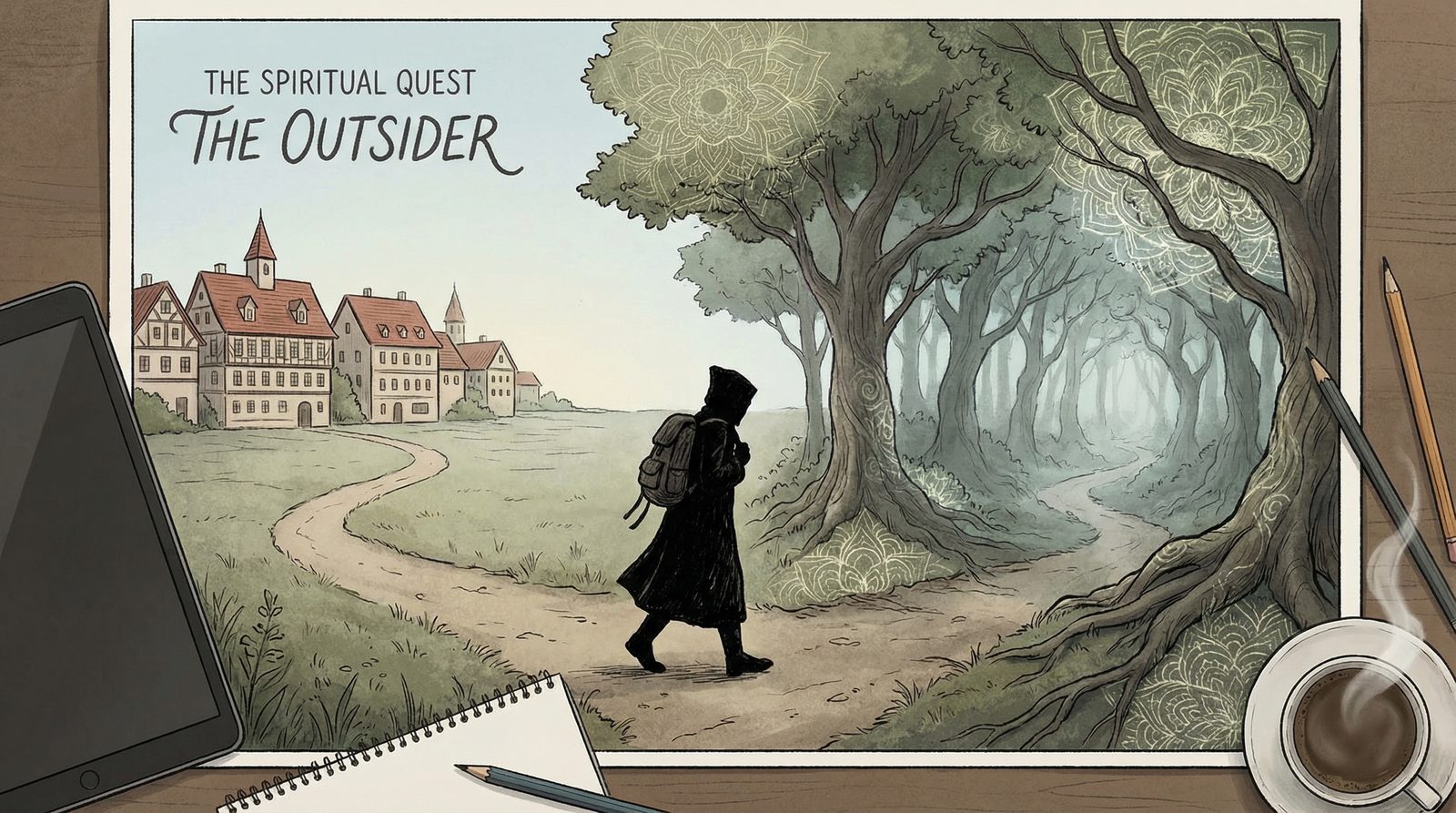
    Illustration inspired by a core idea from 'Brida'

    TRIVIA & AUTHOR FACTS

    Coelho wrote Brida early in his career, drawing on his long-standing interest in esoteric traditions and spiritual searching. The Irish setting let him explore European witchcraft lore through an outsider’s gaze. The character of Wicca has often been described as inspired by a real person Coelho encountered, though details have been kept deliberately vague.

    Small details, Brida reading on bus routes, the forest as a threshold between city and countryside, reflect Coelho’s fascination with turning points where an ordinary life can tip into a different kind of awareness. The soulmate theme, which later became a recurring idea in his work, receives one of its earliest and most bittersweet treatments here.

    SIMILAR BOOKS

    If this novel speaks to you, you might seek out other stories where spiritual search intersects with ordinary love. The Alchemist offers a more fable-like journey built around omens and purpose. Foucault’s Pendulum is a denser, more ironic exploration of occult systems and the human hunger for meaning. And other Coelho novels return to similar questions: what it costs to pursue vocation, and what it costs to refuse it.

    DISCOVERABILITY & LINKS

  • The Pilgrimage (1987)

    The Pilgrimage (1987)

    INTRODUCTION

    The Pilgrimage (1987) by Paulo Coelho
    Spiritual fiction · 276 pages · Spain


    The Pilgrimage is Coelho before The Alchemist turned him into a global brand. Set along the Camino de Santiago in late twentieth-century Spain, it follows “Paulo” as he walks toward Compostela under the stern guidance of his master, Petrus. What begins as a journey across Spain becomes a chain of humiliations, occult drills, and small, piercing moments of clarity.

    The road works as an inner mirror. Crowded streets, empty stretches of the Meseta, and awkward encounters with strangers become tests of vanity, fear, and attention. The tone is restless and self-critical. This is a spiritual quest narrative that keeps tripping over ego, and that is exactly where it becomes interesting.

    PLOT & THEMES

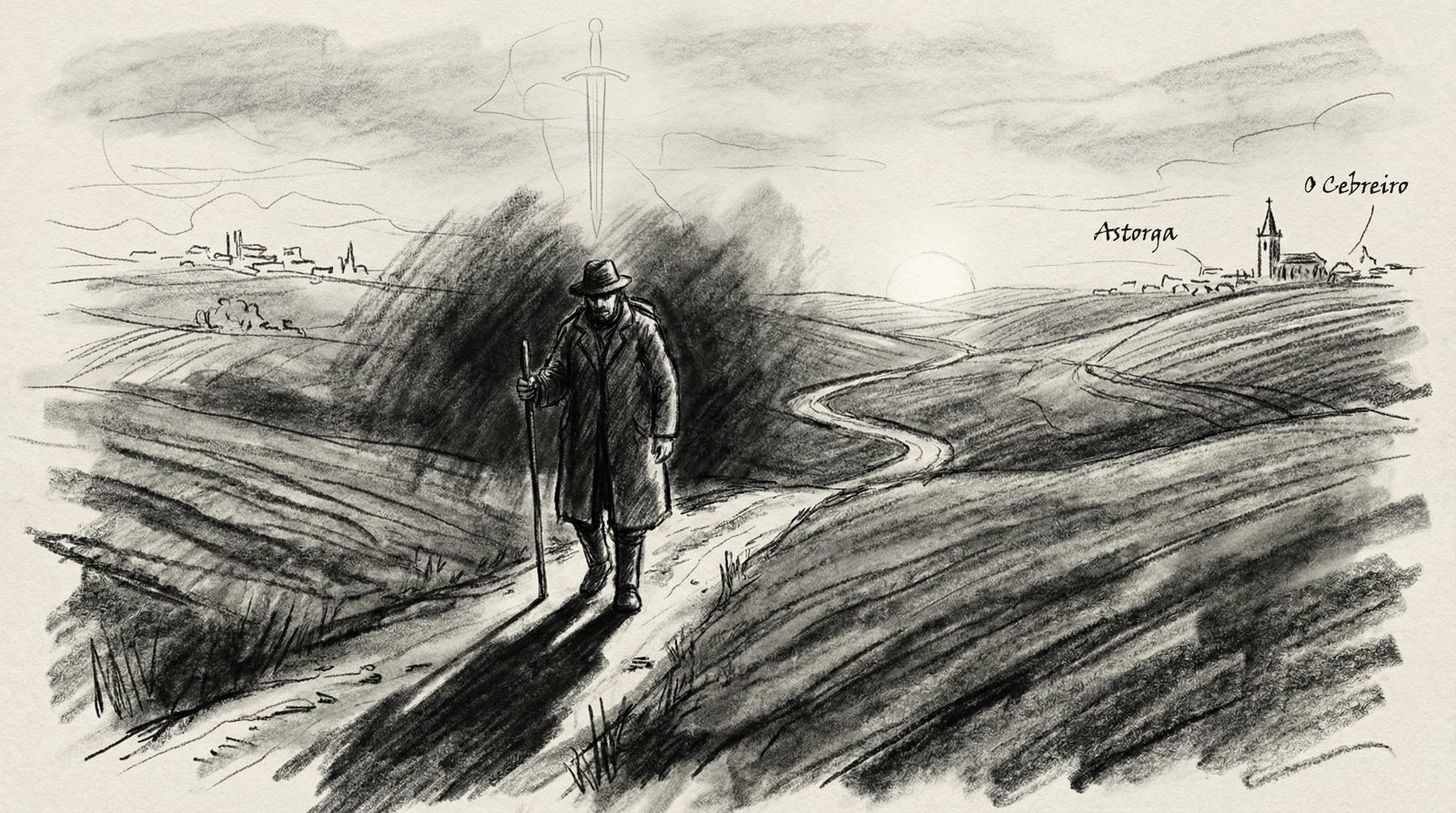
    The plot is disarmingly simple. Paulo has failed an initiation within his esoteric order, RAM, and must walk the Camino to recover a lost sword that symbolizes spiritual authority. Petrus leads him from town to town, and the journey becomes a sequence of exercises that look, at first glance, like New Age party tricks. In practice they function as slow, stubborn methods for stripping pride and building discipline.

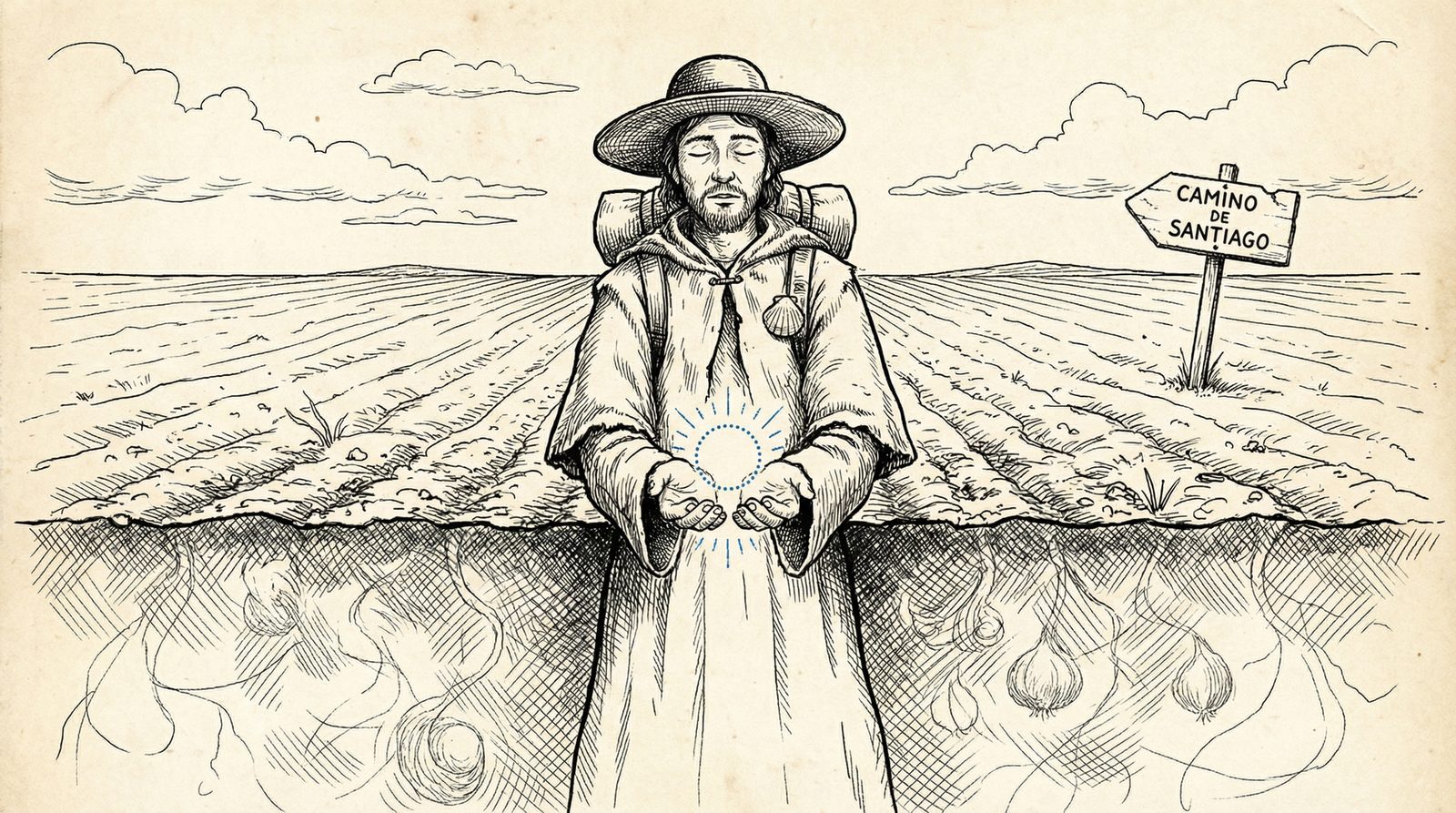
    Several rituals recur in the reader’s memory the way blisters do after a long day of walking. The Seed Exercise asks Paulo to imagine himself buried in darkness before growth. The Speed Exercise forces him to walk excruciatingly slowly while everyone else rushes past. The point is not power. The point is humiliation as instruction, and attention as the only real “skill” being trained.

    The book uses the familiar pilgrimage framework but keeps undercutting the heroic arc. Paulo becomes jealous of a dog, terrified by a madman near a ruined village, and nearly seduced off the path by an encounter that reads like temptation made flesh. The sword remains present as an absence: a symbol of authority that Paulo wants to possess, but does not yet deserve. Themes of obedience, everyday miracles, and spiritual pride run through the journey, but Coelho insists that the holy is found in missed buses, bad wine, aching feet, and arguments with the guide.

    The ending is resolutely uncinematic. Near the end of the Camino, Paulo is forced into a confrontation that feels like a ritualized fight with fear itself. Only after that does Petrus reveal the sword, and the revelation is almost wry: it has been near Paulo all along. The final lesson is not that Santiago grants miracles. It is that practice must continue. The journey is not completed once. It repeats, in different forms, for the rest of a life.

    PROSE & NARRATIVE STRUCTURE

    The book is written as first-person memoir, and that choice matters. Paulo is not an omniscient sage looking back with smug clarity. He is defensive, hungry for approval, and frequently irritated by his teacher. The sentences are short and blunt, and the rhythm can feel awkward until you realize it mirrors the act of walking: repetition, fatigue, and sudden flashes of lucidity.

    Episodes are arranged as parables rather than as a tightly plotted arc. Each town offers a new exercise, a new failure, and a new fragment of insight. Coelho also includes manual-like sections that explain practices directly. This interrupts the narrative spell, but it clarifies the book’s ambition: it wants to be used, not merely read.

    Structurally, the memoir circles back on itself. The opening failure in Brazil is mirrored by Paulo’s near-failure at the end, creating a loop rather than a straight line. The Camino becomes less a path across Spain than a track inside Paulo’s mind, where the same fears return until they are finally faced without performance.

    Conceptual editorial illustration inspired by 'The Pilgrimage'

    CHARACTERS & INTERIORITY

    Paulo is a seeker figure stripped of glamour. He is vain about spiritual rank, sulky when Petrus withholds praise, and occasionally cruel in his private judgments of other pilgrims. This imperfection gives the spiritual material friction. We are not watching a saint in the making. We are watching a person wrestling with the desire for meaning and the desire for status, and trying to pretend they are the same thing.

    Petrus is a trickster mentor who alternates tenderness with mockery. He engineers situations that feel pointless or humiliating, because humiliation is the tool. Minor figures appear briefly but function as mirrors: the pilgrim who quits after losing a bag, the farmer who explains an exercise without mysticism, the stranger who passes Paulo effortlessly, reminding him that pride is often just a story told to cover weakness.

    Interior life is the book’s real arena. Paulo’s obsessive self-monitoring can be exhausting, but it is also the most honest part of the memoir. The drama is not the landscape. It is the mind trying to keep control of the story while the walk keeps undoing it.

    LEGACY & RECEPTION

    In hindsight, this book is often read as the seed of Coelho’s later work. Where The Alchemist turns the quest into a smooth fable, The Pilgrimage keeps the blisters and the awkward pauses. It helped popularize the Camino de Santiago for readers who had never heard of Compostela, and it contributed to the late twentieth-century boom in spiritual memoirs that treat personal crisis as narrative engine.

    Reception has always been split. Some dismiss it as occult tourism. Others value its willingness to show spiritual vanity and failure without disguising them as wisdom. The ending, with the sword revealed in an ordinary field rather than inside a cathedral, has aged well. It refuses the fantasy that holiness lives in famous buildings. The climax is internal: authority is conditional, dependent on ongoing practice, and never finally earned.

    IS IT WORTH READING?

    If you want a polished parable with all rough edges sanded off, this is not it. The memoir is uneven, occasionally naïve, and sometimes embarrassing. That is also why it works. The mix of ritual, Catholic imagery, and blunt self-critique feels like a real person groping toward meaning rather than a guru dispensing aphorisms.

    Readers interested in spiritual practice, in the psychology of faith, or in the Camino as lived from the inside will find plenty to chew on. If you have no patience for mysticism, the book may grate. But as a portrait of stubborn searching, it remains strangely compelling.

    Illustration inspired by a core idea from 'The Pilgrimage'

    TRIVIA & AUTHOR FACTS

    Coelho did walk the Camino de Santiago in the 1980s after a turbulent period that included time in a mental institution and years working as a lyricist in Brazil. The order RAM is presented as real but partially fictionalized and deliberately obscured. The exercises described, including the Seed Exercise and the Blue Sphere Exercise, are framed as practices he claims to have done rather than as invented fantasy.

    The book was first published in Portuguese as O Diário de um Mago (“Diary of a Magus”), emphasizing the occult angle more than the walking-tour aspect. The manual-like appendix has inspired informal study circles and solitary readers who treat the book as a workbook as much as a narrative.

    SIMILAR BOOKS

    If this blend of outer travel and inner upheaval appeals to you, Siddhartha offers a more distilled spiritual journey, while Wild turns the walk into a contemporary reckoning with grief and self. Readers drawn to the Christian mystical angle may also find resonance in conversion narratives like The Seven Storey Mountain, where the road is traded for a monastery but the hunger for transformation remains.

    DISCOVERABILITY & LINKS

  • Vice Versa (1882)

    Vice Versa (1882)

    INTRODUCTION

    Vice Versa (1882) by F. Anstey
    Comic fantasy · 19th Century · Victorian Era · United Kingdom


    Vice Versa (1882) begins with a wish and a stone, and very quickly becomes a quiet little nightmare. F. Anstey takes a familiar motif of wish-fulfilment and flips it into something sour, funny, and oddly tender. Paul Bultitude, a prosperous Victorian businessman, longs for the carefree life of his son Dick at Dr. Grimstone’s boarding school. A mysterious Garuda Stone grants the wish too literally, and father and son exchange bodies. What follows is not just farce, but a slow-burning feel of humiliation and uneasy recognition. Beneath the jokes about Latin primers and cane-wielding masters lies a sharp portrait of the Victorian obsession with discipline, respectability, and hierarchy. The magic is minimal, almost offhand. What Anstey really cares about is how people behave when stripped of their usual power, and whether empathy can survive a term at a place like Dr. Grimstone’s school in Kentish Town.

    PLOT & THEMES

    The central trope is the body swap: Paul Bultitude becomes his son Dick in appearance, while Dick is trapped in his father’s middle-aged body. This early example of Body Swap Comedy Between Generations uses the swap as a moral abrasion rather than a pure joke. Anstey wastes little time on mechanics. The Garuda Stone, brought back by the blustering Uncle Gregory from India, simply works. Then the novel settles into its real concern: role reversal as education.

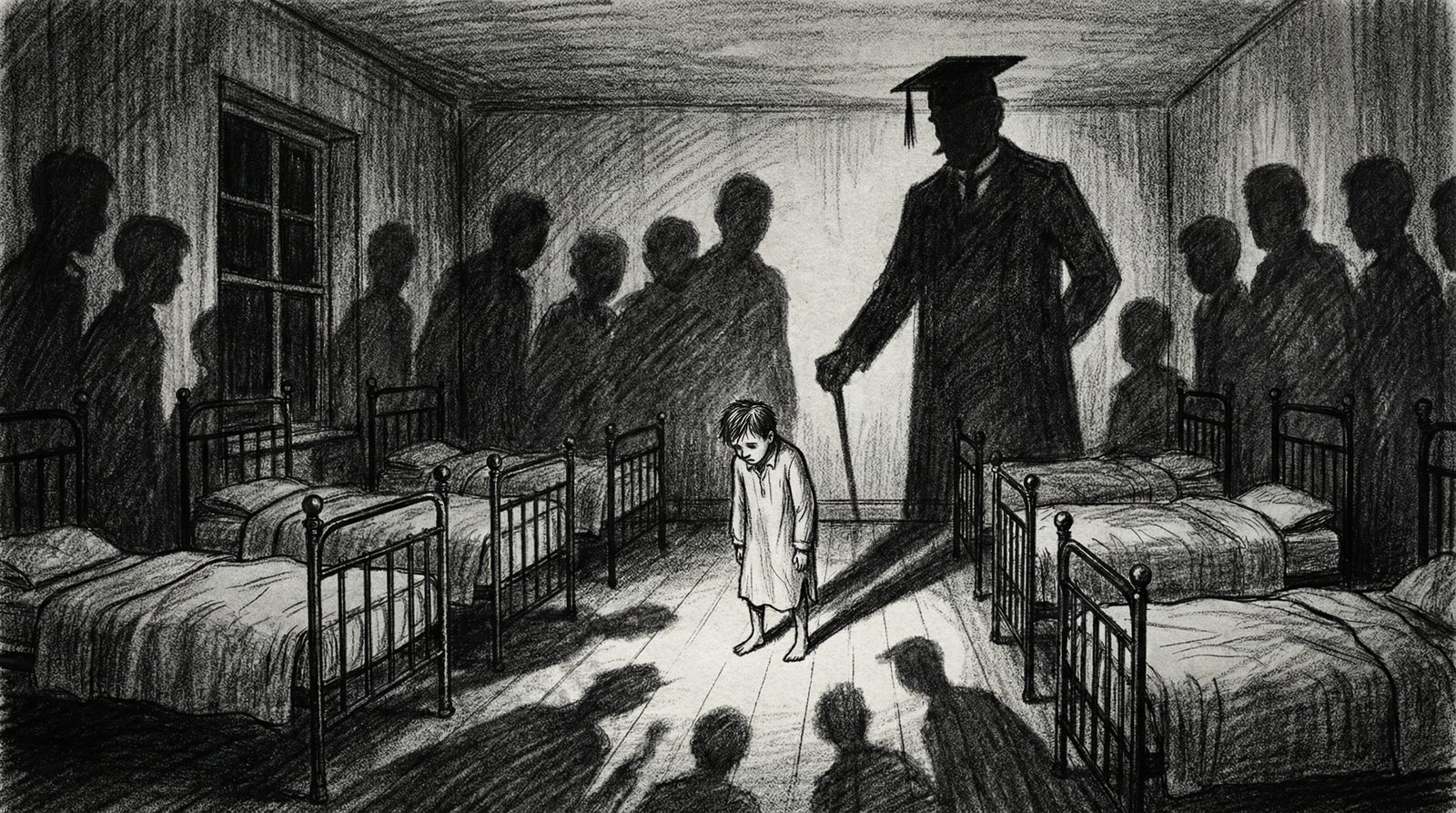
    Paul, now outwardly a schoolboy, is thrust into the brutal routines of Dr. Grimstone’s establishment. The headmaster’s son, the odious Augustus Grimstone, bullies him. Mr. Blinkhorn trembles and obeys. The boys enforce their own pecking order in the dingy playground and the icy dormitory. Scenes like Paul’s panic during the Latin viva voce in the schoolroom, or his miserable attempt to run away through the foggy streets of Kentish Town only to be dragged back, show how little his adult authority counts here. Meanwhile, Dick-as-Paul must bluff his way through business at the City office in Mincing Lane and endure the suffocating attentions of his father’s fiancée, the sentimental Miss Perrott.

    Anstey uses this double embarrassment to attack the hypocrisy of both generations. Parents sentimentalise school as character-building. Boys imagine business as leisurely and dignified. Both are wrong. Discipline is repeatedly framed as cruelty, especially in Grimstone’s pompous sermons about “moral fibre” just before he orders a flogging. Unlike lighter modern takes such as Freaky Friday, the book keeps its edges. The violence at school is not softened, and Paul’s cowardice is not made charming. By the ending, after a final confrontation in Grimstone’s study and another use of the Garuda Stone, the swap is reversed, but nothing is neatly fixed. Paul grudgingly promises to ease Dick’s life at school and abandon Miss Perrott. Dick agrees to behave better. The ending remains uneasy. They walk home through the London streets, outwardly restored and inwardly chastened, with the Stone shattered and its magic gone.

    PROSE & NARRATIVE STRUCTURE

    Anstey writes in a brisk, ironic third person, a narrative technique that allows him to slide between Paul’s pompous self-importance and Dick’s quicksilver anxiety without fully endorsing either. The narrator frequently undercuts Paul with sly asides, describing his “manly horror” of cold water as he faces the school’s tin baths, for instance, yet still lets us feel his genuine terror under Grimstone’s cane. The humour is dry rather than broad, built from overblown speeches and small physical miseries: cold tin baths, undercooked meals, aching muscles after drill, and the constant fear of public humiliation.

    Structurally, the novel is almost theatrical. It alternates set pieces at the school and in the Bultitude household, each chapter a stage with its own dominant authority figure: Grimstone in his study, Uncle Gregory booming in the drawing-room, the City clerk Tipping in the counting-house. This back-and-forth echoes mirrored lives. Every cruelty at school has its counterpart in the casual callousness of adult business and courtship. The pacing is tight. The Garuda Stone appears, works, and is destroyed without mythological fuss, keeping our attention on the social experiment rather than fantasy lore.

    There are occasional sentimental flourishes, especially in scenes with Paul’s young daughter Barbara, but they are quickly undercut by some practical detail or barbed remark. The prose is very much nineteenth-century middlebrow. It is comedy written with a straight face, which makes the cruelty of the school scenes land harder than any melodrama.

    Conceptual editorial illustration inspired by 'Vice Versa (1882)'

    CHARACTERS & INTERIORITY

    Paul Bultitude begins as the classic archetype of the pompous patriarch. Inside Dick’s body, however, he becomes something rarer in Victorian fiction: a grown man forced into genuine vulnerability. Anstey lets us feel his slow erosion. The first caning he treats as an outrage, but repetition grinds that indignation down into dread and, eventually, recognition. His internal monologue shifts from self-pity to a grudging, fearful respect for what Dick has endured.

    Dick, occupying his father’s body, is not idealised either. He revels in ordering servants about and nearly ruins Paul’s business dealings with a childish prank on the nervous clerk Tipping. His horror at Miss Perrott’s flirtations in the Bultitude drawing-room is played for comedy, but it also exposes how little control young people, and especially girls like Barbara, have within these domestic charades.

    Secondary figures are sketched with quick, telling strokes. Dr. Grimstone, with his booming platitudes and private cowardice, is less a villain than a man completely absorbed in his own authority. Mr. Blinkhorn, the underpaid usher, is a portrait of wasted intelligence, too timid to protect the boys he half-pities. Even Augustus Grimstone, the school bully, is shown at one point cramming desperately for an exam, hinting at fear behind his swagger. Interiority here is not lushly psychological, but it is precise. Anstey gives just enough inner flicker to complicate what could have been pure caricature.

    LEGACY & RECEPTION

    Vice Versa was a popular success in late Victorian Britain, and it has never quite vanished, even if it now lives in the shadow of later body-swap stories. Its mix of school-story realism and light fantasy helped pave the way for works that use the fantastic to expose social lies. Stage versions and screen adaptations have tended to soften the book’s harsher edges, often turning the ending into a more straightforward reconciliation. The novel itself leaves a residue of discomfort. Paul and Dick reverse the swap, the Garuda Stone is shattered, and they walk away with no guarantee that their resolutions will hold once the sting of pain fades.

    Critical reception has often filed the book under “juvenile,” but that is misleading. Adults were always the real target, and modern readers who come expecting harmless schoolboy japes may be surprised by how pointed the satire of business, courtship, and parenting remains. It is a minor classic of comic fantasy, but also an early critique of institutions Victorian Britain was most proud of.

    IS IT WORTH READING?

    If you have any interest in school stories, comic fantasy, or the underside of Victorian respectability, Vice Versa is absolutely worth your time. It is short, brisk, and far sharper than its premise suggests. The language is old-fashioned but not forbidding. Readers looking for elaborate world-building or lush romance will not find them here. What you get instead is a tight moral experiment: what happens when a comfortable man is dropped into the world he has always dismissed. The answer is funny, uncomfortable, and surprisingly moving, especially in the scenes between Paul and his daughter Barbara. It is a book that can be read quickly, but lingers in the mind whenever someone reminisces too fondly about the “good old days” of school.

    Illustration of a core idea or motif from 'Vice Versa (1882)'

    TRIVIA & AUTHOR FACTS

    “F. Anstey” was the pen name of Thomas Anstey Guthrie, a barrister-turned-writer who found far more success in comic fiction than in law. Vice Versa was his breakout hit, written when he was still in his twenties. The Garuda Stone reflects the era’s fascination with India as a source of mysterious power, filtered through the casual imperialism of a character like Uncle Gregory, who treats the artifact as a mere curio. Anstey’s long association with Punch magazine shows in the dry asides and caricatured authority figures.

    The school in Kentish Town is not named after a real institution, but its routines, cold baths, bread-and-butter breakfasts, compulsory Latin, mirror contemporary accounts of minor public schools. Anstey later revisited fantastical intrusions into everyday life in novels like The Brass Bottle, but he never again hit quite the same balance between magic and social observation that he achieved here. Vice Versa remains his most widely remembered work.

    SIMILAR BOOKS

    If you enjoy Vice Versa, you might seek out other works that mix light fantasy with social satire. The Wonderful Visit (1895) by H. G. Wells brings an angel into an English village to expose everyday hypocrisy. The Brass Bottle (1900) unleashes a genie into respectable middle-class life with chaotic results. For a harsher, more realistic look at school, Thomas Hughes’s Tom Brown’s Schooldays (1857) offers the earnest version of the same world Anstey mocks. All of these share an interest in how institutions, school, church, family, shape and sometimes warp the people inside them.

  • A Fallen Idol (1886)

    A Fallen Idol (1886)

    INTRODUCTION

    A Fallen Idol (1886) by F. Anstey (Thomas Anstey Guthrie)
    Psychological fiction · United Kingdom


    A Fallen Idol begins like a drawing-room curiosity and steadily curdles into something colder. At first glance it looks like a fashionable Victorian entertainment, a touch of occult glamour enlivening polite society. Beneath that surface, Anstey is conducting a pointed examination of belief, imposture, and the damage done when spiritual hunger collides with social ambition.

    The supernatural element is unmistakable, but it is never allowed to dominate the book in the way a conventional horror story might. Instead, the idol operates as a crooked mirror, reflecting vanity, cowardice, and moral compromise back at the people who claim to revere it. The prevailing mood is unease rather than terror. Anstey is less interested in demons than in how quickly ordinary people betray themselves when mystery becomes fashionable.

    PLOT & THEMES

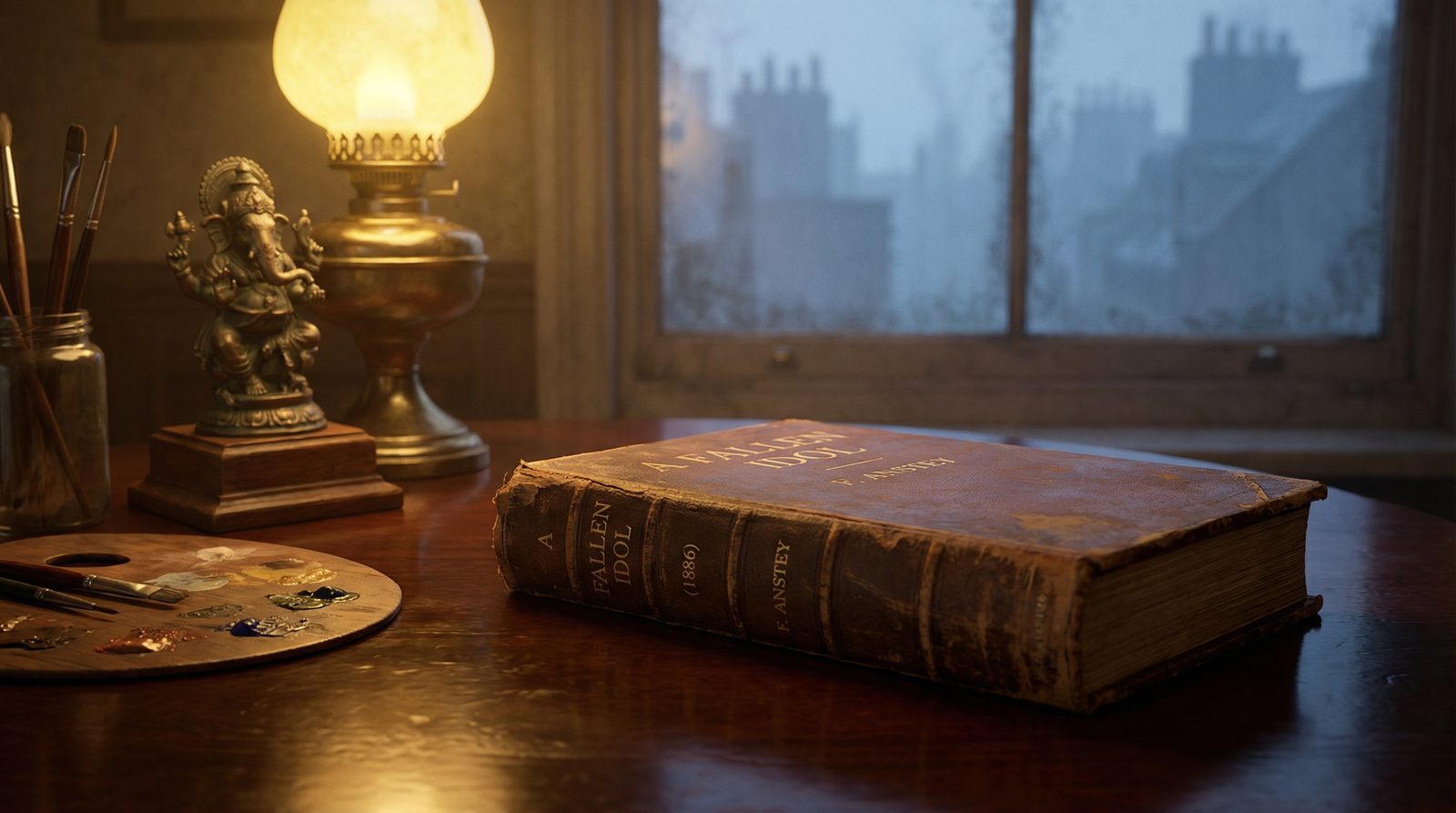
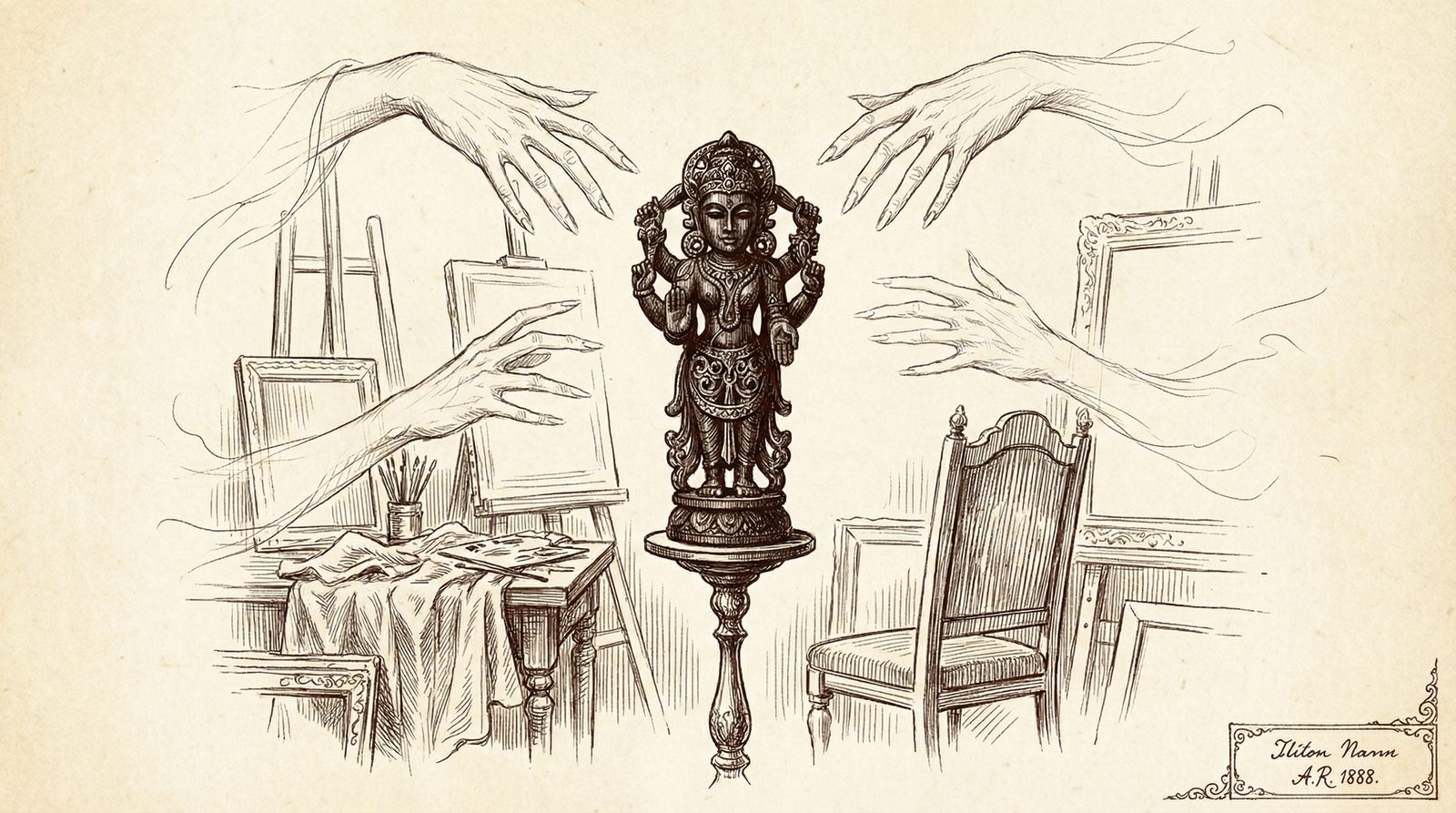
    The story opens in colonial India, where the young barrister Harold Caffyn acquires a strange idol after a violent scene at a temple in Bhowanipore. The circumstances are murky, a worshipper is killed, and whispers of a curse follow the object. Harold brings the idol back to London, where it finds its way into the studio of the painter Mark Ashburn.

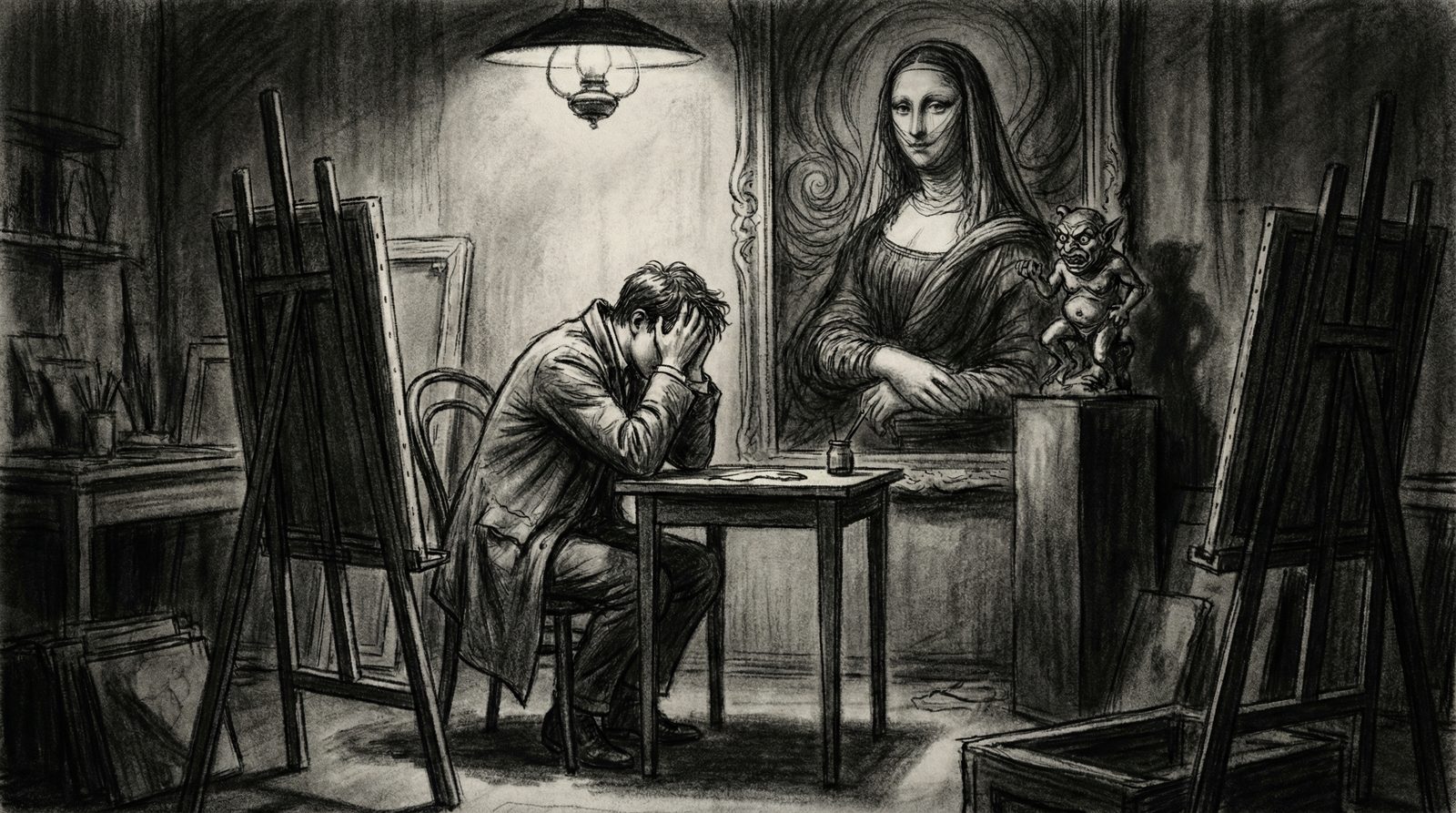
    From there, the idol works slowly and indirectly. Mark’s portraits, especially his painting of the charming Dolly Tredwell, begin to attract attention that feels unearned and unsettling. A circle of fashionable spiritualists gathers around the studio, led by the solemn Mrs. Fothergill and the excitable Miss Tyrell, eager to believe that something ancient and powerful is at work.

    The novel combines the cursed-object tradition with social imposture. Harold, who knows more about the idol’s bloody history than he admits, manipulates its reputation to his advantage, nudging Mark into becoming a reluctant medium. The séances staged in the dim studio become performances of projection. The sitters see what they want to see, while Mark feels himself hollowed out by a role he never meant to play.

    A colonial undercurrent runs through the book, recalling earlier stories of stolen relics such as The Moonstone. The idol is treated as both exotic curiosity and drawing-room entertainment, stripped of context and consequence until the damage is already done. When exposure finally looms, Harold recklessly handles the idol to prove it harmless. The result is disaster rather than vindication.

    The ending is bleakly ironic. Mark survives physically but not ethically. He burns the painting that brought him acclaim, abandons the séances, and returns the idol to a museum, where it is neutralized behind glass and catalog numbers. No one is cleansed of guilt. Reputations remain bruised. The harm lingers quietly, unresolved.

    PROSE & NARRATIVE STRUCTURE

    Anstey writes with a lightness that disguises how carefully the novel is engineered. Free indirect discourse allows the narrative to drift between Mark’s self-doubt, Harold’s cynical calculation, and the eager credulity of the spiritualist circle without heavy-handed transitions.

    Dialogue does much of the work. Characters expose themselves through polished evasions, nervous enthusiasm, and pious certainty. The narrator’s occasional asides sharpen the satire, particularly when séances are squeezed between tea and supper, or when moral outrage coexists comfortably with voyeuristic curiosity.

    Structurally, the novel alternates between scenes of social comedy and increasingly claustrophobic séances in Mark’s studio. Each sitting raises the stakes: gossip spreads, reputations wobble, and belief hardens into expectation. Notably, the idol itself rarely acts in any overt way. Its power lies in what people are willing to do in its presence.

    Conceptual editorial illustration inspired by 'A Fallen Idol'

    CHARACTERS & INTERIORITY

    Mark Ashburn is a reluctant medium, not by conviction but by weakness. He is decent, talented, and insecure enough to be swayed. His interior monologue reveals how easily vanity disguises itself as generosity. During the séances he repeatedly tells himself that he is only humoring others, even as he profits from their belief.

    Harold Caffyn feels strikingly modern. He half believes his own deceptions and treats danger as something to be managed theatrically. Moments of genuine fear break through his composure, but his instinct is always to convert panic into control.

    Dolly Tredwell and the surrounding social figures are sketched with less depth, yet Anstey allows flashes of private disillusionment to surface. In particular, Dolly’s overheard humiliation after a disastrous séance reminds the reader how easily a young woman’s reputation becomes collateral damage in fashionable folly.

    LEGACY & RECEPTION

    A Fallen Idol never matched the popularity of Anstey’s comic successes, and it is often treated as a minor occult curiosity. Victorian reviewers were divided, intrigued by the ingenuity of the séance scenes but unsettled by the novel’s refusal to clarify whether the idol was truly supernatural or merely a catalyst for fraud and hysteria.

    That ambiguity has aged well. The book now reads as a bridge between moralized ghost stories and later psychological hauntings. Its final image, the idol inert in a museum case while the characters quietly absorb their shame, feels unexpectedly modern in its skepticism toward spectacle and belief.

    IS IT WORTH READING?

    If you prefer supernatural fiction that unsettles through psychology rather than shocks, this novel is worth your attention. It moves at a Victorian pace, heavy with conversation and social maneuvering, but the unease accumulates steadily.

    The séances are disturbing not because of what appears, but because of what people are willing to believe. Readers interested in spiritualism, colonial guilt, and the performance of belief will find the novel sharp and quietly corrosive.

    Illustration inspired by a core idea from 'A Fallen Idol'

    TRIVIA & AUTHOR FACTS

    F. Anstey was the pen name of Thomas Anstey Guthrie, a barrister-turned-writer whose legal training shows in the careful sequencing of cause and consequence throughout the novel. The early Indian chapters draw on contemporary travel writing, though filtered through satire.

    Anstey attended real séances in London, and his fascination with spiritualism and fraud informs the novel’s tone. The museum ending reflects his interest in how institutions neutralize danger by classification, turning objects of fear into labeled curiosities.

    SIMILAR BOOKS

    Readers interested in supernatural objects with moral weight may also enjoy The Moonstone for its colonial relic and social fallout, or The Turn of the Screw for a later, more psychological ambiguity. For Victorian skepticism toward spiritual fashion, the earnest writings of Arthur Conan Doyle on séances offer a revealing real-world counterpoint to Anstey’s fiction.

    DISCOVERABILITY & LINKS