Place: Minnesota

  • Lila An Inquiry Into Morals (1991)

    Lila An Inquiry Into Morals (1991)

    INTRODUCTION

    Lila: An Inquiry Into Morals (1991) by Robert M. Pirsig
    Philosophical fiction · 409 pages · United States


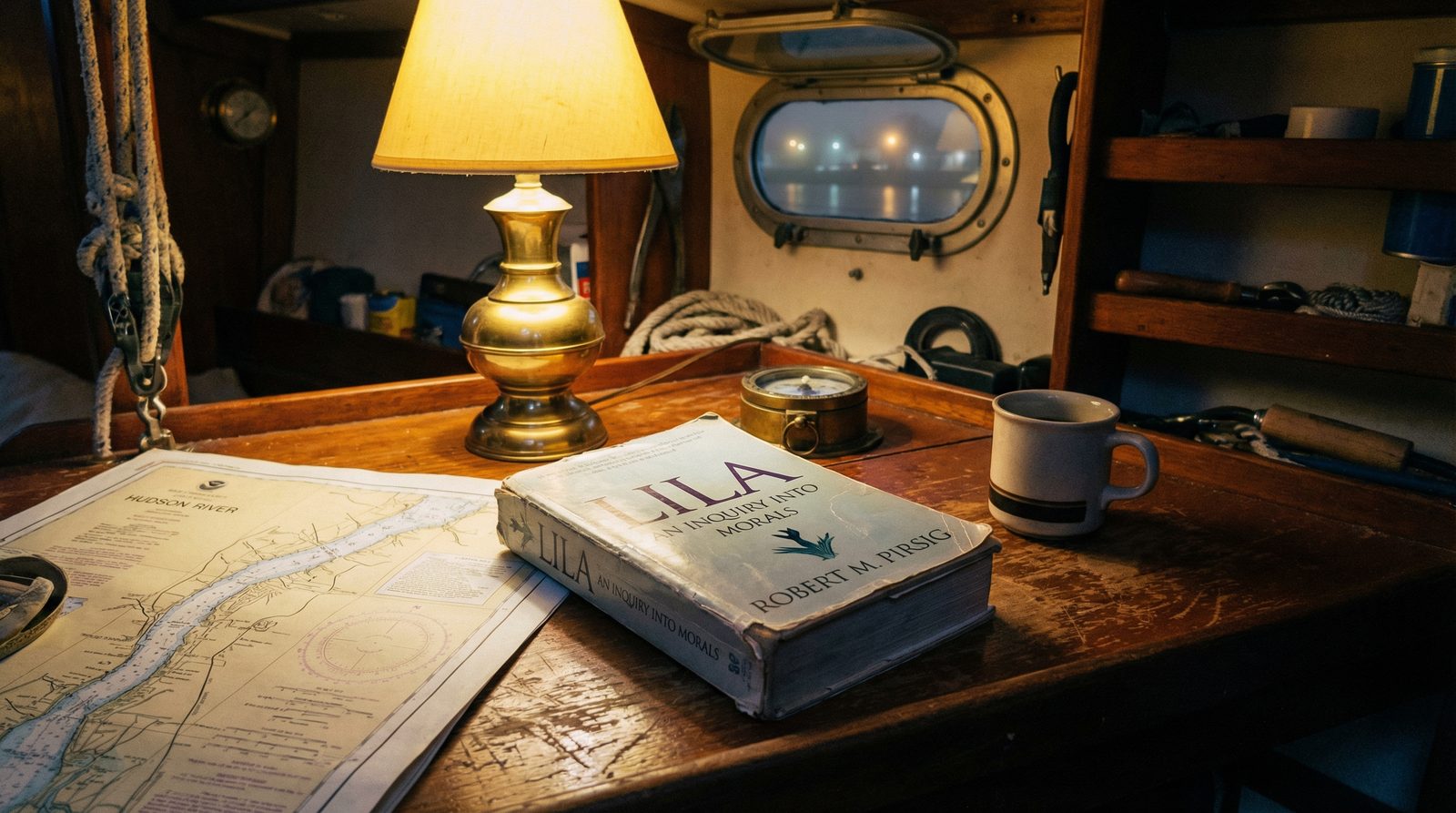
    Lila: An Inquiry Into Morals is a river book that refuses to let metaphysics float free. Pirsig trades the open highways of Zen And The Art Of Motorcycle Maintenance for the cramped cabin of the sailboat Phædrus, drifting down the Hudson in fog, barge traffic, and shifting currents. The setting isn’t decorative. Navigation becomes the narrative engine: every time Phaedrus’s thought climbs into conceptual “high altitude,” the river imposes a somatic veto — a buoy in the mist, a wake cutting the hull, a near-collision that forces the mind back into the stubborn fact of the world.

    The feel is uneasy intimacy. Close quarters with Lila create constant embodied friction: mildew, clutter, fatigue, cigarettes, jewelry clinking in the dark. Then Pirsig opens the frame into abstraction and the river widens into argument. The book’s basic rhythm is interleaved claustrophobia and breadth — cabin detail followed by metaphysical sweep — and the reader is meant to feel the oscillation rather than merely understand it.

    PLOT & THEMES

    Phaedrus takes the Phædrus downriver toward New York, picks up Lila in a Kingston bar, and tries to finish his Metaphysics of Quality while the relationship deteriorates. The road-trip-as-inner-journey trope is reworked into a river passage where each stop triggers another argument about value. On the surface it reads like movement. In practice it reads like containment: the boat is a closed room in motion.

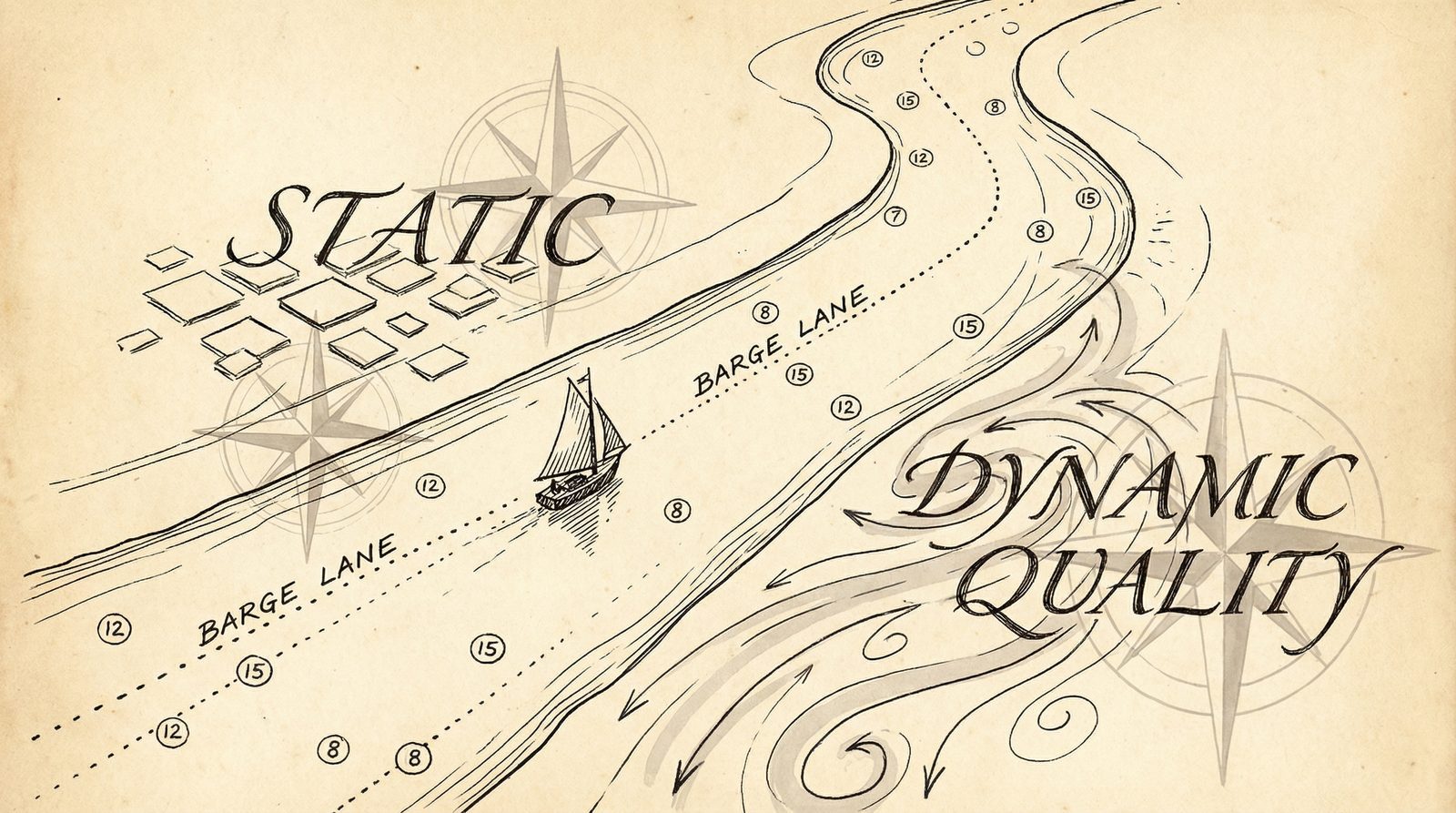
    Pirsig’s Metaphysics of Quality divides reality into static patterns (inorganic, biological, social, intellectual) and Dynamic Quality, the live edge of change. The river belongs to the inorganic register — physics, weather, currents, steel barges — and it keeps humiliating intellectual ambition. Charts and field notes represent static intellectual patterning, while the river keeps insisting on territory: the thing that cannot be fully captured by categories.

    Lila is the destabilizing test case. Her life — poverty, trauma, volatility, custody loss, breakdown — refuses to behave like an idea. Phaedrus repeatedly tries to read her through the MOQ hierarchy, but the book keeps showing how dangerous that becomes in practice. The closer he gets to “explaining” her, the less able he seems to care for her as a person. The intellectual pattern starts to eat the human problem it claims to solve.

    The ending makes the book’s moral logic unavoidable. Lila is institutionalized after a breakdown in a Manhattan hotel. Phaedrus walks away alone, shaken but convinced his system can account for what happened. This is not merely cold behavior. Pirsig forces the reader to see that, inside the MOQ, the Intellectual Pattern (the book, the system, the explanation) is evolutionarily “higher” than the Social/Biological Pattern (Lila’s welfare). Phaedrus enacts the brutal hierarchy he argues for. The disquiet is structural, not incidental.

    PROSE & NARRATIVE STRUCTURE

    Pirsig writes in plain, reportorial sentences that suddenly tip into long interior essays. A near-collision in fog becomes a pivot into subject-object metaphysics. A cigarette burn and a silence in the cabin become an opening into anthropology and moral codes. The book’s technique is not “plot with digressions.” It is an argument that keeps getting interrupted by the physical world, then returning to the argument with increased urgency.

    This is where the book becomes a tight node in the “Zen–Quality–Craft” cluster. In Zen Mind, Beginner’s Mind, “gaining mind” is the impulse to turn practice into achievement: to climb toward an outcome and call that enlightenment. In Lila, Dynamic Quality is the force that cannot be possessed or optimized — the live edge the MOQ tries to protect. The friction is the same in two vocabularies: beginner’s mind resists grasping, while Dynamic Quality resists capture. Pirsig’s tragedy is that the MOQ is built to honor the ungraspable, yet Phaedrus keeps trying to grasp Lila as a pattern.

    The narrative braid is deliberate. Cabin claustrophobia keeps puncturing metaphysical flight. River breadth keeps tempting the mind into system-building. The reader is meant to feel the oscillation as a training exercise: watch the mind reach for explanation, then watch reality pull it back by force.
    Conceptual editorial illustration inspired by 'Lila: An Inquiry Into Morals (1991)'

    CHARACTERS & INTERIORITY

    Lila is written as bruised volatility: introduced as a bar pickup, then gradually revealed as a life shaped by exploitation and abandonment. Phaedrus often treats her as a “case” rather than a person, and the book never fully escapes that objectifying lens. Yet her sudden tenderness, rage, and moments of eerie clarity keep breaking the theoretical frame. She is the human cost the system keeps trying to metabolize.

    Phaedrus is the obsessed philosopher who has survived one metaphysical collapse and now risks repeating it. His interiority is a dense machine of categories and self-justification. The book’s emotional tension comes from watching him do something intellectually impressive while failing at something morally basic: protecting the person beside him.

    LEGACY & RECEPTION

    Lila arrived nearly two decades after Zen And The Art Of Motorcycle Maintenance, and many readers expecting another meditative road memoir were blindsided. It was respected more than loved. The metaphysics is denser, and the ending is abrasive enough to feel like a challenge thrown at the reader: if you accept the system, can you accept what the system just did?

    Its reputation has become quieter and more cultlike than Zen’s. For readers who return to it, the book often functions as the shadow text of the Metaphysics of Quality: the place where the system is not inspirational but dangerous, not a bridge to meaning but a hierarchy with teeth.

    IS IT WORTH READING?

    Lila is worth reading if you’re willing to trade narrative smoothness for intellectual risk and moral discomfort. Expect long stretches of argument punctuated by raw scenes of coercion, exhaustion, and breakdown. If you need tidy arcs or comforting resolutions, it will likely leave you stranded in the fog. If you want to see a metaphysical system tested against one damaged life until both begin to crack, it is singular.
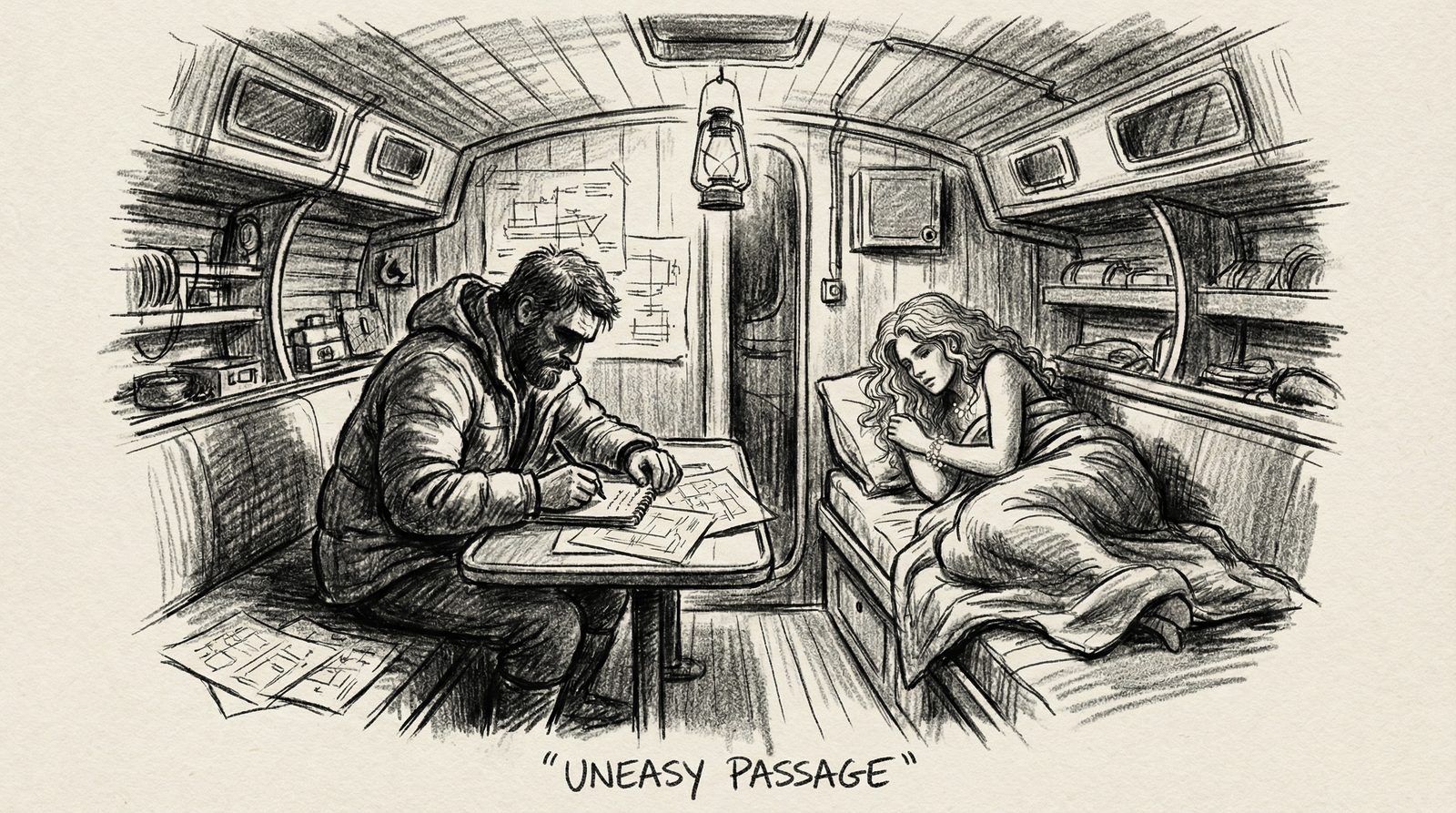
    Illustration of a core idea or motif from 'Lila: An Inquiry Into Morals (1991)'

    TRIVIA & AUTHOR FACTS

    Pirsig reportedly worked on Lila for over a decade. The boat name Phædrus echoes the name he used for his earlier pre-breakdown self, underlining how personal this inquiry is. Several episodes draw on his own sailing experience, including tense navigation among barge traffic on the Hudson.

    DISCOVERABILITY & LINKS

  • Fargo (1996)

    Fargo (1996)

    Fargo (1996) directed by Joel Coen. Crime · 98 minutes · United States.


    INTRODUCTION

    Fargo (1996) occupies a strange, memorable space where true-crime ambience, small-town politeness, and sudden carnage share the same snowdrift. The feel is a mix of bleakness and cozy warmth: a world where people say “you betcha” while standing over a corpse. The Coen brothers take the familiar scaffolding of a regional crime thriller and strip it down until every gesture feels both absurd and inevitable. What begins as a simple-for-hire kidnapping spirals into a quiet tragedy about money, pride, and the limits of common sense. The film’s power lies in its contrast between the white emptiness of the Minnesota winter and the stubborn decency of Marge Gunderson, a pregnant cop who works the case with calm curiosity instead of macho swagger. Fargo feels like a campfire story told in a monotone, where the punchlines are funny until you realize how much blood they leave behind.

    PLOT & THEMES

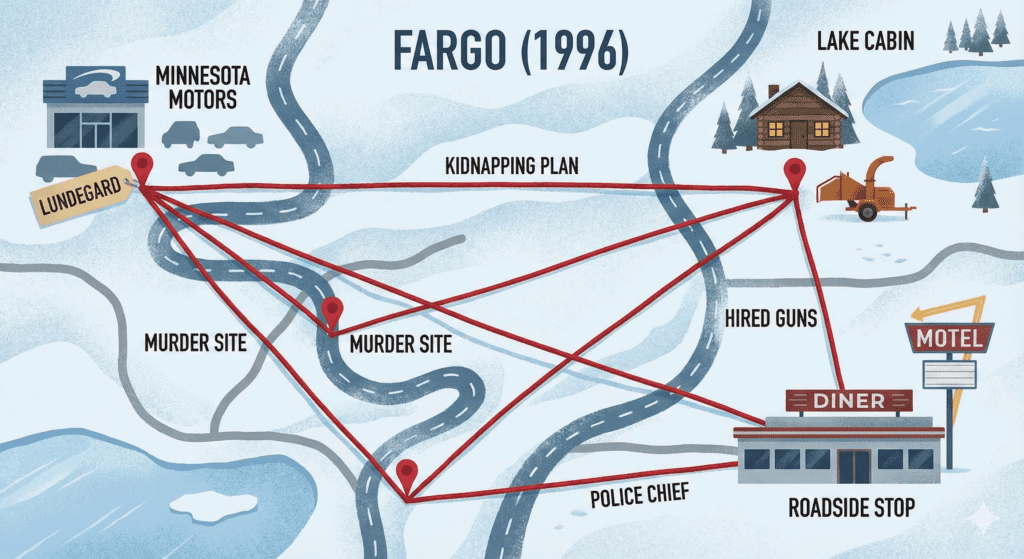
    The plot of Fargo is a classic Coen setup: Jerry Lundegaard, a financially desperate car salesman, hires two criminals to kidnap his wife so he can split the ransom extracted from his wealthy father-in-law. This is the Crime gone wrong trope in its purest form. Every step of the plan is slightly stupid, slightly lazy, and slightly cowardly. That combination proves lethal. A routine traffic stop explodes into triple homicide, and what Jerry imagines as a clever workaround for his debts becomes a trail of bodies stretching across the frozen Midwest.

    The film’s central themes are greed, moral clarity, and the banality of evil. Jerry is not a mastermind; he is a small man with big panic, and Fargo insists that this kind of mediocrity is often what powers real-world cruelty. The White void of snow motif underlines how small these characters look against the landscape. Their crimes feel petty and pointless when framed against endless fields and empty highways.

    Opposite Jerry’s flailing is Marge Gunderson’s steady investigation. Her kindness is not naïve; When she quietly asks a killer why he did all this “for a little bit of money,” the film lands its thesis. Like Blood Simple before it, Fargo treats crime not as glamorous transgression but as a grubby extension of everyday selfishness. The Small-town decency motif, embodied in Marge and her community, becomes a moral counterweight to the spreading stain of violence. The feel is one of slow dread threaded with dry humor, a reminder that horror often arrives in a beige sedan, not a black limousine.

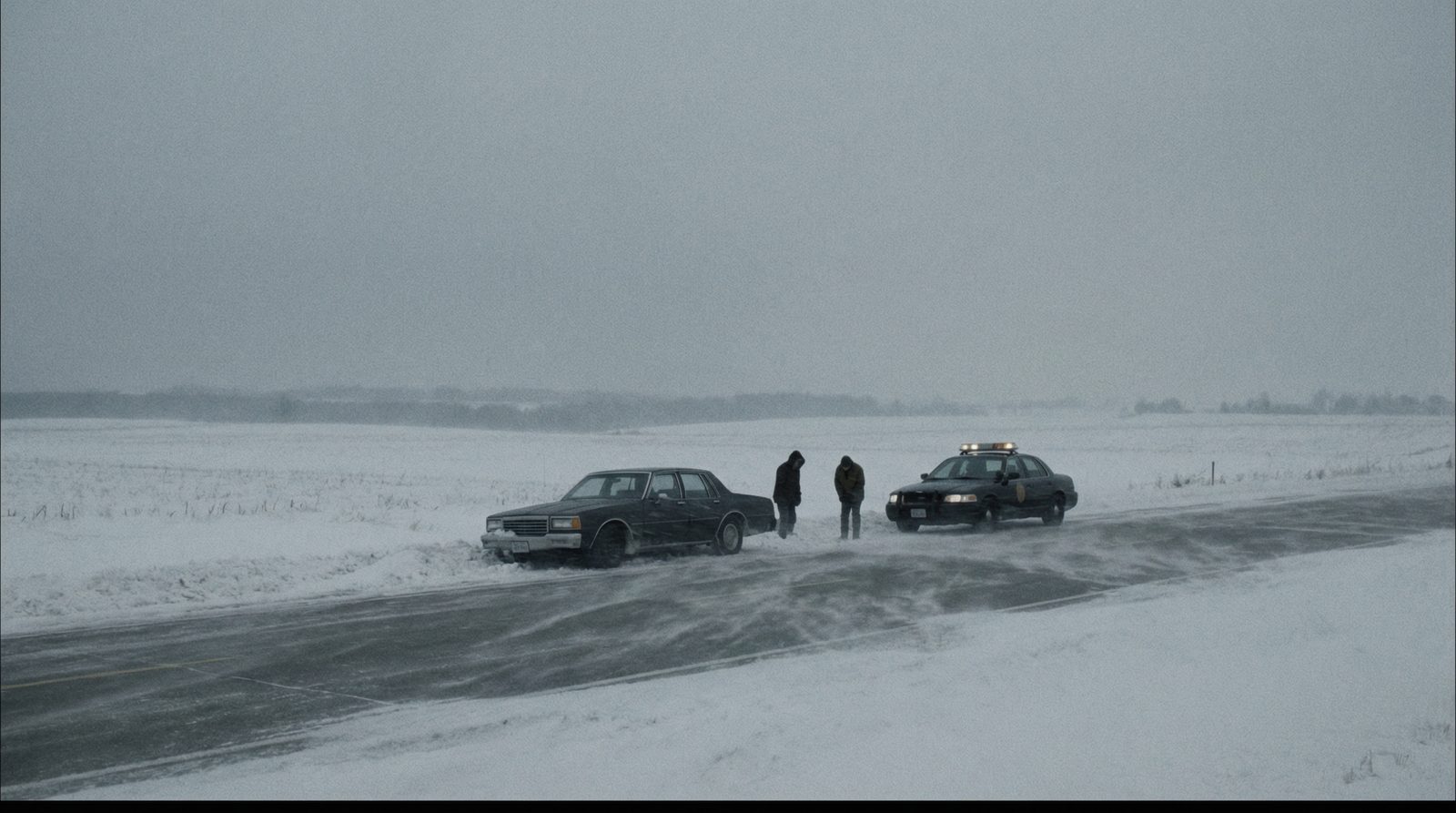
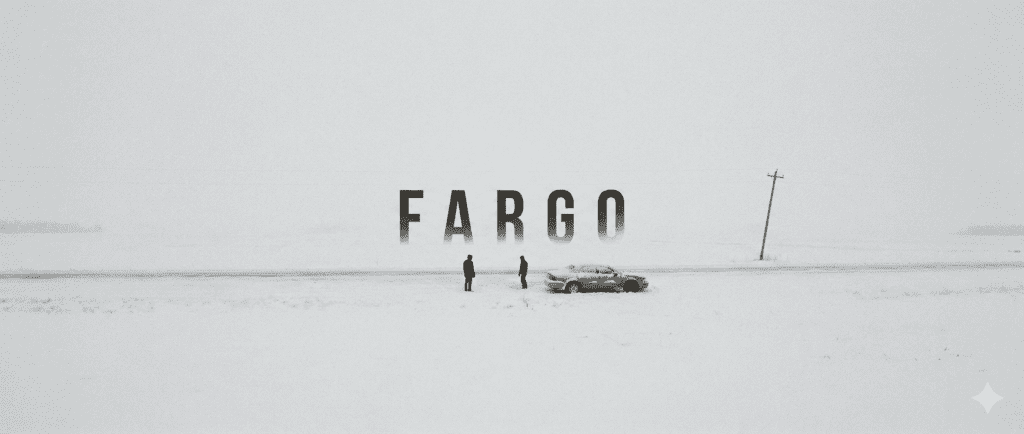
    Editorial illustration inspired by 'Fargo (1996)' – snow-covered highway and stalled cars

    CINEMATIC TECHNIQUE & AESTHETICS

    Cinematographer Roger Deakins builds Fargo around Negative space as a cinematic technique. The White void of snow motif is not just pretty scenery; Characters are often tiny figures swallowed by white fields or framed against blank skies, which makes their frantic schemes look pitiful. The Coens favor Static wide shots that let violence play out at a distance. A roadside murder is shown in long shot, the camera refusing to flinch or editorialize. The feel is clinical and eerily calm, as if the land itself is indifferent.

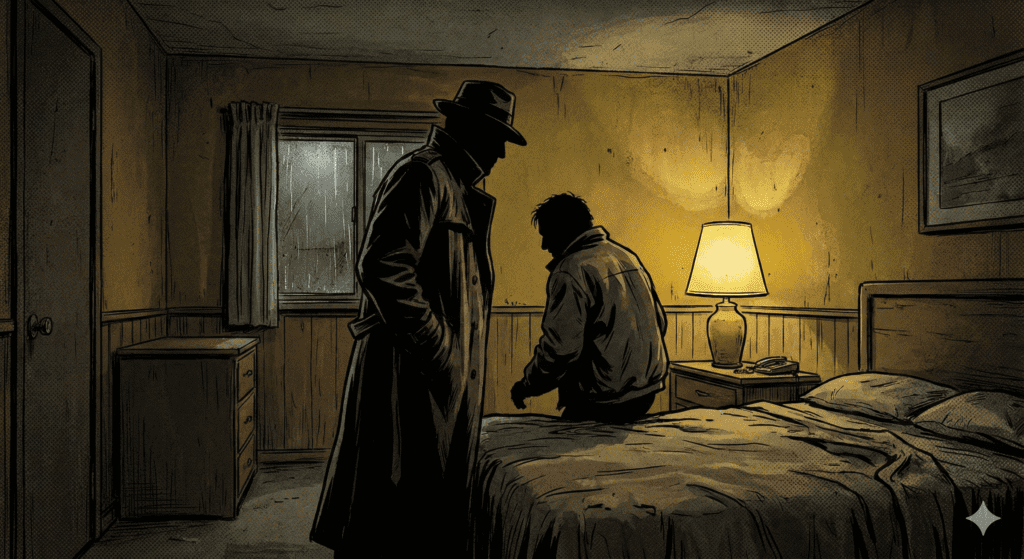
    Inside, the palette shifts to mustard yellows, wood paneling, and fluorescent hum. These drab interiors emphasize the banality of the settings: The Coens use deadpan pacing, letting silences and awkward small talk stretch long enough to become funny, then uncomfortable. The Editing favors long takes over rapid cutting, which makes the sudden eruptions of violence feel like ruptures in ordinary time.

    Carter Burwell’s score leans on a mournful, folk-like theme that swells over the opening shots of a car towing through a blizzard. It gives the story a ballad-like quality, as if we are hearing a regional legend. Dialogue is treated almost musically. The Minnesota accent, with its “yah” and “you betcha,” becomes a rhythmic counterpoint to the brutality on-screen. This contrast between cozy sound and harsh image is a key technique that shapes the film’s uneasy, darkly comic feel. Like No Country for Old Men later on, Fargo uses restraint in camera movement and music to make every burst of action land harder.

    CHARACTERS & PERFORMANCE

    Marge Gunderson is a classic Everyman hero archetype, though she is also a pregnant small-town police chief, which quietly subverts the usual hardboiled detective mold. Frances McDormand plays her with a blend of curiosity, politeness, and steel. Marge’s competence is never loud. She asks simple questions, listens, and notices what others overlook. Her domestic scenes with her husband Norm, discussing stamps and breakfast, ground the film in everyday tenderness. That normalcy is the moral center the story keeps circling back to.

    Jerry Lundegaard, played by William H. Macy, is a Cowardly schemer archetype. His high, pinched voice and nervous tics turn him into a study in flop sweat. Macy makes Jerry both contemptible and oddly pitiable. He is not a grand villain, just a man who keeps choosing the worst possible option rather than admit failure. That smallness is the point.

    On the criminal side, Steve Buscemi’s Carl is a Motor-mouth criminal archetype, all complaints and cheap impatience, while Peter Stormare’s Gaear is a Silent brute archetype, moving through scenes with blank, heavy calm. Their mismatched partnership is a walking argument for how chaos multiplies when people with no shared values are thrown together. Supporting characters, from the obsequious car-lot staff to the stiff in-laws, are sketched with just a few lines and gestures. The performances lean into regional specificity without turning the townsfolk into cartoons, which keeps the humor grounded in recognizable human behavior rather than pure caricature.

    Stylized noir illustration of Fargo (1996) – tense motel-room confrontation in warm drab Midwestern lighting

    CONTEXT & LEGACY

    Fargo arrived in the mid-1990s, when American indie cinema was saturated with ironic crime stories in the wake of Pulp Fiction. What sets Fargo apart is its emotional sincerity. The Coens had already explored doomed schemes in Blood Simple, but here they pair their usual fatalism with genuine affection for their characters. The film’s faux “true story” framing device taps into the era’s fascination with true crime while quietly mocking our hunger for authenticity labels.

    The film’s legacy includes not only its awards and critical acclaim but also the later Fargo television series, which expands on its Small-town decency motif and Crime gone wrong trope across new characters and timelines. Within the Coen brothers’ body of work, Fargo is a pivot point between their scrappier early noirs and the more austere moral parables of No Country for Old Men. Its influence can be felt in later regional crime dramas that mix dry humor with brutality, and in the broader acceptance of stories where the most heroic figure is not a vigilante or a genius, but a decent professional doing their job well.

    IS IT WORTH WATCHING?

    Fargo is worth watching if you are interested in crime stories that care more about character and moral texture than about plot twists. Its pace is unhurried, and its humor is dry enough that some viewers might initially mistake it for aimlessness. Stay with it. The accumulation of small details, awkward conversations, and quiet domestic scenes builds toward a surprisingly moving final stretch. The feel is a blend of dark comedy and melancholy, with moments of sharp horror that never tip into exploitation.

    If you like the Coen brothers’ mix of fatalism and oddball humanity in films like No Country for Old Men, or if you are drawn to stories where the landscape feels like a character, Fargo will likely resonate. It is not a puzzle-box thriller.

    TRIVIA & PRODUCTION NOTES

    The film’s opening claim that it is based on a true story is a deliberate fabrication. The Coens used the “true crime” framing device to tap into the way audiences engage differently with stories they believe are factual. Various small incidents were loosely inspired by real crimes, but Fargo as a whole is invented. The production leaned heavily on location shooting in Minnesota and North Dakota, though an unexpectedly mild winter forced the crew to chase snow and occasionally truck it in.

    Frances McDormand was not present for the first weeks of shooting, which focused on the criminals and Jerry’s unraveling. This scheduling quirk helps explain why Marge feels like a fresh, stabilizing presence when she finally appears. Carter Burwell’s score builds on Scandinavian folk influences to echo the region’s heritage. The Coens and their team paid careful attention to regional dialect, working with local actors and dialect coaches to shape the Minnesota accent. The woodchipper scene, now infamous, was staged with practical effects and strategic framing rather than explicit gore, relying on suggestion and sound to make it unforgettable.

    Diagram-style conceptual illustration of Fargo (1996) – snowfield crime map with red paths and icons

    SIMILAR FILMS

    If Fargo resonates for you, several other works offer related tones and themes. Blood Simple, the Coens’ debut, presents another Crime gone wrong trope in a more overtly noir package, with a similar interest in how ordinary people flail when their schemes collapse. No Country for Old Men shares Fargo’s fascination with moral clarity and its use of landscape as an almost spiritual presence, though it trades dry humor for a harsher, more fatalistic feel.

    Outside the Coen filmography, the television series Fargo extends the Small-town decency motif and regional crime focus across multiple eras. Fans of the mix of politeness and violence might also appreciate how Twin Peaks filters small-town strangeness through a more surreal lens, though its tone is dreamier and less grounded in procedural detail than Fargo’s.

    DISCOVERABILITY & LINKS

    On AllReaders, Fargo sits at the crossroads of crime, small-town stories, and character-driven morality tales. Its white void of snow motif, crime gone wrong trope, and focus on small-town decency connect it to other works where landscape and community shape the stakes as much as the plot does. Readers exploring regional noir, morally grounded detectives, or films that balance dark humor with quiet empathy will find Fargo clustered alongside related titles in our crime and Midwestern story maps.