
Place: Montana

  • Lila An Inquiry Into Morals (1991)

    Lila An Inquiry Into Morals (1991)

    INTRODUCTION

    Lila: An Inquiry Into Morals (1991) by Robert M. Pirsig
    Philosophical fiction · 409 pages · United States


    Lila: An Inquiry Into Morals is a river book that refuses to let metaphysics float free. Pirsig trades the open highways of Zen And The Art Of Motorcycle Maintenance for the cramped cabin of the sailboat Phædrus, drifting down the Hudson in fog, barge traffic, and shifting currents. The setting isn’t decorative. Navigation becomes the narrative engine: every time Phaedrus’s thought climbs into conceptual “high altitude,” the river imposes a somatic veto — a buoy in the mist, a wake cutting the hull, a near-collision that forces the mind back into the stubborn fact of the world.

    The feel is uneasy intimacy. Close quarters with Lila create constant embodied friction: mildew, clutter, fatigue, cigarettes, jewelry clinking in the dark. Then Pirsig opens the frame into abstraction and the river widens into argument. The book’s basic rhythm is interleaved claustrophobia and breadth — cabin detail followed by metaphysical sweep — and the reader is meant to feel the oscillation rather than merely understand it.

    PLOT & THEMES

    Phaedrus takes the Phædrus downriver toward New York, picks up Lila in a Kingston bar, and tries to finish his Metaphysics of Quality while the relationship deteriorates. The road-trip-as-inner-journey trope is reworked into a river passage where each stop triggers another argument about value. On the surface it reads like movement. In practice it reads like containment: the boat is a closed room in motion.

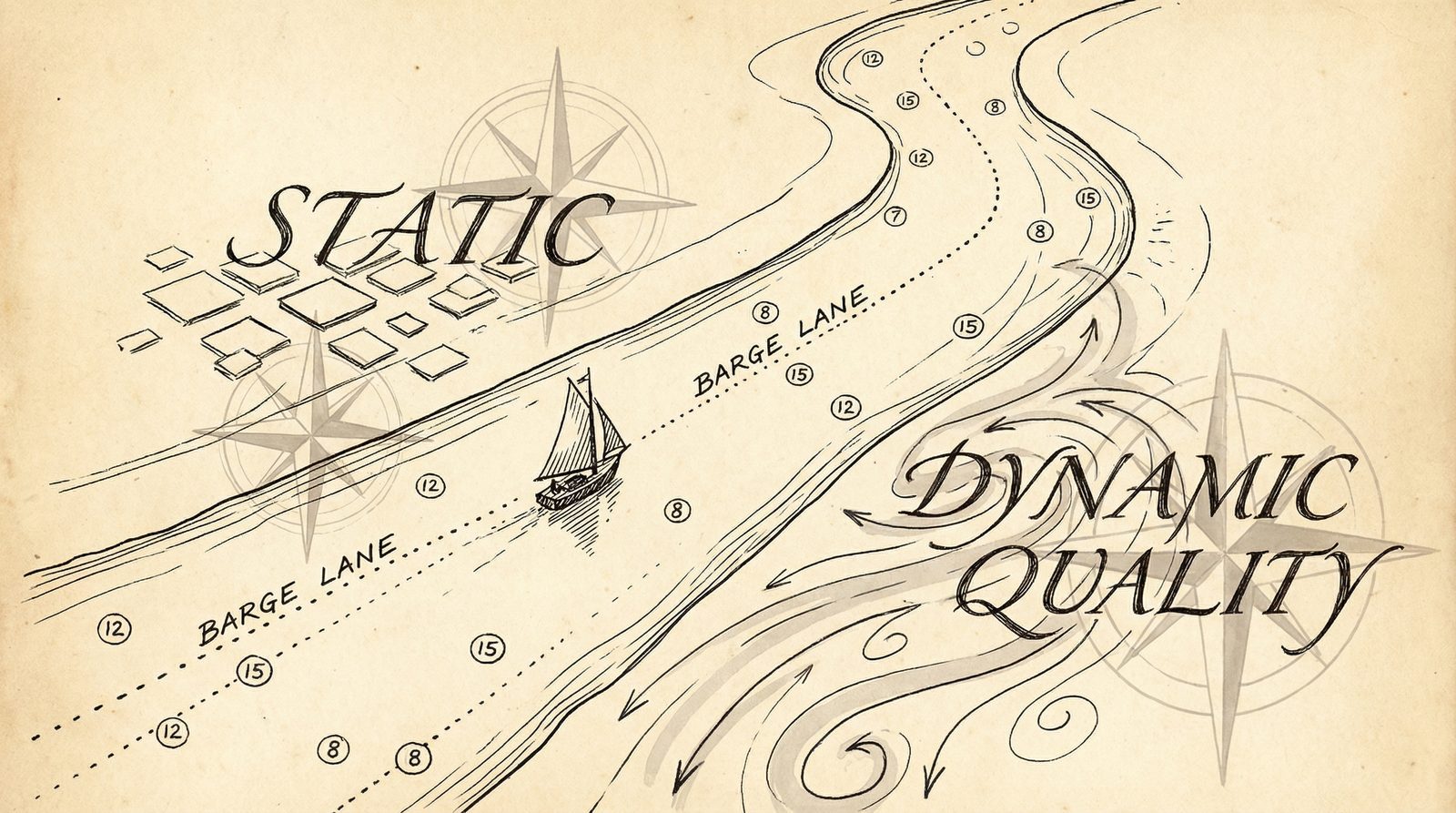
    Pirsig’s Metaphysics of Quality divides reality into static patterns (inorganic, biological, social, intellectual) and Dynamic Quality, the live edge of change. The river belongs to the inorganic register — physics, weather, currents, steel barges — and it keeps humiliating intellectual ambition. Charts and field notes represent static intellectual patterning, while the river keeps insisting on territory: the thing that cannot be fully captured by categories.

    Lila is the destabilizing test case. Her life — poverty, trauma, volatility, custody loss, breakdown — refuses to behave like an idea. Phaedrus repeatedly tries to read her through the MOQ hierarchy, but the book keeps showing how dangerous that becomes in practice. The closer he gets to “explaining” her, the less able he seems to care for her as a person. The intellectual pattern starts to eat the human problem it claims to solve.

    The ending makes the book’s moral logic unavoidable. Lila is institutionalized after a breakdown in a Manhattan hotel. Phaedrus walks away alone, shaken but convinced his system can account for what happened. This is not merely cold behavior. Pirsig forces the reader to see that, inside the MOQ, the Intellectual Pattern (the book, the system, the explanation) is evolutionarily “higher” than the Social/Biological Pattern (Lila’s welfare). Phaedrus enacts the brutal hierarchy he argues for. The disquiet is structural, not incidental.

    PROSE & NARRATIVE STRUCTURE

    Pirsig writes in plain, reportorial sentences that suddenly tip into long interior essays. A near-collision in fog becomes a pivot into subject-object metaphysics. A cigarette burn and a silence in the cabin become an opening into anthropology and moral codes. The book’s technique is not “plot with digressions.” It is an argument that keeps getting interrupted by the physical world, then returning to the argument with increased urgency.

    This is where the book becomes a tight node in the “Zen–Quality–Craft” cluster. In Zen Mind, Beginner’s Mind, “gaining mind” is the impulse to turn practice into achievement: to climb toward an outcome and call that enlightenment. In Lila, Dynamic Quality is the force that cannot be possessed or optimized — the live edge the MOQ tries to protect. The friction is the same in two vocabularies: beginner’s mind resists grasping, while Dynamic Quality resists capture. Pirsig’s tragedy is that the MOQ is built to honor the ungraspable, yet Phaedrus keeps trying to grasp Lila as a pattern.

    The narrative braid is deliberate. Cabin claustrophobia keeps puncturing metaphysical flight. River breadth keeps tempting the mind into system-building. The reader is meant to feel the oscillation as a training exercise: watch the mind reach for explanation, then watch reality pull it back by force.
    Conceptual editorial illustration inspired by 'Lila: An Inquiry Into Morals (1991)'

    CHARACTERS & INTERIORITY

    Lila is written as bruised volatility: introduced as a bar pickup, then gradually revealed as a life shaped by exploitation and abandonment. Phaedrus often treats her as a “case” rather than a person, and the book never fully escapes that objectifying lens. Yet her sudden tenderness, rage, and moments of eerie clarity keep breaking the theoretical frame. She is the human cost the system keeps trying to metabolize.

    Phaedrus is the obsessed philosopher who has survived one metaphysical collapse and now risks repeating it. His interiority is a dense machine of categories and self-justification. The book’s emotional tension comes from watching him do something intellectually impressive while failing at something morally basic: protecting the person beside him.

    LEGACY & RECEPTION

    Lila arrived nearly two decades after Zen And The Art Of Motorcycle Maintenance, and many readers expecting another meditative road memoir were blindsided. It was respected more than loved. The metaphysics is denser, and the ending is abrasive enough to feel like a challenge thrown at the reader: if you accept the system, can you accept what the system just did?

    Its reputation has become quieter and more cultlike than Zen’s. For readers who return to it, the book often functions as the shadow text of the Metaphysics of Quality: the place where the system is not inspirational but dangerous, not a bridge to meaning but a hierarchy with teeth.

    IS IT WORTH READING?

    Lila is worth reading if you’re willing to trade narrative smoothness for intellectual risk and moral discomfort. Expect long stretches of argument punctuated by raw scenes of coercion, exhaustion, and breakdown. If you need tidy arcs or comforting resolutions, it will likely leave you stranded in the fog. If you want to see a metaphysical system tested against one damaged life until both begin to crack, it is singular.
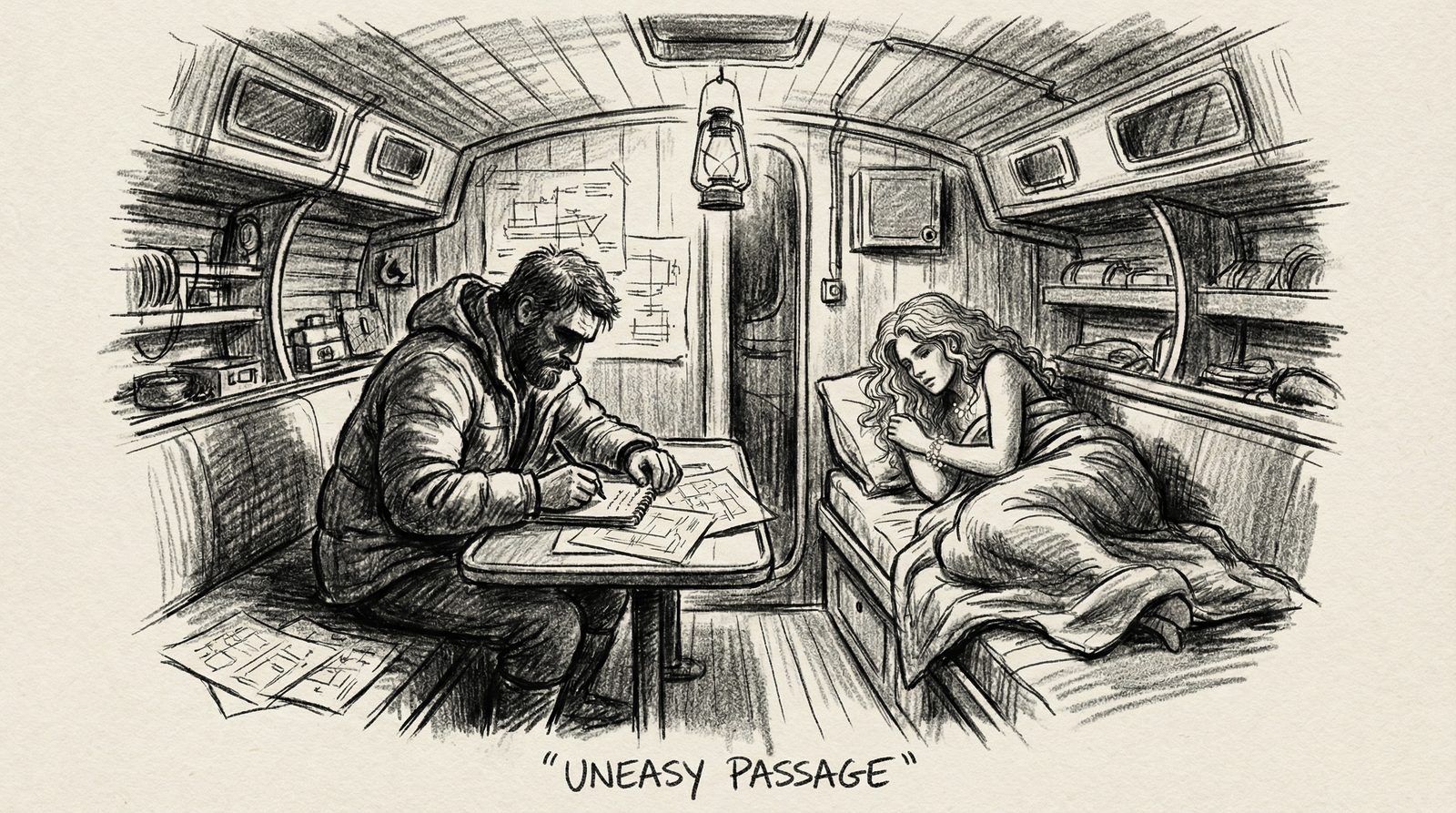
    Illustration of a core idea or motif from 'Lila: An Inquiry Into Morals (1991)'

    TRIVIA & AUTHOR FACTS

    Pirsig reportedly worked on Lila for over a decade. The boat name Phædrus echoes the name he used for his earlier pre-breakdown self, underlining how personal this inquiry is. Several episodes draw on his own sailing experience, including tense navigation among barge traffic on the Hudson.

    DISCOVERABILITY & LINKS

  • Zen And The Art Of Motorcycle Maintenance (1974)

    Zen And The Art Of Motorcycle Maintenance (1974)

    INTRODUCTION

    Zen and the Art of Motorcycle Maintenance (1974) by Robert M. Pirsig
    Philosophical novel · 434 pages · United States


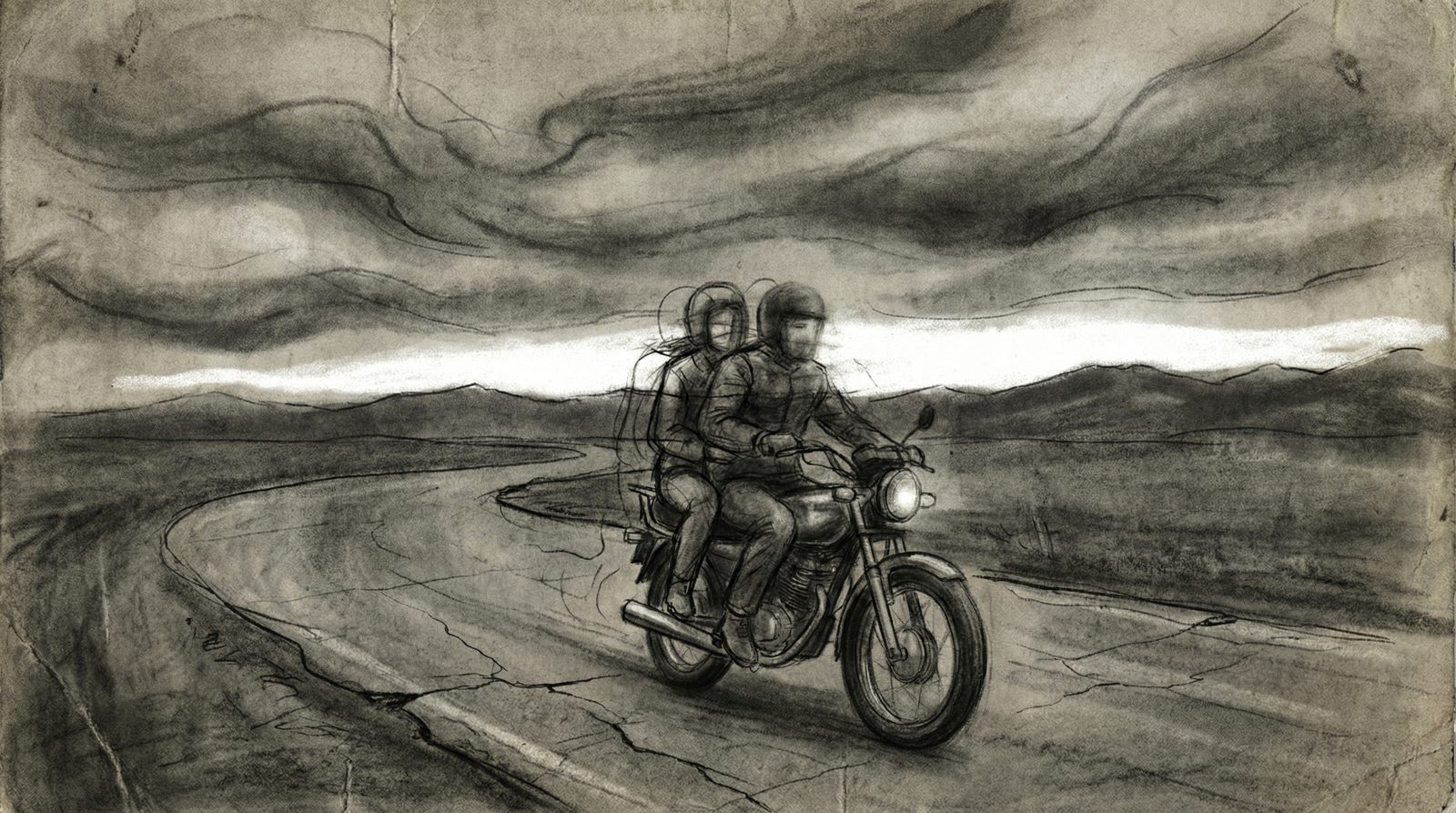
    Zen and the Art of Motorcycle Maintenance is one of those books people claim to have read when what they really remember is the title. It is not a manual and not quite a novel. It uses the open road as a frame: a father and his young son ride a Honda across the American West while, inside the father’s mind, an older self named Phaedrus keeps stirring.

    The mood is uneasy and faintly feverish. There is sun on asphalt, engine vibration, and the nagging sense that something in modern life has gone badly out of tune. Pirsig uses the motorcycle as both machine and moral mirror, asking whether sanity is possible in a culture that worships efficiency but forgets meaning.

    PLOT & THEMES

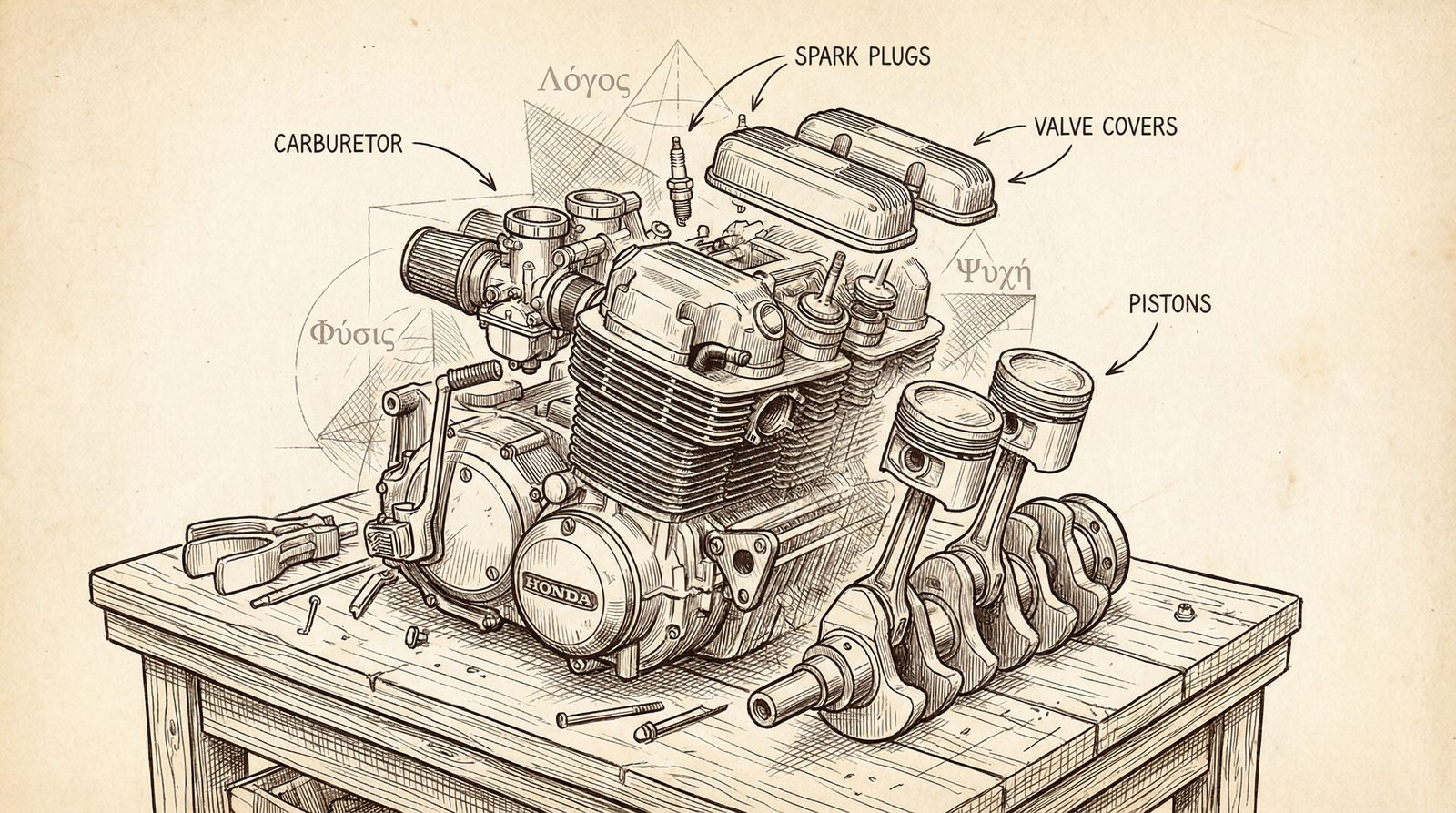
    On the surface, the plot is simple. A nameless narrator rides from Minneapolis toward the Pacific Northwest with his son, Chris. Their friends John and Sylvia Sutherland join them along the way. They cross the Dakotas, move into Montana, and eventually reach the coast. Practical lessons punctuate the ride: valve clearances, chain tension, how to listen for what an engine is trying to tell you.

    But the road trip is a decoy. The real story happens inside the narrator, where memories of Phaedrus begin to reassemble. Phaedrus was a brilliant, obsessive teacher who became consumed by the idea of “Quality.” His pursuit spiraled from intellectual argument into breakdown, ending in institutionalization and electroshock therapy. The book’s central tension is whether the narrator can live without becoming that man again, and whether the narrator can be honest about the fact that Phaedrus never entirely vanished.

    Quality becomes the book’s governing concept: a way to heal the split between classical, rational analysis and romantic, intuitive experience. Pirsig insists that the divide is not just philosophical. It is lived. It shows up in how you fix a machine, how you teach a student, how you talk to your child, and how you survive your own mind when it starts to fracture.

    By the time father and son reach the ocean, the past has broken through. In a motel room, Chris confronts his father about the gaps in their shared history and the fear that he will “go crazy again.” The narrator finally admits what he has been circling for hundreds of pages: he is Phaedrus returned, or at least the person who must now carry Phaedrus’s memories without pretending they belong to someone else. The ending is not a cure narrative. It is a fragile reconciliation, tentative and incomplete, and that incompleteness is the book’s honesty.

    PROSE & NARRATIVE STRUCTURE

    Pirsig structures the book as a braid, alternating scenes from the trip with philosophical “Chautauquas,” long improvised talks delivered directly to the reader. This technique keeps one wheel on the pavement and one in abstraction. A description of cleaning a clogged jet or adjusting ignition points can slide, almost imperceptibly, into a discussion of Plato, Aristotle, or the problem of defining value.

    The prose is plainspoken but elastic. When Pirsig writes about the high plains at dawn or rain near the mountains, there is a quiet lyricism that matches the rhythm of the road. When he writes about breakdown and “stuckness,” the tone tightens into claustrophobia. He becomes precise about the moment before a mind gives way, and about the strange relief that sometimes follows when resistance collapses.

    When he describes the motorcycle as an assemblage of functions, he is not trying to be poetic. He is trying to show that attention can be an ethic. Caring about how something works is a way of caring about the world. Neglect is not neutral. It is a posture toward life, and it spreads.

    Structurally, the argument moves in tightening spirals rather than straight lines. Each day’s ride returns to the same questions, what Quality is, whether analysis can coexist with direct experience, whether the mind can survive its own hunger for certainty. The narrative never fully resolves those questions. It stages them as a lifelong condition, something you learn to live inside rather than something you solve once.

    Conceptual editorial illustration inspired by 'Zen and the Art of Motorcycle Maintenance'

    CHARACTERS & INTERIORITY

    The narrator is an unusual seeker figure: someone who has already broken in pursuit of meaning and now circles back cautiously, wary of his own intensity. His interiority is dense. He appears as careful mechanic, anxious father, and former zealot, sometimes in the same paragraph. The split between “narrator” and “Phaedrus” is not merely a device. It is how he experiences himself, as if his own past were an alien intelligence pressing at the edge of consciousness.

    Chris is written with raw opacity. He is moody, easily hurt, sometimes exhilarated by the trip and sometimes bored. His stomach aches, his fear of abandonment, and his questions about madness carry the emotional weight the philosophy can occasionally evade. Their relationship gives the book its human stakes. You do not need to accept the metaphysics of Quality to feel the ache of a child trying to understand whether his father will remain stable.

    John and Sylvia Sutherland function as foils. John refuses to touch his own BMW’s maintenance, preferring machines to remain mysterious. Sylvia senses that something is off in the narrator’s intensity and detachment. Even minor figures, colleagues who bristle at Phaedrus’s ideas, mechanics who mishandle a bolt, serve as examples of different relationships to care, competence, and attention.

    LEGACY & RECEPTION

    Published after more than a hundred rejections, the book became an unlikely bestseller. It caught a particular American restlessness: the desire for meaning without rejecting technology, the craving for transcendence without surrendering craftsmanship. Engineers saw their pride in workmanship honored. Philosophers argued over whether the “Metaphysics of Quality” was rigorous or naïve. Ordinary readers simply recognized the feeling of being out of tune with modern life and wanting to repair the instrument from the inside.

    Its ending has remained central to its reputation. The father and son bond is only tentatively restored. The narrator accepts that the intensity that once destroyed his life is also bound up with his deepest insight, and that Chris may have inherited some of that dangerous voltage. The unresolved tension between sanity and vision is why the book keeps returning. It refuses to become a tidy inspirational story.

    IS IT WORTH READING?

    This is not a quick read, and it does not pretend to be. If you want a straightforward plot, you will get impatient. If you are willing to sit with long arguments about Quality intercut with roadside coffee and carburetor details, you may find it oddly absorbing.

    Its blind spots are real. The density can feel relentless, and the philosophical passages can occasionally flatten the emotional life around them. Still, the book offers something rare: a serious attempt to think through how to live well in a world of machines without worshiping them and without fleeing from them. If that tension already lives inside you, the ride is worth taking.

    Illustration inspired by a core idea from 'Zen and the Art of Motorcycle Maintenance'

    TRIVIA & AUTHOR FACTS

    Pirsig reportedly received more than 120 rejections before a publisher took a chance on the manuscript. He worked as a technical writer and teacher, and his familiarity with manuals and lab-report precision shapes the maintenance scenes. The “Chautauqua” framing nods to the American tradition of traveling lectures, repurposed here for the highway era.

    The narrator’s Honda is based on Pirsig’s own machine, and many of the mechanical details reflect lived experience rather than symbolic decoration. After the book’s success, Pirsig largely withdrew from public life, publishing one later philosophical novel and resisting the role of guru. That reluctance fits the book’s suspicion of any fixed system, including its own.

    SIMILAR BOOKS

    If this blend of narrative and inquiry works for you, Lila extends Pirsig’s ideas into a different journey. Readers drawn to spiritual searching and interior crisis often find kinship with Siddhartha. For a more chaotic portrait of American seeking, The Electric Kool-Aid Acid Test offers an opposite energy. And for a grounded nonfiction meditation on manual work and meaning, Shop Class as Soulcraft can feel like a distant cousin to Pirsig’s long ride west.

    DISCOVERABILITY & LINKS

    DISCOVERABILITY & LINKS