
Place: United States

  • Zen And The Art Of Motorcycle Maintenance (1974)

    Zen And The Art Of Motorcycle Maintenance (1974)

    INTRODUCTION

    Zen and the Art of Motorcycle Maintenance (1974) by Robert M. Pirsig
    Philosophical novel · 434 pages · United States


    Zen and the Art of Motorcycle Maintenance is one of those books people claim to have read when what they really remember is the title. It is not a manual and not quite a novel. It uses the open road as a frame: a father and his young son ride a Honda across the American West while, inside the father’s mind, an older self named Phaedrus keeps stirring.

    The mood is uneasy and faintly feverish. There is sun on asphalt, engine vibration, and the nagging sense that something in modern life has gone badly out of tune. Pirsig uses the motorcycle as both machine and moral mirror, asking whether sanity is possible in a culture that worships efficiency but forgets meaning.

    PLOT & THEMES

    On the surface, the plot is simple. A nameless narrator rides from Minneapolis toward the Pacific Northwest with his son, Chris. Their friends John and Sylvia Sutherland join them along the way. They cross the Dakotas, move into Montana, and eventually reach the coast. Practical lessons punctuate the ride: valve clearances, chain tension, how to listen for what an engine is trying to tell you.

    But the road trip is a decoy. The real story happens inside the narrator, where memories of Phaedrus begin to reassemble. Phaedrus was a brilliant, obsessive teacher who became consumed by the idea of “Quality.” His pursuit spiraled from intellectual argument into breakdown, ending in institutionalization and electroshock therapy. The book’s central tension is whether the narrator can live without becoming that man again, and whether the narrator can be honest about the fact that Phaedrus never entirely vanished.

    Quality becomes the book’s governing concept: a way to heal the split between classical, rational analysis and romantic, intuitive experience. Pirsig insists that the divide is not just philosophical. It is lived. It shows up in how you fix a machine, how you teach a student, how you talk to your child, and how you survive your own mind when it starts to fracture.

    By the time father and son reach the ocean, the past has broken through. In a motel room, Chris confronts his father about the gaps in their shared history and the fear that he will “go crazy again.” The narrator finally admits what he has been circling for hundreds of pages: he is Phaedrus returned, or at least the person who must now carry Phaedrus’s memories without pretending they belong to someone else. The ending is not a cure narrative. It is a fragile reconciliation, tentative and incomplete, and that incompleteness is the book’s honesty.

    PROSE & NARRATIVE STRUCTURE

    Pirsig structures the book as a braid, alternating scenes from the trip with philosophical “Chautauquas,” long improvised talks delivered directly to the reader. This technique keeps one wheel on the pavement and one in abstraction. A description of cleaning a clogged jet or adjusting ignition points can slide, almost imperceptibly, into a discussion of Plato, Aristotle, or the problem of defining value.

    The prose is plainspoken but elastic. When Pirsig writes about the high plains at dawn or rain near the mountains, there is a quiet lyricism that matches the rhythm of the road. When he writes about breakdown and “stuckness,” the tone tightens into claustrophobia. He becomes precise about the moment before a mind gives way, and about the strange relief that sometimes follows when resistance collapses.

    When he describes the motorcycle as an assemblage of functions, he is not trying to be poetic. He is trying to show that attention can be an ethic. Caring about how something works is a way of caring about the world. Neglect is not neutral. It is a posture toward life, and it spreads.

    Structurally, the argument moves in tightening spirals rather than straight lines. Each day’s ride returns to the same questions, what Quality is, whether analysis can coexist with direct experience, whether the mind can survive its own hunger for certainty. The narrative never fully resolves those questions. It stages them as a lifelong condition, something you learn to live inside rather than something you solve once.

    Conceptual editorial illustration inspired by 'Zen and the Art of Motorcycle Maintenance'

    CHARACTERS & INTERIORITY

    The narrator is an unusual seeker figure: someone who has already broken in pursuit of meaning and now circles back cautiously, wary of his own intensity. His interiority is dense. He appears as careful mechanic, anxious father, and former zealot, sometimes in the same paragraph. The split between “narrator” and “Phaedrus” is not merely a device. It is how he experiences himself, as if his own past were an alien intelligence pressing at the edge of consciousness.

    Chris is written with raw opacity. He is moody, easily hurt, sometimes exhilarated by the trip and sometimes bored. His stomach aches, his fear of abandonment, and his questions about madness carry the emotional weight the philosophy can occasionally evade. Their relationship gives the book its human stakes. You do not need to accept the metaphysics of Quality to feel the ache of a child trying to understand whether his father will remain stable.

    John and Sylvia Sutherland function as foils. John refuses to touch his own BMW’s maintenance, preferring machines to remain mysterious. Sylvia senses that something is off in the narrator’s intensity and detachment. Even minor figures, colleagues who bristle at Phaedrus’s ideas, mechanics who mishandle a bolt, serve as examples of different relationships to care, competence, and attention.

    LEGACY & RECEPTION

    Published after more than a hundred rejections, the book became an unlikely bestseller. It caught a particular American restlessness: the desire for meaning without rejecting technology, the craving for transcendence without surrendering craftsmanship. Engineers saw their pride in workmanship honored. Philosophers argued over whether the “Metaphysics of Quality” was rigorous or naïve. Ordinary readers simply recognized the feeling of being out of tune with modern life and wanting to repair the instrument from the inside.

    Its ending has remained central to its reputation. The father and son bond is only tentatively restored. The narrator accepts that the intensity that once destroyed his life is also bound up with his deepest insight, and that Chris may have inherited some of that dangerous voltage. The unresolved tension between sanity and vision is why the book keeps returning. It refuses to become a tidy inspirational story.

    IS IT WORTH READING?

    This is not a quick read, and it does not pretend to be. If you want a straightforward plot, you will get impatient. If you are willing to sit with long arguments about Quality intercut with roadside coffee and carburetor details, you may find it oddly absorbing.

    Its blind spots are real. The density can feel relentless, and the philosophical passages can occasionally flatten the emotional life around them. Still, the book offers something rare: a serious attempt to think through how to live well in a world of machines without worshiping them and without fleeing from them. If that tension already lives inside you, the ride is worth taking.
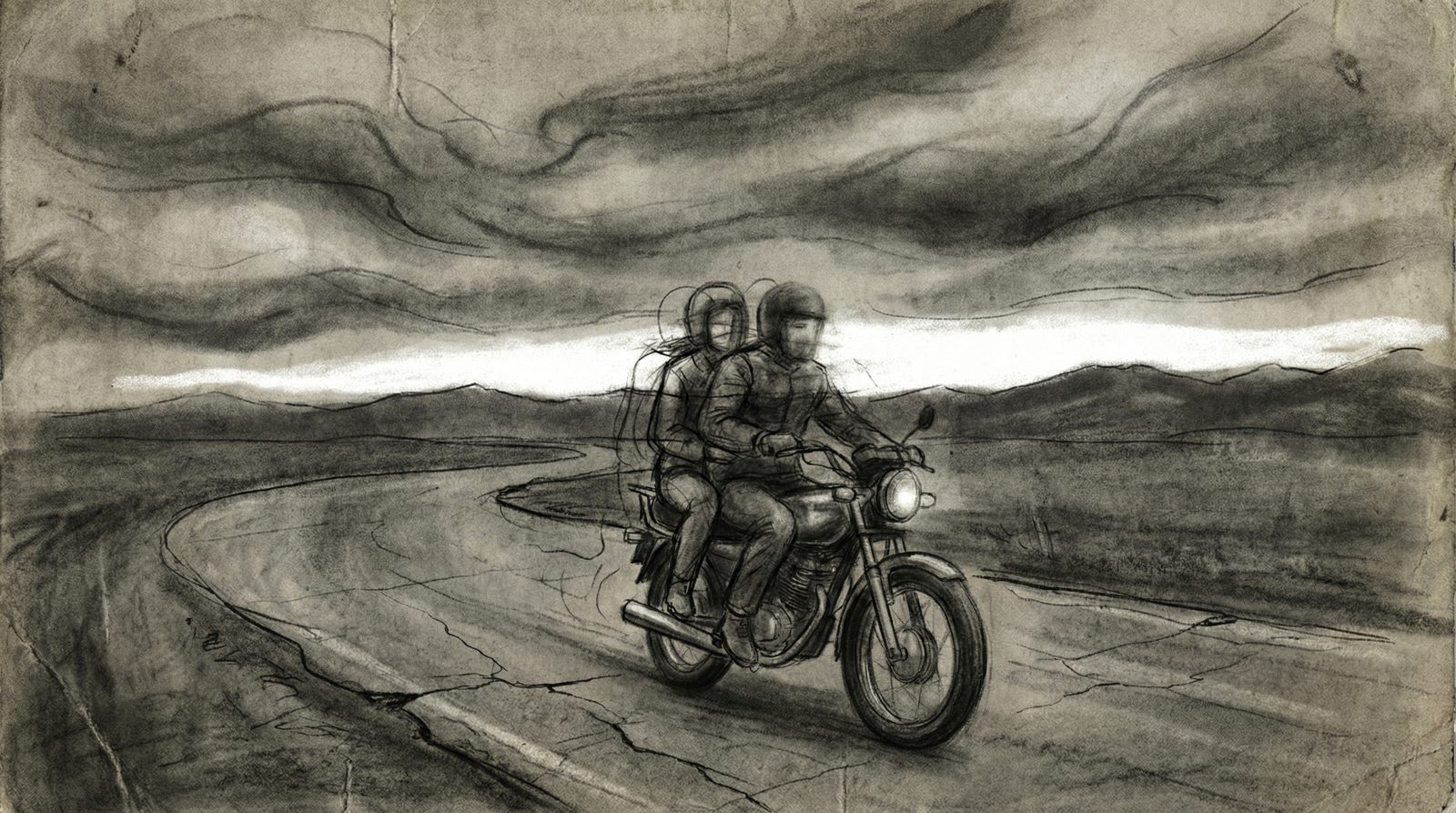
    Illustration inspired by a core idea from 'Zen and the Art of Motorcycle Maintenance'

    TRIVIA & AUTHOR FACTS

    Pirsig reportedly received more than 120 rejections before a publisher took a chance on the manuscript. He worked as a technical writer and teacher, and his familiarity with manuals and lab-report precision shapes the maintenance scenes. The “Chautauqua” framing nods to the American tradition of traveling lectures, repurposed here for the highway era.

    The narrator’s Honda is based on Pirsig’s own machine, and many of the mechanical details reflect lived experience rather than symbolic decoration. After the book’s success, Pirsig largely withdrew from public life, publishing one later philosophical novel and resisting the role of guru. That reluctance fits the book’s suspicion of any fixed system, including its own.

    SIMILAR BOOKS

    If this blend of narrative and inquiry works for you, Lila extends Pirsig’s ideas into a different journey. Readers drawn to spiritual searching and interior crisis often find kinship with Siddhartha. For a more chaotic portrait of American seeking, The Electric Kool-Aid Acid Test offers an opposite energy. And for a grounded nonfiction meditation on manual work and meaning, Shop Class as Soulcraft can feel like a distant cousin to Pirsig’s long ride west.

    DISCOVERABILITY & LINKS

    DISCOVERABILITY & LINKS

  • The Celestine Prophecy (1993)

    The Celestine Prophecy (1993)

    INTRODUCTION

    The Celestine Prophecy (1993) by James Redfield
    Spiritual fiction · 20th Century · United States / Peru


    The Celestine Prophecy arrived in the mid-1990s like a photocopied scripture passed from hand to hand, carrying the promise that everyday life concealed a deeper pattern of meaning. It barely disguises its intentions. This is a novel that wants to instruct, not merely entertain. Yet that lack of irony is part of its peculiar magnetism.

    Set largely in Peru but steeped in American New Age yearning, the book follows an unnamed narrator who drifts from encounter to encounter, repeatedly meeting people who seem to have been waiting for him. The tone is earnest to the point of vulnerability. At times it feels naïve, even awkward. But it is also charged with a restless hope that private dissatisfaction might be a signal of collective transformation.

    As spiritual fiction, the novel sits between adventure story and instructional text. Ancient manuscripts, meaningful coincidence, and invisible energy fields are not narrative ornaments here. They are the argument. Human consciousness itself is framed as the final frontier of the late twentieth century.

    PLOT & THEMES

    The plot unfolds as both a physical journey through Peru and a structured ascent through nine spiritual insights. Nudged by a former teacher, the narrator travels to Lima after hearing rumors of a mysterious manuscript discovered near the ruins of an ancient settlement. Almost immediately, he is warned that the Catholic Church views the document as dangerous.

    From that moment on, the story follows the logic of the chosen seeker. The narrator repeatedly meets exactly the right person at exactly the right moment. Each encounter introduces a new insight, reframing the nature of history, psychology, and human interaction.

    The early insights teach that modern restlessness is not a personal failure but an evolutionary pressure. Later chapters introduce the idea of visible energy fields surrounding living beings, dramatized in scenes where attention itself appears to nourish plants or destabilize human interactions. At the Celestine ruins, competing belief systems are rendered as clashing energetic forces rather than ideological disagreements.

    Redfield weaves in psychological material through the concept of “control dramas”: patterns like the Intimidator, Interrogator, Aloof type, and Poor Me. These strategies, learned in childhood, are presented as unconscious attempts to steal energy from others. Family arguments and strained relationships become laboratories for spiritual diagnosis.

    The later insights grow more radical. Humanity is imagined as learning to consciously exchange energy, extending life and eventually transcending physical death altogether. Unlike the film adaptation, the novel ends without triumph. The manuscript is suppressed, Father Sanchez is arrested, and the narrator leaves Peru committed to living the insights quietly in ordinary life, waiting for a tenth insight to emerge elsewhere.

    As spiritual fiction, the book occupies an uneasy space between allegory and manual. Its ambition is unmistakable: to use narrative itself as a technology for belief change.

    PROSE & NARRATIVE STRUCTURE

    The novel is told in plain first-person prose, almost aggressively stripped of ornament. Sentences explain more than they evoke. Characters rarely act without also clarifying the spiritual meaning of their actions. This flattens suspense but reinforces the book’s instructional purpose.

    Structurally, the book is modular. Each chapter introduces a new insight through a new character or setting: Father Sanchez in a Lima church, Dobson at the Viciente estate, Marjorie and her children in a mountain refuge, Sarah at a scientific research compound. The repetition is deliberate. Learning here happens through accumulation, not surprise.

    Occasional sensory details appear, humid jungle air, stone corridors, flickering candlelight, but they function as brief pauses between extended dialogues about spiritual evolution. Even moments of danger, including the narrator’s imprisonment, exist mainly to usher in the next teaching.

    Formally, the book resembles a self-help text wearing the clothes of an adventure novel. Whether that feels inspiring or tedious depends entirely on how receptive the reader is to the insights themselves.

    CHARACTERS & INTERIORITY

    The unnamed narrator functions less as a character than as an archetypal pilgrim. His background is deliberately vague. He exists primarily as a vessel for the reader’s curiosity and doubt.

    Supporting figures are similarly schematic. Father Sanchez represents institutional religion under threat. Wil plays the role of the seasoned guide, always one insight ahead. Charlene embodies skepticism slowly dissolving into openness. Even minor characters exist to demonstrate specific psychological patterns rather than to develop inner lives.

    Interior experience is reported rather than dramatized. Moments of awakening are described intellectually, not viscerally. Yet there is an odd honesty in this clumsiness. The characters constantly articulate their fears of being wrong, arrested, or deluded. That insecurity mirrors the reader’s own ambivalence about embracing such a totalizing worldview.

    LEGACY & RECEPTION

    The Celestine Prophecy was an unlikely cultural phenomenon. Initially self-published, it climbed bestseller lists and spawned sequels, workshops, and discussion groups. Critics often dismissed its prose as wooden and its ideas as recycled mysticism. Readers, however, embraced its promise of meaning in an era marked by spiritual drift.

    The book helped normalize the idea that a novel could function as spiritual instruction. Its insistence that insight must be lived rather than archived allowed readers to extend the story into their own lives. That open-endedness explains why it lingered in personal libraries and study circles long after its mainstream visibility faded.

    IS IT WORTH READING?

    As a novel, it is undeniably clumsy. As a cultural artifact, it remains fascinating. Readers interested in how New Age spirituality crystallized into narrative form during the 1990s will find it revealing. It rewards a skeptical but open posture: reading with a pencil in hand, questioning its claims, and occasionally feeling an unsettling resonance when coincidence and meaning begin to rhyme with personal experience.

    TRIVIA & AUTHOR FACTS

    James Redfield self-published the novel and distributed copies through independent bookstores before it was picked up by a major publisher. His background in counseling and interest in Eastern philosophy shaped the book’s blend of psychology and spirituality.

    The manuscript and its nine insights are entirely fictional. Redfield has stated that they are a synthesis of various spiritual traditions rather than a rediscovered ancient text.

    SIMILAR BOOKS

    Readers drawn to its blend of spiritual seeking and narrative instruction may also explore The Alchemist (1988) by Paulo Coelho, Hermann Hesse’s Siddhartha (1922), or Dan Millman’s Way of the Peaceful Warrior (1980).

    DISCOVERABILITY & LINKS

    Related works: The Tenth Insight, The Alchemist, Way of the Peaceful Warrior

    DISCOVERABILITY & LINKS

  • Way Of The Peaceful Warrior (1980)

    Way Of The Peaceful Warrior (1980)

    INTRODUCTION

    Way of the Peaceful Warrior (1980) by Dan Millman
    Spiritual memoir · United States


    Way of the Peaceful Warrior is a late twentieth-century spiritual coming-of-age story dressed in sweatpants and chalk dust. It begins in the fluorescent quiet of the UC Berkeley gym and ends somewhere harder to name: a stripped-down awareness where attention itself becomes the discipline. Dan Millman fictionalizes his own past as a champion gymnast, then detonates it with the arrival of a mysterious gas-station sage he calls Socrates.

    The mood is restless and hungry. The book has the rawness of a training diary crossed with a Zen parable, and it is far stranger, funnier, and more abrasive on the page than its later, softer reputation suggests. This is not a gentle self-help story. It is about obsession, humiliation, injury, and the slow dismantling of a young man’s carefully polished identity.

    PLOT & THEMES

    The plot is deceptively simple. Dan is a gifted gymnast at UC Berkeley in the 1970s, already a national champion yet plagued by nightmares and a sense of hollowness. One sleepless night he wanders into an all-night gas station near campus and meets Socrates, an old attendant who moves with impossible grace and casually appears on the roof without using a ladder.

    This encounter launches years of erratic, often humiliating training that has little to do with pommel horses and everything to do with attention, diet, ego, and fear. Socrates teaches by disruption. He withholds praise, assigns absurd tasks, and dismantles Dan’s self-importance piece by piece.

    A recurring theme is the body as a doorway rather than an obstacle. Injuries, exhaustion, hunger, and pain are not framed as enemies to overcome but as teachers that force Dan into the present moment. The body becomes the site where illusion collapses, especially after the motorcycle accident that shatters his athletic future and leaves him learning to walk again with metal pins in his leg.

    Millman contrasts ambition with awareness. Olympic dreams are revealed as just another story the ego tells itself. Love complicates this further. Joy, introduced before Dan’s accident, brings a playful, grounded energy that refuses spiritual theatrics. She challenges his dependence on Socrates and pushes him toward responsibility rather than devotion.

    The book’s ending rejects triumph. Dan does not win a defining competition or achieve permanent enlightenment. Instead, he walks away from the life he built, broke and uncertain, carrying nothing but attention into an ordinary future. The transformation is not heroic. It is unresolved, which is precisely the point.

    PROSE & NARRATIVE STRUCTURE

    The story is told in first-person retrospect. An older Dan narrates his younger self’s confusion with a mix of affection and embarrassment. The prose is straightforward and occasionally clunky, but that plainness suits the material. Millman writes like an athlete keeping notes, not a mystic polishing aphorisms.

    The structure moves in cycles rather than a clean three-act arc. Training sessions in Harmon Gym alternate with late-night conversations at the gas station, dream sequences, and visionary episodes. The most striking of these is the desert initiation, where Dan confronts his own mortality in a canyon littered with bones and imagines his body decaying under the sun.

    Dialogue carries much of the philosophical weight. Socrates is sharp, sarcastic, and frequently cruel. He mocks Dan’s vanity, swears freely, and sends him scrubbing toilets as spiritual practice. Sudden time jumps, including the abrupt cut from pre-accident arrogance to hospital confinement, create a jagged rhythm that mirrors Dan’s psychological disorientation. Enlightenment here is not a smooth ascent but a series of collapses and stubborn re-starts.

    Conceptual editorial illustration inspired by 'Way of the Peaceful Warrior'

    CHARACTERS & INTERIORITY

    Dan is not a flattering protagonist. He is talented, arrogant, anxious, and deeply invested in how others see him. The book spends long stretches inside his mental scorekeeping: pre-meet rituals, locker-room comparisons, and the shame that follows late-night binges on junk food. His interior world is crowded with rankings and imagined judgments.

    Socrates remains the enigmatic center. He functions less as a fully rounded character than as a pressure system designed to break Dan’s defenses. Still, Millman gives him human texture: humming while cleaning gas pumps, favoring simple soup, and later appearing frail and mortal in a hospital bed. The invincible teacher is revealed as temporary.

    Joy disrupts the guru dynamic. She refuses to be a serene muse or spiritual reward. Her insistence that Dan stop outsourcing authority to Socrates forces him into adulthood. Minor figures, including fellow gymnasts and romantic partners, act as mirrors, revealing how strange and self-absorbed his path appears from the outside. The interiority here is not mystical. It is the slow erosion of ego under pressure.

    LEGACY & RECEPTION

    Since its publication, Way of the Peaceful Warrior has lived a double life: cult favorite on college campuses and staple of yoga studios. It arrived as Eastern philosophy filtered into American culture through martial arts, countercultural paperbacks, and spiritual experimentation. Millman’s fusion of sports narrative and inner training made the book unusually accessible.

    The film adaptation, Peaceful Warrior (2006), expanded its audience but softened its edges. Years of discipline were compressed, Joy’s role was reduced, and the harsher bodily lessons were smoothed over. Readers who come to the book after the film are often surprised by how unsentimental it is. Socrates vanishes. Dan does not “win.” What remains is practice. That refusal of closure is why the book has endured.

    IS IT WORTH READING?

    That depends on your tolerance for earnestness. If you want polished literary style, this may grate. If spiritual instruction makes you recoil, Socrates’s aphorisms will feel heavy-handed. But if you are curious about the collision between high-level ambition and inner collapse, the book has a stubborn honesty.

    It is especially worth reading if you have built your identity around performance, sports, grades, career, and then watched that structure begin to shake. The book offers no neat method. It offers a record of stumbling toward attention, one awkward, sweaty, occasionally luminous moment at a time.

    Illustration inspired by a core idea from 'Way of the Peaceful Warrior'

    TRIVIA & AUTHOR FACTS

    Dan Millman was a national-level gymnast at the University of California, Berkeley, and later coached at Stanford. The campus locations and athletic culture are drawn from his real life, though heavily fictionalized. Socrates is a composite figure based on several teachers, amplified into myth. Joy was inspired by a real woman Millman credits with reshaping his understanding of practice.

    The manuscript was initially rejected for being an awkward hybrid, neither straightforward memoir nor pure philosophy. Its success grew slowly through word of mouth, shared passages, and personal recommendation rather than institutional endorsement.

    SIMILAR BOOKS

    Readers who respond to this blend of discipline and awakening may also explore Zen and the Art of Motorcycle Maintenance (1974) for a more philosophical road narrative, or Siddhartha (1922) for a stripped-down spiritual journey. Each asks a version of the same question: what happens when achievement stops being enough?

    DISCOVERABILITY & LINKS

    DISCOVERABILITY & LINKS

    DISCOVERABILITY & LINKS

  • The Tenth Insight (1996)

    The Tenth Insight (1996)

    INTRODUCTION

    The Tenth Insight (1996) by James Redfield
    Spiritual fiction · 236 pages · United States


    The Tenth Insight arrives as both sequel and escalation. Where The Celestine Prophecy moved through Peruvian jungle myth and social tension, this book shifts into a colder, more haunted register. Much of it unfolds in a remote Appalachian valley where fog, ruined cabins, and forgotten logging roads create a mood of unfinished business.

    The emotional tone is hushed urgency. The novel insists that private choices carry historical weight, that a personal awakening can brush against war memory, corporate greed, and environmental collapse. Redfield is not subtle about his intention. This is not conventional fiction so much as a spiritual field report disguised as an adventure story. It asks the reader to treat intuition as seriously as physical survival.

    PLOT & THEMES

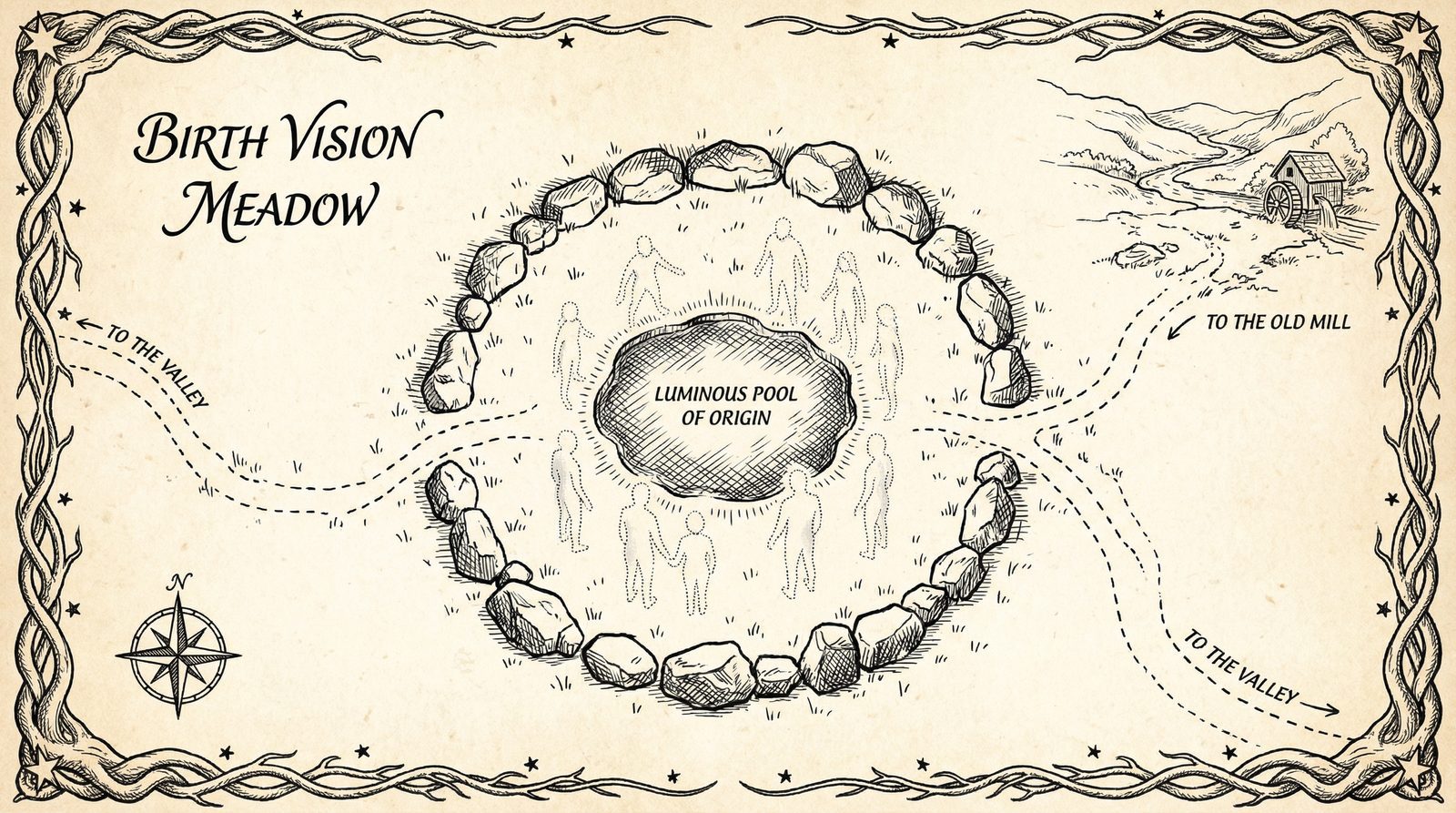
    The story begins when the unnamed narrator returns to the valley from the earlier book, searching for his missing friend Charlene. The setting is presented as a liminal zone where physical and spiritual realities overlap. He encounters Feyman, a young boy with fragmented memories of a pre-birth vision, and Wil, a bitter war veteran trapped in a kind of spiritual numbness.

    The quest structure is straightforward. The narrator follows clues through the valley, meets guides who clarify the metaphysics, and repeatedly crosses into altered states where memory and spirit become tangible. What matters is less the suspense than the framework the book builds: life is not random, suffering is not meaningless, and fear distorts the intentions we supposedly chose before we arrived.

    The central idea is the “birth vision”: the notion that souls choose parents, challenges, and historical eras before incarnation. Through life reviews and glimpses of an afterlife dimension, the narrator witnesses souls preparing for their lives and then watching how those intentions are warped by anxiety, resentment, and control dramas once embodied. The metaphysics are explicit. Redfield wants the reader to see personal psychology and social crisis as part of the same energetic chain.

    That chain is anchored to something concrete. The valley is threatened by an energy project tied to corporate interests, linking spiritual stakes to environmental activism. The climax is not an abstract “ascension” but a confrontation with fear itself. Charlene is found at the edge of leaving life behind, and the resolution hinges on recommitment: choosing to stay incarnate, to keep working inside the imperfect world rather than escaping it.

    Like the earlier book, the novel suggests humanity is on a threshold. But it refuses a clean apocalypse or a clean salvation. The future remains open. The point is practice, not fireworks.

    PROSE & NARRATIVE STRUCTURE

    Redfield’s prose is functional and deliberately geared toward instruction. Action scenes often pause so a guide figure can explain the mechanics of synchronicity, soul memory, and the energetic consequences of fear. It can feel schematic, but the clarity matches the book’s purpose. It wants to be applied, not merely admired.

    Structurally, the novel alternates between physical movement through the valley and excursions into an afterlife dimension. Transitions are triggered by attention and bodily sensation: a chill, pressure in the forehead, a sudden pull toward a memory. These shifts are abrupt on the page, yet they are designed to normalize the book’s premise that boundaries between worlds are thin.

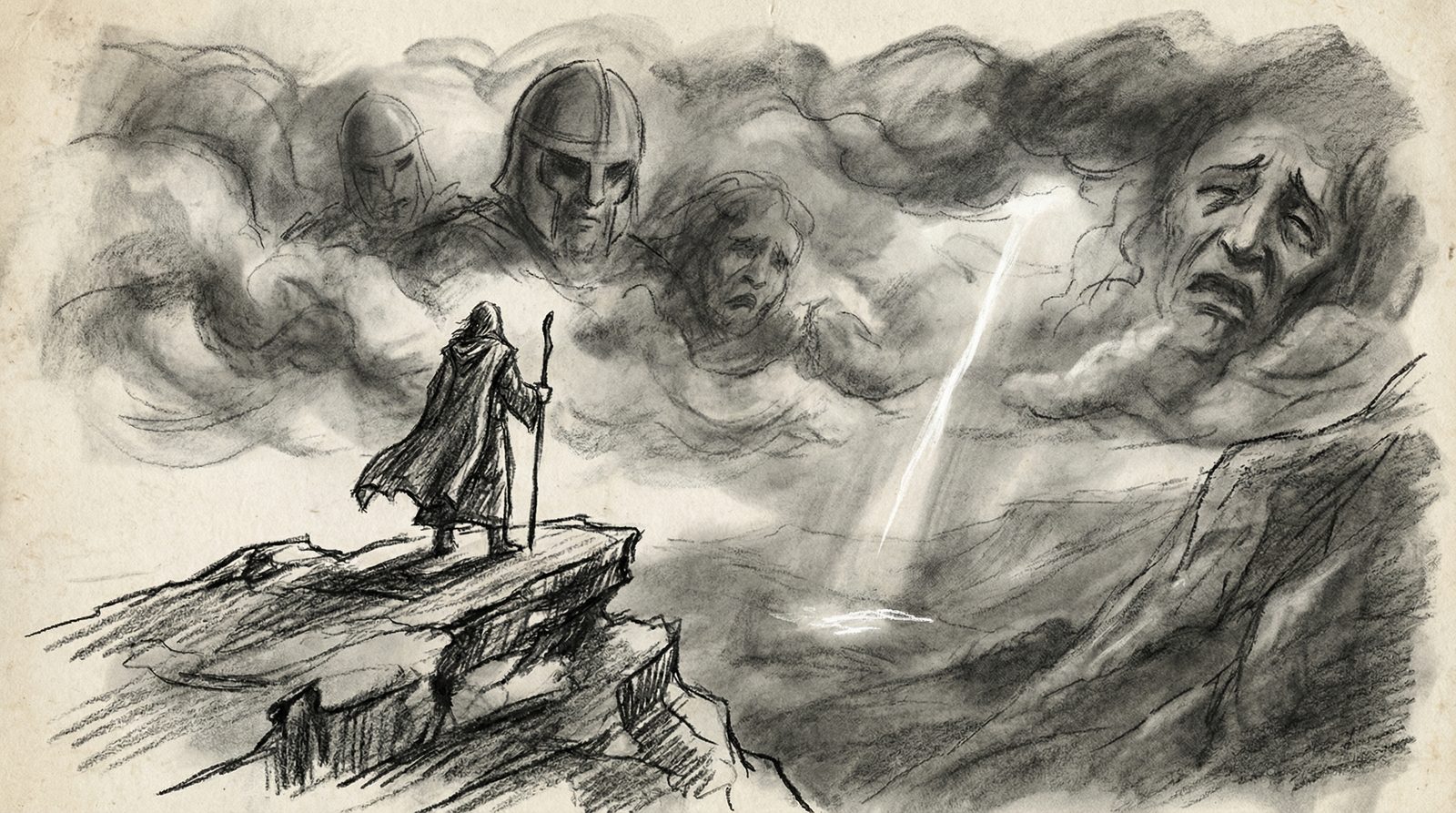
    The most effective passages are the panoramic “world vision” sequences, where the narrator sees human history as a field shaped by collective intention. Industry, war, and ecological collapse are framed as outcomes of accumulated fear. Whether you accept that claim or not, the structure briefly clicks into place. The metaphysical scenes are not escapist fantasies. They are Redfield’s way of forcing moral responsibility onto the reader.

    When the language lands, it does so through simple sensory hooks: light rising from the valley floor, resentment described as a sticky grey aura, trauma replaying like a looped film. The book’s strongest instinct is always the same: abstract belief must be given a texture you can picture.

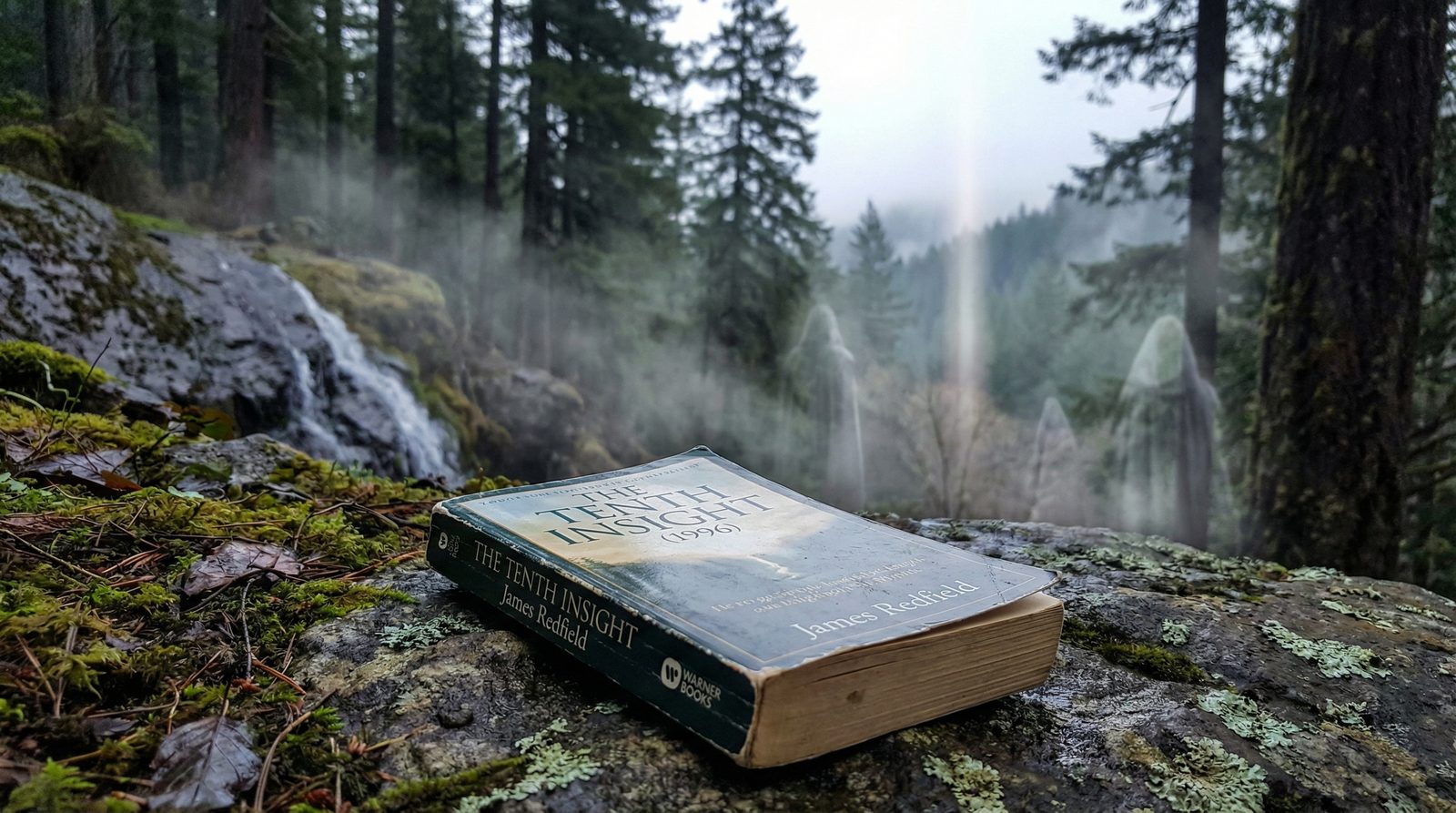
    Conceptual editorial illustration inspired by 'The Tenth Insight'

    CHARACTERS & INTERIORITY

    Characterization is intentionally archetypal. The narrator is defined less by biography than by openness to guidance. Charlene is the resistant seeker, intellectually skeptical but intuitively sensitive. Wil embodies unresolved war trauma, a man whose fear and guilt have hardened into a spiritual paralysis.

    The minor characters do much of the emotional work. Feyman’s insistence that he chose his troubled father gives the metaphysics a raw edge, because it drags the theory into the realm of family pain. Several figures who first appear as obstacles or officials gradually reveal their own half-conscious connection to the valley’s larger pattern.

    Interior life is mostly handled through shared visions rather than subtle psychological shading. When the narrator is pulled into another person’s memory, we are literally inside their fear. This can flatten nuance, with trauma sometimes “resolved” quickly by a single insight. Still, the method is consistent with the book’s claim that consciousness is not private property. The emotional through-line is fear turning into responsibility, and responsibility turning into recommitment.

    LEGACY & RECEPTION

    Published after the runaway success of The Celestine Prophecy, this sequel appealed most to readers who wanted more cosmology and less jungle chase. Some embraced the expansion into pre-birth planning, soul groups, and collective intention. Others found the didactic dialogue heavy and the characters too thin to carry the metaphysical weight.

    Its most durable contribution is the popularization of the “birth vision” idea and its linkage to social change. The book frames environmental activism and historical responsibility as spiritual tasks, not political hobbies. Whether one reads that as inspiring or simplistic, it explains why the novel has stayed alive as a hopeful myth: not transcendence as escape, but awakening as a reason to stay.

    IS IT WORTH READING?

    It is worth reading if you are open to narrative as a vehicle for metaphysical speculation. As a novel, it is uneven. As a framework, it is unusually coherent for the genre. The Appalachian setting gives the ideas physical grounding, and the war memory material adds a darker emotional register than the first book.

    If you want deep character realism, look elsewhere. If you want a story that asks, with complete seriousness, why you might have chosen this life, this era, and these fears, the book still has force.

    Illustration inspired by a core idea from 'The Tenth Insight'

    TRIVIA & AUTHOR FACTS

    Redfield wrote this novel after the unexpected commercial success of his earlier spiritual adventure, leaning more openly into his background in counseling and his interest in both Eastern and Western mysticism. Many of the concepts here, especially soul groups and pre-birth planning, were also discussed in workshops and reader circles around the first book.

    Some editions include the subtitle “Holding the Vision,” which reflects the book’s emphasis on collective focus as a driver of outcomes. The “control drama” concept introduced earlier returns in expanded form, pushed into an explicitly spiritual dimension where fear takes on a more literal, confrontable shape.

    SIMILAR BOOKS

    If this blend of spiritual instruction and story appeals to you, consider Siddhartha for a more literary meditation on awakening, Jonathan Livingston Seagull for a compressed fable of self-mastery, or The Alchemist for a symbolic, parable-style exploration of omens and purpose. Each treats inner experience as a force that shapes outward life, even when their tones and ambitions differ.

    DISCOVERABILITY & LINKS

  • James Redfield

    James Redfield

    ORIGINS & BACKGROUND

    James Redfield is best known as the author of The Celestine Prophecy (1993), a novel that turned spiritual seeking into a page-turning adventure and helped popularize ideas like synchronicity and personal spiritual awakening in the 1990s. Although he has written several other books, including sequels and thematic extensions of that first story, his reputation rests on a very specific blend of narrative fiction and spiritual self-help. He writes not as a distant literary stylist but as someone attempting to guide readers through a process of inner change, using story as a teaching tool.

    Redfield emerged during the New Age fiction boom of the late 20th century, when a wide readership was looking for stories that could double as spiritual guidance. An American writer shaped by the human potential and self-help movements, he approached fiction as a vehicle for spiritual evolution rather than as a purely aesthetic project. The Celestine Prophecy was initially self-published and circulated through word of mouth among readers who felt it articulated their own search for meaning and intuition. That grassroots success eventually led to a mainstream publishing deal and a film adaptation released in 2006.

    His follow-up novels, including The Tenth Insight and The Secret of Shambhala, extend the same fictional universe rather than striking out in unrelated directions. This continuity reflects how Redfield sees his work: as a long-form exploration of spiritual awakening rather than a collection of discrete stories. His background in counseling and interest in both Eastern and Western mystical traditions inform the way he writes about energy, intuition, and higher purpose. Instead of focusing on social or political realism, he turns inward, aiming to map an invisible landscape of consciousness.

    Editorial illustration inspired by James Redfield

    THEMES & MOTIFS

    The central theme in James Redfield’s work is spiritual awakening. His protagonists are usually ordinary people who stumble into extraordinary experiences that force them to question their assumptions about reality. Awakening is presented not as a single epiphany but as a gradual process, often structured as a sequence of insights or realizations that build on one another. Readers are encouraged to view their own lives as part of a similar unfolding.

    A second recurring motif is synchronicity. Characters repeatedly encounter meaningful coincidences that seem to guide them forward, suggesting that the universe is responsive rather than random. In Redfield’s fiction, synchronicity functions both as a plot engine and as a worldview, nudging characters toward higher understanding while reassuring readers that their own chance encounters may be part of a larger pattern.

    He also returns frequently to the idea of energy fields. Characters learn to sense subtle energies around people and places, treating emotions, intentions, and relationships as energetic exchanges rather than purely psychological ones. Landscapes in books like The Tenth Insight and The Secret of Shambhala become spiritual geographies, with sacred sites and hidden realms mirroring an inner journey of growth and healing.

    Throughout his work, there is a persistent tension between fear and faith. Characters hesitate, doubt, and resist, but are ultimately invited to trust intuition, openness, and connection. The emotional through-line is one of seeking meaning, where skepticism is acknowledged but answered through lived experience rather than argument.

    Symbolic illustration inspired by James Redfield

    STYLE & VOICE

    James Redfield writes in a direct, accessible style that prioritizes clarity of message over stylistic complexity. His prose is straightforward and conversational, often pausing the narrative so characters can explain spiritual principles to one another. Dialogue frequently functions as instruction, with one character guiding another through an insight, meditation, or new way of interpreting experience.

    Structurally, his novels follow the pattern of a spiritual quest. Stories move from everyday life into increasingly visionary or mystical experiences, with each new setting revealing another layer of understanding. Moments of danger or pursuit tend to test intuition and openness rather than deliver conventional suspense.

    The overall effect is that of a guided journey. Readers are not only watching characters change, but are implicitly invited to consider their own beliefs about coincidence, purpose, and personal transformation. The tone is earnest and hopeful, with little irony, emphasizing reassurance and the possibility of growth.

    KEY WORKS & LEGACY

    The Celestine Prophecy remains the defining work of James Redfield’s career. It introduced a broad audience to his blend of spiritual awakening, synchronicity, and adventure, framing a series of insights about energy and higher purpose within a chase narrative set largely in Peru. For many readers, it served as an entry point into New Age fiction and metaphysical adventure.

    He continued this storyline in The Tenth Insight, which explores visionary states and the idea of life between lives, and in The Secret of Shambhala, which shifts the focus toward global healing and collective transformation. The film adaptation of The Celestine Prophecy brought his ideas to a wider audience, even as it revealed the difficulty of translating interior, didactic experiences into visual drama.

    Within the larger landscape of spiritual literature, Redfield’s legacy is less about literary innovation than cultural impact. His work helped normalize conversations about synchronicity, intuition, and spiritual evolution for mainstream readers. Whether viewed as inspirational or simplistic, his novels clearly tapped into a widespread desire for stories that treat the search for meaning as a central human adventure.

  • Tourmalin’s Time Cheques (1891)

    Tourmalin’s Time Cheques (1891)

    INTRODUCTION

    Tourmalin’s Time Cheques (1891) by Thomas Anstey Guthrie (F. Anstey/Thomas Anstey Guthrie)
    Science fiction · United Kingdom


    Tourmalin’s Time Cheques is one of Anstey’s strangest and most quietly unsettling experiments. On the surface, it reads like a comic fantasy about time travel filtered through paperwork. Beneath that, it becomes a bleak meditation on debt, self-deception, and the ease with which people mortgage their own futures.

    Instead of machines or paradoxes, the novel gives us cheques, ledgers, clerks, and waiting rooms. Time is not a mystery to be explored but a commodity to be borrowed, extended, and ultimately reclaimed. The tone drifts between dry bureaucratic comedy and low-grade dread, as if the greatest horror of the modern world were not catastrophe but administration.

    PLOT & THEMES

    The premise is simple and cruel. Tourmalin, a minor civil servant bored by routine and mildly dissatisfied with his life, discovers the existence of the Time Cheque Bureau. This institution allows citizens to borrow portions of their own future time in exchange for immediate extensions of the present.

    You sign a form, receive extra hours or days now, and those same hours will later be deducted from your lifespan, often at the most inconvenient moment imaginable. There is no drama in the transaction. It is processed, stamped, and filed.

    At first, Tourmalin uses the system playfully. He extends evenings, delays departures, and stretches moments of pleasure just long enough to feel in control. Each indulgence is shadowed by a ledger entry maintained by the impassive clerk Mr. Virey, whose calm professionalism makes the whole scheme feel terrifyingly legitimate.

    As Tourmalin’s borrowing increases, the consequences become visible. He visits hospital wards where debtors vanish mid-conversation as their accounts are settled. He realizes that the future self paying these debts will not be the same person who signed them. The novel offers no loophole, no rebellion against the system. The ending is blunt and administrative: a contract fulfilled, a life quietly shortened, an absence noted in a file.

    PROSE & NARRATIVE STRUCTURE

    Anstey’s prose is eccentric and densely annotated. Sentences sprawl with parentheses and footnote-like asides, mimicking the cluttered logic of official documents. The story is framed as a recovered case file from the Bureau, interspersed with forms, memoranda, and retrospective commentary.

    The structure is episodic rather than suspense-driven. Each cheque finances a discrete episode: an extended evening at a café, a hurried journey to settle an emotional account, a futile legal appeal in a court that recognizes only arithmetic. What links these scenes is not escalation but accumulation. The pressure builds quietly as Tourmalin’s margin for error disappears.

    Anstey also plays subtle games with chronology. Entire years vanish between chapters, later revealed to be time already sold. The narrative itself skips what Tourmalin has surrendered, creating a hollowed-out structure that mirrors the protagonist’s shrinking future.

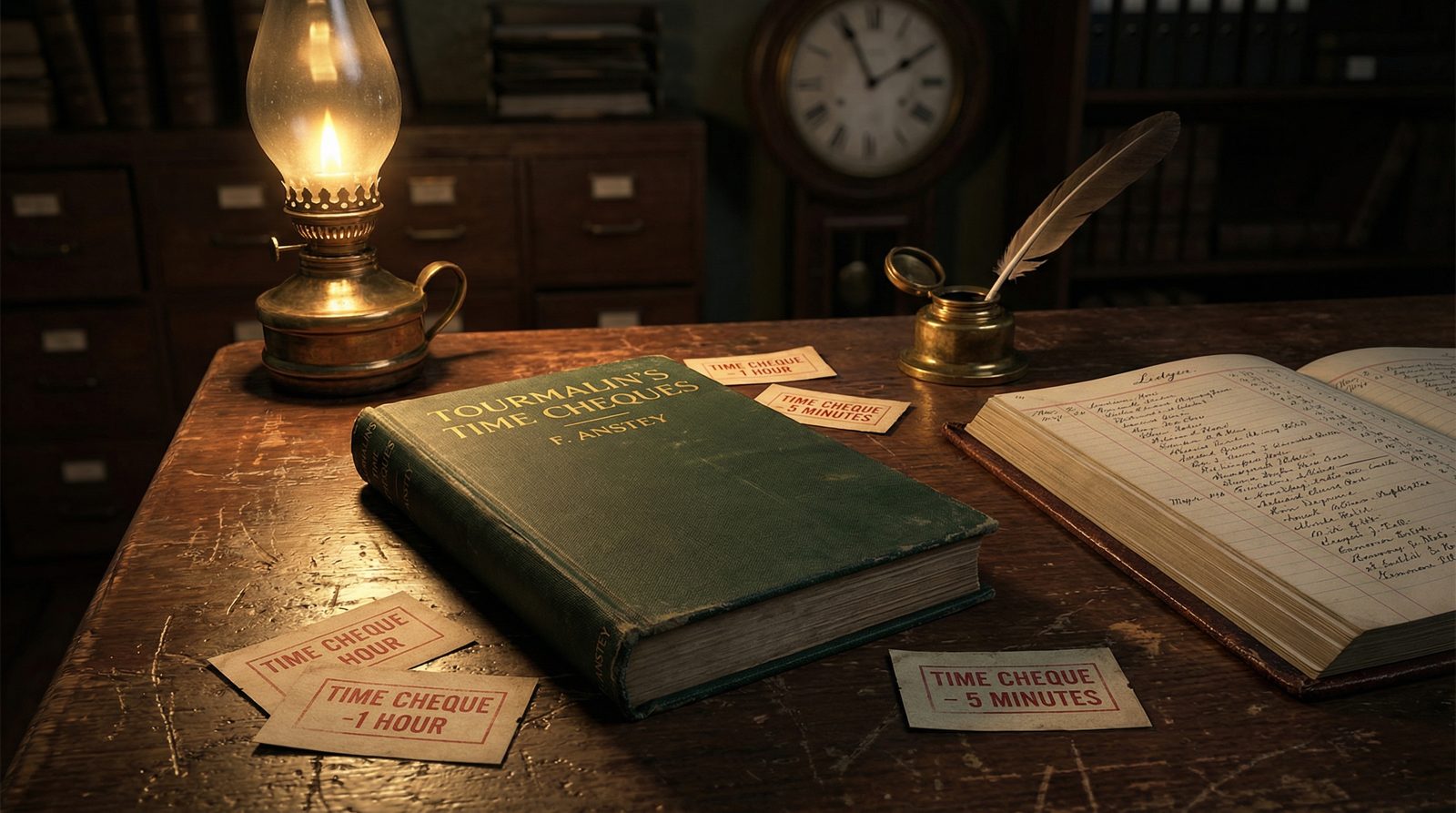
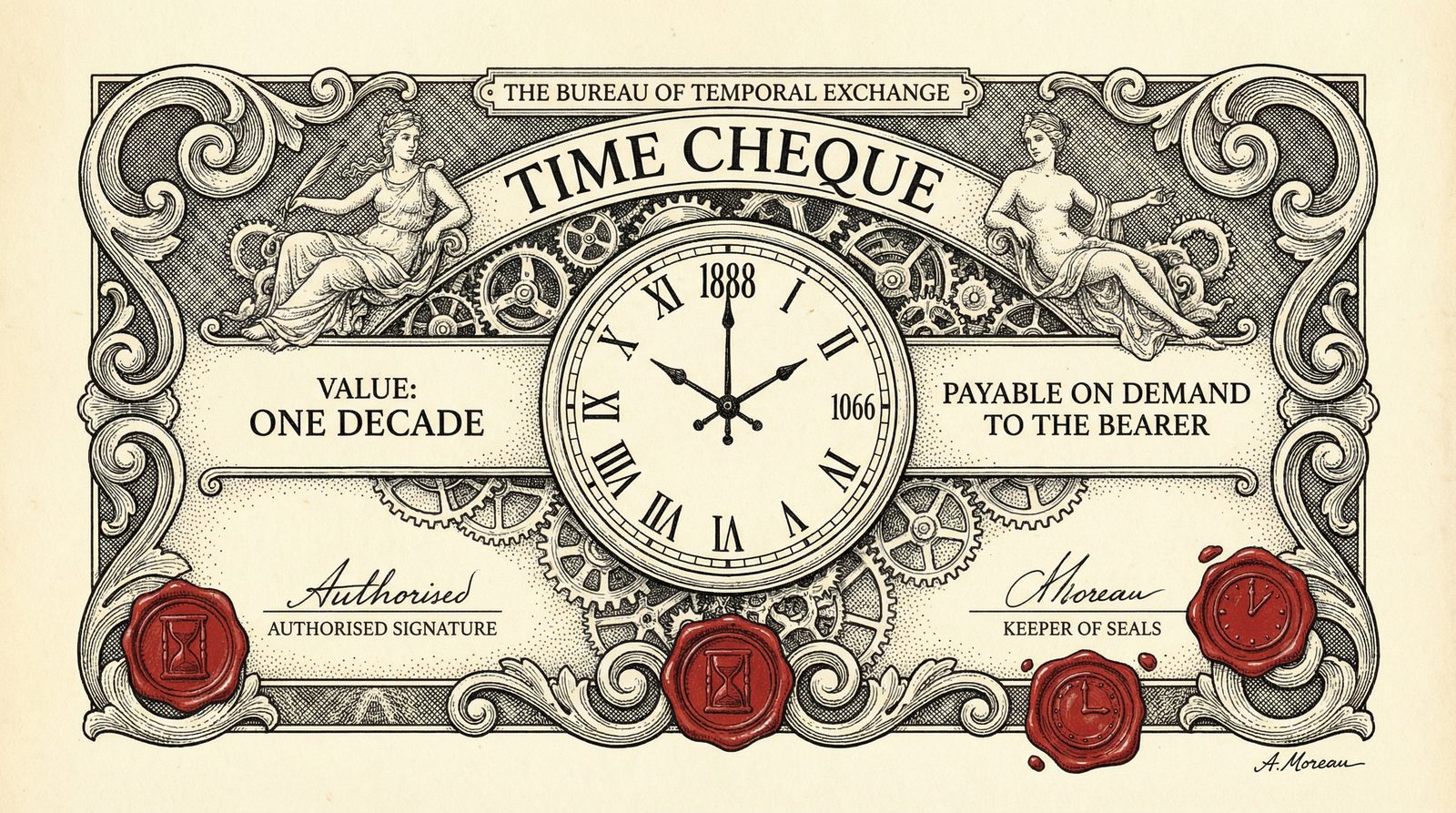
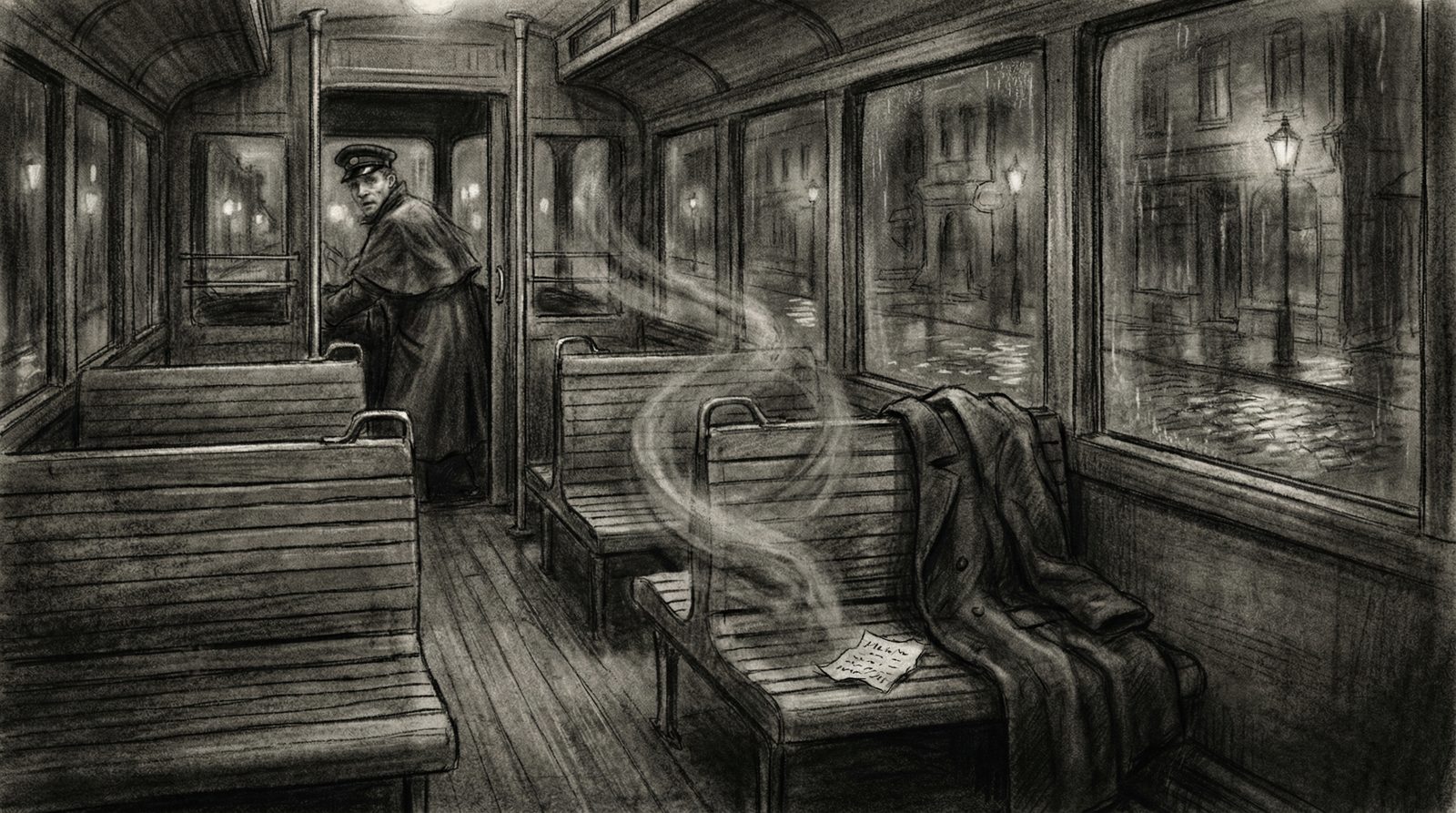
    Conceptual editorial illustration inspired by 'Tourmalin’s Time Cheques'

    CHARACTERS & INTERIORITY

    Tourmalin is not a visionary or a rebel. He is an ordinary man with small vanities and plausible excuses. His interior life is full of postponement: he tells himself he will repay the hours later, once life improves, once he becomes the person he imagines himself to be.

    Mr. Virey, the clerk, is the novel’s most chilling creation. Polite, meticulous, and unfailingly courteous, he represents a system that does not hate its clients and therefore never hesitates. Late in the book, a quiet admission hints that even Virey may be overdrawn himself.

    Secondary figures—landladies, debtors, doctors—appear briefly but reveal a society addicted to temporal credit. Everyone believes they can outmaneuver the ledger. No one can.

    LEGACY & RECEPTION

    Tourmalin’s Time Cheques has always been a marginal work, even within Anstey’s career. Its lack of spectacle and its deliberately shabby setting kept it from popular success. Yet its central idea—time as bureaucratically administered debt—has proven remarkably durable.

    Modern readers often notice how closely the book anticipates contemporary anxieties about burnout, credit, and the monetization of life itself. The ending, in which Tourmalin simply disappears from the narrative with a note in a file, feels less Victorian than chillingly modern.

    IS IT WORTH READING?

    This is not a sleek or comforting book. Its pleasures are dry, its humor bureaucratic, and its logic deliberately unforgiving. Readers looking for adventurous time travel will be disappointed.

    But if the idea of time treated as a ledger, and life as something quietly foreclosed, intrigues you, this odd little novel repays patience. It is a minor work, but a distinctive one, and it lingers in the mind like an unpaid balance.

    Illustration inspired by a core idea from 'Tourmalin’s Time Cheques'

    TRIVIA & AUTHOR FACTS

    Thomas Anstey Guthrie was best known for comic fantasies that smuggled unease into respectable settings. His legal training shows in the novel’s obsession with procedure, documentation, and contractual obligation.

    Although the book has sometimes been misattributed in later bibliographies, it firmly belongs to Anstey’s Victorian phase and shares thematic DNA with his other works that pit ordinary people against supernatural systems that refuse to bend.

    SIMILAR BOOKS

    Readers interested in time as obligation rather than adventure may find echoes in The Time Machine, though Wells treats time as exploration rather than debt. Kafka’s The Trial, while non-speculative, shares the same suffocating logic of systems that process people into disappearance. Later works that treat time as currency echo Anstey’s idea, but rarely with his quiet cruelty.

    DISCOVERABILITY & LINKS

  • Fargo (1996)

    Fargo (1996)

    Fargo (1996) directed by Joel Coen. Crime · 98 minutes · United States.


    INTRODUCTION

    Fargo (1996) occupies a strange, memorable space where true-crime ambience, small-town politeness, and sudden carnage share the same snowdrift. The feel is a mix of bleakness and cozy warmth: a world where people say “you betcha” while standing over a corpse. The Coen brothers take the familiar scaffolding of a regional crime thriller and strip it down until every gesture feels both absurd and inevitable. What begins as a simple-for-hire kidnapping spirals into a quiet tragedy about money, pride, and the limits of common sense. The film’s power lies in its contrast between the white emptiness of the Minnesota winter and the stubborn decency of Marge Gunderson, a pregnant cop who works the case with calm curiosity instead of macho swagger. Fargo feels like a campfire story told in a monotone, where the punchlines are funny until you realize how much blood they leave behind.

    PLOT & THEMES

    The plot of Fargo is a classic Coen setup: Jerry Lundegaard, a financially desperate car salesman, hires two criminals to kidnap his wife so he can split the ransom extracted from his wealthy father-in-law. This is the Crime gone wrong trope in its purest form. Every step of the plan is slightly stupid, slightly lazy, and slightly cowardly. That combination proves lethal. A routine traffic stop explodes into triple homicide, and what Jerry imagines as a clever workaround for his debts becomes a trail of bodies stretching across the frozen Midwest.

    The film’s central themes are greed, moral clarity, and the banality of evil. Jerry is not a mastermind; he is a small man with big panic, and Fargo insists that this kind of mediocrity is often what powers real-world cruelty. The White void of snow motif underlines how small these characters look against the landscape. Their crimes feel petty and pointless when framed against endless fields and empty highways.

    Opposite Jerry’s flailing is Marge Gunderson’s steady investigation. Her kindness is not naïve; When she quietly asks a killer why he did all this “for a little bit of money,” the film lands its thesis. Like Blood Simple before it, Fargo treats crime not as glamorous transgression but as a grubby extension of everyday selfishness. The Small-town decency motif, embodied in Marge and her community, becomes a moral counterweight to the spreading stain of violence. The feel is one of slow dread threaded with dry humor, a reminder that horror often arrives in a beige sedan, not a black limousine.

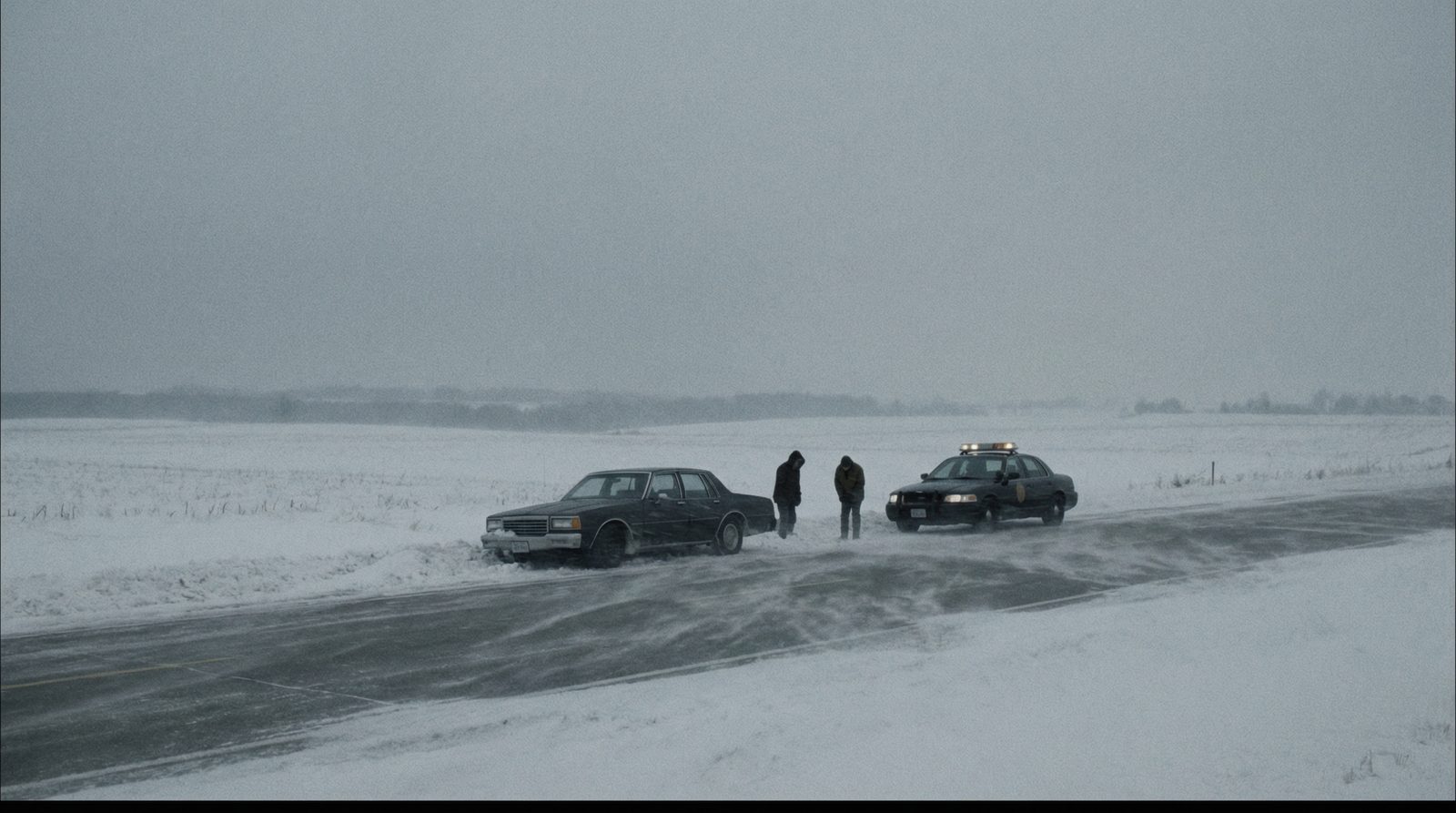
    Editorial illustration inspired by 'Fargo (1996)' – snow-covered highway and stalled cars

    CINEMATIC TECHNIQUE & AESTHETICS

    Cinematographer Roger Deakins builds Fargo around Negative space as a cinematic technique. The White void of snow motif is not just pretty scenery; Characters are often tiny figures swallowed by white fields or framed against blank skies, which makes their frantic schemes look pitiful. The Coens favor Static wide shots that let violence play out at a distance. A roadside murder is shown in long shot, the camera refusing to flinch or editorialize. The feel is clinical and eerily calm, as if the land itself is indifferent.

    Inside, the palette shifts to mustard yellows, wood paneling, and fluorescent hum. These drab interiors emphasize the banality of the settings: The Coens use deadpan pacing, letting silences and awkward small talk stretch long enough to become funny, then uncomfortable. The Editing favors long takes over rapid cutting, which makes the sudden eruptions of violence feel like ruptures in ordinary time.

    Carter Burwell’s score leans on a mournful, folk-like theme that swells over the opening shots of a car towing through a blizzard. It gives the story a ballad-like quality, as if we are hearing a regional legend. Dialogue is treated almost musically. The Minnesota accent, with its “yah” and “you betcha,” becomes a rhythmic counterpoint to the brutality on-screen. This contrast between cozy sound and harsh image is a key technique that shapes the film’s uneasy, darkly comic feel. Like No Country for Old Men later on, Fargo uses restraint in camera movement and music to make every burst of action land harder.

    CHARACTERS & PERFORMANCE

    Marge Gunderson is a classic Everyman hero archetype, though she is also a pregnant small-town police chief, which quietly subverts the usual hardboiled detective mold. Frances McDormand plays her with a blend of curiosity, politeness, and steel. Marge’s competence is never loud. She asks simple questions, listens, and notices what others overlook. Her domestic scenes with her husband Norm, discussing stamps and breakfast, ground the film in everyday tenderness. That normalcy is the moral center the story keeps circling back to.

    Jerry Lundegaard, played by William H. Macy, is a Cowardly schemer archetype. His high, pinched voice and nervous tics turn him into a study in flop sweat. Macy makes Jerry both contemptible and oddly pitiable. He is not a grand villain, just a man who keeps choosing the worst possible option rather than admit failure. That smallness is the point.

    On the criminal side, Steve Buscemi’s Carl is a Motor-mouth criminal archetype, all complaints and cheap impatience, while Peter Stormare’s Gaear is a Silent brute archetype, moving through scenes with blank, heavy calm. Their mismatched partnership is a walking argument for how chaos multiplies when people with no shared values are thrown together. Supporting characters, from the obsequious car-lot staff to the stiff in-laws, are sketched with just a few lines and gestures. The performances lean into regional specificity without turning the townsfolk into cartoons, which keeps the humor grounded in recognizable human behavior rather than pure caricature.

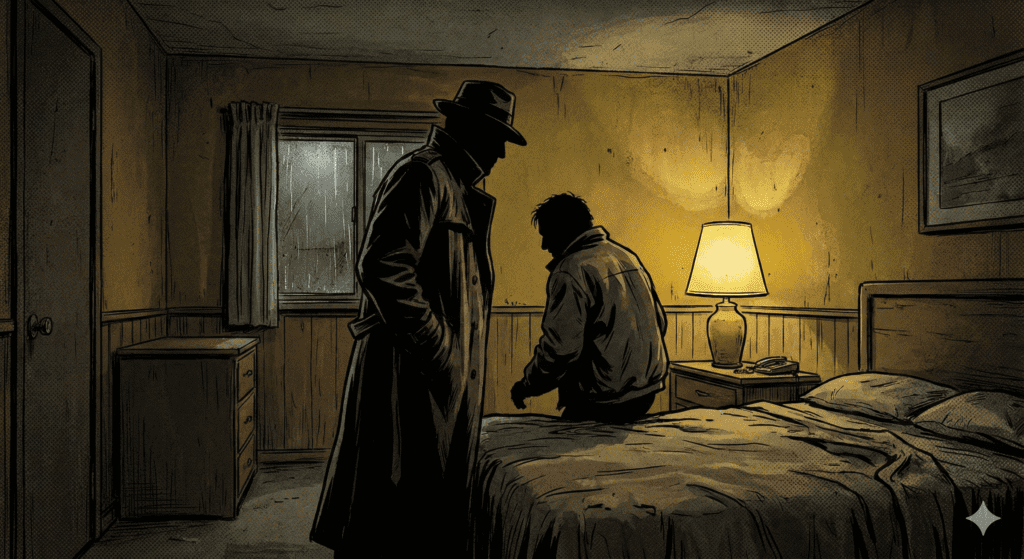
    Stylized noir illustration of Fargo (1996) – tense motel-room confrontation in warm drab Midwestern lighting

    CONTEXT & LEGACY

    Fargo arrived in the mid-1990s, when American indie cinema was saturated with ironic crime stories in the wake of Pulp Fiction. What sets Fargo apart is its emotional sincerity. The Coens had already explored doomed schemes in Blood Simple, but here they pair their usual fatalism with genuine affection for their characters. The film’s faux “true story” framing device taps into the era’s fascination with true crime while quietly mocking our hunger for authenticity labels.

    The film’s legacy includes not only its awards and critical acclaim but also the later Fargo television series, which expands on its Small-town decency motif and Crime gone wrong trope across new characters and timelines. Within the Coen brothers’ body of work, Fargo is a pivot point between their scrappier early noirs and the more austere moral parables of No Country for Old Men. Its influence can be felt in later regional crime dramas that mix dry humor with brutality, and in the broader acceptance of stories where the most heroic figure is not a vigilante or a genius, but a decent professional doing their job well.

    IS IT WORTH WATCHING?

    Fargo is worth watching if you are interested in crime stories that care more about character and moral texture than about plot twists. Its pace is unhurried, and its humor is dry enough that some viewers might initially mistake it for aimlessness. Stay with it. The accumulation of small details, awkward conversations, and quiet domestic scenes builds toward a surprisingly moving final stretch. The feel is a blend of dark comedy and melancholy, with moments of sharp horror that never tip into exploitation.

    If you like the Coen brothers’ mix of fatalism and oddball humanity in films like No Country for Old Men, or if you are drawn to stories where the landscape feels like a character, Fargo will likely resonate. It is not a puzzle-box thriller.

    TRIVIA & PRODUCTION NOTES

    The film’s opening claim that it is based on a true story is a deliberate fabrication. The Coens used the “true crime” framing device to tap into the way audiences engage differently with stories they believe are factual. Various small incidents were loosely inspired by real crimes, but Fargo as a whole is invented. The production leaned heavily on location shooting in Minnesota and North Dakota, though an unexpectedly mild winter forced the crew to chase snow and occasionally truck it in.

    Frances McDormand was not present for the first weeks of shooting, which focused on the criminals and Jerry’s unraveling. This scheduling quirk helps explain why Marge feels like a fresh, stabilizing presence when she finally appears. Carter Burwell’s score builds on Scandinavian folk influences to echo the region’s heritage. The Coens and their team paid careful attention to regional dialect, working with local actors and dialect coaches to shape the Minnesota accent. The woodchipper scene, now infamous, was staged with practical effects and strategic framing rather than explicit gore, relying on suggestion and sound to make it unforgettable.

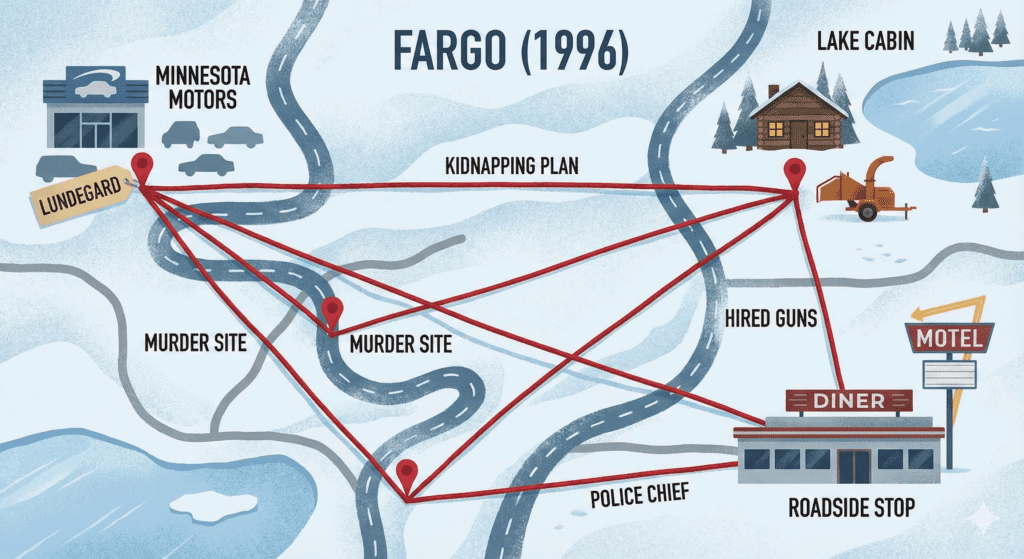
    Diagram-style conceptual illustration of Fargo (1996) – snowfield crime map with red paths and icons

    SIMILAR FILMS

    If Fargo resonates for you, several other works offer related tones and themes. Blood Simple, the Coens’ debut, presents another Crime gone wrong trope in a more overtly noir package, with a similar interest in how ordinary people flail when their schemes collapse. No Country for Old Men shares Fargo’s fascination with moral clarity and its use of landscape as an almost spiritual presence, though it trades dry humor for a harsher, more fatalistic feel.

    Outside the Coen filmography, the television series Fargo extends the Small-town decency motif and regional crime focus across multiple eras. Fans of the mix of politeness and violence might also appreciate how Twin Peaks filters small-town strangeness through a more surreal lens, though its tone is dreamier and less grounded in procedural detail than Fargo’s.

    DISCOVERABILITY & LINKS

    On AllReaders, Fargo sits at the crossroads of crime, small-town stories, and character-driven morality tales. Its white void of snow motif, crime gone wrong trope, and focus on small-town decency connect it to other works where landscape and community shape the stakes as much as the plot does. Readers exploring regional noir, morally grounded detectives, or films that balance dark humor with quiet empathy will find Fargo clustered alongside related titles in our crime and Midwestern story maps.

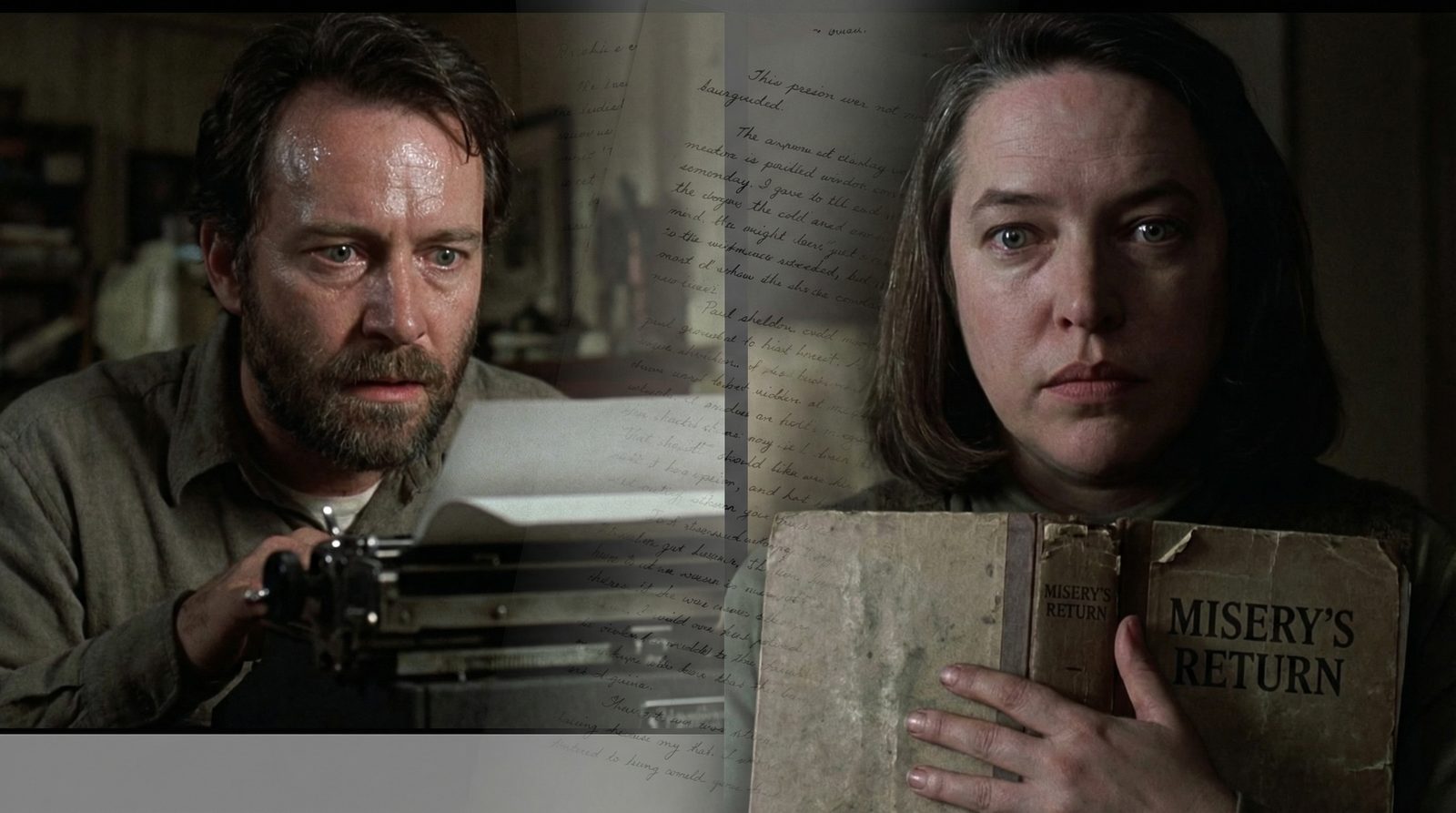
  • Misery (1990)

    Misery (1990)

    Misery (1990), directed by Rob Reiner. Thriller · 107 minutes · United States.


    INTRODUCTION

    Misery arrives as a small film that feels enormous in your chest. It takes place mostly in one room, with two people, in a house swallowed by snow, yet the emotional weather is stormy and changeable. Rob Reiner, coming off the warmth of When Harry Met Sally, leans into a very different feel: creeping dread wrapped in homely comfort. The blankets are soft, the soup is hot, the words are kind, and everything is wrong.

    This is a story about captivity, but not just physical captivity. Misery looks at creative ownership and the way fans can turn into jailers. It probes the uneasy dependency between writer and reader, caregiver and patient. The mood is quietly suffocating rather than loud or frantic. That slow tightening is what makes the film linger; you feel the air thinning scene by scene, until even a simple dinner table becomes a minefield.

    PLOT & THEMES

    On the surface, Misery follows a classic trapped protagonist trope. Paul Sheldon, a successful novelist, crashes his car on a snowy Colorado road after finishing the manuscript that he believes will free him from his bestselling romance series. He wakes in the home of Annie Wilkes, a former nurse and his self-proclaimed “number one fan”. His legs are shattered, the phones are down, the roads are closed. Annie promises to nurse him back to health and insists that he resurrect her beloved character, Misery Chastaine, on the page.

    The plot moves in cycles of apparent safety and sudden eruption. At first Annie seems like a slightly odd caregiver. Gradually, her volatility and control tighten into outright imprisonment. The script uses the fanatic fan trope not for cheap jokes but as a way to examine entitlement. Annie believes she owns Paul’s work because she loves it so completely. Her outrage at his creative choices becomes, in her mind, a moral crusade.

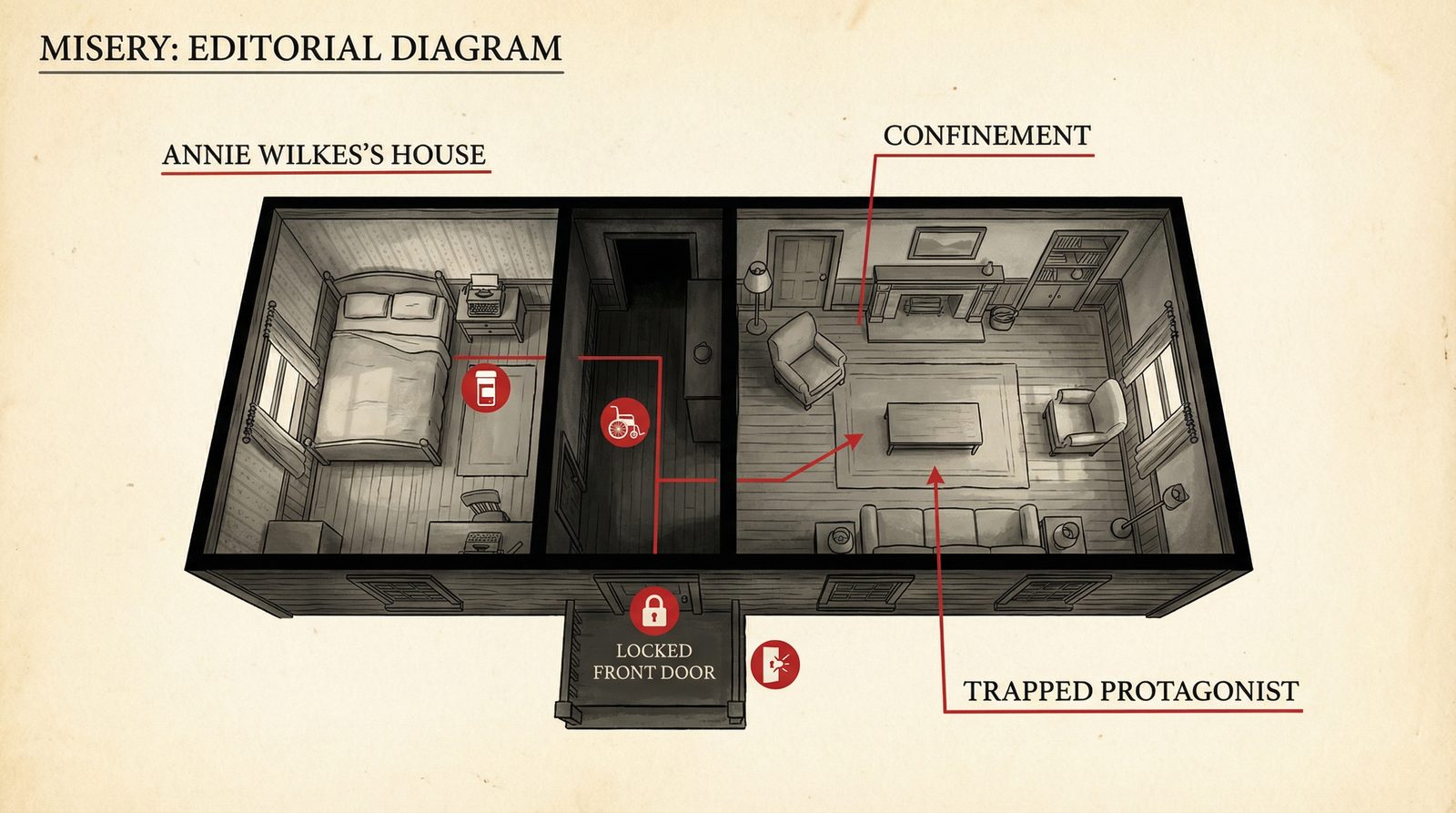
    Several motifs repeat throughout. Confinement is everywhere: doors, locks, wheelchair brakes, even the snowdrifted road outside. Just as central is storytelling as survival. Paul literally writes for his life, reshaping his own artistic compromises in order to stay alive. Unlike many Stephen King adaptations that flirt with the supernatural, Misery keeps its horror human, closer to the psychological menace of films like One Flew Over the Cuckoo’s Nest. The result is a tense study of obsession, authorship, and the thin line between devotion and possession.

    CINEMATIC TECHNIQUE & AESTHETICS

    Rob Reiner and cinematographer Barry Sonnenfeld build the feel of creeping dread through careful framing and camera movement rather than gore. The camera often stays close to Paul’s bed, using tight close-ups that flatten space and make the room feel like a box. When Annie enters, the lens sometimes shifts slightly wider, which subtly distorts her features and makes her presence feel intrusive. Slow tracking shots map out Paul’s potential escape routes, so every later attempt carries a physical memory for the viewer.

    Lighting is deceptively cozy. Warm lamps and daylight soften the interiors, which clashes with the violence that occurs there. The snow outside is bright and overexposed, a white wall that seals the house off from the world. That visual isolation echoes the motif of confinement without resorting to showy stylistic flourishes.

    William Goldman’s adaptation favors slow-burn pacing. Scenes stretch just long enough for small details to become unbearable, while Marc Shaiman’s score stays mostly restrained, stepping forward only when Paul’s inner panic spikes. Compared with the more expressionistic style of The Shining, Misery chooses a plainspoken aesthetic. That restraint makes the notorious “hobbling” scene feel even more brutal, because it erupts into a world that has looked almost ordinary up to that point.

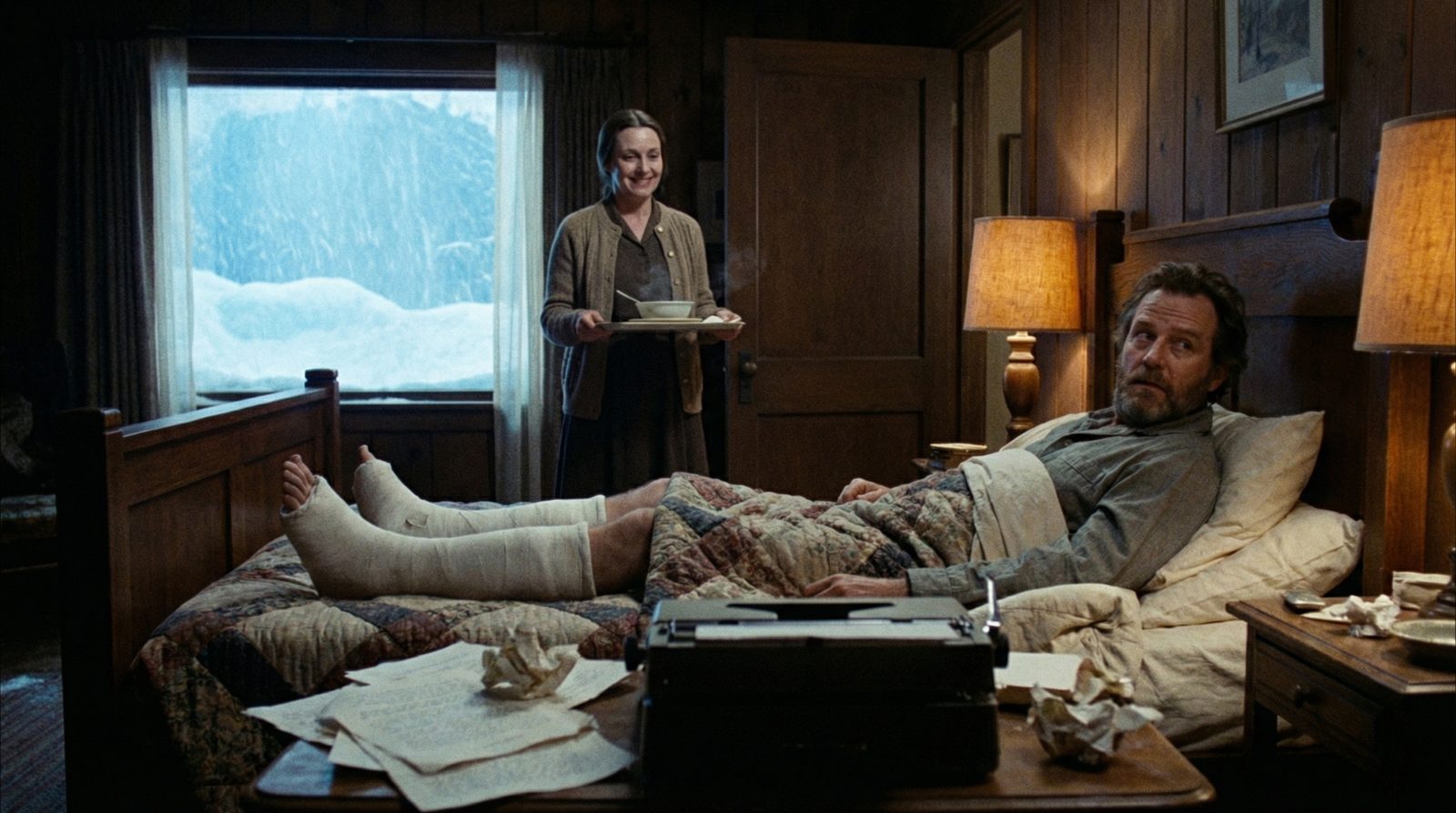
    Editorial illustration inspired by 'Misery (1990)'

    CHARACTERS & PERFORMANCE

    At its core, Misery is a two-hander between a reluctant hero and a monster in human form. James Caan plays Paul Sheldon as a man who has coasted on charm and formula. Trapped and immobilized, he becomes resourceful out of necessity. Caan resists the temptation to turn Paul into a saint; he lets the character’s earlier arrogance and creative laziness show through, which makes his later fight for authorship more meaningful.

    Kathy Bates’s Annie Wilkes is the film’s defining achievement. She embodies the uncanny caregiver archetype, someone whose nurturing gestures are indistinguishable from threats. Her line readings slide from girlish delight to cold fury in a breath, yet she never feels like a cartoon. Bates grounds Annie in a lonely, thwarted life, so her obsession with Misery Chastaine becomes a way to organize her own chaos. The character is terrifying not because she is alien, but because her logic is twisted yet coherent.

    Richard Farnsworth and Frances Sternhagen, as the small-town sheriff and his wife, provide a wry counterpoint. They function as a gentle wise elder presence, poking at the edges of the mystery with humor and patience. Their scenes widen the film’s emotional palette beyond pure terror. The supporting roles are small, but they create a sense of a real community outside Annie’s house, which makes Paul’s isolation feel sharper. Every performance is tuned to the same frequency of realism, which keeps the film from tipping into camp even at its most extreme moments.

    CONTEXT & LEGACY

    Released in 1990, Misery arrived at a point when Stephen King adaptations were already a mini-industry. Instead of chasing the gothic excess of earlier films, Rob Reiner followed the character-driven path he had taken with Stand By Me. Misery’s focus on psychological horror and domestic space helped broaden what a “Stephen King movie” could look like on screen.

    The film also tapped into growing conversations about fandom and celebrity. Long before social media made parasocial relationships a daily reality, Misery dramatized the idea that readers feel ownership over the stories they love. Its success, capped by Kathy Bates’s Oscar, showed that horror-adjacent stories could earn mainstream awards without abandoning genre roots. It has since become a reference point for any narrative about dangerous devotion, from later thrillers to prestige television about stalkers and obsessive fans.

    IS IT WORTH WATCHING?

    Misery is worth watching if you value tension over spectacle. The film is relatively contained in scope, but emotionally it is relentless. Viewers who enjoy psychological horror, character studies, or stage-like thrillers will find a lot to appreciate. Those looking for elaborate mythology or frequent jump scares may find its patience challenging.

    The violence, when it comes, is brief but harrowing, and the mood of creeping dread never fully lifts. What makes the film rewarding is the way it ties that dread to questions about creativity and control. You are not just waiting to see whether Paul escapes; you are watching a writer renegotiate his relationship to his own work under extreme pressure. For many, that mix of suspense, dark humor, and thematic bite makes Misery one of the more memorable King adaptations.

    Symbolic illustration inspired by 'Misery (1990)'

    TRIVIA & PRODUCTION NOTES

    William Goldman’s screenplay streamlines Stephen King’s novel, trimming back some of the more graphic elements while preserving the core dynamic between Paul and Annie. The choice to keep the story grounded in realistic injury and medical detail enhances the psychological focus. Rob Reiner reportedly cast James Caan in part because he wanted an actor associated with toughness to play against physical helplessness.

    Kathy Bates was not yet a household name in film, which helped audiences accept Annie as a fully inhabited character rather than a star vehicle. Her performance earned the Academy Award for Best Actress, a rare honor for a horror-adjacent role. The production made careful use of a single primary set, building the house on a soundstage to control lighting and camera movement. Practical effects, rather than elaborate prosthetics, were used for key moments of violence, which keeps the impact grounded. Misery’s relatively modest budget and contained locations have made it a frequent example in discussions of how to adapt novels into effective, economical films.

    SIMILAR FILMS

    If Misery works for you, several other films explore related territory. The Shining offers another Stephen King story about isolation, creative frustration, and a caretaker turning lethal, though with a more overtly stylized approach. One Flew Over the Cuckoo’s Nest shares Misery’s interest in institutional power and the uncanny caregiver, trading the private home for a psychiatric ward. For a more contemporary echo of the captive–captor dynamic, 10 Cloverfield Lane updates the bottle-episode structure with a sci-fi edge. All of these sit in a cluster of intimate, pressure-cooker narratives where the real horror is another person’s unwavering attention.

    DISCOVERABILITY & LINKS

    Misery connects to several recurring motifs on AllReaders, including captivity, writer held captive, and caretaker as captor. It also sits within clusters about psychological horror, small-town United States settings, and stories that dissect the bond between creator and audience.

  • 10 Cloverfield Lane (2016)

    10 Cloverfield Lane (2016)

    10 Cloverfield Lane (2016), directed by Dan Trachtenberg. Thriller · 103 minutes · United States.


    INTRODUCTION

    10 Cloverfield Lane is a small, airless film that feels huge in your chest. Set almost entirely in an underground bunker, it plays like a pressure cooker of doubt and dread. The premise is simple: a young woman wakes up after a car crash to find herself locked in a stranger’s shelter, told the world outside has ended. From that single claim, the film spins a sustained mood of paranoia and creeping claustrophobia. What makes it stick is not the science fiction dressing but the emotional realism of being trapped with someone who might be your savior or your captor. The story keeps scraping at questions of trust, control, and survival, and the longer you sit in that concrete box, the more you feel how thin the line is between protection and imprisonment. It is a thriller that works on your nerves and your gut at the same time.

    PLOT & THEMES

    The plot of 10 Cloverfield Lane follows Michelle, who flees a relationship, crashes her car, and awakens chained in an underground bunker. Her apparent rescuer, Howard, claims there has been an apocalyptic attack and that the bunker is the only safe place left. Sharing the space is Emmett, a local who helped build the shelter and backs up Howard’s story. From there, the narrative becomes a classic bottle episode, with the outside world reduced to rumor and hearsay. The central tension is simple: can Michelle trust the man who saved her, or is his story a cover for something far worse?

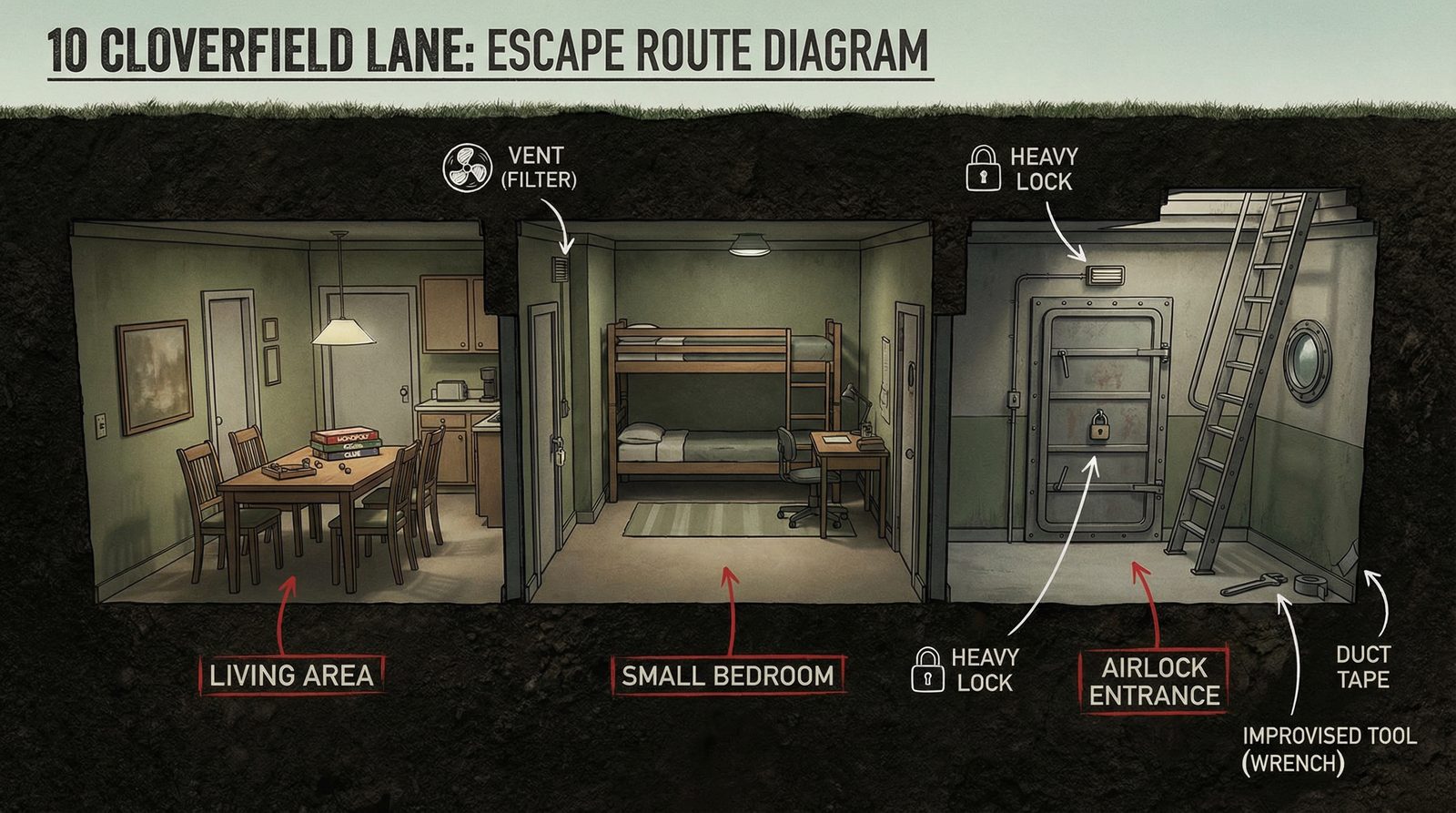
    The film is obsessed with the motif of confinement. Doors, locks, and airlocks are everywhere, underlining how control over space equals control over people. Another recurring motif is survivalism, not just in the prepper gear but in the emotional calculus of what each character is willing to trade for safety. Michelle’s arc is about reclaiming agency. She starts as someone who runs from conflict, then is forced to decide whether to accept captivity for the sake of survival or risk everything on her own judgment.

    Trust and gaslighting drive the emotional core. Howard’s explanations are always just plausible enough, and the script keeps feeding Michelle (and us) contradictory evidence. The trope of the unreliable protector is used very effectively, turning every act of kindness into something suspect. Compared with something like Misery, the film tilts less toward grotesque horror and more toward the slow erosion of certainty. Even when the story finally addresses the larger Cloverfield universe, the thematic focus stays on one question: what kind of danger do you choose to face, the known monster in the room or the unknown one outside?

    CINEMATIC TECHNIQUE & AESTHETICS

    Dan Trachtenberg and cinematographer Jeff Cutter build tension through a careful use of close-up and blocking. The camera often sits uncomfortably close to faces, catching micro-reactions that the characters try to hide from each other. In group scenes, blocking tells you who holds power: Howard positioned at the head of the table, looming in the foreground, while Michelle and Emmett are pushed toward the edges of the frame. The result is a persistent feel of claustrophobia even when the characters are not literally boxed in.

    Lighting and color are tightly controlled. The bunker is warm and domestic on the surface, full of board games and soft lamps, but the corners fall off into shadow. This visual split mirrors the emotional split between Howard’s paternal hospitality and his volatility. When the story shifts toward escape, the palette cools and the editing rhythm sharpens, trading languid, talk-heavy scenes for quick, almost heist-like problem solving. Sound design is another quiet weapon. The muffled thuds from outside, the hum of ventilation, the squeak of a door seal closing all enlarge the space in your imagination while keeping your eyes trapped in the same rooms.

    Montage is used sparingly but effectively, especially in the mid-film sequence where bunker life briefly resembles a sitcom. The editing there creates a fragile feel of normalcy that makes Howard’s next outburst land harder. Compared with the shaky immediacy of Cloverfield, this film prefers clean compositions and deliberate pacing. It feels more like a stage play adapted for the camera, closer in spirit to something like Rear Window, where what you cannot see is as important as what you can.

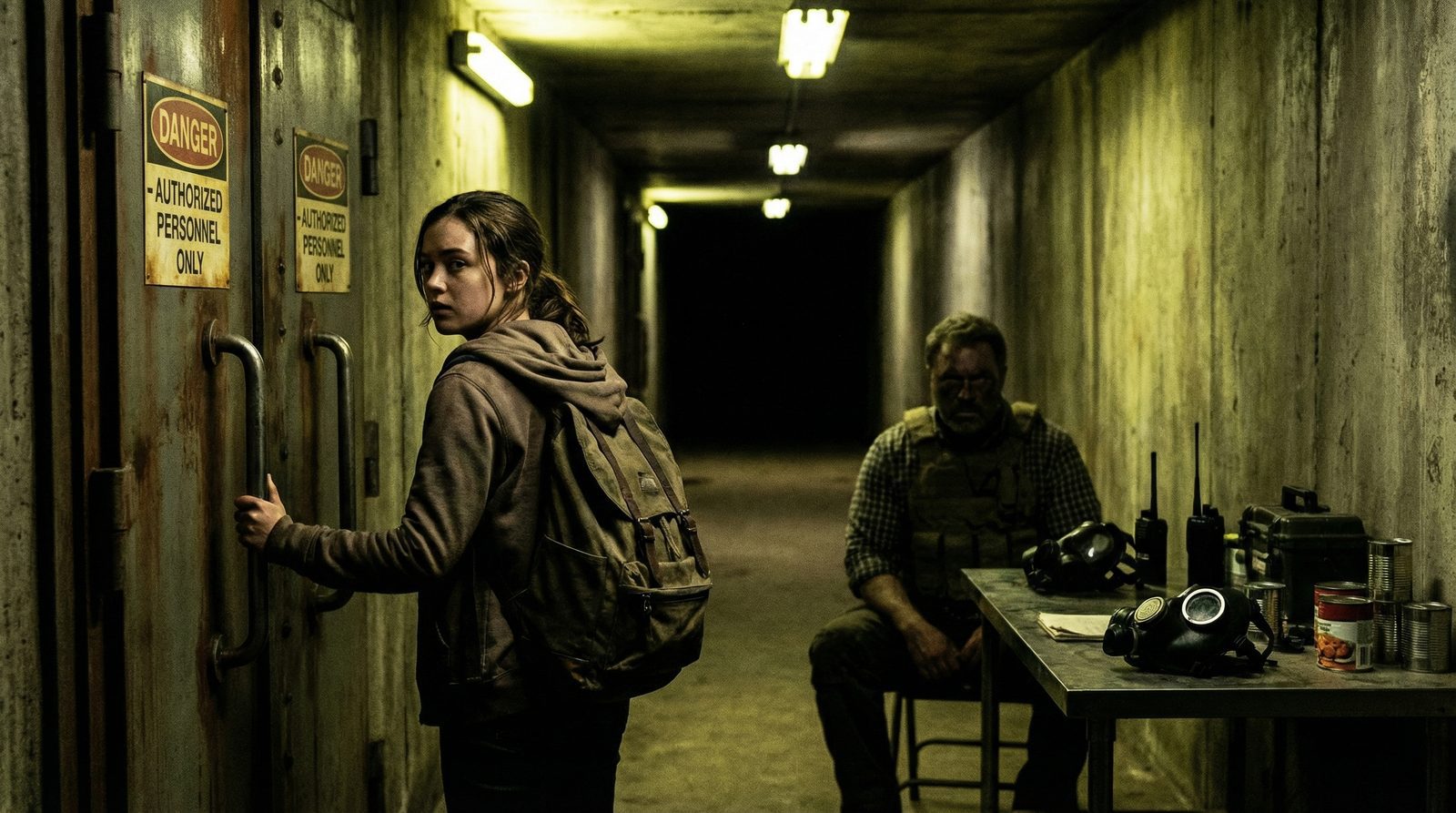
    Editorial illustration inspired by '10 Cloverfield Lane (2016)'

    CHARACTERS & PERFORMANCE

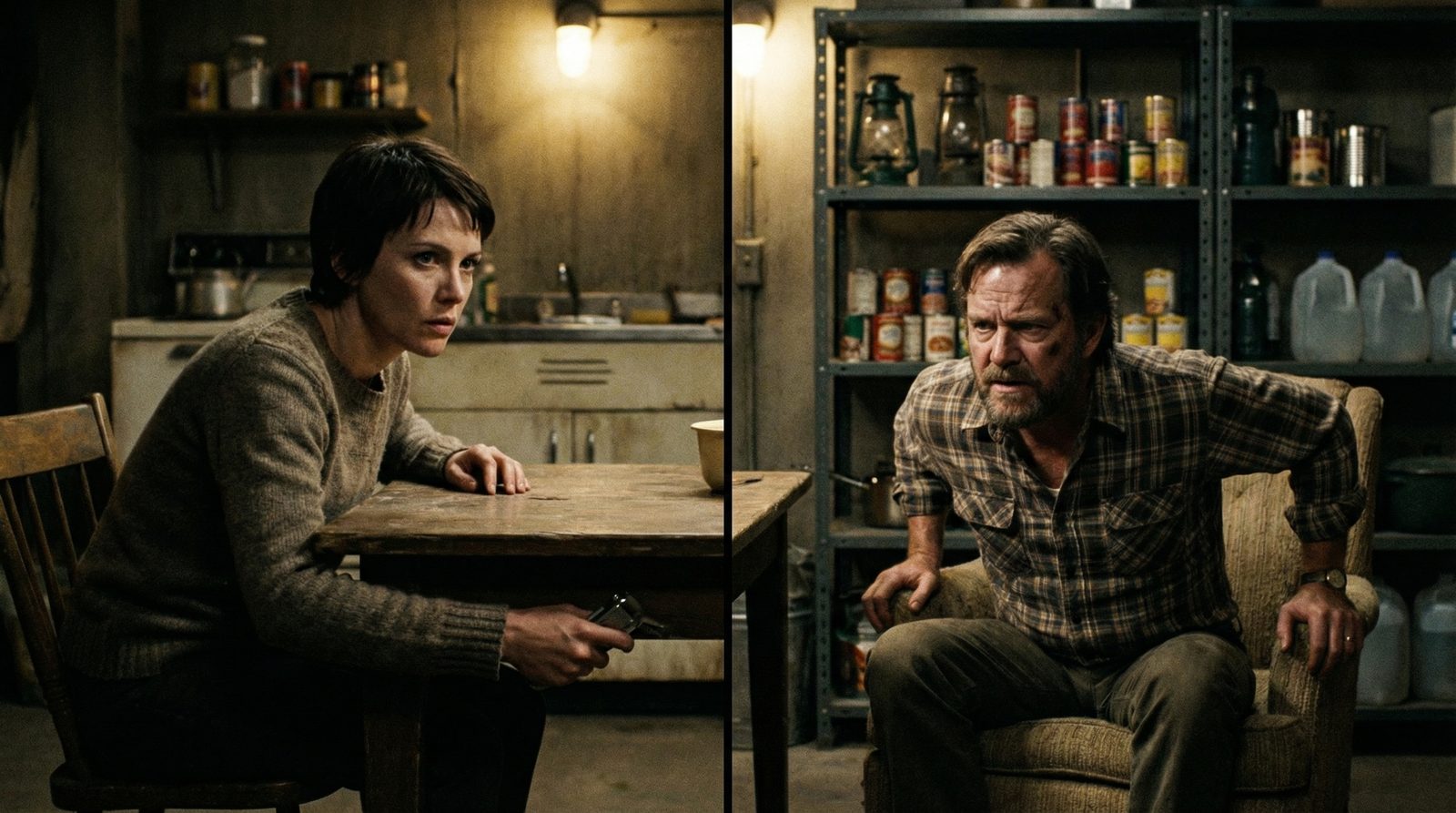
    The film works because its three-character ensemble is so sharply drawn. Michelle is a classic final girl archetype reshaped for a confined space. Mary Elizabeth Winstead plays her not as a quip machine but as a practical problem-solver, always scanning the room, mentally measuring distances, testing stories against details. Her quiet, observational energy grounds the film. We believe she survives not through luck but through a stubborn refusal to stop thinking.

    Howard fits the archetype of the domineering patriarch, a man who confuses control with care. John Goodman makes him terrifying without turning him into a cartoon. He can be goofy, almost childlike, then snap into rage with no warning. That volatility is the real horror. His backstory, full of half-truths and gaps, feeds the theme of gaslighting. You never fully know how much of his paranoia is justified and how much is projection, and Goodman keeps that uncertainty alive in every scene.

    Emmett is the reluctant companion, offering comic relief and a local’s perspective on Howard. John Gallagher Jr. gives him a slouchy warmth that makes his presence feel like a buffer between Michelle and Howard. He is not heroic in any conventional sense, but his small acts of solidarity matter. The triangle among these archetypes creates a shifting balance of power. Allegiances change, secrets leak out, and the bunker starts to feel like a psychological experiment in which three incompatible survival strategies are forced to coexist.

    CONTEXT & LEGACY

    Released as part of the loose Cloverfield anthology, 10 Cloverfield Lane arrived with a marketing strategy built on secrecy and surprise. Rather than a direct sequel to Cloverfield, it functions as a side story, connected more by tone than by plot. That freed it to be a contained thriller first and a science fiction film second. Its strongest legacy is how it showed that a franchise can expand sideways, treating its shared world as a label for mood and theme rather than a single ongoing narrative.

    Within the broader landscape of survival thrillers, it sits comfortably alongside works like Panic Room, which also turns a limited setting into a chessboard of power. It also anticipates the later interest in anthology-style worldbuilding seen in projects like Black Mirror, where each entry explores a different facet of fear under a common banner. For Dan Trachtenberg, this film marked a high-profile feature debut, announcing a director comfortable with genre but more interested in emotional pressure points than spectacle. Over time, 10 Cloverfield Lane has gained a reputation as the quiet standout of its franchise, the one that people remember less for its monsters than for the suffocating human dynamics in that underground room.

    IS IT WORTH WATCHING?

    10 Cloverfield Lane is worth watching if you like your thrillers tight, character-driven, and slightly mean. The film is less about aliens than about the emotional physics of captivity: who gets to decide what is safe, and what it costs to disagree. If you come in expecting a large-scale science fiction spectacle, you may feel the scope is small, but the trade-off is a more intimate, sustained tension. The feeling of paranoia and claustrophobia is strong enough that you might find yourself checking your own doors afterward. It is especially rewarding if you enjoy watching a capable protagonist think her way through impossible choices. Even if you have no investment in the Cloverfield name, the movie stands alone as a sharp little pressure cooker about trust, survivalism, and the danger of men who insist they know what is best for you.

    Symbolic illustration inspired by '10 Cloverfield Lane (2016)'

    TRIVIA & PRODUCTION NOTES

    The project began life as an unrelated script titled The Cellar, a contained thriller about a woman trapped in a bunker with a possibly dangerous man. J.J. Abrams and Bad Robot acquired it and folded it into the Cloverfield umbrella, which involved reworking the ending and adding the broader science fiction elements. This hybrid origin explains why the film feels so self-contained for most of its runtime.

    Dan Trachtenberg, known at the time mainly for his short Portal: No Escape, brought a puzzle-box sensibility to the production. Many props in the bunker are functional clues: the script and design team use these details to set up payoffs in the escape sequences. The shoot itself leaned into the bottle episode structure, with the cast spending long stretches in the same few rooms, which likely fed into the lived-in feel of the bunker. The late shift into overt science fiction divided some viewers, but it also cemented the film’s status as part of an experimental franchise that treats genre as a sandbox rather than a fixed template.

    SIMILAR FILMS

    If the confined dread of 10 Cloverfield Lane works for you, Misery is an obvious companion piece, another story about a captive trying to outthink a captor whose care curdles into control. Panic Room offers a more overtly physical version of the same containment game, with a mother and daughter using their environment as a weapon. Fans of the slow-burn paranoia and limited perspective might also appreciate Rear Window, which similarly turns a single location into a moral and psychological maze. Within the science fiction space, Cloverfield remains useful as a contrast, showing how the same shared world can support both large-scale chaos and intimate psychological siege. All of these films share a fascination with confinement, surveillance, and the uneasy line between safety and imprisonment.

    DISCOVERABILITY & LINKS

    On AllReaders, 10 Cloverfield Lane sits at the crossroads of confinement stories, psychological thrillers, and survivalism narratives. Readers who gravitate toward motifs of confinement, survivalism, and gaslighting, or toward feels of paranoia and claustrophobia, will find it connects cleanly to other bottle-episode films and domineering-patriarch character studies. It is also a useful anchor for exploring how the Cloverfield anthology experiments with shared-world storytelling across different genres and scales.

  • Thinner (1996)

    Thinner (1996)

    Thinner (1996), directed by Tom Holland. Horror · 92 minutes · United States.


    INTRODUCTION

    Thinner (1996) sits in that strange corner of 90s Stephen King adaptations where pulp, moral fable, and cable-ready horror all blur together. On the surface it is a simple curse story, but underneath the film toys with a clammy, anxious feel of bodily betrayal and karmic payback. Tom Holland leans into the queasy mix of dark humor and body horror, so the film keeps shifting between grotesque and absurd. It is not as polished as Misery or as operatic as Carrie, but it has a sour little heart, fascinated with guilt that refuses to speak its name. Thinner is less about the supernatural mechanics of a curse and more about how far a man will go to avoid admitting that he deserves what is happening to him.

    PLOT & THEMES

    Billy Halleck is a successful, well-connected lawyer in a small New England town, introduced as a man cocooned in comfort and self-indulgence. After a celebratory night out, he accidentally kills an elderly Romani woman with his car while his wife is distractedly performing a sexual favor. Between his judge friend and a police chief in his pocket, Billy walks away from the case with no real punishment. The dead woman’s father, Tadzu Lempke, lays a cryptic “thinner” curse on him, and Billy’s weight begins to drop at an impossible rate. What starts as a seemingly welcome diet quickly becomes a nightmare as he wastes away.

    The film leans heavily on the trope of the cursed protagonist. Billy is not a random victim but a man whose unexamined entitlement has finally come due. The plot tracks his increasingly frantic attempts to reverse the curse. Each step reveals another layer of rot in the town’s power structure, where everyone who helped him evade justice begins to suffer their own supernatural punishments. The motif of bodily decay is central: Billy’s shrinking frame is a visible ledger of guilt, and every pound lost is another unpaid moral debt coming due. Alongside that, the motif of moral rot in small-town America creeps through the story, as the respectable facades of courthouse and country club hide a willingness to sacrifice anyone to maintain comfort.

    Thematically, Thinner plays like a nastier cousin to Needful Things or the old EC Comics morality tales. It asks whether retribution can ever be clean when everyone involved is compromised. The curse is both punishment and mirror, forcing Billy to see that his real horror is not supernatural at all but the person he has always been. By the time he turns to violence and manipulation to save himself, the film has quietly shifted from a story about an innocent man under siege to one about a guilty man refusing to accept a deserved sentence.

    CINEMATIC TECHNIQUE & AESTHETICS

    Tom Holland approaches Thinner with a straightforward 90s genre sensibility, but within that frame he uses makeup and prosthetics as the primary cinematic technique. Billy’s transformation from bulky comfort to skeletal ruin relies on layers of latex and fat suits, which range from impressively grotesque to distractingly artificial. The body horror is not subtle. We are meant to feel a clammy sense of revulsion as his skin sags, his clothes hang, and his face sharpens into a skull. The practical effects give the film a tactile, sticky quality that digital work of later decades often lacks.

    Cinematography is modest but functional. Holland and his director of photography favor flat, bright daylight in the early scenes, emphasizing the safe, bland privilege of Billy’s suburban life. As the curse takes hold, the palette cools and the lighting grows harsher, particularly in interiors, pushing his home toward something closer to a sickroom. There are no elaborate tracking shots or baroque compositions, but the camera often lingers just a beat too long on Billy’s face or body, inviting the audience to inventory every new indignity.

    Editing keeps the story moving at a brisk pace, almost to a fault. Moments that could have deepened the moral stakes are clipped in favor of plot progression, which gives the film a pulpy, paperback rhythm. The sound design does some subtle work: the creak of floorboards under Billy’s changing weight, the rasp of his breath, the way background noise drops out during confrontations with Tadzu Lempke. The score nudges toward darkly comic at times, which can undercut the horror but fits the film’s pulp-horror lineage, similar to how Creepshow toys with tone. Overall, the aesthetics serve the story’s focus on bodily decay and karmic payback more than they aim for beauty or grandeur.

    Editorial illustration inspired by 'Thinner (1996)'

    CHARACTERS & PERFORMANCE

    Billy Halleck is written as a fallen hero archetype, though the film is honest enough to show that he was never especially heroic to begin with. Robert John Burke has the tricky job of playing both the smug, comfortable lawyer and the desperate, skeletal wreck. Under heavy makeup and prosthetics his facial mobility is limited, so he leans on voice, posture, and a growing edge of hysteria. When the performance clicks, Billy feels less like a horror victim and more like a man caught in a trap he helped build.

    Tadzu Lempke serves as an avenging trickster archetype, a figure out of folklore who exposes hypocrisy by inflicting pointed punishments. The performance gives him a wiry, mocking presence; he is less a cackling villain and more a weary judge who has seen this pattern of privileged cruelty too many times. His curse is personal, but his speeches hint at a broader history of exploitation and prejudice.

    The supporting cast is populated by archetypes of small-town corruption. Their performances are pitched slightly larger than life, bordering on the theatrical, which suits the story’s moral-fable structure. One interesting figure is the mobster friend Billy enlists, a dark ally archetype whose loyalty is transactional and whose violence escalates the situation rather than resolving it. These characters are not richly psychological, but they are functional symbols in a story about how a community chooses to protect its own comfort over justice. The acting style, broad and sometimes campy, keeps reminding us that we are watching an allegory, not a slice of naturalism.

    CONTEXT & LEGACY

    Thinner arrives late in the first big wave of Stephen King adaptations, after landmarks like Carrie and The Shining and alongside more workmanlike efforts such as Needful Things. Compared to the psychological focus of Misery, Thinner feels pulpier and more schematic, closer in spirit to the morality tales of Creepshow. Tom Holland had already adapted King with some success in The Langoliers, and here he leans into the author’s fondness for curses as externalized guilt.

    The film did not make a large cultural dent, and its reputation today is mixed, often cited as a minor or even disposable King entry. Yet it has a modest afterlife among fans of 90s horror who appreciate its commitment to body horror and its refusal to fully exonerate its protagonist. In a landscape where many supernatural thrillers bend over backward to make their leads innocent, Thinner stands out for keeping Billy morally stained to the end. It also anticipates later genre interest in bodily punishment as metaphor, a thread you can trace forward into films like Drag Me to Hell, even if those later works have more stylistic flair. Its legacy is less about influence and more about occupying a specific niche in the long shelf of King adaptations: a rancid little parable about guilt that refuses to go away.

    IS IT WORTH WATCHING?

    Whether Thinner is worth your time depends on your tolerance for uneven but earnest 90s horror. If you are interested in Stephen King adaptations as a whole, this is a revealing mid-tier entry. The body horror, driven by makeup and prosthetics, has a practical, rubbery charm that some viewers will find effectively nauseating and others will find dated.

    If you want tightly plotted suspense or nuanced psychological drama, you may be frustrated by the film’s broad performances and pulpy tone. But if the idea of a cursed protagonist slowly wasting away under a karmic sentence appeals to you, and you enjoy horror that feels like a rancid parable, Thinner offers a compact, morally sour experience. It is not essential, yet it is distinctive enough to stick in the mind, especially for viewers drawn to stories where the real monster is a character’s own refusal to take responsibility.

    Symbolic illustration inspired by 'Thinner (1996)'

    TRIVIA & PRODUCTION NOTES

    Thinner adapts the Stephen King novel originally published under his Richard Bachman pseudonym, which partly explains its lean, mean narrative and focus on a single, escalating curse. Tom Holland, already familiar with genre material from Fright Night and Child’s Play, was a logical choice for a story that mixes horror with dark humor. The production leans heavily on makeup and prosthetics for Billy’s physical transformation, requiring extensive time in the chair for Robert John Burke and multiple stages of fat suits and emaciation effects.

    The film was shot largely in New England locations to preserve the book’s regional flavor, with small-town streets and courthouse exteriors reinforcing the motif of moral rot in small-town America. Budget constraints are visible in the relatively limited set pieces and the absence of large-scale spectacle, which keeps the focus on character interactions and the slow, queasy progression of bodily decay. While not a box-office sensation, Thinner found a second life on home video and late-night cable, where its compact runtime and pulpy atmosphere made it a regular fixture for horror fans exploring the deeper shelves of King adaptations.

    SIMILAR FILMS

    If Thinner interests you, several other works explore similar territory. Drag Me to Hell revisits the idea of a cursed protagonist punished for a morally dubious decision, with a more kinetic visual style but a comparable streak of dark humor. Needful Things offers another look at moral rot in small-town America, with a supernatural figure exposing hidden greed and hypocrisy. Fans of horror as moral fable might also appreciate Creepshow, which shares the same taste for grotesque punishment as karmic justice. For a different medium, the novel Pet Sematary digs even deeper into guilt and the terrible cost of refusing to accept loss, echoing Thinner’s bleak view of what happens when people try to bargain with fate instead of facing their own responsibility.

    DISCOVERABILITY & LINKS

    On AllReaders.com, Thinner connects to clusters built around the motif of bodily decay, the motif of moral rot in small-town America, and the trope of the cursed protagonist. It also sits alongside other Stephen King adaptations and 1990s horror from the United States that blend body horror with darkly comic tones. Readers exploring stories of karmic payback, corrupt communities, and protagonists who are complicit in their own downfall will find Thinner a useful reference point within those thematic and genre maps.