
Place: Sierra Nevada

  • Way Of The Peaceful Warrior – A Book That Changes Lives (1980)

    Way Of The Peaceful Warrior – A Book That Changes Lives (1980)

    INTRODUCTION

    Way Of The Peaceful Warrior A Book That Changes Lives (1980) by Dan Millman
    Spiritual memoir · generally under 300 pages · United States


    This is a book about a young man who has everything that is supposed to make him happy — talent, a scholarship, the prospect of success — and still lies awake at 3 a.m. Way Of The Peaceful Warrior opens on that insomnia and never fully leaves it. The rest is an argument about what to do with the ache underneath achievement.

    The recurring motif of the gas station at night, with humming fluorescent lights and the smell of oil, becomes a threshold between ordinary striving and something harsher, more awake. The feel is restless, bruised hope: enlightenment here is not a glow but a stripping away. Millman’s encounter with the old attendant he nicknames Socrates begins a long unmaking, told with the intimacy of confession rather than the distance of doctrine.

    PLOT & THEMES

    The plot is deceptively simple. Dan, a star gymnast at UC Berkeley, wanders into an all-night gas station and meets Socrates, an ageless, sharp-tongued attendant who seems to know his thoughts. What begins as banter turns into a demanding apprenticeship. Socrates assigns humiliating exercises and strange ordeals — fasting, late-night runs, attention drills — designed to dismantle ego rather than build skill.

    The book’s central trope is the mentor as trickster sage. Socrates lies, withholds, and stage-manages lessons, pushing Dan toward direct experience instead of explanation. Dreams and visions recur — nightmares of falling, lucid memory sequences, threshold moments where fear becomes instruction — blurring the line between psychological breakdown and spiritual initiation.

    A severe injury pivots the story from athletic ambition to reckoning. The body’s failure becomes the forcing mechanism: it strips Dan of the identity built on performance and forces him to confront how he relates to pain, fear, and control. That’s why this book sits naturally beside Athletic Discipline As Spiritual Practice and Awakening Through Physical Injury in your cluster logic: training becomes inner work, and injury becomes the hard stop that makes the work non-optional.

    The ending focuses on a shift in awareness rather than a trophy. The “win” is internal: the gradual discovery that presence matters more than applause, and that the next moment is always the real arena. Compared with the film adaptation, which tends to compress and dramatize the arc into a neater sports-redemption shape, the book keeps returning to relapse and stubbornness, insisting that the path is spiral-shaped, not linear.

    PROSE & NARRATIVE STRUCTURE

    Millman uses a straightforward first-person memoir frame but keeps tilting it toward fable. The technique blends retrospective commentary with present-tense immediacy: older Dan reflects on younger arrogance, then drops the reader into a late-night run through fog or a silent attention drill in the gas station’s back room. The prose is clean and plain, which makes sudden visionary passages hit harder.

    Structurally, the book moves in spirals. Each apparent breakthrough is followed by regression. Dan has a moment of stillness, then falls back into old patterns of striving and anxiety. Chapters often end on a line of Socratic dialogue or a small shock, keeping the pacing brisk even when the text becomes didactic. Sensory detail — chalk dust, soreness, fluorescent hum, fog, exhaustion — keeps the spiritual language anchored in the body.

    Conceptual editorial illustration inspired by 'Way Of The Peaceful Warrior A Book That Changes Lives (1980)'

    CHARACTERS & INTERIORITY

    Dan is the classic seeker archetype. His interior monologue is crowded with comparison: against teammates, against imagined future versions of himself, against the serene ideal he projects onto Socrates. That constant self-measurement is the psychological engine of the book. We watch him resent the mentor, idolize him, then see through him — only to realize the real struggle is fear of ordinariness.

    Socrates is less a fully rounded character than a deliberately constructed mirror. He shifts from gruff mechanic to almost otherworldly presence, appearing in dreams and unlikely places. Millman still slips in humanizing details — tea in the cluttered back room, small acts of quiet service — to keep the figure from dissolving into pure symbol. Joy functions as a softer counterpoint: the teaching embodied without the mentor’s drama, a glimpse of ease Dan wants but cannot yet live.
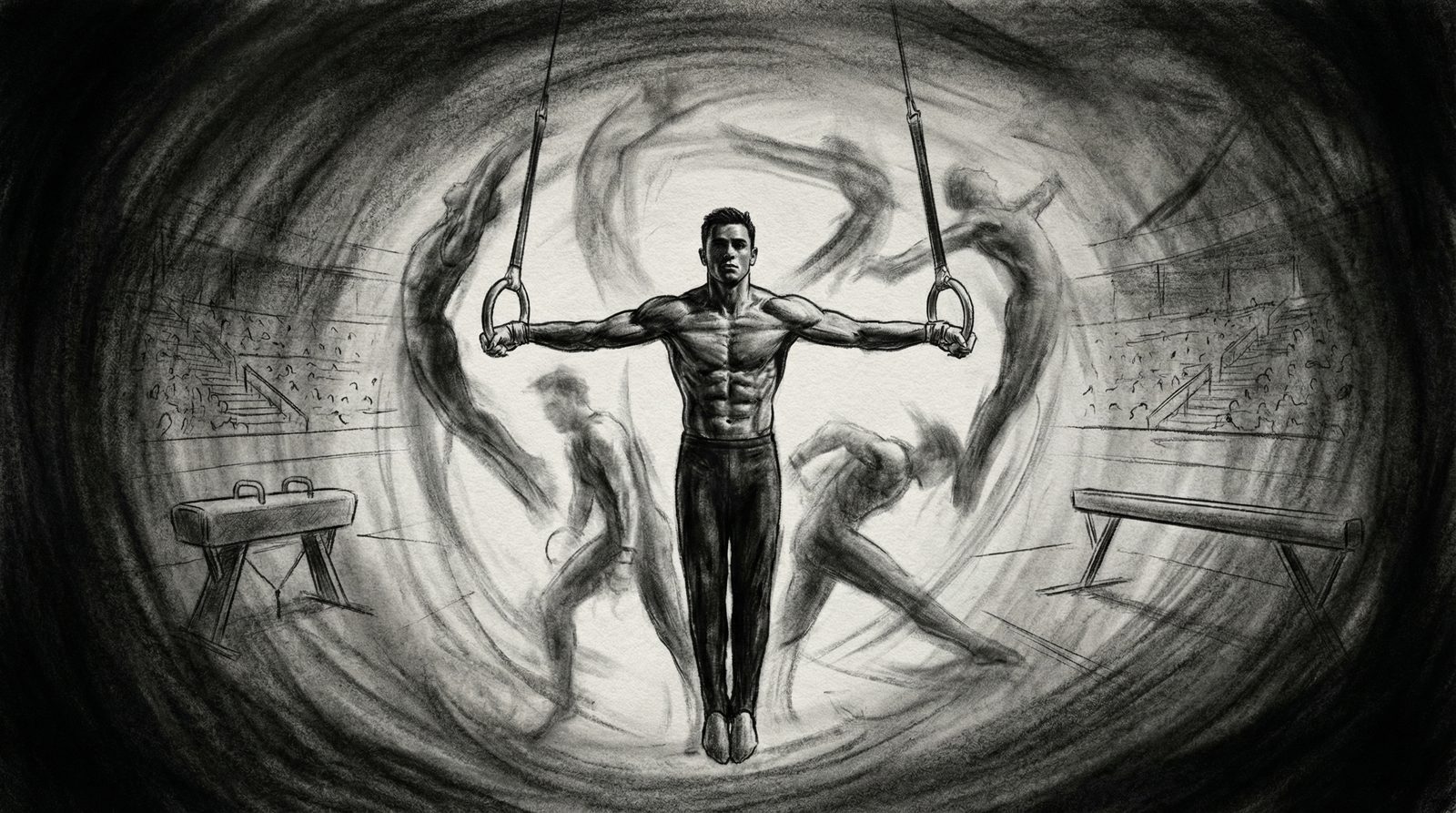
    Illustration inspired by 'Way Of The Peaceful Warrior A Book That Changes Lives (1980)'

    LEGACY & RECEPTION

    Since 1980, Way Of The Peaceful Warrior has lived a double life: modestly reviewed on release, then passed hand to hand in gyms, yoga studios, and college dorms. It occupies a similar shelf-space to other late-20th-century “mind-body” books, but with a distinctly athletic frame. The book’s continued circulation owes a lot to its refusal to end in easy victory. It offers sustained awareness rather than a career-defining moment, and that choice has made it both beloved and frustrating depending on what a reader expects.

    IS IT WORTH READING?

    It depends on your tolerance for earnestness and didactic dialogue. If you want a tightly plotted sports narrative, you’ll likely be frustrated. If you’re interested in how ambition corrodes from the inside and how a life might be rebuilt around presence rather than achievement, it still has bite. Read it not as a manual but as one flawed person’s record of stumbling toward a different way of being.

    TRIVIA & AUTHOR FACTS

    Millman draws heavily from his own background in collegiate athletics. Many readers treat Socrates as a real mentor figure filtered through spiritual allegory, and Millman has described the character as composite rather than simple reportage. The subtitle “A Book That Changes Lives” was not part of the original small-press edition and was added as the book gained a following through reissues.

    SIMILAR BOOKS

    If this resonates, you may prefer other narratives where spiritual inquiry is grounded in bodily discipline and everyday struggle. The strongest neighbors tend to share the same premise: transformation is not a vision; it’s a practice lived under pressure.

    DISCOVERABILITY & LINKS

  • The Laws Of Spirit (1995)

    The Laws Of Spirit (1995)

    INTRODUCTION

    The Laws Of Spirit (1995) by Dan Millman
    Spiritual fable · 108 pages · United States


    The Laws Of Spirit is a quiet, walking book. A nameless traveler hikes into the mountains, exhausted by the noise of late 20th-century life, and meets an ageless woman who introduces herself simply as the Sage. Over the course of a single day and night, they walk ridgelines, cross streams, and talk through ten laws that supposedly govern inner freedom. The mood is gentle but insistent, a stripped-down clarity rather than mystical fireworks.

    This is not a novel in the conventional sense. It’s a spiritual allegory that borrows the motif of pilgrimage and pares it down to two voices and a trail. Millman uses the landscape itself — wind in the pines, moon on snowmelt, the physical difficulty of footing — as a third presence, a reminder that the answers here are meant to feel elemental rather than esoteric.

    PLOT & THEMES

    The “plot” is deliberately skeletal. A hiker escapes into the mountains and meets the Sage in a high meadow. She leads him along a simple circuit through forest, river gorge, and a small lakeside town, using each stop to embody one of the ten laws: Balance, Choice, Process, Presence, Compassion, Faith, Expectation, Integrity, Action, and Surrender. The trope is familiar — wise guide leading a seeker through staged lessons — but Millman keeps the scale intimate. There are no miracles, only small, charged encounters.

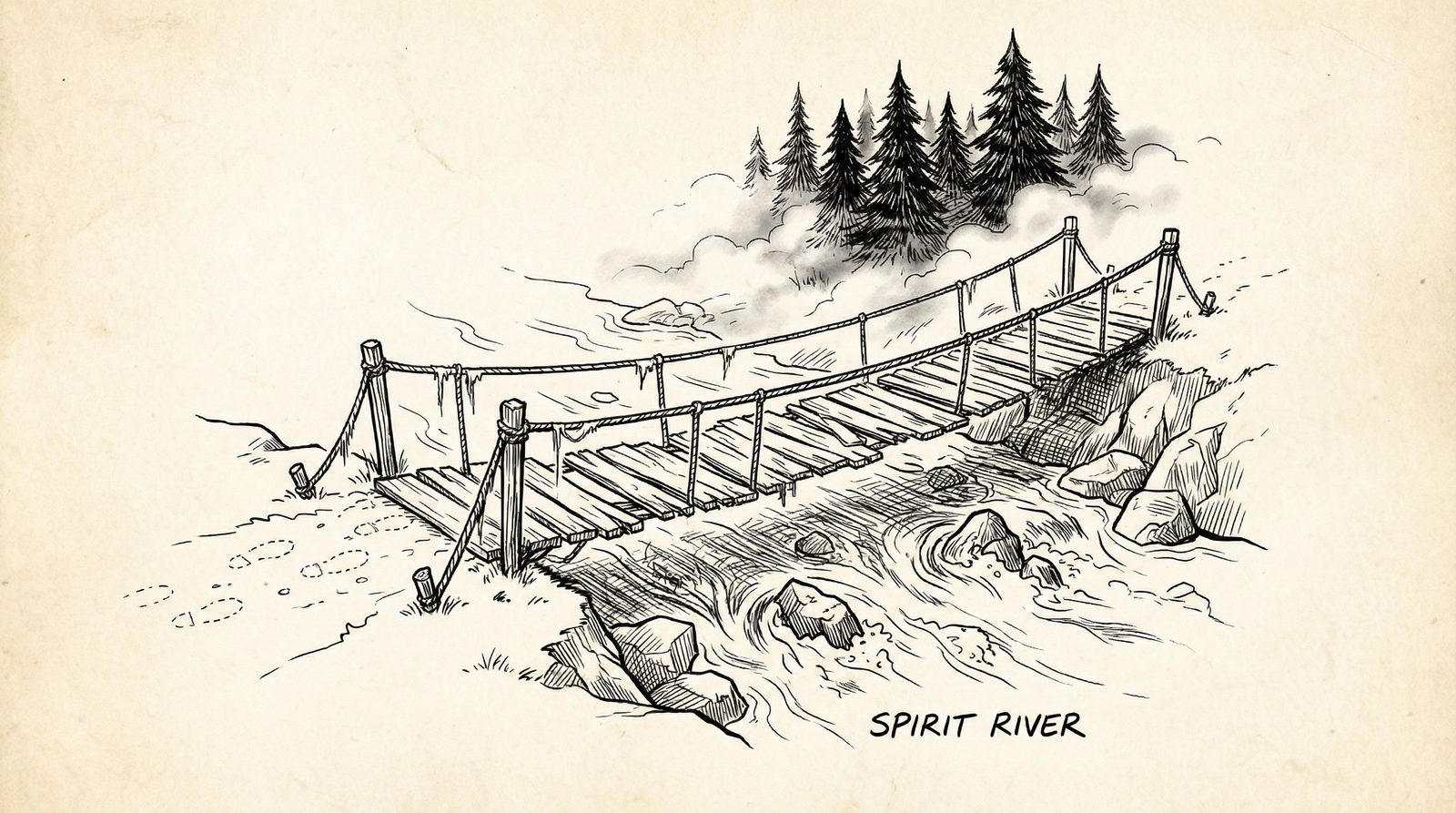
    What makes the book work is how it anchors abstraction in physical friction. A rickety bridge becomes the Law of Balance. A diner becomes the Law of Compassion without sentimentality. A fire lookout layered with decades of carved names becomes the Law of Process: lives as trace, not as finish line. The central motif is pilgrimage as inner cartography: every turn in the trail mirrors a shift in the traveler’s orientation to choice and fear.

    Unlike cosmology-heavy spiritual books, The Laws Of Spirit stays practice-forward. It frames the laws as ways of responding to layoffs, divorce, illness, and ordinary adulthood rather than as metaphysical claims you must accept. By the end, the Sage makes it explicit: the laws do not guarantee comfort; they describe how meaning can be made inside uncertainty.

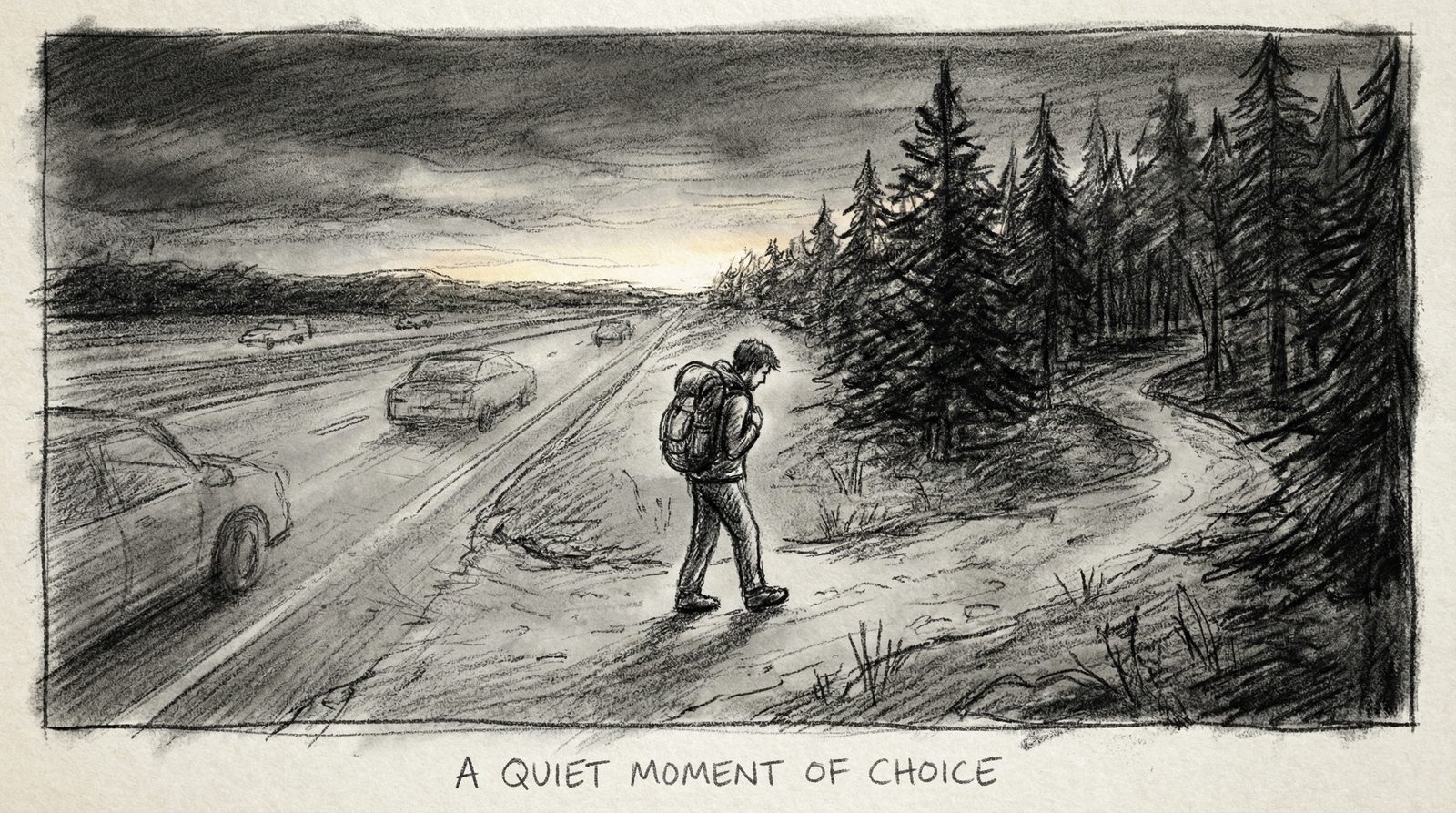
    The ending is unflashy but decisive. After a night conversation under meteor showers, the Sage walks the narrator back to the trailhead at first light and disappears into the trees without explanation. The traveler drives back toward the city, traffic thickening, repeating the Law of Action to himself and choosing to change his work and relationships rather than escaping back to the mountains again.

    PROSE & NARRATIVE STRUCTURE

    The book uses a simple frame narrative: an older narrator recalling a formative encounter years earlier. This lets Millman alternate between the immediacy of the hike and reflective distance. The prose is plainspoken and spare. Sentences are short, verbs concrete. When Presence is introduced beside a river, the description stays tactile: pine scent, bootlaces, the glint of water through branches.

    Each chapter is structured around a single law with a consistent pattern: encounter, metaphor, integration. That modular structure makes the book easy to re-enter; you can open to Integrity or Surrender and get a complete arc in miniature. The didacticism is softened by unhurried pacing and the steady return to dirt, sky, weather, and breath.

    Conceptual editorial illustration inspired by 'The Laws Of Spirit (1995)'

    CHARACTERS & INTERIORITY

    The narrator is a seeker archetype: competent enough in ordinary life but inwardly frayed. We learn scraps — a recent breakup, work that pays but feels hollow, a sense of wasted time — and his interiority is carried through resistance followed by recognition. He bristles, then admits the Sage is right. That pattern becomes the psychological rhythm of the book.

    The Sage is a classic mentor archetype with a wry, almost grandmotherly edge. She teases, contradicts herself, and occasionally uses her own impulsiveness to illustrate choice. Her backstory appears only in quick glimpses, keeping her human enough to feel present while still operating as a parable figure. Minor characters are thin but functional mirrors that force the traveler to notice reflex judgment and fear in small, everyday interactions.

    Interiority here is less about deep excavation than about catching micro-moments of choice. The book insists those moments are the true sites of transformation: not the mountaintop vision, but the second you decide how to respond.

    Illustration inspired by 'The Laws Of Spirit (1995)'

    LEGACY & RECEPTION

    The Laws Of Spirit arrived in the mid-1990s, when spiritual memoirs and parables were thick on bookstore shelves. It never reached the mass cultural saturation of blockbuster spiritual adventure, but within Millman’s readership it became a pocket companion: often handed to friends going through divorce, burnout, or a crisis of meaning. Its brevity and lack of institutional religion make it portable across belief systems, which has helped it stay quietly in circulation.

    Its ending — the Sage simply walking away and the traveler returning to traffic — is a quiet rebuke to spiritual escapism. The point is not to stay on the mountain. The point is to carry the laws into the mess of ordinary days.

    IS IT WORTH READING?

    If you’re looking for dense theology or complex plotting, no. This is closer to a long, thoughtful walk with an older friend than to a conventional narrative. Its value lies in how cleanly it frames familiar dilemmas. The structure is easy to revisit, the language accessible, and the imagery — bridges, rivers, ridgelines — simple enough to stick.

    For readers allergic to jargon but open to reflective, quietly directive prose, this slim book can land with surprising force. For others, it may feel like a gentle echo of insights they’ve already met elsewhere.

    TRIVIA & AUTHOR FACTS

    Dan Millman is best known as a former world-champion gymnast and coach who turned to writing and teaching about personal growth. The Laws Of Spirit sits mid-bibliography, after more autobiographical work and before later, more systematized teaching formats. The book’s compact length was intentional: designed to be read in one sitting or carried on an actual hike.

    SIMILAR BOOKS

    If this book resonates, you may prefer other spare, journey-based spiritual narratives where a single encounter reshapes how life is lived afterward. The closest neighbors tend to use pilgrimage and mentorship as structure, keeping spiritual insight grounded in ordinary decision-making rather than in spectacle.

    DISCOVERABILITY & LINKS