Place: Peru

  • The Celestine Prophecy (2006)

    The Celestine Prophecy (2006)

    The Celestine Prophecy (2006) directed by Armand Mastroianni. Spiritual drama · 99 minutes · United States. Released April 21, 2006.


    INTRODUCTION

    The Celestine Prophecy (2006) is a spiritual drama adapted from James Redfield’s bestselling novel, attempting to turn a sequence of New Age ideas into a cinematic journey. The film’s defining quality is its “illustrated lecture” structure: scenes exist primarily to deliver concepts about intuition, “energy,” and meaningful coincidence, with Peru framed as a contemplative backdrop even when the script sprinkles in gunmen and chase beats.

    The mood stays calm and meditative more often than suspenseful. For viewers who want a visual companion to the book’s worldview, that steadiness can feel like a guided workshop in narrative form. For viewers expecting a thriller with spiritual seasoning, the same steadiness can feel like the movie is constantly interrupting itself to explain what it means.

    PLOT & THEMES

    The plot follows John, a disillusioned schoolteacher, who is pulled toward Peru through a chain of coincidences that the film treats as evidence rather than convenience. He learns of an ancient manuscript describing Nine Insights about human evolution and spiritual perception. The story is structured as a staircase of lessons: each new guide introduces an Insight, John absorbs it, and the narrative advances to the next checkpoint.

    The film’s main themes are spiritual awakening and the tension between control and surrender. Synchronicity functions as plot armor and worldview proof at the same time: John’s “progress” depends less on tactics than on alignment, attention, and willingness to be guided. The journey itself is the inner transformation. Physical movement through jungle ruins is mainly there to keep the teaching structure in motion.

    There is also a mild institutional critique. Authority figures—religious, military, corporate—are framed as forces that fear the manuscript because it loosens control. This conflict exists mostly to provide pressure between lessons; the real escalation is conceptual. The script doesn’t raise stakes by deepening danger so much as by deepening explanation, which is exactly why the film feels more like instruction than suspense.

    CINEMATIC TECHNIQUE & AESTHETICS

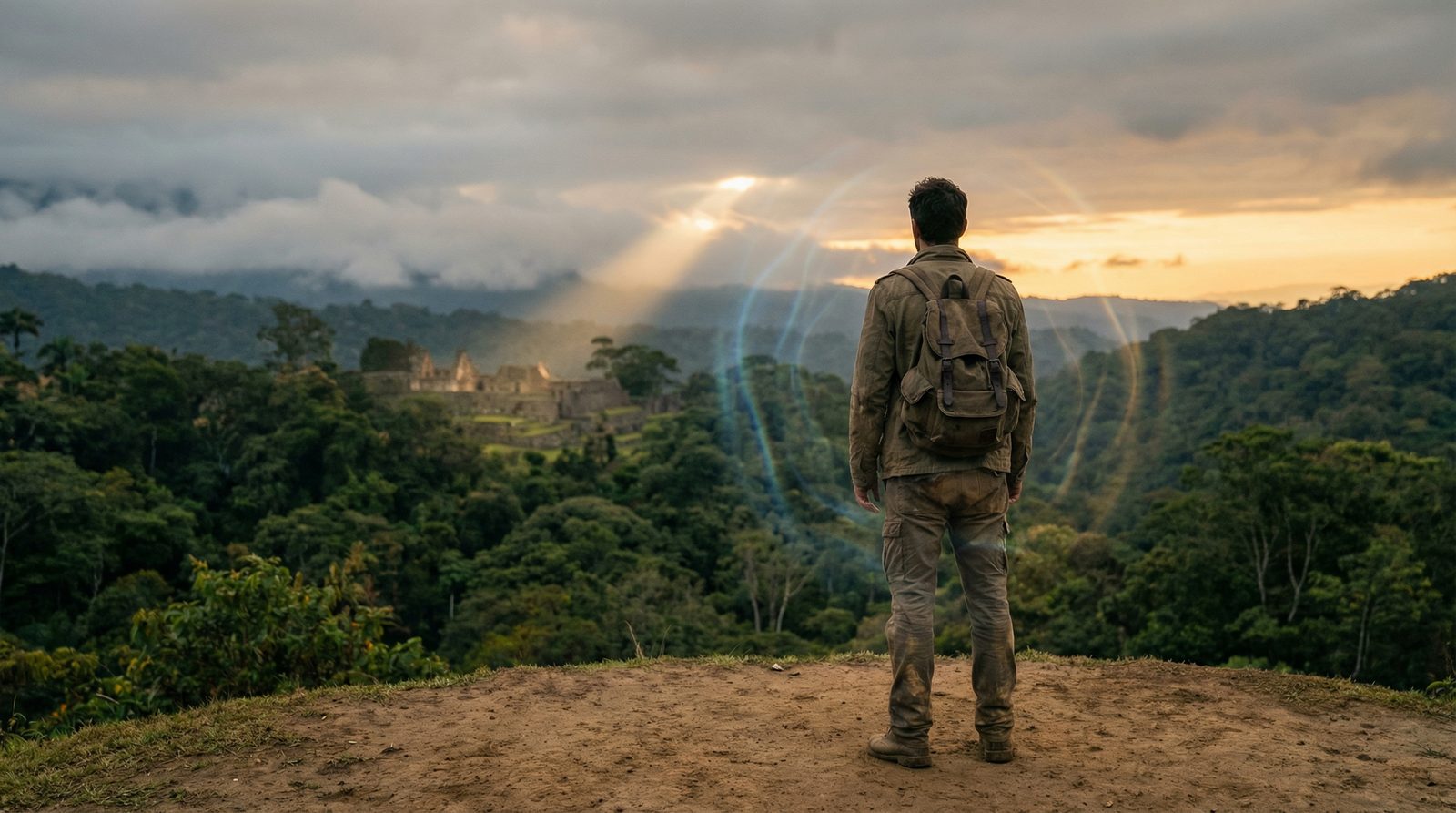
    Mastroianni leans hard on natural lighting and wide location framing to create an atmosphere of sanctuary. The Peruvian setting is photographed with stillness in mind, which produces a tonal friction: the camera wants contemplation even when the plot wants urgency. That mismatch is one reason the film’s action beats can feel airy or weightless.

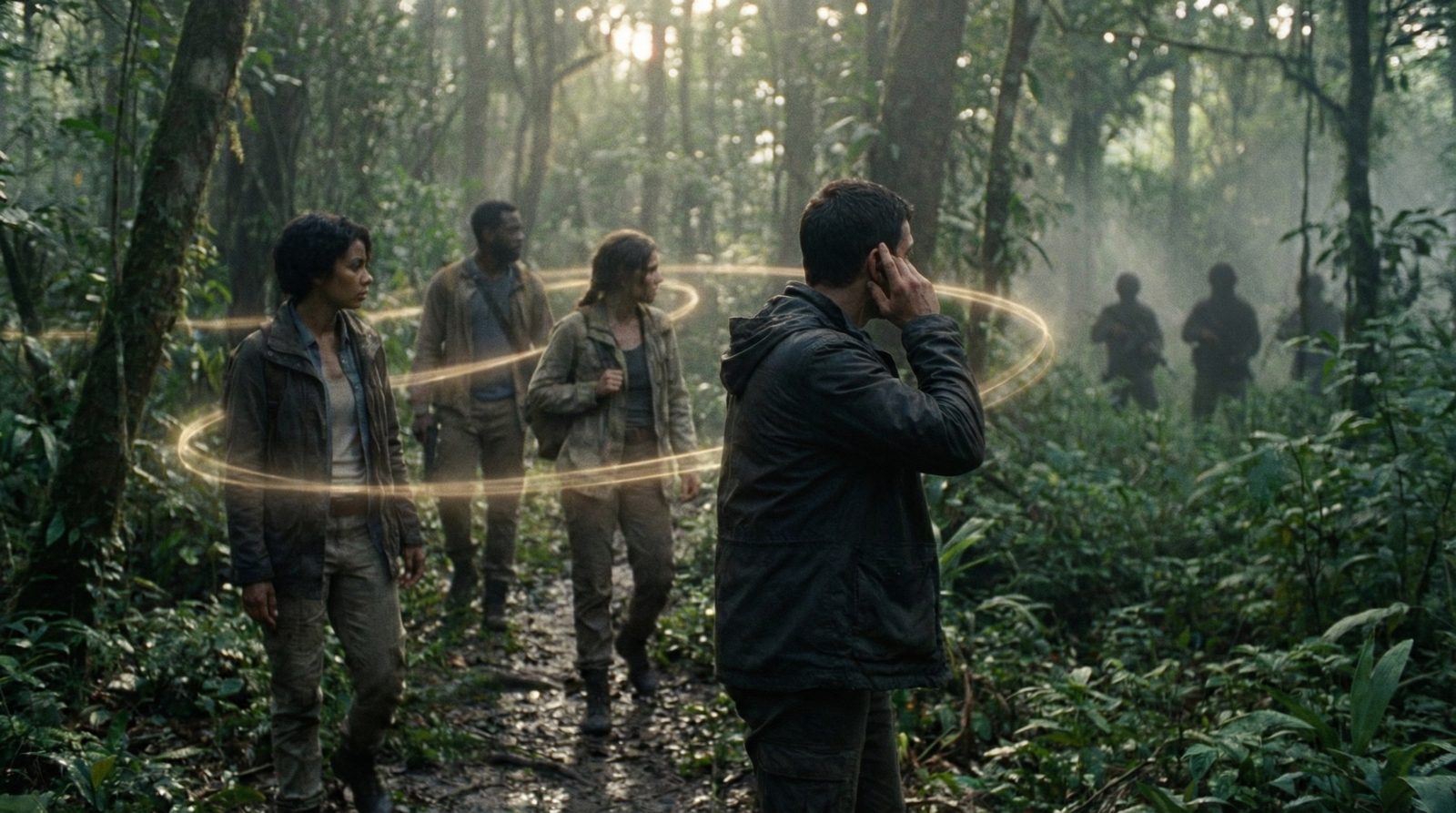
    The movie uses voiceover frequently as a safety net, compressing and clarifying the Nine Insights so the “lesson” does not get lost. Dialogue scenes tend to be staged in simple two-shots with minimal blocking, prioritizing clarity of speech over visual dynamism. When the script turns to “energy fields,” the film uses soft-focus glow and restrained effects that suggest metaphor more than physics.

    Editing remains unhurried. The rhythm favors conversation and reflection, which supports the film’s instructional goals but weakens conventional tension. The overall experience is closer to a filmed retreat session than a genre adventure, and the film’s success depends on whether a viewer wants that.
    Editorial illustration inspired by 'The Celestine Prophecy (2006)'

    CHARACTERS & PERFORMANCE

    John is built as a Seeker archetype: decent, skeptical, and primed for change. The performance is intentionally low-key, keeping him receptive rather than commanding. That passivity fits the film’s worldview—follow the signs—but it can make the protagonist feel more like a viewpoint character than a driver of events.

    Supporting characters arrive as functional archetypes: mentors who deliver each Insight, skeptics who voice audience resistance, and authority figures who represent control. Performances stay calm and seminar-like, even in danger. This helps preserve the film’s meditative feel, but it also flattens suspense because characters rarely behave like people who believe they might die.

    CONTEXT & LEGACY

    The core challenge of this adaptation is structural. The novel’s appeal is idea-first revelation: readers can linger inside interior “insights” without needing behavior to carry them. Film is less forgiving. Here, the adaptation chooses doctrinal fidelity over cinematic transformation, leaning into explanation even when that reduces drama.

    Commercially, the film failed to convert the book’s massive readership into a mainstream movie audience, and it became a cautionary example of how difficult it is to adapt a didactic self-help narrative without either turning it into a sermon or betraying its point. Its lasting impact is mostly within spiritual/self-help circles, where it continues to function as a reference object for synchronicity language and “energy” framing rather than as a widely admired piece of cinema.

    IS IT WORTH WATCHING?

    It depends on what you want. If you’re already invested in Redfield’s worldview, the film can work as a calm, visual companion piece, giving landscape and faces to ideas you may have first encountered on the page.

    If you’re looking for a gripping adventure or a spiritually themed thriller, it will likely disappoint. The jungle setting and chases are secondary. The primary experience is listening to a worldview explained repeatedly, with the story serving as delivery mechanism.
    Symbolic illustration inspired by 'The Celestine Prophecy (2006)'

    TRIVIA & PRODUCTION NOTES

    The film was produced with direct involvement from James Redfield, which helps explain its fidelity to the terminology and teaching structure of the novel. Much of the dialogue about the Nine Insights is close to the book’s wording, prioritizing doctrinal clarity over naturalistic speech.

    Depicting invisible “energy” on a modest budget led to soft, restrained visual choices: glow, bloom, and subtle aura-like effects rather than heavy CGI. Voiceover is used to tie together the episodic lesson structure and keep the didactic spine explicit.

    SIMILAR FILMS

    If you respond to the film as a spiritual-journey object rather than a thriller, you may prefer other works where travel and encounter produce gradual inner change. In this site’s current cluster, the closest neighbors are films that treat movement as moral pressure rather than spectacle.

    DISCOVERABILITY & LINKS

  • The Motorcycle Diaries (2004)

    The Motorcycle Diaries (2004)

    The Motorcycle Diaries (2004), directed by Walter Salles. Road Movie · 126 minutes · Argentina / Brazil / Chile / Peru / United States.


    INTRODUCTION

    The Motorcycle Diaries is a Road Movie that feels quietly revolutionary in its modesty. Rather than racing through the milestones of a famous life, it lingers on formative moments before myth hardens into ideology. Walter Salles follows a 23-year-old Ernesto Guevara in 1952, long before he becomes “Che,” tracing a journey across South America that reshapes his sense of responsibility and belonging.

    The film belongs to the coming-of-age tradition, but the coming-of-age is political as much as personal. By the time the credits roll, nothing “historic” has happened in conventional biopic terms. Yet everything has shifted internally. The mood is contemplative, melancholic, and grounded in physical travel rather than rhetoric.

    PLOT & THEMES

    The story follows Ernesto Guevara, a middle-class Argentine medical student, and his friend Alberto Granado as they set off on a ramshackle motorcycle trip across South America. What begins as youthful adventure quickly becomes a lesson in limits. The motorcycle breaks down, money disappears, and the pair are forced into closer contact with people living far outside their social bubble.

    As they travel through Argentina, Chile, and Peru, the tone shifts from comic misadventure to moral confrontation. Encounters with exploited miners, Indigenous communities, and patients at a leper colony expose Ernesto to structural injustice he cannot ignore. Travel becomes transformation, not through spectacle but through accumulation: each border crossed introduces a new ethical tension.

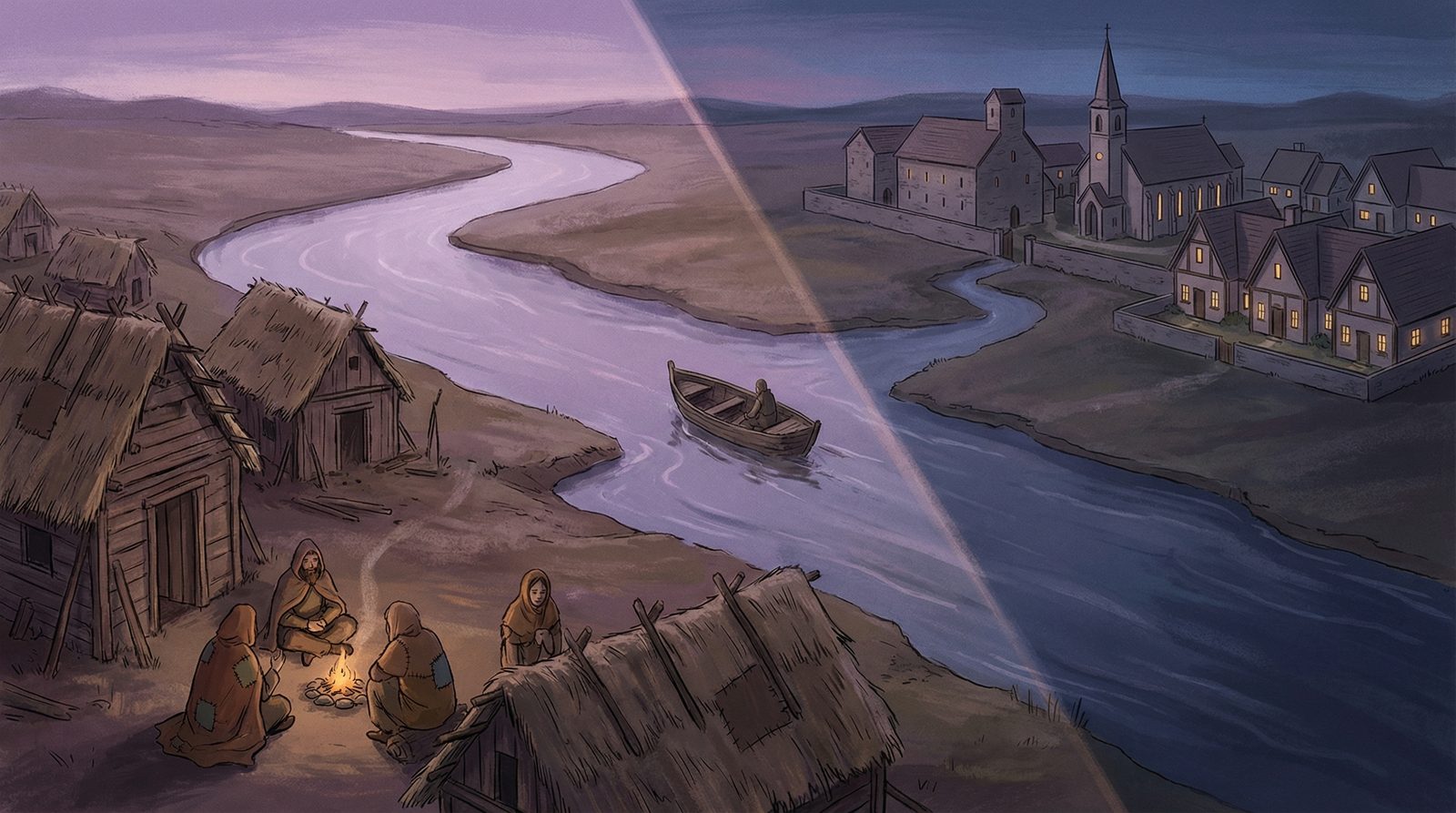
    Illness and bodies play a central role. Ernesto’s asthma and his medical training keep politics anchored in physical vulnerability. Inequality is not discussed abstractly; it is breathed, touched, and treated. The film resists cathartic conversion scenes, favoring gradual awakening. By the river crossing at the leper colony, Ernesto’s decision to swim across becomes a physical declaration of solidarity rather than a speech.

    CINEMATIC TECHNIQUE & AESTHETICS

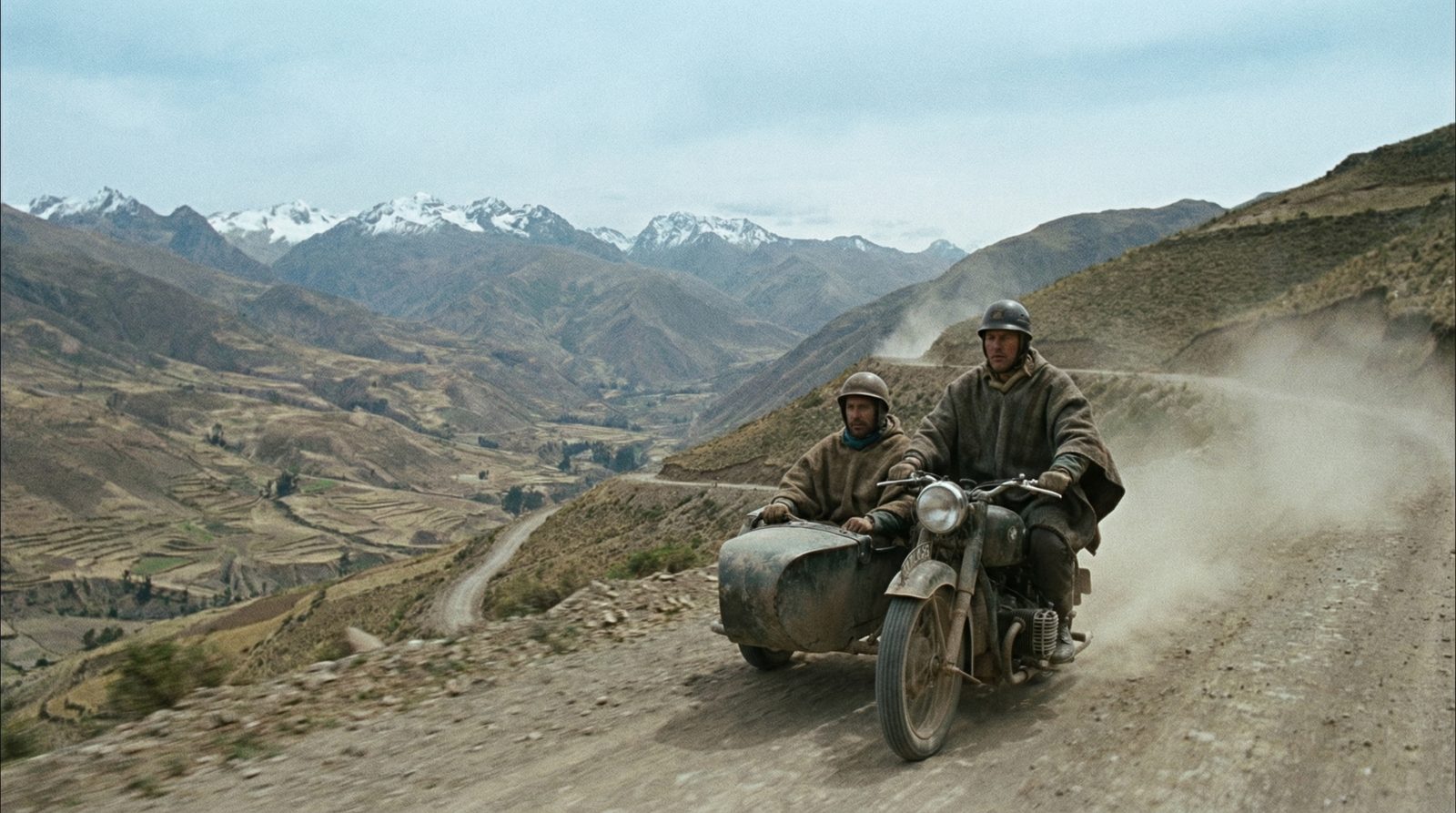
    Walter Salles relies on naturalistic lighting and extensive location shooting to ground the film in lived geography rather than postcard imagery. Landscapes dwarf the protagonists, reinforcing humility and disorientation. Long takes allow discomfort to settle, particularly during encounters with marginalized communities.

    Handheld camera work during travel sequences gives the journey a tactile instability. The bike rattles, the frame shudders, and progress feels provisional. By contrast, scenes at the leper colony use steadier compositions and visual symmetry, as if the film itself slows down to observe rather than roam.

    Sound design favors ambient noise — engines, wind, water — with Gustavo Santaolalla’s score entering quietly, like memory rather than commentary. Voiceover drawn from Guevara’s diary is used sparingly and often complicates what we see. The final montage of faces anchors the film’s politics in lived human presence rather than ideology.

    Editorial illustration inspired by 'The Motorcycle Diaries (2004)'

    CHARACTERS & PERFORMANCE

    Gael García Bernal plays Ernesto as a restrained Idealist rather than a charismatic firebrand. He is awkward, asthmatic, observant — more listener than speaker. Bernal emphasizes hesitation and internal pressure, letting the awakening register through silence and posture rather than declarations.

    Rodrigo de la Serna’s Alberto Granado provides contrast as a Trickster figure: charming, opportunistic, and emotionally open. Their dynamic balances gravity with warmth. Friendship becomes the film’s emotional vehicle for political realization.

    Supporting characters appear briefly but leave lasting impressions. They function less as individualized arcs and more as lived evidence of inequality. The restrained performances avoid sentimentality, keeping the film from drifting into didacticism.

    CONTEXT & LEGACY

    Released in the early 2000s, The Motorcycle Diaries arrived when Che Guevara’s image had become globally commodified. By focusing on his pre-revolutionary years, the film sidesteps later controversies and instead explores the formation of conscience. Its legacy lies not in political instruction but in showing how empathy precedes ideology.

    Within Latin American cinema, it stands as a key example of the socially conscious Road Movie, using movement to expose class and racial divides. Internationally, it remains a touchstone for films that treat political awakening as a slow, embodied process rather than a single decisive moment.

    IS IT WORTH WATCHING?

    Yes — especially if you prefer character-driven journeys over conventional biopics. The film rewards patience, attention, and openness. It is less interested in answers than in formation.

    Viewers expecting a full account of Che Guevara’s later politics may find it incomplete. As a portrait of an inner shift — from individual adventure to continental awareness — it remains quietly powerful.

  • The Celestine Prophecy (1993)

    The Celestine Prophecy (1993)

    INTRODUCTION

    The Celestine Prophecy (1993) by James Redfield
    Spiritual fiction · 20th Century · United States / Peru


    The Celestine Prophecy arrived in the mid-1990s like a photocopied scripture passed from hand to hand, carrying the promise that everyday life concealed a deeper pattern of meaning. It barely disguises its intentions. This is a novel that wants to instruct, not merely entertain. Yet that lack of irony is part of its peculiar magnetism.

    Set largely in Peru but steeped in American New Age yearning, the book follows an unnamed narrator who drifts from encounter to encounter, repeatedly meeting people who seem to have been waiting for him. The tone is earnest to the point of vulnerability. At times it feels naïve, even awkward. But it is also charged with a restless hope that private dissatisfaction might be a signal of collective transformation.

    As spiritual fiction, the novel sits between adventure story and instructional text. Ancient manuscripts, meaningful coincidence, and invisible energy fields are not narrative ornaments here. They are the argument. Human consciousness itself is framed as the final frontier of the late twentieth century.

    PLOT & THEMES

    The plot unfolds as both a physical journey through Peru and a structured ascent through nine spiritual insights. Nudged by a former teacher, the narrator travels to Lima after hearing rumors of a mysterious manuscript discovered near the ruins of an ancient settlement. Almost immediately, he is warned that the Catholic Church views the document as dangerous.

    From that moment on, the story follows the logic of the chosen seeker. The narrator repeatedly meets exactly the right person at exactly the right moment. Each encounter introduces a new insight, reframing the nature of history, psychology, and human interaction.

    The early insights teach that modern restlessness is not a personal failure but an evolutionary pressure. Later chapters introduce the idea of visible energy fields surrounding living beings, dramatized in scenes where attention itself appears to nourish plants or destabilize human interactions. At the Celestine ruins, competing belief systems are rendered as clashing energetic forces rather than ideological disagreements.

    Redfield weaves in psychological material through the concept of “control dramas”: patterns like the Intimidator, Interrogator, Aloof type, and Poor Me. These strategies, learned in childhood, are presented as unconscious attempts to steal energy from others. Family arguments and strained relationships become laboratories for spiritual diagnosis.

    The later insights grow more radical. Humanity is imagined as learning to consciously exchange energy, extending life and eventually transcending physical death altogether. Unlike the film adaptation, the novel ends without triumph. The manuscript is suppressed, Father Sanchez is arrested, and the narrator leaves Peru committed to living the insights quietly in ordinary life, waiting for a tenth insight to emerge elsewhere.

    As spiritual fiction, the book occupies an uneasy space between allegory and manual. Its ambition is unmistakable: to use narrative itself as a technology for belief change.

    PROSE & NARRATIVE STRUCTURE

    The novel is told in plain first-person prose, almost aggressively stripped of ornament. Sentences explain more than they evoke. Characters rarely act without also clarifying the spiritual meaning of their actions. This flattens suspense but reinforces the book’s instructional purpose.

    Structurally, the book is modular. Each chapter introduces a new insight through a new character or setting: Father Sanchez in a Lima church, Dobson at the Viciente estate, Marjorie and her children in a mountain refuge, Sarah at a scientific research compound. The repetition is deliberate. Learning here happens through accumulation, not surprise.

    Occasional sensory details appear, humid jungle air, stone corridors, flickering candlelight, but they function as brief pauses between extended dialogues about spiritual evolution. Even moments of danger, including the narrator’s imprisonment, exist mainly to usher in the next teaching.

    Formally, the book resembles a self-help text wearing the clothes of an adventure novel. Whether that feels inspiring or tedious depends entirely on how receptive the reader is to the insights themselves.

    CHARACTERS & INTERIORITY

    The unnamed narrator functions less as a character than as an archetypal pilgrim. His background is deliberately vague. He exists primarily as a vessel for the reader’s curiosity and doubt.

    Supporting figures are similarly schematic. Father Sanchez represents institutional religion under threat. Wil plays the role of the seasoned guide, always one insight ahead. Charlene embodies skepticism slowly dissolving into openness. Even minor characters exist to demonstrate specific psychological patterns rather than to develop inner lives.

    Interior experience is reported rather than dramatized. Moments of awakening are described intellectually, not viscerally. Yet there is an odd honesty in this clumsiness. The characters constantly articulate their fears of being wrong, arrested, or deluded. That insecurity mirrors the reader’s own ambivalence about embracing such a totalizing worldview.

    LEGACY & RECEPTION

    The Celestine Prophecy was an unlikely cultural phenomenon. Initially self-published, it climbed bestseller lists and spawned sequels, workshops, and discussion groups. Critics often dismissed its prose as wooden and its ideas as recycled mysticism. Readers, however, embraced its promise of meaning in an era marked by spiritual drift.

    The book helped normalize the idea that a novel could function as spiritual instruction. Its insistence that insight must be lived rather than archived allowed readers to extend the story into their own lives. That open-endedness explains why it lingered in personal libraries and study circles long after its mainstream visibility faded.

    IS IT WORTH READING?

    As a novel, it is undeniably clumsy. As a cultural artifact, it remains fascinating. Readers interested in how New Age spirituality crystallized into narrative form during the 1990s will find it revealing. It rewards a skeptical but open posture: reading with a pencil in hand, questioning its claims, and occasionally feeling an unsettling resonance when coincidence and meaning begin to rhyme with personal experience.

    TRIVIA & AUTHOR FACTS

    James Redfield self-published the novel and distributed copies through independent bookstores before it was picked up by a major publisher. His background in counseling and interest in Eastern philosophy shaped the book’s blend of psychology and spirituality.

    The manuscript and its nine insights are entirely fictional. Redfield has stated that they are a synthesis of various spiritual traditions rather than a rediscovered ancient text.

    SIMILAR BOOKS

    Readers drawn to its blend of spiritual seeking and narrative instruction may also explore The Alchemist (1988) by Paulo Coelho, Hermann Hesse’s Siddhartha (1922), or Dan Millman’s Way of the Peaceful Warrior (1980).

    DISCOVERABILITY & LINKS

    Related works: The Tenth Insight, The Alchemist, Way of the Peaceful Warrior

    DISCOVERABILITY & LINKS

  • James Redfield

    James Redfield

    ORIGINS & BACKGROUND

    James Redfield is best known as the author of The Celestine Prophecy (1993), a novel that turned spiritual seeking into a page-turning adventure and helped popularize ideas like synchronicity and personal spiritual awakening in the 1990s. Although he has written several other books, including sequels and thematic extensions of that first story, his reputation rests on a very specific blend of narrative fiction and spiritual self-help. He writes not as a distant literary stylist but as someone attempting to guide readers through a process of inner change, using story as a teaching tool.

    Redfield emerged during the New Age fiction boom of the late 20th century, when a wide readership was looking for stories that could double as spiritual guidance. An American writer shaped by the human potential and self-help movements, he approached fiction as a vehicle for spiritual evolution rather than as a purely aesthetic project. The Celestine Prophecy was initially self-published and circulated through word of mouth among readers who felt it articulated their own search for meaning and intuition. That grassroots success eventually led to a mainstream publishing deal and a film adaptation released in 2006.

    His follow-up novels, including The Tenth Insight and The Secret of Shambhala, extend the same fictional universe rather than striking out in unrelated directions. This continuity reflects how Redfield sees his work: as a long-form exploration of spiritual awakening rather than a collection of discrete stories. His background in counseling and interest in both Eastern and Western mystical traditions inform the way he writes about energy, intuition, and higher purpose. Instead of focusing on social or political realism, he turns inward, aiming to map an invisible landscape of consciousness.

    Editorial illustration inspired by James Redfield

    THEMES & MOTIFS

    The central theme in James Redfield’s work is spiritual awakening. His protagonists are usually ordinary people who stumble into extraordinary experiences that force them to question their assumptions about reality. Awakening is presented not as a single epiphany but as a gradual process, often structured as a sequence of insights or realizations that build on one another. Readers are encouraged to view their own lives as part of a similar unfolding.

    A second recurring motif is synchronicity. Characters repeatedly encounter meaningful coincidences that seem to guide them forward, suggesting that the universe is responsive rather than random. In Redfield’s fiction, synchronicity functions both as a plot engine and as a worldview, nudging characters toward higher understanding while reassuring readers that their own chance encounters may be part of a larger pattern.

    He also returns frequently to the idea of energy fields. Characters learn to sense subtle energies around people and places, treating emotions, intentions, and relationships as energetic exchanges rather than purely psychological ones. Landscapes in books like The Tenth Insight and The Secret of Shambhala become spiritual geographies, with sacred sites and hidden realms mirroring an inner journey of growth and healing.

    Throughout his work, there is a persistent tension between fear and faith. Characters hesitate, doubt, and resist, but are ultimately invited to trust intuition, openness, and connection. The emotional through-line is one of seeking meaning, where skepticism is acknowledged but answered through lived experience rather than argument.

    Symbolic illustration inspired by James Redfield

    STYLE & VOICE

    James Redfield writes in a direct, accessible style that prioritizes clarity of message over stylistic complexity. His prose is straightforward and conversational, often pausing the narrative so characters can explain spiritual principles to one another. Dialogue frequently functions as instruction, with one character guiding another through an insight, meditation, or new way of interpreting experience.

    Structurally, his novels follow the pattern of a spiritual quest. Stories move from everyday life into increasingly visionary or mystical experiences, with each new setting revealing another layer of understanding. Moments of danger or pursuit tend to test intuition and openness rather than deliver conventional suspense.

    The overall effect is that of a guided journey. Readers are not only watching characters change, but are implicitly invited to consider their own beliefs about coincidence, purpose, and personal transformation. The tone is earnest and hopeful, with little irony, emphasizing reassurance and the possibility of growth.

    KEY WORKS & LEGACY

    The Celestine Prophecy remains the defining work of James Redfield’s career. It introduced a broad audience to his blend of spiritual awakening, synchronicity, and adventure, framing a series of insights about energy and higher purpose within a chase narrative set largely in Peru. For many readers, it served as an entry point into New Age fiction and metaphysical adventure.

    He continued this storyline in The Tenth Insight, which explores visionary states and the idea of life between lives, and in The Secret of Shambhala, which shifts the focus toward global healing and collective transformation. The film adaptation of The Celestine Prophecy brought his ideas to a wider audience, even as it revealed the difficulty of translating interior, didactic experiences into visual drama.

    Within the larger landscape of spiritual literature, Redfield’s legacy is less about literary innovation than cultural impact. His work helped normalize conversations about synchronicity, intuition, and spiritual evolution for mainstream readers. Whether viewed as inspirational or simplistic, his novels clearly tapped into a widespread desire for stories that treat the search for meaning as a central human adventure.