Narrative Techniques: Close Third-Person

  • Pet Sematary (1983)

    Pet Sematary (1983)

    By: Stephen King
    Genre: Horror
    Country: United States


    INTRODUCTION

    Among Stephen King’s work, Pet Sematary (1983) is the one that feels like it hates you a little for reading it. Set in the late twentieth century, it is soaked in dread, domestic routine, and the slow rot of inevitability. The motif of roads and crossings runs through everything: the busy Route 15 where the Orinco trucks scream past, the worn path to the children’s graveyard, the secret trail beyond the deadfall into the Micmac burial ground. The feeling is suffocating grief, but also the ordinary tenderness of a young family trying to settle into a new town. King builds a world of PTA meetings, university politics, and neighborly beers on the porch, then lets something ancient and foul seep up through its floorboards. This is not simply a scary book; it is a brutal argument about the cost of refusing to accept that everything ends.


    PLOT & THEMES

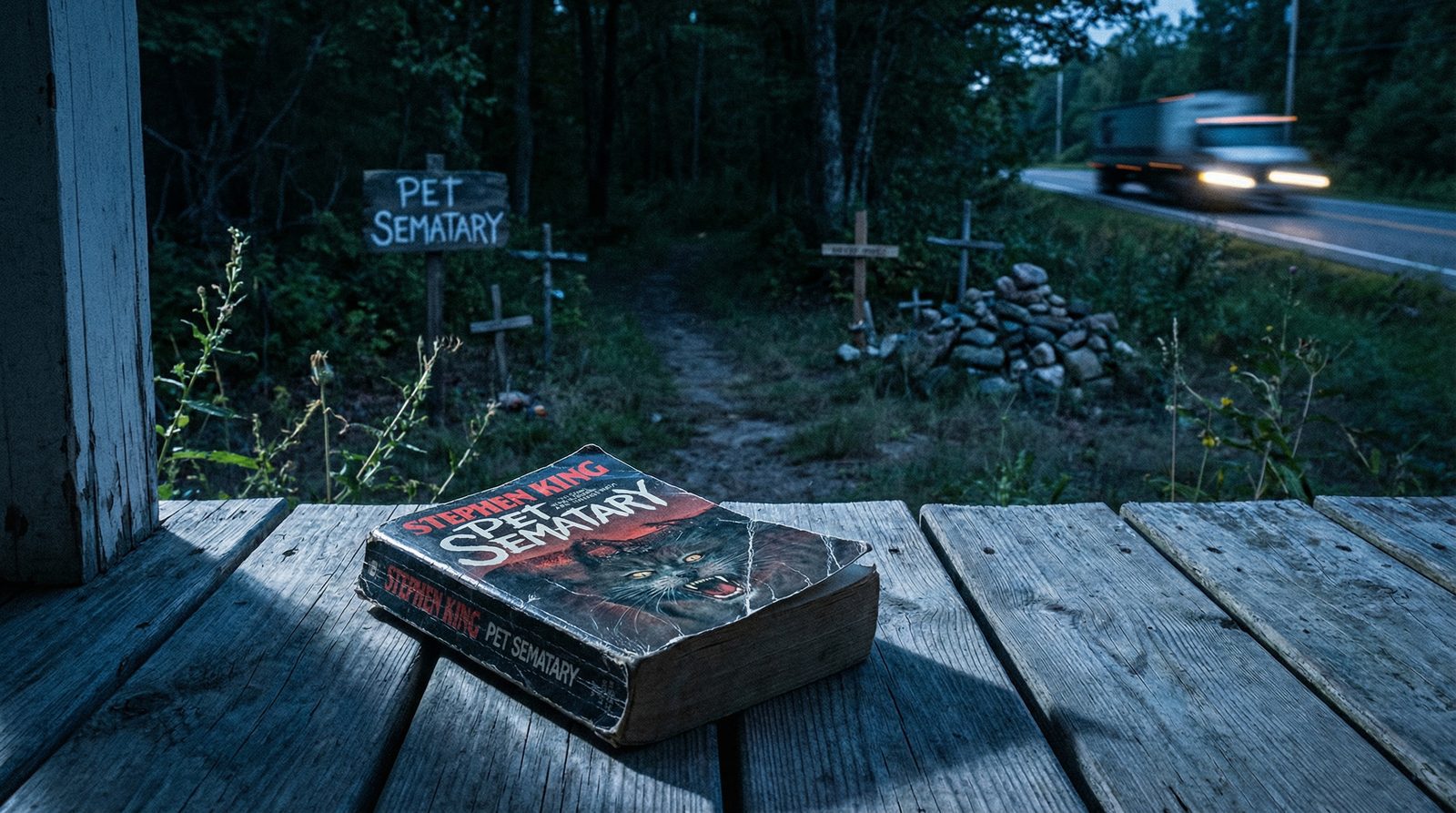
    On the surface, the plot is simple. Louis Creed, a doctor, moves with his family to a rented house in Ludlow, Maine, for a job at the University of Maine’s student health center. Across the road lives Jud Crandall, the elderly neighbor who becomes Louis’s guide to the local geography: the children’s “pet sematary” in the woods and, beyond the deadfall, the sour Micmac burial ground. When Ellie’s cat, Church, is killed on the dangerous road, Jud takes Louis past the burial ground’s stone cairns. Church returns, but wrong – sluggish, foul-smelling, with a flat, alien gaze. The motif of corrupted resurrection is born here and never loosens.

    The trope of the Faustian bargain is explicit. Louis is not tricked; he understands that what comes back is not what went into the earth, yet when his toddler son Gage is killed by an Orinco truck, he chooses the burial ground again, this time alone. King threads in smaller thematic filaments: Rachel’s childhood trauma with her dying sister Zelda, hidden away like a family shame; Louis’s clinical detachment at the university clinic, shattered by Victor Pascow’s grotesque head injury and prophetic warning; the way the Creed marriage strains under unspoken fears about death. Compared with the film adaptations, the novel lingers more cruelly on Louis’s planning – the grave-robbing at Mount Hope Cemetery, the meticulous timing around Rachel and Ellie’s absence.

    The book’s ending is unambiguously bleak. Gage’s resurrected body murders Jud and Rachel with a scalpel, and Louis, half-mad, kills his son a second time with a morphine syringe before burning Jud’s house. Yet he still carries Rachel’s corpse to the burial ground, convinced that waiting less time will produce a better result. The final scene shows Rachel returning, reeking and decayed, dropping a maggot from her eye socket as she touches Louis and says, “Darling.” He welcomes her. There is no last-minute salvation here; only a man who has chosen damnation over grief.


    PROSE & NARRATIVE STRUCTURE

    The book uses close third-person as its primary narrative technique, staying mostly with Louis while occasionally slipping into Jud’s memories or Rachel’s private terrors. This tight focus lets King turn mundane details – the smell of autumn leaves on the path to the pet sematary, the sound of the Orinco trucks’ air brakes – into pressure points. The feeling is one of incremental suffocation; every chapter nudges the boundary of what Louis will accept, then quietly resets what counts as normal.

    Structurally, the novel is almost cruelly patient. The first half is domestic realism: Louis’s first day at the university, Ellie’s fear about death after seeing the pet sematary, Thanksgiving plans, even an ugly argument with Rachel’s parents in Chicago. King uses repetition of phrases – “Sometimes dead is better,” Victor Pascow’s “the soil of a man’s heart is stonier” – as a kind of incantation, echoing through Louis’s thoughts and Jud’s stories. These refrains acquire new meaning each time they surface, like a chorus that grows more ominous on each return.

    There is also a subtle use of foreshadowing through dreams and premonitions: Ellie’s nightmares about “Paxcow” (her mispronunciation of Pascow), Rachel’s sense of approaching disaster on her frantic trip back to Ludlow, Louis’s own half-waking vision of a Wendigo-like shape towering over the burial ground. Compared with something like The Shining (1977), the prose here is plainer, less baroque, but the rhythms are merciless. Sentences shorten as Louis’s sanity frays; paragraphs splinter into jagged interior monologue during the grave-robbing sequence and Gage’s return. The result is a narrative that feels like a long, slow descent punctured by sudden, shocking drops.
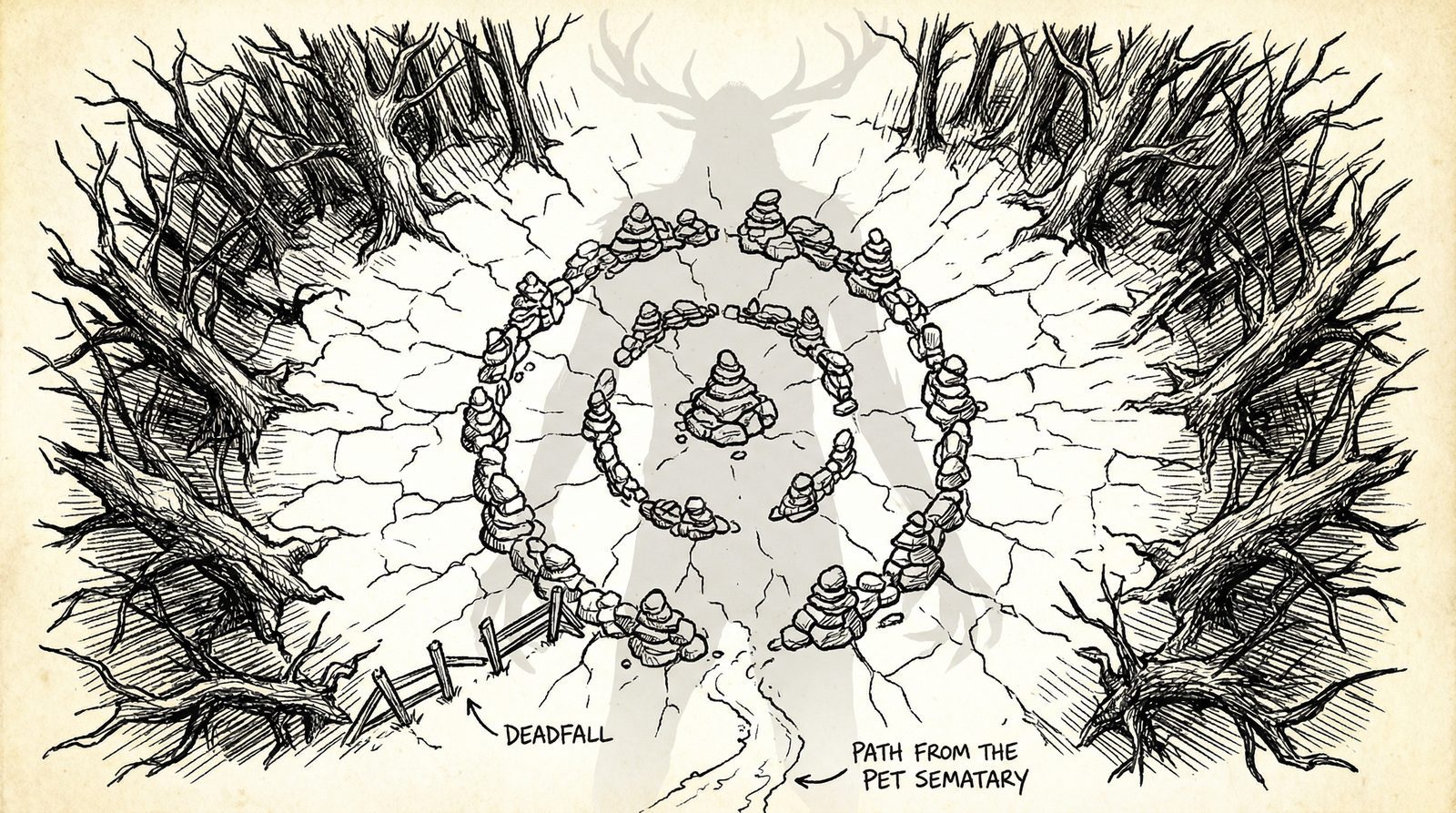
    Conceptual editorial illustration inspired by 'Pet Sematary (1983)'

    CHARACTERS & INTERIORITY

    Louis Creed begins as the rational protagonist archetype. King is careful to make him neither saint nor monster. He is petty about his in-laws, occasionally selfish, but genuinely loves Rachel, Ellie, and Gage. His interiority is where the horror really lives. We sit inside his rationalizations as he moves from burying a cat to contemplating, then committing, the exhumation of his own child. The justifications come in waves, each a little thinner than the last.

    Jud Crandall, often softened in adaptations, is more morally ambiguous on the page. He is the kindly old neighbor, yes, but also the man who opens the door to the Micmac burial ground because he cannot bear to see Ellie grieve. His stories about Timmy Baterman, the resurrected World War II soldier who came back knowing everyone’s secrets, are soaked in guilt. Rachel, meanwhile, is defined by her terror of death, rooted in the grotesque memory of caring for Zelda, whose spinal meningitis twisted her body and mind. Her shame and trauma are not side notes; they are a parallel study in how families mishandle mortality.

    Even minor figures – Norma Crandall with her heart trouble, Irwin and Dory Goldman with their brittle hostility, the student Steve Masterton who helps Louis in the clinic – are drawn with enough interior shading to feel like casualties of the same force. The book’s cruelty lies in how intimately it understands each character’s weak point, then lets the burial ground press on it.


    LEGACY & RECEPTION

    King has said he nearly didn’t publish Pet Sematary because he thought it went too far, and that unease clings to its reputation. Among horror readers it’s often cited as one of the few novels that can still genuinely unsettle jaded adults. Its late twentieth century setting, Orinco trucks, university politics, airline schedules, anchors the supernatural in the banal, making the final sequence, with Rachel’s corpse shambling into the kitchen, feel less like gothic flourish and more like the natural endpoint of bad decisions.

    The various film adaptations have made the story widely known, but they also blur how uncompromising the book’s ending truly is. There is no burning house as catharsis, no surviving child to carry a glimmer of hope. Louis ends the novel sitting at the kitchen table, playing solitaire, waiting for the thing he has made of his wife. That starkness is part of why the book endures: it refuses the usual horror bargain where insight or sacrifice buys survival. Instead, it suggests that some doors, once opened, can only keep swinging wider.


    IS IT WORTH READING?

    Yes, but with the understanding that Pet Sematary (1983) is less a thrill ride than a slow moral poisoning. If you’re interested in horror that is genuinely about something – parental love, denial, the arrogance of thinking you can bargain with the inevitable – this is essential. The prose is accessible, the structure straightforward, but the emotional impact is punishing. There are no comforting ironies, no narrative hand-holding. The book will ask you, quite directly, what you would do if you had access to that burial ground, and it will not let you answer quickly. For many readers, it becomes the Stephen King novel they respect most and reread least, precisely because it hits so close to the bone.
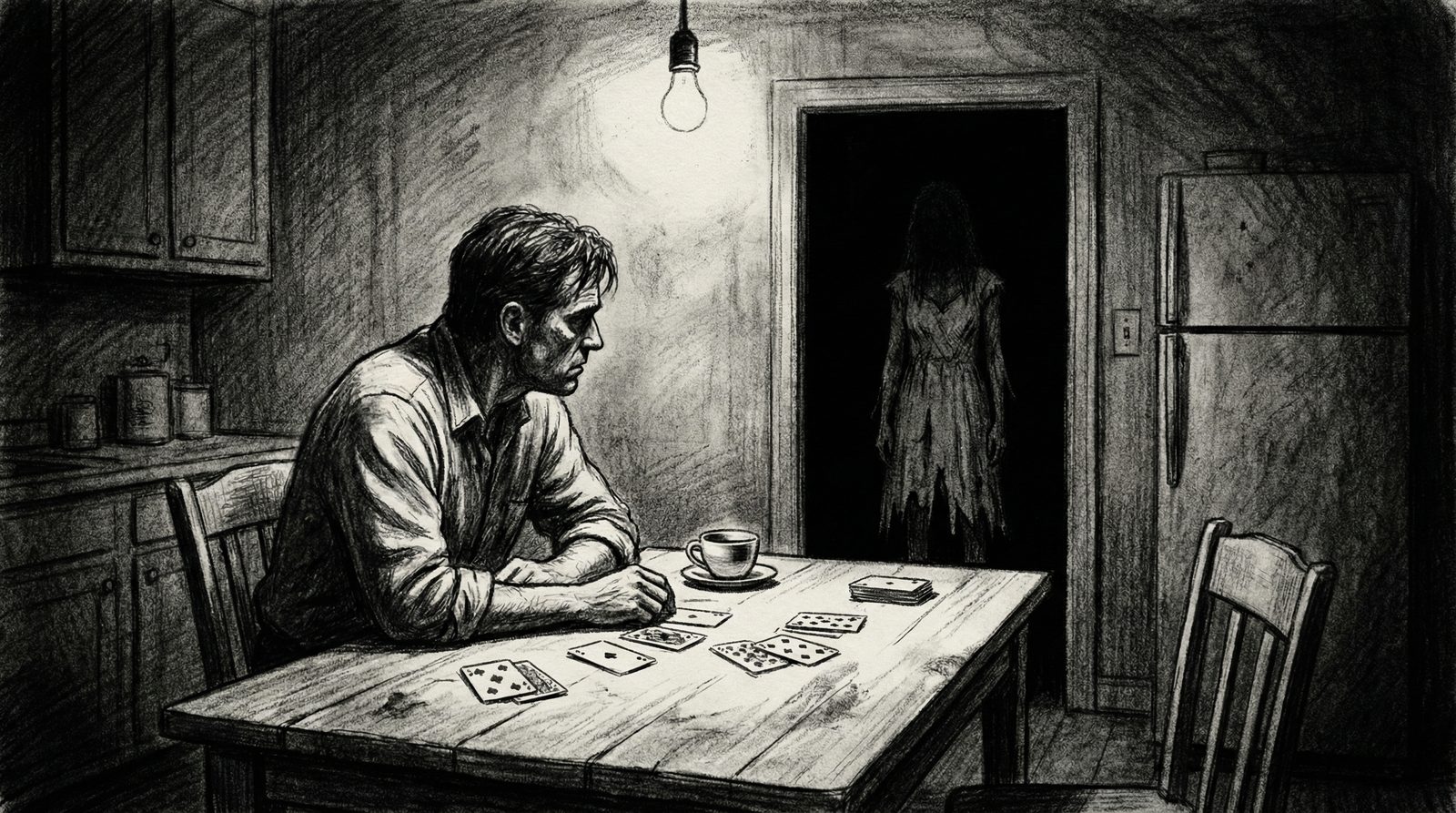
    Illustration of a core idea or motif from 'Pet Sematary (1983)'

    TRIVIA & AUTHOR FACTS

    King wrote Pet Sematary after moving his own young family to a house near a busy road in Orrington, Maine, where a pet cemetery really existed in the woods behind the property. His daughter’s cat was killed on that road, an event that directly inspired Church’s fate. The manuscript reportedly disturbed him so much that he shelved it for a time, only publishing it to fulfill a contractual obligation.

    Several details in the book echo King’s broader fictional Maine: Ludlow sits not far from other invented towns like Derry and Castle Rock, and the Micmac burial ground hints at an older, shared supernatural geography. The University of Maine setting draws on King’s own experience teaching there. The phrase “Sometimes dead is better,” spoken by Jud, became one of King’s most quoted lines, encapsulating the novel’s entire moral argument in four blunt words. Despite his misgivings, the book became one of his most discussed works, especially among readers who are parents.


    SIMILAR BOOKS

    If you’re drawn to the way Pet Sematary fuses family drama with supernatural horror, you might look toward Shirley Jackson’s The Haunting of Hill House (1959) for another study in psychological erosion. For a different but related take on grief and uncanny return, Peter Straub’s Ghost Story (1979) offers an older generation haunted by past sins. Those interested in the rural, ritualistic side of horror might turn to Thomas Tryon’s Harvest Home (1973), where small-town traditions conceal something far older and crueler. All share with King an interest in how ordinary people remake themselves – sometimes monstrously – when confronted with the unacceptable.


    DISCOVERABILITY & LINKS

    This review of Pet Sematary (1983) is connected on our site to wider discussions of motifs like roads and crossings, tropes such as the Faustian bargain, and related horror novels that explore grief, family, and the dangerous allure of undoing death.

  • Misery 1987

    Misery 1987

    By: Stephen King
    Genre: Horror
    Country: United States


    INTRODUCTION

    Misery is a novel about pain as a kind of language. A bestselling author, a lonely superfan, and a snowbound house in rural Colorado: King strips away the outside world until only two people and their shared hallucination of a fictional heroine remain. The recurring motif of confinement is everywhere — locked doors, plaster dust, the wheelchair’s narrow orbit around the bedroom. As the story tightens, another motif surfaces: the blurred line between creation and self-destruction. The book is less about jump scares than about the slow erosion of will, the way dependency can feel like a sick form of intimacy. Misery is a horror story, yes, but it’s also a bitter little fable about what happens when your work belongs more to your audience than to you.


    PLOT & THEMES

    Misery opens with novelist Paul Sheldon waking up after a car crash in rural Colorado, his legs shattered, his body soaked in painkillers. He’s in the home of Annie Wilkes, a former nurse who calls herself his “number-one fan.” At first the trope of the rescuer turned jailer plays almost gently: she feeds him, manages his medication, and praises his work. Then she discovers his latest manuscript, where he has killed off Misery, and the story turns. She burns his new book in front of him, forcing him to watch every page go black in the grill, and demands he write Misery’s Return just for her.

    The motif of bodily mutilation runs alongside the erosion of Paul’s autonomy — from his shattered legs to the infamous amputation of his foot with an axe, and later the loss of his thumb. Unlike the film adaptation, where the sheriff dies inside the house, in the novel a state trooper becomes suspicious of Annie and investigates Paul’s disappearance; Annie murders him out in the yard, running him over with her riding lawnmower while Paul watches helplessly from the window. The world keeps trying to seep in, and Annie keeps cutting it off, figuratively and literally.

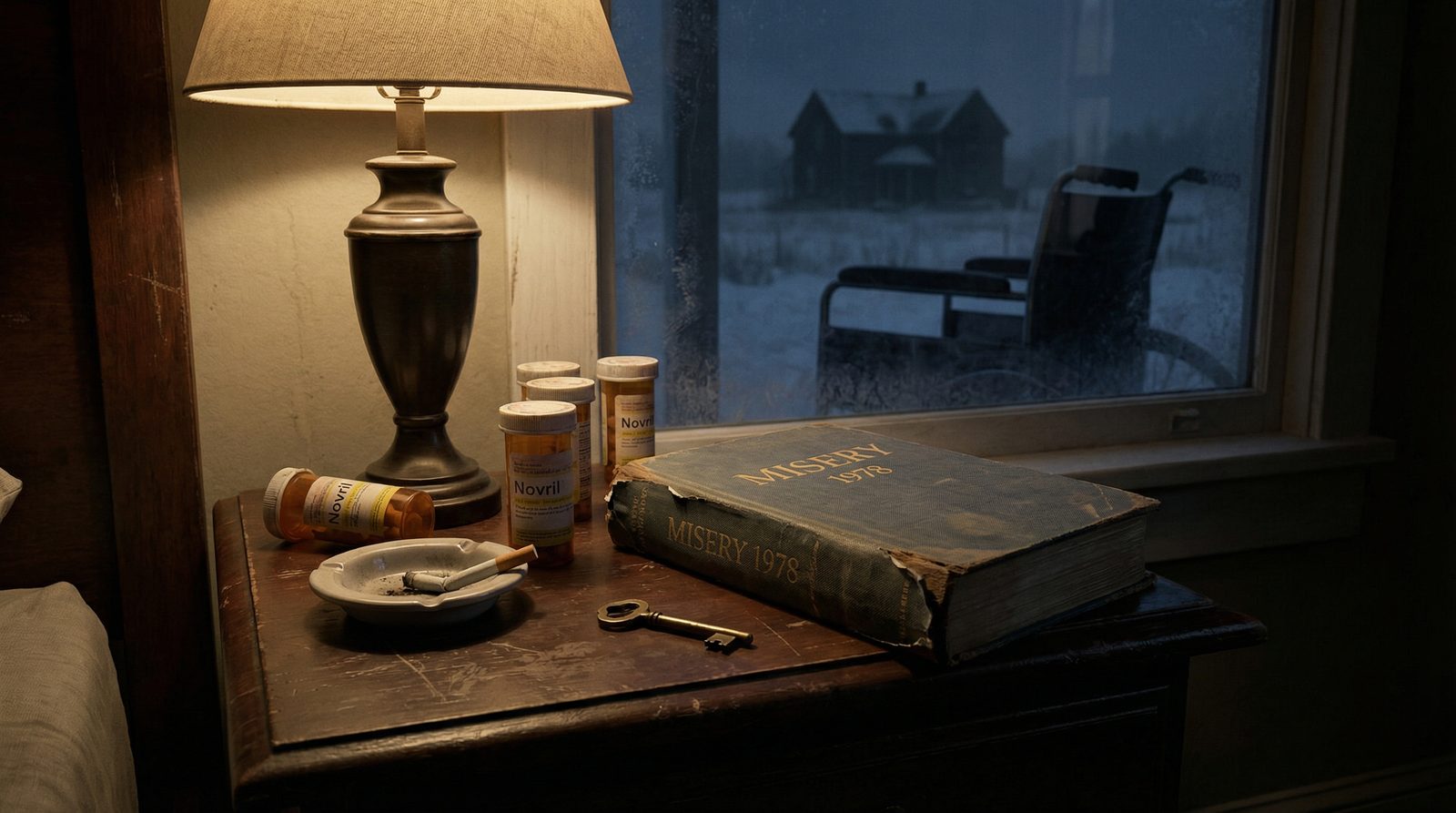
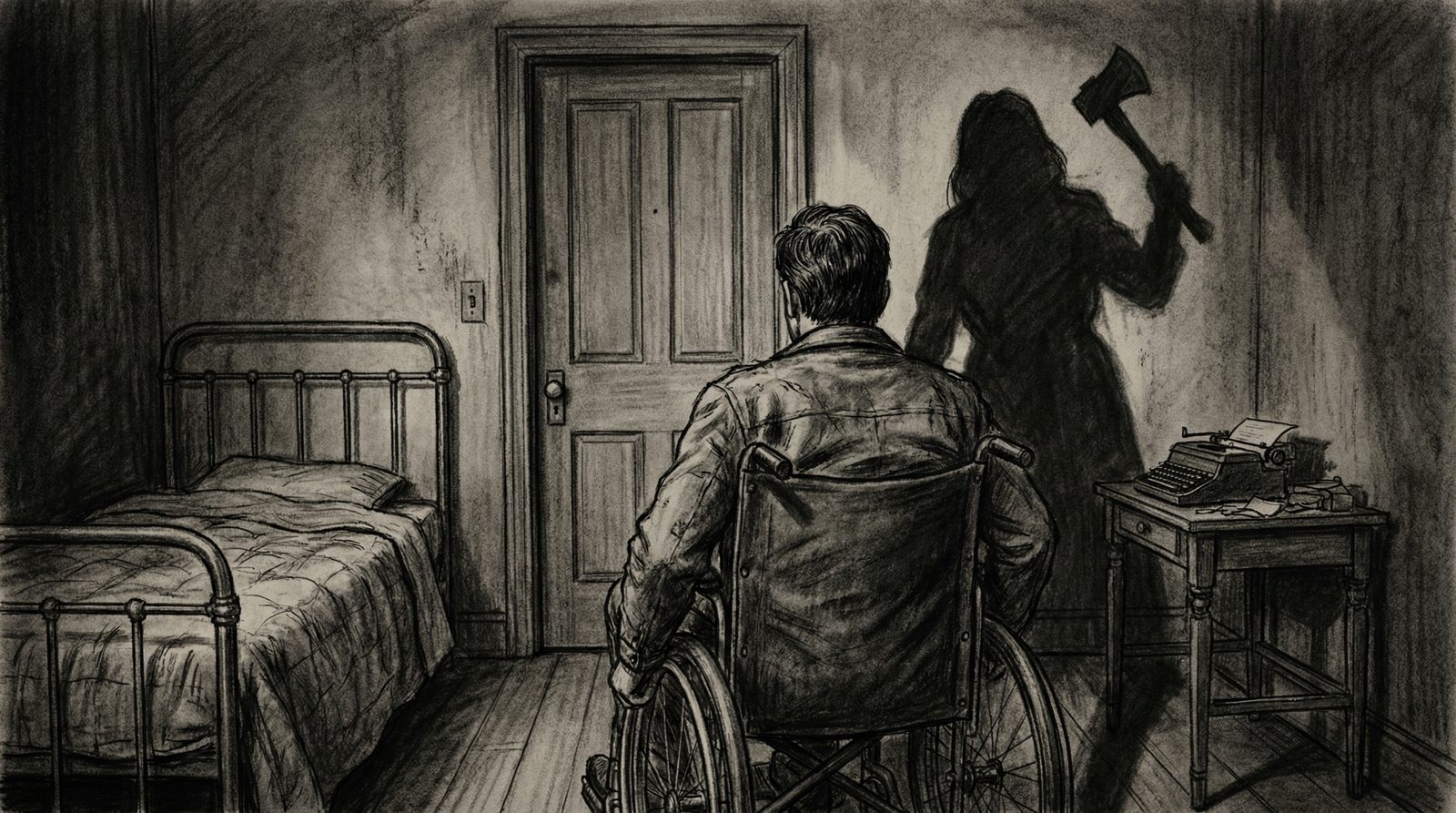
    King runs addiction and dependency as parallel themes. Paul’s history with alcohol and cigarettes mirrors his new dependency on Novril, the fictional painkiller Annie doles out and withholds. His writing of Misery’s Return becomes a survival strategy and a self-betrayal: he’s resurrecting a character he despises in order to live. The final showdown begins in the bedroom, where Paul sets fire to the manuscript as a decoy and uses the heavy typewriter as a weapon; Annie is later found dead in the barn after crawling out of the house, apparently on her way to fetch a chainsaw. Paul survives, but he is haunted — literally seeing Annie in public places, still hearing her voice. Unlike the cleaner catharsis of many film adaptations, the novel leaves him damaged, sober, and permanently entangled with the monster he outwrote but never quite escaped.

    Read alongside something like The Shining (1977) or the film Black Swan (2010), Misery sits in a line of stories where artistic creation becomes a crucible that burns away everything extraneous, including sanity.


    PROSE & NARRATIVE STRUCTURE

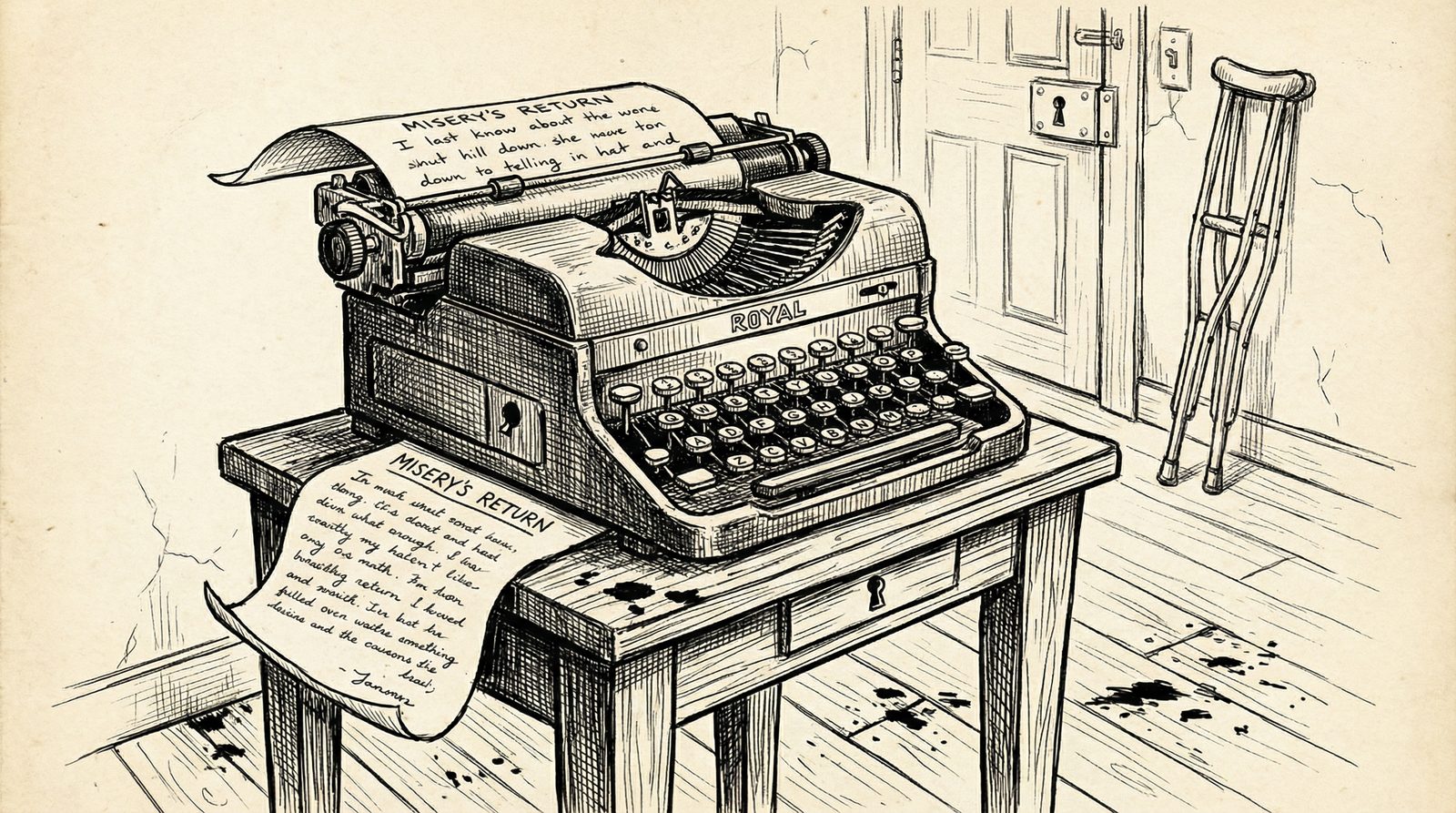
    The book uses close third-person as its primary narrative technique, locked almost claustrophobically inside Paul’s mind. We feel every throb in his shattered legs, every itch he can’t scratch, every spike of terror when he hears Annie’s car on the gravel. The prose has a jittery, pain-soaked feel: sentences sometimes fracture under the weight of morphine dreams and panic. King litters the text with Paul’s private slang — “goddams,” “laughing place,” the way he calls his typewriter the “Royal” as if it were a temperamental animal. These details never made it into the more streamlined adaptation, but on the page they’re crucial to how we inhabit his consciousness.

    Structurally, Misery is a chamber drama. Almost everything happens in one house, mostly one room, and King leans hard on repetition: Annie’s entrances, the ritual of the Novril pills, the clack of the typewriter keys. Interleaved with the main narrative are long passages of Misery’s Return itself, printed in a faux-typed font in many editions, complete with typos when keys stick or letters break off the typewriter. This embedded narrative isn’t just a gimmick; it’s a second story about resurrection and control that mirrors Paul’s situation.

    The book’s pacing is a slow crank. King alternates between stretches of grinding routine and short, vicious bursts of violence — the feeding of the rat in the basement, the discovery of the scrapbook that documents Annie’s past murders at Sidewinder General Hospital, the moment she cuts off Paul’s foot for trying to escape. The structure traps the reader the way Annie traps Paul: you learn the rhythms of her moods, you wait for the next explosion, and you know, long before he does, that there is no safe way out.

    Conceptual editorial illustration inspired by 'Misery (1987)'

    CHARACTERS & INTERIORITY

    Paul Sheldon begins as the familiar archetype of the jaded author. Trapped in Annie’s guest room, he’s stripped down to something more raw. His interior monologue swings between self-disgust, petty vanity, and a stubborn will to live. He bargains with himself as much as with Annie — promising another chapter in exchange for another day, another cigarette, another chance to crawl to the door.

    Annie Wilkes is one of King’s most precise portraits of madness. On the surface she’s the nurturing caregiver, the “good nurse” who knows how to set a splint and manage a dosage. Underneath, she’s a childlike absolutist, incapable of tolerating narrative disappointment. Her language — “dirty bird,” “cockadoodie,” her fury at “swearing” — gives her the affect of a prudish aunt, which only makes the sudden violence more jarring. The scrapbook in the spare room, where she has pasted clippings about the deaths of infants and elderly patients under her care, is a quiet, book-only horror that deepens her beyond the more theatrical moments.

    Their relationship is not simply captor and captive; it’s a grotesque parody of author and audience. Annie demands emotional honesty and narrative satisfaction on her terms. Paul, in turn, learns to manipulate her through plot twists, cliffhangers, and the promise of Misery’s resurrection. The interiority of both characters is built around control — who has it, who’s pretending to have it, and what happens when it shifts by a fraction. Even minor figures, like the store clerk at the Silver Creek market who notices Annie buying reams of paper, exist mainly as distant reminders that there is a world where people have names and choices, a world Paul can no longer quite reach.


    LEGACY & RECEPTION

    Within Stephen King’s body of work, Misery is one of the leaner, more disciplined novels, often cited alongside Gerald’s Game (1992) as proof that he can do tight, small-scale horror as well as expansive epics. Readers and critics have long read it as King’s argument with his own fame: Paul’s resentment of the Misery books echoes King’s unease with being known primarily for horror when he wanted to write other things. The novel’s focus on writer’s block, addiction, and the punishing expectations of fans has made it a touchstone for discussions about parasocial relationships decades before that term became common.

    The book’s ending, with Paul sober in New York, still seeing Annie’s ghost in a passing stranger and still half-hallucinating her voice as he writes a new, non-Misery novel, leaves a lingering aftertaste. Survival here is not triumph but a damaged continuation. That refusal to tidy up the trauma is part of why the novel has endured, even as its more famous adaptation softened some of the bodily harm and gave audiences a slightly clearer emotional release. On the page, Misery remains a sharp little knife aimed at the uneasy bond between artists and the people who consume them.


    IS IT WORTH READING?

    If you have any patience for psychological horror, Misery is worth your time. It’s compact, vicious, and oddly moving in its portrait of a man bargaining with his own worst habits as much as with his captor. The violence is graphic but not gratuitous; the real horror is the loss of agency and the way pain narrows a life to a few square feet of floor and a stack of typed pages. It’s also one of the clearest windows into how a popular writer thinks about his craft under pressure. If you want haunted houses or sprawling mythologies, look elsewhere. If you want two people locked in a room, fighting over a story and a body, this is as good as it gets.

    Illustration of a core idea or motif from 'Misery (1987)'

    TRIVIA & AUTHOR FACTS

    Stephen King has said that the idea for Misery came from a dream about a fan who held him captive and forced him to write. The fictional painkiller Novril is part of a loose web of invented drugs that appear across his work, reflecting his own struggles with substance abuse during the period. The town of Sidewinder, mentioned in Annie’s nursing history, also appears elsewhere in his Colorado-set stories, tying this small, brutal narrative into a larger imagined geography.

    The embedded novel Misery’s Return was originally much shorter in draft; King expanded it to better show Paul’s reluctant craftsmanship. The decision to have Annie’s body ultimately discovered in the barn rather than in the main house was a late structural change, meant to move the final confrontation out of the now-familiar bedroom and into a rougher, more elemental space. King has also noted that Paul’s shift from genre series work to a more serious, literary-leaning manuscript after his ordeal mirrors his own periodic attempts to step outside the expectations attached to his name.


    SIMILAR BOOKS

    If Misery appeals to you, try The Shining (1977) for another intense portrait of a writer under supernatural and psychological siege. Gerald’s Game (1992) offers a similar single-location nightmare, this time inside a marriage. For a different angle on dangerous devotion, John Fowles’s The Collector (1963) tracks a kidnapper who treats his victim like a rare specimen, not unlike Annie treating Paul as the source of her beloved stories. And if the focus on bodily vulnerability and constrained space is what grips you, you might also seek out more recent psychological horror that keeps its cast small and its emotional stakes painfully close to the skin.


    DISCOVERABILITY & LINKS

    This review of Misery is connected to wider motifs, tropes, and related works across the site, helping you trace patterns of confinement, obsession, and the uneasy bond between creators and their audiences through other books and media.