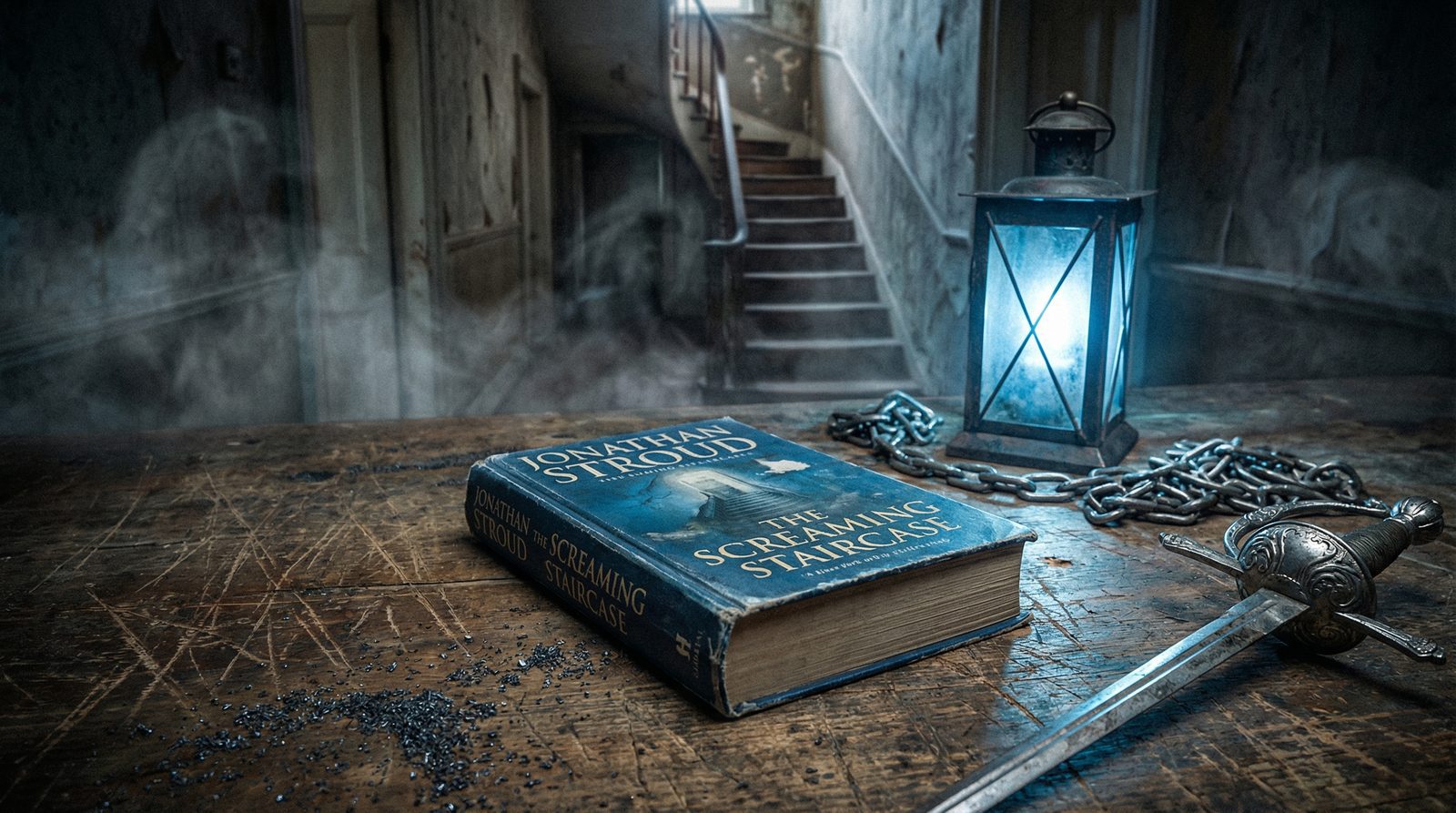
Narrative Techniques: First-person retrospective narration

  • The Screaming Staircase (2013)

    The Screaming Staircase (2013)

    INTRODUCTION

    The Screaming Staircase (2013) by Jonathan Stroud
    Supernatural mystery · 467 pages · United Kingdom


    The Screaming Staircase is a ghost story built on anxiety and ash rather than comfort. Jonathan Stroud imagines a London quietly broken by hauntings, where children carry rapiers and iron chains while adults retreat behind curfews and committees. Silence and sound run through everything: the sudden dead hush before a Visitor appears, the scrape of chains on stone, the way fear makes even ordinary rooms feel underexposed. Yet the book is also wry at the edges, especially in the kitchen scenes at 35 Portland Row, where tea and bickering become a survival ritual after near-death.

    The feel is a mix of dread and camaraderie — late-night adrenaline followed by exhausted laughter. Stroud isn’t chasing cheap shocks. He’s interested in what it means to grow up when danger is simply the weather of your world, and when the only people who will really fight for you are your equally damaged friends.

    PLOT & THEMES

    The story follows Lucy Carlyle, a young agent with the rare ability to hear ghosts, as she joins the tiny, precarious agency Lockwood & Co. After an early case damages their reputation, Lucy, Lockwood, and George are forced to take on a high-profile haunting at Combe Carey Hall to secure the agency’s future. The hall’s infamous Red Room and the Screaming Staircase become the physical heart of the plot, but the deeper theme is institutional failure: a society that cannot protect children, yet depends on them to survive.

    Stroud plays with the haunted-house investigation structure but twists it so the kids are professionals, not meddling amateurs. Smaller jobs and research threads lead toward the Combe Carey case, giving the novel a procedural rhythm. Thematically, it’s about exploitation and secrecy: Lucy’s past, the way agencies compete, and the adults who hide information while children bleed for them. Even George’s obsession with dangerous artifacts hints at the book’s moral logic: in this world, the dead are constantly being turned into tools.

    The ending is survivalist rather than comforting. At Combe Carey Hall, Lucy and Lockwood uncover the true horror beneath the staircase: a history saturated into the house itself. Lucy descends into the source space and manages to calm the dead long enough for escape as the hall burns. The case is “won,” but the victory is smoky and incomplete. The agency emerges with money and renewed reputation, but Lucy senses the Problem is far larger than one house or one wealthy villain.

    PROSE & NARRATIVE STRUCTURE

    The book uses first-person retrospective narration, with Lucy speaking from an unspecified point in the future. That choice quietly shapes everything. She withholds, circles back, and drops hints about later catastrophes, creating a braided structure: the present case narrative threaded with the shadow of earlier trauma and future consequence. The opening isn’t Combe Carey at all, but a smaller job that shows how the series can be comic in one scene and lethal in the next.

    Stroud’s prose is clean, rhythmic, and slyly funny. Sensory detail does a lot of the horror work: the sour-metal taste of ectoplasm, the greasy chill of a Visitor’s touch, the way ghost-fog muffles sound along streets and rivers. Jokes about crumbs, clothing, and petty arguments puncture tension without dissolving it. Structurally, the novel alternates between tight set pieces (the Red Room, the Staircase) and quieter interludes at Portland Row, where case files and tea become tools of worldbuilding.

    During hauntings, Stroud favors clipped dialogue and abrupt paragraph breaks that mimic the jerkiness of fear. The book reads fast, but it leaves an aftertaste, especially in the throwaway lines where Lucy implies how many names she will eventually carry as ghosts in memory.

    Conceptual editorial illustration inspired by 'The Screaming Staircase (2013)'

    CHARACTERS & INTERIORITY

    Lucy is built as a haunted prodigy: gifted, stubborn, and shaped by betrayal. Her guilt over earlier disasters colors every risk she takes. She’s not just fighting ghosts; she’s trying not to repeat the adult negligence that got people killed before she ever arrived at Portland Row.

    Lockwood is more mask than man in this first volume. Stroud withholds his backstory, letting the reader see him mainly through Lucy’s fascination and irritation. George is gloriously unglamorous: messy, obsessive, and research-driven. His friction with Lucy and his willingness to break rules for information establish him as a parallel moral center rather than a sidekick.

    The character work sings through constant friction. The trio bickers, misreads each other, and still shows up. The ghosts are frightening, but the deeper drama is three teenagers trying to build a life and a business in a world that expects them to die young.

    LEGACY & RECEPTION

    When The Screaming Staircase arrived in 2013, it entered a crowded market of paranormal YA, but Stroud’s approach felt different. He treated ghosts as a labor problem and children as underpaid professionals. Readers responded to the intricate rule-based worldbuilding — iron, salt, lanterns, agency rivalries — and to the dry humor that kept the horror from curdling.

    The series has aged well because the first book is starker than a typical genre opener. It does not promise the world will become safe. It promises only that the kids will keep working anyway, and that grim logic gives the story its bite.

    IS IT WORTH READING?

    If you want a ghost story that respects its young characters’ intelligence and suffering, The Screaming Staircase is worth reading. It’s genuinely eerie, but the real hook is the emotional texture: exhausted kids making tea at midnight, joking because the alternative is breaking down. The pacing is brisk, the humor dry, and the horror grounded in physical detail rather than abstract spookiness.

    If you need tidy moral resolutions or adults who know what they’re doing, you may bounce off it. But if you’re willing to sit with ambiguity and a world that won’t be fixed by one brave act, this first Lockwood & Co. book sets the tone sharply and rewards you for following the series forward.
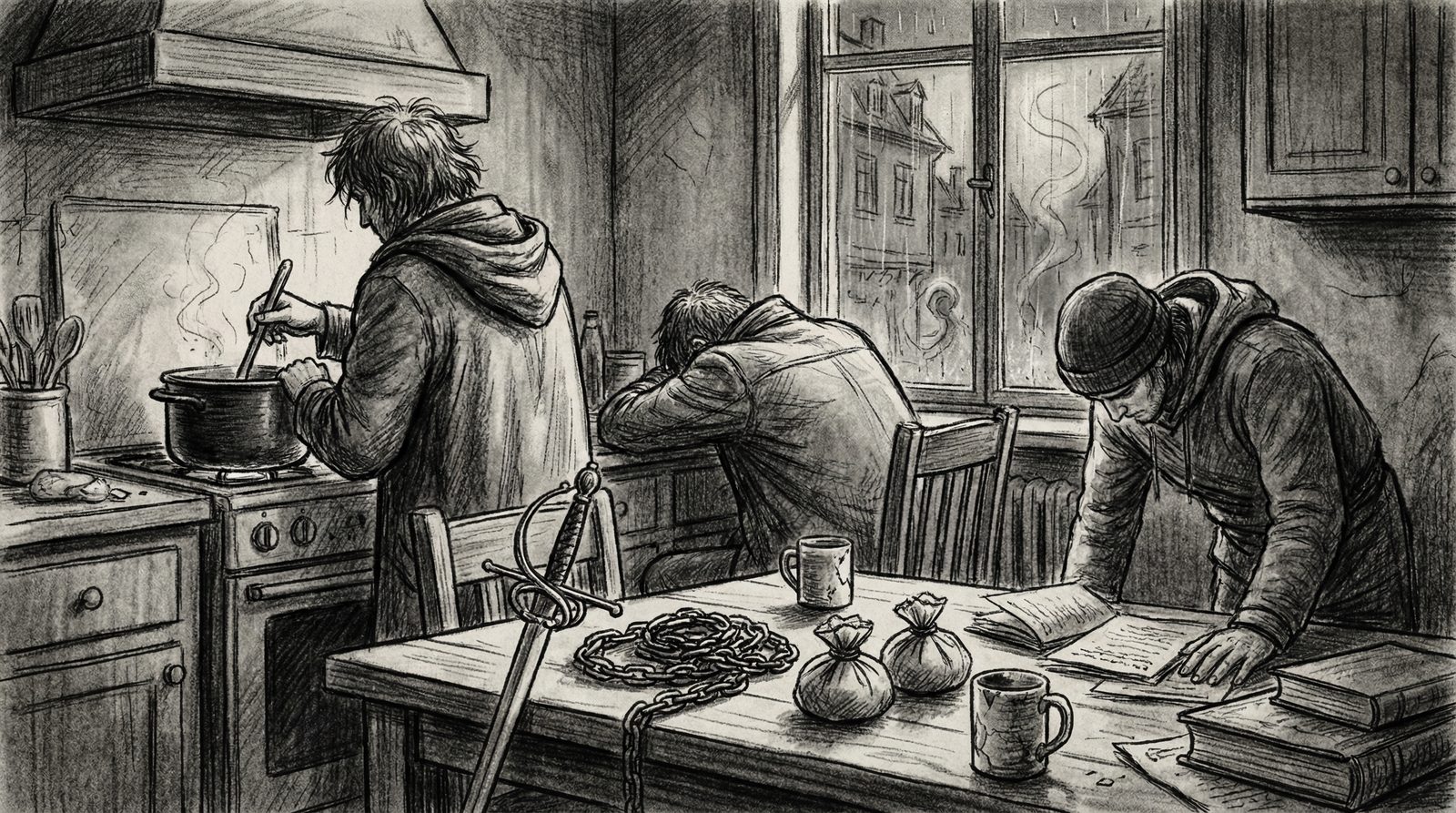
    Illustration inspired by 'The Screaming Staircase (2013)'

    TRIVIA & AUTHOR FACTS

    Jonathan Stroud was already known for the Bartimaeus sequence when he began Lockwood & Co. This first volume is written with a clear long game in mind: Lucy’s retrospective voice hints at later catastrophes, and several small details become crucial later, including the locked room at Portland Row and the dangerous artifacts George can’t stop studying.

    The UK setting is not cosmetic. Stroud leans into terraced houses, foggy canals, and municipal bureaucracy to make the hauntings feel local and structural. The series began as a grounded thought experiment: what if children were the only ones who could safely do the most dangerous job in society?

    SIMILAR BOOKS

    If this book works for you, you may enjoy other stories where the supernatural collides with institutional neglect and where young people are forced into professional danger. The strongest neighbors tend to treat fear as logistical and social, not only mystical.

    DISCOVERABILITY & LINKS

  • The Whispering Skull (2014)

    The Whispering Skull (2014)

    INTRODUCTION

    The Whispering Skull (2014) by Jonathan Stroud
    Young adult fantasy · 448 pages (UK hardcover) · United Kingdom


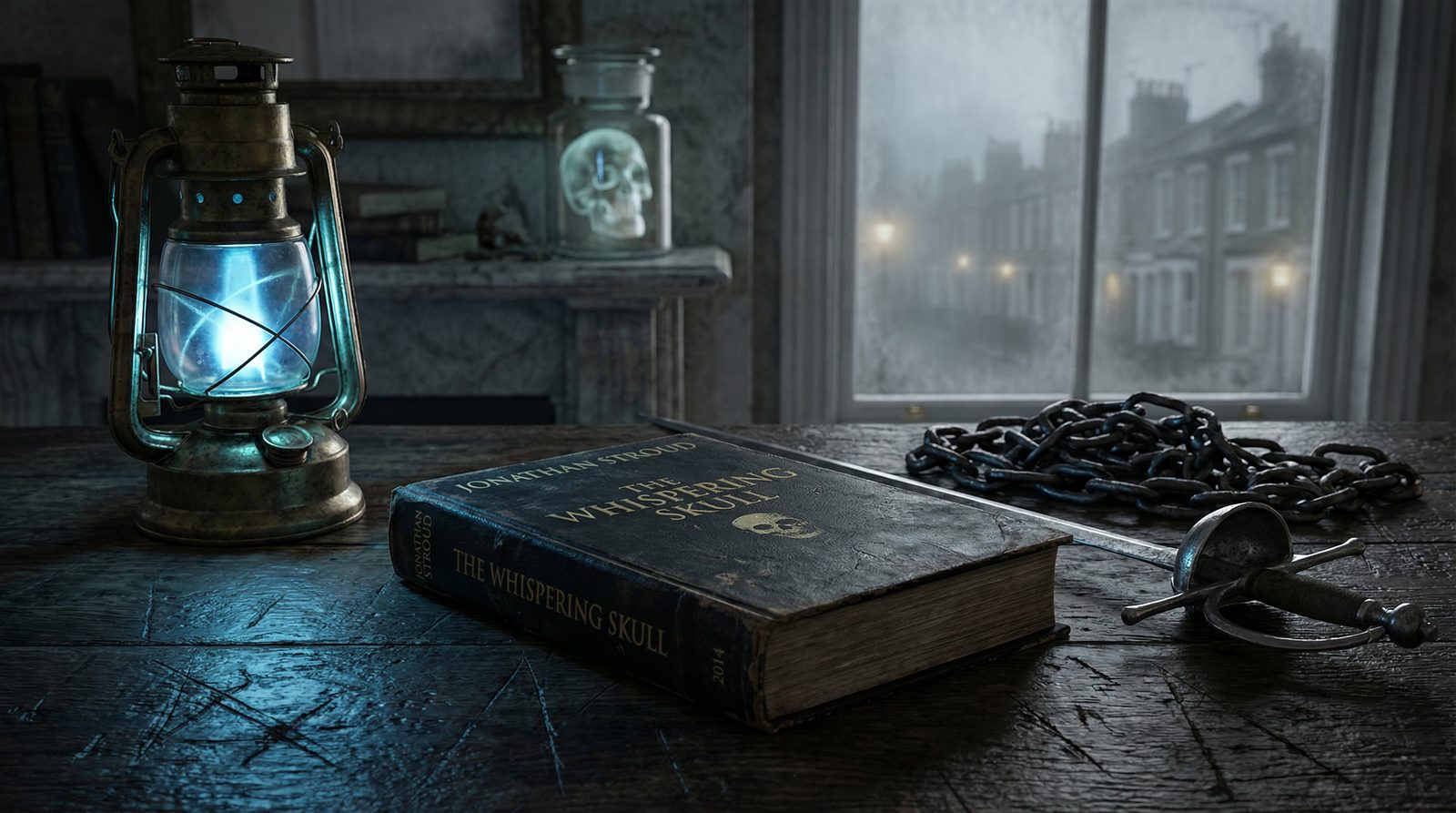
    The Whispering Skull is where Lockwood & Co. stops feeling like a clever ghost-hunting premise and starts to feel like a haunted friendship. Stroud takes his alternate 2010s London and leans into bones, relics, and buried history. The tone stays brisk and funny, but there’s a persistent melancholy under the banter, as if every joke is being told with the cemetery gates still swinging behind you. This second book tightens focus on the small agency at 35 Portland Row and pushes them into direct conflict with both spectral threats and the petty cruelties of adult institutions.

    It’s not just about defeating Visitors. It’s about what happens to children who grow up with iron chains in one hand and a ghost-lantern in the other, and how long they can keep pretending that’s normal.

    PLOT & THEMES

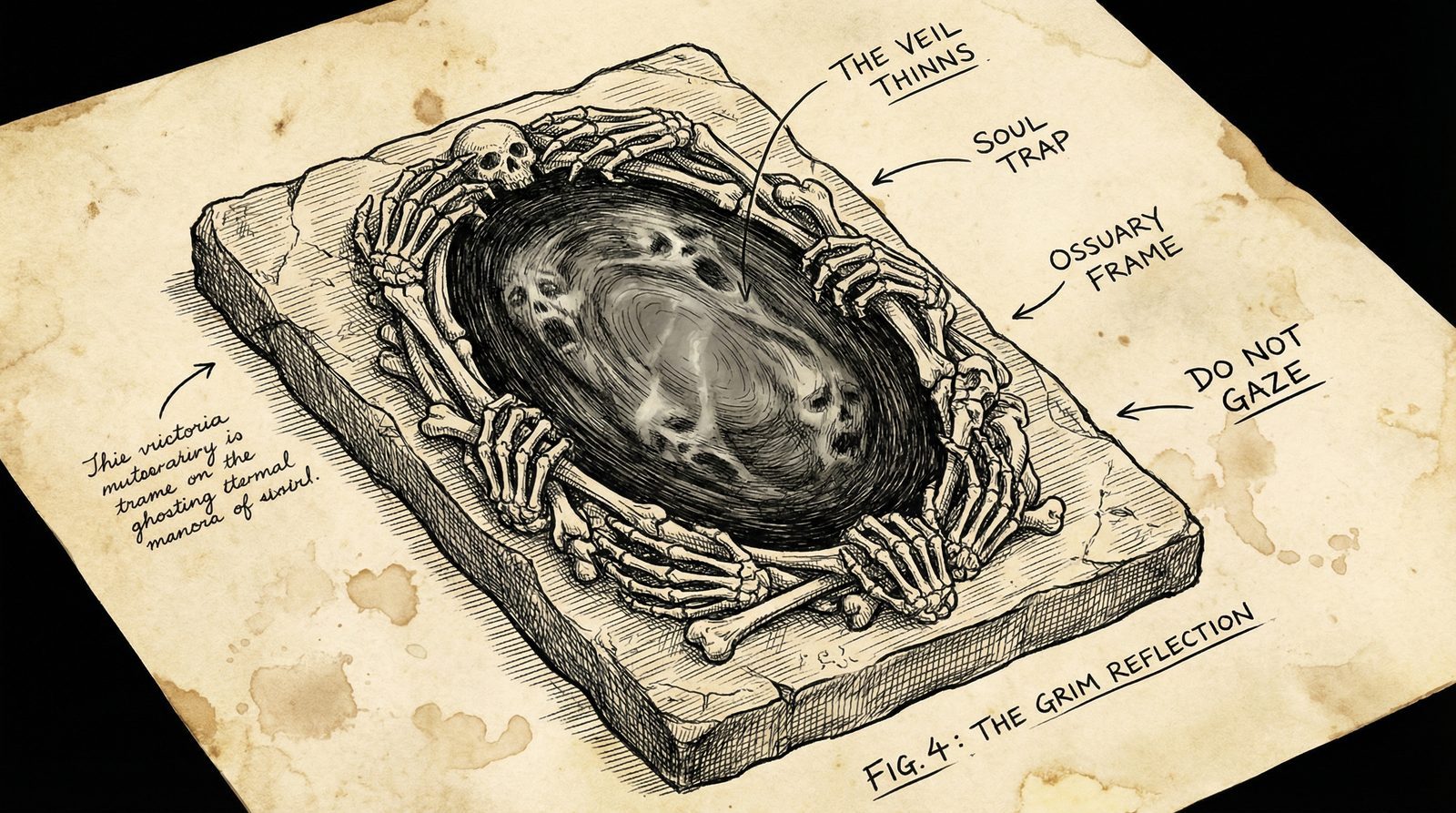
    The plot hinges on two dangerous objects: a stolen bone mirror taken from the grave of the Victorian occultist Edmund Bickerstaff, and the titular Whispering Skull, a communicative ghost sealed in a glass jar in Lockwood’s basement. The rivalry with the larger Fittes agency continues, turning every case into a contest for prestige and survival. Quill Kipps and his squad are comic foils, but they also remind the reader that Lockwood’s outfit is underfunded and one serious mistake away from ruin.

    Mirrors and reflection become the book’s central symbolic logic. The bone mirror does not merely show the past; it shows unbearable truths and functions like a psychic trap. That’s why the story keeps returning to private looking as a form of danger. The mirror’s influence on George becomes increasingly insidious, culminating in a near-fatal compulsion to face its visions alone.

    The institutional layer expands. Visits to cemeteries, research facilities, and agency strongholds hint at a wider exploitation of the Problem: not only fear management, but profit, secrecy, and competitive sabotage. The book’s procedural spine keeps the world grounded in rules and consequences, which ties naturally to the Ghost Hunting Agency motif and brushes up against Magical Bureaucracy whenever oversight and institutional obstruction enter the frame.

    The ending is clean and decisive. Lockwood, Lucy, and George confront the mirror in the catacombs and destroy it with Greek Fire, denying its power to everyone who wants to weaponize it. The final sting comes back at home: the Skull retaliates by revealing it knows something about Lockwood’s locked room and his dead sister, turning a solved case into a deeper future threat.

    PROSE & NARRATIVE STRUCTURE

    Stroud’s prose is deceptively light, and Lucy’s first-person retrospective narration gives everything a double edge. We are in the moment with a frightened, stubborn teenager, but we are also listening to a voice that already understands which mistakes will echo. That distance lets Stroud slide from kitchen banter at Portland Row into a chilling description of the bone mirror’s surface without changing gears.

    The structure alternates between set-piece hauntings and slower investigative passages: cemetery missions, mausoleum sequences, and the final catacomb descent, broken up by research in George’s paper-strewn basement and Lucy’s late-night conversations with the Skull. Those Skull scenes feel like a dangerous kind of therapy: comfort mixed with coercion. Domestic rituals — tea, toast, Lockwood’s immaculate suits — become a fragile defense against the encroaching dead.

    Action is cleanly choreographed and tactile: iron chains on stone, salt and flame, the sudden drop in temperature when a Visitor arrives. The pacing is confident because the book knows what it is doing: it keeps feeding casework forward while quietly tightening the emotional screws inside the house.

    Conceptual editorial illustration inspired by 'The Whispering Skull (2014)'

    CHARACTERS & INTERIORITY

    At the center is Lucy Carlyle, a haunted-heroine variation who is both weapon and witness. Her Listening talent makes her uniquely vulnerable to the Skull’s taunts, and Stroud lets the reader feel her mix of pride and fear whenever she pushes her ability further. Her prickliness and jealousy, especially toward rival agency figures, ground the character in mid-teen social pain rather than generic heroism.

    Anthony Lockwood remains charmingly opaque. We glimpse grief through fissures: his fury at institutional threats, his tight-lipped silence about the locked room, the way he flinches when certain names surface. George Cubbins gains sharper interiority here, with the mirror’s pull revealing how the Problem corrodes even the researcher’s sense of control. The Skull becomes the most unsettling presence of all because Lucy begins to seek its validation even as she knows it is malicious.

    LEGACY & RECEPTION

    The Whispering Skull is often remembered as the installment where the series “locks in.” The world of iron chains, ghost-fog, and child agents becomes not just a setting but a coherent system with rules and moral cost. The later screen adaptation rearranges material, but the book’s quieter achievements remain hard to replicate: Lucy’s voice, George’s creeping obsession, and the Skull’s final revelation that lands like a stone in still water.

    Within YA supernatural fiction, the novel stands out for combining procedural casework with emotional fracture. It trusts readers to sit with unresolved questions while still delivering a clean, satisfying case conclusion.

    IS IT WORTH READING?

    If you liked the first book but wanted more emotional weight and stranger ghosts, this is worth your time. It balances spectral action with character work and lets jokes coexist with dread. The horror isn’t gore; it’s standing in the dark with something whispering in your ear, telling you what you most want — and fear — to hear. If Lucy’s voice and her uneasy bond with the Skull click for you here, the rest of the series will reward you.

    Illustration inspired by 'The Whispering Skull (2014)'

    TRIVIA & AUTHOR FACTS

    Stroud’s experience with voice-driven fantasy in the Bartimaeus books shows in the Skull’s sardonic commentary. This installment continues his interest in pairing young protagonists with dangerous, talkative supernatural entities. The novel also deepens the series’ working-world logic: agencies, relic markets, regulation, and institutional secrecy layered over classic ghost story fear.

    Real London locations are tilted into the uncanny, and Stroud’s material toolkit — iron, salt, Greek Fire, sealed jars — keeps the magic tactile rather than abstract. The procedural clarity is part of the series’ signature: the rules matter, and so do the consequences of breaking them.

    SIMILAR BOOKS

    If you enjoy the mix of banter, ghosts, and real peril here, you may like other series that combine investigative structure with a strong voice and a dangerous partnership. The best matches tend to treat supernatural rules as work rules and use humor as a survival strategy rather than a mood.

    DISCOVERABILITY & LINKS

  • Demian (1919)

    Demian (1919)

    INTRODUCTION

    Demian (1919) by Hermann Hesse
    Bildungsroman · 268 pages · Germany


    Demian is a quiet, unsettling book, one that feels less like a story than like waking up inside someone else’s conscience. Written at the end of World War I, it traces the inner life of Emil Sinclair as he moves from the “world of light” of his bourgeois childhood into a shadowed realm of guilt, desire, and self-recognition.

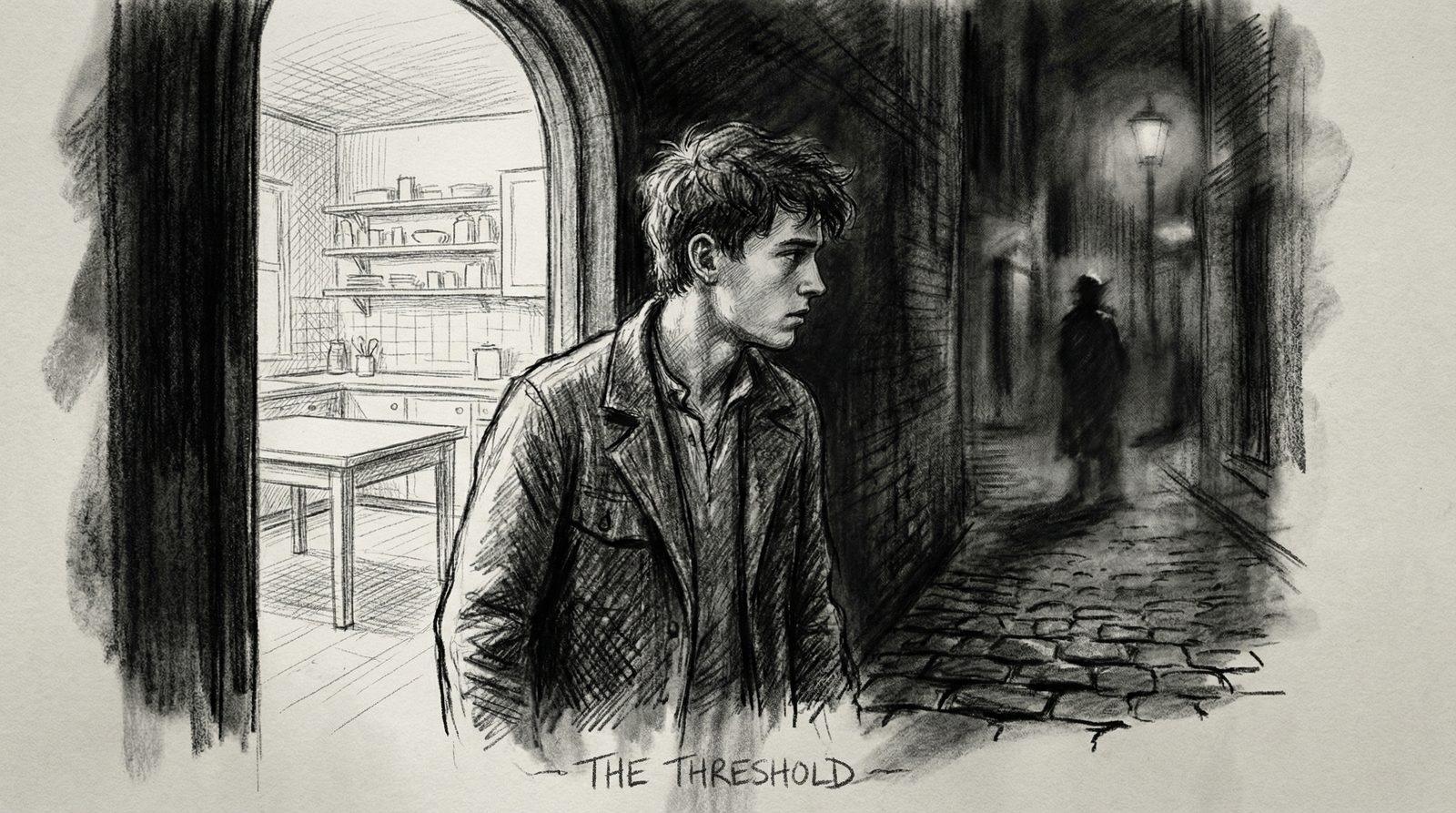
    The novel is not interested in plot fireworks. It is interested in fracture: the moment when inherited morality stops working and something unnamed begins to press from inside. Kitchens, classrooms, and church hymns coexist uneasily with alleyways, forbidden thoughts, and dreams that refuse to be decoded. The tone is restless and intimate, as if every page is leaning toward a transformation that cannot be safely named.

    PLOT & THEMES

    On paper, the plot is simple. Emil Sinclair grows up. In practice, this is a coming-of-age story stripped down to a spiritual case study. As a child in a respectable German town, Sinclair is blackmailed by the bully Franz Kromer after boasting about a minor crime. The lie cracks open the boundary between what Sinclair has been taught to call good and evil.

    Max Demian enters as an unsettling presence rather than a conventional rescuer. He dismantles Kromer’s power not through force but through psychological clarity. From that moment, Demian becomes a catalyst, pushing Sinclair away from inherited moral categories and toward an inner law he barely understands.

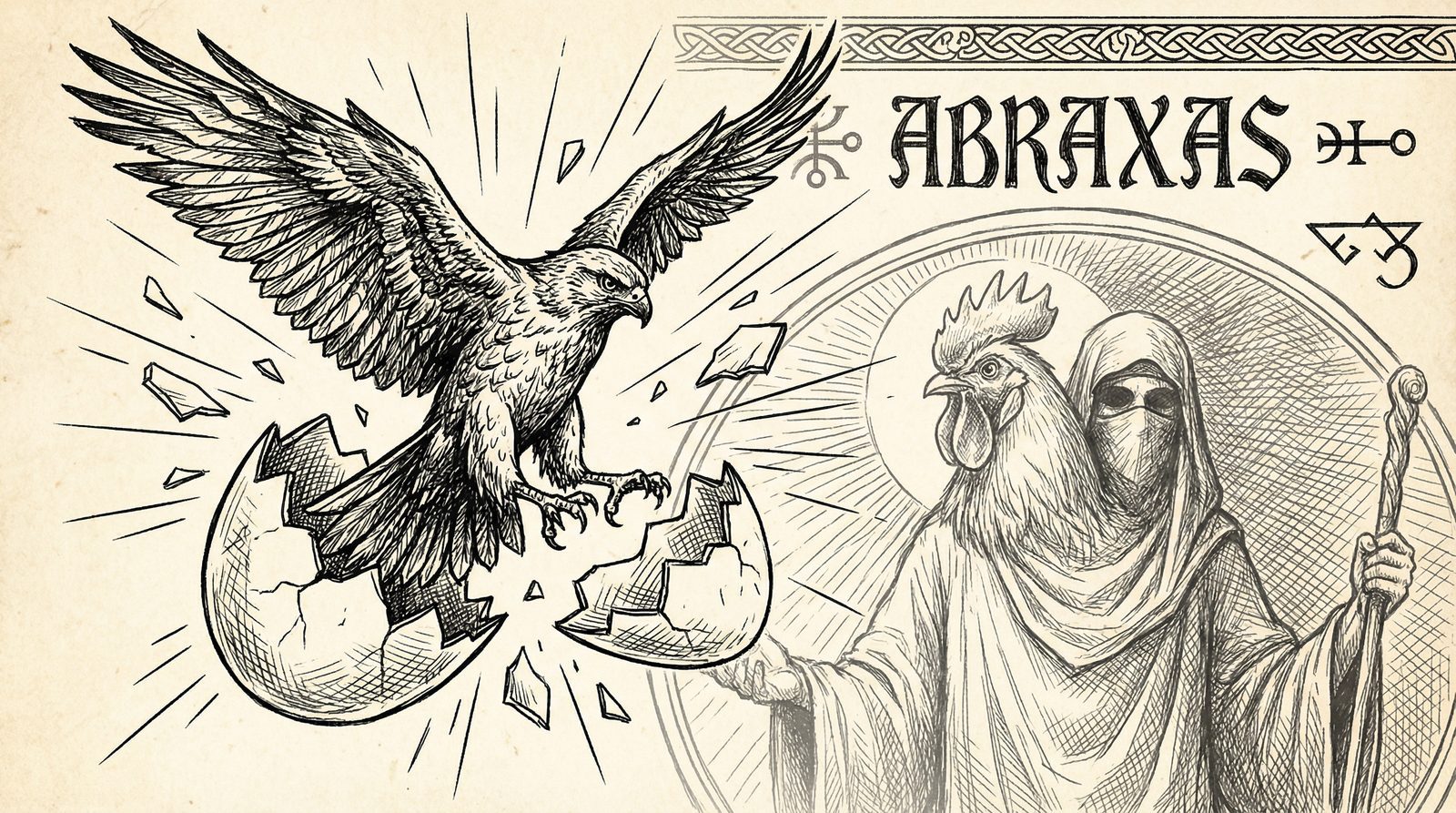
    The novel organizes itself around dualities. Sinclair moves between light and dark, spirit and flesh, obedience and rebellion. At boarding school he sinks into drinking and numb routine, then experiences a jolt of awakening through a dream of a bird breaking free from its egg. This image leads him to Demian’s mother, Frau Eva, whose house becomes a sanctuary for those drawn to a god who unites opposites rather than separating them.

    World War I remains mostly at the margins until it erupts at the end. Sinclair is wounded at the front and wakes in a field hospital to learn that Demian has been mortally injured. Demian appears one last time, perhaps in reality, perhaps as vision, and tells Sinclair that from now on he must find Demian within himself. The novel closes without consolation. The inner journey has been completed, but the world has been shattered.

    PROSE & NARRATIVE STRUCTURE

    The book is told in first-person retrospect. Sinclair narrates as an adult, looking back to locate the fault lines that ran under his youth. The prose is clear and restrained, punctured by moments of symbolic intensity: the smell of damp stone where Kromer corners him, the charged stillness of Pistorius’s organ loft, the recurring image of the hawk and the mark of Cain.

    Structurally, the novel advances in stages of consciousness rather than acts. Chapters function like psychological stations, each marking a shift in self-perception. External events often blur into interior states. Years pass quickly when Sinclair is spiritually asleep; moments of crisis expand and slow when something essential breaks or is recognized.

    Hesse keeps the focus narrow and vertical. There are no real subplots. Everything bends toward the same pressure point: the cost of becoming oneself in a world that demands conformity.

    Conceptual editorial illustration inspired by 'Demian'

    CHARACTERS & INTERIORITY

    Sinclair begins as a sheltered child who believes in the moral clarity of his parents’ world. What defines him is how quickly that certainty fractures. His interior life is obsessive and self-scrutinizing. Guilt, longing, and fascination churn long before they surface in action.

    Demian himself remains deliberately elusive. He shifts between schoolboy, prophet, and mirror. His interpretation of the Cain story reframes Sinclair’s sense of being marked as not cursed but set apart. Frau Eva embodies a vision of wholeness that Sinclair longs for, calm, inclusive, and indifferent to conventional morality.

    Minor figures are no less charged. Pistorius represents the danger of living only in symbols without fully entering the world. Kromer lingers as a reminder that darkness is not abstract. It has a voice, a smell, and a presence that can follow you into adulthood. Hesse allows these characters to blur into one another, as if they were facets of a single divided self.

    LEGACY & RECEPTION

    First published under a pseudonym, Demian spoke directly to readers emerging from the devastation of World War I. It offered neither patriotism nor consolation, but a language for inner dislocation. Its blend of psychological introspection and spiritual rebellion helped shape what would later be recognized as twentieth-century existential fiction.

    The novel’s refusal of a redemptive ending has been central to its endurance. Growing up here does not mean fitting in or finding peace. It means learning to recognize the mark that sets you apart and living with it. That idea has echoed through later portraits of alienated youth, from Hesse’s own later work to mid-century American fiction.

    IS IT WORTH READING?

    If you want a brisk plot or social panorama, this book will frustrate you. It is short, dense, and relentlessly interior. But if you are drawn to stories of adolescence as a spiritual earthquake, it remains one of the most honest accounts ever written.

    The language is accessible, the chapters compact, but the ideas linger. Hesse does not offer answers. He offers a vocabulary for the feeling that you do not quite belong to the world you were given, and that becoming yourself may require breaking something you were taught to protect.

    Illustration inspired by a core idea from 'Demian'

    TRIVIA & AUTHOR FACTS

    Hermann Hesse originally published the novel under the pseudonym “Emil Sinclair,” presenting it as the confession of an unknown young writer. Only later was his authorship revealed. The book draws heavily on Hesse’s engagement with Jungian psychology and his own period of analysis during the war years.

    The figure of Abraxas comes from Gnostic traditions, reshaped by Hesse to express the unity of opposing forces. Many images in the novel echo Hesse’s own childhood memories and recurring dreams. Demian marked a decisive turn in his career toward the introspective, spiritually questing works that would define his later reputation.

    SIMILAR BOOKS

    Readers who respond to this inward intensity may also turn to Siddhartha for a later, calmer spiritual journey, or Steppenwolf for a more fractured portrait of identity and rebellion. For a different cultural register of adolescent alienation, The Catcher in the Rye offers a similarly haunted voice without the explicit mysticism.

    DISCOVERABILITY & LINKS