
Trope: Spiritual Quest

  • The Peaceful Warrior The Life Of Dan Millman (2006)

    The Peaceful Warrior The Life Of Dan Millman (2006)

    Peaceful Warrior (2006) · Drama · United States.


    INTRODUCTION

    Peaceful Warrior adapts Dan Millman’s semi-autobiographical spiritual story into a reflective sports drama that feels half locker room, half meditation hall. It follows a talented college gymnast whose life is shattered by a catastrophic accident and rebuilt through an encounter with a mysterious mentor. Instead of chasing the usual underdog victory, the film leans into slow-burn transformation, asking what success means when the body and ego are stripped down.

    The tone moves between grounded collegiate routine and moments of mystical instruction, touching a steady feel of spiritual yearning and bittersweet hope. The story plays closer to parable than conventional sports narrative, inviting viewers to sit with its questions rather than its twists.

    PLOT & THEMES

    The plot centers on Dan, a driven college gymnast whose life is defined by discipline, competition, and an image of control. A late-night encounter at a gas station introduces him to an older man he nicknames Socrates, who speaks in riddles and quietly dismantles Dan’s certainties. When a motorcycle accident shatters Dan’s leg and threatens his athletic future, the story pivots from ambition to apprenticeship, framing crisis as the opening to inner change.

    The film’s central concern is the tension between external achievement and inner peace. Training sequences become exercises in presence rather than pure performance. The accident functions as Awakening Through Physical Injury, forcing Dan to confront who he is without his body’s reliability and without applause. In that sense, the film sits directly inside Athletic Discipline As Spiritual Practice, treating repetition as a method of transformation rather than punishment.

    A quieter thread is isolation versus community. Teammates and relationships orbit Dan, but the film keeps foregrounding solitary nights, private fear, and the long grind of recovery. The spiritual quest logic turns the campus environment into a kind of everyday monastery where the real contest is not against rivals but against the ego’s demand to be exceptional.

    CINEMATIC TECHNIQUE & AESTHETICS

    The film’s technique tries to bridge everyday realism with the feel of spiritual instruction. Campus and gym interiors are shot with functional clarity, while key moments of insight lean on slowed time, softened sound, and a slight stylization that pulls the viewer into Dan’s headspace. During routines, sound often drops toward a muffled thrum, mimicking tunnel vision and obsessive focus.

    Slow motion is used in both triumph and catastrophe, stretching midair gymnastics into suspended moments and treating the crash with similar durational emphasis. This repetition reinforces the film’s claim that disaster and awakening can arrive through the same instant of attention.

    The overall palette stays muted and grounded, making brief “insight” beats feel like small awakenings rather than grand revelations. The aesthetic aims for sincerity over spectacle, consistent with the story’s emphasis on practice and presence.

    Editorial illustration inspired by 'Peaceful Warrior'

    CHARACTERS & PERFORMANCE

    Dan is written as a high-achiever whose identity depends on performance. Early scenes emphasize restlessness and arrogance, which gives later vulnerability real contrast. His arc is less about learning a new skill than about unlearning his dependence on control and validation.

    Socrates functions as the Wise Mentor, a blend of mechanic, sage, and trickster. He appears at odd hours, dispenses blunt advice, and assigns tasks that feel pointless until their meaning clicks. The character works best when played with dry patience rather than mystical grandeur, keeping the “dojo at a gas station” concept grounded.

    Supporting characters mainly serve as mirrors for Dan’s fixation on achievement: teammates, rivals, and romantic interests illustrate different responses to pressure. The film is most affecting when it slows down into small domestic beats—tea after a mission, late-night doubt, quiet repair—because that is where the transformation becomes believable.

    CONTEXT & LEGACY

    Peaceful Warrior comes from the late-20th-century wave of spirituality where personal crisis and enlightenment share the same narrative space. As an adaptation, it condenses long arcs of practice and doubt into a digestible cinematic shape. Where a book can linger inside interior revelation, film must externalize insight through dialogue and behavior, which can make philosophy feel slogan-like.

    Its legacy is quieter than its literary source, but for viewers drawn to recovery stories, mentorship narratives, and the idea that discipline can be a spiritual path, it remains a touchstone. It argues that athletic excellence and awakening can coexist, though never comfortably, because the ego keeps trying to turn insight into another trophy.

    IS IT WORTH WATCHING?

    If you want an earnest film about recovery, mentorship, and the inner life of high achievement, Peaceful Warrior can resonate. If you want a tightly plotted sports drama where competition is the main engine, you may find the pacing slack and the stakes underplayed. The film plays best as a companion to the book’s worldview and as a meditation on what remains after performance collapses.

    Symbolic illustration inspired by 'Peaceful Warrior'

    TRIVIA & PRODUCTION NOTES

    As an adaptation of Dan Millman’s semi-autobiographical story, the film condenses and rearranges events to keep the focus on the mentor relationship and the injury-to-awareness arc. Certain supporting roles function as composites, emphasizing the contrast between external achievement culture and inner practice.

    Gymnastics sequences typically rely on a mix of actor performance, doubles, and strategic camera placement to sell difficult routines. The film often uses softened sound and slowed time to express the internal experience of performance rather than purely the spectacle of movement.

    SIMILAR FILMS

    If Peaceful Warrior works for you, look for other stories where mentorship and discipline serve an inner-journey function and where crisis forces a redefinition of identity. The most relevant neighbors tend to combine physical practice with a spiritual or philosophical reframing of success.

    DISCOVERABILITY & LINKS

  • The Tenth Insight (1996)

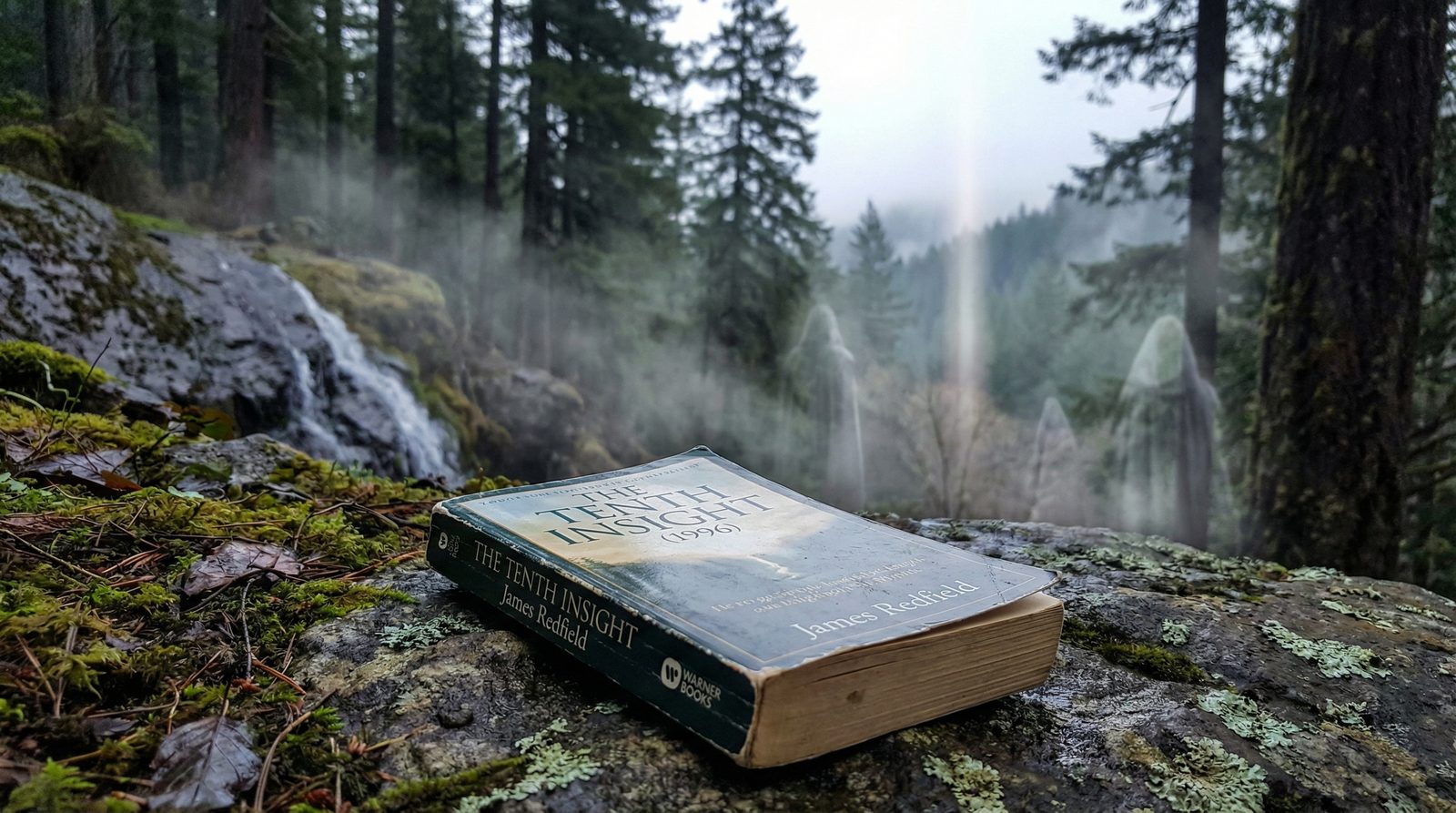
    The Tenth Insight (1996)

    INTRODUCTION

    The Tenth Insight (1996) by James Redfield
    Spiritual fiction · 236 pages · United States


    The Tenth Insight arrives as both sequel and escalation. Where The Celestine Prophecy moved through Peruvian jungle myth and social tension, this book shifts into a colder, more haunted register. Much of it unfolds in a remote Appalachian valley where fog, ruined cabins, and forgotten logging roads create a mood of unfinished business.

    The emotional tone is hushed urgency. The novel insists that private choices carry historical weight, that a personal awakening can brush against war memory, corporate greed, and environmental collapse. Redfield is not subtle about his intention. This is not conventional fiction so much as a spiritual field report disguised as an adventure story. It asks the reader to treat intuition as seriously as physical survival.

    PLOT & THEMES

    The story begins when the unnamed narrator returns to the valley from the earlier book, searching for his missing friend Charlene. The setting is presented as a liminal zone where physical and spiritual realities overlap. He encounters Feyman, a young boy with fragmented memories of a pre-birth vision, and Wil, a bitter war veteran trapped in a kind of spiritual numbness.

    The quest structure is straightforward. The narrator follows clues through the valley, meets guides who clarify the metaphysics, and repeatedly crosses into altered states where memory and spirit become tangible. What matters is less the suspense than the framework the book builds: life is not random, suffering is not meaningless, and fear distorts the intentions we supposedly chose before we arrived.

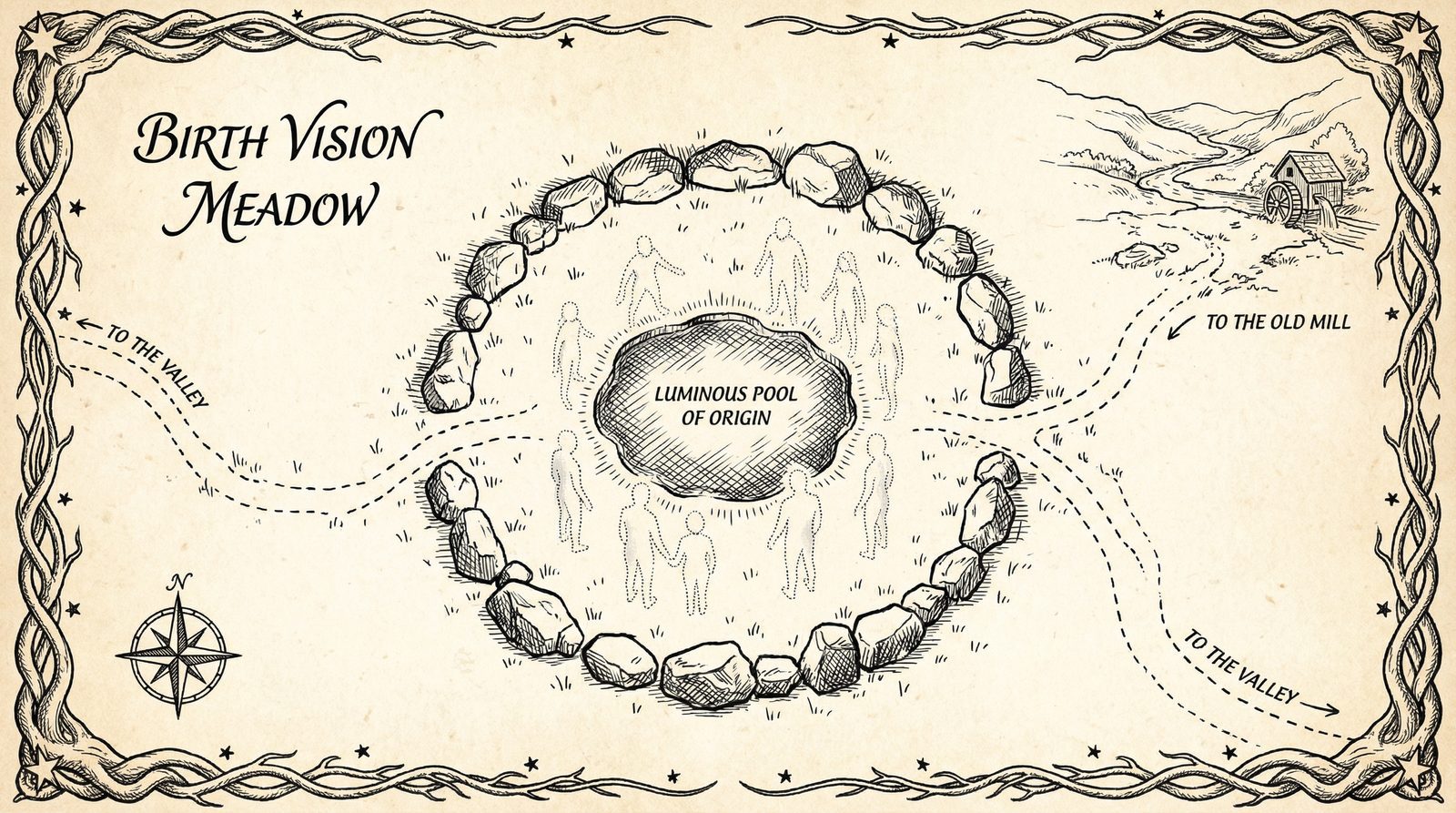
    The central idea is the “birth vision”: the notion that souls choose parents, challenges, and historical eras before incarnation. Through life reviews and glimpses of an afterlife dimension, the narrator witnesses souls preparing for their lives and then watching how those intentions are warped by anxiety, resentment, and control dramas once embodied. The metaphysics are explicit. Redfield wants the reader to see personal psychology and social crisis as part of the same energetic chain.

    That chain is anchored to something concrete. The valley is threatened by an energy project tied to corporate interests, linking spiritual stakes to environmental activism. The climax is not an abstract “ascension” but a confrontation with fear itself. Charlene is found at the edge of leaving life behind, and the resolution hinges on recommitment: choosing to stay incarnate, to keep working inside the imperfect world rather than escaping it.

    Like the earlier book, the novel suggests humanity is on a threshold. But it refuses a clean apocalypse or a clean salvation. The future remains open. The point is practice, not fireworks.

    PROSE & NARRATIVE STRUCTURE

    Redfield’s prose is functional and deliberately geared toward instruction. Action scenes often pause so a guide figure can explain the mechanics of synchronicity, soul memory, and the energetic consequences of fear. It can feel schematic, but the clarity matches the book’s purpose. It wants to be applied, not merely admired.

    Structurally, the novel alternates between physical movement through the valley and excursions into an afterlife dimension. Transitions are triggered by attention and bodily sensation: a chill, pressure in the forehead, a sudden pull toward a memory. These shifts are abrupt on the page, yet they are designed to normalize the book’s premise that boundaries between worlds are thin.

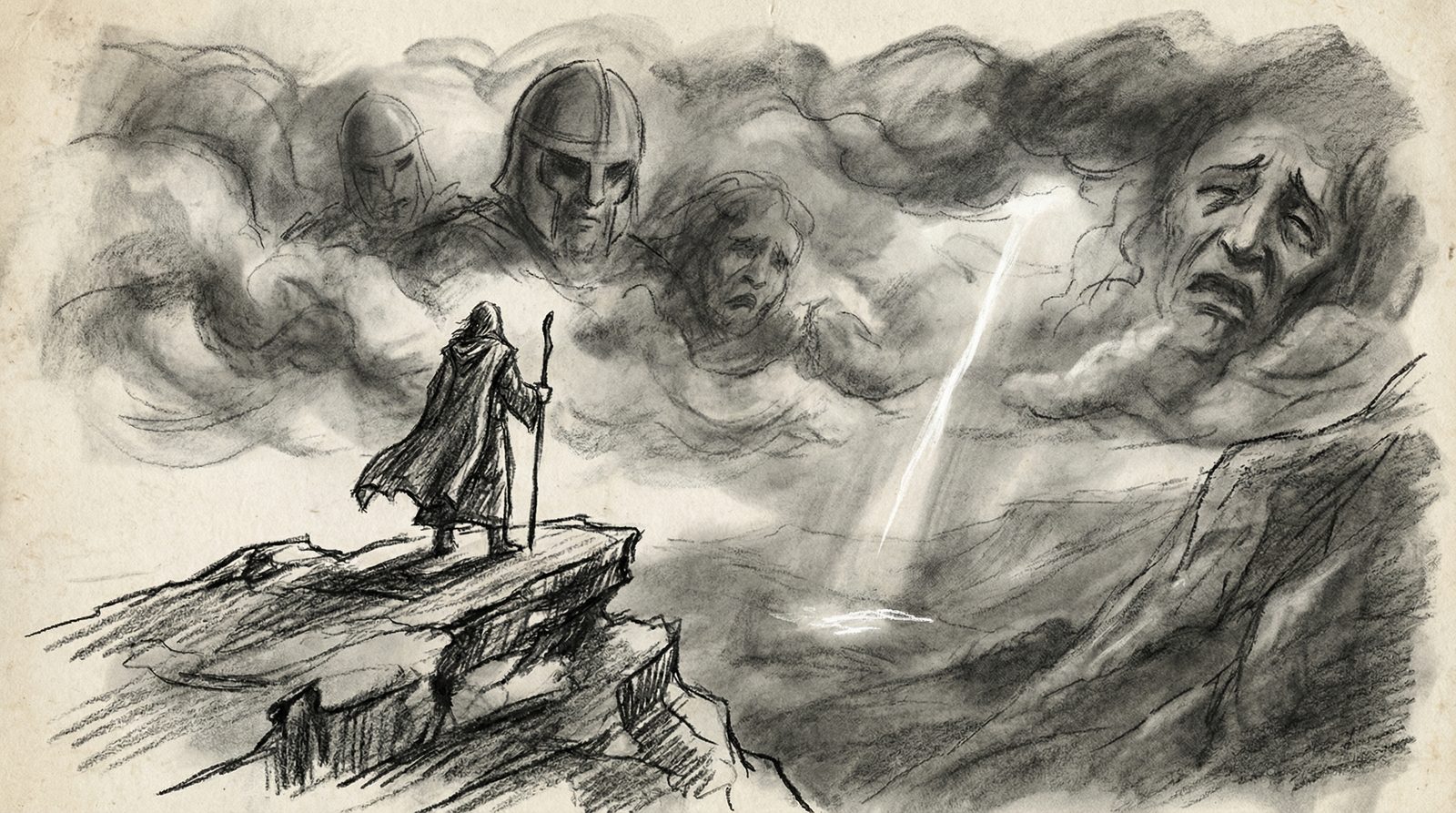
    The most effective passages are the panoramic “world vision” sequences, where the narrator sees human history as a field shaped by collective intention. Industry, war, and ecological collapse are framed as outcomes of accumulated fear. Whether you accept that claim or not, the structure briefly clicks into place. The metaphysical scenes are not escapist fantasies. They are Redfield’s way of forcing moral responsibility onto the reader.

    When the language lands, it does so through simple sensory hooks: light rising from the valley floor, resentment described as a sticky grey aura, trauma replaying like a looped film. The book’s strongest instinct is always the same: abstract belief must be given a texture you can picture.

    Conceptual editorial illustration inspired by 'The Tenth Insight'

    CHARACTERS & INTERIORITY

    Characterization is intentionally archetypal. The narrator is defined less by biography than by openness to guidance. Charlene is the resistant seeker, intellectually skeptical but intuitively sensitive. Wil embodies unresolved war trauma, a man whose fear and guilt have hardened into a spiritual paralysis.

    The minor characters do much of the emotional work. Feyman’s insistence that he chose his troubled father gives the metaphysics a raw edge, because it drags the theory into the realm of family pain. Several figures who first appear as obstacles or officials gradually reveal their own half-conscious connection to the valley’s larger pattern.

    Interior life is mostly handled through shared visions rather than subtle psychological shading. When the narrator is pulled into another person’s memory, we are literally inside their fear. This can flatten nuance, with trauma sometimes “resolved” quickly by a single insight. Still, the method is consistent with the book’s claim that consciousness is not private property. The emotional through-line is fear turning into responsibility, and responsibility turning into recommitment.

    LEGACY & RECEPTION

    Published after the runaway success of The Celestine Prophecy, this sequel appealed most to readers who wanted more cosmology and less jungle chase. Some embraced the expansion into pre-birth planning, soul groups, and collective intention. Others found the didactic dialogue heavy and the characters too thin to carry the metaphysical weight.

    Its most durable contribution is the popularization of the “birth vision” idea and its linkage to social change. The book frames environmental activism and historical responsibility as spiritual tasks, not political hobbies. Whether one reads that as inspiring or simplistic, it explains why the novel has stayed alive as a hopeful myth: not transcendence as escape, but awakening as a reason to stay.

    IS IT WORTH READING?

    It is worth reading if you are open to narrative as a vehicle for metaphysical speculation. As a novel, it is uneven. As a framework, it is unusually coherent for the genre. The Appalachian setting gives the ideas physical grounding, and the war memory material adds a darker emotional register than the first book.

    If you want deep character realism, look elsewhere. If you want a story that asks, with complete seriousness, why you might have chosen this life, this era, and these fears, the book still has force.

    Illustration inspired by a core idea from 'The Tenth Insight'

    TRIVIA & AUTHOR FACTS

    Redfield wrote this novel after the unexpected commercial success of his earlier spiritual adventure, leaning more openly into his background in counseling and his interest in both Eastern and Western mysticism. Many of the concepts here, especially soul groups and pre-birth planning, were also discussed in workshops and reader circles around the first book.

    Some editions include the subtitle “Holding the Vision,” which reflects the book’s emphasis on collective focus as a driver of outcomes. The “control drama” concept introduced earlier returns in expanded form, pushed into an explicitly spiritual dimension where fear takes on a more literal, confrontable shape.

    SIMILAR BOOKS

    If this blend of spiritual instruction and story appeals to you, consider Siddhartha for a more literary meditation on awakening, Jonathan Livingston Seagull for a compressed fable of self-mastery, or The Alchemist for a symbolic, parable-style exploration of omens and purpose. Each treats inner experience as a force that shapes outward life, even when their tones and ambitions differ.

    DISCOVERABILITY & LINKS