Country: United Kingdom

  • Jonathan Stroud

    Jonathan Stroud

    ORIGINS & BACKGROUND

    Jonathan Stroud is best known for character-driven fantasy that treats magic and ghosts less as glitter and more as workplace hazards. Across the Bartimaeus books and Lockwood Co, he builds systems where the supernatural is managed through procedure, rivalry, and institutional pressure. The result is adventurous fiction with sharp humor on the surface, but a steady preoccupation with power, responsibility, and the cost of survival.

    Stroud grew up and works in the United Kingdom, and his writing carries a distinctly British blend of dry wit, skepticism about authority, and affection for creaky institutions. Before becoming a full-time author, he worked as an editor in children’s publishing, which shows in his pacing, his clarity, and his instinct for what younger readers can handle emotionally without diluting the stakes.

    In the Bartimaeus sequence, beginning with The Amulet Of Samarkand (2003), Stroud imagines an alternate London run by magicians whose power depends on enslaved spirits. The setting is recognizably urban and modern, but filtered through history and satire. Later, with Lockwood Co and its opening novel The Screaming Staircase (2013), he shifts to a haunted London where children are the only effective defense against ghosts, creating a precarious professional ecosystem built on risk and exploitation.

    Rather than foregrounding personal trivia, Stroud lets background appear sideways: in memos, disciplinary language, petty rivalries, and the weary tone of officials who enforce rules they don’t fully understand. His worlds feel plausible because they behave like institutions, not fairy tales.

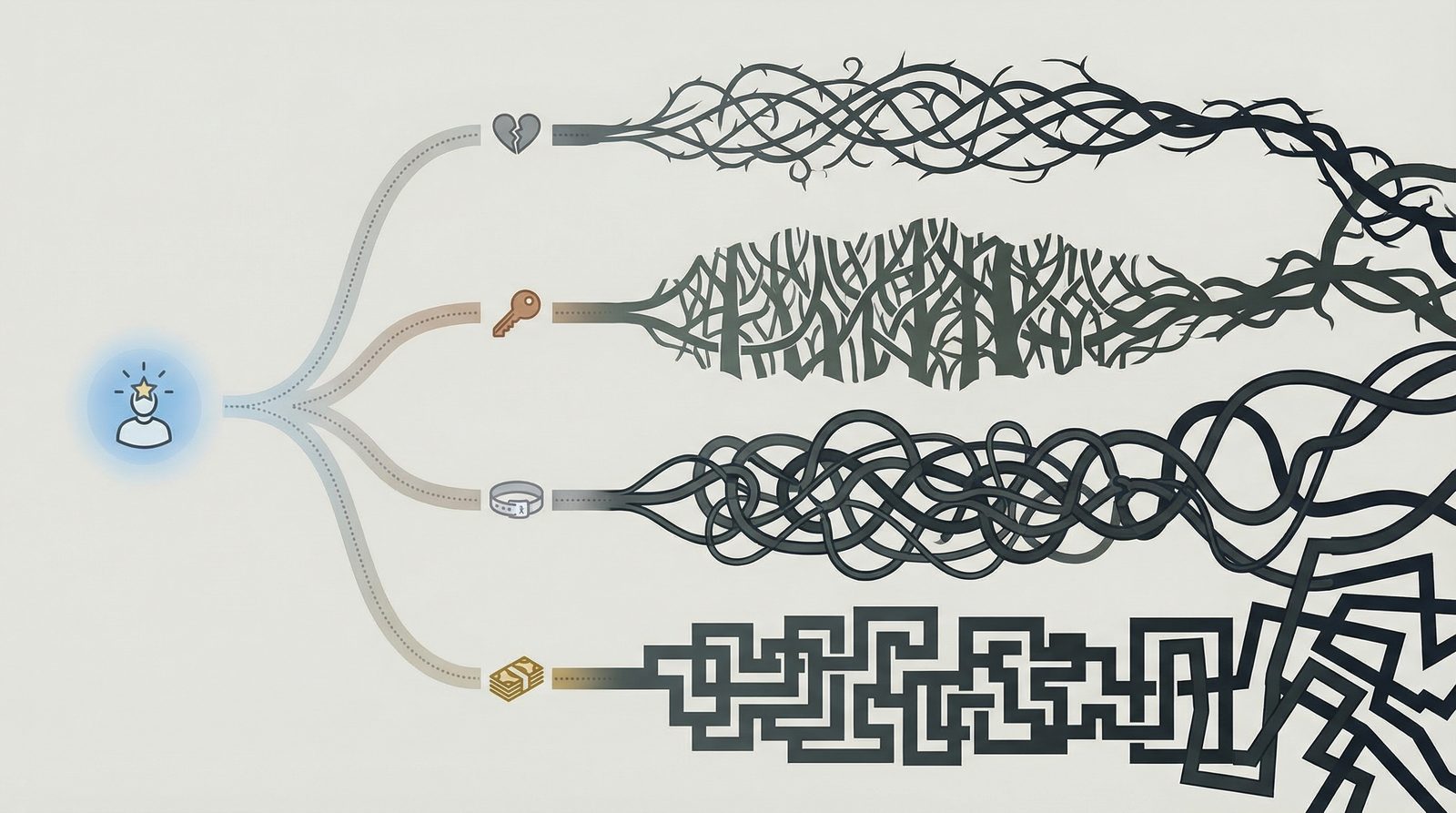
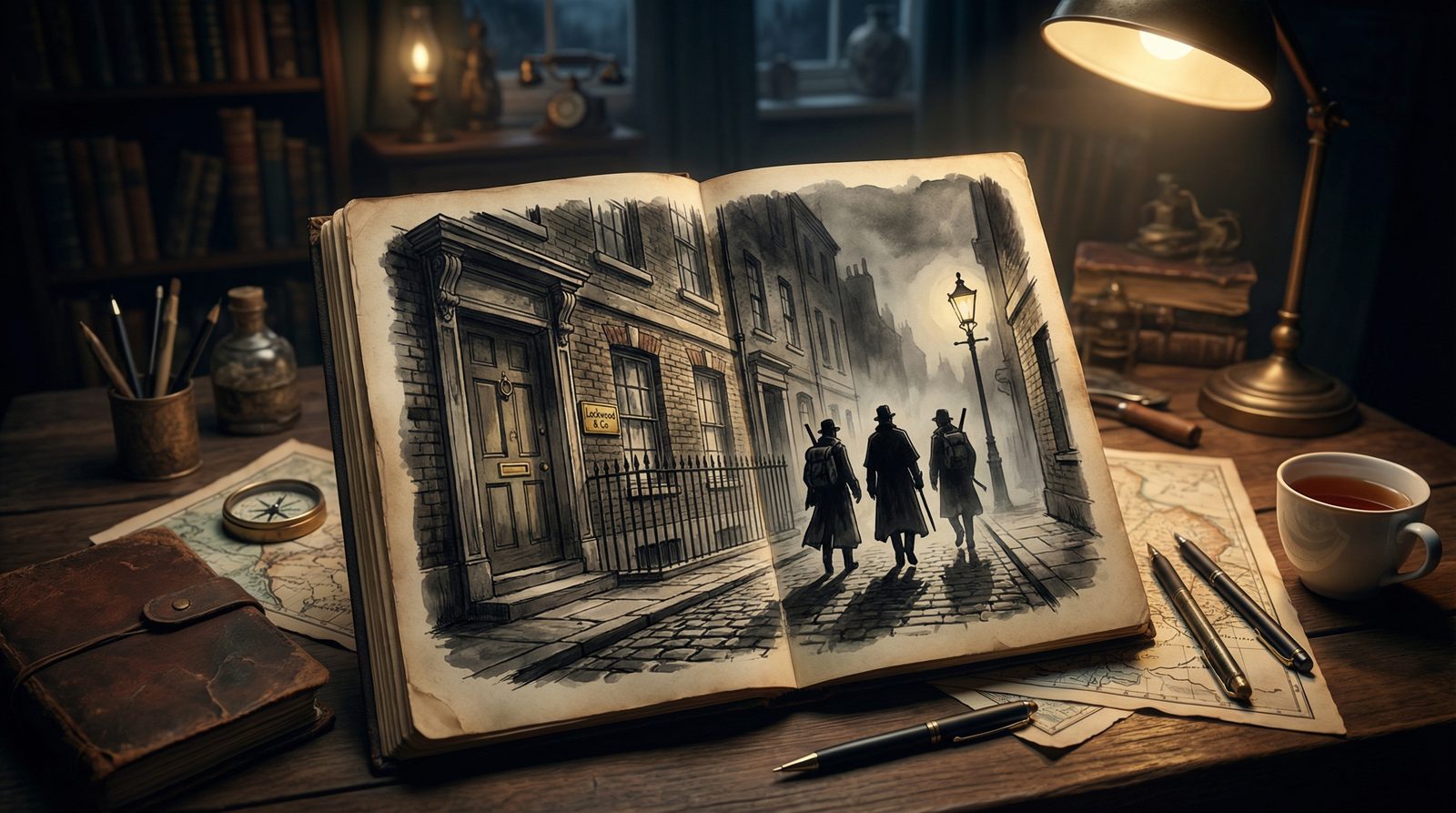
    Editorial illustration inspired by 'Jonathan Stroud'

    THEMES & MOTIFS

    A central engine in Stroud’s work is Magical Bureaucracy. In The Amulet Of Samarkand, magicians behave like civil servants and politicians: rule-bound in public, ruthless in private, and willing to weaponize procedure for personal gain. The supernatural is powerful, but the real leverage often sits in permissions, rank, and punishment.

    His later haunted-London world sharpens the logic of the Ghost Hunting Agency. In The Screaming Staircase, child sensitivity to ghosts becomes a professional resource, which turns bravery into an economic model. Young agents are praised, needed, and quietly treated as replaceable. Stroud returns to the tension between competence and vulnerability, showing how systems rely on the people they endanger.

    Power and servitude run through both series. In the Bartimaeus books, magic depends on exploitation, and the narrative keeps circling back to complicity and resistance. Even when characters benefit, the moral abrasion remains. In the ghost-agency world, power sits in information: who controls records, who sets policy, and who is allowed to define what “safe” means.

    Stroud also favors motifs of unreliable authority and buried history. Official explanations are rarely complete, and protagonists win by uncovering what institutions have forgotten or concealed. Alongside this is a quieter thread of found family, where humor and banter function as a survival tactic rather than sentimentality.

    Across his work, the motif systems are not window dressing. They are engines that let Stroud ask how much moral agency is possible inside structures built to reward compromise.
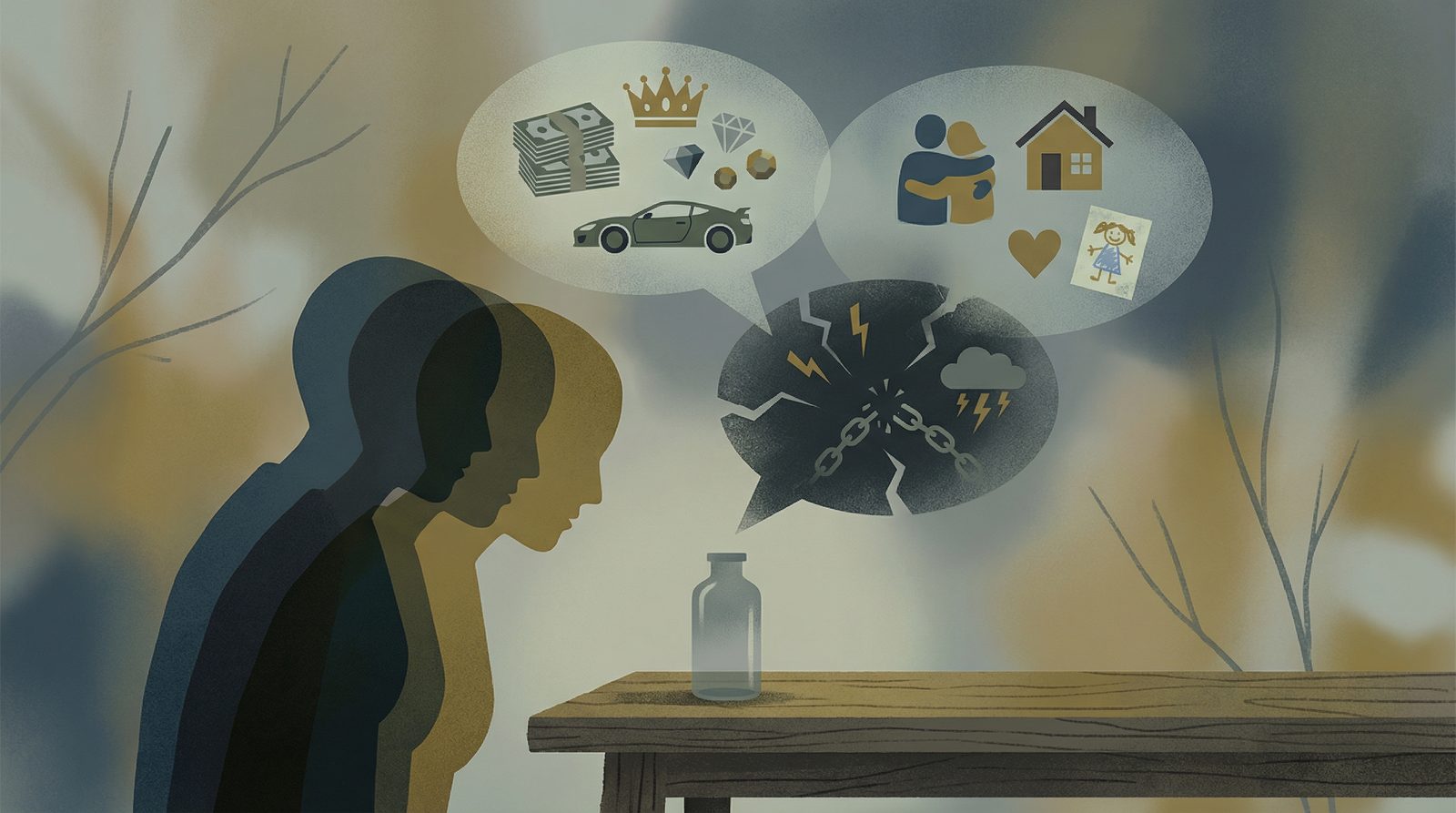
    Symbolic illustration inspired by 'Jonathan Stroud'

    STYLE & VOICE

    Stroud’s style is marked by wit, structural playfulness, and an unhurried confidence with worldbuilding. In the Bartimaeus books, he uses footnotes and a sardonic first-person voice to let the djinni comment on events, undercutting solemnity with sarcasm. The humor sharpens the critique rather than softening it, keeping power and procedure in view even during action.

    In Lockwood Co, the narrative voice is more direct but still dry and observant. Scenes of investigation and confrontation are tightly staged, with clear physical space and escalating dread. Stroud often alternates eerie fieldwork with domestic or office-like scenes inside the agency, which keeps the supernatural grounded in routine and logistics.

    His pacing favors accumulation over shock. Mysteries unfold through clues, conversations, and small revelations, with early details paying off later. Dialogue carries emotional weight, especially when characters test each other’s loyalty under pressure. Even in intense moments, Stroud avoids melodrama, creating a tone that is adventurous, eerie, and quietly bitter.

    KEY WORKS & LEGACY

    The Bartimaeus series, launched with The Amulet Of Samarkand, established Stroud’s signature blend of satire and stakes. It crystallizes his interest in institutions, exploitative power, and the ethics of control, using the human magician and the djinni Bartimaeus to show the same system from opposing angles.

    The Screaming Staircase launched his ghost-agency world, where the horror is constant but the economy is what makes it brutal. Stroud imagines a society reshaped by a long-term haunting crisis and centers young agents whose competence is essential while their safety is treated as negotiable.

    Stroud’s enduring appeal lies in how he marries adventure with skepticism. His worlds are full of djinn and ghosts, yet the real threats are often contracts, ministries, rival firms, and the compromises people make to survive inside systems that reward the worst instincts. That tension gives his fiction resonance beyond its immediate thrills.

  • Valets And Butlers

    Valets And Butlers

    DEFINITION & CORE IDEA

    Valets And Butlers is a motif built around the personal servant who is close enough to see everything, disciplined enough to say almost nothing, and competent enough to keep a household (or a protagonist) from collapsing. On the surface, valets and butlers exist to perform routine tasks: managing clothing, announcing visitors, maintaining schedules, smoothing over small social frictions. In narrative terms, they often function as the story’s most reliable intelligence inside a world of performative status.

    The motif’s charge comes from inversion. The servant holds the lowest formal rank while possessing the highest practical awareness. Because they are expected to be discreet, people speak freely around them, treat them as part of the room, and underestimate how much they notice. That gap between visibility and knowledge turns service into a form of power: quiet, deniable, and structurally essential.

    In the comic tradition shaped by P. G. Wodehouse, this inversion becomes the engine of farce. In Right Ho, Jeeves and The Code Of The Woosters, the socially superior employer repeatedly creates the mess while the valet quietly contains it. The humor is not simply that the servant is smarter. It is that the entire social order depends on someone who is never meant to be credited.

    At its core, Valets And Butlers explores what it means to serve and what service costs. It asks who truly holds power in a room, how much control can exist without recognition, and what kind of intimacy forms when one person’s job is to manage another’s life more competently than they ever could themselves.


    HOW IT WORKS IN STORIES

    Most stories using this motif keep the servant constantly present but rarely centered. Valets and butlers move through scenes performing routine actions while absorbing information, witnessing private failures, and tracking social pressure points. Writers use this access to make the servant a natural witness, confidant, and stabilizer inside a household that would otherwise fracture under its own ego and etiquette.

    Structurally, these characters often function as corrective force. When the plot threatens to spin into scandal or humiliation, the servant intervenes indirectly: shifting timing, redirecting people, removing evidence, arranging encounters, limiting damage. The employer may believe they are in control, but the narrative repeatedly demonstrates that outcomes depend on the servant’s judgment, restraint, and ability to act without being seen acting.

    This same architecture works outside pure comedy. In a mystery or a socially sharper story, the servant may be the only person with complete situational awareness because they were present during the moments others dismissed as background. Even when they say little, their position reveals how much labor is required to maintain the illusion of order and how dependent “status” is on invisible work.

    Dialogue becomes a tool of power without confrontation. Formal speech and minimal responses allow valets and butlers to communicate warning, irony, or correction while preserving the hierarchy’s appearance. A phrase like “Very good, sir” can carry obedience, exasperation, or quiet judgment depending on context. That ambiguity lets the motif explore control without turning the story into a lecture about class.

    Because these characters move freely between rooms, conversations, and social layers, they also serve as narrative connective tissue. Information passes through them. Emotional shifts register with them first. The household feels coherent because one figure circulates through all its compartments while everyone else remains trapped inside their own priorities.


    Editorial illustration inspired by 'Valets And Butlers'

    EMOTIONAL EFFECT ON THE READER

    This motif produces a blend of reassurance and unease. There is comfort in knowing that someone competent is present when authority figures are impulsive, naive, or self-absorbed. In a Jeeves-style story, readers relax slightly because they trust the servant will contain the chaos even when characters cannot manage themselves.

    At the same time, the motif carries quiet tension. The servant sees everything and remembers it. Readers understand that the social order depends on continued discretion and goodwill. Beneath the comedy sits an unspoken question: what happens if the person holding the system together decides to stop?

    The emotional intimacy of service deepens that effect. A valet or butler assists with private routines, hears confessions, and observes vulnerability without reciprocity. That closeness can feel protective or quietly tragic, especially when the servant’s own inner life remains unspoken and structurally suppressed.

    The motif also taps into a powerful fantasy: being understood so well that problems are solved before they need to be explained. The Jeeves and Wooster (TV Series) version makes that fantasy playful, turning competence into a safety net the viewer can rely on. Even when stories handle the motif with sharper satire, the same comfort remains: someone is paying attention, even if the people in charge are not.


    Symbolic illustration inspired by 'Valets And Butlers'

    VARIATIONS & RELATED MOTIFS

    Several variations recur within Valets And Butlers. The best-known is the hyper-competent servant whose intelligence far exceeds that of their employer, producing comedy through contrast: authority fails publicly while competence operates quietly in the background. Another variation is the stoic butler whose restraint becomes the drama, where the emotional payoff comes from what is withheld rather than expressed.

    A darker variation reframes the servant as an active manipulator. Because they stand at the intersection of information and access, they can redirect events for personal advantage, shifting the motif toward suspense or moral ambiguity. A satirical variation turns the servant into a mirror held up to the ruling class, exposing how fragile “refinement” becomes once it relies on invisible labor to remain believable.

    This motif overlaps naturally with Country House Comedy and Comic Misunderstandings And Farce, where servants often become the stabilizing intelligence inside a house full of schemes. It also connects to Victorian And Edwardian Social Satire, where the upstairs-downstairs perspective turns manners into a pressure system. In broader comedy-of-manners traditions, writers like Evelyn Waugh and Nancy Mitford echo the same logic: social status performs authority, but real control often sits with the people expected not to speak.

  • Country House Comedy

    Country House Comedy

    DEFINITION & CORE IDEA

    Country House Comedy is a comic motif where most of the action unfolds in and around a large rural estate packed with guests, servants, and secrets. The house functions as a social arena, trapping everyone together long enough for romantic tangles, class clashes, and elaborate misunderstandings to bloom. The setting promises peace and refinement. What it delivers instead is controlled social chaos.

    Writers use Country House Comedy because it creates a contained world full of built-in tension. City and country collide the moment visitors arrive from town. Old money and new money share the same drawing rooms. Servants observe the performance from the margins, often seeing more than anyone upstairs realizes. The estate’s routines and boundaries force repeated contact between people who would rather avoid each other, which is exactly what comedy needs.

    The motif appears cleanly in the work of P. G. Wodehouse, who uses the stately home as a pressure system for farce. In Leave It To Psmith, a house-party weekend becomes a knot of imposture, theft, and romantic interference, with every attempt at dignity immediately undercut by escalation. At its core, Country House Comedy punctures pretension by forcing refined people to behave irrationally while still trying to look respectable.


    HOW IT WORKS IN STORIES

    Country House Comedy usually begins with an invitation. Guests arrive at the estate for a weekend party, a family gathering, or some supposedly “dignified” social occasion. The host expects order. The reader can feel the collision course immediately. By concentrating a mixed group in one place, the story creates a social laboratory where etiquette becomes a trap rather than a stabilizer.

    The cast is designed for friction. There is often a protagonist who cannot speak plainly about what they want, an authority figure who polices the rules of the house, and at least one person whose identity or intentions are not what they seem. Mistaken identity is an especially efficient engine here, because it forces politeness to do the dirty work: once you have greeted the wrong person as the right person, you must keep the lie alive to preserve “good form.” In Leave It To Psmith, Wodehouse turns that logic into momentum, using the house party to keep thieves, romantics, and impostors in the same orbit long enough for small deceptions to become full-scale farce.

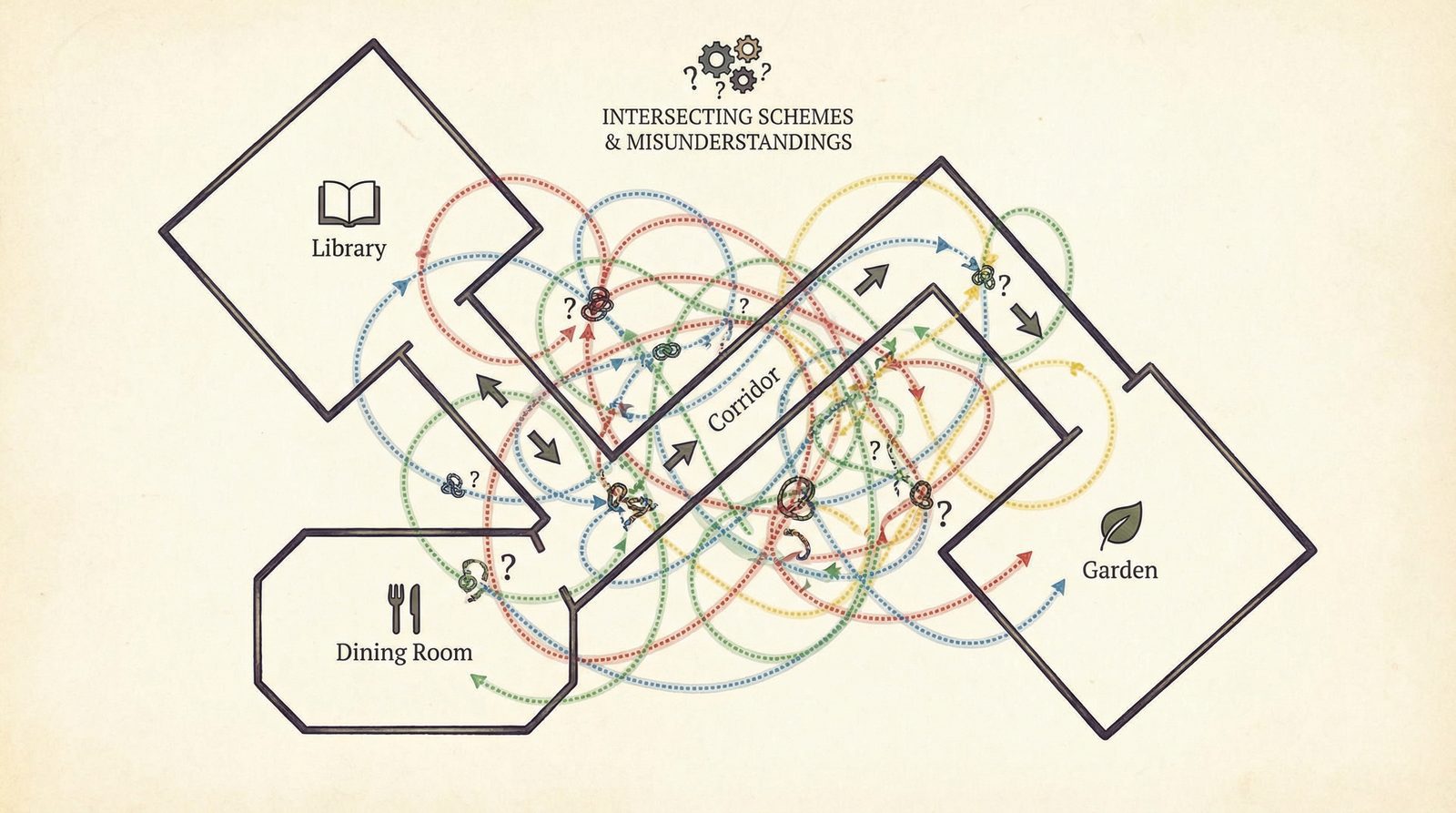
    The building’s layout becomes part of the plot machine. Gardens invite overheard confessions and badly timed proposals. Libraries and sitting rooms host “private” conversations that are never fully private. Bedrooms, corridors, and staircases generate midnight traffic, near-misses, and people hiding in plain sight. Meals and formal events act as recurring pressure points, forcing enemies and co-conspirators to sit politely side by side while chaos continues underneath the tablecloth.

    Timing is the fuel. Country House Comedy thrives on near-misses: someone exits a room seconds before the person they most need to avoid enters; a letter lands in the wrong hands; a disguise nearly fails in the hallway. Because nobody can simply leave, small lies snowball fast. A harmless excuse meant to avoid embarrassment can, within a day, require a coordinated performance involving half the guest list. The story usually ends with an “untying” sequence where secrets spill, motives surface, and the social order re-forms into a new set of alliances and pairings.


    Editorial illustration inspired by 'Country House Comedy'

    EMOTIONAL EFFECT ON THE READER

    Country House Comedy feels like being invited to a party where you are safely invisible. You get to roam the corridors, listen at doors, and watch everyone make fools of themselves without being the one who has to recover socially afterward. Even when characters are panicking, the tone stays light because the stakes remain survivable: reputations wobble, plans collapse, but nobody is truly ruined.

    The reading pleasure often comes as a mix of anticipation and relief. Anticipation, because you can see the collisions lining up: the misplaced letter, the wrong person entering at the wrong moment, the lie that is one step from exposure. Relief, because the genre promises a soft landing. The fun is watching embarrassment expand to its maximum size without tipping into real harm.

    There is also a comforting sense of containment. The estate becomes a sealed bubble where modern noise drops away and the primary “disasters” are social. The reader gets a holiday from consequence, watching wit, timing, and luck restore order just enough for the story to close cleanly.


    Symbolic illustration inspired by 'Country House Comedy'

    VARIATIONS & RELATED MOTIFS

    Country House Comedy has a few reliable variations. One leans toward romance, using the weekend as a matchmaking machine where jealousy, misread signals, and misdirected messages push the “correct” couples into place. Another emphasizes farce, where the plot is driven by impostors, stolen objects, and rapid entrances and exits that feel almost theatrical.

    It also overlaps with broader social satire, where the comedy comes from watching manners and hierarchy fail under pressure. In these versions, the laughs are not only about who ends up in the wrong room, but about how hard people work to maintain status while behaving absurdly. The servant perspective often sharpens that satire, because the people with the least social power may have the clearest view of what is actually happening.

    The motif intersects naturally with comic misunderstandings and farce, mistaken identity logic, and fish-out-of-water dynamics, because the setting intensifies every mismatch. A person who does not understand the rules of the house will break them by accident, and everyone else will scramble to repair the damage without admitting anything is wrong. That scramble is the comedy.

  • Synchronicity And Meaningful Coincidence

    Synchronicity And Meaningful Coincidence

    DEFINITION & CORE IDEA

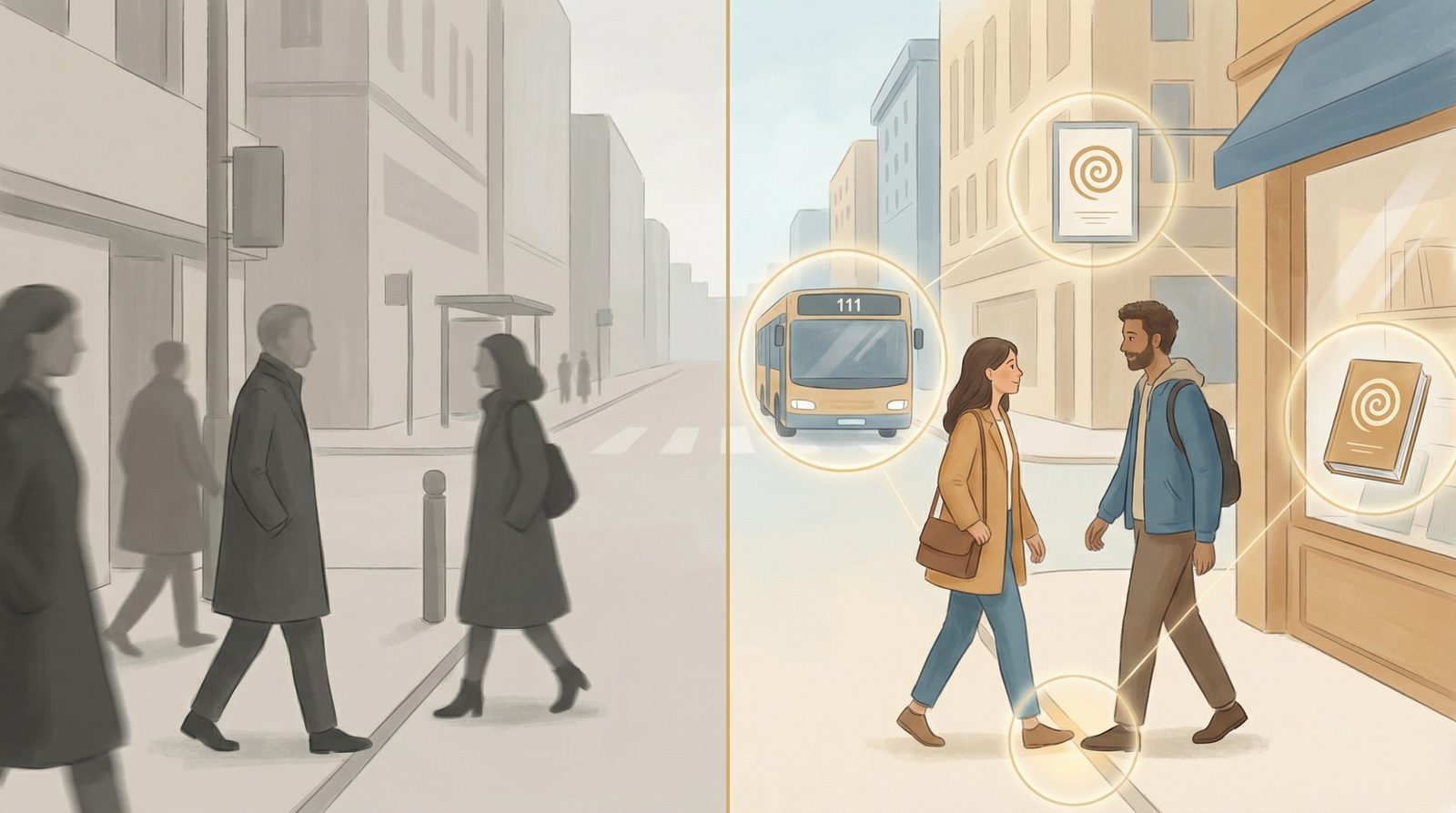
    Synchronicity And Meaningful Coincidence is the motif where events align with a precision that feels narratively excessive if everything is truly random. A stranger says the exact phrase the protagonist has been circling internally. A missed train leads to the only meeting that matters. The same symbol appears across unrelated places and moments. The story does not need to prove the supernatural; what matters is that the character experiences these alignments as communication rather than noise.

    In stories built around this motif, coincidence becomes information. The protagonist begins to treat timing, repetition, and interruption as meaningful data rather than background chaos. The explanation may vary — fate, God, a hidden order, the unconscious mind — but structurally the coincidences function the same way: they influence choice. Once the character starts acting as if meaning is real, the story has crossed its threshold.

    This logic is explicit in The Celestine Prophecy, where sequential encounters operate as instructions disguised as chance. In The Tenth Insight, the same mechanism is expanded into a system, training characters to read coincidence as guidance rather than accident. The Alchemist reframes this dynamic more quietly: dreams, omens, and chance meetings grant permission to abandon a stable life in favor of a meaningful one. In Way Of The Peaceful Warrior, coincidence is less mystical and more instructional, nudging attention back to discipline, presence, and embodied awareness.


    HOW IT WORKS IN STORIES

    Synchronicity usually enters a story quietly. The protagonist notices something small and easily dismissible: a repeated number, a perfectly timed interruption, an overheard sentence that lands too close to home. Early scenes preserve plausible deniability so the reader can remain skeptical without breaking immersion.

    The engine activates when coincidences begin to cluster. One coincidence is texture; several in close succession create pressure. These clusters tend to appear at decision points, moments when the protagonist is stuck between options or close to abandoning a path. In narratives like The Celestine Prophecy, each encounter functions as a breadcrumb that must be followed or consciously rejected. In The Alchemist, ignoring omens does not trigger punishment, but it stalls the story, draining momentum until attention realigns.

    Effective uses of this motif always impose cost. Following a “sign” risks embarrassment, loss of stability, or the appearance of irrationality. The character must accept the possibility of being wrong, foolish, or delusional. This risk is essential. Without it, synchronicity collapses into wish fulfillment. The choice to trust coincidence must feel dangerous enough to matter.

    Resolution typically arrives in one of two forms. In affirming narratives, the character learns to live inside a world where meaning does not need constant confirmation. In more ambiguous stories — as in I Origins — coincidences remain interpretable rather than proven, and the payoff is psychological. What changes is not the universe, but the character’s relationship to uncertainty.


    Editorial illustration inspired by 'Synchronicity And Meaningful Coincidence'

    EMOTIONAL EFFECT ON THE READER

    This motif is designed to feel intimate. The reader becomes a co-interpreter, scanning scenes for repetition, echo, and timing. When an early detail reappears in a charged moment, it produces a quiet jolt of recognition, as if the story is rewarding attention.

    At its most comforting, synchronicity offers relief from randomness. Detours feel purposeful. Delays feel protective. In books like The Alchemist, this reassurance is central to the reading experience, allowing setbacks to be reinterpreted as alignment rather than failure. The world feels readable, and the reader is invited to believe that attention itself has value.

    The same mechanics can also generate unease. Too many coincidences create the sense of being watched or guided too forcefully. In more psychological versions of the motif, the reader begins to question whether meaning is emerging organically or being imposed as a defense against chaos. That tension between enchantment and suspicion keeps the motif from becoming sentimental.

    When the motif works, the after-effect is practical. The reader finishes with heightened awareness of how easily meaning can arise once repetition and timing are framed as communication — and how much depends on where attention is placed.


    Symbolic illustration inspired by 'Synchronicity And Meaningful Coincidence'

    VARIATIONS & RELATED MOTIFS

    Synchronicity And Meaningful Coincidence appears in several recognizable variations. The spiritual guidance version treats coincidence as instruction, rewarding trust and punishing inattention. Romantic and literary versions soften the logic into serendipity, where repeated encounters transform chance into inevitability. Philosophical variants retain the pattern but refuse explanation, letting the reader decide whether meaning is discovered or constructed.

    A darker variation reframes synchronicity as a trap. Here, pattern recognition becomes exploitable, and “signs” function as lures rather than help. The story’s tension comes from uncertainty: is the universe speaking, is someone engineering the coincidences, or is the protagonist assembling meaning to avoid confronting randomness?

    This motif naturally overlaps with Spiritual Awakening, where heightened attention makes coincidence feel louder and more personal. It also pairs with Spiritual Pilgrimage and Inner Journey, where movement and reflection create the friction that makes “signs” feel necessary. When coincidence is framed as destiny language, it often converges with Personal Legend And Destiny.

  • Spiritual Awakening

    Spiritual Awakening

    DEFINITION & CORE IDEA

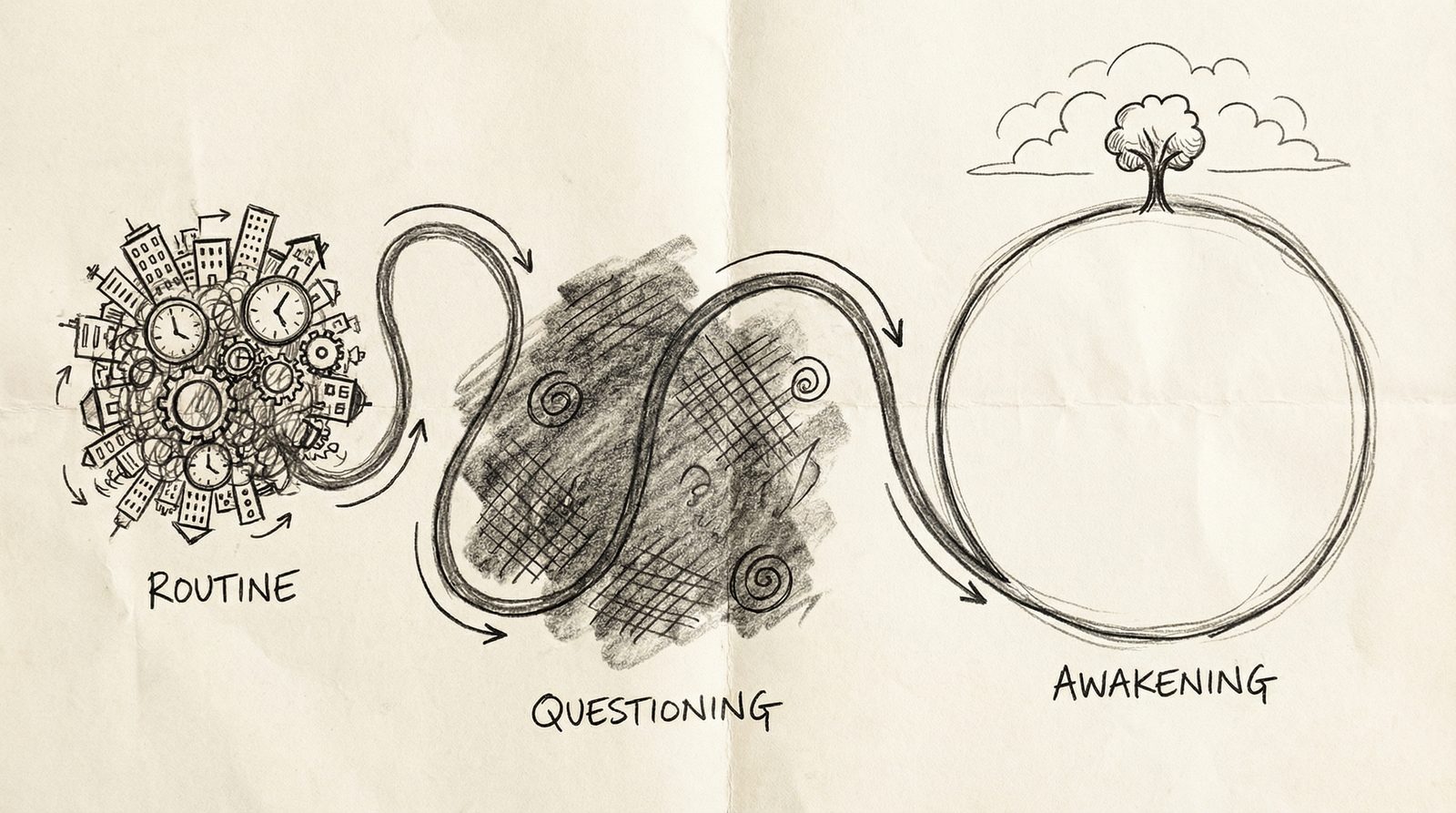
    Spiritual Awakening is the motif where a character’s interpretive frame breaks and re-forms. The person who could previously live on routine, status, or habit begins to perceive meaning, pattern, or selfhood differently. The story treats this shift as real change, not a cosmetic mood swing. What matters is not adopting a label or joining a religion, but the reorganization of attention, value, and identity.

    In awakening narratives, the protagonist often begins inside a life that “works” externally but fails internally. They may chase achievement, romance, or control and discover it does not answer the underlying question of purpose. The plot then follows the conversion process: a new vocabulary for reality appears, the character tests it, and their old identity starts to fail under the new pressure.

    Books such as The Celestine Prophecy, The Tenth Insight, The Alchemist, Way Of The Peaceful Warrior, and Siddhartha are classic examples. The “event” is internal: perception shifts, and that shift changes what the same world means.


    HOW IT WORKS IN STORIES

    Spiritual Awakening usually begins with an existential breach. The character feels restless, stuck, or out of place in a life that looks fine from the outside. A promotion feels hollow, a relationship stops fitting, or a loss cracks certainty. The important point is structural: the old worldview stops functioning as a complete explanation.

    Next, a threshold event provides a new interpretive system. This can be a guide figure, a text, a vision, or a sequence of “coincidences” that the character begins to treat as communication. In The Celestine Prophecy and The Tenth Insight, the engine is sequential insights delivered through encounters that mix guidance with risk. In The Alchemist, a dream and a meeting function as permission to leave the old life and treat omens as navigational data. In Way Of The Peaceful Warrior, a teacher figure reframes discipline and attention as a daily practice rather than an abstract belief.

    The middle phase is testing and attrition. The character tries new practices, interpretations, and choices, then pays the cost of inconsistency. Old identities fall away faster than new ones stabilize. A “dark night” phase is common: the character feels more lost than before because certainty has collapsed but insight is still incomplete.

    Resolution is usually a return to ordinary life with a changed relationship to it. Work, love, and struggle remain, but they are held inside a wider frame. The story closes when the character can sustain the new perception without needing constant signs or external validation.


    Editorial illustration inspired by 'Spiritual Awakening'

    EMOTIONAL EFFECT ON THE READER

    This motif is built to feel personal. The reader is invited to project their own restlessness onto the protagonist’s shift, using the character as a safe container for questions about meaning, purpose, and identity.

    It often produces a “synchronicity high” in the reading experience. The plot rewards attention by making small events feel linked: a conversation, a symbol, or a coincidence lands as guidance rather than noise. That can feel reassuring, because it implies the world is readable.

    The cost is loss. Awakening narratives usually require the character to abandon a comforting interpretation of their life. Relationships strain, identity becomes unstable, and certainty is traded for a framework that is truer but harder to live inside.

    When the motif works, the after-effect is practical rather than sentimental. The reader finishes with heightened awareness of attention itself: what they ignore, what they treat as “just life,” and what patterns they might be using to avoid change.


    Symbolic illustration inspired by 'Spiritual Awakening'

    VARIATIONS & RELATED MOTIFS

    Spiritual Awakening appears in several common variations. The solitary seeker version follows a character cycling through teachers and lifestyles until a stable insight forms, as in Siddhartha. The reluctant mystic version forces awakening through crisis or loss, where the character resists the new frame until resistance becomes impossible. Another variation frames awakening as part of a larger system of human evolution, expanding the personal shift into a collective one, as in the Redfield sequence.

    The motif also has practical variants, where the new awareness is tested in daily routine rather than on mountaintops. Here, the story cares less about visions and more about whether the character can keep behaving differently when the world remains the same.

    This motif commonly overlaps with Synchronicity And Meaningful Coincidence, because meaning is delivered through “pattern recognition” in events. It also pairs naturally with Spiritual Pilgrimage and Inner Journey, where travel or reflection supplies the friction that forces change.

  • Inner Journey

    Inner Journey

    DEFINITION & CORE IDEA

    The Inner Journey motif is about a character whose most important travel happens inside their own mind and heart. The outside world can be busy, dangerous, or beautiful, but the core story is the shift in how this person understands themselves, other people, or reality itself. In Siddhartha, the river, the city, and the forest matter, but the real movement is the protagonist’s changing sense of identity and meaning.

    Writers use the Inner Journey to examine belief, self-concept, and value. The plot might involve travel, romance, work, or crisis, but events function as mirrors: the character encounters situations that reveal what they avoid, what they rationalize, and what they cannot keep pretending.

    This motif often includes reflection, doubt, and contradiction. A character may be pulled between comfort and risk, duty and desire, faith and skepticism. Works such as Zen And The Art Of Motorcycle Maintenance and Demian use daily life, travel, and relationships as the surface action while the real stakes remain internal: whether the character can become honest with themselves.


    HOW IT WORKS IN STORIES

    The Inner Journey usually starts with a fracture of self. The character feels that something is off: success feels empty, a relationship feels misaligned, grief breaks old habits, or a change exposes how little their previous identity can hold. This discomfort becomes the trigger for looking inward.

    Writers often pair the Inner Journey with an outer journey so the reader has concrete scenes to track. In Zen And The Art Of Motorcycle Maintenance, the road trip gives shape to a philosophical search. In Siddhartha, distinct stages of life function as stages of internal change. The external plot provides milestones, but the turning points happen in private moments where the character’s interpretation of the world shifts.

    Structurally, the Inner Journey often moves through cycles of hope, confusion, and partial clarity. The character tries on beliefs or identities, then discovers their limits. They may swing between extremes, such as total freedom and heavy responsibility, intense longing and cool detachment, spiritual devotion and cynical withdrawal. The story tracks how those opposites are integrated into something more stable.

    Small details carry a lot of weight. A recurring object, repeated phrase, or familiar setting can show internal movement without a dramatic plot beat. The same kitchen table or street appears early and late, but it reads differently because the person looking at it has changed. The ending can be quiet, with no grand victory, yet the inner landscape is measurably transformed.


    Editorial illustration inspired by 'Inner Journey'

    EMOTIONAL EFFECT ON THE READER

    Inner Journey stories create recognition rather than suspense. The reader is invited into the space where the character stops lying to themselves. That can feel intimate and uncomfortable, because the questions the character cannot avoid are often questions the reader recognizes.

    The mood is often reflective. Even when events are dramatic, the narrative keeps returning to interpretation: what does this mean, and what does it reveal about who I am? The emotional intensity comes less from plot twists than from the slow accumulation of self-knowledge.

    These stories also create a specific kind of tension: the character may refuse closure. Instead of giving a clean answer, the narrative shows the cost of uncertainty and the cost of certainty, and asks the reader to sit with the same unresolved pressure.

    When the motif works, the after-effect is practical. The reader leaves with a sharper awareness of how a person’s internal frame can change what the same world means. The story does not just entertain; it reorients.


    Symbolic illustration inspired by 'Inner Journey'

    VARIATIONS & RELATED MOTIFS

    The Inner Journey appears in multiple genres. In coming-of-age stories, it is a search for identity and separation from inherited scripts. In spiritual narratives, the focus is on insight, faith, or a direct experience of the sacred. In midlife and late-life stories, the inner journey becomes reevaluation: regret, responsibility, and the attempt to make peace with the person one has been.

    Some versions are explicitly philosophical, using dialogue, essays, or long conversations to argue ideas. Others stay close to daily routine, showing inner change through small acts, habits, and repetitions. The pace can be slow and reflective, or tense, especially when the character’s developing self clashes with obligations and old roles.

    This motif often overlaps with Spiritual Awakening and Spiritual Pilgrimage, where external movement supplies the friction needed for internal change. It also pairs naturally with Intimacy as Healing, where a relationship becomes the mirror that forces honesty and makes transformation possible.

  • Personal Legend And Destiny

    Personal Legend And Destiny

    DEFINITION & CORE IDEA

    Personal Legend And Destiny is the motif where a character believes there is a specific path, mission, or role that is uniquely theirs. It is not ordinary ambition. The calling is treated as a teleological claim: the character’s life has a “correct” direction, and the plot measures whether they recognize it and commit when commitment demands sacrifice.

    In The Alchemist, Paulo Coelho makes the idea explicit, turning “Personal Legend” into a named rule of the story’s world. The same structure appears in quieter forms as well. A character is pulled toward a vocation, an art, or a responsibility they cannot fully explain, and every attempt to live safely produces restlessness rather than relief.

    Writers use this motif to give everyday choices narrative gravity. Changing jobs, leaving home, or refusing a stable life becomes more than preference. It becomes alignment or refusal. The story is the argument between the calling and everything that pressures the character to compromise, delay, or shrink it into something acceptable.


    HOW IT WORKS IN STORIES

    The motif usually begins with restlessness. The character feels out of place. Their job, hometown, and relationships feel deadening or ill-fitting. This discomfort is treated as signal, not mood. The story often externalizes it through signs, recurring dreams, prophecies, or chance encounters that the character reads as communication rather than coincidence.

    Then comes the call to action. A letter arrives, a stranger offers an opportunity, or a crisis forces a choice. Saying yes usually means leaving comfort and social approval behind. Saying no may preserve stability in the short term, but the narrative increases the cost of refusal until staying becomes its own form of loss.

    As the character moves toward the calling, they meet helpers and tempters. Mentors, spiritual guides, and friends validate the direction and offer methods. Opposing them are institutions and relationships that reward safety. The motif thrives on the tug-of-war between the mythic pressure to pursue the irrational calling and the social pressure to remain “reasonable.”

    Structurally, this motif often maps onto a journey. Sometimes that journey is literal travel; sometimes it is an inner program of practice, work, or discipline. The character advances, loses faith, is tempted to accept a smaller dream, and then faces a point of no return where compromise becomes a defining choice.

    By the end, the story usually resolves through alignment or refusal. Either the character commits to the calling and accepts the cost, or they choose safety and live with the residue of what was not attempted. The motif’s claim is not that destiny is guaranteed. It is that destiny demands a decision.


    Editorial illustration inspired by 'Personal Legend And Destiny'

    EMOTIONAL EFFECT ON THE READER

    This motif targets the fear of insignificance. It offers a counter-claim: that a specific life can have a readable direction. The reader is invited to measure their own choices against the character’s willingness to commit.

    The unease comes from sunk cost. The story forces a private inventory of missed exits and deferred risks. Even optimistic versions create pressure because they imply that safety is not neutral; it is a decision with consequences.

    When the character chooses alignment, the reader often feels relief mixed with grief for what was sacrificed. When the character refuses, the emotion is quieter and sharper: the sense of a life narrowing, not through tragedy, but through avoidance.


    Symbolic illustration inspired by 'Personal Legend And Destiny'

    VARIATIONS & RELATED MOTIFS

    In allegorical or spiritual stories, the calling is framed as a cosmic assignment, and coincidence is treated as guidance. In grounded fiction, the same structure is reframed as authenticity without supernatural endorsement, with the “signs” replaced by pattern recognition and self-knowledge.

    One variation treats destiny as burden. The character is named “chosen” early, and the conflict becomes whether the script is theirs or someone else’s. Another variation delays recognition until late life, where the calling is discovered after years of compromise, turning the motif into a reckoning rather than a quest.

    This motif often overlaps with Spiritual Pilgrimage and Synchronicity and Meaningful Coincidence, since both motifs rely on the idea that events can be read as communication. It also pairs naturally with coming-of-age and redemption arcs, where the calling functions as a test of identity.

    In darker uses, the “destiny” can be misread or weaponized. The character follows the wrong calling, or a true calling arrives too late to be lived cleanly. The story then becomes a warning about interpretation rather than a promise about fulfillment.

  • Statue Comes To Life

    Statue Comes To Life

    DEFINITION & CORE IDEA

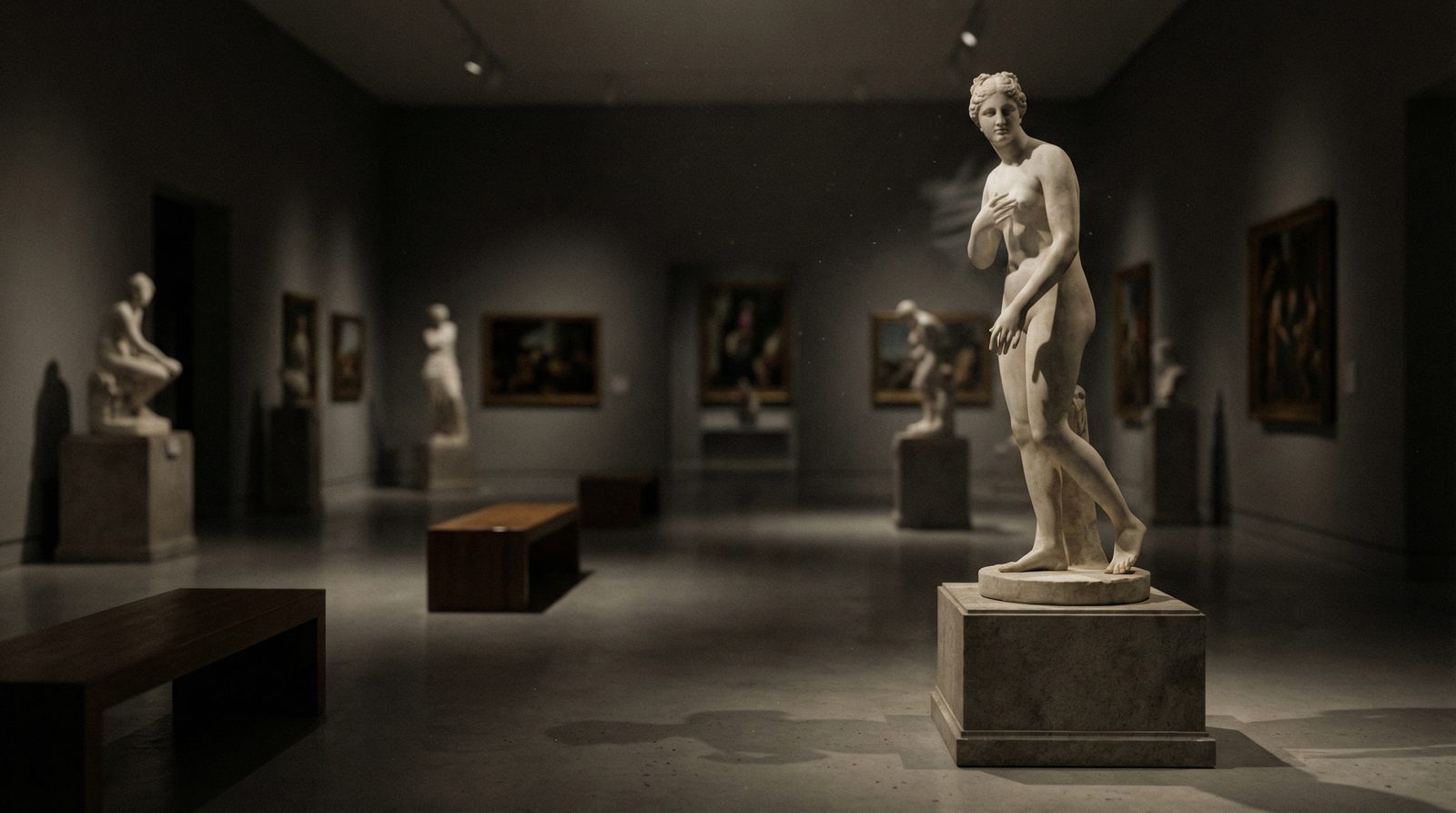
    The Statue Comes To Life motif is exactly what it sounds like. Stone turns to flesh, a department-store mannequin wakes up, or a bronze goddess steps down from her pedestal. The core thrill comes from watching something we are used to seeing as an object suddenly reveal a mind, a will, and often a heart.

    Writers use this motif to explore wish fulfillment, loneliness, and the unstable line between ideal and reality. A character may fall in love with an image they helped create, echoing the Pygmalion pattern, or stumble into a relationship with a figure that was never meant to move at all. Stories such as The Tinted Venus by Thomas Anstey Guthrie play with the shock, comedy, or horror of an inanimate figure stepping into ordinary life.

    At its heart, the motif asks a simple but unsettling question. What happens when our fantasies talk back? The living statue is usually designed as perfection, whether beautiful, sacred, or terrifying. Once it awakens, the human characters are forced to confront how different a real, autonomous being is from the silent, obedient figure they imagined.


    HOW IT WORKS IN STORIES

    The setup is often deceptively simple. A sculptor, shop employee, scholar, or lonely observer forms an attachment to an object that cannot answer back. Through magic, a curse, a wish, or a god’s intervention, the figure comes alive. From there, the story splits into two broad paths.

    On the side of wonder, the living statue experiences the world with fresh eyes. Money, social rules, and human habits make little sense. Everyday life becomes strange and funny. In romantic or comic versions such as Mannequin (1987) or One Touch Of Venus (1948), this innocence is charming. The animated figure pushes the human lead to loosen routines, challenge assumptions, and admit what they actually want.

    On the side of disruption, the animated statue breaks boundaries. Property, religion, and personal relationships collapse under the weight of something that was never meant to walk freely. Even lighter tales such as The Tinted Venus show how a living idol can upend careers, engagements, and social standing.

    Structurally, the motif builds toward a choice. Secrets must be kept, authorities get involved, and the human characters must decide whether to cling to safety or accept an unpredictable relationship. The ending usually turns on whether the statue remains alive, returns to its pedestal, or demands a price for having crossed the boundary between object and person.


    Editorial illustration inspired by 'Statue Comes To Life'

    EMOTIONAL EFFECT ON THE READER

    This motif taps into a primal wish: that the things we admire in silence might look back and choose us. The idea that a statue could turn its head and see us is thrilling and unsettling at the same time.

    In romantic or comedic versions, there is a warm sense of fantasy fulfillment. The protagonist is chosen by someone impossibly ideal, a literal embodiment of beauty or devotion.

    Darker uses of the motif replace comfort with dread. The same transformation that feels magical in light stories becomes a violation when the animated figure moves with cold purpose or divine anger.


    Symbolic illustration inspired by 'Statue Comes To Life'

    VARIATIONS & RELATED MOTIFS

    The motif appears in several recognizable forms. The classic variation follows a creator-and-creation pattern where an artist’s work reflects their ideals and blind spots. A modern twist replaces the handcrafted statue with a mass-produced figure, shifting the focus toward consumer fantasy and the idea of the perfect partner as a commodity.

    Mythological versions present the statue as a dormant deity rather than a neutral object. In these stories, the figure was never truly asleep, only waiting. This overlaps strongly with Pagan Goddess In Modern Society, where ancient power collides with modern norms.

    Horror-leaning variants treat the awakening as punishment instead of reward, while bittersweet versions allow the figure to remain human only temporarily.

  • Eastwest Philosophical Synthesis

    Eastwest Philosophical Synthesis

    DEFINITION & CORE IDEA

    East-West Philosophical Synthesis is a motif in which Eastern and Western ideas about life, morality, and meaning are brought into direct conversation and gradually woven together. Instead of treating East and West as fixed or exotic opposites, stories using this motif allow characters to test Buddhist detachment against capitalist ambition, Confucian duty against individual freedom, or Western rationalism against mystical insight. The point is not that one side wins, but that both are altered through sustained contact.

    In practice, East-West Philosophical Synthesis often appears when a character moves between cultures, studies within a foreign tradition, or grows up inside a mixed philosophical inheritance. They might try to apply meditation and non-attachment to modern work pressure, or use Western psychology to interpret karma, desire, and rebirth. The narrative becomes a kind of laboratory where everyday problems like love, family, work, and grief are approached using tools drawn from more than one civilizational story about what humans are and what they owe each other.

    This motif is especially visible in modern spiritual literature that seeks to translate non-Western traditions into a language accessible to contemporary readers. In Zen and the Art of Motorcycle Maintenance: An Inquiry Into Values, Robert M. Pirsig uses the act of motorcycle maintenance as a bridge between Eastern ideas of presence and Western rational analysis. Quality becomes not a technical metric but a lived experience, discovered through attention rather than theory.

    Editorial illustration inspired by 'Eastwest Philosophical Synthesis'

    HOW IT WORKS IN STORIES

    East-West Philosophical Synthesis usually begins with contact, and early scenes often highlight misunderstanding. A Western-trained professional dismisses traditional practices as superstition. A spiritual teacher views Western self-focus as indulgent. A child of immigrants is told to follow their heart at school while being expected to honor the family at home.

    The story then develops situations where neither a purely Eastern nor a purely Western response feels sufficient. A character raised on individualism may find relief in ideas of interdependence and community. Someone taught to suppress desire for the sake of harmony may discover that Western concepts of boundaries and selfhood provide tools for resistance. Tensions such as fate versus free will, duty versus authenticity, and mind versus body are reopened through lived consequence.

    Over time, the motif shifts from argument to experiment. Characters begin trying hybrid approaches, often clumsily. The synthesis is rarely elegant. It involves compromise, partial misunderstanding, and moments of recognition where a character realizes they have simplified a deep tradition into something more convenient than true.

    Some stories lean toward philosophical rigor, as in the inward journeys of Hermann Hesse. Others move toward accessible spiritual narrative. In Way of the Peaceful Warrior, Eastern ideas of discipline and presence are filtered through a distinctly Western self-help structure, emphasizing personal transformation over metaphysical coherence.

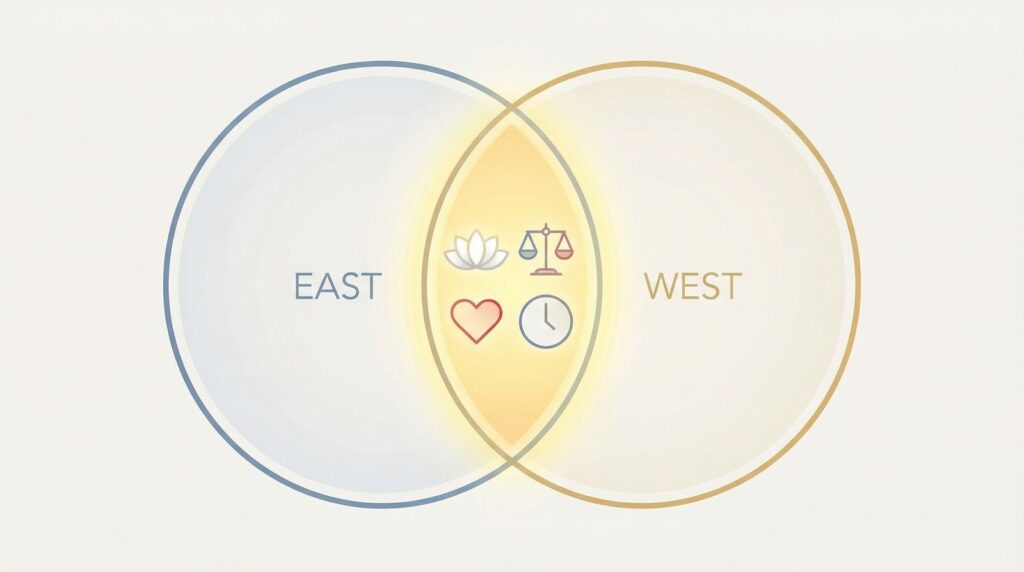
    Symbolic illustration inspired by 'Eastwest Philosophical Synthesis'
    Symbolic illustration inspired by ‘Eastwest Philosophical Synthesis’

    EMOTIONAL EFFECT ON THE READER

    Reading a story shaped by East-West Philosophical Synthesis often feels like sitting in on a long, intimate conversation about how to live. There is pleasure in seeing familiar ideas reframed, where spiritual concepts become practical tools and everyday decisions become moral experiments.

    The motif can also be unsettling. It invites readers to notice how much of their moral intuition is inherited rather than chosen. When characters sincerely try practices drawn from outside their native culture, the reader is asked to imagine doing the same, feeling both curiosity and resistance.

    At its most effective, the motif produces a sense of widened possibility. Cultures are not treated as sealed containers but as living systems capable of dialogue and change. Even when the synthesis fails or remains incomplete, the effort itself carries meaning.


    VARIATIONS & RELATED MOTIFS

    East-West Philosophical Synthesis appears in several distinct modes. In literary fiction, it often takes the form of a demanding inner journey, as in Siddhartha and Demian, where spiritual insight must be earned through suffering and self-confrontation. In popular spiritual fiction, the synthesis becomes more approachable but also more ambiguous.

    In The Celestine Prophecy and The Tenth Insight, James Redfield presents a New Age-inflected synthesis, where Eastern concepts of energy and synchronicity are adapted to Western narrative expectations of clarity, progress, and personal destiny. The result is less philosophically rigorous than Pirsig or Hesse, but emotionally accessible to a broad audience.

    Across these variations, the core remains the same. East-West Philosophical Synthesis is about what happens when different civilizational accounts of meaning, duty, and selfhood are forced to coexist within a single human life.

  • Craftsmanship And Quality Of Work

    Craftsmanship And Quality Of Work

    DEFINITION & CORE IDEA

    “Craftsmanship And Quality Of Work” is the motif where the way a character performs their work becomes a direct expression of their inner life. It is not simply about employment or productivity. The focus is on care, precision, pride, and the satisfaction of doing something properly, even when no one is watching. Whether the task is tuning an engine, preparing a meal, writing software, or shaping wood, the work itself carries moral weight.

    Stories built around this motif slow down and pay attention to process. In Zen And The Art Of Motorcycle Maintenance: An Inquiry Into Values (1974), motorcycle maintenance becomes a way of examining “Quality” as something experienced rather than defined. In Lila: An Inquiry Into Morals (1991), that concern expands into ethics and social life, still grounded in the idea that values are revealed through attention and care.

    At its core, this motif treats work as a moral and emotional discipline. It asks where standards come from, how they are practiced, and what is lost when integrity collides with systems that reward speed, scale, or convenience.


    HOW IT WORKS IN STORIES

    Craftsmanship And Quality Of Work usually appears through the rhythms of daily labor. Writers linger on routines: opening a workspace each morning, laying out tools, repeating movements until they become instinctive, inspecting the final result with quiet seriousness. The story may not be overtly “about” the job, but the way the work is done reveals character more clearly than dialogue alone.

    Sometimes the work itself becomes the teacher. In Shop Class As Soulcraft: An Inquiry Into The Value Of Work (2009), written by Matthew B. Crawford, manual problem-solving is framed as intellectually demanding and ethically grounding. Stories echo this idea when characters develop patience, humility, or self-respect through repeated, concrete tasks. A flawed repair or failed attempt is not just a setback, but a test of standards.

    Conflict often enters when the surrounding world does not value quality in the same way. A supervisor pushes for speed over care, a system rewards shortcuts, or customers demand something cheap and disposable. The character must decide whether to compromise, resist, or walk away. That decision becomes a clear statement of identity.

    This motif allows writers to make abstract ideas tangible. In the work of Robert M. Pirsig, the road, the machine, and the act of maintenance become tools for thinking about attention, rationality, and lived experience. Meaning is not explained. It is encountered through effort, failure, and care.

    Even in intimate or domestic narratives, the motif shapes relationships. A parent teaching a child a careful technique, or a mentor guiding an apprentice, passes on more than skill. They transmit a way of engaging with the world that can become a form of trust or love.


    EMOTIONAL EFFECT ON THE READER

    Stories shaped by this motif often feel grounding. There is comfort in watching someone care deeply about what they are doing, especially in a culture that feels rushed and disposable. Attention to tools, textures, and small decisions can be quietly absorbing.

    At the same time, the motif can provoke sadness or anger. When care is dismissed or punished, the loss feels personal. Stories about disappearing skills or neglected standards often carry a sense of dignity under threat.

    For many readers, this motif turns inward. It encourages reflection on everyday effort and responsibility. The question it raises is simple but unsettling: where does quality still matter in your own life, and what does it cost to protect it?

    There is also intimacy in this focus. Watching a character work carefully is like watching them unguarded. Habits and rituals reveal who they are when performance drops away, making later choices feel heavier and more personal.


    VARIATIONS & RELATED MOTIFS

    Craftsmanship And Quality Of Work takes many forms. In some stories, it centers on manual trades. In others, the craft is intellectual or emotional, such as teaching, caregiving, or programming. What unites them is the same pattern: the character treats their work as something deserving of attention, and their sense of self is bound to doing it properly.

    A common variation is the “lost craft” narrative, where older ways of working are disappearing. Another focuses on the collision between personal standards and impersonal systems, where care is labeled inefficient or excessive.

    This motif often pairs with Eastwest Philosophical Synthesis. In Pirsig’s writing, the road and the act of maintenance bridge Western analysis and Eastern presence. In Crawford’s work, the workshop becomes a site of moral clarity. Different settings, the same question: how should attention be lived?

    Across its variations, the motif returns to a single concern: when people invest genuine care in their work, how does that shape who they become?