
Country: United States

  • Easy Rider (2012)

    Easy Rider (2012)

    Easy Rider (2012) directed by James Benning. Experimental · 97 minutes · United States.


    INTRODUCTION

    James Benning’s Easy Rider (2012) is not a remake so much as a séance. He revisits locations associated with Dennis Hopper’s 1969 Easy Rider, strips away the bikers, the drugs, the road-movie chatter, and leaves only landscapes and ambient sound. The result feels patient, haunted, and quietly confrontational. Where the original surfed countercultural velocity, Benning lingers on what remains after the dream drains away.

    The film sits somewhere between gallery installation and cinema, asking viewers to meet it halfway and supply memory as context. If Hopper’s film was about forward motion, this one is about staying put and listening. The American West appears as both a physical place and a faded idea. It becomes a road movie without a road, an anti-spectacle about looking, duration, and the afterlife of myth.

    PLOT & THEMES

    There is almost no plot in Easy Rider (2012). The “story” is a sequence of fixed shots filmed at or near locations connected to the 1969 film’s itinerary. Where Hopper followed charismatic outsiders on a doomed cross-country trip, Benning removes character and incident but keeps the route as an invisible skeleton. The narrative becomes whatever the viewer remembers, projects, or resists.

    The core themes are memory, the American Dream, and the erosion of counterculture. By revisiting these sites decades later, Benning invites us to measure the distance between a 1960s fantasy of freedom and a present shaped by highways, strip malls, and fenced-off land. The “open road” is no longer pure symbol. It’s infrastructure, habit, and noise.

    Another strong motif is ghostly absence. Benning never shows the 1969 Easy Rider directly, yet its ghosts hover over every frame. The film functions like a palimpsest: we see the present landscape while mentally overlaying earlier scenes and cultural memory. The mood is meditative rather than nostalgic, with a faint ache underneath the calm surfaces. It’s less about rebellion than about what rebellion leaves behind.

    CINEMATIC TECHNIQUE & AESTHETICS

    Formally, Easy Rider (2012) is built from long takes and static framing. Each location is held for an extended duration with the camera locked off. This durational approach forces a different rhythm of attention. Instead of cutting to guide the viewer, Benning lets small details emerge over time: a shift in light, a passing car, wind in scrub, or the slow realization that “nothing happening” is the point.

    Benning’s static compositions are deceptively simple. Roads bisect frames, power lines draw grids, and horizons settle into a mathematical calm. The lack of camera movement creates a contemplative feel, encouraging the viewer to scan the image and notice texture. The film is rigorous about place: the image does not exist to serve narrative; narrative is something the viewer manufactures while looking.

    Sound design is crucial. Ambient sound replaces dialogue and score. We hear engines, birds, distant traffic, sometimes a near-oppressive quiet. This observational soundscape anchors images in real time and refuses romanticization. Benning’s refusal of conventional coverage—no close-ups, no reverse shots, no explanatory montage—underscores his interest in duration and environment rather than character psychology.
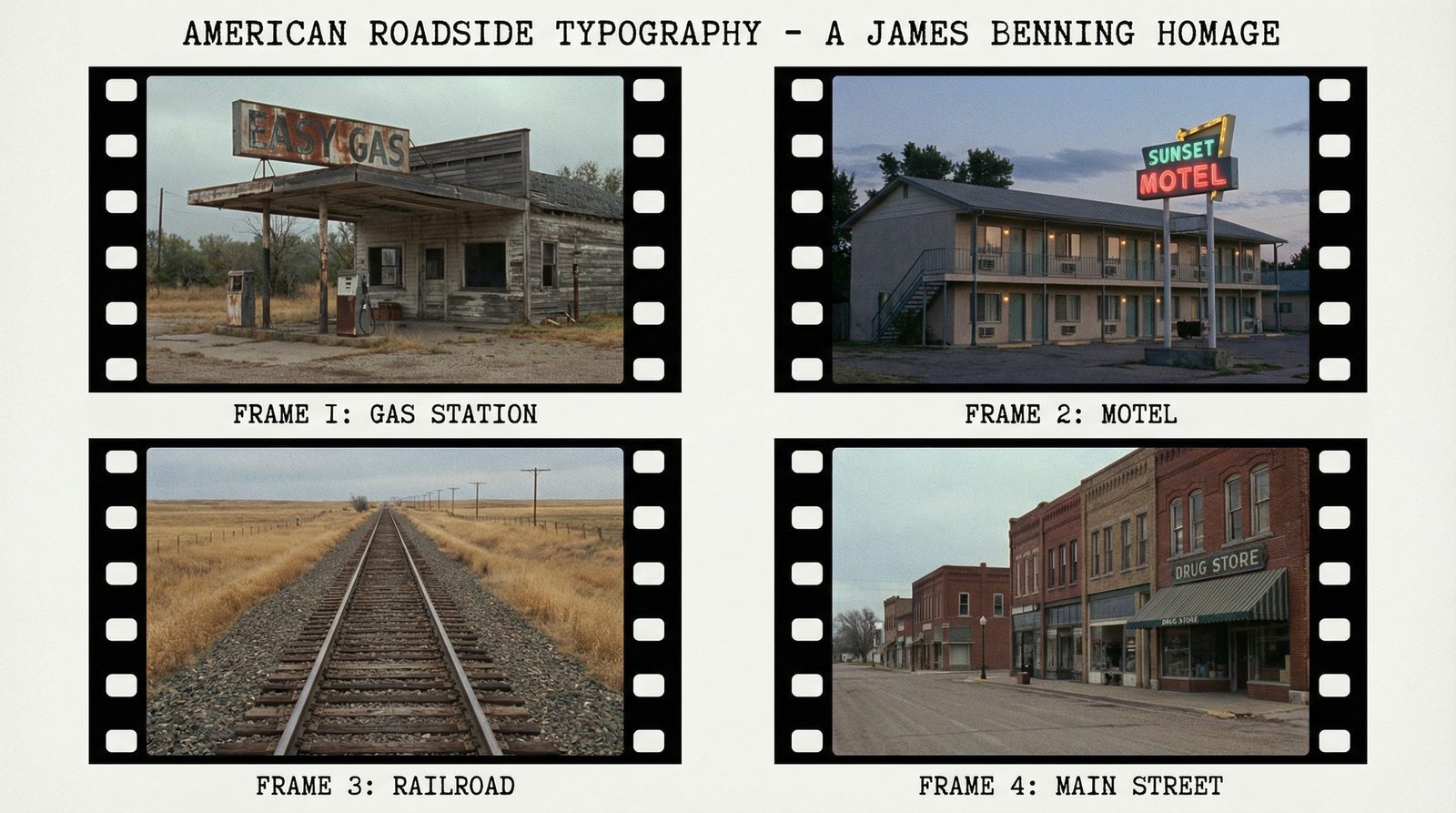
    Editorial illustration inspired by 'Easy Rider (2012)'

    CHARACTERS & PERFORMANCE

    There are no conventional characters in Easy Rider (2012). The landscapes take on the role of a kind of landscape-as-character presence: gas stations, highways, rural fields, small-town streets. In the absence of actors, the viewer projects personality and history onto space. The film banks on cultural memory of road mythology to fill in the blanks.

    When humans appear, they are incidental. They are not framed as protagonists or even supporting players, only as elements of the environment moving through public space. The “performance” happens in the viewer’s mind, in the act of remembering and in noticing the gap between then and now. The film’s emotional temperature depends on how strongly you feel that gap.

    CONTEXT & LEGACY

    Easy Rider (2012) sits within James Benning’s long project of filming American landscapes with forensic patience. It also participates in a broader current of experimental re-visitation, where cinema interrogates its own myths by returning to places rather than re-staging scenes. Benning’s choice of Easy Rider as a source text is telling: the 1969 film crystallized a dream of American freedom tied to mobility and rebellion. Benning returns to the locations decades later to measure what that dream looks like as infrastructure.

    The film’s legacy is mostly art-house and academic rather than mainstream. It functions as a reference point in discussions of landscape cinema, structural film, and the afterlife of counterculture. Its radical gesture is simple: record a place long enough that the viewer can no longer pretend it’s just a background.

    IS IT WORTH WATCHING?

    Whether Easy Rider (2012) is worth your time depends on your tolerance for minimalism. If you come expecting narrative propulsion and soundtrack-driven momentum, this will feel austere, even alienating. There is almost no dialogue, no character arc, and no conventional story payoff.

    If you are interested in experimental film, landscape studies, or the way cinema remembers and erases, it can be quietly rewarding. The film offers a sustained opportunity to think about attention: what happens when a movie refuses to entertain you into meaning and instead asks you to construct it.
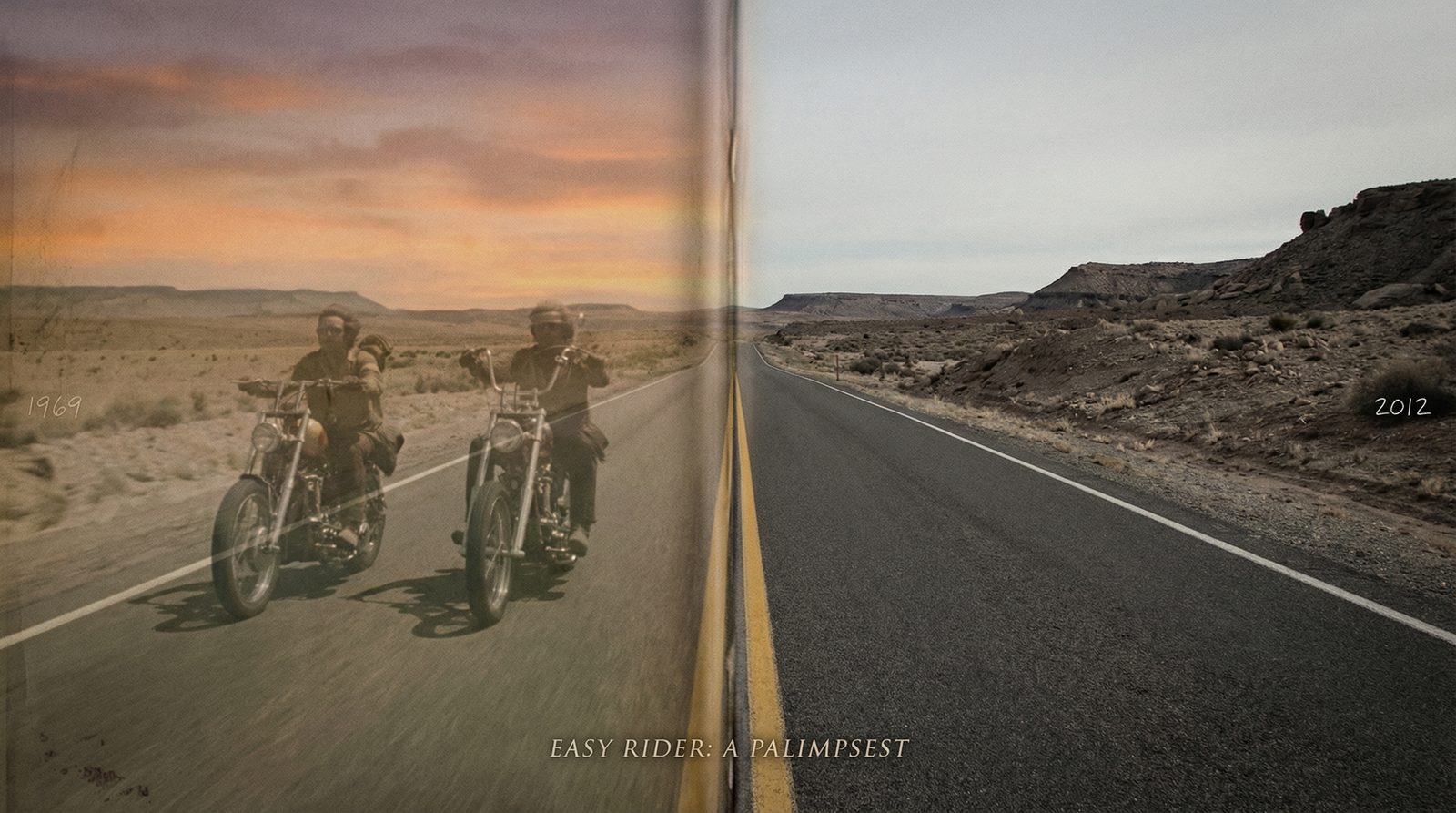
    Symbolic illustration inspired by 'Easy Rider (2012)'

    TRIVIA & PRODUCTION NOTES

    Benning is known for meticulous preparation, and Easy Rider (2012) fits that pattern. He tracked down locations tied to the earlier film and revisited them with a stripped-down production method designed to preserve real light and real time. What would be a throwaway establishing shot in another movie becomes an entire scene here.

    The film’s structure is shaped by durational choices rather than plot beats. Weather, light, and incidental human movement become the “action.” The approach links this film to Benning’s broader landscape work, where the drama is not who wins or dies, but what remains visible when you stop rushing.

    SIMILAR FILMS

    If Easy Rider (2012) works for you, you may enjoy other films built around duration, place, and the viewer’s attention rather than narrative closure. Pairing this film with the 1969 Easy Rider also makes a potent double feature: one riding through the myth of the American West, the other sitting with its lingering traces.

    DISCOVERABILITY & LINKS

  • The Motorcycle Diaries (2004)

    The Motorcycle Diaries (2004)

    The Motorcycle Diaries (2004), directed by Walter Salles. Road Movie · 126 minutes · Argentina / Brazil / Chile / Peru / United States.


    INTRODUCTION

    The Motorcycle Diaries is a Road Movie that feels quietly revolutionary in its modesty. Rather than racing through the milestones of a famous life, it lingers on formative moments before myth hardens into ideology. Walter Salles follows a 23-year-old Ernesto Guevara in 1952, long before he becomes “Che,” tracing a journey across South America that reshapes his sense of responsibility and belonging.

    The film belongs to the coming-of-age tradition, but the coming-of-age is political as much as personal. By the time the credits roll, nothing “historic” has happened in conventional biopic terms. Yet everything has shifted internally. The mood is contemplative, melancholic, and grounded in physical travel rather than rhetoric.

    PLOT & THEMES

    The story follows Ernesto Guevara, a middle-class Argentine medical student, and his friend Alberto Granado as they set off on a ramshackle motorcycle trip across South America. What begins as youthful adventure quickly becomes a lesson in limits. The motorcycle breaks down, money disappears, and the pair are forced into closer contact with people living far outside their social bubble.

    As they travel through Argentina, Chile, and Peru, the tone shifts from comic misadventure to moral confrontation. Encounters with exploited miners, Indigenous communities, and patients at a leper colony expose Ernesto to structural injustice he cannot ignore. Travel becomes transformation, not through spectacle but through accumulation: each border crossed introduces a new ethical tension.

    Illness and bodies play a central role. Ernesto’s asthma and his medical training keep politics anchored in physical vulnerability. Inequality is not discussed abstractly; it is breathed, touched, and treated. The film resists cathartic conversion scenes, favoring gradual awakening. By the river crossing at the leper colony, Ernesto’s decision to swim across becomes a physical declaration of solidarity rather than a speech.

    CINEMATIC TECHNIQUE & AESTHETICS

    Walter Salles relies on naturalistic lighting and extensive location shooting to ground the film in lived geography rather than postcard imagery. Landscapes dwarf the protagonists, reinforcing humility and disorientation. Long takes allow discomfort to settle, particularly during encounters with marginalized communities.

    Handheld camera work during travel sequences gives the journey a tactile instability. The bike rattles, the frame shudders, and progress feels provisional. By contrast, scenes at the leper colony use steadier compositions and visual symmetry, as if the film itself slows down to observe rather than roam.

    Sound design favors ambient noise — engines, wind, water — with Gustavo Santaolalla’s score entering quietly, like memory rather than commentary. Voiceover drawn from Guevara’s diary is used sparingly and often complicates what we see. The final montage of faces anchors the film’s politics in lived human presence rather than ideology.

    Editorial illustration inspired by 'The Motorcycle Diaries (2004)'

    CHARACTERS & PERFORMANCE

    Gael García Bernal plays Ernesto as a restrained Idealist rather than a charismatic firebrand. He is awkward, asthmatic, observant — more listener than speaker. Bernal emphasizes hesitation and internal pressure, letting the awakening register through silence and posture rather than declarations.

    Rodrigo de la Serna’s Alberto Granado provides contrast as a Trickster figure: charming, opportunistic, and emotionally open. Their dynamic balances gravity with warmth. Friendship becomes the film’s emotional vehicle for political realization.

    Supporting characters appear briefly but leave lasting impressions. They function less as individualized arcs and more as lived evidence of inequality. The restrained performances avoid sentimentality, keeping the film from drifting into didacticism.

    CONTEXT & LEGACY

    Released in the early 2000s, The Motorcycle Diaries arrived when Che Guevara’s image had become globally commodified. By focusing on his pre-revolutionary years, the film sidesteps later controversies and instead explores the formation of conscience. Its legacy lies not in political instruction but in showing how empathy precedes ideology.

    Within Latin American cinema, it stands as a key example of the socially conscious Road Movie, using movement to expose class and racial divides. Internationally, it remains a touchstone for films that treat political awakening as a slow, embodied process rather than a single decisive moment.

    IS IT WORTH WATCHING?

    Yes — especially if you prefer character-driven journeys over conventional biopics. The film rewards patience, attention, and openness. It is less interested in answers than in formation.

    Viewers expecting a full account of Che Guevara’s later politics may find it incomplete. As a portrait of an inner shift — from individual adventure to continental awareness — it remains quietly powerful.

  • Neale Donald Walsch

    Neale Donald Walsch

    ORIGINS & BACKGROUND

    Neale Donald Walsch is best known as a contemporary spiritual writer whose work sits at the crossroads of memoir, theology, and personal growth. He emerged in the 1990s in the same broad wave of spiritual publishing that brought readers books like The Celestine Prophecy and The Alchemist. His signature move is to present spirituality as an ongoing, candid conversation rather than a fixed set of doctrines, which made him a major reference point in modern New Age and personal transformation circles.

    The public origin story of Walsch’s career begins in crisis. Before he became widely known as a spiritual author, he cycled through ordinary jobs, personal setbacks, and a period of homelessness that left him angry and disillusioned. Out of that low point, he describes writing an anguished letter to God and unexpectedly experiencing a flowing, dialogic response. That experience became the seed of Conversations With God: An Uncommon Dialogue, Book 1, the work that would define his career.

    Walsch writes as someone raised within conventional Western religious ideas but no longer satisfied with inherited beliefs. His background is less about formal theological training and more about lived frustration with institutions, work, and relationships. That tension—between traditional religion and direct experience—is central to his books. It places him alongside writers like Dan Millman and Don Miguel Ruiz, where the emphasis shifts from belonging to a church toward cultivating a personal relationship with the divine.

    Rather than positioning himself as a guru, Walsch frames his life as a case study in spiritual trial and error. Failure and collapse become narrative proof that the later insights are not abstract theories but hard-won realizations. This biographical framing underlines his recurring themes of personal transformation, direct dialogue with God, and the idea that crisis itself can function as invitation.

    Editorial illustration inspired by 'Neale Donald Walsch'

    THEMES & MOTIFS

    The defining motif in Walsch’s work is direct dialogue with the divine. Rather than presenting God as distant or unreachable, he portrays the divine as conversational and accessible, willing to engage in plain language about money, relationships, fear, sex, politics, and everyday frustration. The dialogue format is not only a narrative choice; it is the claim that spiritual access is immediate, personal, and available in ordinary life.

    A second recurring thread is spiritual questioning. Walsch treats doubt, anger, and confusion as legitimate starting points rather than signs of failure. His narrator argues, pushes back, and admits resistance, and the text frames this conflict as part of the path. The effect is less a tidy lesson and more a sustained conversation where beliefs are revised in motion.

    Personal transformation runs through everything. Walsch’s books trace a movement from victim consciousness toward intentional co-creation. The idea that thoughts, beliefs, and choices shape experience echoes the broader New Age movement, but Walsch’s method is intimate: the spiritual material is tested against bills, grief, failed relationships, and daily shame rather than staged as mythic adventure.

    Another motif is everyday spirituality. Walsch repeatedly insists that spirituality is not confined to churches, rituals, or retreats. It shows up in how you talk to your partner, how you handle a job loss, and how you respond to fear. In his framing, the sacred is not a separate domain. It is the texture of ordinary choices.

    Finally, a strong thread of unity consciousness runs through his “God” voice: separation is treated as illusion, interconnectedness as reality, love as the underlying condition. This places him firmly in the New Age lineage while the conversational format keeps the philosophy anchored in personal dilemmas rather than abstract metaphysics.

    Symbolic illustration inspired by 'Neale Donald Walsch'

    STYLE & VOICE

    Walsch writes in a confessional tone that feels closer to a late-night conversation than a sermon. His signature structure is the back-and-forth between his own questioning voice and the voice of God, presented as dialogue. This script-like rhythm keeps pacing brisk even when the subject matter becomes metaphysical.

    The “God” voice is conversational and occasionally playful, mixing spiritual claims with colloquial language. This strips away the solemnity of traditional religious writing and replaces it with a mentoring presence that is meant to feel intimate rather than authoritarian.

    Walsch favors clear, direct prose over literary flourish. Ideas are often restated in slightly different forms, anticipating the reader’s objections and trying to translate concepts into usable daily guidance. The result is didactic but personal, with a recurring emphasis on applying spiritual insight to everyday relationships, work stress, and fear.

    Emotionally, his books aim for reassurance with a sharpened edge of accountability. The tone is comforting, but readers are also pressed to take responsibility for beliefs and choices, which gives the voice a subtle insistence beneath its warmth.

    KEY WORKS & LEGACY

    Conversations With God: An Uncommon Dialogue, Book 1 (1995) is the defining work of Neale Donald Walsch. It introduces his core premise of direct conversation with God and lays out his major themes of personal transformation, unity consciousness, and everyday spirituality. The book’s success led to sequels and spin-offs, but this first volume remains the entry point for most readers and the clearest expression of his approach.

    In the broader landscape of late twentieth-century spiritual writing, Walsch sits alongside authors like Dan Millman, Don Miguel Ruiz, and James Redfield. Where The Alchemist uses parable and where narrative seekers use adventure structures, Walsch’s distinctive legacy is the normalization of spiritual dialogue as a practice: “talking to God” becomes something a reader can attempt, not merely something saints or prophets claim.

    His influence shows up in how many readers now treat spirituality less as adherence to a system and more as an ongoing, personal conversation. Even critics who question his claims often acknowledge the emotional impact of his framing: it gives permission to question, to argue, and to seek without needing institutional approval.

  • Alan Watts

    Alan Watts

    ORIGINS & BACKGROUND

    Alan Watts is best known as a bridge figure, a British-born writer and speaker who helped popularize Asian thought for Western audiences in the mid-twentieth century. He was raised in England with a mix of Anglican Christianity and a sharp curiosity about the wider world, which led him early toward Buddhist and Hindu texts. Eventually he moved to the United States, studied theology, and served as an Episcopal priest before leaving the church to focus on a more fluid Eastwest Philosophical Synthesis.

    What matters for his work is less the institutional path and more the way he stood at a cultural crossroads. He wrote and lectured at a time when Western readers were just beginning to take Zen Buddhism, Taoism, and Vedanta seriously. Rather than presenting them as exotic systems, he treated them as practical lenses for everyday life. His training in Christian theology gave him a sharp sense of how religious language can clarify, distort, and control, and he used that insight to cut through dogma on all sides.

    Watts was less interested in constructing a tight philosophical system than in describing how ideas feel from the inside. His biography feeds directly into this approach: a restless mover between countries, institutions, and traditions, he turned his own life into an experiment in living without clinging too tightly to any one identity.

    Editorial illustration inspired by 'Alan Watts'

    THEMES & MOTIFS

    A central theme in Watts’s work is the illusion of a separate self. Again and again he returns to the idea that the “I” we defend is a mental construct, a useful convention that becomes painful when we treat it as something solid. For Watts, the self is more like a pattern in motion than a hard object, and much of our anxiety comes from trying to freeze that motion into certainty and control.

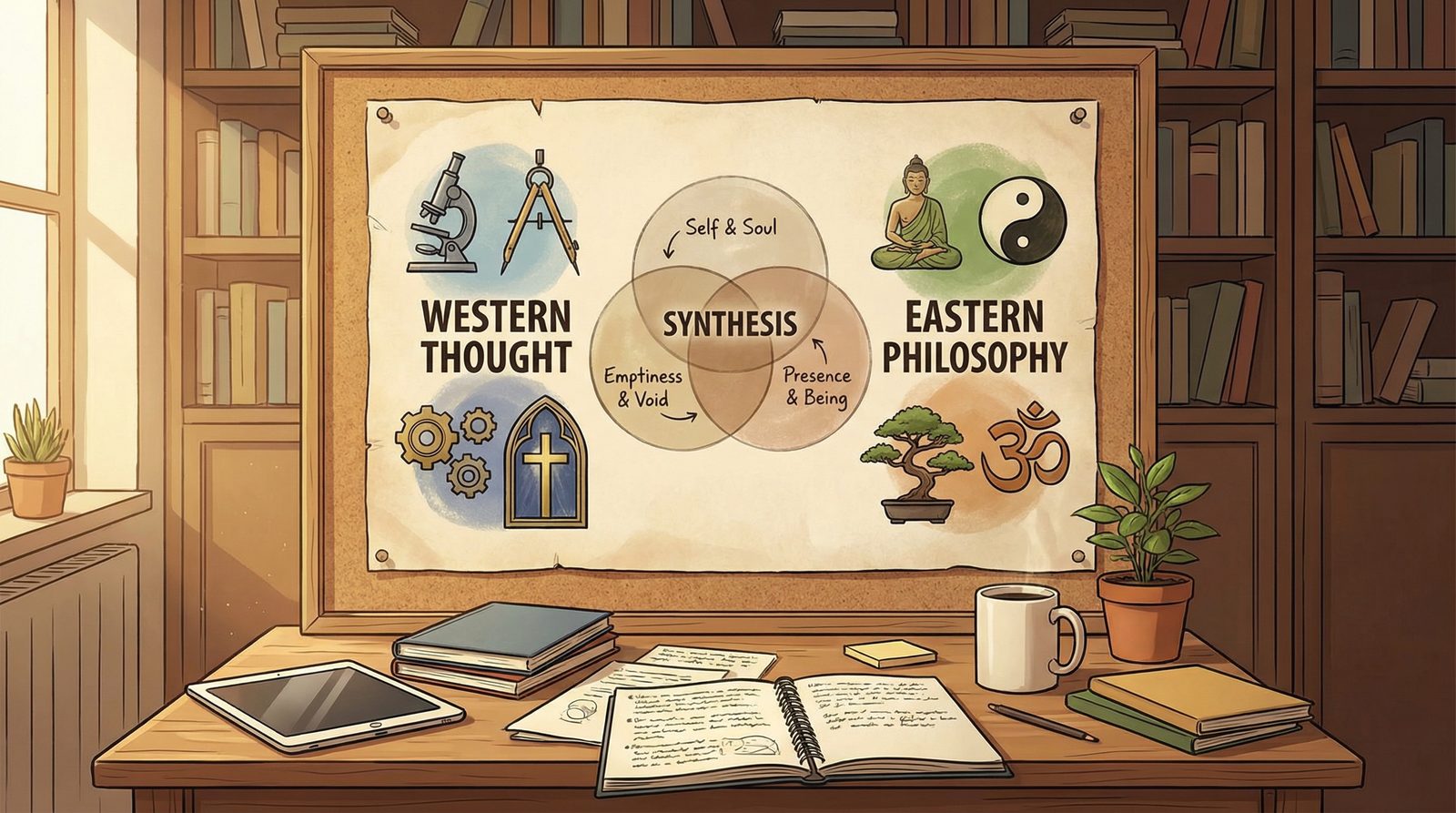
    Another recurring motif is Eastwest Philosophical Synthesis. He places Zen, Taoism, and Hinduism alongside Western psychology, science, and Christian imagery, not to flatten them into one bland system but to show how each tradition reveals a different blind spot. The synthesis is less about agreement than about creative friction, where unfamiliar language opens new ways of seeing familiar problems.

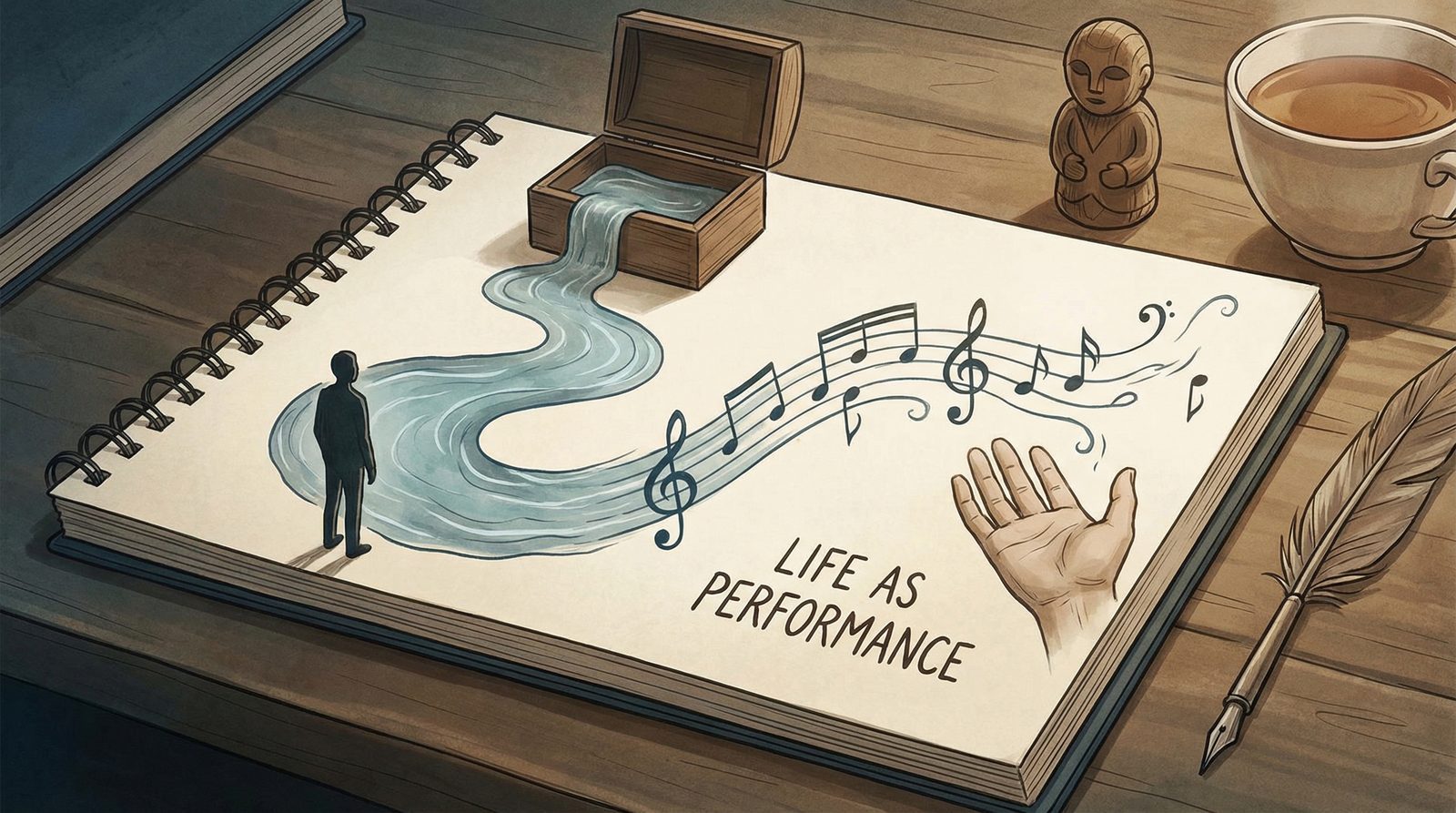
    Watts is also preoccupied with the tension between control and surrender. He returns to images of water, music, and dance to suggest that life works better when approached as a performance rather than a problem to be solved. This places him in useful contrast with more strictly instructional works like Zen Mind, Beginner’s Mind, where discipline and practice are emphasized more than play and improvisation.

    Finally, he explores insecurity and groundlessness directly. In The Wisdom Of Insecurity, Watts argues that the demand for absolute certainty is itself a generator of suffering. Rather than promising stable answers, he invites the reader to become more intimate with change, ambiguity, and the passing nature of experience. That willingness to sit with not-knowing is one of the signatures of his voice.

    Symbolic illustration inspired by 'Alan Watts'

    STYLE & VOICE

    Watts writes and speaks in a conversational, sometimes mischievous tone. His style is closer to a late-night talk than to formal philosophy. He uses jokes, parables, and sudden shifts in perspective to loosen the reader’s grip on familiar assumptions. Rather than building dense chains of argument, he circles a topic from multiple angles until something clicks at the level of intuition.

    There is a musical quality to his pacing. He often begins with something concrete and ordinary, widens the frame to cosmic scale, then drops back into the personal. This rhythm mirrors his themes about the unity of self and world, moving the reader between the intimate and the vast without insisting on a final “system.”

    Compared with more austere Zen teachers or more systematic writers, Watts is comfortable with contradiction and unresolved tension. He will often present two opposing views and then suggest that both are partial, inviting the listener to feel their way into a third position that cannot be neatly stated. The tone is playful, sometimes irreverent, but underneath is a steady seriousness about suffering, compassion, and seeing the world with fresh eyes.

    KEY WORKS & LEGACY

    Because so much of Watts’s influence came through lectures and radio broadcasts, his key works are as much spoken as written. Collections of his talks continue to circulate, shaping how English-speaking audiences encounter ideas like non-duality, impermanence, and the limits of the ego. His writing helped make these concepts feel close to everyday life rather than locked in monasteries.

    His legacy is not a single doctrine but a set of habits: questioning the solidity of the self, treating synthesis as a living conversation rather than a museum display, and approaching spiritual practice with a mix of seriousness and humor. For many readers and listeners, Watts was the first voice that made spiritual life feel exploratory rather than rule-bound, and that permission continues to ripple through modern writing on consciousness, psychology, and attention.

  • Matthew B Crawford

    Matthew B Crawford

    STYLE & VOICE

    Crawford’s style blends essayistic reflection with concrete anecdote. He moves from a seized engine bolt or a poorly designed interface to questions about authority, freedom, and responsibility. The voice is patient, skeptical, and occasionally wry, shaped by someone who has argued these ideas in both seminar rooms and garages.

    Structurally, his books braid memoir, reportage, and philosophy. Rather than building a single linear argument, he circles his claims from multiple angles, inviting readers to test them against their own experience of work and attention. The tone is critical but not despairing; he consistently points to real pockets of agency that still exist.

    KEY WORKS & LEGACY

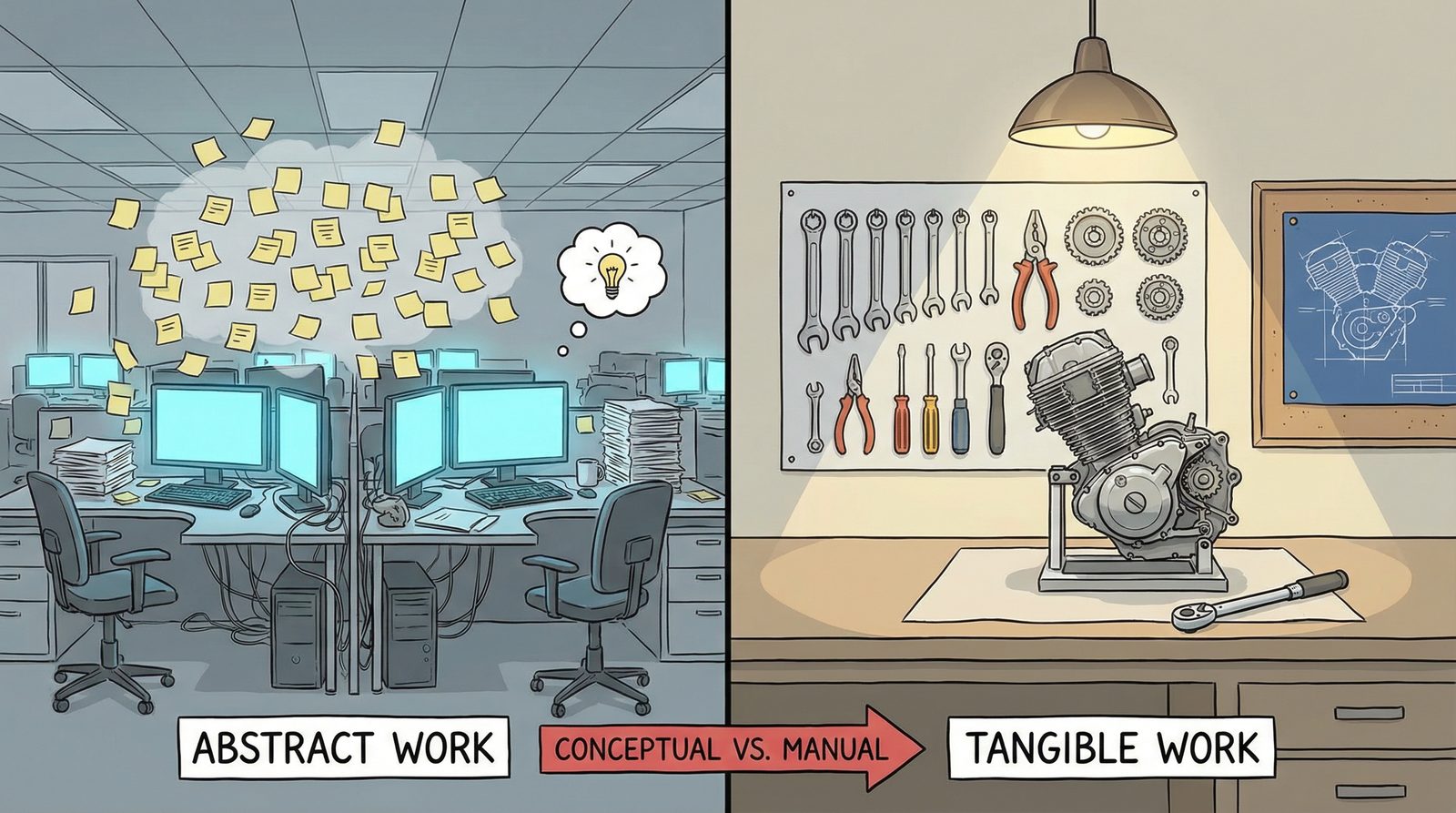
    Crawford’s most influential book is Shop Class as Soulcraft (2009), which argues that the decline of manual trades has moral and civic consequences. Drawing on his experience as a mechanic, he contrasts work that produces tangible feedback with white-collar labor that obscures cause and effect.

    He expanded these ideas in The World Beyond Your Head (2015) and Why We Drive (2020), broadening the argument from making things to navigating shared spaces. Across these works, Crawford’s legacy lies in defending friction, attention, and responsibility as the foundations of meaningful freedom.

    ORIGINS & BACKGROUND

    Matthew B. Crawford is best known as a writer and thinker who treats everyday work as a serious philosophical problem. Trained as a political philosopher, he also spent years working as a motorcycle mechanic, most visibly in an independent repair shop. That double life—moving between academic theory and manual practice—is the biographical fact that matters most for understanding his work. It gives him a vantage point from which to question how modern societies define expertise, freedom, and responsibility.

    Crawford writes in the wake of Robert M. Pirsig, whose Zen and the Art of Motorcycle Maintenance and Lila: An Inquiry into Morals used mechanical work and travel as frames for moral inquiry. Like Pirsig, Crawford is preoccupied with Craftsmanship And Quality Of Work, but he relocates that concern firmly inside the late-modern economy of screens, automation, and precarious white-collar labor. His background in political theory allows him to connect the feel of a workday to institutions, incentives, and power.

    Although he writes from an American context, Crawford’s concerns are not nationalist. He is interested in a broader modern condition: what happens when people are pushed away from tangible skills toward increasingly abstract forms of labor. His biography matters less as a timeline than as a pattern of choices—again and again testing ideas against stubborn material reality, whether on a workbench or in public debate.

    Editorial illustration inspired by 'Matthew B Crawford'

    THEMES & MOTIFS

    The central motif in Crawford’s work is Craftsmanship And Quality Of Work. He treats manual competence not as nostalgia but as a live moral question: what kind of work allows a person to know, concretely, that they have done something well? Across his essays and books, he argues that good work is a conversation with reality, one in which materials and tools push back and demand accountability.

    From this follows a sustained critique of frictionless freedom. Crawford argues that a culture obsessed with convenience and unlimited choice often produces passivity rather than autonomy. Constraint, resistance, and feedback are not obstacles to freedom; they are the conditions under which judgment and responsibility form.

    Another recurring concern is attention as a moral resource. Crawford examines how environments are designed to fragment focus and how this erosion of attention weakens both work and citizenship. Rather than retreating from modern life, he asks what it would mean to design streets, tools, and workplaces that support sustained engagement.

    Throughout his writing, the craftsman appears as a quiet rebel. By insisting that things be done properly, Crawford’s favored figures resist bureaucratic and corporate scripts without spectacle. In that insistence, he locates a form of dignity that is both personal and political.

    Symbolic illustration inspired by 'Matthew B Crawford'

    STYLE & VOICE

    Crawford’s style blends essayistic reflection with concrete anecdote. He moves from a seized engine bolt or a poorly designed interface to questions about authority, freedom, and responsibility. The voice is patient, skeptical, and occasionally wry, shaped by someone who has argued these ideas in both seminar rooms and garages.

    Structurally, his books braid memoir, reportage, and philosophy. Rather than building a single linear argument, he circles his claims from multiple angles, inviting readers to test them against their own experience of work and attention. The tone is critical but not despairing; he consistently points to real pockets of agency that still exist.

    KEY WORKS & LEGACY

    Crawford’s most influential book is Shop Class as Soulcraft (2009), which argues that the decline of manual trades has moral and civic consequences. Drawing on his experience as a mechanic, he contrasts work that produces tangible feedback with white-collar labor that obscures cause and effect.

    He expanded these ideas in The World Beyond Your Head (2015) and Why We Drive (2020), broadening the argument from making things to navigating shared spaces. Across these works, Crawford’s legacy lies in defending friction, attention, and responsibility as the foundations of meaningful freedom.

    ORIGINS & BACKGROUND

    Matthew B. Crawford is best known as a writer and thinker who treats everyday work as a serious philosophical problem. Trained as a political philosopher, he also spent years working as a motorcycle mechanic, most visibly in an independent repair shop. That double life—moving between academic theory and manual practice—is the biographical fact that matters most for understanding his work. It gives him a vantage point from which to question how modern societies define expertise, freedom, and responsibility.

    Crawford writes in the wake of Robert M. Pirsig, whose Zen and the Art of Motorcycle Maintenance and Lila: An Inquiry into Morals used mechanical work and travel as frames for moral inquiry. Like Pirsig, Crawford is preoccupied with Craftsmanship And Quality Of Work, but he relocates that concern firmly inside the late-modern economy of screens, automation, and precarious white-collar labor. His background in political theory allows him to connect the feel of a workday to institutions, incentives, and power.

    Although he writes from an American context, Crawford’s concerns are not nationalist. He is interested in a broader modern condition: what happens when people are pushed away from tangible skills toward increasingly abstract forms of labor. His biography matters less as a timeline than as a pattern of choices—again and again testing ideas against stubborn material reality, whether on a workbench or in public debate.

    Editorial illustration inspired by 'Matthew B Crawford'

    THEMES & MOTIFS

    The central motif in Crawford’s work is Craftsmanship And Quality Of Work. He treats manual competence not as nostalgia but as a live moral question: what kind of work allows a person to know, concretely, that they have done something well? Across his essays and books, he argues that good work is a conversation with reality, one in which materials and tools push back and demand accountability.

    From this follows a sustained critique of frictionless freedom. Crawford argues that a culture obsessed with convenience and unlimited choice often produces passivity rather than autonomy. Constraint, resistance, and feedback are not obstacles to freedom; they are the conditions under which judgment and responsibility form.

    Another recurring concern is attention as a moral resource. Crawford examines how environments are designed to fragment focus and how this erosion of attention weakens both work and citizenship. Rather than retreating from modern life, he asks what it would mean to design streets, tools, and workplaces that support sustained engagement.

    Throughout his writing, the craftsman appears as a quiet rebel. By insisting that things be done properly, Crawford’s favored figures resist bureaucratic and corporate scripts without spectacle. In that insistence, he locates a form of dignity that is both personal and political.

    Symbolic illustration inspired by 'Matthew B Crawford'

    STYLE & VOICE

    Crawford’s style blends essayistic reflection with concrete anecdote. He moves from a seized engine bolt or a poorly designed interface to questions about authority, freedom, and responsibility. The voice is patient, skeptical, and occasionally wry, shaped by someone who has argued these ideas in both seminar rooms and garages.

    Structurally, his books braid memoir, reportage, and philosophy. Rather than building a single linear argument, he circles his claims from multiple angles, inviting readers to test them against their own experience of work and attention. The tone is critical but not despairing; he consistently points to real pockets of agency that still exist.

    KEY WORKS & LEGACY

    Crawford’s most influential book is Shop Class as Soulcraft (2009), which argues that the decline of manual trades has moral and civic consequences. Drawing on his experience as a mechanic, he contrasts work that produces tangible feedback with white-collar labor that obscures cause and effect.

    He expanded these ideas in The World Beyond Your Head (2015) and Why We Drive (2020), broadening the argument from making things to navigating shared spaces. Across these works, Crawford’s legacy lies in defending friction, attention, and responsibility as the foundations of meaningful freedom.

    ORIGINS & BACKGROUND

    Matthew B. Crawford is best known as a writer and thinker who treats everyday work as a serious philosophical problem. Trained as a political philosopher, he also spent years working as a motorcycle mechanic, most visibly in an independent repair shop. That double life—moving between academic theory and manual practice—is the biographical fact that matters most for understanding his work. It gives him a vantage point from which to question how modern societies define expertise, freedom, and responsibility.

    Crawford writes in the wake of Robert M. Pirsig, whose Zen and the Art of Motorcycle Maintenance and Lila: An Inquiry into Morals used mechanical work and travel as frames for moral inquiry. Like Pirsig, Crawford is preoccupied with Craftsmanship And Quality Of Work, but he relocates that concern firmly inside the late-modern economy of screens, automation, and precarious white-collar labor. His background in political theory allows him to connect the feel of a workday to institutions, incentives, and power.

    Although he writes from an American context, Crawford’s concerns are not nationalist. He is interested in a broader modern condition: what happens when people are pushed away from tangible skills toward increasingly abstract forms of labor. His biography matters less as a timeline than as a pattern of choices—again and again testing ideas against stubborn material reality, whether on a workbench or in public debate.

    Editorial illustration inspired by 'Matthew B Crawford'

    THEMES & MOTIFS

    The central motif in Crawford’s work is Craftsmanship And Quality Of Work. He treats manual competence not as nostalgia but as a live moral question: what kind of work allows a person to know, concretely, that they have done something well? Across his essays and books, he argues that good work is a conversation with reality, one in which materials and tools push back and demand accountability.

    From this follows a sustained critique of frictionless freedom. Crawford argues that a culture obsessed with convenience and unlimited choice often produces passivity rather than autonomy. Constraint, resistance, and feedback are not obstacles to freedom; they are the conditions under which judgment and responsibility form.

    Another recurring concern is attention as a moral resource. Crawford examines how environments are designed to fragment focus and how this erosion of attention weakens both work and citizenship. Rather than retreating from modern life, he asks what it would mean to design streets, tools, and workplaces that support sustained engagement.

    Throughout his writing, the craftsman appears as a quiet rebel. By insisting that things be done properly, Crawford’s favored figures resist bureaucratic and corporate scripts without spectacle. In that insistence, he locates a form of dignity that is both personal and political.

    Symbolic illustration inspired by 'Matthew B Crawford'

    STYLE & VOICE

    Crawford’s style blends essayistic reflection with concrete anecdote. He moves from a seized engine bolt or a poorly designed interface to questions about authority, freedom, and responsibility. The voice is patient, skeptical, and occasionally wry, shaped by someone who has argued these ideas in both seminar rooms and garages.

    Structurally, his books braid memoir, reportage, and philosophy. Rather than building a single linear argument, he circles his claims from multiple angles, inviting readers to test them against their own experience of work and attention. The tone is critical but not despairing; he consistently points to real pockets of agency that still exist.

    KEY WORKS & LEGACY

    Crawford’s most influential book is Shop Class as Soulcraft (2009), which argues that the decline of manual trades has moral and civic consequences. Drawing on his experience as a mechanic, he contrasts work that produces tangible feedback with white-collar labor that obscures cause and effect.

    He expanded these ideas in The World Beyond Your Head (2015) and Why We Drive (2020), broadening the argument from making things to navigating shared spaces. Across these works, Crawford’s legacy lies in defending friction, attention, and responsibility as the foundations of meaningful freedom.

  • Robert M Pirsig

    Robert M Pirsig

    ORIGINS & BACKGROUND

    Robert M Pirsig is best known as a writer who used the American road as a moving classroom, blending narrative with philosophy without locking either into academic form. Trained in both science and philosophy, and deeply influenced by Asian thought, he became a kind of outsider teacher, less interested in institutional debate than in how ideas hold up inside ordinary life. His work unfolds in garages, classrooms, and small towns rather than ivory towers, which keeps his questions about value and meaning close to the ground.

    What matters most about his background is not a list of institutions, but the way he bridged technical know-how with spiritual restlessness. He wrote about motorcycles, boats, and repair not as hobbies but as gateways into a larger inquiry about how to live well in a technological society. This interest in Craftsmanship And Quality Of Work reflects a lifetime of moving between intellectual abstraction and hands-on problem solving.

    Pirsig’s books arrived in a cultural moment when readers were drawn to road narratives as symbols of freedom, but he pushed the form beyond rebellion. Instead of celebrating escape, he examined responsibility, attention, and care. His work sits in conversation with figures like Alan Watts, who helped popularize Eastern philosophy in the West, and later writers like Matthew B Crawford, whose Shop Class As Soulcraft An Inquiry Into The Value Of Work echoes Pirsig’s respect for manual skill and moral seriousness. Across his career, Pirsig kept returning to the question of what “quality” means in a fragmented, distracted age.

    Editorial illustration inspired by 'Robert M Pirsig'

    THEMES & MOTIFS

    A central through-line in Pirsig’s work is Eastwest Philosophical Synthesis. He brings together classical Western logic, with its love of definitions and categories, and Buddhist or Taoist attention to direct experience. Rather than choosing sides, he lets these traditions argue inside the same narrative, using travel and conversation to test them against real conditions. The synthesis is not decorative; it is the main tool he uses to ask what counts as a good life.

    Another core motif is Craftsmanship And Quality Of Work. For Pirsig, tightening a bolt or diagnosing an engine is never just technical labor. It becomes a moral exercise in patience, presence, and respect for the material world. This connects directly to Crawford’s defense of skilled work in Shop Class As Soulcraft, where competence is treated as an ethical stance against a culture of distraction and abstraction.

    Pirsig also returns to the tension between rationality and breakdown, analysis and fragility. His narratives circle the fear that thinking can fracture the self if it loses contact with lived experience. This is where his work feels more haunted than the popularized “Zen” surface suggests. He is interested in attention, but also in what happens when attention becomes obsessive or unmoored.

    Throughout his work, travel is less about sightseeing than about testing ideas in motion. The road and the river become laboratories for inquiry. That is why the recurring threads remain consistent: Eastwest Philosophical Synthesis as method, craftsmanship as moral practice, and an insistence that “quality” has to be lived, not merely defined.

    Symbolic illustration inspired by 'Robert M Pirsig'

    STYLE & VOICE

    Pirsig writes in a hybrid form that drifts between memoir, travelogue, and philosophical essay. His style is patient and discursive. Scenes of riding or repair are interrupted by long reflections on metaphysics, then folded back into the narrative with an emphasis on lived consequence rather than pure abstraction. The pacing can feel meditative, but it is also methodical, as if the prose itself is committed to doing careful work.

    His voice is intimate and analytical at the same time. He lets readers into doubt, breakdown, and revision, which gives the philosophical material emotional weight. Instead of presenting a finished system, he invites the reader into a working process where ideas are tested, stressed, and re-evaluated. That workshop quality mirrors his commitment to craft: an idea has to “run” in experience, not merely sound convincing.

    Structurally, Pirsig favors braided narratives. External travel unfolds alongside internal monologue and abstract argument, with each layer illuminating the others. Readers who enjoy the reflective, conversational style of Alan Watts will recognize a similar willingness to think out loud, but Pirsig’s prose is denser, more technical, and more anchored in the concrete realities of machines, weather, and maintenance.

    KEY WORKS & LEGACY

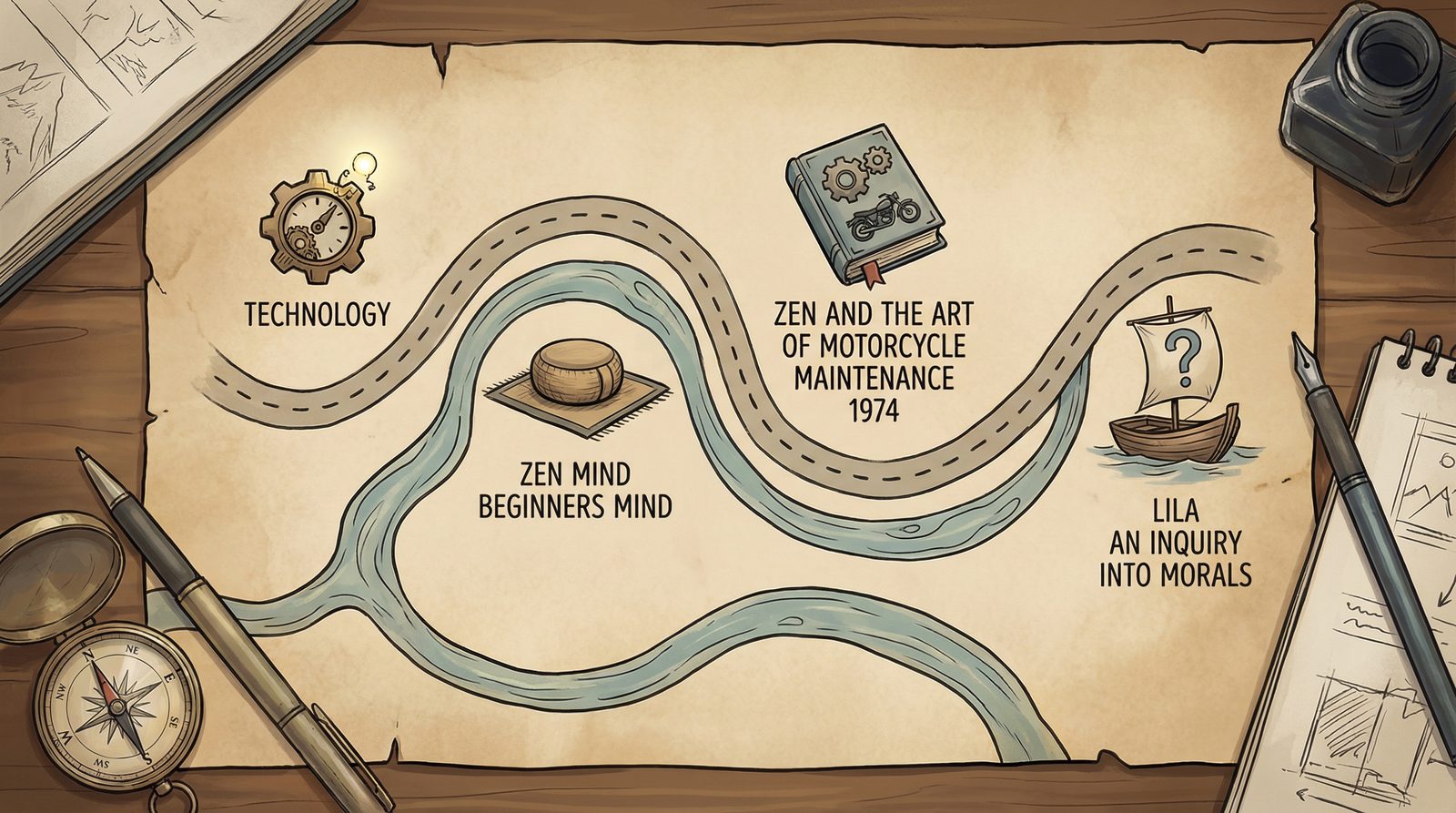
    Pirsig’s reputation rests primarily on Zen And The Art Of Motorcycle Maintenance (1974), a book that became a touchstone for readers who wanted philosophy without leaving the open road. A father-and-son motorcycle trip becomes the frame for exploring his evolving notion of quality, his critique of narrow rationalism, and his attempt at Eastwest Philosophical Synthesis. The scenes of tuning engines and navigating back roads anchor abstraction in the tactile world of craft.

    He later extended that inquiry in Lila: An Inquiry Into Morals (1991), shifting from motorcycles to a boat journey and from personal crisis to a broader examination of social and moral patterns. Where Zen And The Art Of Motorcycle Maintenance centers on individual quality, Lila pushes toward a more systematic account of how values evolve in communities. Together, the books form a two-part exploration of how metaphysics might grow out of everyday experience.

    Pirsig’s legacy can be felt in modern defenses of hands-on skill and moral seriousness, including Crawford’s Shop Class As Soulcraft. He remains a key figure in conversations about how to reconcile technology with inner life, and his distinctive contribution is to treat the garage, the road, and the workshop as legitimate philosophical sites. For readers drawn to craft, attention, and the lived texture of ideas, his work offers a slow, rigorous argument that value is something you practice.

  • Valets And Butlers

    Valets And Butlers

    DEFINITION & CORE IDEA

    Valets And Butlers is a motif built around the personal servant who is close enough to see everything, disciplined enough to say almost nothing, and competent enough to keep a household (or a protagonist) from collapsing. On the surface, valets and butlers exist to perform routine tasks: managing clothing, announcing visitors, maintaining schedules, smoothing over small social frictions. In narrative terms, they often function as the story’s most reliable intelligence inside a world of performative status.

    The motif’s charge comes from inversion. The servant holds the lowest formal rank while possessing the highest practical awareness. Because they are expected to be discreet, people speak freely around them, treat them as part of the room, and underestimate how much they notice. That gap between visibility and knowledge turns service into a form of power: quiet, deniable, and structurally essential.

    In the comic tradition shaped by P. G. Wodehouse, this inversion becomes the engine of farce. In Right Ho, Jeeves and The Code Of The Woosters, the socially superior employer repeatedly creates the mess while the valet quietly contains it. The humor is not simply that the servant is smarter. It is that the entire social order depends on someone who is never meant to be credited.

    At its core, Valets And Butlers explores what it means to serve and what service costs. It asks who truly holds power in a room, how much control can exist without recognition, and what kind of intimacy forms when one person’s job is to manage another’s life more competently than they ever could themselves.


    HOW IT WORKS IN STORIES

    Most stories using this motif keep the servant constantly present but rarely centered. Valets and butlers move through scenes performing routine actions while absorbing information, witnessing private failures, and tracking social pressure points. Writers use this access to make the servant a natural witness, confidant, and stabilizer inside a household that would otherwise fracture under its own ego and etiquette.

    Structurally, these characters often function as corrective force. When the plot threatens to spin into scandal or humiliation, the servant intervenes indirectly: shifting timing, redirecting people, removing evidence, arranging encounters, limiting damage. The employer may believe they are in control, but the narrative repeatedly demonstrates that outcomes depend on the servant’s judgment, restraint, and ability to act without being seen acting.

    This same architecture works outside pure comedy. In a mystery or a socially sharper story, the servant may be the only person with complete situational awareness because they were present during the moments others dismissed as background. Even when they say little, their position reveals how much labor is required to maintain the illusion of order and how dependent “status” is on invisible work.

    Dialogue becomes a tool of power without confrontation. Formal speech and minimal responses allow valets and butlers to communicate warning, irony, or correction while preserving the hierarchy’s appearance. A phrase like “Very good, sir” can carry obedience, exasperation, or quiet judgment depending on context. That ambiguity lets the motif explore control without turning the story into a lecture about class.

    Because these characters move freely between rooms, conversations, and social layers, they also serve as narrative connective tissue. Information passes through them. Emotional shifts register with them first. The household feels coherent because one figure circulates through all its compartments while everyone else remains trapped inside their own priorities.


    Editorial illustration inspired by 'Valets And Butlers'

    EMOTIONAL EFFECT ON THE READER

    This motif produces a blend of reassurance and unease. There is comfort in knowing that someone competent is present when authority figures are impulsive, naive, or self-absorbed. In a Jeeves-style story, readers relax slightly because they trust the servant will contain the chaos even when characters cannot manage themselves.

    At the same time, the motif carries quiet tension. The servant sees everything and remembers it. Readers understand that the social order depends on continued discretion and goodwill. Beneath the comedy sits an unspoken question: what happens if the person holding the system together decides to stop?

    The emotional intimacy of service deepens that effect. A valet or butler assists with private routines, hears confessions, and observes vulnerability without reciprocity. That closeness can feel protective or quietly tragic, especially when the servant’s own inner life remains unspoken and structurally suppressed.

    The motif also taps into a powerful fantasy: being understood so well that problems are solved before they need to be explained. The Jeeves and Wooster (TV Series) version makes that fantasy playful, turning competence into a safety net the viewer can rely on. Even when stories handle the motif with sharper satire, the same comfort remains: someone is paying attention, even if the people in charge are not.


    Symbolic illustration inspired by 'Valets And Butlers'

    VARIATIONS & RELATED MOTIFS

    Several variations recur within Valets And Butlers. The best-known is the hyper-competent servant whose intelligence far exceeds that of their employer, producing comedy through contrast: authority fails publicly while competence operates quietly in the background. Another variation is the stoic butler whose restraint becomes the drama, where the emotional payoff comes from what is withheld rather than expressed.

    A darker variation reframes the servant as an active manipulator. Because they stand at the intersection of information and access, they can redirect events for personal advantage, shifting the motif toward suspense or moral ambiguity. A satirical variation turns the servant into a mirror held up to the ruling class, exposing how fragile “refinement” becomes once it relies on invisible labor to remain believable.

    This motif overlaps naturally with Country House Comedy and Comic Misunderstandings And Farce, where servants often become the stabilizing intelligence inside a house full of schemes. It also connects to Victorian And Edwardian Social Satire, where the upstairs-downstairs perspective turns manners into a pressure system. In broader comedy-of-manners traditions, writers like Evelyn Waugh and Nancy Mitford echo the same logic: social status performs authority, but real control often sits with the people expected not to speak.

  • Synchronicity And Meaningful Coincidence

    Synchronicity And Meaningful Coincidence

    DEFINITION & CORE IDEA

    Synchronicity And Meaningful Coincidence is the motif where events align with a precision that feels narratively excessive if everything is truly random. A stranger says the exact phrase the protagonist has been circling internally. A missed train leads to the only meeting that matters. The same symbol appears across unrelated places and moments. The story does not need to prove the supernatural; what matters is that the character experiences these alignments as communication rather than noise.

    In stories built around this motif, coincidence becomes information. The protagonist begins to treat timing, repetition, and interruption as meaningful data rather than background chaos. The explanation may vary — fate, God, a hidden order, the unconscious mind — but structurally the coincidences function the same way: they influence choice. Once the character starts acting as if meaning is real, the story has crossed its threshold.

    This logic is explicit in The Celestine Prophecy, where sequential encounters operate as instructions disguised as chance. In The Tenth Insight, the same mechanism is expanded into a system, training characters to read coincidence as guidance rather than accident. The Alchemist reframes this dynamic more quietly: dreams, omens, and chance meetings grant permission to abandon a stable life in favor of a meaningful one. In Way Of The Peaceful Warrior, coincidence is less mystical and more instructional, nudging attention back to discipline, presence, and embodied awareness.


    HOW IT WORKS IN STORIES

    Synchronicity usually enters a story quietly. The protagonist notices something small and easily dismissible: a repeated number, a perfectly timed interruption, an overheard sentence that lands too close to home. Early scenes preserve plausible deniability so the reader can remain skeptical without breaking immersion.

    The engine activates when coincidences begin to cluster. One coincidence is texture; several in close succession create pressure. These clusters tend to appear at decision points, moments when the protagonist is stuck between options or close to abandoning a path. In narratives like The Celestine Prophecy, each encounter functions as a breadcrumb that must be followed or consciously rejected. In The Alchemist, ignoring omens does not trigger punishment, but it stalls the story, draining momentum until attention realigns.

    Effective uses of this motif always impose cost. Following a “sign” risks embarrassment, loss of stability, or the appearance of irrationality. The character must accept the possibility of being wrong, foolish, or delusional. This risk is essential. Without it, synchronicity collapses into wish fulfillment. The choice to trust coincidence must feel dangerous enough to matter.

    Resolution typically arrives in one of two forms. In affirming narratives, the character learns to live inside a world where meaning does not need constant confirmation. In more ambiguous stories — as in I Origins — coincidences remain interpretable rather than proven, and the payoff is psychological. What changes is not the universe, but the character’s relationship to uncertainty.


    Editorial illustration inspired by 'Synchronicity And Meaningful Coincidence'

    EMOTIONAL EFFECT ON THE READER

    This motif is designed to feel intimate. The reader becomes a co-interpreter, scanning scenes for repetition, echo, and timing. When an early detail reappears in a charged moment, it produces a quiet jolt of recognition, as if the story is rewarding attention.

    At its most comforting, synchronicity offers relief from randomness. Detours feel purposeful. Delays feel protective. In books like The Alchemist, this reassurance is central to the reading experience, allowing setbacks to be reinterpreted as alignment rather than failure. The world feels readable, and the reader is invited to believe that attention itself has value.

    The same mechanics can also generate unease. Too many coincidences create the sense of being watched or guided too forcefully. In more psychological versions of the motif, the reader begins to question whether meaning is emerging organically or being imposed as a defense against chaos. That tension between enchantment and suspicion keeps the motif from becoming sentimental.

    When the motif works, the after-effect is practical. The reader finishes with heightened awareness of how easily meaning can arise once repetition and timing are framed as communication — and how much depends on where attention is placed.


    Symbolic illustration inspired by 'Synchronicity And Meaningful Coincidence'

    VARIATIONS & RELATED MOTIFS

    Synchronicity And Meaningful Coincidence appears in several recognizable variations. The spiritual guidance version treats coincidence as instruction, rewarding trust and punishing inattention. Romantic and literary versions soften the logic into serendipity, where repeated encounters transform chance into inevitability. Philosophical variants retain the pattern but refuse explanation, letting the reader decide whether meaning is discovered or constructed.

    A darker variation reframes synchronicity as a trap. Here, pattern recognition becomes exploitable, and “signs” function as lures rather than help. The story’s tension comes from uncertainty: is the universe speaking, is someone engineering the coincidences, or is the protagonist assembling meaning to avoid confronting randomness?

    This motif naturally overlaps with Spiritual Awakening, where heightened attention makes coincidence feel louder and more personal. It also pairs with Spiritual Pilgrimage and Inner Journey, where movement and reflection create the friction that makes “signs” feel necessary. When coincidence is framed as destiny language, it often converges with Personal Legend And Destiny.

  • Spiritual Awakening

    Spiritual Awakening

    DEFINITION & CORE IDEA

    Spiritual Awakening is the motif where a character’s interpretive frame breaks and re-forms. The person who could previously live on routine, status, or habit begins to perceive meaning, pattern, or selfhood differently. The story treats this shift as real change, not a cosmetic mood swing. What matters is not adopting a label or joining a religion, but the reorganization of attention, value, and identity.

    In awakening narratives, the protagonist often begins inside a life that “works” externally but fails internally. They may chase achievement, romance, or control and discover it does not answer the underlying question of purpose. The plot then follows the conversion process: a new vocabulary for reality appears, the character tests it, and their old identity starts to fail under the new pressure.

    Books such as The Celestine Prophecy, The Tenth Insight, The Alchemist, Way Of The Peaceful Warrior, and Siddhartha are classic examples. The “event” is internal: perception shifts, and that shift changes what the same world means.


    HOW IT WORKS IN STORIES

    Spiritual Awakening usually begins with an existential breach. The character feels restless, stuck, or out of place in a life that looks fine from the outside. A promotion feels hollow, a relationship stops fitting, or a loss cracks certainty. The important point is structural: the old worldview stops functioning as a complete explanation.

    Next, a threshold event provides a new interpretive system. This can be a guide figure, a text, a vision, or a sequence of “coincidences” that the character begins to treat as communication. In The Celestine Prophecy and The Tenth Insight, the engine is sequential insights delivered through encounters that mix guidance with risk. In The Alchemist, a dream and a meeting function as permission to leave the old life and treat omens as navigational data. In Way Of The Peaceful Warrior, a teacher figure reframes discipline and attention as a daily practice rather than an abstract belief.

    The middle phase is testing and attrition. The character tries new practices, interpretations, and choices, then pays the cost of inconsistency. Old identities fall away faster than new ones stabilize. A “dark night” phase is common: the character feels more lost than before because certainty has collapsed but insight is still incomplete.

    Resolution is usually a return to ordinary life with a changed relationship to it. Work, love, and struggle remain, but they are held inside a wider frame. The story closes when the character can sustain the new perception without needing constant signs or external validation.


    Editorial illustration inspired by 'Spiritual Awakening'

    EMOTIONAL EFFECT ON THE READER

    This motif is built to feel personal. The reader is invited to project their own restlessness onto the protagonist’s shift, using the character as a safe container for questions about meaning, purpose, and identity.

    It often produces a “synchronicity high” in the reading experience. The plot rewards attention by making small events feel linked: a conversation, a symbol, or a coincidence lands as guidance rather than noise. That can feel reassuring, because it implies the world is readable.

    The cost is loss. Awakening narratives usually require the character to abandon a comforting interpretation of their life. Relationships strain, identity becomes unstable, and certainty is traded for a framework that is truer but harder to live inside.

    When the motif works, the after-effect is practical rather than sentimental. The reader finishes with heightened awareness of attention itself: what they ignore, what they treat as “just life,” and what patterns they might be using to avoid change.


    Symbolic illustration inspired by 'Spiritual Awakening'

    VARIATIONS & RELATED MOTIFS

    Spiritual Awakening appears in several common variations. The solitary seeker version follows a character cycling through teachers and lifestyles until a stable insight forms, as in Siddhartha. The reluctant mystic version forces awakening through crisis or loss, where the character resists the new frame until resistance becomes impossible. Another variation frames awakening as part of a larger system of human evolution, expanding the personal shift into a collective one, as in the Redfield sequence.

    The motif also has practical variants, where the new awareness is tested in daily routine rather than on mountaintops. Here, the story cares less about visions and more about whether the character can keep behaving differently when the world remains the same.

    This motif commonly overlaps with Synchronicity And Meaningful Coincidence, because meaning is delivered through “pattern recognition” in events. It also pairs naturally with Spiritual Pilgrimage and Inner Journey, where travel or reflection supplies the friction that forces change.

  • Inner Journey

    Inner Journey

    DEFINITION & CORE IDEA

    The Inner Journey motif is about a character whose most important travel happens inside their own mind and heart. The outside world can be busy, dangerous, or beautiful, but the core story is the shift in how this person understands themselves, other people, or reality itself. In Siddhartha, the river, the city, and the forest matter, but the real movement is the protagonist’s changing sense of identity and meaning.

    Writers use the Inner Journey to examine belief, self-concept, and value. The plot might involve travel, romance, work, or crisis, but events function as mirrors: the character encounters situations that reveal what they avoid, what they rationalize, and what they cannot keep pretending.

    This motif often includes reflection, doubt, and contradiction. A character may be pulled between comfort and risk, duty and desire, faith and skepticism. Works such as Zen And The Art Of Motorcycle Maintenance and Demian use daily life, travel, and relationships as the surface action while the real stakes remain internal: whether the character can become honest with themselves.


    HOW IT WORKS IN STORIES

    The Inner Journey usually starts with a fracture of self. The character feels that something is off: success feels empty, a relationship feels misaligned, grief breaks old habits, or a change exposes how little their previous identity can hold. This discomfort becomes the trigger for looking inward.

    Writers often pair the Inner Journey with an outer journey so the reader has concrete scenes to track. In Zen And The Art Of Motorcycle Maintenance, the road trip gives shape to a philosophical search. In Siddhartha, distinct stages of life function as stages of internal change. The external plot provides milestones, but the turning points happen in private moments where the character’s interpretation of the world shifts.

    Structurally, the Inner Journey often moves through cycles of hope, confusion, and partial clarity. The character tries on beliefs or identities, then discovers their limits. They may swing between extremes, such as total freedom and heavy responsibility, intense longing and cool detachment, spiritual devotion and cynical withdrawal. The story tracks how those opposites are integrated into something more stable.

    Small details carry a lot of weight. A recurring object, repeated phrase, or familiar setting can show internal movement without a dramatic plot beat. The same kitchen table or street appears early and late, but it reads differently because the person looking at it has changed. The ending can be quiet, with no grand victory, yet the inner landscape is measurably transformed.


    Editorial illustration inspired by 'Inner Journey'

    EMOTIONAL EFFECT ON THE READER

    Inner Journey stories create recognition rather than suspense. The reader is invited into the space where the character stops lying to themselves. That can feel intimate and uncomfortable, because the questions the character cannot avoid are often questions the reader recognizes.

    The mood is often reflective. Even when events are dramatic, the narrative keeps returning to interpretation: what does this mean, and what does it reveal about who I am? The emotional intensity comes less from plot twists than from the slow accumulation of self-knowledge.

    These stories also create a specific kind of tension: the character may refuse closure. Instead of giving a clean answer, the narrative shows the cost of uncertainty and the cost of certainty, and asks the reader to sit with the same unresolved pressure.

    When the motif works, the after-effect is practical. The reader leaves with a sharper awareness of how a person’s internal frame can change what the same world means. The story does not just entertain; it reorients.


    Symbolic illustration inspired by 'Inner Journey'

    VARIATIONS & RELATED MOTIFS

    The Inner Journey appears in multiple genres. In coming-of-age stories, it is a search for identity and separation from inherited scripts. In spiritual narratives, the focus is on insight, faith, or a direct experience of the sacred. In midlife and late-life stories, the inner journey becomes reevaluation: regret, responsibility, and the attempt to make peace with the person one has been.

    Some versions are explicitly philosophical, using dialogue, essays, or long conversations to argue ideas. Others stay close to daily routine, showing inner change through small acts, habits, and repetitions. The pace can be slow and reflective, or tense, especially when the character’s developing self clashes with obligations and old roles.

    This motif often overlaps with Spiritual Awakening and Spiritual Pilgrimage, where external movement supplies the friction needed for internal change. It also pairs naturally with Intimacy as Healing, where a relationship becomes the mirror that forces honesty and makes transformation possible.