
Genre: Horror

  • Rapid Weight Loss And Body Decay

    Rapid Weight Loss And Body Decay

    DEFINITION & CORE IDEA

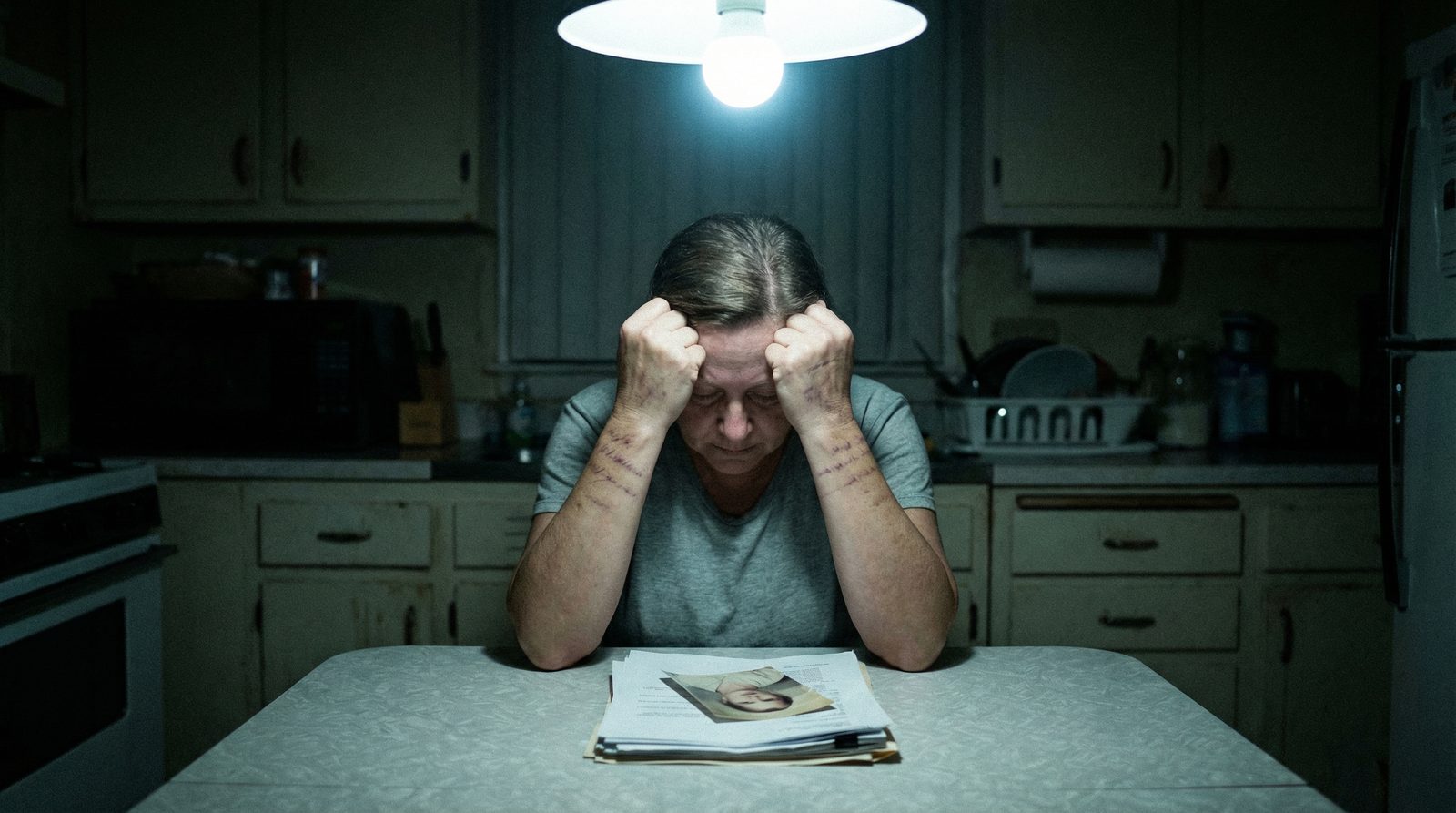
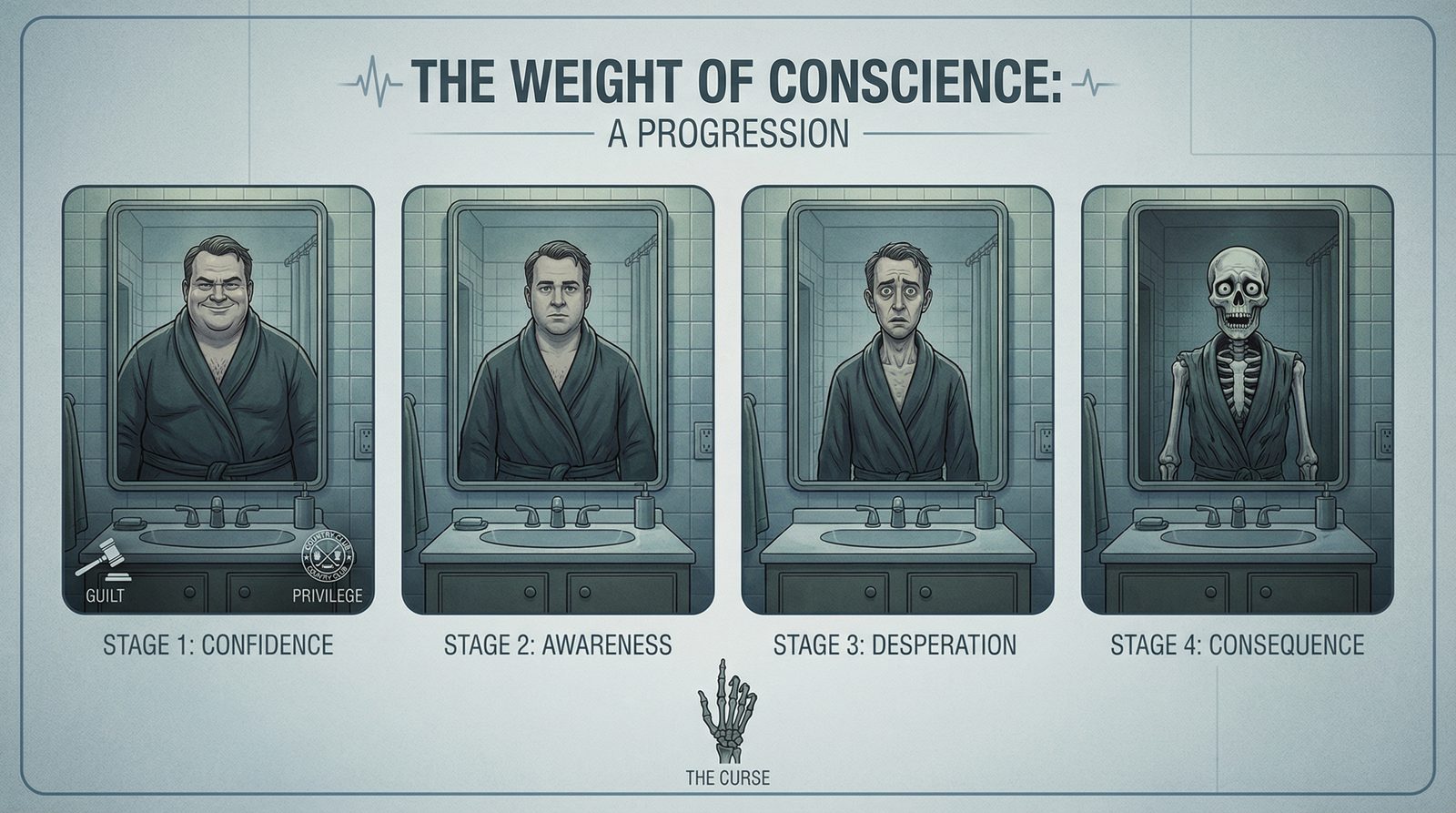
    Rapid Weight Loss And Body Decay is a motif where a character’s body starts to waste away at an unnaturally fast pace. Flesh shrinks, bones jut out, skin discolors or hangs loose, teeth loosen, hair falls out. The change is visible, undeniable, and usually unstoppable. It is not just about being thin; it is about the body clearly failing, like a machine burning itself out.

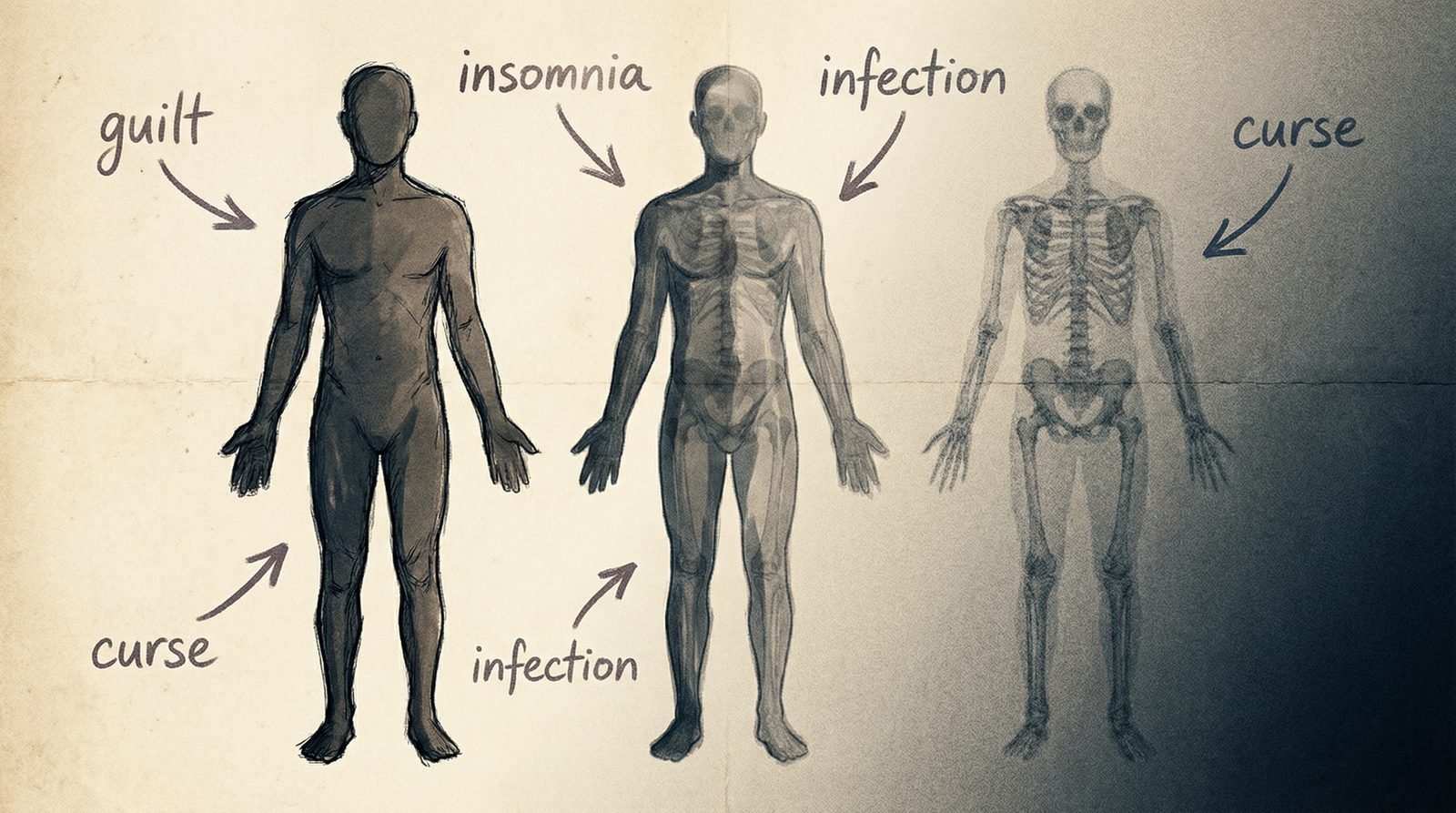
    Stories use Rapid Weight Loss And Body Decay to make inner problems show up on the outside. A curse, a disease, a parasite, an experiment gone wrong, or untreated guilt can all manifest as a body that is literally disappearing. In Thinner (1984) and its film adaptation, the wasting is a supernatural punishment that keeps going no matter how much the character eats. In The Machinist, the main character’s skeletal frame mirrors his insomnia, paranoia, and buried secrets. In The Troop, the body decay comes from an invasive horror that turns hunger and weight loss into something monstrous.

    This motif sits at the intersection of body horror and psychological terror. It takes something many people quietly fear – illness, aging, loss of control over their own body – and accelerates it. The body becomes a visible countdown clock, a daily reminder that time is running out and that something is deeply wrong, whether in the world, in the mind, or in the character’s past.


    HOW IT WORKS IN STORIES

    Rapid Weight Loss And Body Decay usually begins with small, easy-to-dismiss signs. A character drops a few pounds without trying, feels oddly tired, or notices their clothes hanging looser. At first they may be flattered or mildly concerned. The reader knows better, because every sentence about a loose waistband or hollowed cheek feels like the start of something worse.

    The story then escalates. The character eats constantly and still loses weight, or they cannot keep food down, or something inside them is devouring every calorie. Medical tests come back normal, or show something baffling. Doctors shrug, or the hospital becomes another stage for humiliation as strangers comment on the character’s appearance. The ordinary logic of diet and health breaks down, which is part of the horror.

    Writers often tie the decay to a specific cause. In supernatural horror like Thinner, the wasting is a curse laid on a guilty protagonist, a physical form of judgment that cannot be reasoned with. In psychological stories like The Machinist, the body reflects an inner collapse: sleeplessness, guilt, and trauma etch themselves into bone and skin. In creature or infection horror like The Troop, the decay comes from a parasite or experiment, turning the human body into a laboratory for something hungry and inhuman.

    As the Rapid Weight Loss And Body Decay accelerates, relationships strain. Friends and family may stage interventions, accuse the character of having an eating disorder, drug problem, or mental break. The character might lie about their condition, hide their body under layers of clothing, or isolate to avoid pitying or horrified stares. Everyday tasks become exhausting. Mirrors turn into enemies.

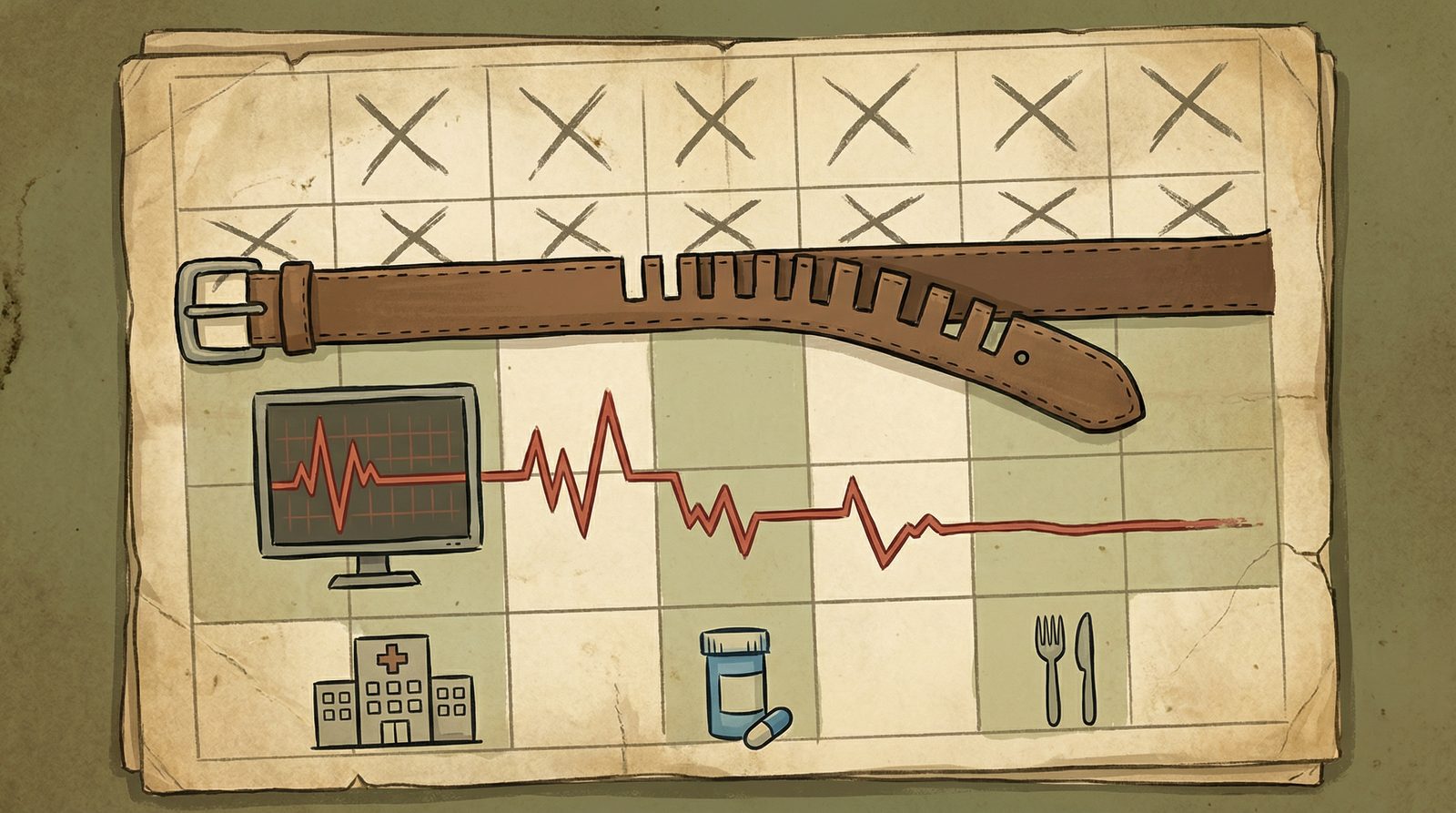
    Structurally, the motif gives the story a built-in ticking clock. The reader can see the stakes rising just by how the character looks and moves. Each chapter can mark a new threshold – another notch on the belt, another comment from a stranger, another failed attempt to reverse the process. The question becomes how far the body will go before the character breaks, confesses, or is consumed.

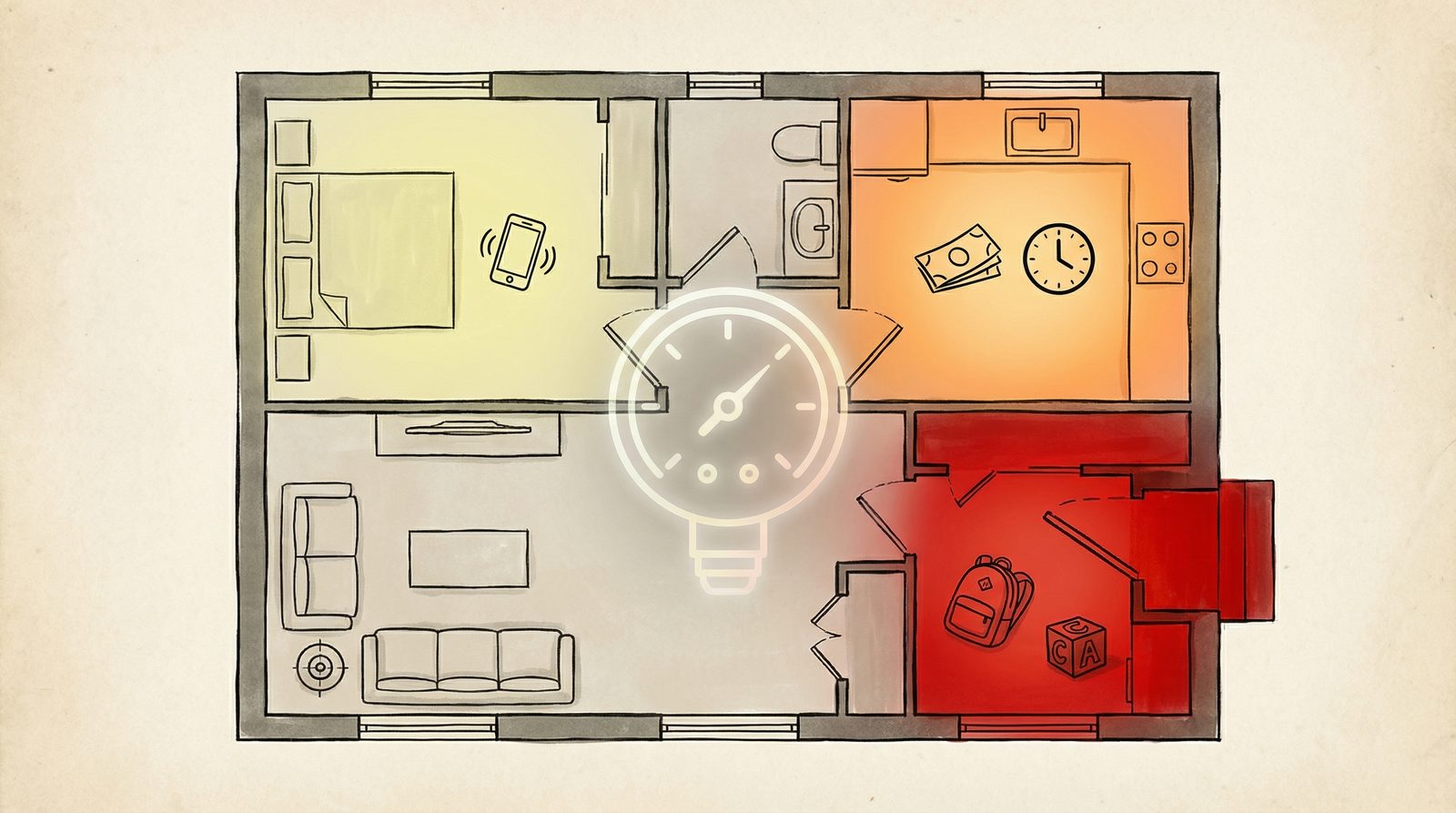
    Editorial illustration inspired by 'Rapid Weight Loss And Body Decay'

    EMOTIONAL EFFECT ON THE READER

    Rapid Weight Loss And Body Decay hits readers in a very physical way. It is hard not to imagine your own body when you read about someone else’s shrinking, bruising, or failing. The descriptions can trigger a mix of disgust, fascination, and dread. You may want to look away, but you also want to know how far it will go.

    There is also a strong current of helplessness. Watching a character do everything right – eating, resting, seeking help – and still deteriorate taps into fears about cancer, wasting diseases, or any illness that does not care how “good” you are. When the decay is tied to guilt or punishment, as in Thinner, the feeling gets even more complicated: you might think the character deserves it, yet still flinch at every new detail of their suffering.

    Shame is another powerful note. As the body changes, the character often feels exposed and judged. Scenes where they try to hide their frame, avoid being touched, or endure comments about their appearance can be more painful than the outright horror. Readers who have ever felt out of control in their own bodies may recognize that embarrassment and anxiety, even if the story itself is fantastical.

    At the same time, Rapid Weight Loss And Body Decay can stir a strange sympathy. The character is literally stripped down, defenses and vanity falling away along with the pounds. That vulnerability can make their confessions, reconciliations, or last acts hit harder. Even in the bleakest horror, there is often a moment where the reader feels the full weight of the character’s humanity, right as the body is failing them most.

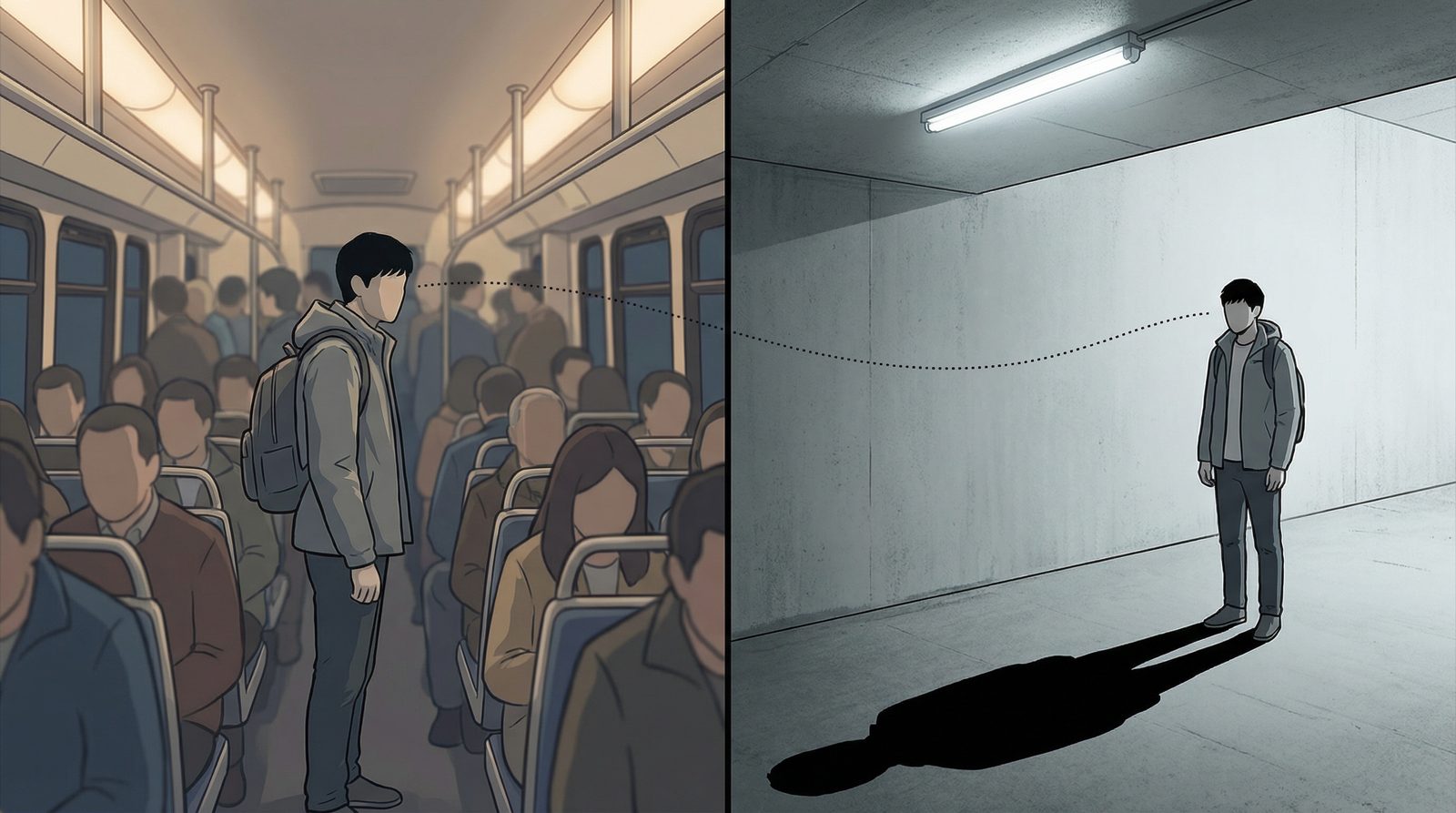
    Symbolic illustration inspired by 'Rapid Weight Loss And Body Decay'

    VARIATIONS & RELATED MOTIFS

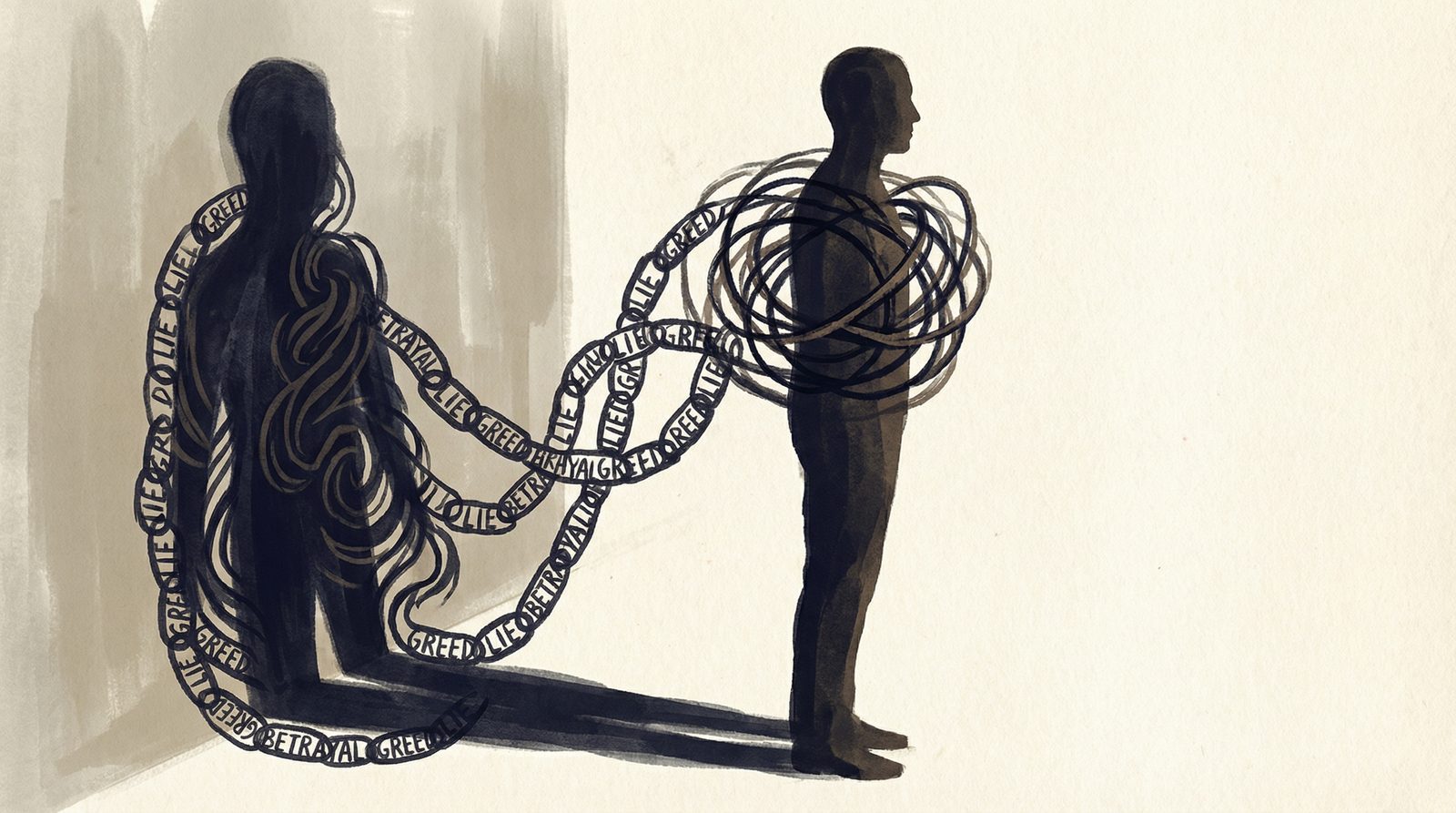
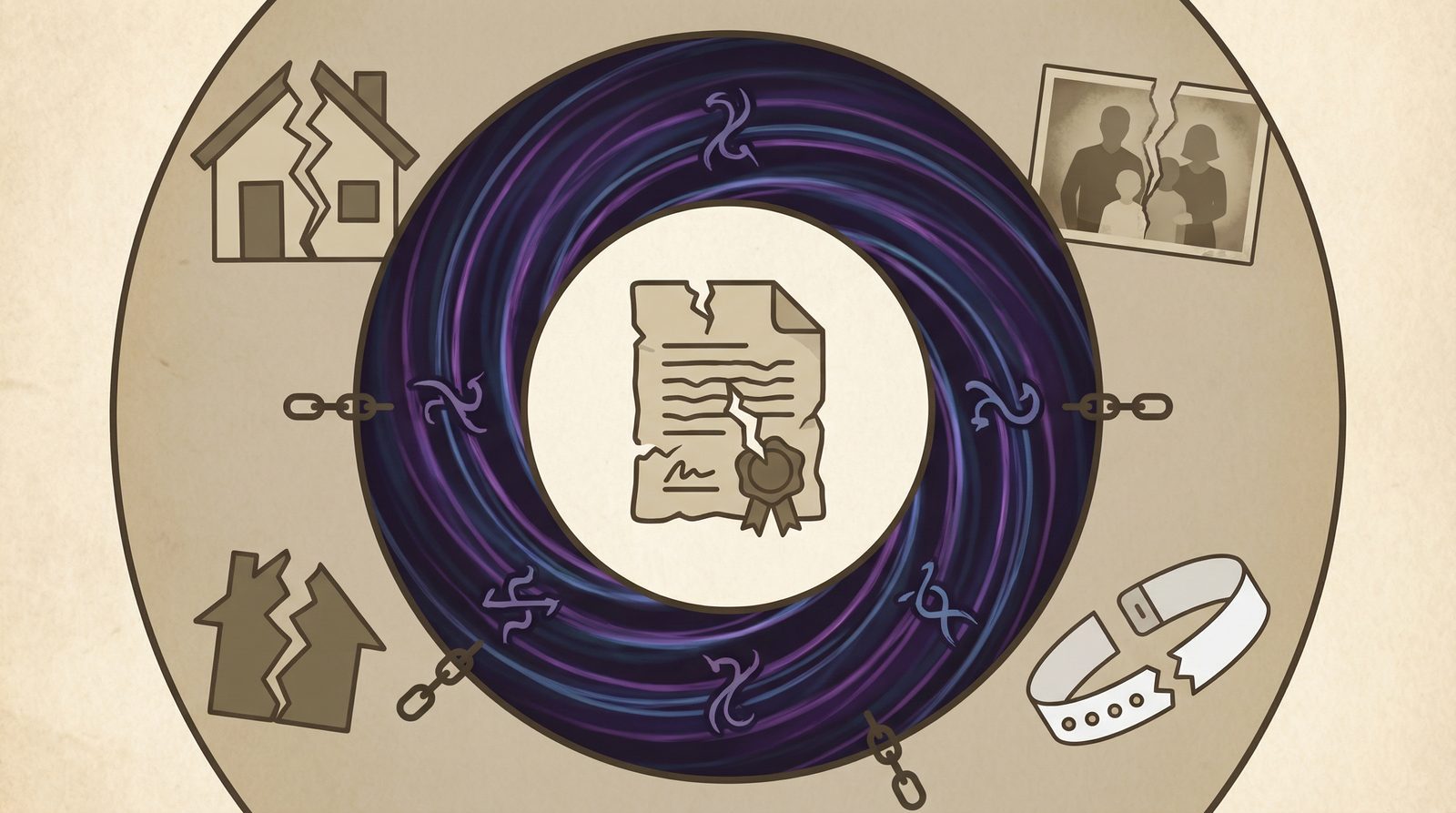
    Rapid Weight Loss And Body Decay shows up in several distinct flavors. One common variation is the cursed punishment story, like in Thinner, where the wasting is a moral sentence. The character’s shrinking body becomes a public confession of their crime. This can intersect with motifs about guilt made visible or supernatural justice, where the body tells the truth the character would rather hide.

    Another variation is the psychological spiral, as in The Machinist. Here, the focus is less on gore and more on how mental strain writes itself onto the body. Rapid Weight Loss And Body Decay overlaps with motifs about unreliable narrators, trauma resurfacing, and insomnia as unraveling. The reader is left wondering how much of the decay is real and how much is filtered through a damaged mind.

    There is also the parasitic or scientific horror version, like The Troop, where the decay is caused by infection, experiment, or alien biology. This ties Rapid Weight Loss And Body Decay to motifs such as body as laboratory, contagion, and the commodified body, where human flesh is just another resource to be used, altered, or consumed.

    Finally, the motif can blend with more grounded narratives: medical dramas about aggressive illness, or realistic stories about eating disorders and self-destruction. In those cases, Rapid Weight Loss And Body Decay intersects with motifs of survival as performance, family caretaking, and the failing body. The horror is quieter but often more emotionally devastating, because it feels so close to real life.

    Across all these variations, the core remains the same: a body that is vanishing too quickly, turning private fears and hidden sins into something you cannot help but see.

  • Curses As Moral Punishment

    Curses As Moral Punishment

    DEFINITION & CORE IDEA

    In the motif of Curses As Moral Punishment, a character is singled out by a supernatural force and punished specifically for a moral failing. The curse is not random bad luck. It is framed as justice, payback, or a lesson, often delivered by a wronged person, a vengeful spirit, or some cosmic law the character did not know they were breaking.

    This motif turns ethics into something with teeth. A lie, a hit-and-run, a cruel joke, a greedy wish, a broken promise – instead of being handled by courts or social fallout, these choices trigger a spell that warps the character’s body, life, or reality. In Thinner (1984) and its adaptation, the curse literally wastes the protagonist away as punishment for his crime. In Drag Me To Hell and Wishmaster, characters are condemned or twisted for selfish choices and careless cruelty.

    Writers use Curses As Moral Punishment when they want the story’s universe to feel like it has a conscience. The curse is a visible, often grotesque embodiment of guilt, hypocrisy, or corruption. It says: what you did matters so much that reality itself will not let it slide. Whether that feels fair, ironic, or horrifying is part of the tension that keeps readers hooked.


    HOW IT WORKS IN STORIES

    Curses As Moral Punishment usually starts with a transgression. Someone is wronged, a taboo is broken, or a character’s selfishness crosses a line. The story may linger on how “minor” the offense seems at first, which makes the later punishment feel shocking or darkly ironic. The curse is often delivered in a charged moment: a confrontation, a funeral, a refusal to help, a cruel decision made under pressure.

    Once the curse lands, the plot shifts into a mix of mystery, negotiation, and chase. The victim first dismisses what is happening as coincidence. As the pattern becomes undeniable, they scramble to understand the rules. Who cursed them? Why this specific punishment? Is there a loophole? In Thinner, the weight loss seems like a blessing before it becomes a death sentence. In Drag Me To Hell, the cursed character cycles through denial, bargaining, and desperate attempts to pass the doom onto someone else.

    The curse often escalates in stages. Each new symptom or setback forces the character to confront what they did and how far they are willing to go to escape consequences. They might try conventional fixes (doctors, lawyers, police) and find them useless against supernatural rules. This is where Curses As Moral Punishment overlaps with Corrupt Justice And Supernatural Retribution: once human systems fail or prove inadequate, something older and harsher takes over.

    Stories can play with responsibility and fairness. Sometimes the cursed person truly deserves it, and the narrative leans into grim satisfaction. Other times, the punishment is wildly excessive or falls on someone only partly at fault, raising questions about who gets blamed in a broken world. The climax often forces a choice: confess, sacrifice, pass the curse to someone else, or accept ruin. There is rarely a clean option.


    Editorial illustration inspired by 'Curses As Moral Punishment'

    EMOTIONAL EFFECT ON THE READER

    Curses As Moral Punishment hits a nerve because it turns private guilt into something you cannot hide. The character’s secret or flaw is dragged into the open, often through their own body or their luck falling apart. Readers feel a mix of dread and voyeurism watching someone’s inner rot become visible. It taps into the childhood fear that if you do something bad, the universe will “get you” – only now it is literal and merciless.

    This motif also creates a nagging question: how much punishment is enough? As the curse unfolds, it invites readers to judge the character’s original sin and every choice they make afterward. There can be a grim satisfaction when a smug or cruel person finally faces consequences, as in parts of Wishmaster. At the same time, many stories lean into discomfort, making the punishment feel so extreme that we start to pity the cursed, even if they were wrong.

    Because the curse often cannot be solved by logic or force, there is a strong feeling of helplessness. The character is trapped in a moral maze where every exit demands a sacrifice. That claustrophobic tension is part of the appeal. Readers are pushed to imagine what they would confess, who they would sacrifice, or what they would endure to escape a similar fate. The result is horror that lingers as self-examination, not just jump scares.


    Symbolic illustration inspired by 'Curses As Moral Punishment'

    VARIATIONS & RELATED MOTIFS

    Curses As Moral Punishment can take many forms. In some stories, the curse mirrors the crime: a liar finds their tongue twisting against them; a voyeur is forced to watch their own downfall; a hit-and-run driver’s body slowly deteriorates in a way that echoes their victim’s injuries. In others, the connection is more symbolic or ironic, like a greedy wish being granted in a way that ruins the wisher’s life in Wishmaster. The curse might be inherited, punishing descendants for an ancestor’s sin, or contagious, forcing the cursed to decide whether to infect someone else to survive.

    Another variation plays with whether the curse is truly “moral” or just vindictive. In Drag Me To Hell, part of the horror comes from how debatable the protagonist’s guilt is, and how merciless the supernatural response becomes. Some stories reveal that the curse-giver is corrupt or petty, twisting the motif into a critique of who gets to define morality in the first place.

    This motif often intersects with Corrupt Justice And Supernatural Retribution. When courts, police, or social systems fail, the curse steps in as a brutal stand-in for justice. It can also overlap with motifs like Faustian bargains, where the “punishment” is baked into the fine print of a wish, or with haunted objects, where using a cursed item triggers a tailored moral backlash.

    Writers can soften or sharpen the motif by adjusting the possibility of redemption. Some stories allow the cursed character to break the spell through sincere atonement, confession, or sacrifice. Others lock the rules so tightly that no apology can help, turning Curses As Moral Punishment into pure tragedy, where the lesson is not how to escape, but how a single choice can warp a life beyond repair.

  • Ordinary People In Extreme Situations

    Ordinary People In Extreme Situations

    DEFINITION & CORE IDEA

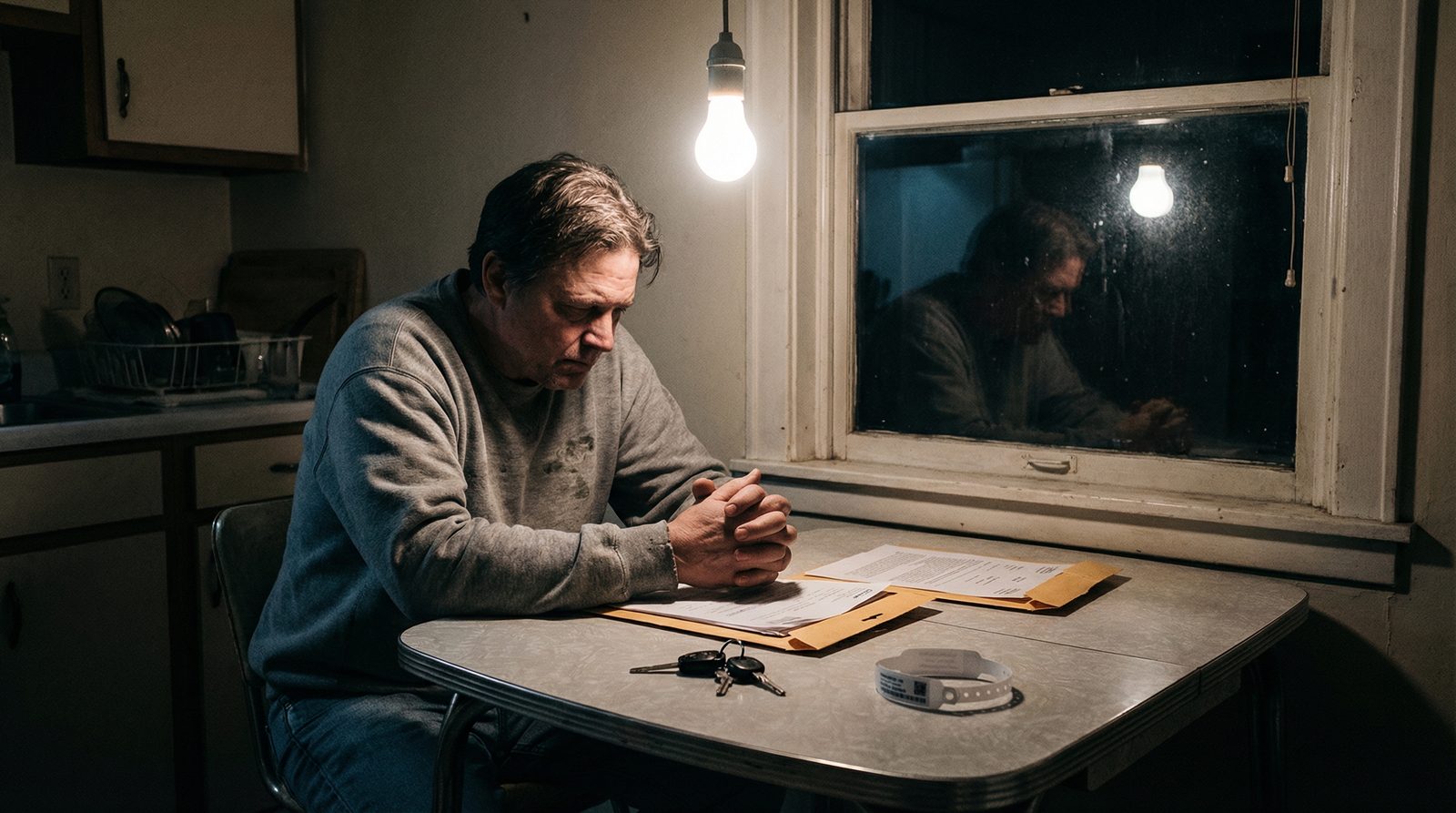
    “Ordinary People In Extreme Situations” is a motif where the main characters start out as recognizably average. They do not have special training, magical powers, or elite status. They have jobs, families, debts, routines. Then something happens that rips them out of that routine and drops them into a situation they are completely unprepared for.

    The core idea is simple: take someone who could be your neighbor, then crank up the pressure until they either adapt, break, or transform. Stories like Misery, Pet Sematary, Thinner (1984), and Blaze (2007) often start with everyday people and then push them into horror, obsession, or moral collapse. The gap between the character’s ordinary life and their extreme new reality creates both tension and dark curiosity.

    Writers use this motif to explore what people might really do when stripped of comfort and control. It asks questions like: How far would you go to save someone you love? What would you sacrifice to survive? Which parts of your identity are solid, and which are just habits that fall apart under stress? “Ordinary People In Extreme Situations” lets readers test their own limits safely, from the other side of the page.


    HOW IT WORKS IN STORIES

    In stories built around this motif, the early chapters usually linger on normal life. We see commutes, family dinners, casual arguments, and familiar frustrations. This grounding is important. The more clearly the reader understands what “ordinary” looks like for this character, the more sharply they feel the rupture when everything goes wrong.

    The trigger can be external: a car crash, a kidnapping, a violent stranger, or a supernatural event. In Misery, a writer is just driving home when an accident strands him with a fan who quickly becomes his captor. In Thinner, a careless moment leads to a curse that turns a routine life into a desperate countdown. In Pet Sematary, a family’s move to a quiet town opens a door to grief and resurrection that no one is equipped for. Sometimes the trigger is more subtle – a slow economic squeeze, a spouse’s illness, the discovery of a buried secret that can’t be ignored.

    Once the extreme situation takes hold, the story narrows around hard choices. The ordinary person might have to hide a crime, bargain with something inhuman, endure captivity, or navigate a cruel new system that treats them like a pawn. Everyday skills suddenly matter in strange ways: a nurse’s training in a disaster, a mechanic’s knowledge in a breakdown, a parent’s stubbornness when a child is threatened. At the same time, their usual social supports often fail. Friends don’t believe them, authorities are useless, or the threat is too bizarre to explain.

    Structurally, the motif often moves through stages: disbelief, coping, adaptation, and fallout. The character may become more ruthless, more honest, or more broken than they ever imagined. The story keeps circling one question: who are you when there is no safe, ordinary life to retreat to?


    Editorial illustration inspired by 'Ordinary People In Extreme Situations'

    EMOTIONAL EFFECT ON THE READER

    The emotional pull of “Ordinary People In Extreme Situations” comes from recognition. Readers look at these characters and think, “That could be me.” The jobs, marriages, debts, and small frustrations feel familiar, so when the story twists into horror or high-stakes drama, it hits closer to home than tales about superheroes or trained agents. The fear is not abstract; it is the fear that your next routine drive, hospital visit, or shortcut through the woods could change everything.

    This motif often creates a mix of dread and grim fascination. There is tension in watching someone try to think their way through a nightmare using only the tools of an ordinary life. Readers might feel frustration when characters make bad decisions, then a jolt of empathy when they realize they might have done the same under that kind of pressure. Stories like Misery and Thinner lean on this uncomfortable identification: the protagonists are not saints or geniuses, just people trying to survive with very human flaws.

    There can also be a strange kind of catharsis. Seeing an average person endure captivity, grief, or moral crisis can make everyday problems feel smaller by comparison, or it can validate how fragile normal life really is. Some readers come away shaken, others oddly reassured by the resilience on display, even when the ending is tragic. The motif invites quiet self-interrogation: if the worst happened on an ordinary day, who would you actually be?


    Symbolic illustration inspired by 'Ordinary People In Extreme Situations'

    VARIATIONS & RELATED MOTIFS

    “Ordinary People In Extreme Situations” can tilt in many directions. Some versions are intimate psychological horror, like a single patient trapped with a caregiver who has too much power, as in Misery. Others are more supernatural, like Pet Sematary and Thinner, where a curse or uncanny place turns ordinary grief or guilt into something monstrous. A story like Blaze (2007) leans into crime and desperation, showing how poverty, bad luck, and one terrible idea can push a not-particularly-special person into kidnapping and violence.

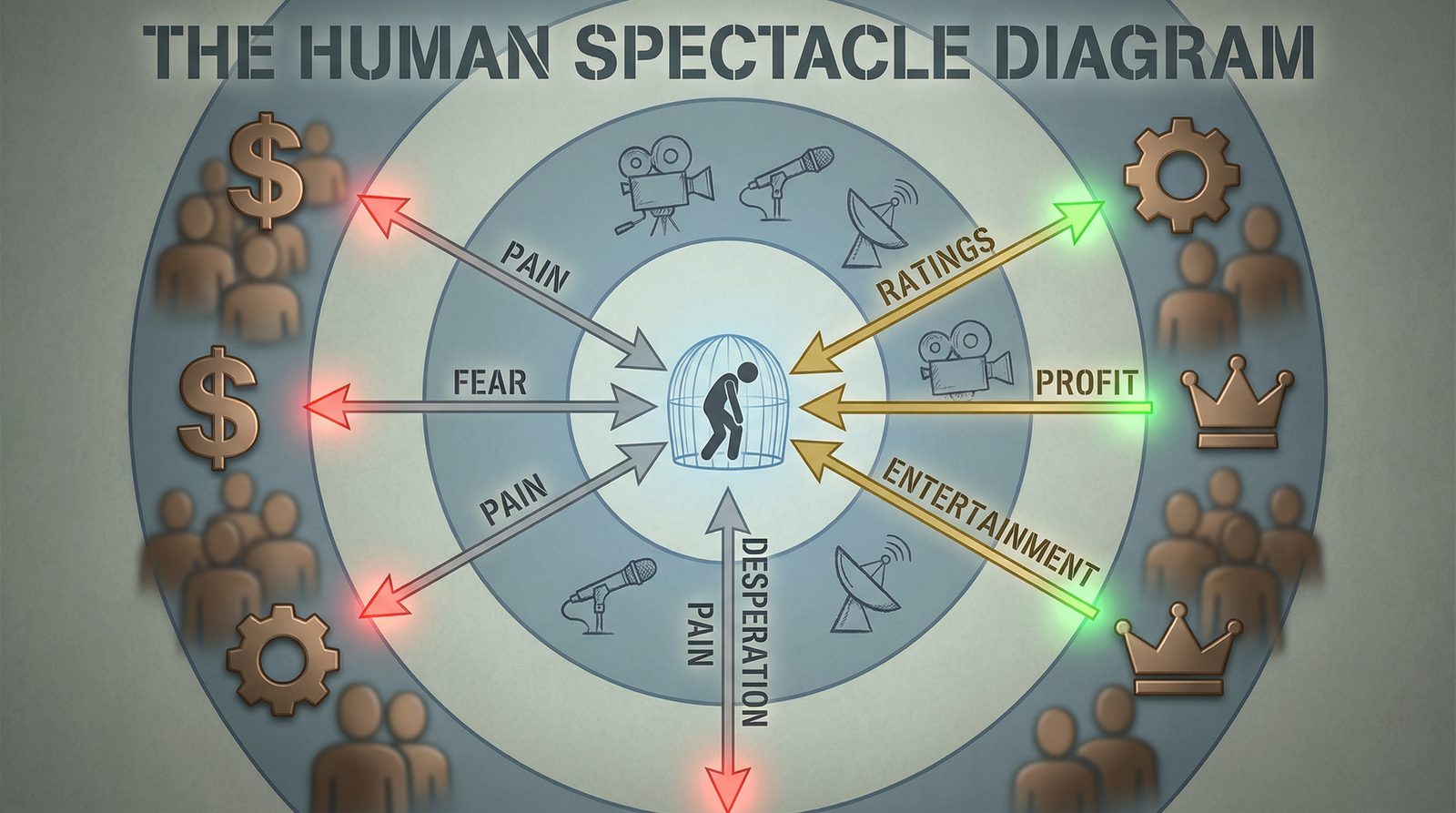
    Sometimes the focus is on survival in a twisted system. That is where this motif can intersect with Dystopian Game Shows, where regular contestants are forced to perform for their lives under rules they did not choose. In those stories, the extremity is not just the danger, but the way the whole world seems to watch and judge. Other times the emphasis is inward, overlapping with Identity Collapse In Isolation. A character cut off from normal social feedback may start to question who they are, what they are capable of, and whether the ordinary self they remember was ever real.

    There are hopeful variations, where the extreme situation reveals hidden strengths or prompts moral courage. There are bleak ones, where ordinary people crack, become cruel, or lose themselves entirely. Writers like Richard Bachman often favor the darker end of the spectrum, using the motif to show how thin the line can be between a life that looks normal from the outside and one that is quietly rotting under pressure. Across all these versions, the constant is the same: the story asks what happens when an average person is forced into a test they never signed up for.

  • Dystopian Game Shows

    Dystopian Game Shows

    DEFINITION & CORE IDEA

    Dystopian game shows are stories where a rigged contest, reality show, or televised event becomes a matter of life and death. The rules look like entertainment, but the stakes are survival. Contestants run obstacle courses that can kill them, answer questions under threat of punishment, or hunt and are hunted for the amusement of a distant audience. The game is usually controlled by a powerful government, corporation, or media empire that treats human beings as disposable content.

    Unlike simple arena battles, dystopian game shows lean on the language of TV and celebrity. The cruelty is wrapped in bright lights and canned applause. The Running Man, written under the name Richard Bachman, is a classic example, where a desperate man signs up for a lethal televised manhunt. The surface promise is money and fame; the underlying reality is systemic exploitation.

    Writers use this motif to ask how far a society will go when suffering becomes a product. The format is familiar enough to feel plausible, yet twisted enough to be horrifying. Dystopian game shows exaggerate trends in reality TV, social media, and advertising to show what happens when entertainment and cruelty fully merge. At its core, the motif is about people trying to stay human while the world insists they are just contestants.


    HOW IT WORKS IN STORIES

    In dystopian game show stories, the plot often begins with a rigged choice. The protagonist volunteers out of desperation, is coerced, or is randomly selected. Like the men in Richard Bachman stories such as The Running Man, they are usually ordinary or down-on-their-luck people, not trained warriors. The show offers them a miracle: money, freedom, or a chance to clear their name. The price is stepping into a game designed to break them.

    The narrative then moves into the preparation and staging of the show. We see contracts, waivers, and fine print. We meet the smirking host, the ruthless producer, the faceless executives. The world of the game is full of artificial sets, hidden cameras, and scripted moments. Even genuine danger is choreographed for maximum spectacle. The protagonist quickly discovers that the rules are flexible and always favor the house.

    Once the game begins, the story turns into a survival puzzle. Challenges are designed to pit contestants against each other, force betrayals, or tempt them with shortcuts that have hidden costs. The show’s audience becomes a character in its own right. The protagonist might gain sudden popularity, become a villain in the public eye, or be erased entirely if they stop being useful for ratings.

    Behind the spectacle, the plot often reveals a larger conspiracy or social rot. The game show might be a tool of social control, a distraction from political collapse, or a way to dispose of “undesirable” people. The climax usually involves one of three things: beating the game on its own terms, exposing it to the public, or refusing to play by its logic at all. Whether the character lives or dies, the story asks what it means to be real in a world that only values you as content.


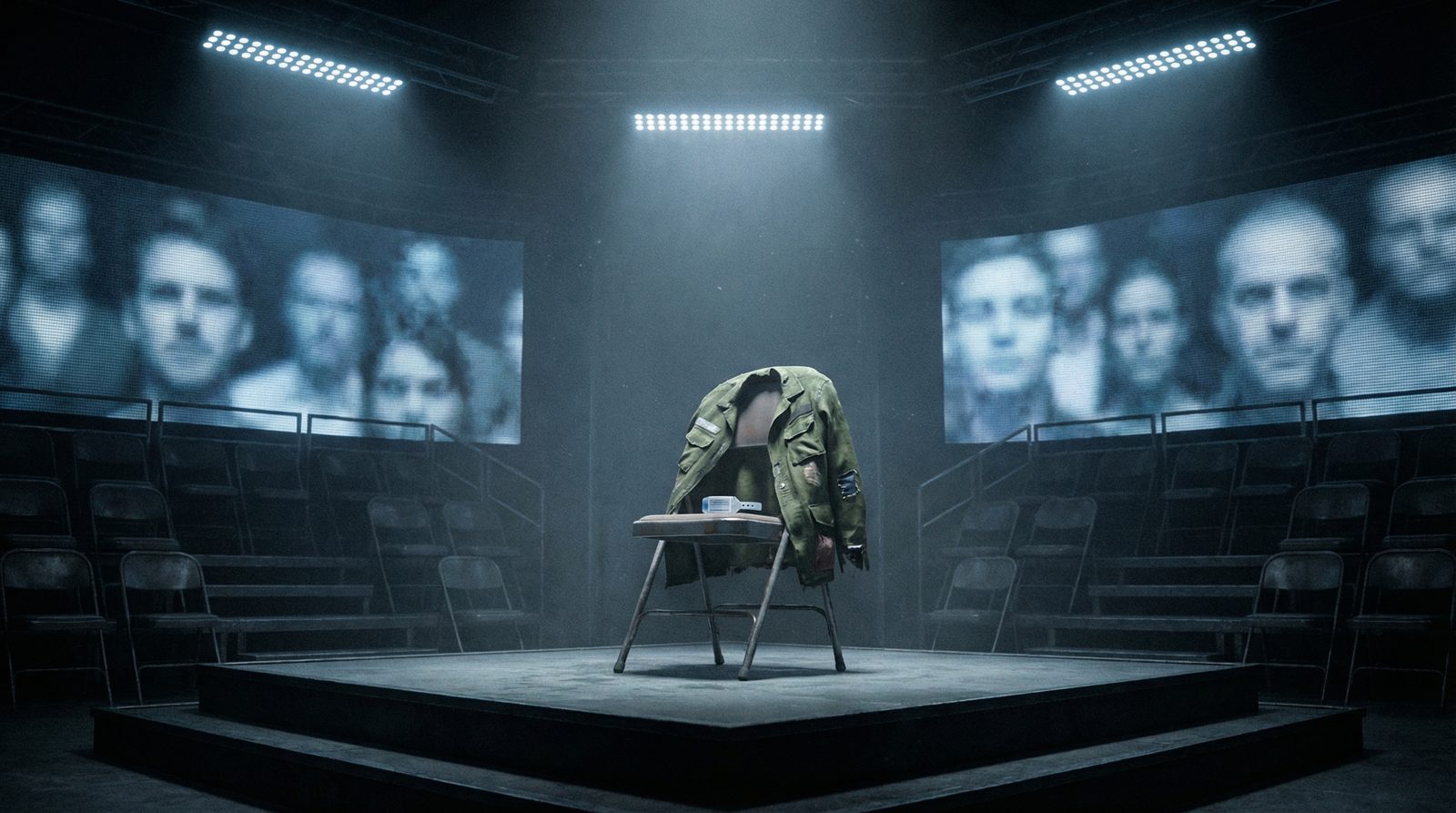
    Editorial illustration inspired by 'Dystopian Game Shows'

    EMOTIONAL EFFECT ON THE READER

    Reading dystopian game show stories often feels like watching a nightmare version of a reality show you half-recognize. There is a sickening mix of excitement and dread. The tension is not just “will they win,” but “how much of themselves will they have to lose to survive.”

    The motif taps into the uneasy feeling that our own media habits might be cruel. When a crowd in the story cheers for someone’s suffering, it is hard not to think of viral humiliation clips or scandal-driven news. That recognition can make the reader feel complicit, as if they are sitting in the studio audience, enjoying the show while knowing it is wrong.

    At the same time, there is often a strong emotional bond with the contestants. Their small acts of kindness, defiance, or humor stand out sharply against the artificial cruelty around them. Moments where characters refuse to betray each other, or choose dignity over survival, can hit harder precisely because the system is built to crush those choices. The result is a blend of adrenaline, anger, and a bruised kind of hope that someone will break the cycle, even if they pay for it.


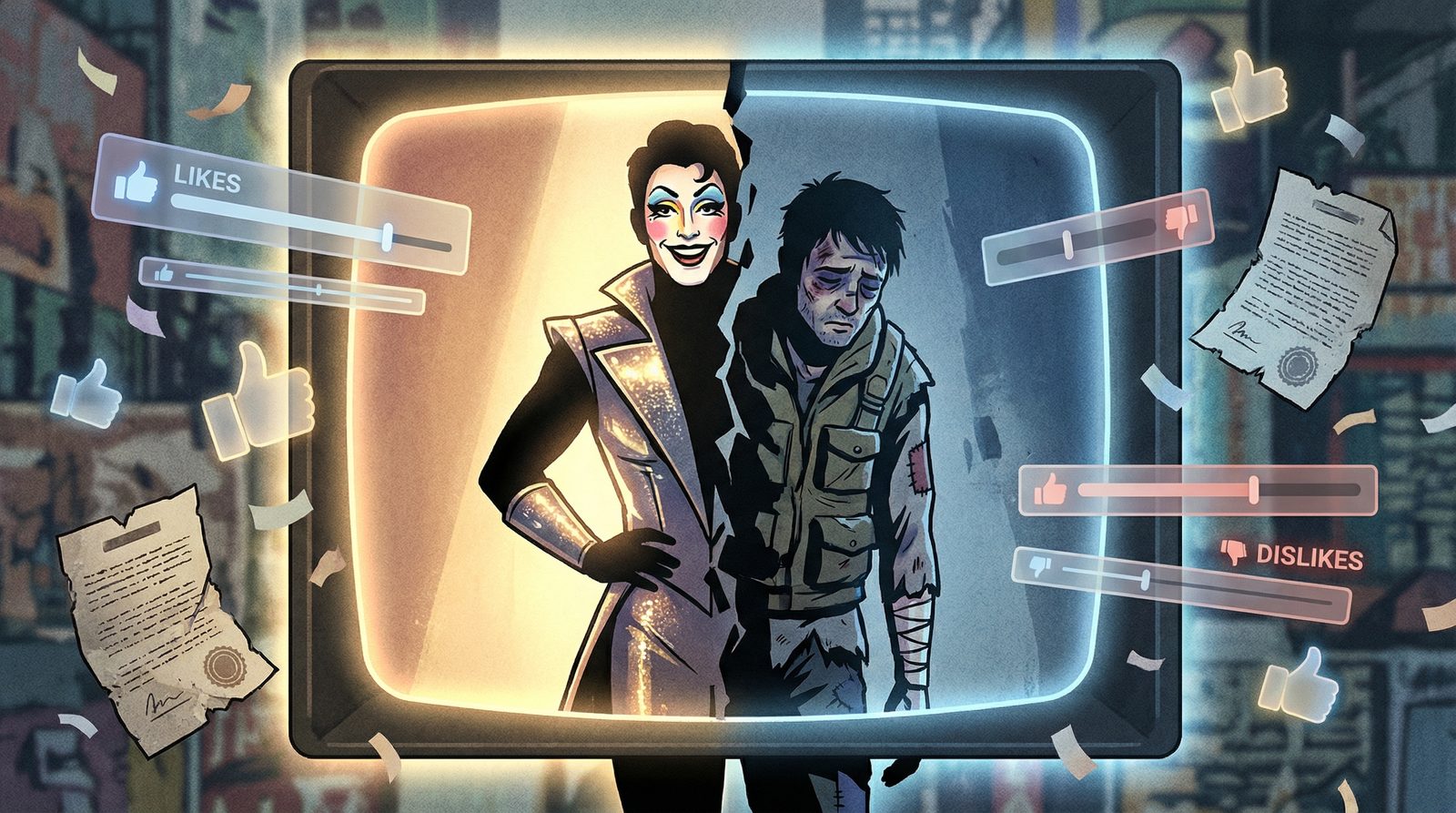
    Symbolic illustration inspired by 'Dystopian Game Shows'

    VARIATIONS & RELATED MOTIFS

    Dystopian game shows can take many forms. Some stories focus on physical combat, turning the show into a gladiator arena with cameras. Others use puzzles, social manipulation, or moral dilemmas as the core challenge. A contestant might have to choose which loved one gets saved on live TV, or decide whether to expose a secret that will ruin innocent people. The tone can range from grimly realistic to darkly comic, with some works leaning hard into satire about advertising, celebrity culture, or class.

    There are also variations in how much the outside world matters. In some stories, the game is a closed bubble, and we only see what the cameras see. In others, the world beyond the show is just as bleak: the game is not an exception but a symptom of a larger sickness. The show becomes a pressure valve for a society that has already decided which lives are expendable.

    This motif overlaps strongly with Ordinary People In Extreme Situations. The contestants are rarely superheroes; they are regular citizens pushed into a twisted system. It can also intersect with motifs about the commodified body, survival as performance, or fame as a double-edged sword. A character might gain celebrity status while being slowly destroyed by the very show that made them famous.

    Some stories end with the game continuing, unchanged, emphasizing how hard it is to fight a system that turns everything into a show. Others let a single act of defiance ripple outward, inspiring viewers or exposing the truth. Either way, dystopian game shows linger because they feel uncomfortably close to the world we already live in, just pushed a few notches further past the point of no return.

  • Thinner (1996)

    Thinner (1996)

    Thinner (1996), directed by Tom Holland. Horror · 92 minutes · United States.


    INTRODUCTION

    Thinner (1996) sits in that strange corner of 90s Stephen King adaptations where pulp, moral fable, and cable-ready horror all blur together. On the surface it is a simple curse story, but underneath the film toys with a clammy, anxious feel of bodily betrayal and karmic payback. Tom Holland leans into the queasy mix of dark humor and body horror, so the film keeps shifting between grotesque and absurd. It is not as polished as Misery or as operatic as Carrie, but it has a sour little heart, fascinated with guilt that refuses to speak its name. Thinner is less about the supernatural mechanics of a curse and more about how far a man will go to avoid admitting that he deserves what is happening to him.

    PLOT & THEMES

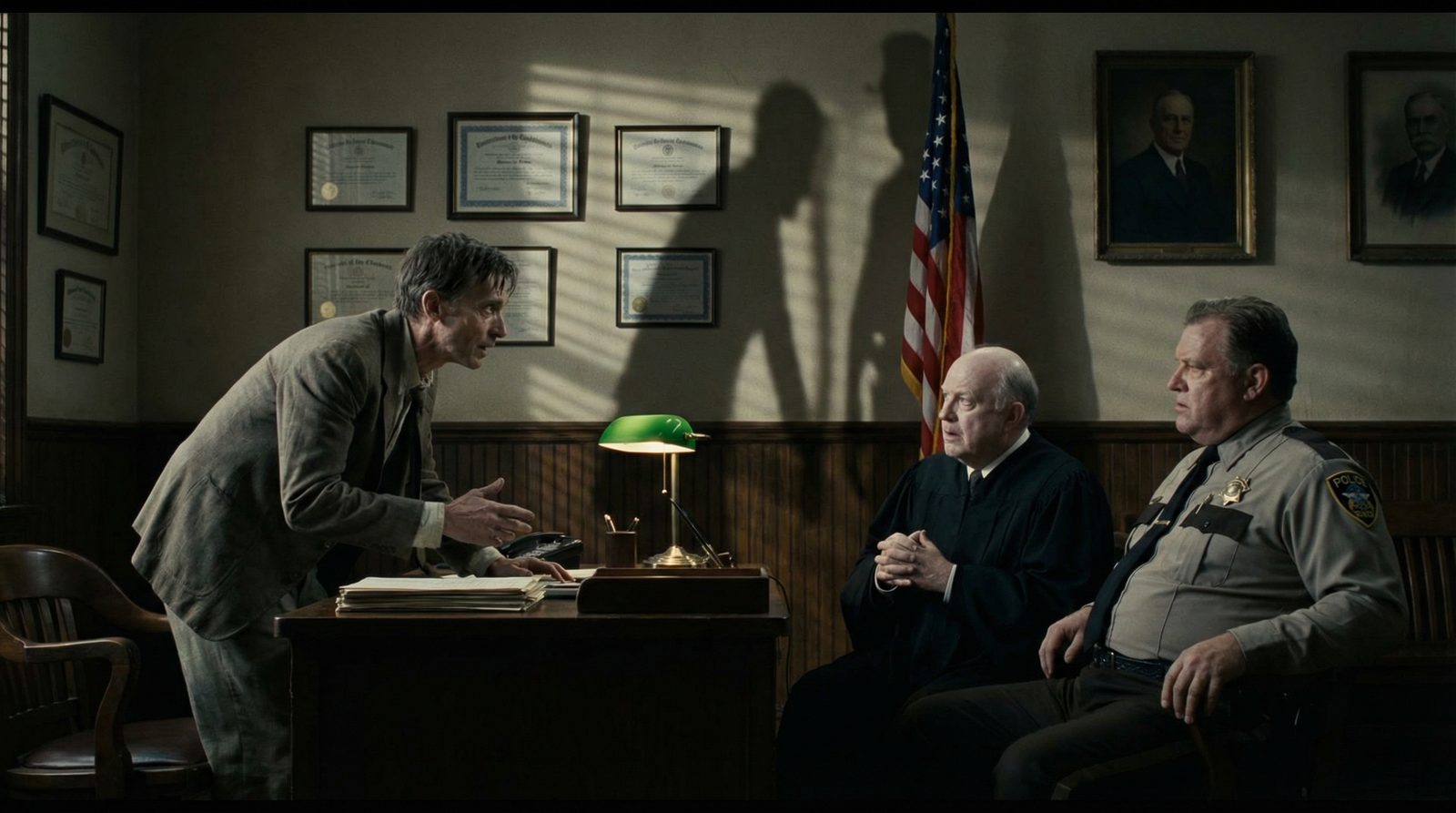
    Billy Halleck is a successful, well-connected lawyer in a small New England town, introduced as a man cocooned in comfort and self-indulgence. After a celebratory night out, he accidentally kills an elderly Romani woman with his car while his wife is distractedly performing a sexual favor. Between his judge friend and a police chief in his pocket, Billy walks away from the case with no real punishment. The dead woman’s father, Tadzu Lempke, lays a cryptic “thinner” curse on him, and Billy’s weight begins to drop at an impossible rate. What starts as a seemingly welcome diet quickly becomes a nightmare as he wastes away.

    The film leans heavily on the trope of the cursed protagonist. Billy is not a random victim but a man whose unexamined entitlement has finally come due. The plot tracks his increasingly frantic attempts to reverse the curse. Each step reveals another layer of rot in the town’s power structure, where everyone who helped him evade justice begins to suffer their own supernatural punishments. The motif of bodily decay is central: Billy’s shrinking frame is a visible ledger of guilt, and every pound lost is another unpaid moral debt coming due. Alongside that, the motif of moral rot in small-town America creeps through the story, as the respectable facades of courthouse and country club hide a willingness to sacrifice anyone to maintain comfort.

    Thematically, Thinner plays like a nastier cousin to Needful Things or the old EC Comics morality tales. It asks whether retribution can ever be clean when everyone involved is compromised. The curse is both punishment and mirror, forcing Billy to see that his real horror is not supernatural at all but the person he has always been. By the time he turns to violence and manipulation to save himself, the film has quietly shifted from a story about an innocent man under siege to one about a guilty man refusing to accept a deserved sentence.

    CINEMATIC TECHNIQUE & AESTHETICS

    Tom Holland approaches Thinner with a straightforward 90s genre sensibility, but within that frame he uses makeup and prosthetics as the primary cinematic technique. Billy’s transformation from bulky comfort to skeletal ruin relies on layers of latex and fat suits, which range from impressively grotesque to distractingly artificial. The body horror is not subtle. We are meant to feel a clammy sense of revulsion as his skin sags, his clothes hang, and his face sharpens into a skull. The practical effects give the film a tactile, sticky quality that digital work of later decades often lacks.

    Cinematography is modest but functional. Holland and his director of photography favor flat, bright daylight in the early scenes, emphasizing the safe, bland privilege of Billy’s suburban life. As the curse takes hold, the palette cools and the lighting grows harsher, particularly in interiors, pushing his home toward something closer to a sickroom. There are no elaborate tracking shots or baroque compositions, but the camera often lingers just a beat too long on Billy’s face or body, inviting the audience to inventory every new indignity.

    Editing keeps the story moving at a brisk pace, almost to a fault. Moments that could have deepened the moral stakes are clipped in favor of plot progression, which gives the film a pulpy, paperback rhythm. The sound design does some subtle work: the creak of floorboards under Billy’s changing weight, the rasp of his breath, the way background noise drops out during confrontations with Tadzu Lempke. The score nudges toward darkly comic at times, which can undercut the horror but fits the film’s pulp-horror lineage, similar to how Creepshow toys with tone. Overall, the aesthetics serve the story’s focus on bodily decay and karmic payback more than they aim for beauty or grandeur.

    Editorial illustration inspired by 'Thinner (1996)'

    CHARACTERS & PERFORMANCE

    Billy Halleck is written as a fallen hero archetype, though the film is honest enough to show that he was never especially heroic to begin with. Robert John Burke has the tricky job of playing both the smug, comfortable lawyer and the desperate, skeletal wreck. Under heavy makeup and prosthetics his facial mobility is limited, so he leans on voice, posture, and a growing edge of hysteria. When the performance clicks, Billy feels less like a horror victim and more like a man caught in a trap he helped build.

    Tadzu Lempke serves as an avenging trickster archetype, a figure out of folklore who exposes hypocrisy by inflicting pointed punishments. The performance gives him a wiry, mocking presence; he is less a cackling villain and more a weary judge who has seen this pattern of privileged cruelty too many times. His curse is personal, but his speeches hint at a broader history of exploitation and prejudice.

    The supporting cast is populated by archetypes of small-town corruption. Their performances are pitched slightly larger than life, bordering on the theatrical, which suits the story’s moral-fable structure. One interesting figure is the mobster friend Billy enlists, a dark ally archetype whose loyalty is transactional and whose violence escalates the situation rather than resolving it. These characters are not richly psychological, but they are functional symbols in a story about how a community chooses to protect its own comfort over justice. The acting style, broad and sometimes campy, keeps reminding us that we are watching an allegory, not a slice of naturalism.

    CONTEXT & LEGACY

    Thinner arrives late in the first big wave of Stephen King adaptations, after landmarks like Carrie and The Shining and alongside more workmanlike efforts such as Needful Things. Compared to the psychological focus of Misery, Thinner feels pulpier and more schematic, closer in spirit to the morality tales of Creepshow. Tom Holland had already adapted King with some success in The Langoliers, and here he leans into the author’s fondness for curses as externalized guilt.

    The film did not make a large cultural dent, and its reputation today is mixed, often cited as a minor or even disposable King entry. Yet it has a modest afterlife among fans of 90s horror who appreciate its commitment to body horror and its refusal to fully exonerate its protagonist. In a landscape where many supernatural thrillers bend over backward to make their leads innocent, Thinner stands out for keeping Billy morally stained to the end. It also anticipates later genre interest in bodily punishment as metaphor, a thread you can trace forward into films like Drag Me to Hell, even if those later works have more stylistic flair. Its legacy is less about influence and more about occupying a specific niche in the long shelf of King adaptations: a rancid little parable about guilt that refuses to go away.

    IS IT WORTH WATCHING?

    Whether Thinner is worth your time depends on your tolerance for uneven but earnest 90s horror. If you are interested in Stephen King adaptations as a whole, this is a revealing mid-tier entry. The body horror, driven by makeup and prosthetics, has a practical, rubbery charm that some viewers will find effectively nauseating and others will find dated.

    If you want tightly plotted suspense or nuanced psychological drama, you may be frustrated by the film’s broad performances and pulpy tone. But if the idea of a cursed protagonist slowly wasting away under a karmic sentence appeals to you, and you enjoy horror that feels like a rancid parable, Thinner offers a compact, morally sour experience. It is not essential, yet it is distinctive enough to stick in the mind, especially for viewers drawn to stories where the real monster is a character’s own refusal to take responsibility.

    Symbolic illustration inspired by 'Thinner (1996)'

    TRIVIA & PRODUCTION NOTES

    Thinner adapts the Stephen King novel originally published under his Richard Bachman pseudonym, which partly explains its lean, mean narrative and focus on a single, escalating curse. Tom Holland, already familiar with genre material from Fright Night and Child’s Play, was a logical choice for a story that mixes horror with dark humor. The production leans heavily on makeup and prosthetics for Billy’s physical transformation, requiring extensive time in the chair for Robert John Burke and multiple stages of fat suits and emaciation effects.

    The film was shot largely in New England locations to preserve the book’s regional flavor, with small-town streets and courthouse exteriors reinforcing the motif of moral rot in small-town America. Budget constraints are visible in the relatively limited set pieces and the absence of large-scale spectacle, which keeps the focus on character interactions and the slow, queasy progression of bodily decay. While not a box-office sensation, Thinner found a second life on home video and late-night cable, where its compact runtime and pulpy atmosphere made it a regular fixture for horror fans exploring the deeper shelves of King adaptations.

    SIMILAR FILMS

    If Thinner interests you, several other works explore similar territory. Drag Me to Hell revisits the idea of a cursed protagonist punished for a morally dubious decision, with a more kinetic visual style but a comparable streak of dark humor. Needful Things offers another look at moral rot in small-town America, with a supernatural figure exposing hidden greed and hypocrisy. Fans of horror as moral fable might also appreciate Creepshow, which shares the same taste for grotesque punishment as karmic justice. For a different medium, the novel Pet Sematary digs even deeper into guilt and the terrible cost of refusing to accept loss, echoing Thinner’s bleak view of what happens when people try to bargain with fate instead of facing their own responsibility.

    DISCOVERABILITY & LINKS

    On AllReaders.com, Thinner connects to clusters built around the motif of bodily decay, the motif of moral rot in small-town America, and the trope of the cursed protagonist. It also sits alongside other Stephen King adaptations and 1990s horror from the United States that blend body horror with darkly comic tones. Readers exploring stories of karmic payback, corrupt communities, and protagonists who are complicit in their own downfall will find Thinner a useful reference point within those thematic and genre maps.


  • Pet Sematary (1983)

    Pet Sematary (1983)

    By: Stephen King
    Genre: Horror
    Country: United States


    INTRODUCTION

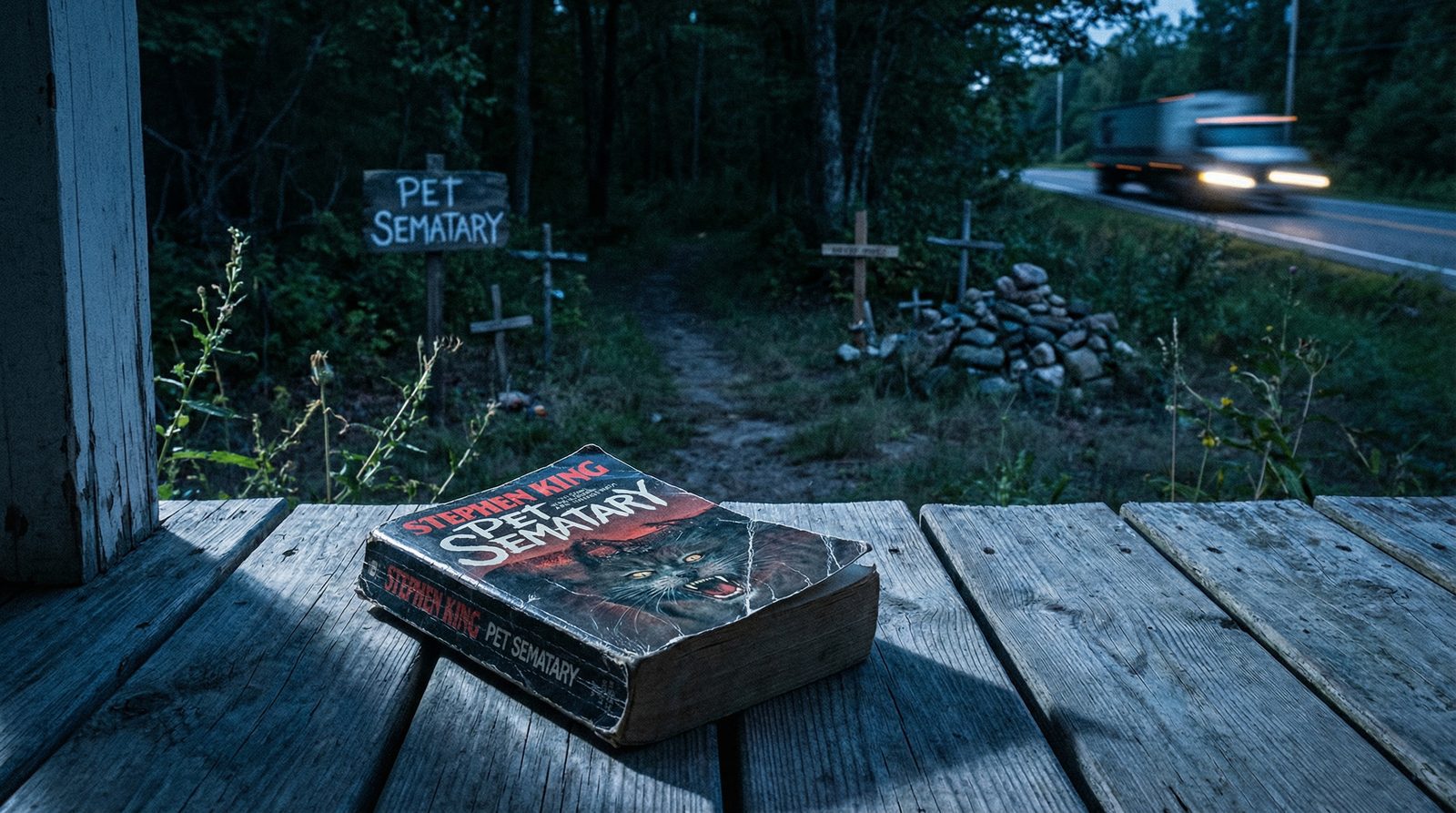
    Among Stephen King’s work, Pet Sematary (1983) is the one that feels like it hates you a little for reading it. Set in the late twentieth century, it is soaked in dread, domestic routine, and the slow rot of inevitability. The motif of roads and crossings runs through everything: the busy Route 15 where the Orinco trucks scream past, the worn path to the children’s graveyard, the secret trail beyond the deadfall into the Micmac burial ground. The feeling is suffocating grief, but also the ordinary tenderness of a young family trying to settle into a new town. King builds a world of PTA meetings, university politics, and neighborly beers on the porch, then lets something ancient and foul seep up through its floorboards. This is not simply a scary book; it is a brutal argument about the cost of refusing to accept that everything ends.


    PLOT & THEMES

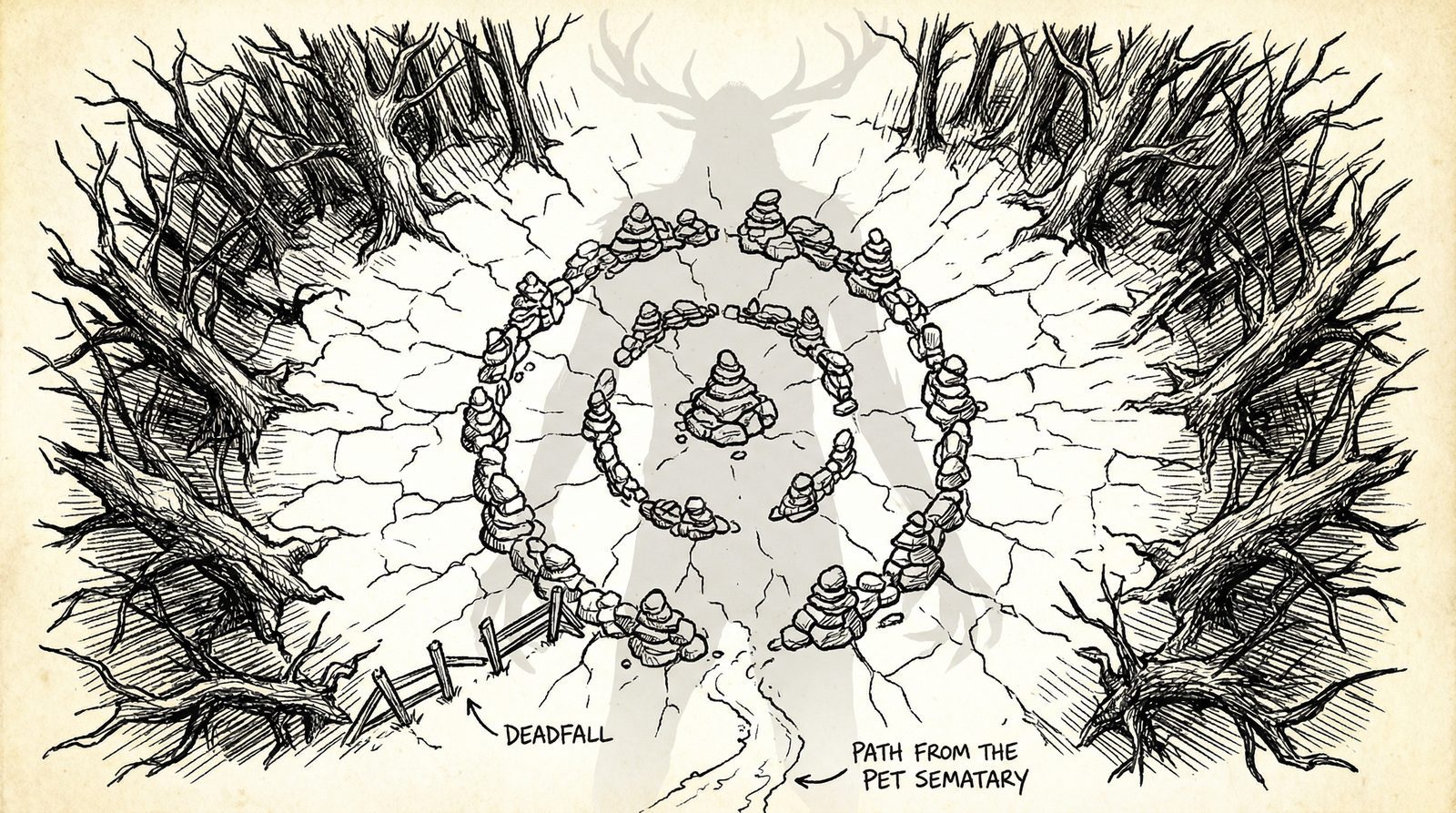
    On the surface, the plot is simple. Louis Creed, a doctor, moves with his family to a rented house in Ludlow, Maine, for a job at the University of Maine’s student health center. Across the road lives Jud Crandall, the elderly neighbor who becomes Louis’s guide to the local geography: the children’s “pet sematary” in the woods and, beyond the deadfall, the sour Micmac burial ground. When Ellie’s cat, Church, is killed on the dangerous road, Jud takes Louis past the burial ground’s stone cairns. Church returns, but wrong – sluggish, foul-smelling, with a flat, alien gaze. The motif of corrupted resurrection is born here and never loosens.

    The trope of the Faustian bargain is explicit. Louis is not tricked; he understands that what comes back is not what went into the earth, yet when his toddler son Gage is killed by an Orinco truck, he chooses the burial ground again, this time alone. King threads in smaller thematic filaments: Rachel’s childhood trauma with her dying sister Zelda, hidden away like a family shame; Louis’s clinical detachment at the university clinic, shattered by Victor Pascow’s grotesque head injury and prophetic warning; the way the Creed marriage strains under unspoken fears about death. Compared with the film adaptations, the novel lingers more cruelly on Louis’s planning – the grave-robbing at Mount Hope Cemetery, the meticulous timing around Rachel and Ellie’s absence.

    The book’s ending is unambiguously bleak. Gage’s resurrected body murders Jud and Rachel with a scalpel, and Louis, half-mad, kills his son a second time with a morphine syringe before burning Jud’s house. Yet he still carries Rachel’s corpse to the burial ground, convinced that waiting less time will produce a better result. The final scene shows Rachel returning, reeking and decayed, dropping a maggot from her eye socket as she touches Louis and says, “Darling.” He welcomes her. There is no last-minute salvation here; only a man who has chosen damnation over grief.


    PROSE & NARRATIVE STRUCTURE

    The book uses close third-person as its primary narrative technique, staying mostly with Louis while occasionally slipping into Jud’s memories or Rachel’s private terrors. This tight focus lets King turn mundane details – the smell of autumn leaves on the path to the pet sematary, the sound of the Orinco trucks’ air brakes – into pressure points. The feeling is one of incremental suffocation; every chapter nudges the boundary of what Louis will accept, then quietly resets what counts as normal.

    Structurally, the novel is almost cruelly patient. The first half is domestic realism: Louis’s first day at the university, Ellie’s fear about death after seeing the pet sematary, Thanksgiving plans, even an ugly argument with Rachel’s parents in Chicago. King uses repetition of phrases – “Sometimes dead is better,” Victor Pascow’s “the soil of a man’s heart is stonier” – as a kind of incantation, echoing through Louis’s thoughts and Jud’s stories. These refrains acquire new meaning each time they surface, like a chorus that grows more ominous on each return.

    There is also a subtle use of foreshadowing through dreams and premonitions: Ellie’s nightmares about “Paxcow” (her mispronunciation of Pascow), Rachel’s sense of approaching disaster on her frantic trip back to Ludlow, Louis’s own half-waking vision of a Wendigo-like shape towering over the burial ground. Compared with something like The Shining (1977), the prose here is plainer, less baroque, but the rhythms are merciless. Sentences shorten as Louis’s sanity frays; paragraphs splinter into jagged interior monologue during the grave-robbing sequence and Gage’s return. The result is a narrative that feels like a long, slow descent punctured by sudden, shocking drops.

    Conceptual editorial illustration inspired by 'Pet Sematary (1983)'

    CHARACTERS & INTERIORITY

    Louis Creed begins as the rational protagonist archetype. King is careful to make him neither saint nor monster. He is petty about his in-laws, occasionally selfish, but genuinely loves Rachel, Ellie, and Gage. His interiority is where the horror really lives. We sit inside his rationalizations as he moves from burying a cat to contemplating, then committing, the exhumation of his own child. The justifications come in waves, each a little thinner than the last.

    Jud Crandall, often softened in adaptations, is more morally ambiguous on the page. He is the kindly old neighbor, yes, but also the man who opens the door to the Micmac burial ground because he cannot bear to see Ellie grieve. His stories about Timmy Baterman, the resurrected World War II soldier who came back knowing everyone’s secrets, are soaked in guilt. Rachel, meanwhile, is defined by her terror of death, rooted in the grotesque memory of caring for Zelda, whose spinal meningitis twisted her body and mind. Her shame and trauma are not side notes; they are a parallel study in how families mishandle mortality.

    Even minor figures – Norma Crandall with her heart trouble, Irwin and Dory Goldman with their brittle hostility, the student Steve Masterton who helps Louis in the clinic – are drawn with enough interior shading to feel like casualties of the same force. The book’s cruelty lies in how intimately it understands each character’s weak point, then lets the burial ground press on it.


    LEGACY & RECEPTION

    King has said he nearly didn’t publish Pet Sematary because he thought it went too far, and that unease clings to its reputation. Among horror readers it’s often cited as one of the few novels that can still genuinely unsettle jaded adults. Its late twentieth century setting, Orinco trucks, university politics, airline schedules, anchors the supernatural in the banal, making the final sequence, with Rachel’s corpse shambling into the kitchen, feel less like gothic flourish and more like the natural endpoint of bad decisions.

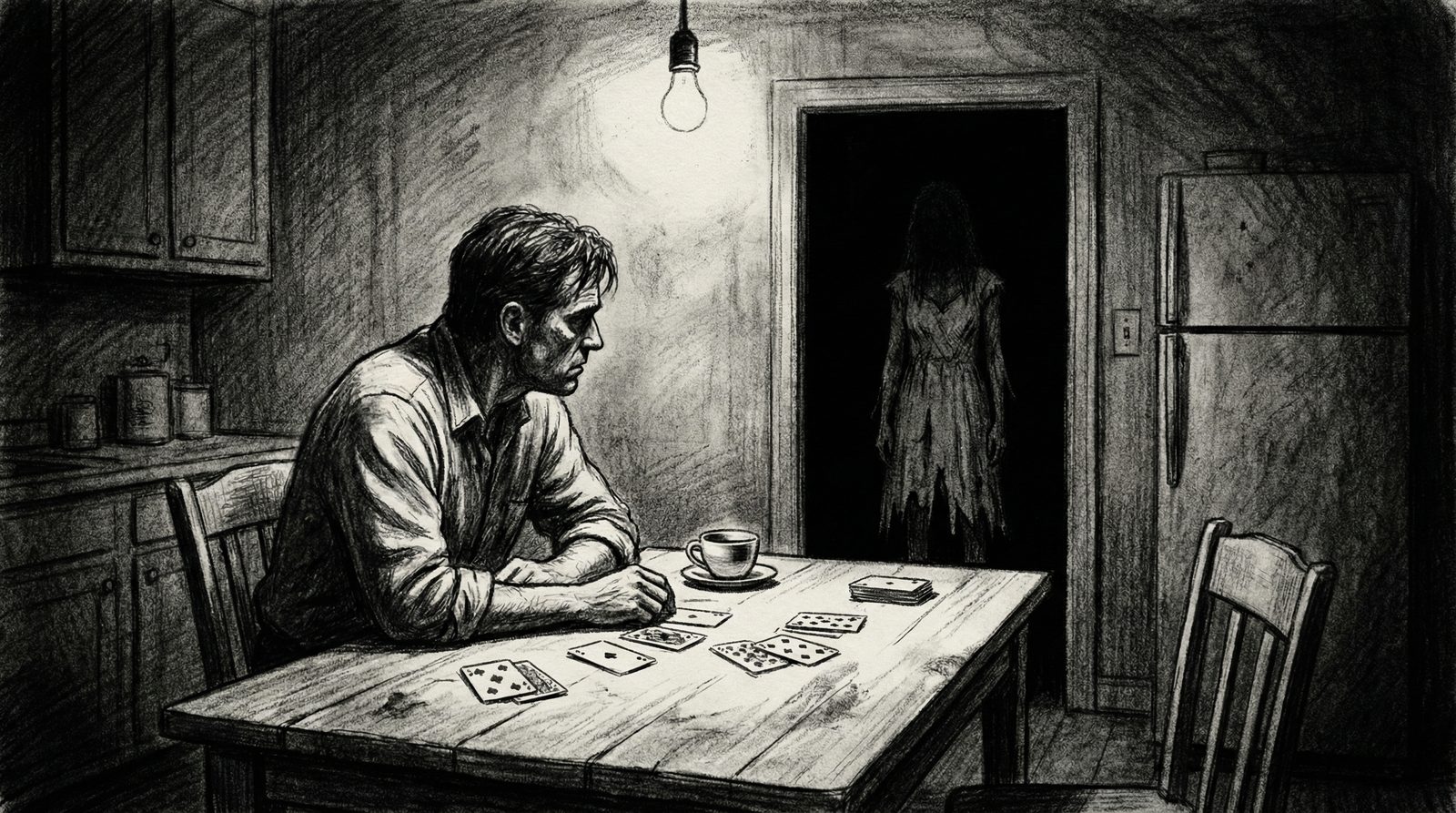
    The various film adaptations have made the story widely known, but they also blur how uncompromising the book’s ending truly is. There is no burning house as catharsis, no surviving child to carry a glimmer of hope. Louis ends the novel sitting at the kitchen table, playing solitaire, waiting for the thing he has made of his wife. That starkness is part of why the book endures: it refuses the usual horror bargain where insight or sacrifice buys survival. Instead, it suggests that some doors, once opened, can only keep swinging wider.


    IS IT WORTH READING?

    Yes, but with the understanding that Pet Sematary (1983) is less a thrill ride than a slow moral poisoning. If you’re interested in horror that is genuinely about something – parental love, denial, the arrogance of thinking you can bargain with the inevitable – this is essential. The prose is accessible, the structure straightforward, but the emotional impact is punishing. There are no comforting ironies, no narrative hand-holding. The book will ask you, quite directly, what you would do if you had access to that burial ground, and it will not let you answer quickly. For many readers, it becomes the Stephen King novel they respect most and reread least, precisely because it hits so close to the bone.

    Illustration of a core idea or motif from 'Pet Sematary (1983)'

    TRIVIA & AUTHOR FACTS

    King wrote Pet Sematary after moving his own young family to a house near a busy road in Orrington, Maine, where a pet cemetery really existed in the woods behind the property. His daughter’s cat was killed on that road, an event that directly inspired Church’s fate. The manuscript reportedly disturbed him so much that he shelved it for a time, only publishing it to fulfill a contractual obligation.

    Several details in the book echo King’s broader fictional Maine: Ludlow sits not far from other invented towns like Derry and Castle Rock, and the Micmac burial ground hints at an older, shared supernatural geography. The University of Maine setting draws on King’s own experience teaching there. The phrase “Sometimes dead is better,” spoken by Jud, became one of King’s most quoted lines, encapsulating the novel’s entire moral argument in four blunt words. Despite his misgivings, the book became one of his most discussed works, especially among readers who are parents.


    SIMILAR BOOKS

    If you’re drawn to the way Pet Sematary fuses family drama with supernatural horror, you might look toward Shirley Jackson’s The Haunting of Hill House (1959) for another study in psychological erosion. For a different but related take on grief and uncanny return, Peter Straub’s Ghost Story (1979) offers an older generation haunted by past sins. Those interested in the rural, ritualistic side of horror might turn to Thomas Tryon’s Harvest Home (1973), where small-town traditions conceal something far older and crueler. All share with King an interest in how ordinary people remake themselves – sometimes monstrously – when confronted with the unacceptable.


    DISCOVERABILITY & LINKS

    This review of Pet Sematary (1983) is connected on our site to wider discussions of motifs like roads and crossings, tropes such as the Faustian bargain, and related horror novels that explore grief, family, and the dangerous allure of undoing death.

  • Thinner (1984)

    Thinner (1984)

    By: Stephen King (as Richard Bachman)
    Genre: Horror
    Country: United States


    INTRODUCTION

    Thinner (1984) is a curse story that feels like it could have been overheard in a bar in the late twentieth century. The motif of bodily decay is obvious, but what lingers is the quieter erosion of excuses. Billy Halleck, a comfortable Connecticut lawyer, runs over an old Romani woman on a dark street, and the whole town helps him walk away clean. Judge, cops, the local power structure closing ranks. When the old man Taduz Lemke brushes Billy’s cheek and whispers “thinner,” the horror is less about magic than about a conscience finally cornered. The feel here is mounting dread, the sense that the bill for years of entitlement has finally come due.


    PLOT & THEMES

    The plot is a classic trope: a Faustian curse that can’t simply be out-argued. After killing an old Romani woman with his car on a street in Fairview, Billy is shielded by his connections, Judge Cary Rossington, Chief Hopley, and the ingrained racism toward the “gypsy” caravan. Taduz Lemke’s touch marks Billy, and the weight begins to drop. Parallel hexes hit Rossington (his face turns into a grotesque hive of scales) and Dr. Mike Houston (he develops painful boils), reinforcing the motif of corrupted bodies as moral scorecards.

    As Billy confronts the caravan from Fairview into New England resort towns and finally onto Maine backroads, the book worries at American privilege. The motif of appetite (food, sex, power) runs through every scene, from Heidi’s furtive affair with Houston to Ginelli’s relish in psychological warfare against the Lemkes (dead animals in trailers, night-time gunfire, sugar in gas tanks).

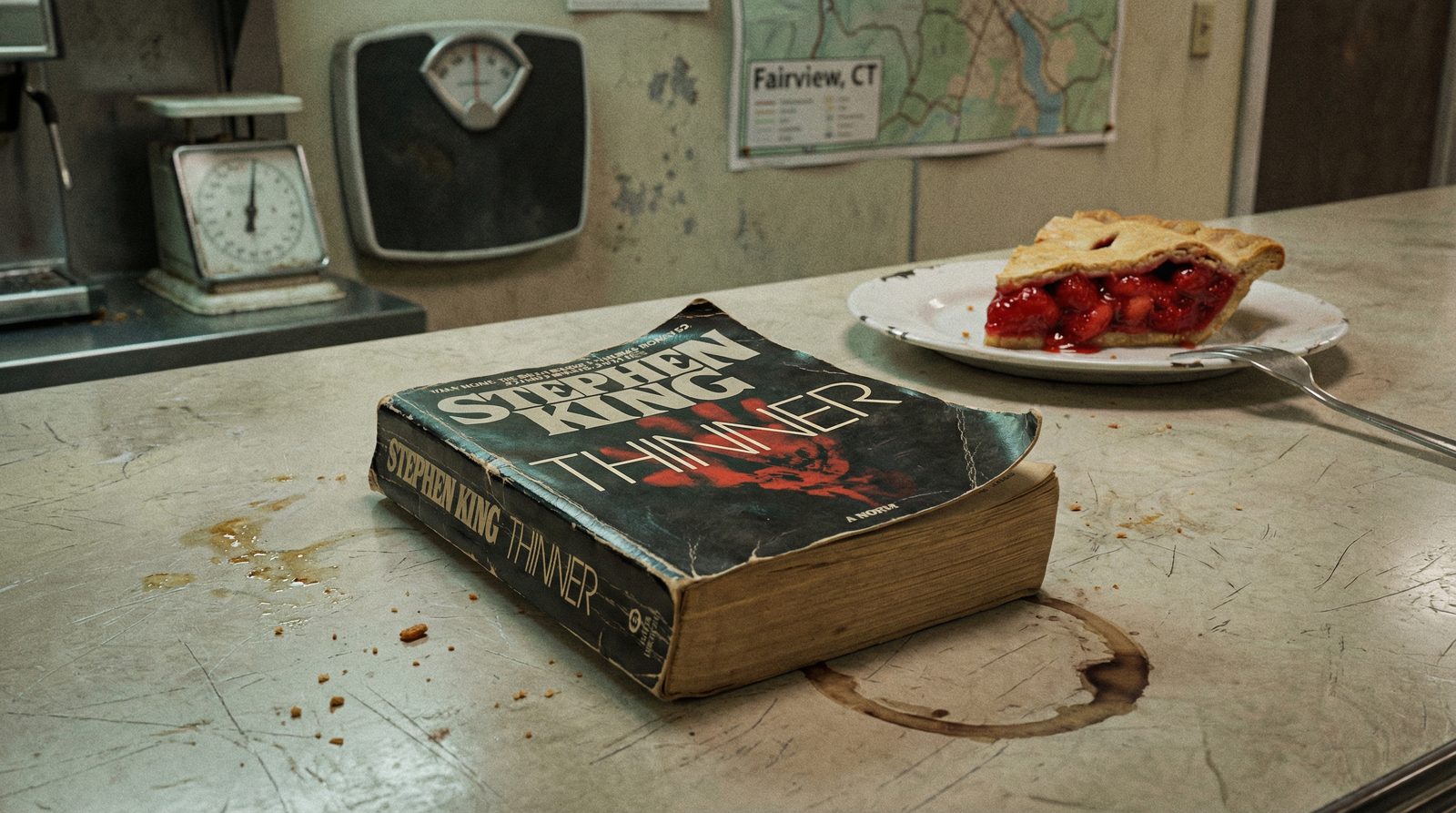
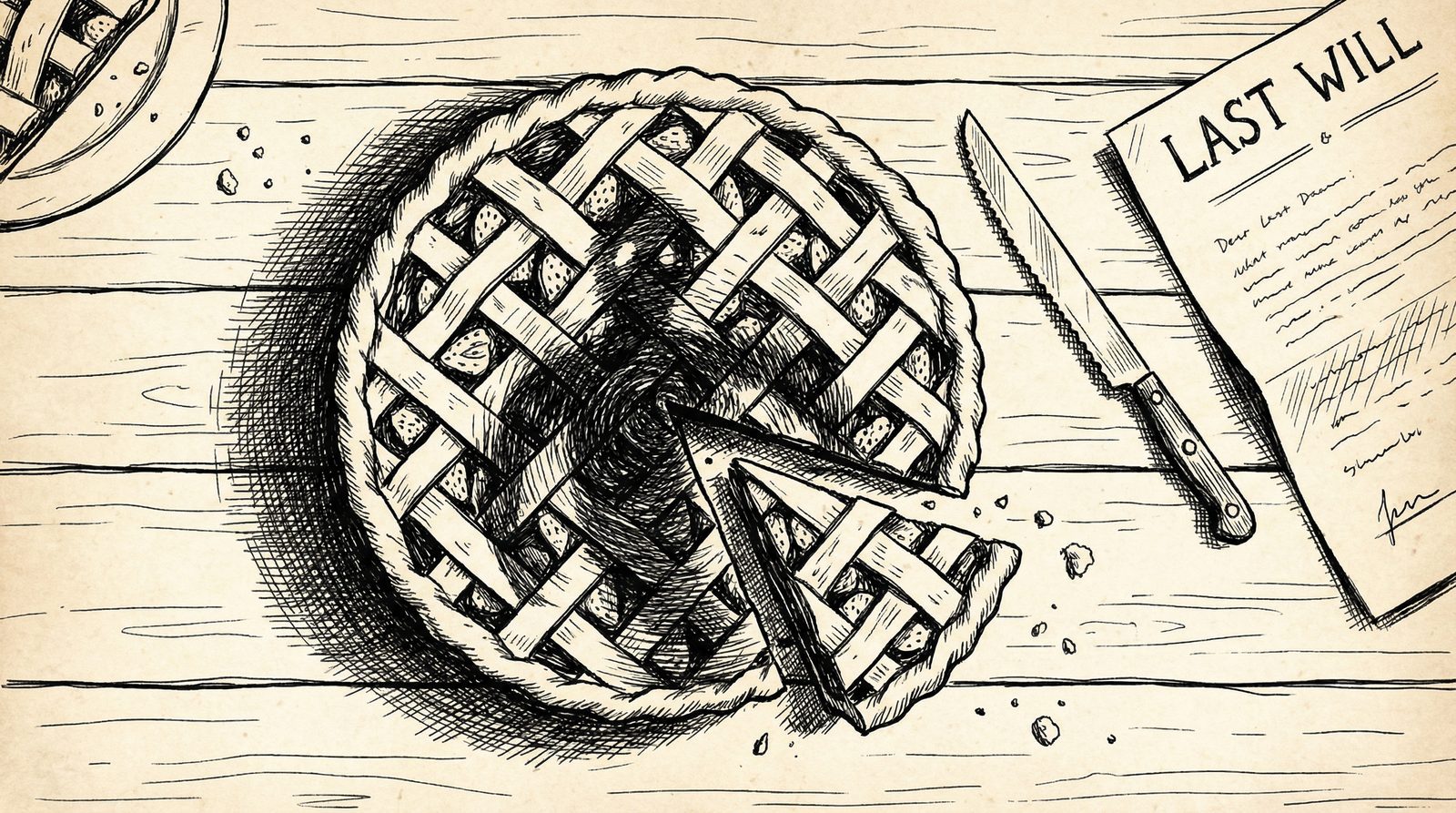
    Unlike the film adaptation, which softens and sensationalizes some of Ginelli’s campaign, the novel lingers on his methodical harassment and on Billy’s own moral slide as he accepts collateral damage. The book’s ending is brutally clear: Lemke agrees to move the curse into a strawberry pie that Billy must feed to someone else. Billy brings it home, intending to give it to Heidi. He later discovers that she has eaten a slice for breakfast. Realizing what he has done, he sits at the table in the final pages, cutting himself a generous slice of the cursed pie, ready to finish what he started.

    In its sour way, Thinner (1984) rhymes with works like Pet Sematary (1983) and the moral reckonings of The Twilight Zone (1959), where bargains are always paid in full, just not in the currency you expected.


    PROSE & NARRATIVE STRUCTURE

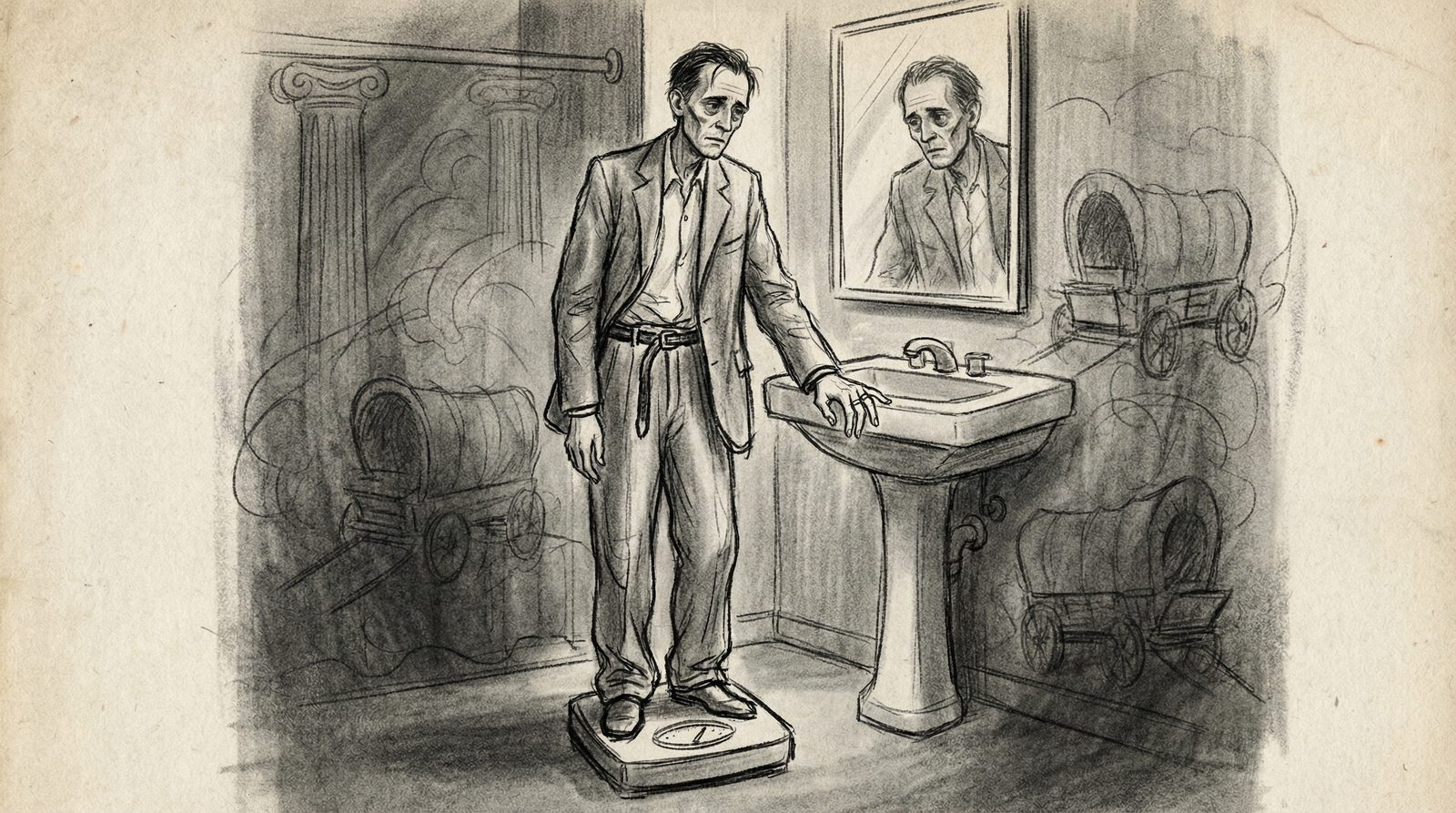
    Written under the Bachman mask, the prose is leaner and meaner than mid-1980s King. The narrative technique of close third-person limited pins us inside Billy’s increasingly frantic mind, but the voice keeps a hard, almost pulp edge. There are no baroque flourishes; that plainness sharpens the feeling of claustrophobic anxiety. Billy counting calories in reverse, watching the bathroom scale like a death clock.

    Structurally, the novel moves in three acts: the crime and cover-up in Fairview; the medical and legal rationalizations as Billy consults Dr. Houston and half-heartedly sues Lemke; and finally the road novel–cum–war story as Ginelli joins the fray. King uses short, punchy chapters that often end on a physical detail. A notch on Billy’s belt, the way his wedding ring slides loose on his finger. King uses it to reinforce the motif of bodily decay. Interludes from other perspectives, like Ginelli’s cool internal monologues about “pressure” and “messages,” widen the frame without losing momentum.

    One of the book’s subtler moves is how the narrative keeps trying to revert to normalcy. Billy returns to his law office on Main Street, goes through motions with clients, even plays golf, but the prose undercuts these scenes with intrusive bodily sensations. This repetition functions almost like a legal brief being revised; each new draft admits more guilt. Compared with the more sprawling horror of ’Salem’s Lot (1975), Thinner (1984) is stripped down to a single throughline: a man shrinking into the size of his crime.

    Conceptual editorial illustration inspired by 'Thinner (1984)'

    CHARACTERS & INTERIORITY

    Billy Halleck begins as the archetype of the comfortable sinner. His interiority is a steady slide from rationalization to obsession. Early on, he frames the accident as “her fault” for darting into the road; later, as the pounds vanish, his thoughts narrow to the scale and the next pound lost, even as the people around him fall apart.

    Heidi is more than a stock unfaithful wife. Her fear of Billy’s changing body and her retreat into Dr. Houston’s arms come off as a panicked grab at normal touch, not simple betrayal. Judge Rossington and Chief Hopley embody institutional rot — men who think a fixed trial is just “common sense.” Taduz Lemke, with his bottle of white dust and his slingshot-carrying granddaughter Gina, is not romanticized. The caravan community, especially Gina’s hard-eyed contempt for Billy, gives the curse a human face rather than a mystical abstraction.

    The most intriguing presence is Richie Ginelli, an underworld fixer who treats the whole affair as a problem of leverage. His interior monologues about “messages” and “counter-messages” echo Billy’s legal mindset, but stripped of illusion. Ginelli’s willingness to wage a small war on the Lemkes — accepting that he himself may be marked — throws Billy’s cowardice into sharper relief. By the time Billy sits with the strawberry pie, the interior landscape is scorched.


    LEGACY & RECEPTION

    First published as a Richard Bachman novel in the 1980s, Thinner (1984) initially puzzled some readers. It lacked the supernatural sprawl of The Stand (1978) or the nostalgic warmth of It (1986). What it offered instead was a nastier, more focused moral fable. Once King’s authorship was exposed, the book was reabsorbed into the larger King canon, often cited as one of his purest examples of the “monkey’s paw” story — every wish granted, every loophole closed.

    The later film adaptation sanded off some of the book’s bleakness and shifted emphases, but the novel’s ending remains one of King’s most vicious: the casual breakfast that kills a family, the quiet decision to eat the rest of the pie. Critics have since read the book as an early, nasty cousin to later explorations of guilt and consequence in American horror fiction. Its reputation has grown less on jump scares than on its willingness to follow a morally compromised man all the way to the logical, bitter end of his choices, without offering redemption or cosmic comfort.


    IS IT WORTH READING?

    If you want sprawling mythology or sympathetic heroes, this is not the book. Thinner (1984) is short, mean, and morally airless, a story that starts with a bad decision and refuses to look away as the bill comes due. Its horror is intimate — bathroom scales, loosened belts, a pie on a kitchen table — rather than cosmic. The prose is brisk, the plot unrelenting, and the final pages land like a punch to the gut. For readers interested in how horror can interrogate privilege, guilt, and the stories we tell ourselves after we do something unforgivable, it’s absolutely worth the time. Just don’t expect to like anyone very much by the end, including the man wasting away at the center.

    Illustration of a core idea or motif from 'Thinner (1984)'

    TRIVIA & AUTHOR FACTS

    Thinner (1984) was the last novel published under the Richard Bachman pseudonym before a bookstore clerk famously connected the dots between King and Bachman via Library of Congress records. The book’s focus on weight and appetite came from King’s own anxieties about his body and his growing fame in the mid-1980s. Fairview, the Connecticut town where Billy lives, is one of King’s less fantastical suburbs — no haunted hotels or vampire-infested villages, just country clubs and backroom deals.

    Ginelli’s Italian restaurant and his off-the-books “friends” nod to King’s interest in how organized crime mirrors small-town power structures. The recurring image of white powder — Lemke’s curse dust — prefigures King’s later, more literal engagements with addiction and substances. And the strawberry pie, so ordinary and homey, is one of King’s most quietly vicious symbolic objects: a dessert that turns domestic comfort into a weapon, sitting innocently on the kitchen table while lives end around it.


    SIMILAR BOOKS

    If Thinner (1984) hooks you, you might look toward other tight, morally focused horror novels. Pet Sematary (1983) offers a different kind of curse, trading weight loss for resurrection and parental grief. Needful Things (1991) stretches the “deal with the devil” structure across an entire town, showing how small compromises add up. Outside King, Clive Barker’s The Hellbound Heart (1986) shares the same interest in bodily punishment as a mirror of desire, while Jack Ketchum’s The Girl Next Door (1989) pushes the idea of community-sanctioned cruelty into even more brutal territory. All of them, like Thinner (1984), ask how far ordinary people will go to avoid admitting what they’ve done.


    DISCOVERABILITY & LINKS

    This review connects Thinner (1984) to wider motifs of bodily decay, appetite, and cursed bargains across horror fiction. Our indexing links these themes, tropes, and related works so you can move easily from this novel’s lean, bitter morality tale to other stories that gnaw at similar questions of guilt, consequence, and the prices we pay.

  • Misery 1987

    Misery 1987

    By: Stephen King
    Genre: Horror
    Country: United States


    INTRODUCTION

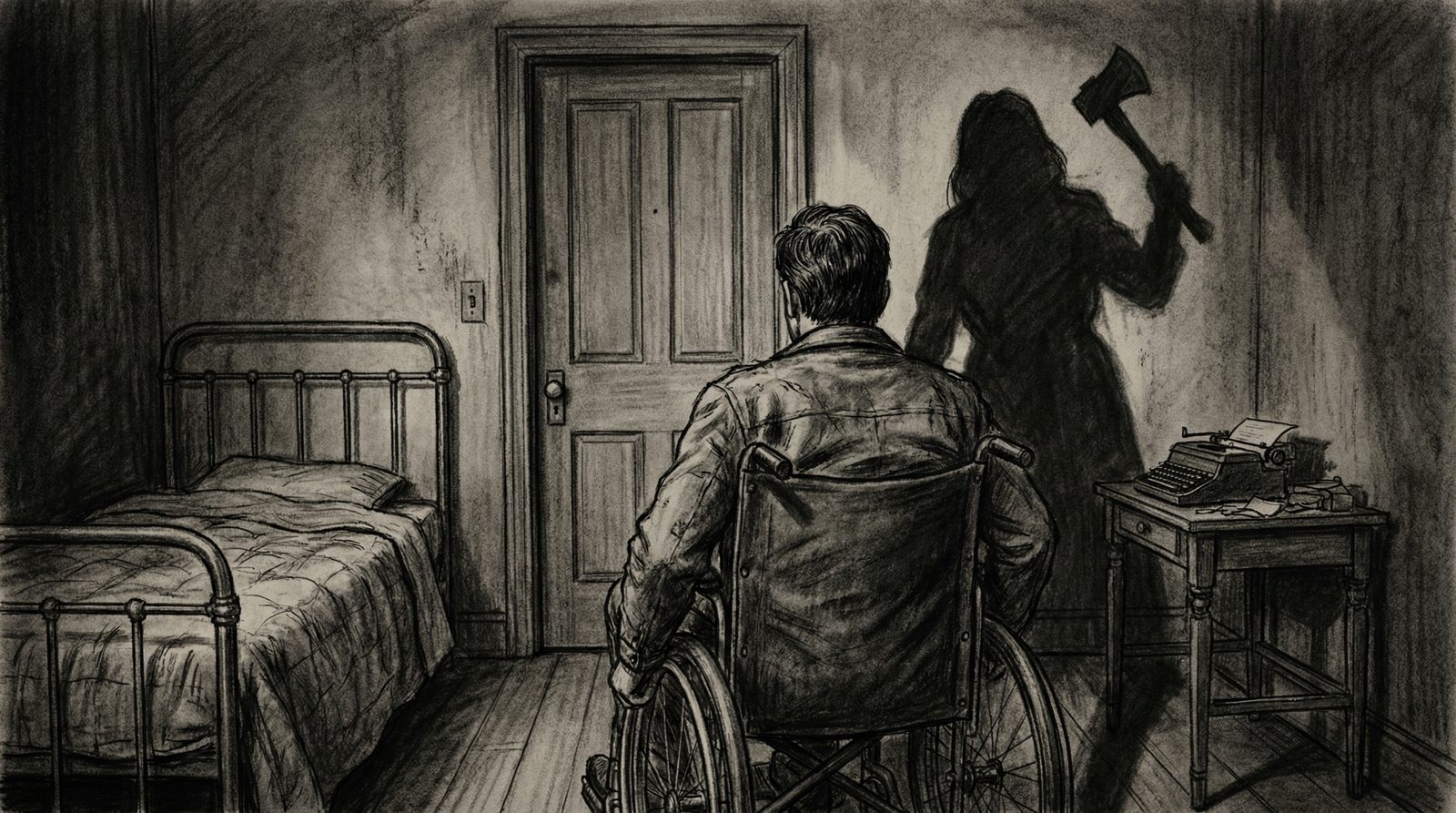
    Misery is a novel about pain as a kind of language. A bestselling author, a lonely superfan, and a snowbound house in rural Colorado: King strips away the outside world until only two people and their shared hallucination of a fictional heroine remain. The recurring motif of confinement is everywhere — locked doors, plaster dust, the wheelchair’s narrow orbit around the bedroom. As the story tightens, another motif surfaces: the blurred line between creation and self-destruction. The book is less about jump scares than about the slow erosion of will, the way dependency can feel like a sick form of intimacy. Misery is a horror story, yes, but it’s also a bitter little fable about what happens when your work belongs more to your audience than to you.


    PLOT & THEMES

    Misery opens with novelist Paul Sheldon waking up after a car crash in rural Colorado, his legs shattered, his body soaked in painkillers. He’s in the home of Annie Wilkes, a former nurse who calls herself his “number-one fan.” At first the trope of the rescuer turned jailer plays almost gently: she feeds him, manages his medication, and praises his work. Then she discovers his latest manuscript, where he has killed off Misery, and the story turns. She burns his new book in front of him, forcing him to watch every page go black in the grill, and demands he write Misery’s Return just for her.

    The motif of bodily mutilation runs alongside the erosion of Paul’s autonomy — from his shattered legs to the infamous amputation of his foot with an axe, and later the loss of his thumb. Unlike the film adaptation, where the sheriff dies inside the house, in the novel a state trooper becomes suspicious of Annie and investigates Paul’s disappearance; Annie murders him out in the yard, running him over with her riding lawnmower while Paul watches helplessly from the window. The world keeps trying to seep in, and Annie keeps cutting it off, figuratively and literally.

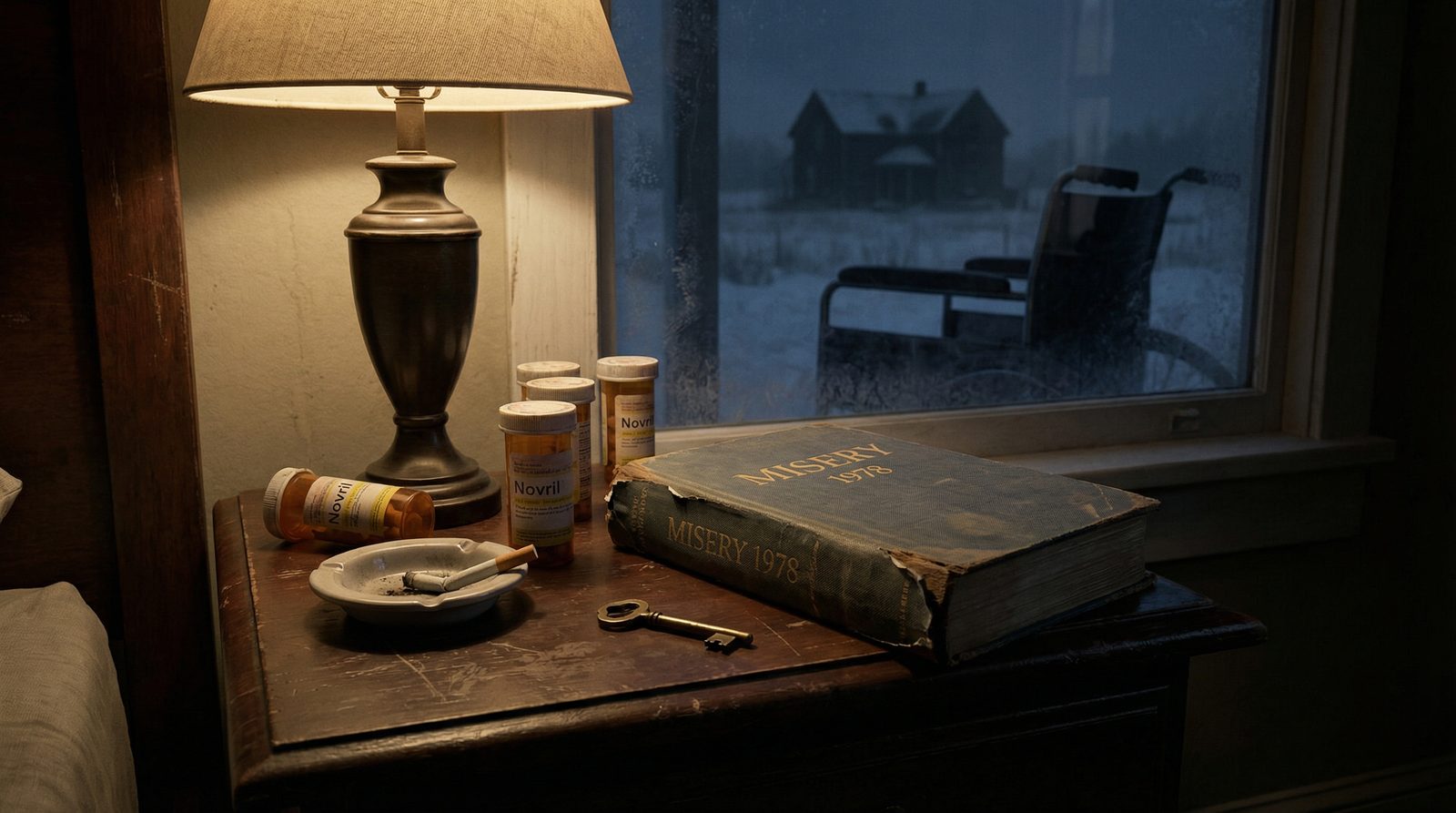
    King runs addiction and dependency as parallel themes. Paul’s history with alcohol and cigarettes mirrors his new dependency on Novril, the fictional painkiller Annie doles out and withholds. His writing of Misery’s Return becomes a survival strategy and a self-betrayal: he’s resurrecting a character he despises in order to live. The final showdown begins in the bedroom, where Paul sets fire to the manuscript as a decoy and uses the heavy typewriter as a weapon; Annie is later found dead in the barn after crawling out of the house, apparently on her way to fetch a chainsaw. Paul survives, but he is haunted — literally seeing Annie in public places, still hearing her voice. Unlike the cleaner catharsis of many film adaptations, the novel leaves him damaged, sober, and permanently entangled with the monster he outwrote but never quite escaped.

    Read alongside something like The Shining (1977) or the film Black Swan (2010), Misery sits in a line of stories where artistic creation becomes a crucible that burns away everything extraneous, including sanity.


    PROSE & NARRATIVE STRUCTURE

    The book uses close third-person as its primary narrative technique, locked almost claustrophobically inside Paul’s mind. We feel every throb in his shattered legs, every itch he can’t scratch, every spike of terror when he hears Annie’s car on the gravel. The prose has a jittery, pain-soaked feel: sentences sometimes fracture under the weight of morphine dreams and panic. King litters the text with Paul’s private slang — “goddams,” “laughing place,” the way he calls his typewriter the “Royal” as if it were a temperamental animal. These details never made it into the more streamlined adaptation, but on the page they’re crucial to how we inhabit his consciousness.

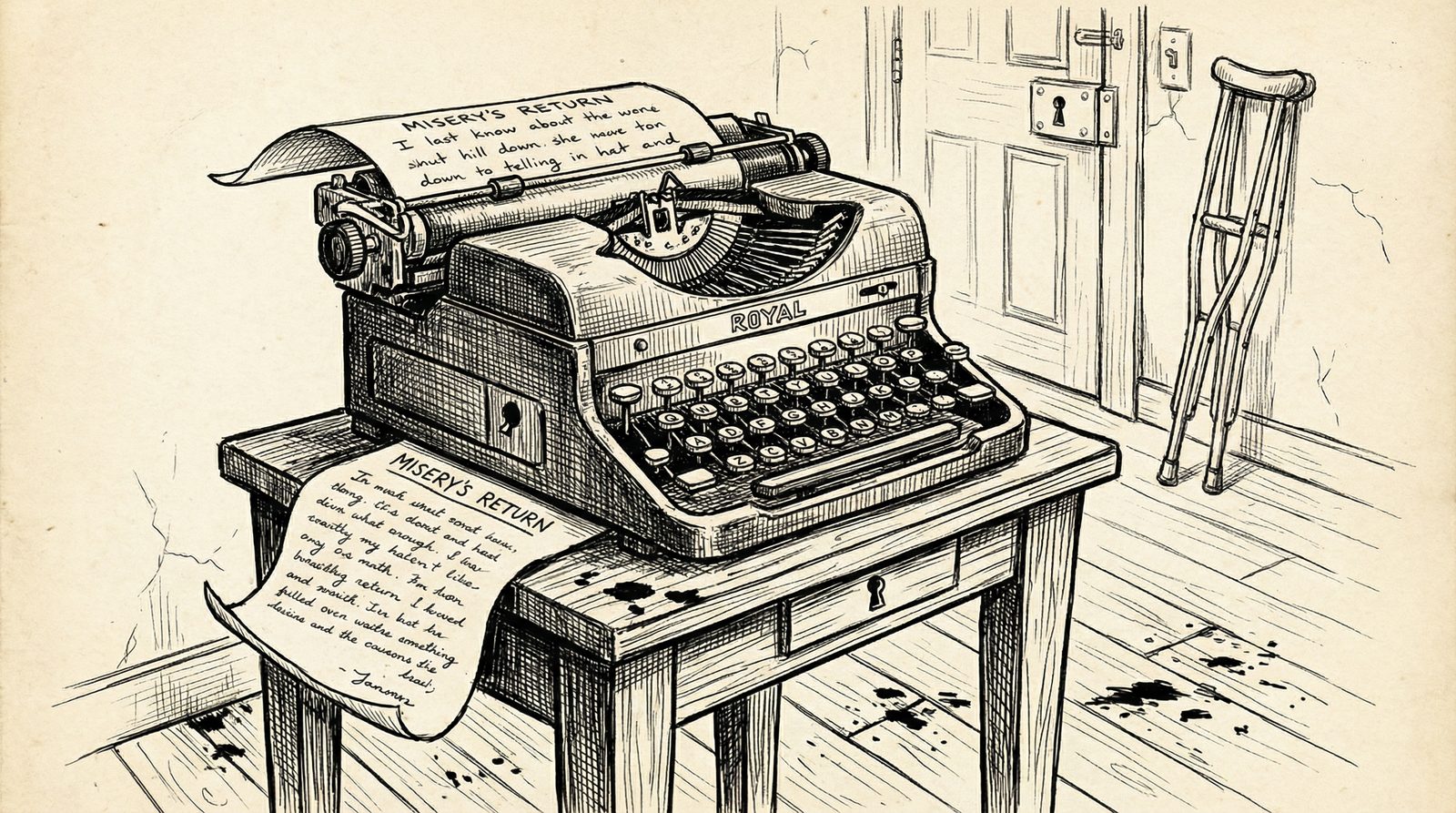
    Structurally, Misery is a chamber drama. Almost everything happens in one house, mostly one room, and King leans hard on repetition: Annie’s entrances, the ritual of the Novril pills, the clack of the typewriter keys. Interleaved with the main narrative are long passages of Misery’s Return itself, printed in a faux-typed font in many editions, complete with typos when keys stick or letters break off the typewriter. This embedded narrative isn’t just a gimmick; it’s a second story about resurrection and control that mirrors Paul’s situation.

    The book’s pacing is a slow crank. King alternates between stretches of grinding routine and short, vicious bursts of violence — the feeding of the rat in the basement, the discovery of the scrapbook that documents Annie’s past murders at Sidewinder General Hospital, the moment she cuts off Paul’s foot for trying to escape. The structure traps the reader the way Annie traps Paul: you learn the rhythms of her moods, you wait for the next explosion, and you know, long before he does, that there is no safe way out.

    Conceptual editorial illustration inspired by 'Misery (1987)'

    CHARACTERS & INTERIORITY

    Paul Sheldon begins as the familiar archetype of the jaded author. Trapped in Annie’s guest room, he’s stripped down to something more raw. His interior monologue swings between self-disgust, petty vanity, and a stubborn will to live. He bargains with himself as much as with Annie — promising another chapter in exchange for another day, another cigarette, another chance to crawl to the door.

    Annie Wilkes is one of King’s most precise portraits of madness. On the surface she’s the nurturing caregiver, the “good nurse” who knows how to set a splint and manage a dosage. Underneath, she’s a childlike absolutist, incapable of tolerating narrative disappointment. Her language — “dirty bird,” “cockadoodie,” her fury at “swearing” — gives her the affect of a prudish aunt, which only makes the sudden violence more jarring. The scrapbook in the spare room, where she has pasted clippings about the deaths of infants and elderly patients under her care, is a quiet, book-only horror that deepens her beyond the more theatrical moments.

    Their relationship is not simply captor and captive; it’s a grotesque parody of author and audience. Annie demands emotional honesty and narrative satisfaction on her terms. Paul, in turn, learns to manipulate her through plot twists, cliffhangers, and the promise of Misery’s resurrection. The interiority of both characters is built around control — who has it, who’s pretending to have it, and what happens when it shifts by a fraction. Even minor figures, like the store clerk at the Silver Creek market who notices Annie buying reams of paper, exist mainly as distant reminders that there is a world where people have names and choices, a world Paul can no longer quite reach.


    LEGACY & RECEPTION

    Within Stephen King’s body of work, Misery is one of the leaner, more disciplined novels, often cited alongside Gerald’s Game (1992) as proof that he can do tight, small-scale horror as well as expansive epics. Readers and critics have long read it as King’s argument with his own fame: Paul’s resentment of the Misery books echoes King’s unease with being known primarily for horror when he wanted to write other things. The novel’s focus on writer’s block, addiction, and the punishing expectations of fans has made it a touchstone for discussions about parasocial relationships decades before that term became common.

    The book’s ending, with Paul sober in New York, still seeing Annie’s ghost in a passing stranger and still half-hallucinating her voice as he writes a new, non-Misery novel, leaves a lingering aftertaste. Survival here is not triumph but a damaged continuation. That refusal to tidy up the trauma is part of why the novel has endured, even as its more famous adaptation softened some of the bodily harm and gave audiences a slightly clearer emotional release. On the page, Misery remains a sharp little knife aimed at the uneasy bond between artists and the people who consume them.


    IS IT WORTH READING?

    If you have any patience for psychological horror, Misery is worth your time. It’s compact, vicious, and oddly moving in its portrait of a man bargaining with his own worst habits as much as with his captor. The violence is graphic but not gratuitous; the real horror is the loss of agency and the way pain narrows a life to a few square feet of floor and a stack of typed pages. It’s also one of the clearest windows into how a popular writer thinks about his craft under pressure. If you want haunted houses or sprawling mythologies, look elsewhere. If you want two people locked in a room, fighting over a story and a body, this is as good as it gets.

    Illustration of a core idea or motif from 'Misery (1987)'

    TRIVIA & AUTHOR FACTS

    Stephen King has said that the idea for Misery came from a dream about a fan who held him captive and forced him to write. The fictional painkiller Novril is part of a loose web of invented drugs that appear across his work, reflecting his own struggles with substance abuse during the period. The town of Sidewinder, mentioned in Annie’s nursing history, also appears elsewhere in his Colorado-set stories, tying this small, brutal narrative into a larger imagined geography.

    The embedded novel Misery’s Return was originally much shorter in draft; King expanded it to better show Paul’s reluctant craftsmanship. The decision to have Annie’s body ultimately discovered in the barn rather than in the main house was a late structural change, meant to move the final confrontation out of the now-familiar bedroom and into a rougher, more elemental space. King has also noted that Paul’s shift from genre series work to a more serious, literary-leaning manuscript after his ordeal mirrors his own periodic attempts to step outside the expectations attached to his name.


    SIMILAR BOOKS

    If Misery appeals to you, try The Shining (1977) for another intense portrait of a writer under supernatural and psychological siege. Gerald’s Game (1992) offers a similar single-location nightmare, this time inside a marriage. For a different angle on dangerous devotion, John Fowles’s The Collector (1963) tracks a kidnapper who treats his victim like a rare specimen, not unlike Annie treating Paul as the source of her beloved stories. And if the focus on bodily vulnerability and constrained space is what grips you, you might also seek out more recent psychological horror that keeps its cast small and its emotional stakes painfully close to the skin.


    DISCOVERABILITY & LINKS

    This review of Misery is connected to wider motifs, tropes, and related works across the site, helping you trace patterns of confinement, obsession, and the uneasy bond between creators and their audiences through other books and media.

  • Stephen King

    Stephen King

    ORIGINS & BACKGROUND

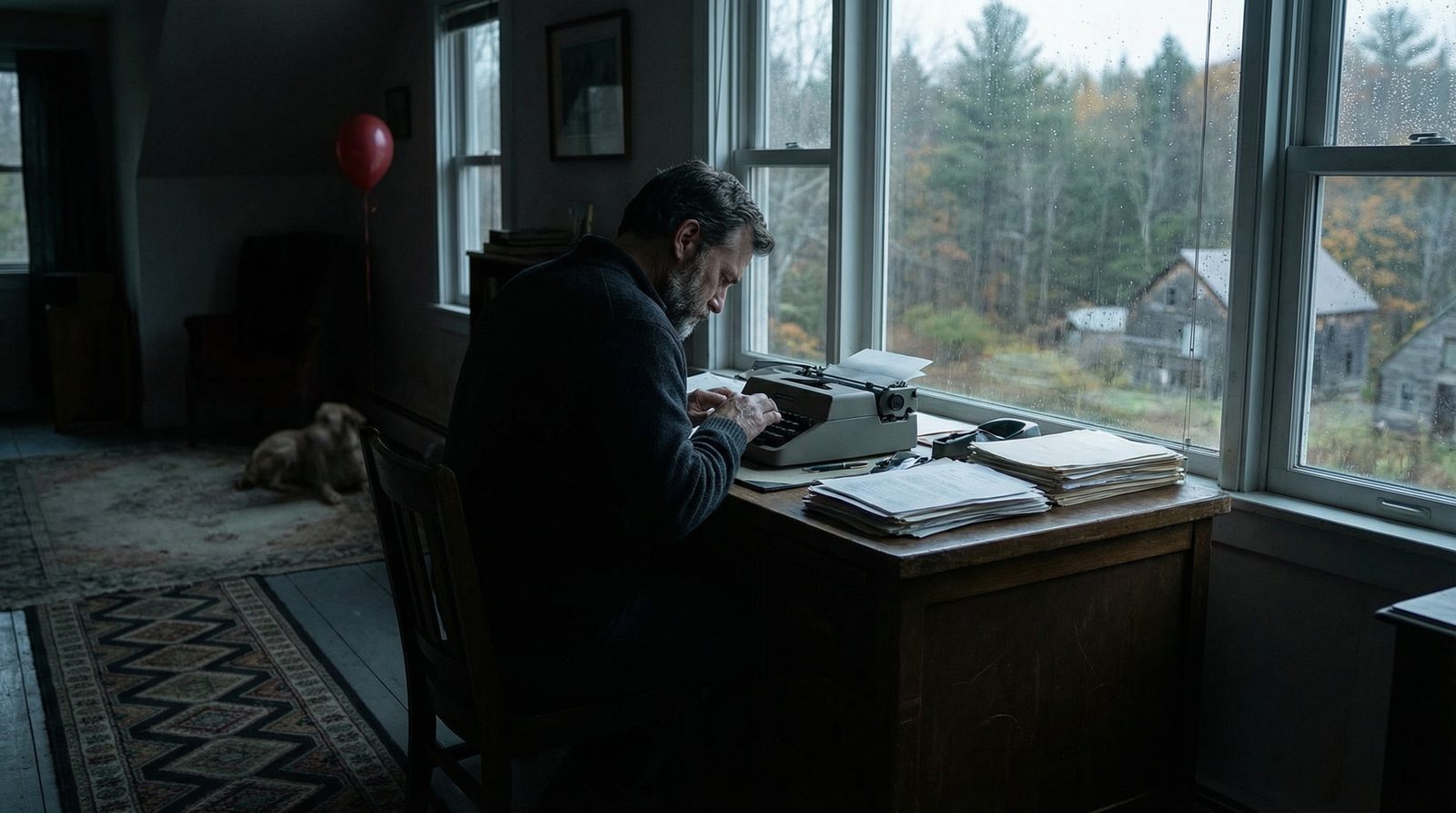
    Stephen King is one of the most widely read storytellers of the late 20th and early 21st centuries, and his work has shaped how popular culture imagines horror, suspense, and the supernatural. Born in 1947 in Portland, Maine, and raised largely in working-class New England, he has returned again and again to the textures of small-town life. That sense of place is not just scenery; it is the pressure cooker for his characters.

    His early success with “Carrie (1974)” and “The Shining (1977)” came from blending the supernatural with very ordinary pain. King has spoken and written about his own struggles with addiction, and you can feel that personal knowledge of self-destruction running through his work, especially in “The Shining (1977)” and “Doctor Sleep (2013)”. The line between the haunted house and the haunted mind is thin.

    Across decades and dozens of novels, collections, and novellas, King has moved beyond strict horror into fantasy, crime, and coming-of-age fiction, but he tends to keep the same emotional territory: ordinary people pushed into extraordinary situations where their buried fears and desires become literal. Whether he is writing about a killer clown in “It (1986)” or a prison friendship in “Rita Hayworth and Shawshank Redemption (1982)”, the focus is less on the monster and more on how people respond when their world stops making sense.

    Stephen King grew up in the postwar United States, in a culture saturated with pulp paperbacks, monster movies, and comic books. That mix of high anxiety and low-budget imagination fed directly into his fiction. His New England upbringing, especially in Maine, is crucial to his work. The recurring fictional town of Derry in “It (1986)” and Castle Rock in books like “Cujo (1981)” and “The Dead Zone (1979)” are composites of the places he knew. The small town becomes a laboratory for fear and for community.

    He began as a high school English teacher writing in the margins of his day, and that sense of the working writer never really left. Many of his protagonists are ordinary workers, teachers, writers, or kids, people who do not have special training to face the supernatural. This focus on everyday people deepens his motif of ordinary evil.

    King’s own life has been marked by brushes with mortality, including a near-fatal accident in 1999. That experience sharpened his interest in survival and recovery, visible in works like “Misery (1987)” and “11/22/63 (2011)”, where bodies and timelines are broken and then painfully mended. His long career also means readers have grown older alongside him, moving from the adolescent terror of “Carrie (1974)” to the reflective nostalgia and regret of stories like “The Body (1982)” and “Doctor Sleep (2013)”. The biography matters less as trivia than as a source of his recurring concerns with trauma, addiction, and the persistence of memory.

    Editorial illustration inspired by 'Stephen King'

    THEMES & MOTIFS

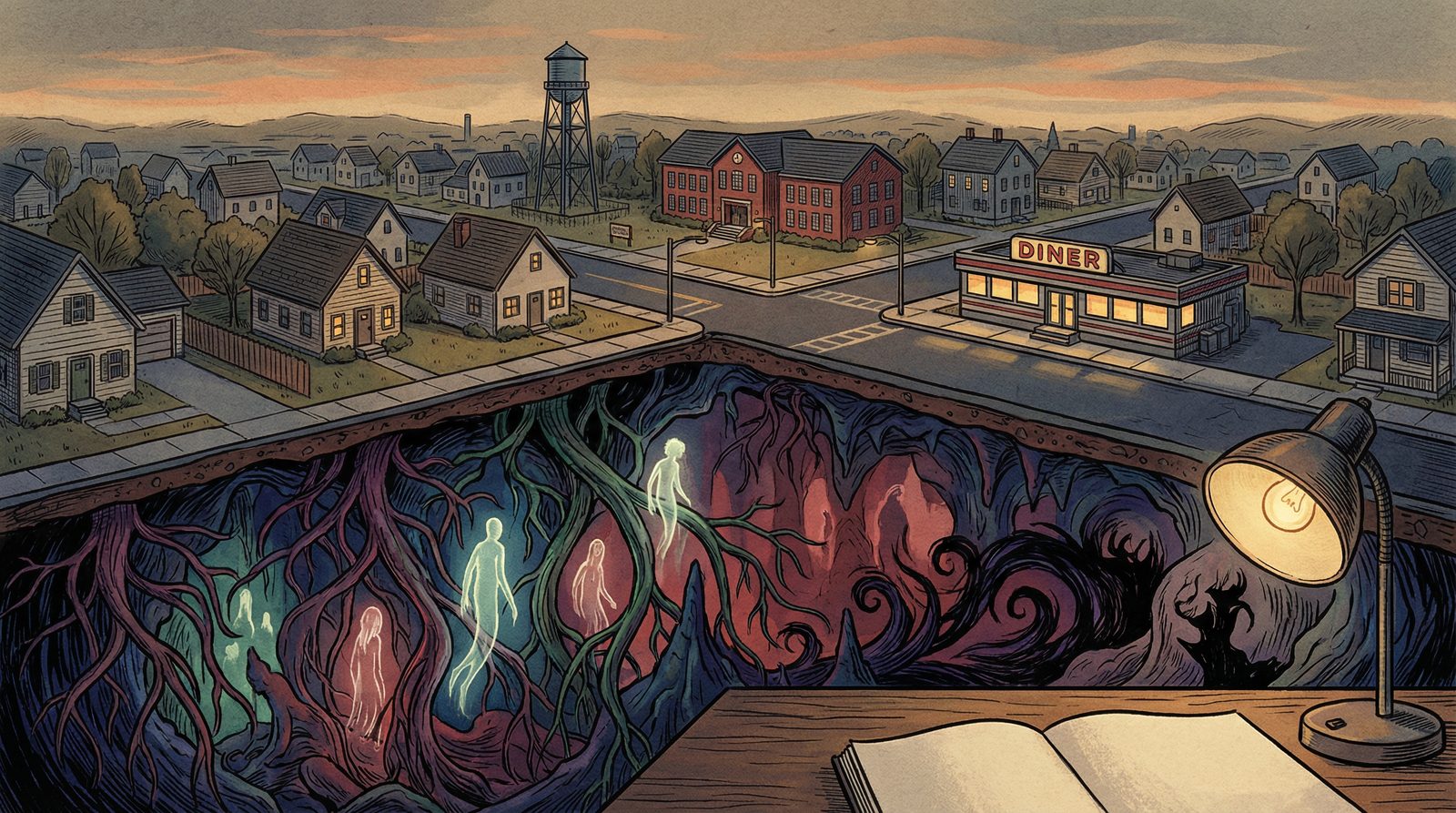
    At the heart of King’s work is the collision of ordinary life with supernatural horror. He returns again and again to the idea that the uncanny is never far from the surface of the everyday. A prom becomes a massacre in “Carrie (1974)”, a family vacation becomes a descent into madness in “The Shining (1977)”, and a childhood summer becomes a battleground with an ancient evil in “It (1986)”. This ordinary life meets supernatural horror dynamic lets him explore fear without abandoning realism.

    King is also preoccupied with small-town secrets. Towns like Derry and Castle Rock are full of buried crimes, shared silences, and generational guilt. In “It (1986)”, the town’s willingness to look away from violence feeds the creature that preys on children. This motif of small-town secrets links to his broader interest in generational trauma: “The Shining (1977)” and “Doctor Sleep (2013)” trace how alcoholism and violence ripple through a family across decades.

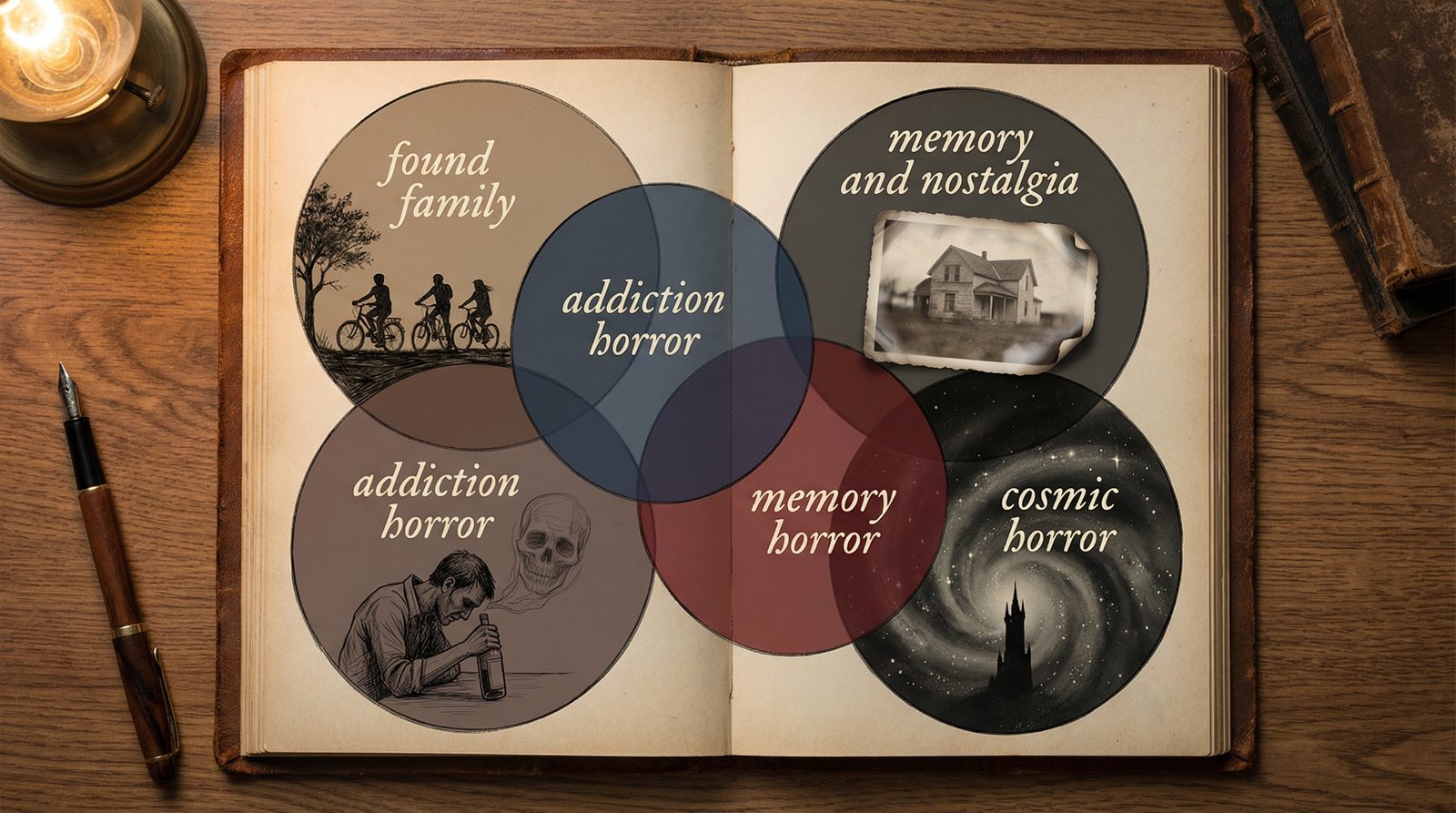
    Another persistent thread is found family. In “It (1986)”, the Losers’ Club is a group of misfits who become a chosen family to survive both bullying and a shapeshifting monster. In “Rita Hayworth and Shawshank Redemption (1982)”, friendship and solidarity inside prison are the only defenses against despair. These found family bonds are often the counterweight to evil, suggesting that connection is the only real magic people have.

    King is fascinated by addiction and redemption. Characters like Jack Torrance in “The Shining (1977)” and Danny Torrance in “Doctor Sleep (2013)” embody addiction horror, where the monster is as much the bottle as any ghost. The horror of losing control of oneself, of becoming a danger to the people you love, is one of his most unsettling themes. Alongside this runs a quieter focus on memory and nostalgia. Stories like “The Body (1982)” and “11/22/63 (2011)” treat the past as both a refuge and a trap, where childhood and history can never be fully recovered or fixed.

    Finally, King often uses cosmic horror, especially in “It (1986)” and “The Dark Tower (1982)”, to suggest that human struggles are set against vast, indifferent forces. Yet his tone rarely sinks into pure despair. Even when facing cosmic horror, his characters cling to compassion, humor, and stubborn courage, which gives his work a distinctive blend of dread and hope.

    Symbolic illustration inspired by 'Stephen King'

    STYLE & VOICE

    Stephen King’s style is conversational and plainspoken, closer to someone telling a long story at the kitchen table than to literary ornament. He favors a character-driven horror approach, spending pages on the rhythms of daily life before anything overtly frightening happens. That slow-burn suspense is part of his method. By the time the supernatural appears, readers feel they know the people it threatens.

    He often uses multiple perspectives and braided timelines. In “It (1986)”, the narrative jumps between the protagonists as children and as adults, creating a layered sense of memory and inevitability. In “The Stand (1978)”, he moves among a large ensemble cast scattered across a devastated America, building an epic scale from many intimate viewpoints. This ensemble storytelling lets him explore how different kinds of people respond to the same crisis.

    King’s prose is full of colloquial dialogue, brand names, and pop culture references. That realism can make the horror feel more intrusive, as if it is invading a recognizable world. He is also fond of interior monologue and sudden flashes of dark humor, which keep the tone from becoming monotonously bleak. Even in his grimmest stories, a joke or a stray thought will cut through the tension, reminding readers of the messiness of real minds under stress.

    Structurally, he often blends horror with coming-of-age arcs and crime or fantasy frameworks, as in “Misery (1987)” and “11/22/63 (2011)”. His endings can be divisive, sometimes abrupt or ambiguous, but that inconsistency is part of his risk-taking. Across genres, his voice remains recognizable.

    KEY WORKS & LEGACY

    Certain books have come to define Stephen King for many readers. “Carrie (1974)” announced his blend of high school cruelty and telekinetic horror. “The Shining (1977)” crystallized his obsession with addiction horror and the haunted family. “The Stand (1978)” showed his ability to stretch horror into post-apocalyptic epic, while “It (1986)” became a landmark of small-town secrets, generational trauma, and found family facing cosmic horror.

    His shorter work has also had an outsized impact. The novella “The Body (1982)” became the film “Stand by Me”, a touchstone for coming-of-age storytelling. “Rita Hayworth and Shawshank Redemption (1982)”, another novella in Different Seasons, turned into the film “The Shawshank Redemption” (1994), which many viewers think of less as horror than as a story of endurance and hope. “Misery (1987)” and “Doctor Sleep (2013)” continue his interest in the relationship between creators and fans, addiction, and the fragile process of recovery.

    King’s influence on horror and popular fiction is hard to overstate. He helped normalize the idea that horror could be mainstream, emotionally rich, and focused on character rather than just shock. His work sits alongside that of earlier figures in American horror and suspense, but he brought a distinctly late-20th-century sensibility.

    Beyond specific titles, his legacy includes the many writers and filmmakers who have taken cues from his character-driven horror and his mix of dread and hope. He showed that horror could be a flexible tool for exploring grief, guilt, and the possibility of redemption. Even readers who have never picked up one of his novels live in a culture shaped by his images of haunted hotels, killer clowns, and kids on bikes riding toward something they cannot yet name.


    DISCOVERABILITY & LINKS

    This creator page connects Stephen King to the wider Bachman–King network on AllReaders. Follow the links above to explore how his novels, pseudonymous works, and recurring motifs intertwine across horror, suspense, and character-driven storytelling.

  • Richard Bachman

    Richard Bachman

    ORIGINS & BACKGROUND

    Richard Bachman began as a pseudonym for Stephen King, a way to publish more books than the market supposedly allowed and to test whether his success was luck or something built into the stories themselves. That experiment matters because it shaped what kind of tales appeared under the Bachman name. The pseudonym became a container for the meaner, more stripped-down ideas, where sentimentality is scarce and the world feels rigged against the characters from page one.

    Within that frame, Bachman stories often center on ordinary people in extreme situations rather than heroes with special gifts. A salesman, a drifter, a caretaker, a kid in a rigged contest: the Bachman voice is a way to explore identity collapse in isolation, the way a person’s sense of self frays when they are cut off from community, safety, or even their own body. You can see those tensions in works like Thinner (1984) and Blaze (2007), where the protagonists are pushed so far that their moral compass and self-image begin to disintegrate.

    Because Richard Bachman is a constructed identity, questions of authorship and persona are baked into his legacy. The unmasking of Bachman as Stephen King turned the pseudonym into a kind of ghost character who haunts King’s bibliography, a place where he could channel the grimmer, more fatalistic side of his imagination. That tension between masks and truth is at the heart of how readers now approach the Bachman books.

    Editorial illustration inspired by 'Richard Bachman'

    THEMES & MOTIFS

    The most consistent thread in Richard Bachman’s work is the focus on ordinary people in extreme situations. Everyday figures are hurled into scenarios that feel like rigged experiments. The point is not heroism but exposure. When the pressure mounts, the stories ask what remains of decency, love, or self-respect when survival becomes the only obvious goal. This is closely tied to identity collapse in isolation, where characters are cut off from help, trapped by geography, illness, or a sadistic game, and slowly lose the narratives they once told themselves about who they were.

    A second key motif is dystopian game shows, most clearly embodied in The Running Man. Here, entertainment and punishment blur as a televised manhunt turns suffering into spectacle. The idea that the audience is complicit, that people at home are cheering for someone’s death, turns the story into a critique of media, class, and the way systems feed on desperation. That same sense of a rigged stage appears in quieter ways in caretaker-focused stories, where a job that should be mundane becomes a trap.

    Body horror and guilt also run through the Bachman persona. In Thinner (1984), a curse transforms weight loss into a slow-motion execution, tying vanity, privilege, and punishment together. The body becomes a scoreboard of sin. That bodily erosion mirrors psychological erosion in Blaze (2007), where a damaged man is pulled into crime and obsession. Across these works, the world rarely feels fair. Fate is cruel, institutions are indifferent, and any supernatural twist tends to amplify existing injustice rather than redeem it. Even when you compare the tone to novels like Misery (1987) or Pet Sematary (1983), which share obsessions with captivity, obsession, and grief, the Bachman flavor is usually colder and more fatalistic, less interested in catharsis and more interested in how far down the spiral a person can go.

    Together, these motifs create a landscape where games are rigged, bodies betray their owners, and isolation strips away every comforting story. Richard Bachman’s world is one where the mask of normal life is peeled back to reveal how fragile identity, morality, and sanity really are when the rules change overnight.

    Symbolic illustration inspired by 'Richard Bachman'

    STYLE & VOICE

    Richard Bachman’s style feels leaner and more abrasive than the warmer, more expansive tone many readers associate with Stephen King. The sentences tend to be straightforward and sharp, with less digression and fewer nostalgic detours. Pacing is usually tight. That structure suits stories built around ordinary people in extreme situations, because the narrative itself feels like a pressure cooker.

    The voice often carries a dry, sometimes bitter humor, but it rarely softens the blows. Instead, it highlights the absurdity of suffering in a world that treats pain as entertainment, as in the dystopian game shows of The Running Man. There is a streak of working-class realism in the details of jobs, debts, and small-town routines, which makes the intrusion of horror or dystopia feel like an extension of everyday stress rather than a break from it.

    Psychologically, the narration is willing to sit inside identity collapse in isolation, lingering on obsessive thoughts, paranoia, and self-loathing. Internal monologues can loop and fray, mirroring the way the characters’ identities are coming apart. Compared to the emotional range readers might associate with Stephen King’s mainline work, Bachman’s emotional palette is narrower and harsher. The result is a voice that feels like it is testing both its characters and its readers, asking how much cruelty and pressure a story can contain before something breaks.

    KEY WORKS & LEGACY

    The Running Man (1982) is the clearest expression of Richard Bachman’s fascination with dystopian game shows. Set in a near-future media landscape where a man is hunted for sport on live television, it distills his anger at economic inequality, voyeurism, and the way systems feed on the poor. The book’s relentless pace and bleak conclusion define the Bachman strain of pessimism. It also anticipates later cultural obsessions with violent reality shows and survival contests, giving it a long afterlife in discussions of dystopian fiction.

    Thinner (1984) takes a more intimate route, focusing on a cursed lawyer whose rapid weight loss becomes a metaphor for guilt and entitlement. The horror is personal and bodily, yet it still reflects a larger moral economy where power and privilege are called to account. Blaze, written earlier but published later, reads like a dark, off-kilter crime novel about a damaged man pulled into kidnapping and obsession. Both books push deeply into identity collapse in isolation, showing how characters lose themselves as the consequences of their choices close in.

    Although Richard Bachman is technically a pseudonym, his influence stretches beyond those specific titles. The Bachman books sharpened Stephen King’s interest in ordinary people in extreme situations and in the kind of claustrophobic, character-driven horror that also powers works like Misery and Pet Sematary. Readers who come to Bachman after those novels often recognize the shared DNA but notice the cooler temperature and harsher judgments. In the larger landscape of horror and dystopian fiction, Bachman stands as a reminder that genre can be a tool for social anger as much as for scares, and that sometimes an invented author can reveal a writer’s most unsparing instincts.


    DISCOVERABILITY & LINKS

    This creator page links Richard Bachman into the wider Bachman–King cluster on AllReaders. From here you can move into the books, films, and motifs that express his colder, more fatalistic strain of Stephen King’s imagination.