Period: 20th Century

  • One Touch of Venus (1948)

    One Touch of Venus (1948)

    One Touch Of Venus (1948) directed by William A. Seiter. Romantic fantasy · 82 minutes · United States. Released August 1948.


    INTRODUCTION

    One Touch Of Venus (1948) is a romantic fantasy that treats desire like a prank the gods play on a cautious man. Set inside a glossy New York department store, it imagines what happens when a marble statue of Venus briefly becomes the most alive person in the room. The feel is fizzy and escapist, closer to a champagne buzz than a full intoxication. Under the wisecracks and musical numbers, there is a quiet ache about compromise and the way routine can harden into something stone-like.

    The film borrows the lightness of screwball comedy but adds a supernatural twist, turning the showroom into a temple where mannequins, mirrors, and display lights become part of a modern myth. It’s a story about the shock of being seen by someone who embodies everything you secretly want and are slightly afraid to reach for.

    PLOT & THEMES

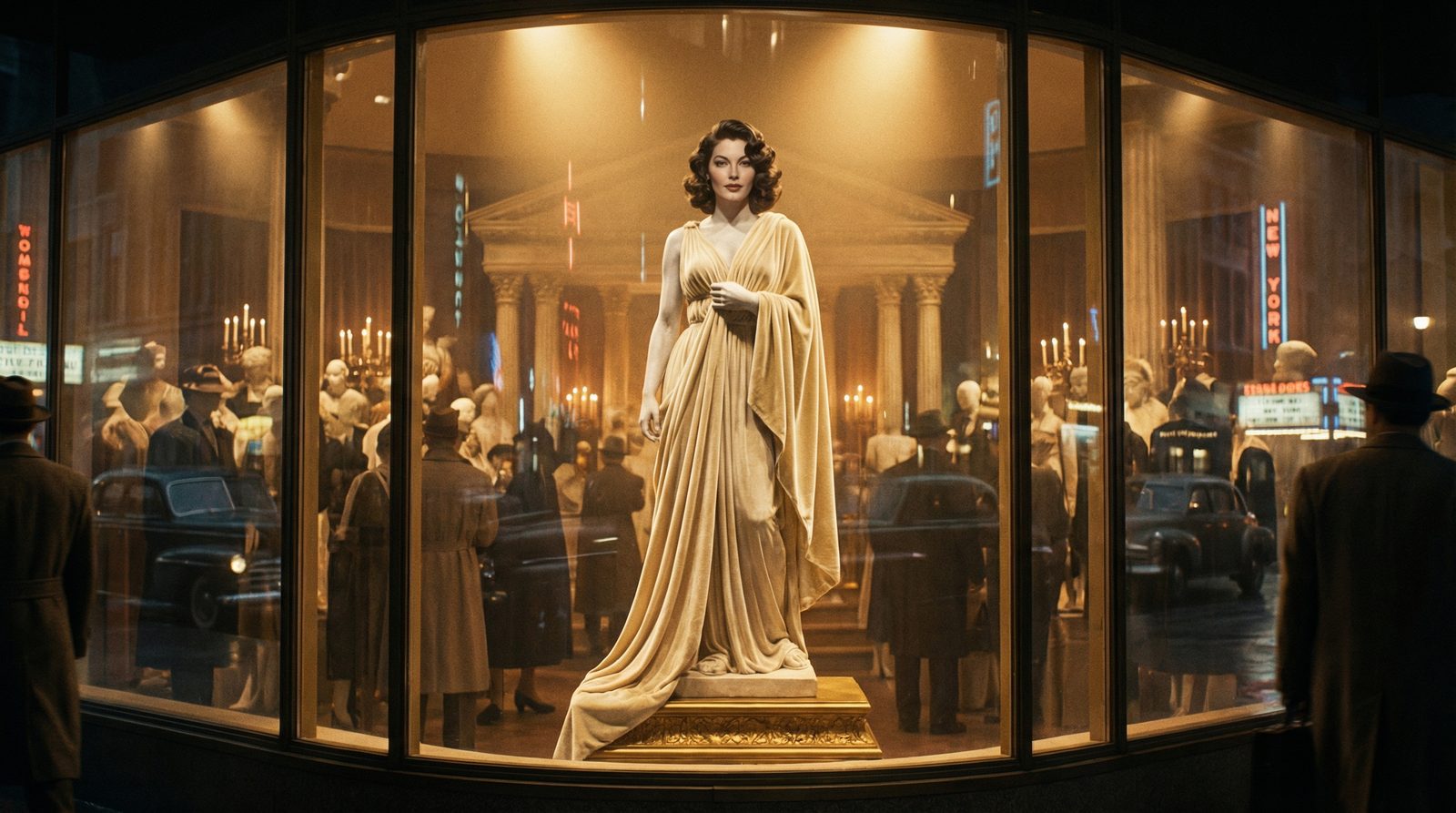
    The plot follows Eddie Hatch, a mild window dresser engaged to a sensible co-worker, Gloria. Asked to prepare a display around a newly acquired statue of Venus, he impulsively kisses the marble lips. This act awakens the goddess, who steps down from her pedestal and into his life. What follows is a supernatural romance built on a reverse-Pygmalion logic: the “ideal” tries to reshape the ordinary man into someone bolder and more honest.

    Complications pile up. The statue appears to have been stolen, Eddie is suspected, and his engagement begins to crumble as Venus shadows him through the city. The film keeps testing fantasy versus security. Venus represents the intoxicating promise of living fully in the moment, while the store and Eddie’s engagement represent routine, approval, and the comfort of predictability. The story repeatedly asks whether the true miracle is the goddess herself or the courage she provokes in a man who has accepted too small a life.

    Beneath the farce, there is a gentle critique of consumer culture. The store treats Venus as a luxury object, while the film insists she is a disruptive force that refuses to stay in a case. The recurring motif of statues and mannequins implies that most people are already half-petrified by habit. Venus’s presence is less about conquest than about waking Eddie up.

    CINEMATIC TECHNIQUE & AESTHETICS

    One Touch Of Venus is built on Classical Hollywood craft: continuity editing, unfussy camera work, and staging that prioritizes timing and performance. Venus is frequently framed in medium shots that allow stillness and gaze to carry the supernatural charge. When she first awakens, soft focus and careful lighting give her a dreamlike halo without resorting to heavy spectacle.

    The department store interiors are staged almost theatrically, with corridors of merchandise and mirrored surfaces that support a secondary motif of reflection. Eddie is repeatedly framed between Venus and Gloria, turning blocking into a visual diagram of divided loyalties. Musical numbers are integrated as emotional punctuation rather than set-piece spectacle.

    Special effects are restrained: match cuts, dissolves, and modest tricks that let performance do the heavy lifting. The magical elements feel intimate and psychological because the film doesn’t insist on “proving” them. It asks the viewer to accept the miracle as a change in emotional temperature, not a technical event.
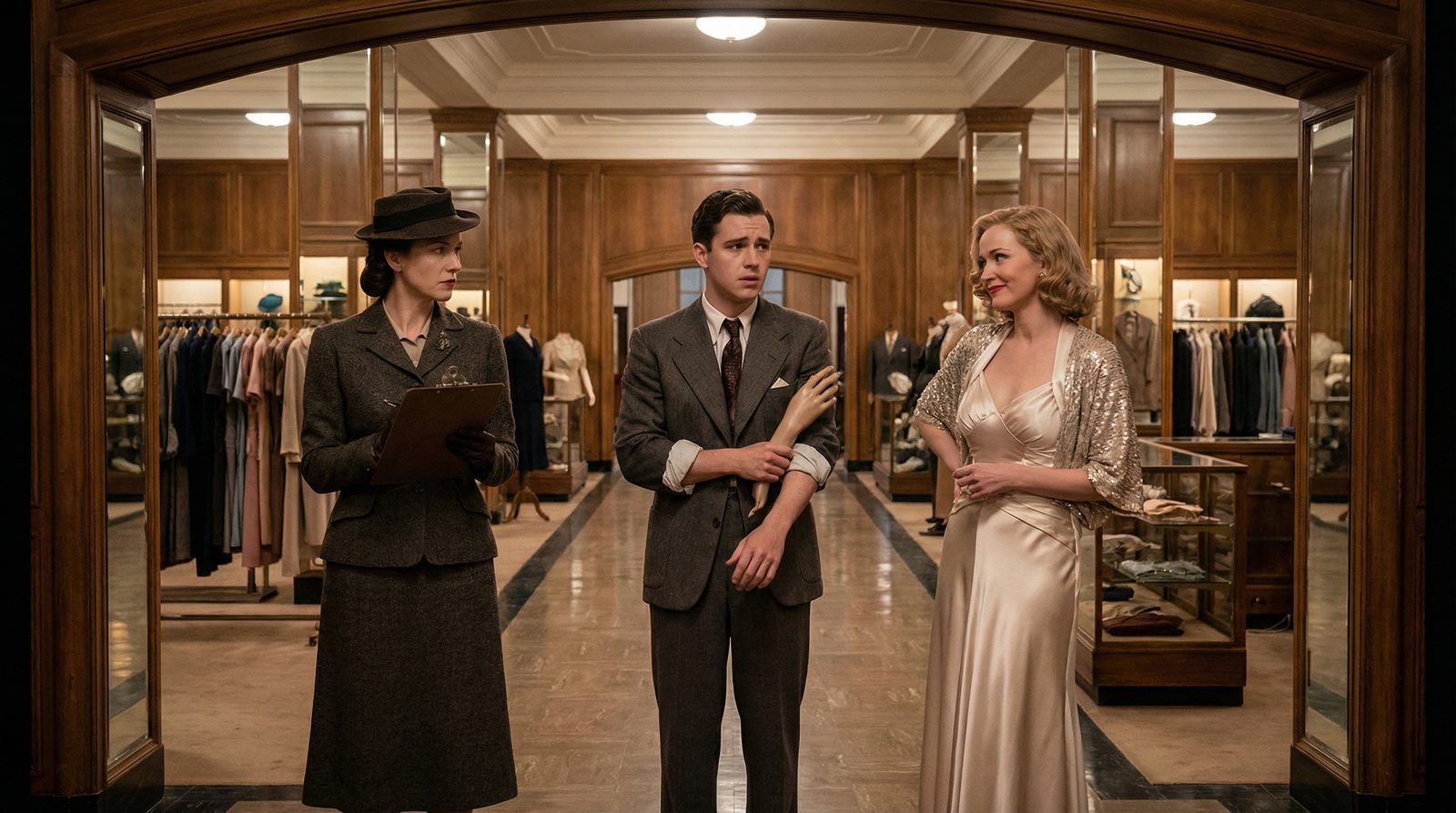
    Editorial illustration inspired by 'One Touch Of Venus (1948)'

    CHARACTERS & PERFORMANCE

    Venus functions as a trickster mentor. She is not a nurturing guide so much as a teasing provocateur who disrupts Eddie’s self-image and forces choice. Ava Gardner plays her with languor and sly amusement, letting flickers of loneliness show through so immortality feels like both power and boredom.

    Eddie is an Everyman: timid, earnest, and quietly resigned. His arc is not heroic conquest but movement from passivity toward agency. Gloria fills the role of sensible stability; the film is not always fair to her, but she is written as a real person rather than a pure obstacle. The supporting cast provides a chorus of social pressure, which makes Venus’s freedom look even more radical.

    CONTEXT & LEGACY

    Adapted from the 1943 Broadway musical, One Touch Of Venus arrived at the tail end of the 1940s when Hollywood romantic fantasy offered audiences gentle escape from postwar reality. It belongs to a small cycle of films where supernatural visitors drift into urban professional life and quietly expose domestic complacency.

    Its legacy is modest but persistent. The image of a literal ideal stepping off a pedestal has lingered, and later retail-based fantasies echo its logic. Today the film reads as both a charming romantic time capsule and a window into mid-century fantasies about gender, desire, and the costs of “settling.”

    IS IT WORTH WATCHING?

    If you want light, urbane romantic fantasy with classical studio-era craft, One Touch Of Venus is worth watching. The stakes stay low and the darker implications of mortal/goddess romance are mostly sidestepped, but Ava Gardner’s performance and the film’s gentle wit make it an easy, charming experience.

    If you’re looking for a more emotionally intense or philosophically probing myth story, it may feel too airy. The pleasure here is in timing, tone, and the small sting of realizing how quickly comfort can become petrification.

    Symbolic illustration inspired by 'One Touch Of Venus (1948)'

    TRIVIA & PRODUCTION NOTES

    The film is based on the 1943 Broadway musical One Touch Of Venus, with music by Kurt Weill. The adaptation trims and reshapes much of the score, shifting emphasis toward dialogue and situational comedy. The department store setting is staged as both a temple of consumption and a playground for a bored goddess.

    The statue-to-human illusion is achieved mostly through classical studio-era craft: match cuts, dissolves, careful lighting, and performance rather than heavy effects. The short runtime keeps the farce brisk, even when the myth logic is deliberately light.

    SIMILAR FILMS

    If One Touch Of Venus appeals to you, look for other romantic fantasies where an extraordinary figure interrupts domestic routine and forces a choice between safety and aliveness. These films tend to treat magic as emotional pressure rather than spectacle.

    DISCOVERABILITY & LINKS

  • Mannequin (1987)

    Mannequin (1987)

    Mannequin (1987) directed by Michael Gottlieb. Comedy · 89 minutes · United States of America. Released February 13, 1987.


    INTRODUCTION

    Mannequin (1987) is a featherlight 1980s comedy that treats a Philadelphia department store as a fairy-tale kingdom hiding in plain sight. The premise is unabashedly absurd: a struggling artist falls in love with a mannequin who comes to life only for him. The film leans into a fizzy romantic feel, with synth-pop, soft focus, and neon reflections doing as much work as the script.

    What keeps it from floating away entirely is a sincere belief in creativity, love, and the dignity of low-stakes work. Jonathan is a misfit who can’t survive the grind of 1980s capitalism until he finds a place where imagination is treated as useful labor. The result is a retail fantasy that is shamelessly cheesy and oddly tender.

    PLOT & THEMES

    Andrew McCarthy plays Jonathan Switcher, a young sculptor whose perfectionism keeps getting him fired from menial jobs. His one triumph is a mannequin he designs, which later appears at the struggling department store Prince & Company. When the mannequin—inhabited by the spirit of Emmy—comes to life for him alone, Jonathan stumbles into a secret romance and a new career as a window dresser. The core is a Pygmalion fantasy: the artist rewarded when his creation becomes real.

    The story is also a makeover narrative, except the subject is a failing business. Emmy and Jonathan’s elaborate window displays transform Prince & Company into a buzzing 1980s dreamspace. Under the slapstick, the film carries a mild critique of corporate logic: Jonathan’s artistry is only “validated” once it boosts sales, and Emmy’s daylight restriction makes love itself conditional on hiding from the practical world.

    The workplace becomes a family enclave. Misfit employees defend their shared space against corporate raiders, and the movie treats retail labor as something that can still contain dignity when it’s fueled by care, craft, and community rather than fear. That is the film’s soft-hearted trick: it turns fluorescent capitalism into an arena where magic can briefly win.

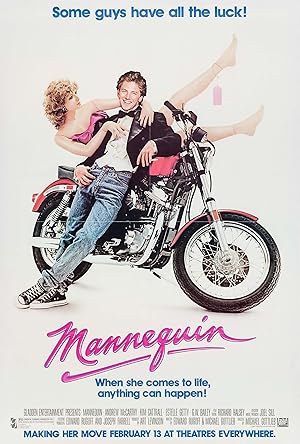
    Official poster for 'Mannequin (1987)'

    CINEMATIC TECHNIQUE & AESTHETICS

    The film’s most reliable tool is the 1980s montage. Jonathan and Emmy’s after-hours escapades unfold in music-driven sequences that feel closer to MTV than classical Hollywood. The famous “Nothing’s Gonna Stop Us Now” montage compresses an entire corporate turnaround into pop anthem logic: if the windows look magical, the world becomes magical.

    Lighting and production design build a clean binary between dead daytime retail and enchanted night. Fluorescent overheads flatten everything during business hours, while the store glows after dark with saturated pinks, blues, and golds that keep the romance buoyant. The camera remains straightforward, but loosens when Emmy is alive, treating the store like a stage for costume changes and physical comedy.

    The transformation effect is charmingly low-tech: match-cuts, practical posing, and simple tricks that ask the audience to play along. That handmade quality is part of the film’s appeal. It never tries to convince you the magic is “real.” It tries to convince you it is worth believing in for 89 minutes.

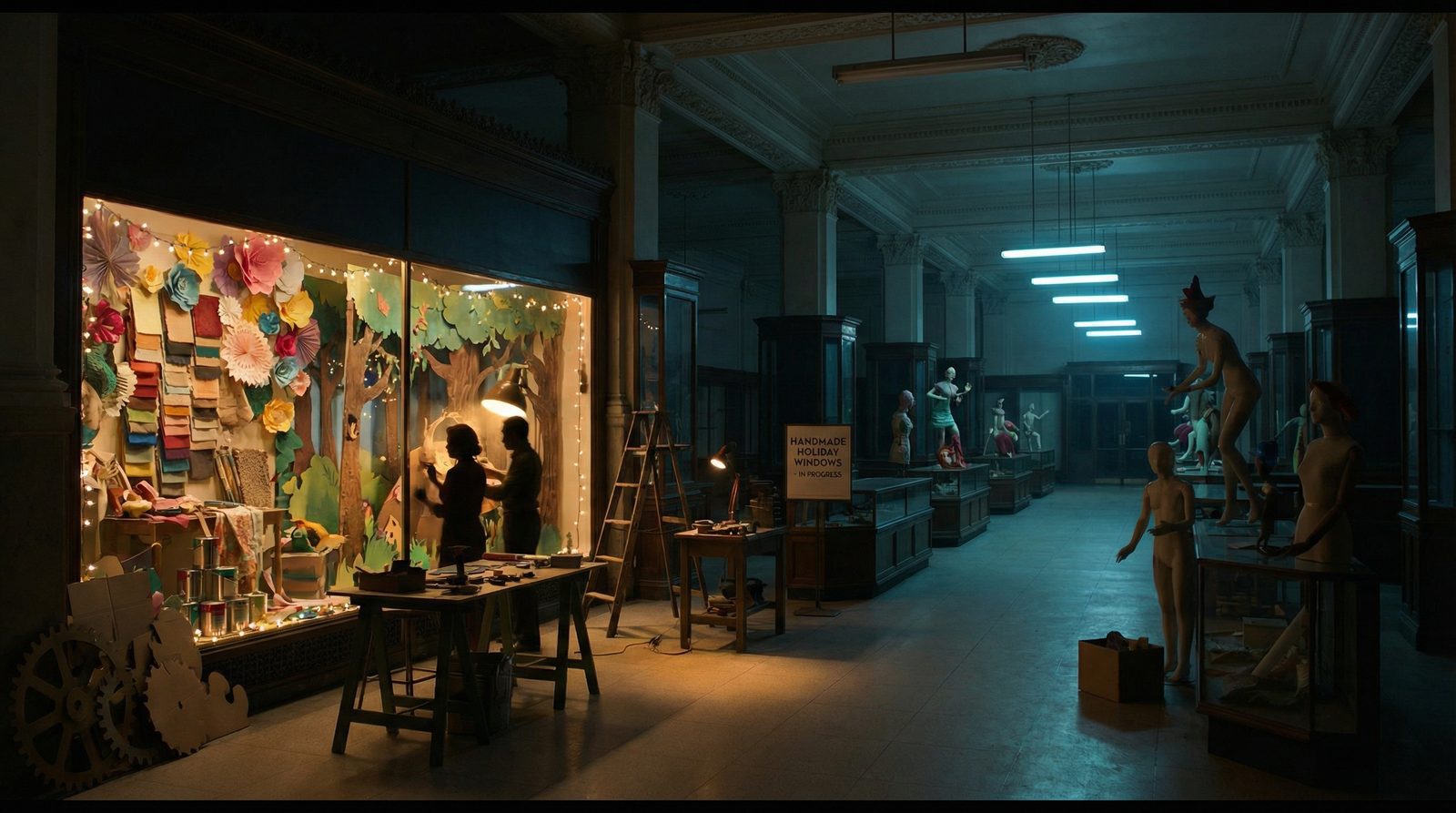
    Editorial illustration inspired by 'Mannequin (1987)'

    CHARACTERS & PERFORMANCE

    Jonathan Switcher is a gentle dreamer archetype. Andrew McCarthy plays him with boyish sincerity; he’s more convincing as a sweet misfit than as a tormented artist. Kim Cattrall’s Emmy provides the film’s spark. She plays the fish-out-of-water variation with physical delight, helping the Pygmalion premise feel less like obsession and more like mutual awakening.

    The most vivid presence is Hollywood Montrose, played by Meshach Taylor. He functions as a flamboyant mentor and protector of the creative bubble inside the store. The performance is broad and rooted in stereotype, but also genuinely warm, which makes Hollywood the emotional center of the workplace family. On the antagonist side, corporate climbers and buffoonish security exist mainly to keep the fairy-tale logic simple: joyless adults threaten the kingdom, so imagination must defend it.

    CONTEXT & LEGACY

    Released in 1987, Mannequin arrived during a wave of 1980s high-concept fantasies that fused romance, consumer culture, and gentle magical disruption. Critics were largely hostile, but audiences responded to its retail fantasy and its sincerity about creativity as salvation. The soundtrack, especially Starship’s “Nothing’s Gonna Stop Us Now,” became more culturally durable than the narrative itself.

    Over time, the film has settled into cult status as an 80s time capsule. Its gender roles and queer coding feel dated, yet Hollywood Montrose has also been reclaimed by some viewers as an early (if imperfect) example of a visibly queer-coded figure in mainstream comedy. The legacy is less about artistic innovation and more about mood: a bright, artificial dream of work, love, and store-window magic.

    IS IT WORTH WATCHING?

    It depends on your tolerance for 1980s cheese and your appetite for high-concept romance. As a narrative, it’s flimsy and often clumsy, with jokes that miss and attitudes that have aged unevenly. As a feel, it’s oddly winning. If you like glossy 80s fantasies and don’t mind a premise that runs on pure charm, it’s a sometimes-charming watch. If you want grounded character realism, the mannequin romance will likely leave you cold.

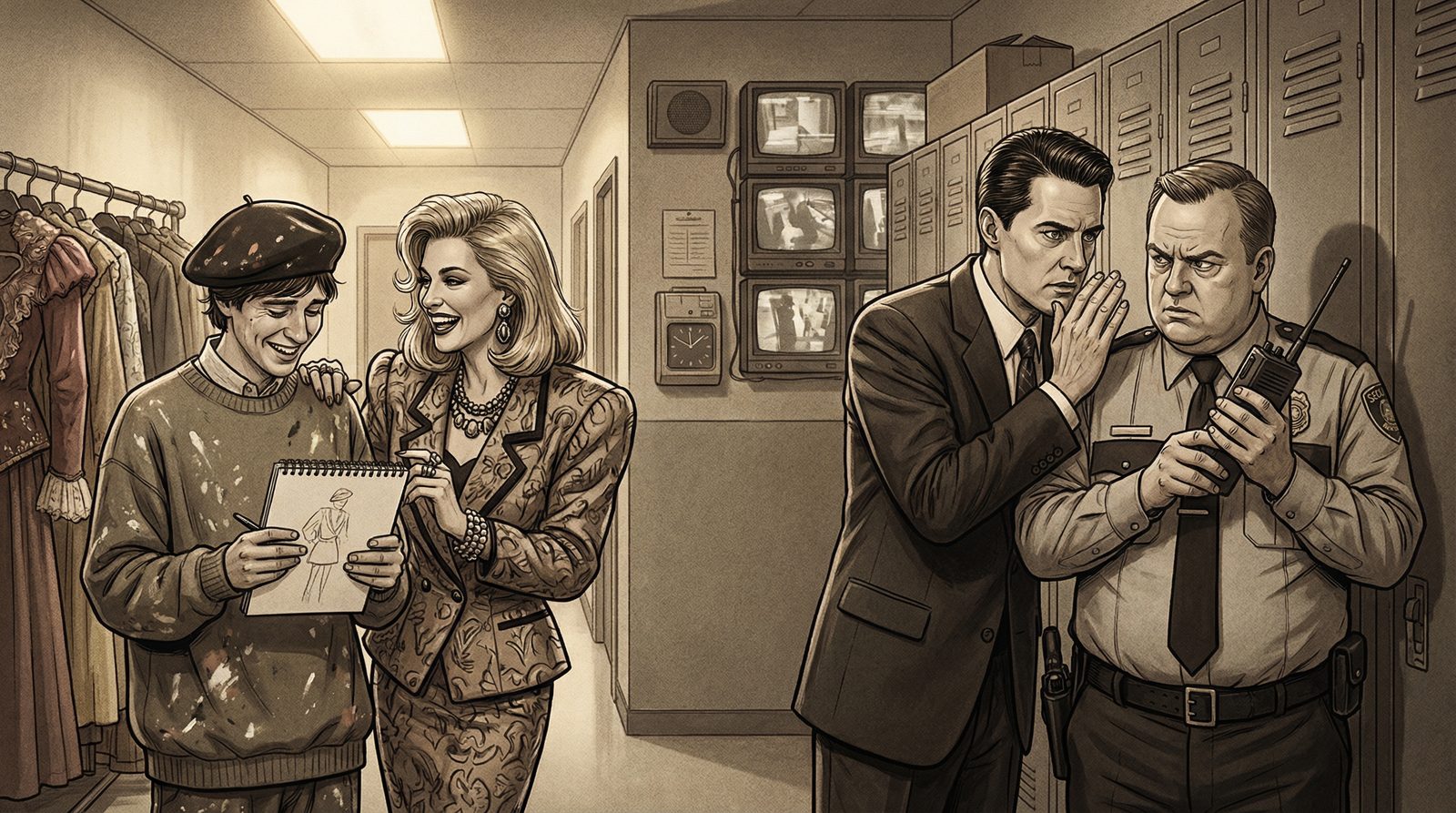
    Symbolic illustration inspired by 'Mannequin (1987)'

    TRIVIA & PRODUCTION NOTES

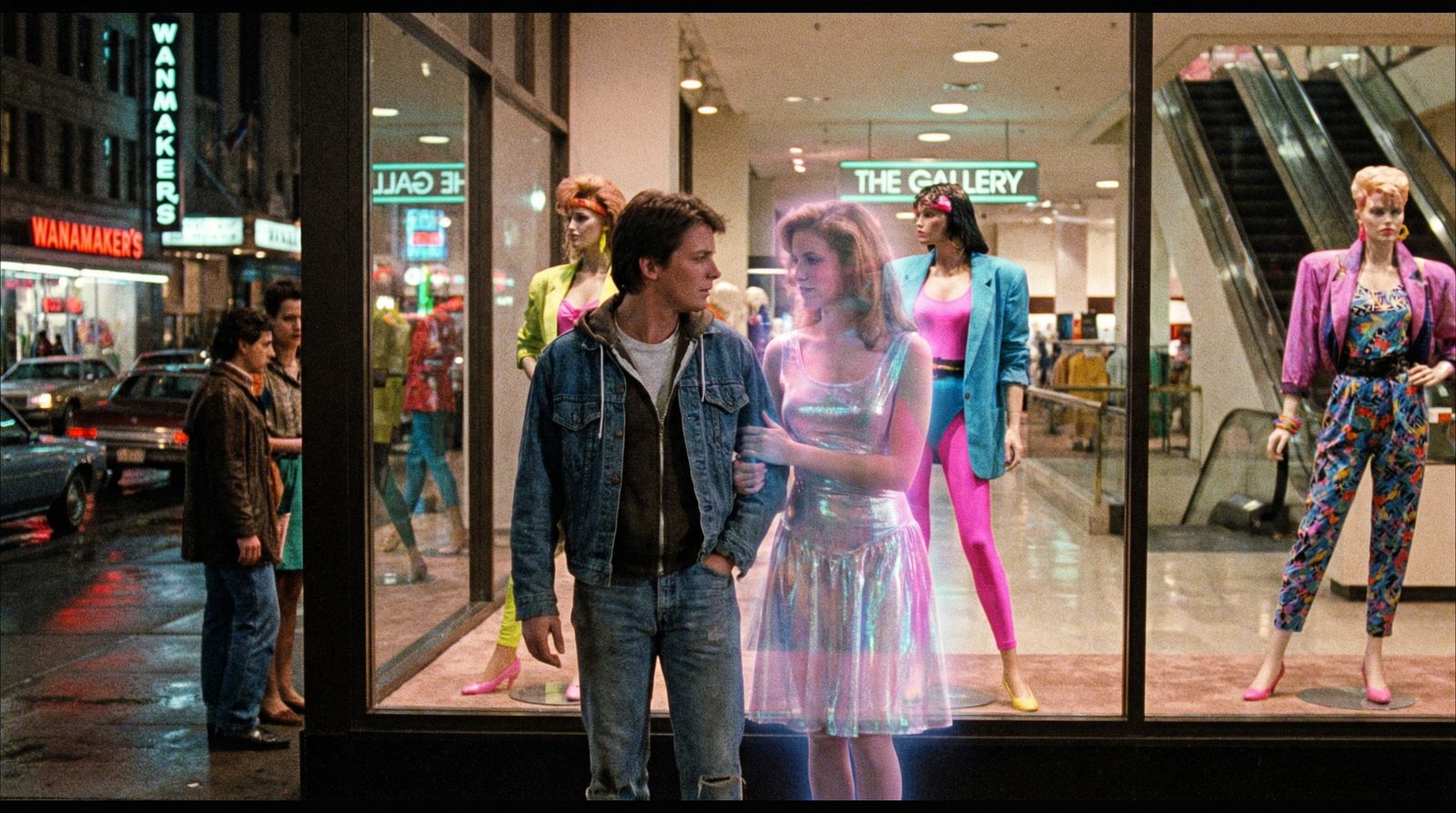
    Mannequin was shot largely on location in Philadelphia, with exteriors and many interiors filmed at Wanamaker’s, which adds authenticity to its retail fantasy. The production relied on full-body mannequins, performance posing, and practical editing tricks to sell the transformation. Meshach Taylor’s presence as Hollywood Montrose became one of the film’s most memorable elements, shaping the tone of the store-as-family dynamic.

    The film’s modest box office success was amplified by its soundtrack. Starship’s “Nothing’s Gonna Stop Us Now” became a major hit and helped cement the movie’s place in 1980s pop culture. A sequel followed, recycling the premise with a new cast and setting, which testifies to the durable appeal of department-store magic even when the concept is thin.

    SIMILAR FILMS

    If Mannequin’s retail fantasy and romantic absurdity appeals to you, seek out other high-concept comedies where magic collides with everyday work and consumer life. The best matches tend to share its buoyant tone, its affection for misfits, and its willingness to treat commerce as a stage for invention.

    DISCOVERABILITY & LINKS

  • Easy Rider (2012)

    Easy Rider (2012)

    Easy Rider (2012) directed by James Benning. Experimental · 97 minutes · United States.


    INTRODUCTION

    James Benning’s Easy Rider (2012) is not a remake so much as a séance. He revisits locations associated with Dennis Hopper’s 1969 Easy Rider, strips away the bikers, the drugs, the road-movie chatter, and leaves only landscapes and ambient sound. The result feels patient, haunted, and quietly confrontational. Where the original surfed countercultural velocity, Benning lingers on what remains after the dream drains away.

    The film sits somewhere between gallery installation and cinema, asking viewers to meet it halfway and supply memory as context. If Hopper’s film was about forward motion, this one is about staying put and listening. The American West appears as both a physical place and a faded idea. It becomes a road movie without a road, an anti-spectacle about looking, duration, and the afterlife of myth.

    PLOT & THEMES

    There is almost no plot in Easy Rider (2012). The “story” is a sequence of fixed shots filmed at or near locations connected to the 1969 film’s itinerary. Where Hopper followed charismatic outsiders on a doomed cross-country trip, Benning removes character and incident but keeps the route as an invisible skeleton. The narrative becomes whatever the viewer remembers, projects, or resists.

    The core themes are memory, the American Dream, and the erosion of counterculture. By revisiting these sites decades later, Benning invites us to measure the distance between a 1960s fantasy of freedom and a present shaped by highways, strip malls, and fenced-off land. The “open road” is no longer pure symbol. It’s infrastructure, habit, and noise.

    Another strong motif is ghostly absence. Benning never shows the 1969 Easy Rider directly, yet its ghosts hover over every frame. The film functions like a palimpsest: we see the present landscape while mentally overlaying earlier scenes and cultural memory. The mood is meditative rather than nostalgic, with a faint ache underneath the calm surfaces. It’s less about rebellion than about what rebellion leaves behind.

    CINEMATIC TECHNIQUE & AESTHETICS

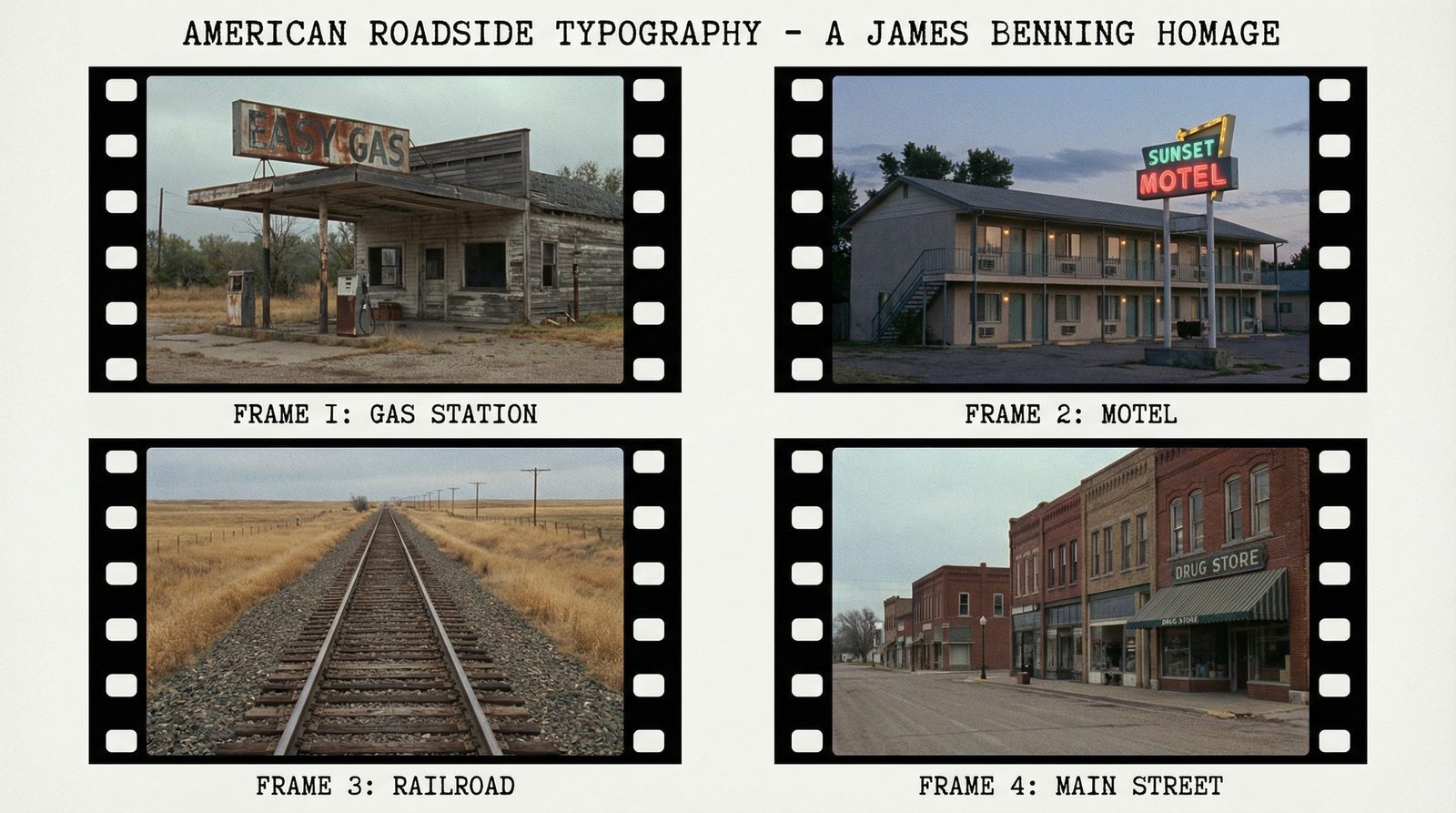
    Formally, Easy Rider (2012) is built from long takes and static framing. Each location is held for an extended duration with the camera locked off. This durational approach forces a different rhythm of attention. Instead of cutting to guide the viewer, Benning lets small details emerge over time: a shift in light, a passing car, wind in scrub, or the slow realization that “nothing happening” is the point.

    Benning’s static compositions are deceptively simple. Roads bisect frames, power lines draw grids, and horizons settle into a mathematical calm. The lack of camera movement creates a contemplative feel, encouraging the viewer to scan the image and notice texture. The film is rigorous about place: the image does not exist to serve narrative; narrative is something the viewer manufactures while looking.

    Sound design is crucial. Ambient sound replaces dialogue and score. We hear engines, birds, distant traffic, sometimes a near-oppressive quiet. This observational soundscape anchors images in real time and refuses romanticization. Benning’s refusal of conventional coverage—no close-ups, no reverse shots, no explanatory montage—underscores his interest in duration and environment rather than character psychology.

    Editorial illustration inspired by 'Easy Rider (2012)'

    CHARACTERS & PERFORMANCE

    There are no conventional characters in Easy Rider (2012). The landscapes take on the role of a kind of landscape-as-character presence: gas stations, highways, rural fields, small-town streets. In the absence of actors, the viewer projects personality and history onto space. The film banks on cultural memory of road mythology to fill in the blanks.

    When humans appear, they are incidental. They are not framed as protagonists or even supporting players, only as elements of the environment moving through public space. The “performance” happens in the viewer’s mind, in the act of remembering and in noticing the gap between then and now. The film’s emotional temperature depends on how strongly you feel that gap.

    CONTEXT & LEGACY

    Easy Rider (2012) sits within James Benning’s long project of filming American landscapes with forensic patience. It also participates in a broader current of experimental re-visitation, where cinema interrogates its own myths by returning to places rather than re-staging scenes. Benning’s choice of Easy Rider as a source text is telling: the 1969 film crystallized a dream of American freedom tied to mobility and rebellion. Benning returns to the locations decades later to measure what that dream looks like as infrastructure.

    The film’s legacy is mostly art-house and academic rather than mainstream. It functions as a reference point in discussions of landscape cinema, structural film, and the afterlife of counterculture. Its radical gesture is simple: record a place long enough that the viewer can no longer pretend it’s just a background.

    IS IT WORTH WATCHING?

    Whether Easy Rider (2012) is worth your time depends on your tolerance for minimalism. If you come expecting narrative propulsion and soundtrack-driven momentum, this will feel austere, even alienating. There is almost no dialogue, no character arc, and no conventional story payoff.

    If you are interested in experimental film, landscape studies, or the way cinema remembers and erases, it can be quietly rewarding. The film offers a sustained opportunity to think about attention: what happens when a movie refuses to entertain you into meaning and instead asks you to construct it.

    Symbolic illustration inspired by 'Easy Rider (2012)'

    TRIVIA & PRODUCTION NOTES

    Benning is known for meticulous preparation, and Easy Rider (2012) fits that pattern. He tracked down locations tied to the earlier film and revisited them with a stripped-down production method designed to preserve real light and real time. What would be a throwaway establishing shot in another movie becomes an entire scene here.

    The film’s structure is shaped by durational choices rather than plot beats. Weather, light, and incidental human movement become the “action.” The approach links this film to Benning’s broader landscape work, where the drama is not who wins or dies, but what remains visible when you stop rushing.

    SIMILAR FILMS

    If Easy Rider (2012) works for you, you may enjoy other films built around duration, place, and the viewer’s attention rather than narrative closure. Pairing this film with the 1969 Easy Rider also makes a potent double feature: one riding through the myth of the American West, the other sitting with its lingering traces.

    DISCOVERABILITY & LINKS

  • The Motorcycle Diaries (2004)

    The Motorcycle Diaries (2004)

    The Motorcycle Diaries (2004), directed by Walter Salles. Road Movie · 126 minutes · Argentina / Brazil / Chile / Peru / United States.


    INTRODUCTION

    The Motorcycle Diaries is a Road Movie that feels quietly revolutionary in its modesty. Rather than racing through the milestones of a famous life, it lingers on formative moments before myth hardens into ideology. Walter Salles follows a 23-year-old Ernesto Guevara in 1952, long before he becomes “Che,” tracing a journey across South America that reshapes his sense of responsibility and belonging.

    The film belongs to the coming-of-age tradition, but the coming-of-age is political as much as personal. By the time the credits roll, nothing “historic” has happened in conventional biopic terms. Yet everything has shifted internally. The mood is contemplative, melancholic, and grounded in physical travel rather than rhetoric.

    PLOT & THEMES

    The story follows Ernesto Guevara, a middle-class Argentine medical student, and his friend Alberto Granado as they set off on a ramshackle motorcycle trip across South America. What begins as youthful adventure quickly becomes a lesson in limits. The motorcycle breaks down, money disappears, and the pair are forced into closer contact with people living far outside their social bubble.

    As they travel through Argentina, Chile, and Peru, the tone shifts from comic misadventure to moral confrontation. Encounters with exploited miners, Indigenous communities, and patients at a leper colony expose Ernesto to structural injustice he cannot ignore. Travel becomes transformation, not through spectacle but through accumulation: each border crossed introduces a new ethical tension.

    Illness and bodies play a central role. Ernesto’s asthma and his medical training keep politics anchored in physical vulnerability. Inequality is not discussed abstractly; it is breathed, touched, and treated. The film resists cathartic conversion scenes, favoring gradual awakening. By the river crossing at the leper colony, Ernesto’s decision to swim across becomes a physical declaration of solidarity rather than a speech.

    CINEMATIC TECHNIQUE & AESTHETICS

    Walter Salles relies on naturalistic lighting and extensive location shooting to ground the film in lived geography rather than postcard imagery. Landscapes dwarf the protagonists, reinforcing humility and disorientation. Long takes allow discomfort to settle, particularly during encounters with marginalized communities.

    Handheld camera work during travel sequences gives the journey a tactile instability. The bike rattles, the frame shudders, and progress feels provisional. By contrast, scenes at the leper colony use steadier compositions and visual symmetry, as if the film itself slows down to observe rather than roam.

    Sound design favors ambient noise — engines, wind, water — with Gustavo Santaolalla’s score entering quietly, like memory rather than commentary. Voiceover drawn from Guevara’s diary is used sparingly and often complicates what we see. The final montage of faces anchors the film’s politics in lived human presence rather than ideology.

    Editorial illustration inspired by 'The Motorcycle Diaries (2004)'

    CHARACTERS & PERFORMANCE

    Gael García Bernal plays Ernesto as a restrained Idealist rather than a charismatic firebrand. He is awkward, asthmatic, observant — more listener than speaker. Bernal emphasizes hesitation and internal pressure, letting the awakening register through silence and posture rather than declarations.

    Rodrigo de la Serna’s Alberto Granado provides contrast as a Trickster figure: charming, opportunistic, and emotionally open. Their dynamic balances gravity with warmth. Friendship becomes the film’s emotional vehicle for political realization.

    Supporting characters appear briefly but leave lasting impressions. They function less as individualized arcs and more as lived evidence of inequality. The restrained performances avoid sentimentality, keeping the film from drifting into didacticism.

    CONTEXT & LEGACY

    Released in the early 2000s, The Motorcycle Diaries arrived when Che Guevara’s image had become globally commodified. By focusing on his pre-revolutionary years, the film sidesteps later controversies and instead explores the formation of conscience. Its legacy lies not in political instruction but in showing how empathy precedes ideology.

    Within Latin American cinema, it stands as a key example of the socially conscious Road Movie, using movement to expose class and racial divides. Internationally, it remains a touchstone for films that treat political awakening as a slow, embodied process rather than a single decisive moment.

    IS IT WORTH WATCHING?

    Yes — especially if you prefer character-driven journeys over conventional biopics. The film rewards patience, attention, and openness. It is less interested in answers than in formation.

    Viewers expecting a full account of Che Guevara’s later politics may find it incomplete. As a portrait of an inner shift — from individual adventure to continental awareness — it remains quietly powerful.

  • Don Miguel Ruiz

    Don Miguel Ruiz

    ORIGINS & BACKGROUND

    Don Miguel Ruiz is best known as a Mexican-born spiritual teacher who brought elements of Toltec philosophy into the mainstream of English-language self-help. Trained first in Western medicine as a surgeon, he later turned toward questions of consciousness, suffering, and meaning after a personal turning point. That mix of scientific training and mystical curiosity sits in the background of his books, which read like clear, almost clinical manuals while still relying on myth, metaphor, and symbolic story.

    Rather than presenting himself as a distant guru, Ruiz writes as a guide who assumes the reader is dealing with the same traps: self-judgment, people-pleasing, fear, and the exhausting attempt to control how others see you. His use of Toltec wisdom is less about historical reconstruction and more about applying an indigenous philosophical lens to modern problems of identity and success. Readers who arrive through The Four Agreements often find a bridge between familiar Western self-help and a more symbolic way of thinking about the mind.

    In the larger landscape of spiritual writing, Ruiz fits alongside figures like Dan Millman, who also translate inner change into repeatable practice. Where some contemporaries lean heavily on visionary experience, Ruiz keeps returning to commitments that can be tested in daily life. That focus on lived practice, rather than metaphysical speculation, is central to how his background informs his work.

    Editorial illustration inspired by 'Don Miguel Ruiz'

    THEMES & MOTIFS

    The core of Ruiz’s work is the idea that personal freedom depends on the stories you agree to believe. He argues that much suffering is not caused by external events, but by unconscious agreements formed through family expectation, cultural pressure, and harsh internal language. The Four Agreements compresses this worldview into four repeatable commitments:

    • Be impeccable with your word.
    • Don’t take anything personally.
    • Don’t make assumptions.
    • Always do your best.

    Closely tied to this is the motif of inner dialogue. Ruiz describes the mind as crowded with voices, judgments, and stories, sometimes framed as “mitote,” an inner fog that blurs perception. The agreements are tools for clearing that fog. By changing how language is used in thought and speech, he suggests that inner dialogue can shift from a constant courtroom of self-judgment into something calmer, more honest, and more workable.

    Another recurring theme is spiritual simplicity. Ruiz takes large spiritual questions and reduces them to practices that can be remembered and repeated. The Fifth Agreement extends the framework with a further principle:

    • Be skeptical, but learn to listen.

    This addition deepens his exploration of perception and belief, inviting readers to question inherited narratives without closing themselves off to wisdom. The simplicity here is functional rather than shallow: Ruiz strips away ornament until only what can be lived remains.

    Comparisons are often made between The Four Agreements and a modern parable like The Alchemist. Both invite readers to see life as a journey of awakening, guided by attention and inner knowing. The difference is emphasis. Ruiz is less interested in outward adventure and more in the daily work of changing agreements—what you say, what you assume, and what you rehearse inside your own mind.

    Symbolic illustration inspired by 'Don Miguel Ruiz'

    STYLE & VOICE

    Ruiz writes in a calm, unhurried tone that feels more like a conversation than a lecture. His style is direct and stripped down, favoring short chapters and declarative sentences. The prose embodies the same principle he teaches: remove the noise until the practice is usable.

    Structurally, his books move between explanation, parable, and instruction. A concept is introduced, illustrated through story or Toltec framing, and then anchored in a concrete practice a reader can test immediately. Readers who like spiritually oriented guidance will recognize the steady cadence, but Ruiz is notably concise and disciplined about returning to the same few levers: language, agreement, assumption, and attention.

    Emotionally, his voice balances compassion with firmness. He names the ways people injure themselves through harsh inner dialogue and rigid expectations, but he does so without scolding. The reader is treated as capable of change, and the agreements are offered as tools rather than commandments.

    KEY WORKS & LEGACY

    The Four Agreements (1997) is the book that defines Ruiz for most readers. Its principles have circulated far beyond the book itself, appearing in therapy, recovery communities, coaching, and everyday conversation. That spread is part of his legacy: he compressed a worldview into phrases people actually remember and use, especially under stress.

    The Fifth Agreement (2010), written with his son Don Jose Ruiz, extends the framework by adding skepticism and discernment. Together, these books reinforce Ruiz’s core claim that freedom is largely linguistic: if you can change what you agree to believe, you can change what you experience as possible.

    Placed alongside spiritual storytellers like Dan Millman, Ruiz occupies a distinct niche. He offers fewer dramatic narratives and more focused practices. His influence shows up in the way people use the agreements as shorthand for healthier boundaries, cleaner communication, and a less punitive relationship with the self.

  • Dan Millman

    Dan Millman

    ORIGINS & BACKGROUND

    Dan Millman is best known as the author of Way Of The Peaceful Warrior (1980), a hybrid of memoir and spiritual fable that turns competitive athletics into a story about inner transformation. Before he became a spiritual teacher on the page, he was an elite athlete and coach, and that history quietly shapes everything he writes. Millman’s spirituality stays close to the body and to routine: the daily grind of training, work, and relationships rather than abstract cosmology.

    Rather than building a dense philosophical system, Millman uses crisis as an entry point into questions of purpose and identity. A sudden rupture—especially Awakening Through Physical Injury—forces the character to confront what achievement has been propping up. In his core myth, the injury is not treated as random tragedy but as a forced stop that exposes the cost of ambition and the fragility of the self built around performance.

    Millman writes for readers who feel split between outer success and inner restlessness. His work sits on the same shelf as spiritual adventure narratives like The Celestine Prophecy and The Alchemist, but his sensibility is more gym-floor than mystical. Meaning arrives through repetition, fatigue, fear, and the small negotiations that happen when the body is pushed to its edge.

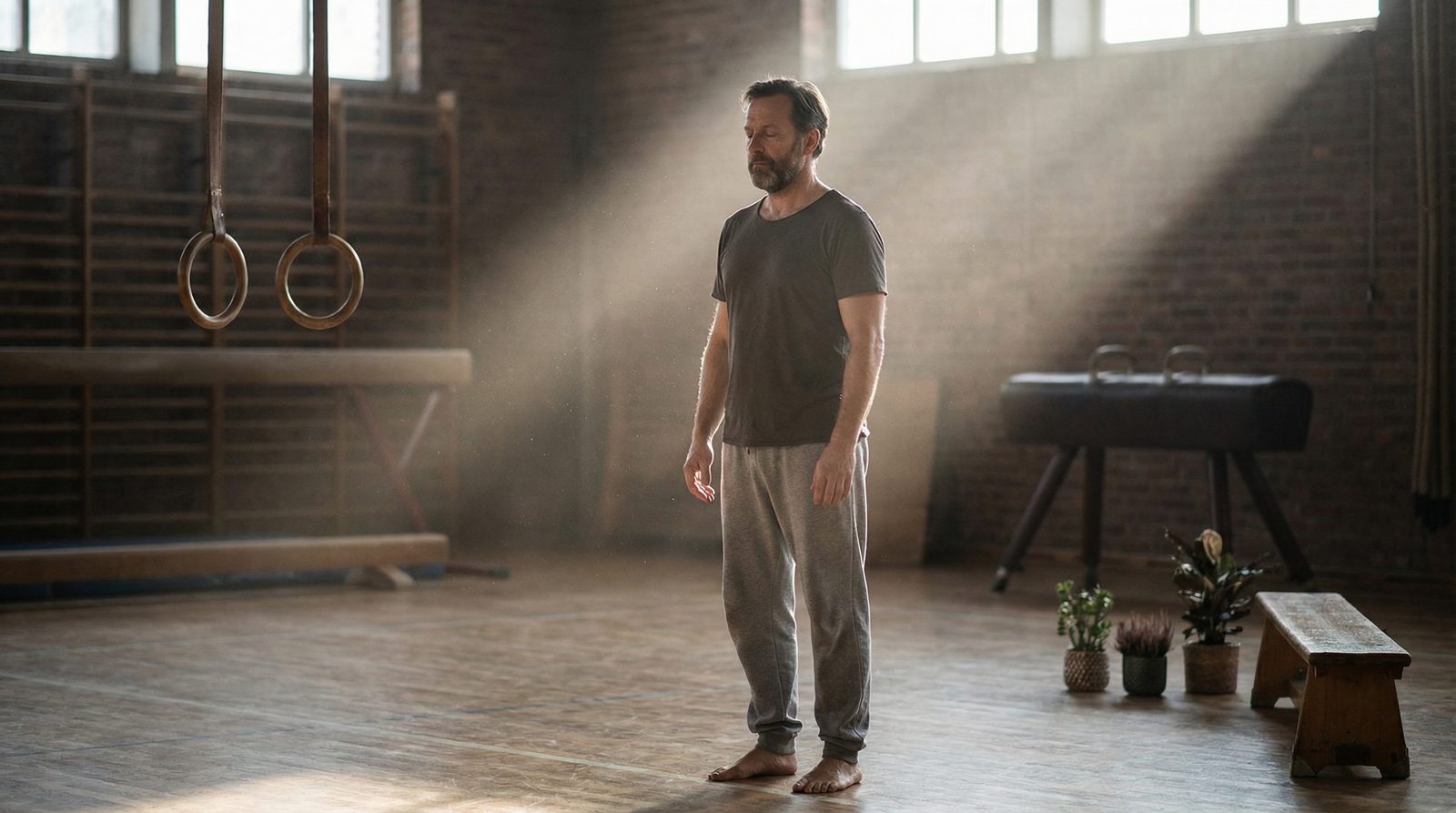
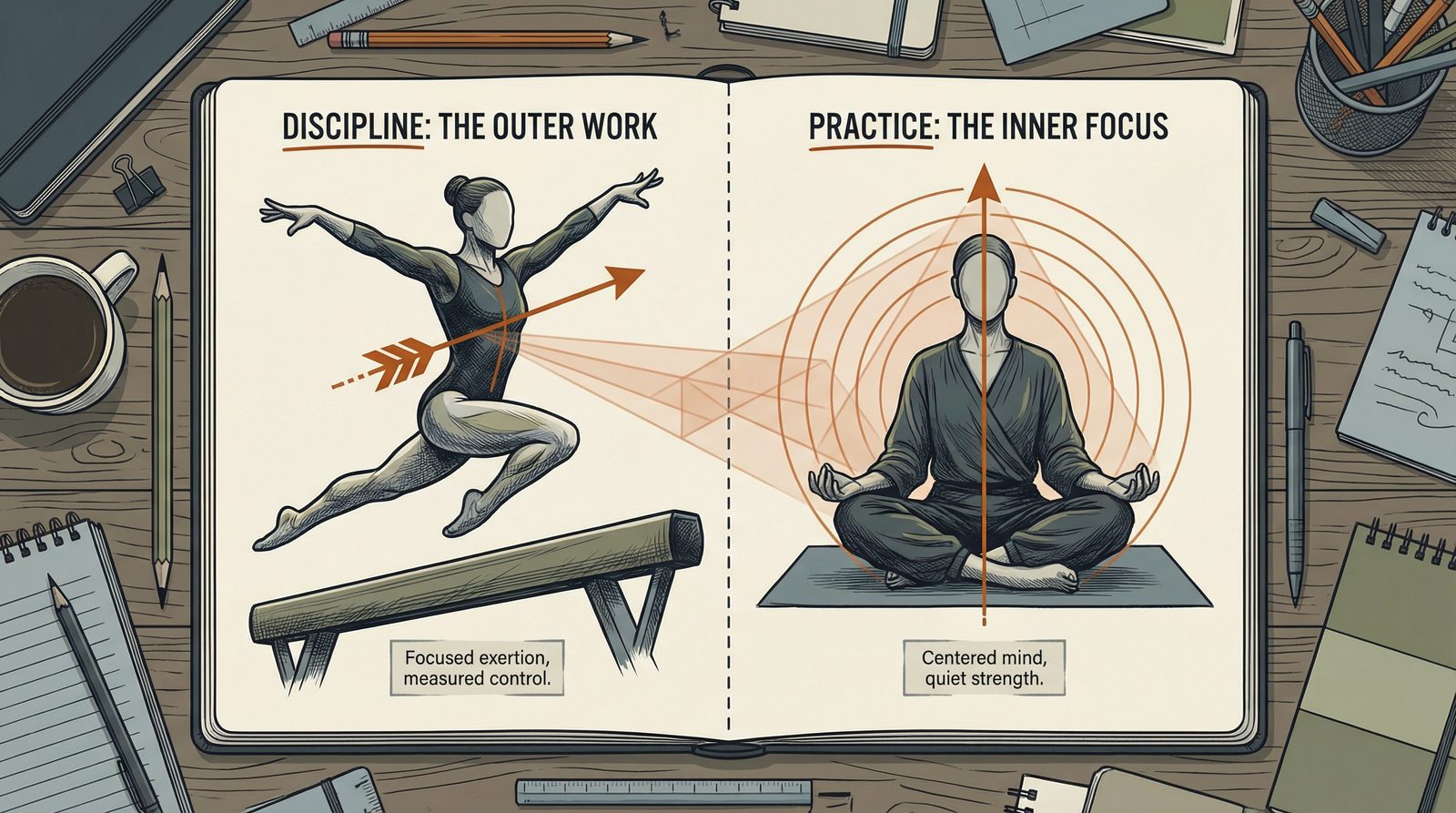
    The crucial fact about Millman’s background is that he began as an athlete, not as a theorist. High-level gymnastics and coaching gave him an intimate understanding of technical repetition and mental pressure, and that becomes the engine of his storytelling. His signature idea—Athletic Discipline As Spiritual Practice—grows directly out of hours spent in training environments where a minor adjustment can mean the difference between control and a fall.

    Over time, Millman moved from telling a formative story to articulating broader principles. In The Laws Of Spirit, he distills his worldview into practical guidelines while retaining a coach’s sensibility: break big change into doable steps, keep returning to basics, and treat attention as a discipline rather than a mood.

    Editorial illustration inspired by 'Dan Millman'

    THEMES & MOTIFS

    The most persistent thread in Millman’s work is Athletic Discipline As Spiritual Practice. Training drills, conditioning, and competition are treated as inner work made visible. The gym becomes a kind of dojo where ego, fear, and doubt are confronted as tangibly as sore muscles. The qualities needed to stay with a difficult routine—patience, resilience, presence—become the same qualities needed to stay with a spiritual path.

    Another central motif is Awakening Through Physical Injury. In Millman’s narratives, the body breaking down is rarely the end of the story. Injury strips away familiar identities and exposes how much worth has been tied to performance. The forced pause becomes the space where new questions surface: who are you without your role, your achievements, or your body’s reliability?

    Millman also relies on the wise mentor pattern. In Way Of The Peaceful Warrior, the mentor figure functions as tough-love guidance, using paradox, chores, and blunt honesty to disrupt the protagonist’s certainty. The lessons are less “belief” than practice: attention, humility, and the willingness to stop negotiating with reality.

    Across his work, Millman returns to the tension between ambition and peace, the search for purpose beyond external success, and the need to integrate insight into ordinary schedules. Even when he writes in a more didactic mode, his underlying promise stays consistent: the everyday discipline you already live with can become a doorway into steadier awareness.

    Symbolic illustration inspired by 'Dan Millman'

    STYLE & VOICE

    Millman’s style sits between memoir, parable, and self-help manual. In narrative books like Way Of The Peaceful Warrior, he uses a conversational first-person voice that makes spiritual questions feel like late-night talks in a dorm room or locker room. The tone is direct and unpretentious, often punctured by dry humor from the mentor figure who undercuts the protagonist’s drama with a simple task.

    Structurally, he favors clear episodic scenes. Each episode tends to revolve around a single insight, reinforced by dialogue or a physical challenge. When he shifts into principle-driven writing in The Laws Of Spirit, the voice becomes calmer and more didactic, but retains the same clarity and coaching cadence.

    Emotionally, his work carries steady compassion for people who are striving and exhausted. He writes with familiarity about anxiety, perfectionism, and fear of failure, and he rarely glamorizes transcendence. Moments of insight are usually small and practical, arriving in the middle of practice, injury, or everyday frustration.

    KEY WORKS & LEGACY

    Way Of The Peaceful Warrior is the defining entry point into Millman’s world. It introduces the core pattern of a driven young athlete who meets an unconventional mentor and is forced to reconsider what success means. The book’s enduring appeal lies in how it translates spiritual ideas into the concrete language of training, fatigue, and fear.

    The Laws Of Spirit shifts from story to principle, distilling lessons into practical guidance about balance, service, and attention. Together, these works map a trajectory from personal crisis through teaching to reflection, showing how a formative rupture can be revisited as a lifelong practice rather than a single breakthrough.

    In the broader landscape of contemporary spirituality, Millman occupies a middle ground between narrative-driven seekers and more doctrinal teachers. His legacy is less about a unique cosmology and more about a stance: for readers living through the collapse of a cherished identity, he offers language for turning rupture into practice and practice into a steadier way of being.

  • Robert M Pirsig

    Robert M Pirsig

    ORIGINS & BACKGROUND

    Robert M Pirsig is best known as a writer who used the American road as a moving classroom, blending narrative with philosophy without locking either into academic form. Trained in both science and philosophy, and deeply influenced by Asian thought, he became a kind of outsider teacher, less interested in institutional debate than in how ideas hold up inside ordinary life. His work unfolds in garages, classrooms, and small towns rather than ivory towers, which keeps his questions about value and meaning close to the ground.

    What matters most about his background is not a list of institutions, but the way he bridged technical know-how with spiritual restlessness. He wrote about motorcycles, boats, and repair not as hobbies but as gateways into a larger inquiry about how to live well in a technological society. This interest in Craftsmanship And Quality Of Work reflects a lifetime of moving between intellectual abstraction and hands-on problem solving.

    Pirsig’s books arrived in a cultural moment when readers were drawn to road narratives as symbols of freedom, but he pushed the form beyond rebellion. Instead of celebrating escape, he examined responsibility, attention, and care. His work sits in conversation with figures like Alan Watts, who helped popularize Eastern philosophy in the West, and later writers like Matthew B Crawford, whose Shop Class As Soulcraft An Inquiry Into The Value Of Work echoes Pirsig’s respect for manual skill and moral seriousness. Across his career, Pirsig kept returning to the question of what “quality” means in a fragmented, distracted age.

    Editorial illustration inspired by 'Robert M Pirsig'

    THEMES & MOTIFS

    A central through-line in Pirsig’s work is Eastwest Philosophical Synthesis. He brings together classical Western logic, with its love of definitions and categories, and Buddhist or Taoist attention to direct experience. Rather than choosing sides, he lets these traditions argue inside the same narrative, using travel and conversation to test them against real conditions. The synthesis is not decorative; it is the main tool he uses to ask what counts as a good life.

    Another core motif is Craftsmanship And Quality Of Work. For Pirsig, tightening a bolt or diagnosing an engine is never just technical labor. It becomes a moral exercise in patience, presence, and respect for the material world. This connects directly to Crawford’s defense of skilled work in Shop Class As Soulcraft, where competence is treated as an ethical stance against a culture of distraction and abstraction.

    Pirsig also returns to the tension between rationality and breakdown, analysis and fragility. His narratives circle the fear that thinking can fracture the self if it loses contact with lived experience. This is where his work feels more haunted than the popularized “Zen” surface suggests. He is interested in attention, but also in what happens when attention becomes obsessive or unmoored.

    Throughout his work, travel is less about sightseeing than about testing ideas in motion. The road and the river become laboratories for inquiry. That is why the recurring threads remain consistent: Eastwest Philosophical Synthesis as method, craftsmanship as moral practice, and an insistence that “quality” has to be lived, not merely defined.

    Symbolic illustration inspired by 'Robert M Pirsig'

    STYLE & VOICE

    Pirsig writes in a hybrid form that drifts between memoir, travelogue, and philosophical essay. His style is patient and discursive. Scenes of riding or repair are interrupted by long reflections on metaphysics, then folded back into the narrative with an emphasis on lived consequence rather than pure abstraction. The pacing can feel meditative, but it is also methodical, as if the prose itself is committed to doing careful work.

    His voice is intimate and analytical at the same time. He lets readers into doubt, breakdown, and revision, which gives the philosophical material emotional weight. Instead of presenting a finished system, he invites the reader into a working process where ideas are tested, stressed, and re-evaluated. That workshop quality mirrors his commitment to craft: an idea has to “run” in experience, not merely sound convincing.

    Structurally, Pirsig favors braided narratives. External travel unfolds alongside internal monologue and abstract argument, with each layer illuminating the others. Readers who enjoy the reflective, conversational style of Alan Watts will recognize a similar willingness to think out loud, but Pirsig’s prose is denser, more technical, and more anchored in the concrete realities of machines, weather, and maintenance.

    KEY WORKS & LEGACY

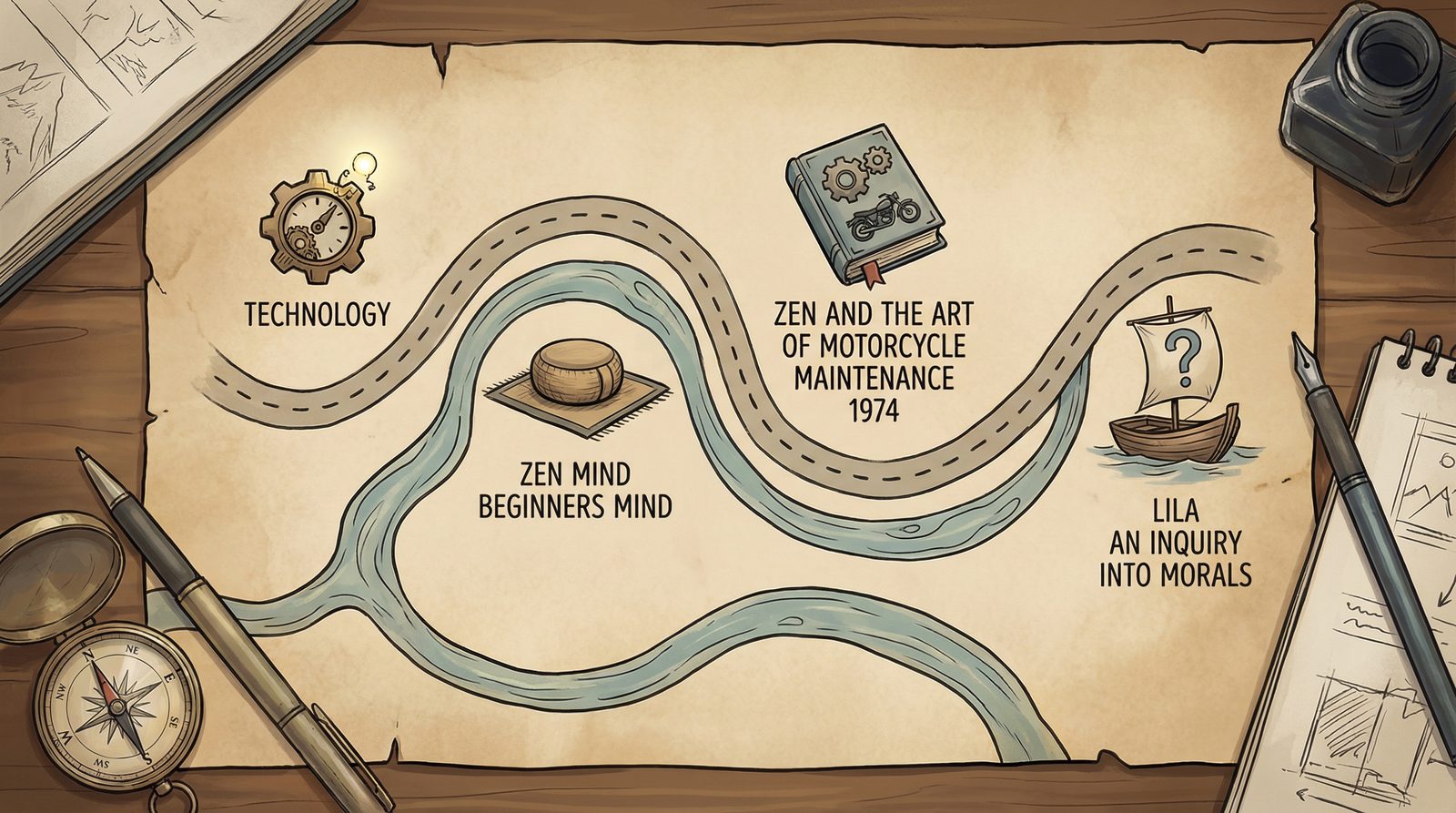
    Pirsig’s reputation rests primarily on Zen And The Art Of Motorcycle Maintenance (1974), a book that became a touchstone for readers who wanted philosophy without leaving the open road. A father-and-son motorcycle trip becomes the frame for exploring his evolving notion of quality, his critique of narrow rationalism, and his attempt at Eastwest Philosophical Synthesis. The scenes of tuning engines and navigating back roads anchor abstraction in the tactile world of craft.

    He later extended that inquiry in Lila: An Inquiry Into Morals (1991), shifting from motorcycles to a boat journey and from personal crisis to a broader examination of social and moral patterns. Where Zen And The Art Of Motorcycle Maintenance centers on individual quality, Lila pushes toward a more systematic account of how values evolve in communities. Together, the books form a two-part exploration of how metaphysics might grow out of everyday experience.

    Pirsig’s legacy can be felt in modern defenses of hands-on skill and moral seriousness, including Crawford’s Shop Class As Soulcraft. He remains a key figure in conversations about how to reconcile technology with inner life, and his distinctive contribution is to treat the garage, the road, and the workshop as legitimate philosophical sites. For readers drawn to craft, attention, and the lived texture of ideas, his work offers a slow, rigorous argument that value is something you practice.

  • Athletic Discipline As Spiritual Practice

    Athletic Discipline As Spiritual Practice

    DEFINITION & CORE IDEA

    Athletic Discipline As Spiritual Practice is a motif where physical training becomes a method of inner change. A character may begin by chasing medals, approval, or bodily perfection, but the story steadily redirects the goal away from external victory. Repetition and pain function as meditative practice rather than punishment, reshaping attention, ego, and self-understanding through the body.

    Writers use this motif to argue that insight does not require a monastery. It can emerge at dawn, under fluorescent lights, through breath control, posture, balance, and endurance. The body becomes a closed system the character can actually work with. By mastering effort inside that finite space, the character develops a template for meeting uncertainty outside it.

    Dan Millman’s Way Of The Peaceful Warrior stands near the center of this motif because the mentor figure reframes training as awareness rather than achievement. Drills are not abandoned, but their meaning changes. What matters is not the score, but what collapses and what remains when the character can no longer hide behind performance.


    HOW IT WORKS IN STORIES

    Stories built on this motif often begin with a narrow definition of progress. The character believes effort produces results in a straight line. Training sequences follow familiar sports beats because the worldview is still mechanical: more work equals more worth.

    The pivot arrives when the body stops cooperating with the ego. Injury, exhaustion, or humiliation exposes the limits of willpower. A mentor, breakdown, or enforced pause introduces a consequence-driven question: who are you when success is unavailable, and what social or internal hierarchy collapses when that identity fails?

    Narrative tension is resolved through physical sensation rather than dialogue. Training is shown in close detail: breath, soreness, boredom, micro-adjustments, the mental noise that surfaces once distraction is stripped away. When the character tries to dominate the process, they become brittle. When they commit to the process without bargaining, the first shift is practical: staying present inside discomfort without turning it into self-punishment.

    By the middle of the story, the competition may still exist, but it no longer functions as the climax. The decisive moment is a choice: leaving a destructive coach, accepting limits without collapse, or returning to training after crisis with a different internal metric. External outcomes matter less than whether the character can remain steady under pressure.

    By the end, the discipline generalizes. The character faces grief, conflict, or uncertainty the way they face a long session: one breath, one repetition, one return to form. In some stories this logic is explicit through martial traditions that frame training as “the way.” In others it remains secular. Either way, training becomes a usable philosophy rather than a machine for validation.


    Editorial illustration inspired by 'Athletic Discipline As Spiritual Practice'

    EMOTIONAL EFFECT ON THE READER

    This motif often leaves readers both energized and calm. There is satisfaction in routine, effort, and incremental mastery, paired with a quieter pleasure: watching mental noise recede as attention narrows to the present task.

    Readers who have trained seriously tend to feel recognized. The motif validates the private hours that never appear on highlight reels. It frames repetition and boredom as meaningful labor, not wasted time, especially when insight arrives through failure rather than applause.

    For other readers, the motif functions as invitation. It suggests meaning does not require ideal conditions. One can begin with breath, posture, and effort. That promise is reassuring precisely because it is ordinary and sustainable.

    There is also a melancholy edge. After the event ends and the crowd disperses, the character still has to live inside their body and choices. The story often closes in that integration space, where discipline must survive everyday life without the scaffolding of competition.


    Symbolic illustration inspired by 'Athletic Discipline As Spiritual Practice'

    VARIATIONS & RELATED MOTIFS

    This motif appears in several stable variations. One emphasizes mentorship: a coach uses paradoxes, chores, or repetitive drills to dismantle status-hunger and redirect attention. Another emphasizes solitude, following athletes who train alone or recover in isolation, where boredom and fear become the primary teachers.

    The motif overlaps naturally with Awakening Through Physical Injury, where pain or limitation forces a reassessment of purpose. It also aligns with Spiritual Awakening and Inner Journey, because insight is earned through repetition rather than revelation.

  • Valets And Butlers

    Valets And Butlers

    DEFINITION & CORE IDEA

    Valets And Butlers is a motif built around the personal servant who is close enough to see everything, disciplined enough to say almost nothing, and competent enough to keep a household (or a protagonist) from collapsing. On the surface, valets and butlers exist to perform routine tasks: managing clothing, announcing visitors, maintaining schedules, smoothing over small social frictions. In narrative terms, they often function as the story’s most reliable intelligence inside a world of performative status.

    The motif’s charge comes from inversion. The servant holds the lowest formal rank while possessing the highest practical awareness. Because they are expected to be discreet, people speak freely around them, treat them as part of the room, and underestimate how much they notice. That gap between visibility and knowledge turns service into a form of power: quiet, deniable, and structurally essential.

    In the comic tradition shaped by P. G. Wodehouse, this inversion becomes the engine of farce. In Right Ho, Jeeves and The Code Of The Woosters, the socially superior employer repeatedly creates the mess while the valet quietly contains it. The humor is not simply that the servant is smarter. It is that the entire social order depends on someone who is never meant to be credited.

    At its core, Valets And Butlers explores what it means to serve and what service costs. It asks who truly holds power in a room, how much control can exist without recognition, and what kind of intimacy forms when one person’s job is to manage another’s life more competently than they ever could themselves.


    HOW IT WORKS IN STORIES

    Most stories using this motif keep the servant constantly present but rarely centered. Valets and butlers move through scenes performing routine actions while absorbing information, witnessing private failures, and tracking social pressure points. Writers use this access to make the servant a natural witness, confidant, and stabilizer inside a household that would otherwise fracture under its own ego and etiquette.

    Structurally, these characters often function as corrective force. When the plot threatens to spin into scandal or humiliation, the servant intervenes indirectly: shifting timing, redirecting people, removing evidence, arranging encounters, limiting damage. The employer may believe they are in control, but the narrative repeatedly demonstrates that outcomes depend on the servant’s judgment, restraint, and ability to act without being seen acting.

    This same architecture works outside pure comedy. In a mystery or a socially sharper story, the servant may be the only person with complete situational awareness because they were present during the moments others dismissed as background. Even when they say little, their position reveals how much labor is required to maintain the illusion of order and how dependent “status” is on invisible work.

    Dialogue becomes a tool of power without confrontation. Formal speech and minimal responses allow valets and butlers to communicate warning, irony, or correction while preserving the hierarchy’s appearance. A phrase like “Very good, sir” can carry obedience, exasperation, or quiet judgment depending on context. That ambiguity lets the motif explore control without turning the story into a lecture about class.

    Because these characters move freely between rooms, conversations, and social layers, they also serve as narrative connective tissue. Information passes through them. Emotional shifts register with them first. The household feels coherent because one figure circulates through all its compartments while everyone else remains trapped inside their own priorities.


    Editorial illustration inspired by 'Valets And Butlers'

    EMOTIONAL EFFECT ON THE READER

    This motif produces a blend of reassurance and unease. There is comfort in knowing that someone competent is present when authority figures are impulsive, naive, or self-absorbed. In a Jeeves-style story, readers relax slightly because they trust the servant will contain the chaos even when characters cannot manage themselves.

    At the same time, the motif carries quiet tension. The servant sees everything and remembers it. Readers understand that the social order depends on continued discretion and goodwill. Beneath the comedy sits an unspoken question: what happens if the person holding the system together decides to stop?

    The emotional intimacy of service deepens that effect. A valet or butler assists with private routines, hears confessions, and observes vulnerability without reciprocity. That closeness can feel protective or quietly tragic, especially when the servant’s own inner life remains unspoken and structurally suppressed.

    The motif also taps into a powerful fantasy: being understood so well that problems are solved before they need to be explained. The Jeeves and Wooster (TV Series) version makes that fantasy playful, turning competence into a safety net the viewer can rely on. Even when stories handle the motif with sharper satire, the same comfort remains: someone is paying attention, even if the people in charge are not.


    Symbolic illustration inspired by 'Valets And Butlers'

    VARIATIONS & RELATED MOTIFS

    Several variations recur within Valets And Butlers. The best-known is the hyper-competent servant whose intelligence far exceeds that of their employer, producing comedy through contrast: authority fails publicly while competence operates quietly in the background. Another variation is the stoic butler whose restraint becomes the drama, where the emotional payoff comes from what is withheld rather than expressed.

    A darker variation reframes the servant as an active manipulator. Because they stand at the intersection of information and access, they can redirect events for personal advantage, shifting the motif toward suspense or moral ambiguity. A satirical variation turns the servant into a mirror held up to the ruling class, exposing how fragile “refinement” becomes once it relies on invisible labor to remain believable.

    This motif overlaps naturally with Country House Comedy and Comic Misunderstandings And Farce, where servants often become the stabilizing intelligence inside a house full of schemes. It also connects to Victorian And Edwardian Social Satire, where the upstairs-downstairs perspective turns manners into a pressure system. In broader comedy-of-manners traditions, writers like Evelyn Waugh and Nancy Mitford echo the same logic: social status performs authority, but real control often sits with the people expected not to speak.

  • Country House Comedy

    Country House Comedy

    DEFINITION & CORE IDEA

    Country House Comedy is a comic motif where most of the action unfolds in and around a large rural estate packed with guests, servants, and secrets. The house functions as a social arena, trapping everyone together long enough for romantic tangles, class clashes, and elaborate misunderstandings to bloom. The setting promises peace and refinement. What it delivers instead is controlled social chaos.

    Writers use Country House Comedy because it creates a contained world full of built-in tension. City and country collide the moment visitors arrive from town. Old money and new money share the same drawing rooms. Servants observe the performance from the margins, often seeing more than anyone upstairs realizes. The estate’s routines and boundaries force repeated contact between people who would rather avoid each other, which is exactly what comedy needs.

    The motif appears cleanly in the work of P. G. Wodehouse, who uses the stately home as a pressure system for farce. In Leave It To Psmith, a house-party weekend becomes a knot of imposture, theft, and romantic interference, with every attempt at dignity immediately undercut by escalation. At its core, Country House Comedy punctures pretension by forcing refined people to behave irrationally while still trying to look respectable.


    HOW IT WORKS IN STORIES

    Country House Comedy usually begins with an invitation. Guests arrive at the estate for a weekend party, a family gathering, or some supposedly “dignified” social occasion. The host expects order. The reader can feel the collision course immediately. By concentrating a mixed group in one place, the story creates a social laboratory where etiquette becomes a trap rather than a stabilizer.

    The cast is designed for friction. There is often a protagonist who cannot speak plainly about what they want, an authority figure who polices the rules of the house, and at least one person whose identity or intentions are not what they seem. Mistaken identity is an especially efficient engine here, because it forces politeness to do the dirty work: once you have greeted the wrong person as the right person, you must keep the lie alive to preserve “good form.” In Leave It To Psmith, Wodehouse turns that logic into momentum, using the house party to keep thieves, romantics, and impostors in the same orbit long enough for small deceptions to become full-scale farce.

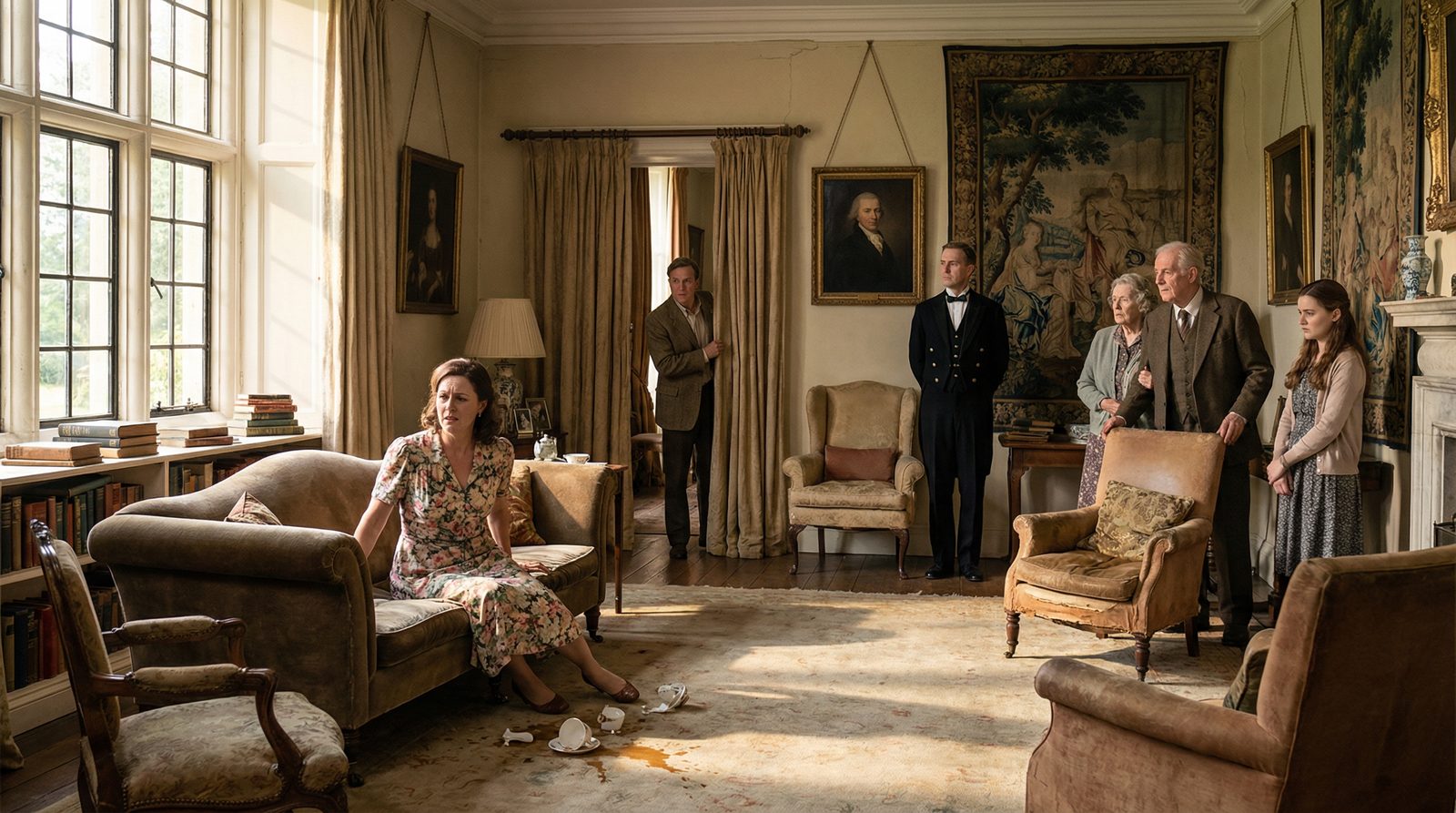
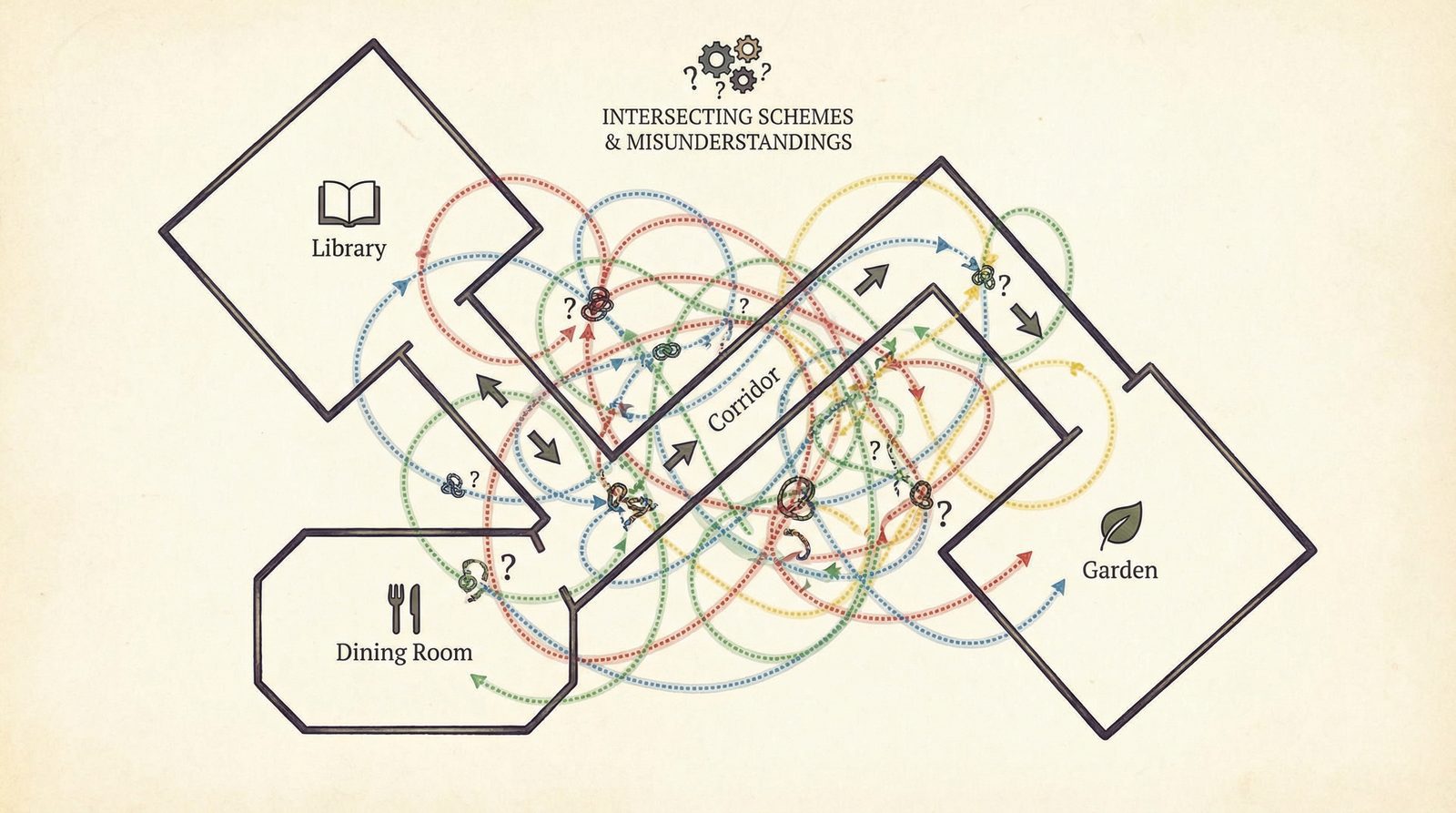
    The building’s layout becomes part of the plot machine. Gardens invite overheard confessions and badly timed proposals. Libraries and sitting rooms host “private” conversations that are never fully private. Bedrooms, corridors, and staircases generate midnight traffic, near-misses, and people hiding in plain sight. Meals and formal events act as recurring pressure points, forcing enemies and co-conspirators to sit politely side by side while chaos continues underneath the tablecloth.

    Timing is the fuel. Country House Comedy thrives on near-misses: someone exits a room seconds before the person they most need to avoid enters; a letter lands in the wrong hands; a disguise nearly fails in the hallway. Because nobody can simply leave, small lies snowball fast. A harmless excuse meant to avoid embarrassment can, within a day, require a coordinated performance involving half the guest list. The story usually ends with an “untying” sequence where secrets spill, motives surface, and the social order re-forms into a new set of alliances and pairings.


    Editorial illustration inspired by 'Country House Comedy'

    EMOTIONAL EFFECT ON THE READER

    Country House Comedy feels like being invited to a party where you are safely invisible. You get to roam the corridors, listen at doors, and watch everyone make fools of themselves without being the one who has to recover socially afterward. Even when characters are panicking, the tone stays light because the stakes remain survivable: reputations wobble, plans collapse, but nobody is truly ruined.

    The reading pleasure often comes as a mix of anticipation and relief. Anticipation, because you can see the collisions lining up: the misplaced letter, the wrong person entering at the wrong moment, the lie that is one step from exposure. Relief, because the genre promises a soft landing. The fun is watching embarrassment expand to its maximum size without tipping into real harm.

    There is also a comforting sense of containment. The estate becomes a sealed bubble where modern noise drops away and the primary “disasters” are social. The reader gets a holiday from consequence, watching wit, timing, and luck restore order just enough for the story to close cleanly.


    Symbolic illustration inspired by 'Country House Comedy'

    VARIATIONS & RELATED MOTIFS

    Country House Comedy has a few reliable variations. One leans toward romance, using the weekend as a matchmaking machine where jealousy, misread signals, and misdirected messages push the “correct” couples into place. Another emphasizes farce, where the plot is driven by impostors, stolen objects, and rapid entrances and exits that feel almost theatrical.

    It also overlaps with broader social satire, where the comedy comes from watching manners and hierarchy fail under pressure. In these versions, the laughs are not only about who ends up in the wrong room, but about how hard people work to maintain status while behaving absurdly. The servant perspective often sharpens that satire, because the people with the least social power may have the clearest view of what is actually happening.

    The motif intersects naturally with comic misunderstandings and farce, mistaken identity logic, and fish-out-of-water dynamics, because the setting intensifies every mismatch. A person who does not understand the rules of the house will break them by accident, and everyone else will scramble to repair the damage without admitting anything is wrong. That scramble is the comedy.