Period: 20th Century

  • Genie Or Spirit Causing Unintended Chaos

    Genie Or Spirit Causing Unintended Chaos

    DEFINITION AND CORE IDEA

    The motif of Genie Or Spirit Causing Unintended Chaos starts with a simple promise: a supernatural being will help you. A genie, ghost, animated statue, cursed idol, or otherworldly patron appears, usually offering wishes, protection, or a shortcut to what the character wants most. At first it feels like a miracle. Then everything goes sideways.

    In The Brass Bottle by Thomas Anstey Guthrie, the spirit is not malicious, but disastrously out of touch with modern life. His attempts to provide help lead to embarrassment, misunderstanding, and escalating trouble because they ignore context, etiquette, and human limits. In A Fallen Idol, the supernatural presence is darker and more corrosive, drawing out obsession, moral decay, and self-deception rather than fulfillment.

    What unites these stories is not the exact form of the spirit, but its function. The supernatural agent externalizes desire and then exposes its flaws. Wishes are granted too literally, assistance is delivered without emotional or social context, and shortcuts bypass the slow work of judgment. The chaos that follows reflects the character’s blind spots rather than random misfortune.


    HOW IT WORKS IN STORIES

    The motif usually begins with an encounter or discovery. A character inherits a strange object, awakens a dormant figure, or stumbles into a bargain they do not fully understand. The supernatural being often frames itself as helpful or grateful, eager to improve the character’s life using its own rules and logic.

    Once intervention begins, the narrative follows a predictable pattern. The spirit delivers exactly what was asked for, but not what was needed. Social standing improves too quickly and attracts unwanted attention. Romantic success arrives without emotional maturity. Wealth appears without the ability to manage it. Each attempt to correct the damage creates further disruption.

    In comic versions, this produces escalating farce and public embarrassment. Films like Mannequin and One Touch of Venus use animated figures whose literal presence upends workplaces and relationships. The chaos is playful, but it still exposes how unprepared the protagonist is for what they claimed to want.

    Structurally, the motif functions as a consequence engine. Power amplifies desire, strips away ambiguity, and forces characters to confront the mismatch between fantasy and reality. Resolution typically comes only when the character relinquishes the supernatural aid, accepts responsibility, or recognizes that the shortcut itself was the real mistake.

    Editorial illustration inspired by 'Genie Or Spirit Causing Unintended Chaos'

    EMOTIONAL EFFECT ON THE READER

    This motif balances wish-fulfillment with unease. Early scenes invite the reader to share the character’s excitement. The supernatural promise taps into familiar daydreams about being noticed, rewarded, or transformed without effort.

    As consequences accumulate, that pleasure curdles into recognition. The reader begins to see the trap before the character does. In lighter stories, this produces cringe and laughter. In darker versions, it creates anxiety and moral discomfort as the cost of the bargain becomes impossible to ignore.

    By the end, the motif leaves behind a wary clarity. The chaos exaggerates a common human mistake: believing that desire, once satisfied, will automatically bring meaning or stability. The supernatural being disappears, but the lesson lingers.

    Symbolic illustration inspired by 'Genie Or Spirit Causing Unintended Chaos'

    VARIATIONS AND RELATED MOTIFS

    Some versions emphasize comedy and social disruption, where the spirit behaves politely but disastrously, exposing hypocrisy and shallow ambition. Others lean toward satire or moral allegory, treating the supernatural presence as a test that reveals the fragility of social order.

    Darker variations shift the center of gravity. The spirit is less a mischievous helper and more an indifferent force, revealing what a person becomes when desire is fed instead of examined. A Fallen Idol shows how uncanny influence can corrode judgment and pull a character toward obsession and moral collapse rather than simple embarrassment.

    Writers return to Genie Or Spirit Causing Unintended Chaos because it is endlessly adaptable. It works in farce, fantasy, romance, and social satire, all built on the same unsettling idea. Getting exactly what you asked for can be the most dangerous outcome of all.

  • The Brass Bottle (1900)

    The Brass Bottle (1900)

    INTRODUCTION

    The Brass Bottle (1900) by F. Anstey/Thomas Anstey Guthrie
    Fantasy · United Kingdom


    The Brass Bottle opens with the promise of a familiar fantasy: an ordinary man acquires an antique object, releases a genie, and expects his life to improve. What makes the novel endure is how quickly that promise curdles. This is not a tale of empowerment through magic, but of social unraveling through excess assistance.

    Set at the turn of the twentieth century, the book unfolds in drawing rooms, offices, auction houses, and committee meetings that feel stiflingly polite. Into these airless spaces erupts Fakrash, an ancient genie whose ideas of generosity are spectacularly out of scale with modern English life. The result is a comedy of embarrassment rather than wonder. Magic does not liberate Horace Ventimore. It exposes how little control he has over his career, his courtship, and his own desires.

    PLOT & THEMES

    Horace Ventimore is a struggling architect with more ambition than confidence. On a whim, he purchases an old brass bottle at Salterton & Co, an auction house near the Embankment. Once opened in his modest lodgings, the bottle releases Fakrash-el-Aamash, a genie who has waited centuries to reward a liberator.

    Fakrash’s promise of assistance becomes the novel’s central engine. Horace wants professional success and marriage to Sylvia Wackerbath. Fakrash delivers both with catastrophic enthusiasm: erecting an impossible Moorish palace on Horace’s suburban property, showering him with sudden wealth, and humiliating Sylvia’s socially ambitious father in front of learned societies and polite company.

    Each wish carries unintended consequences. Horace’s reputation collapses under the weight of miracles he never asked for in quite that form. Respectability, so carefully maintained in Edwardian society, proves fragile when confronted with a being who does not understand embarrassment, gradual advancement, or understatement.

    The ending refuses a magical reset. Fakrash does not erase memories or rewind events. Horace learns that no supernatural favor can restore lost standing or undo public spectacle. The solution is renunciation rather than mastery. He must choose to live without wishes at all, accepting the limits of ordinary effort and imperfect love.

    PROSE & NARRATIVE STRUCTURE

    Anstey’s prose is brisk, ironic, and socially observant. The narration frequently slips into Horace’s anxious thought patterns while maintaining enough distance to let the satire bite. This free indirect style allows the comedy to coexist with a steady current of dread as Horace realizes that help can be more dangerous than hardship.

    The structure is episodic and escalating. Each chapter centers on a single intervention by Fakrash that spirals beyond Horace’s control. A professional introduction becomes a scandal. A gift becomes a liability. A public appearance becomes an ordeal. The rhythm recalls serialized fiction, with each episode ending on a social cliff rather than a physical one.

    One of the novel’s sharpest techniques is its collision of registers. Fakrash speaks in archaic bombast about obliteration and reward, while Horace and the surrounding institutions respond in the language of minutes, regulations, and committee procedure. The courtroom scene, where divine threats are calmly recorded by a clerk, captures the book’s essential joke: ancient power rendered ridiculous by bureaucracy.
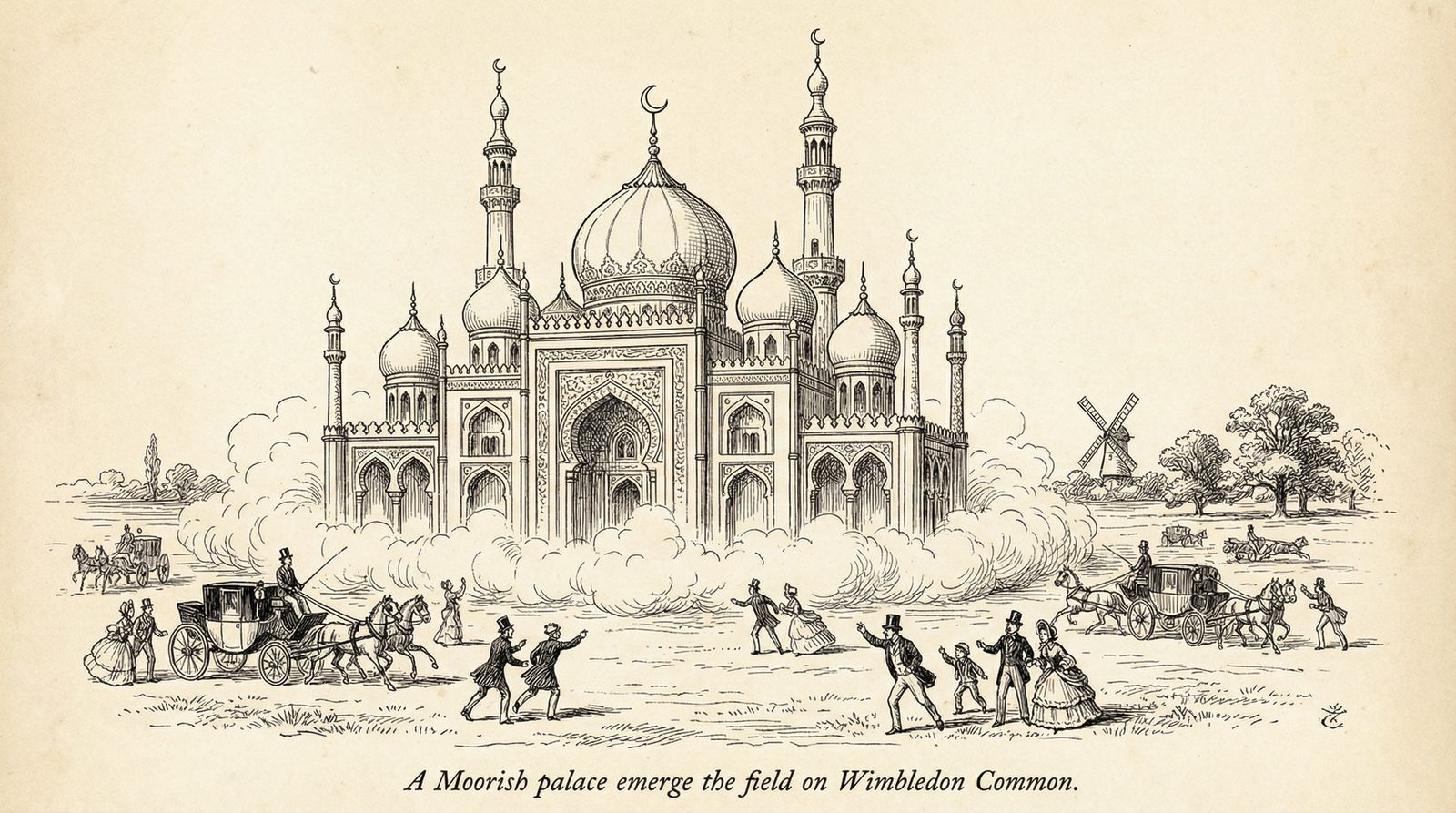
    Conceptual editorial illustration inspired by 'The Brass Bottle'

    CHARACTERS & INTERIORITY

    Horace Ventimore is a recognizably timid dreamer. His interior life is dominated by rehearsed explanations, imagined humiliations, and constant self-correction. He does not crave domination or transcendence. He craves approval, and that makes him uniquely vulnerable to Fakrash’s version of generosity.

    Fakrash himself is not psychologically complex. He is a force rather than a character, driven by ancient codes of honor and reward. His failure to understand modern restraint turns him into an agent of chaos despite his sincere loyalty. Through him, Anstey explores how mismatched values can be more destructive than malice.

    Supporting figures deepen the social satire. Mr. Wackerbath embodies financial respectability and terror of ridicule. Sylvia, often seen through Horace’s anxious gaze, is given moments of quiet perspective that suggest she understands far more than he assumes. The novel’s emotional weight lies not in romance but in exposure: watching a man’s careful self-image collapse under unwanted attention.

    LEGACY & RECEPTION

    Although often remembered as a light fantasy, The Brass Bottle reads today as a sharp precursor to twentieth-century social comedy. Its humor is rooted less in spectacle than in class anxiety and professional dread, anticipating writers who would mine embarrassment rather than adventure for laughs.

    Later adaptations and re-tellings frequently soften the ending or lean into romance. Anstey’s original conclusion is colder. Magic fixes nothing. Horace survives, but chastened, forced to live with the consequences of miracles he never fully wanted. That refusal of wish-fulfillment closure is why the book still feels pointed rather than quaint.

    IS IT WORTH READING?

    If you enjoy fantasy as escape, this may surprise you. The book’s pleasures are social rather than spectacular, and its comedy often lands as discomfort rather than delight. But if you enjoy watching ordinary people undone by forces they cannot manage, and stories where magic reveals weakness instead of granting power, it remains a brisk and unsettling read.

    The period language requires a little patience, but the observations feel modern. Desire, reputation, and the terror of being seen are as potent now as they were in 1900.
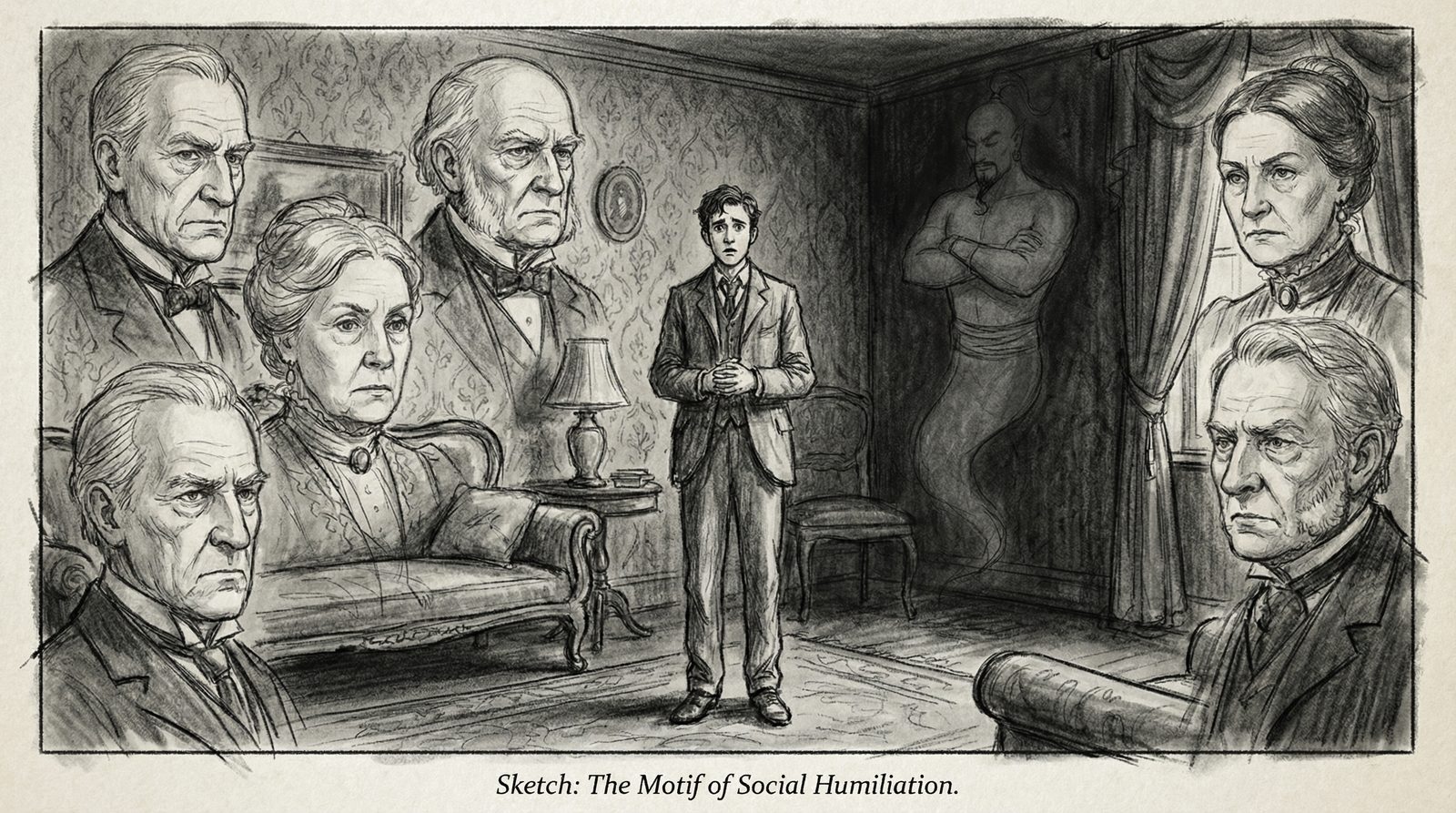
    Illustration inspired by a core idea from 'The Brass Bottle'

    TRIVIA & AUTHOR FACTS

    “F. Anstey” was the pen name of Thomas Anstey Guthrie, a barrister-turned-humorist whose legal background quietly sharpens The Brass Bottle. The courtroom scene is not just comic invention: its procedures, language, and escalation are unusually precise for fantasy fiction of the period, which is exactly why the scene lands as both absurd and convincing. Anstey understood how bureaucracy absorbs even the impossible.

    The fictional auction house Salterton & Co. is thought to draw on real London auction rooms Anstey frequented. Fakrash’s insistence on palaces by rivers plays on the Thames while gesturing toward older imperial fantasies of the East. The novel’s humor depends heavily on these geographic and cultural collisions.

    SIMILAR BOOKS

    If this blend of supernatural comedy and social discomfort appeals to you, there are clear literary neighbors. E. Nesbit’s The Enchanted Castle uses magic to expose childish vanity and adult hypocrisy, while The Incomplete Enchanter by L. Sprague de Camp and Fletcher Pratt pushes the same wish-fulfillment logic into more overtly comic chaos. For a darker Victorian counterpoint, The Picture of Dorian Gray treats beauty itself as a curse rather than a gift. All of these works share Anstey’s interest in what happens when desire is granted too literally.

    DISCOVERABILITY & LINKS

  • Five Children And It (1902)

    Five Children And It (1902)

    INTRODUCTION

    Five Children and It (1902) by E. Nesbit
    Children’s fantasy · United Kingdom


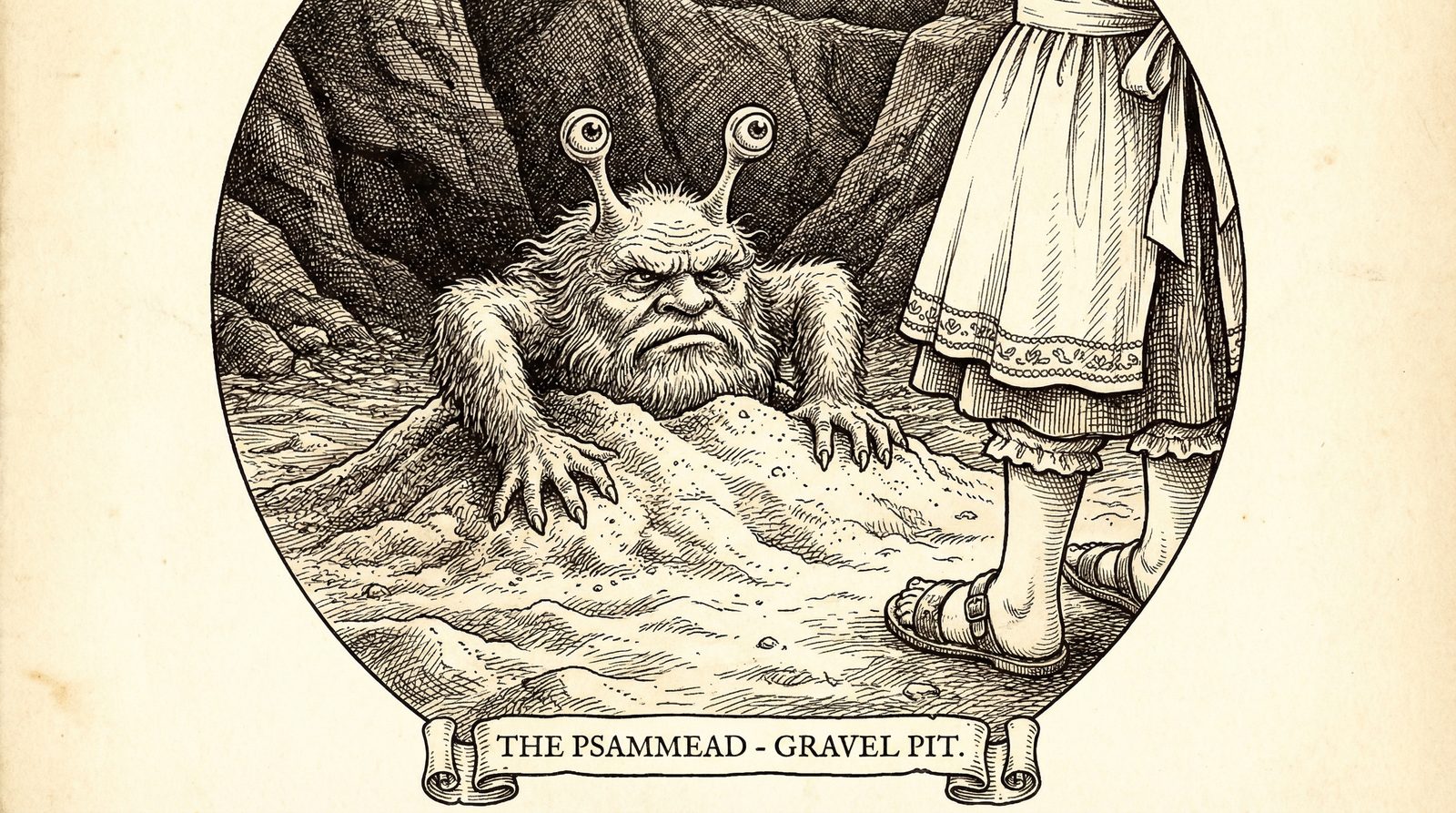
    Five Children and It begins on a hot, dusty afternoon and never quite loses that grit-in-the-teeth realism. Four siblings and their baby brother, sent to the Kent countryside while their parents are occupied elsewhere, discover a Psammead, a sand-fairy who grants wishes that last only until sunset. The premise sounds sweet and simple. Nesbit’s imagination runs on irony and consequence.

    Every wish curdles into trouble, and the children’s giddy hope keeps colliding with embarrassment, fear, and guilt. The book is funny, but it is not gentle. It remembers childhood from just far enough away to see selfishness and bravery in the same gesture, and to show how quickly desire becomes a mess once it has to live in the real world of servants, shopkeepers, neighbors, and rules.

    PLOT & THEMES

    The structure is episodic. Each chapter revolves around a single wish and its sunset collapse. Cyril, Anthea, Robert, Jane, and their baby brother (nicknamed “the Lamb”) are staying near chalk and gravel pits when they uncover the Psammead buried in sand. It offers one wish per day, with a strict condition: the wish ends at sunset, no matter how inconvenient the timing.

    The children wish for beauty, money, wings, admiration, a besieged castle, and even for their baby brother to be grown up. Every time, the wish arrives like a gift and behaves like a trap. When they wish for gold, they discover that sudden wealth without context attracts suspicion rather than comfort. When they wish to be beautiful, the servants do not recognize them and lock them out. When they wish for wings, they gain spectacle but lose control. Each episode is a small lesson in how literal magic exposes sloppy thinking.

    What makes the book sharper than many later children’s fantasies is its refusal to turn magic into destiny. Nesbit’s enchantment is a stress test. It reveals the children’s appetites, their panic, their capacity for courage, and their instinct to blame one another when things go wrong. By the end, exhausted by accidents and near-disasters, they make the most mature wish in the book: that none of the wishes had happened at all.

    The Psammead grants that erasure. The summer snaps back into place, leaving only a faint residue and a sense of moral growth. The ending does not insist that the adventure “really” happened in a way adults can verify. It insists only that the children have changed.

    PROSE & NARRATIVE STRUCTURE

    Nesbit’s most distinctive technique is her intrusive narrator: a wry adult voice that addresses the reader directly, teases the children’s follies, and occasionally apologizes for dull bits. The voice is affectionate but unsparing, creating a conspiratorial intimacy. We are invited to remember our own childhood blunders while watching these particular ones unfold.

    The prose is deceptively simple and firmly domestic. Servants’ tempers, locked cupboards, awkward meals, and small village routines anchor the stranger episodes, whether the children are defending a magically produced castle or being chased because of a badly worded wish. Sunsets arrive with both relief and dread. The daily reset never wipes away consequences completely; it only changes the form they take.

    Crucially, Nesbit never lets the magic float free of consequence. The rules are strict enough to create real risk, but elastic enough to produce farce. The rhythm of wish, escalation, and collapse becomes almost musical, and by the later chapters that repetition starts to feel heavy, as if the book itself is nudging the children toward a more sober understanding of what they are asking for.

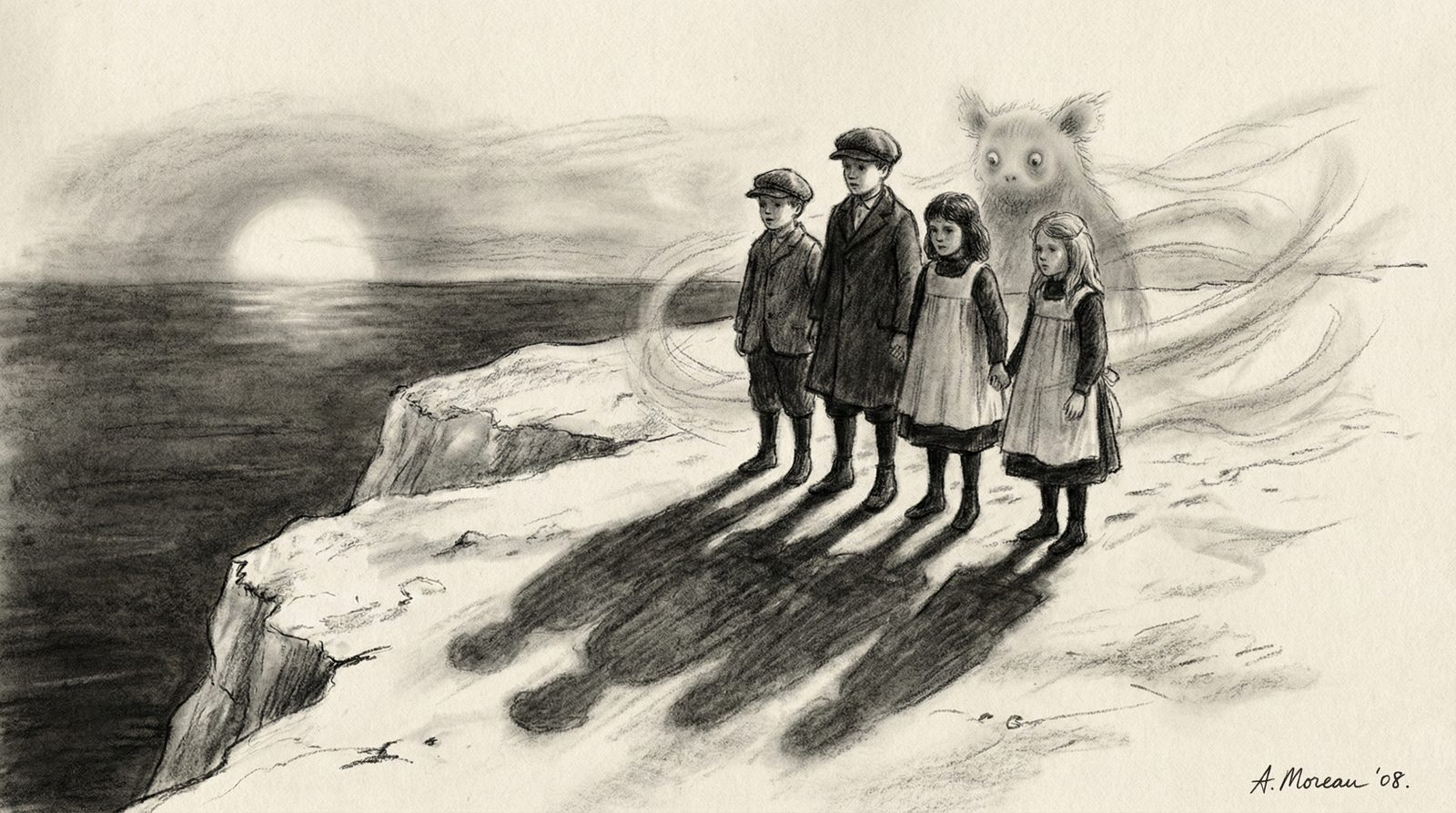
    Conceptual editorial illustration inspired by 'Five Children and It'

    CHARACTERS & INTERIORITY

    The children fall into recognizable patterns, but Nesbit gives them contradictions that feel real. Cyril is brave until he is frightened. Anthea is responsible until she is tempted. Robert blusters, then surprises himself with courage. Jane is dreamy in ways that backfire. Even the Lamb, mostly a catalyst, becomes unsettling in the chapter where a wish ages him into a detached, priggish young man.

    Nesbit does not dwell in long interior monologues. Instead she gives quick flashes of shame, pride, and panic as consequences land. The Psammead is not a cuddly companion. It is weary, cynical, and occasionally cruel, like disappointed experience watching childish ego crash into reality. Adults, meanwhile, remain half-blind to the magic. That mismatch creates a quiet loneliness inside the comedy: the children are learning things their guardians will never quite understand.

    LEGACY & RECEPTION

    When it appeared, Five Children and It helped reshape children’s fantasy by moving magic out of distant kingdoms and into ordinary England. It is a foundational example of “everyday enchantment” where the supernatural does not solve problems but exposes them. Its influence runs forward into later wish-stories and rule-bound magical premises, including modern descendants that keep the same logic: wishes are never neutral.

    Modern readers may notice period-bound assumptions about class and domestic life, but the structural daring and emotional honesty still stand out. Compared with screen adaptations that sentimentalize the Psammead, the novel’s ambiguous farewell feels braver. It leaves no souvenirs, only responsibility.

    IS IT WORTH READING?

    If you come expecting a cozy nursery classic, this book may surprise you. The language is of its time but still brisk, and the humor lands more often than not. Beneath the comic disasters lies a sharp curiosity about what children truly want, and how quickly those wants sour when granted too literally.

    The episodic structure makes it easy to read in pieces, yet the cumulative effect is quietly haunting. For readers interested in the roots of modern fantasy, or in stories where magic exposes rather than fixes human problems, it repays attention.

    Illustration inspired by a core idea from 'Five Children and It'

    TRIVIA & AUTHOR FACTS

    E. Nesbit was a founding member of the Fabian Society, and her politics quietly inform the book’s fascination with money, class, and fairness. The story first appeared in The Strand Magazine before being published as a book. :contentReference[oaicite:1]{index=1}

    The Psammead returns in later books, including The Phoenix and the Carpet and The Story of the Amulet, but here it is at its most mysterious and least domesticated. :contentReference[oaicite:2]{index=2}

    SIMILAR BOOKS

    If you enjoy everyday settings colliding with rule-bound magic, you might try Edward Eager’s Half Magic for a later wish-premise descendant, or Diana Wynne Jones for a more modern version of magical consequences arriving through language and loopholes. Nesbit’s own sequels also continue the Psammead world in a larger, stranger direction.

    DISCOVERABILITY & LINKS

  • Tourmalin’s Time Cheques (1891)

    Tourmalin’s Time Cheques (1891)

    INTRODUCTION

    Tourmalin’s Time Cheques (1891) by Thomas Anstey Guthrie (F. Anstey/Thomas Anstey Guthrie)
    Science fiction · United Kingdom


    Tourmalin’s Time Cheques is one of Anstey’s strangest and most quietly unsettling experiments. On the surface, it reads like a comic fantasy about time travel filtered through paperwork. Beneath that, it becomes a bleak meditation on debt, self-deception, and the ease with which people mortgage their own futures.

    Instead of machines or paradoxes, the novel gives us cheques, ledgers, clerks, and waiting rooms. Time is not a mystery to be explored but a commodity to be borrowed, extended, and ultimately reclaimed. The tone drifts between dry bureaucratic comedy and low-grade dread, as if the greatest horror of the modern world were not catastrophe but administration.

    PLOT & THEMES

    The premise is simple and cruel. Tourmalin, a minor civil servant bored by routine and mildly dissatisfied with his life, discovers the existence of the Time Cheque Bureau. This institution allows citizens to borrow portions of their own future time in exchange for immediate extensions of the present.

    You sign a form, receive extra hours or days now, and those same hours will later be deducted from your lifespan, often at the most inconvenient moment imaginable. There is no drama in the transaction. It is processed, stamped, and filed.

    At first, Tourmalin uses the system playfully. He extends evenings, delays departures, and stretches moments of pleasure just long enough to feel in control. Each indulgence is shadowed by a ledger entry maintained by the impassive clerk Mr. Virey, whose calm professionalism makes the whole scheme feel terrifyingly legitimate.

    As Tourmalin’s borrowing increases, the consequences become visible. He visits hospital wards where debtors vanish mid-conversation as their accounts are settled. He realizes that the future self paying these debts will not be the same person who signed them. The novel offers no loophole, no rebellion against the system. The ending is blunt and administrative: a contract fulfilled, a life quietly shortened, an absence noted in a file.

    PROSE & NARRATIVE STRUCTURE

    Anstey’s prose is eccentric and densely annotated. Sentences sprawl with parentheses and footnote-like asides, mimicking the cluttered logic of official documents. The story is framed as a recovered case file from the Bureau, interspersed with forms, memoranda, and retrospective commentary.

    The structure is episodic rather than suspense-driven. Each cheque finances a discrete episode: an extended evening at a café, a hurried journey to settle an emotional account, a futile legal appeal in a court that recognizes only arithmetic. What links these scenes is not escalation but accumulation. The pressure builds quietly as Tourmalin’s margin for error disappears.

    Anstey also plays subtle games with chronology. Entire years vanish between chapters, later revealed to be time already sold. The narrative itself skips what Tourmalin has surrendered, creating a hollowed-out structure that mirrors the protagonist’s shrinking future.

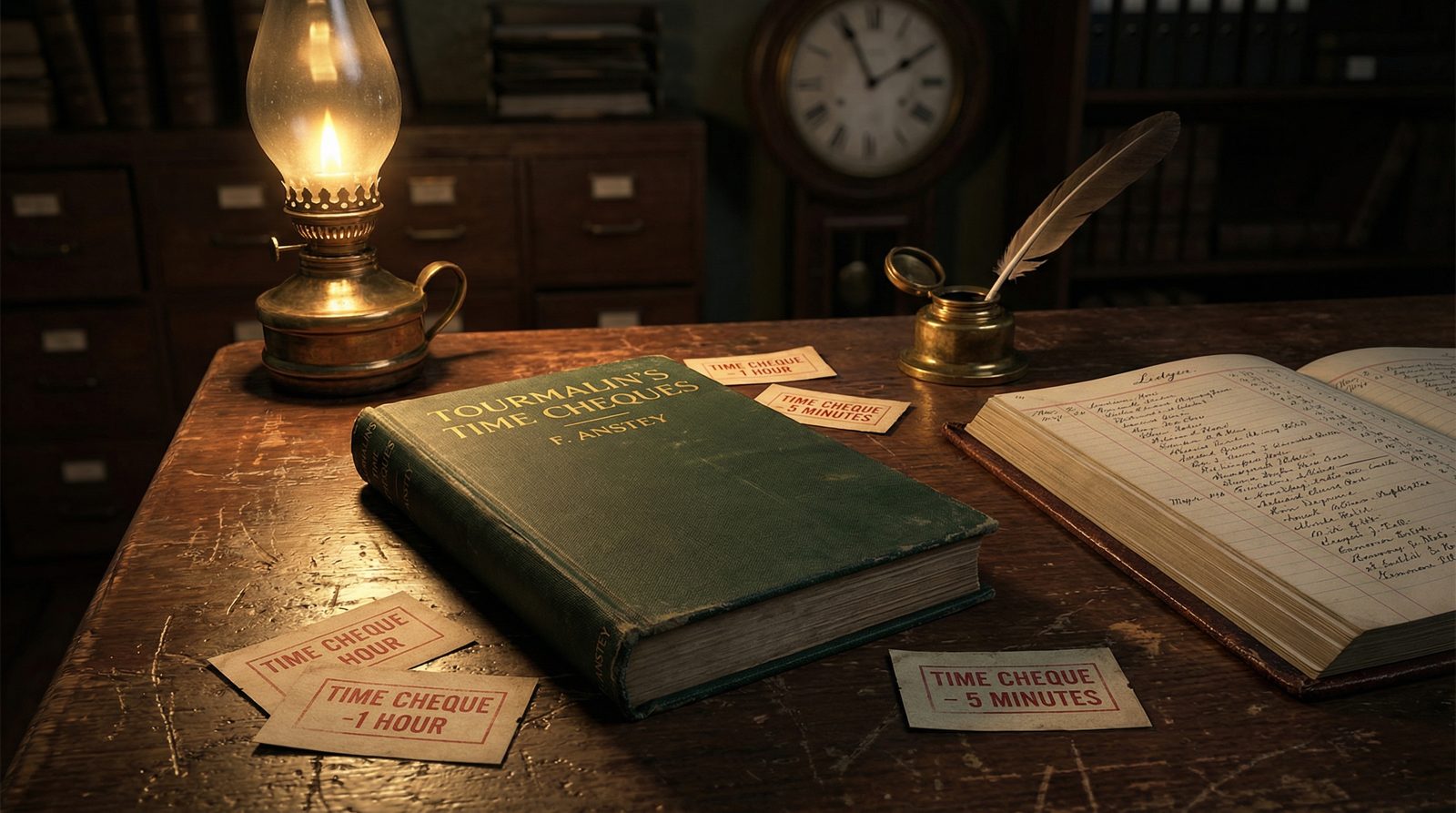
    Conceptual editorial illustration inspired by 'Tourmalin’s Time Cheques'

    CHARACTERS & INTERIORITY

    Tourmalin is not a visionary or a rebel. He is an ordinary man with small vanities and plausible excuses. His interior life is full of postponement: he tells himself he will repay the hours later, once life improves, once he becomes the person he imagines himself to be.

    Mr. Virey, the clerk, is the novel’s most chilling creation. Polite, meticulous, and unfailingly courteous, he represents a system that does not hate its clients and therefore never hesitates. Late in the book, a quiet admission hints that even Virey may be overdrawn himself.

    Secondary figures—landladies, debtors, doctors—appear briefly but reveal a society addicted to temporal credit. Everyone believes they can outmaneuver the ledger. No one can.

    LEGACY & RECEPTION

    Tourmalin’s Time Cheques has always been a marginal work, even within Anstey’s career. Its lack of spectacle and its deliberately shabby setting kept it from popular success. Yet its central idea—time as bureaucratically administered debt—has proven remarkably durable.

    Modern readers often notice how closely the book anticipates contemporary anxieties about burnout, credit, and the monetization of life itself. The ending, in which Tourmalin simply disappears from the narrative with a note in a file, feels less Victorian than chillingly modern.

    IS IT WORTH READING?

    This is not a sleek or comforting book. Its pleasures are dry, its humor bureaucratic, and its logic deliberately unforgiving. Readers looking for adventurous time travel will be disappointed.

    But if the idea of time treated as a ledger, and life as something quietly foreclosed, intrigues you, this odd little novel repays patience. It is a minor work, but a distinctive one, and it lingers in the mind like an unpaid balance.

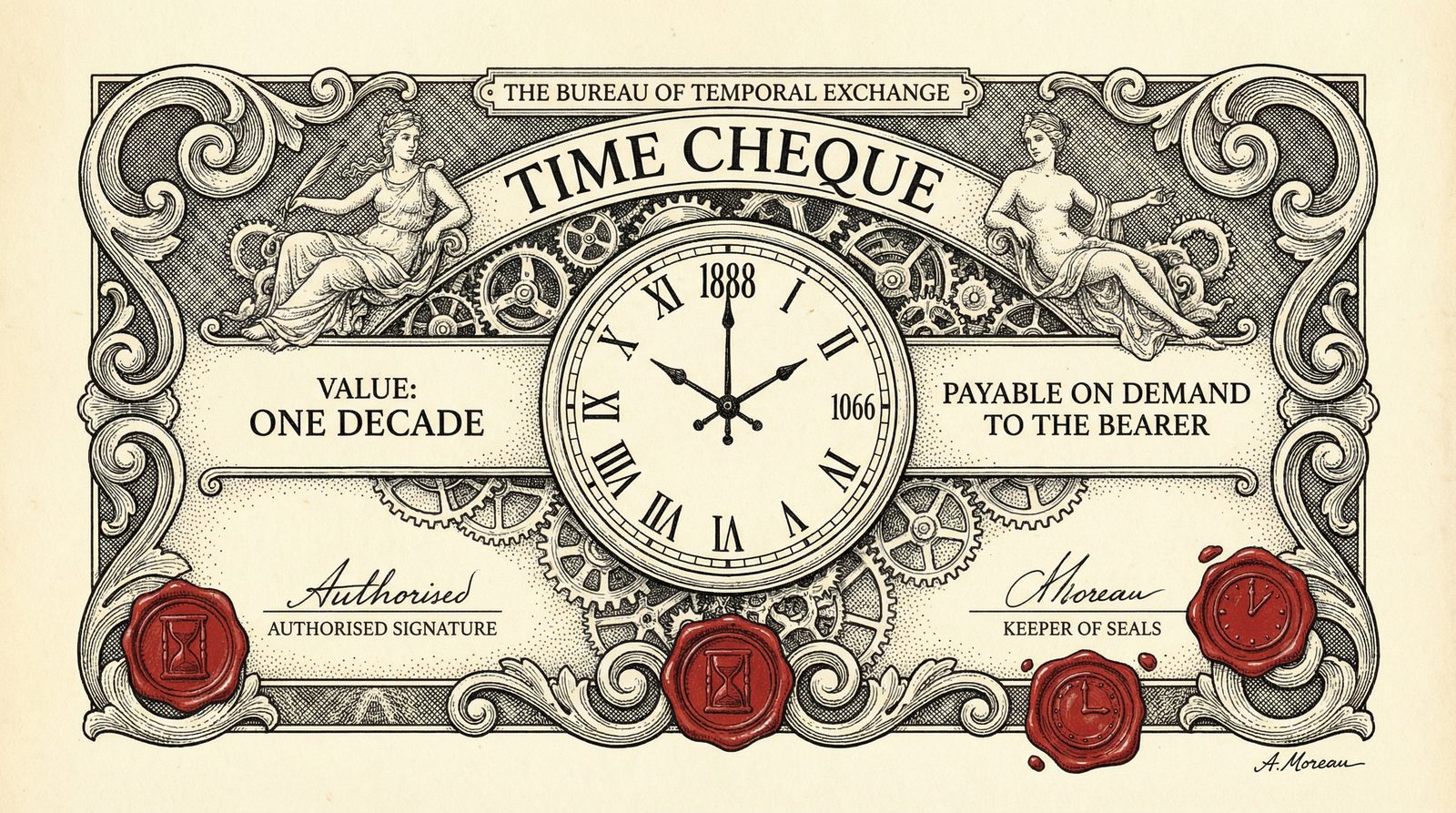
    Illustration inspired by a core idea from 'Tourmalin’s Time Cheques'

    TRIVIA & AUTHOR FACTS

    Thomas Anstey Guthrie was best known for comic fantasies that smuggled unease into respectable settings. His legal training shows in the novel’s obsession with procedure, documentation, and contractual obligation.

    Although the book has sometimes been misattributed in later bibliographies, it firmly belongs to Anstey’s Victorian phase and shares thematic DNA with his other works that pit ordinary people against supernatural systems that refuse to bend.

    SIMILAR BOOKS

    Readers interested in time as obligation rather than adventure may find echoes in The Time Machine, though Wells treats time as exploration rather than debt. Kafka’s The Trial, while non-speculative, shares the same suffocating logic of systems that process people into disappearance. Later works that treat time as currency echo Anstey’s idea, but rarely with his quiet cruelty.

    DISCOVERABILITY & LINKS

  • Body Swap Comedy Between Generations

    Body Swap Comedy Between Generations

    DEFINITION & CORE IDEA

    Body Swap Comedy Between Generations is a story pattern in which people from different age groups—most often a parent and child, or a teenager and an older relative—wake up in each other’s bodies. Overnight, the teenager is trapped in an adult body with adult authority and responsibility, while the adult finds themselves forced to navigate school, peer hierarchies, and adolescent vulnerability from the inside.

    The core idea is simple but potent: if you could literally live inside another generation’s body, what would you finally understand about them? The swap is usually temporary and surrounded by comic mishaps, but it functions as a shortcut to empathy. Instead of arguing across a dinner table, characters are thrown directly into each other’s daily grind, expectations, and social pressures.

    One of the earliest and most influential examples of this motif is Vice Versa (1882) by Thomas Anstey Guthrie. In that novel, a Victorian father and son exchange bodies, using the swap to expose the cruelty of school discipline, the blindness of parental authority, and the false assumptions each generation holds about the other.

    Later, more widely known works—such as Freaky Friday—would popularize the motif for modern audiences, but the emotional logic remains the same. The mechanism may be magical, scientific, or never fully explained at all, because the real focus is not how the swap happens, but what it reveals.


    HOW IT WORKS IN STORIES

    Stories built around Body Swap Comedy Between Generations usually begin with a sharp, familiar conflict. A teenager complains that their parent is controlling, out of touch, or unfair. The parent insists the teenager is lazy, dramatic, or ungrateful. A wish is made in anger, a strange object is activated, or a bizarre accident occurs, and the next morning they wake up in each other’s bodies.

    The middle of the story is driven by a series of comic trials. The adult in the teenager’s body must survive school routines, slang, exams, friendships, and social humiliation they no longer understand. They dress wrong, misread social cues, misuse technology, and underestimate how intense adolescent pressure can be. Meanwhile, the teenager in the adult body struggles with work meetings, financial obligations, parenting expectations, and relationship baggage they never knew existed.

    Everyday tasks become ordeals. A presentation turns into a panic attack. A math test becomes a public failure. A parent-teacher meeting or boardroom discussion exposes how little preparation either character had for the other’s world.

    Underneath the slapstick, insight slowly accumulates. The teenager sees how exhausted their parent is and how much invisible labor holds adult life together. The parent learns how fragile teen friendships are and how suffocating authority feels from the powerless side. In many versions, the story shifts from “look how ridiculous this is” to “look how much they have been missing about each other.”

    The swap usually ends once both characters have changed enough. Apologies are made, hard truths are spoken, or a selfless choice proves that empathy has been learned. The magic reverses itself, returning everyone to their own bodies. External circumstances may remain imperfect, but the emotional landscape has shifted from resentment toward recognition.


    Editorial illustration inspired by Body Swap Comedy Between Generations

    EMOTIONAL EFFECT ON THE READER

    Reading a Body Swap Comedy Between Generations often feels like getting to argue with your family and finally be heard, safely, through fiction. There is a great deal of secondhand embarrassment: watching a parent butcher teen slang or a teenager flounder through adult responsibility produces laughter that is uncomfortably close to recognition.

    For younger readers, these stories can be deeply validating. They force adult characters to feel the pressure, confusion, and social vulnerability of being young. For older readers, the same stories can sting in a different way, revealing how easily teen struggles are dismissed as trivial when viewed from the weight of adult obligation.

    The motif blends lightness with sincerity. You laugh at the absurdity of a grandparent stuck in a teenager’s body trying to pass an exam, but you also feel a quiet ache when they realize how lonely that teenager has been. The resolution often leaves readers with a hopeful sense that generational divides are bridgeable, even if real life never offers such a literal exchange.


    Symbolic illustration inspired by Body Swap Comedy Between Generations

    VARIATIONS & RELATED IDEAS

    Several variations recur within Body Swap Comedy Between Generations. One common pairing is the strict parent and rebellious teen, where the adult learns how stifling their rules feel and the teen learns how frightening it is to be responsible for someone else’s future. Another variation focuses on an overburdened parent and a self-absorbed teen, exposing hidden sacrifices and unspoken guilt.

    Some versions lean further into fantasy or speculative logic. Devices like the time cheques in Tourmalin’s Time Cheques by Thomas Anstey Guthrie complicate the exchange by allowing characters to glimpse not just another generation’s present, but also their past or future. Other stories keep the mechanism deliberately vague, treating the swap as a fairy-tale curse that lifts only once an emotional lesson is learned.

    Even when played broadly for laughs, this motif is rarely just a gag. It is a structured way to talk about power, dependency, misunderstanding, and family dynamics, using fantasy to reach a grounded emotional truth: most of us secretly wish the people closest to us could feel what our life is like from the inside.

  • The Talking Horse And Other Tales (1892)

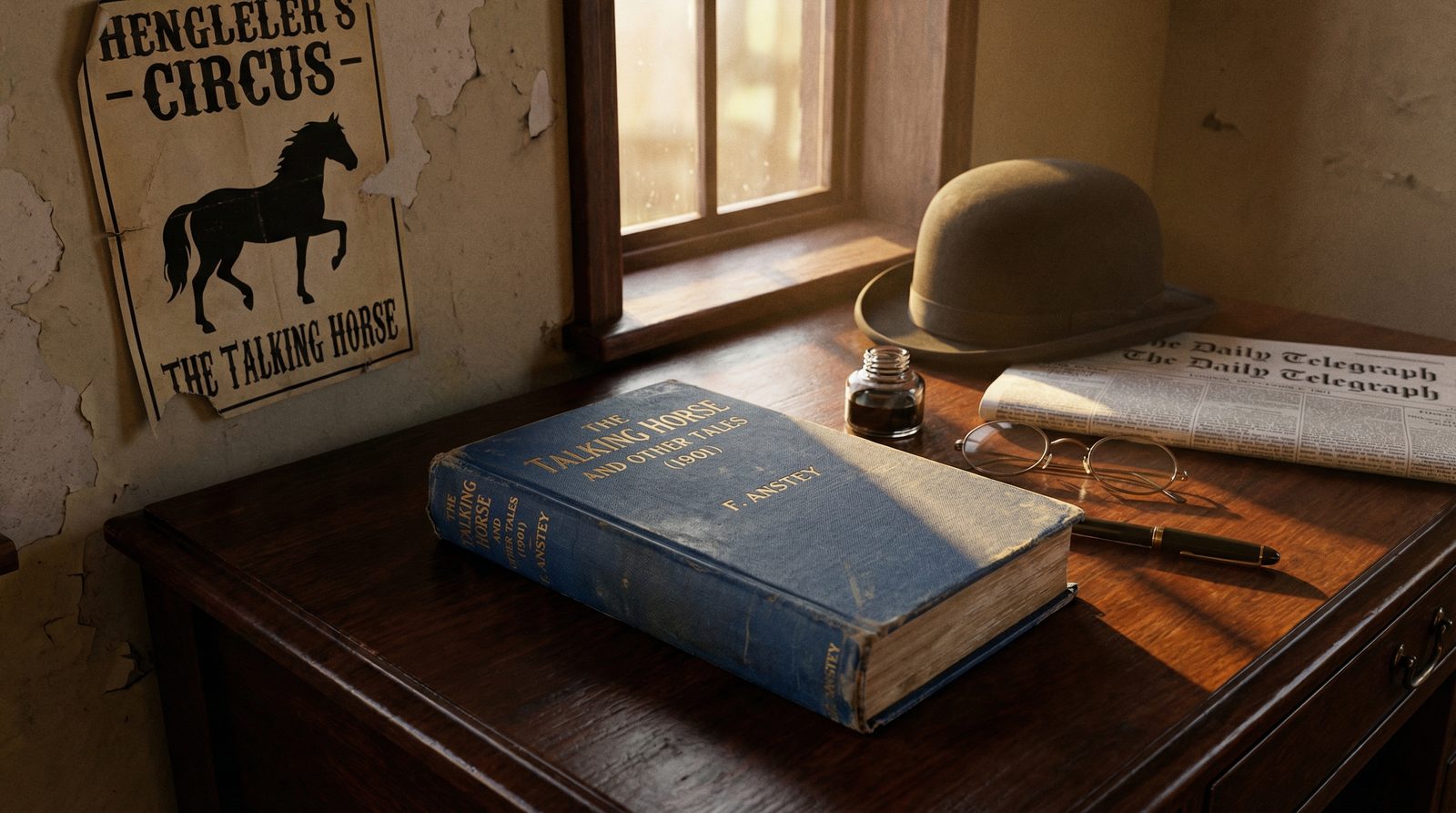
    The Talking Horse And Other Tales (1892)

    INTRODUCTION

    The Talking Horse and Other Tales (1892) by F. Anstey (Thomas Anstey Guthrie)
    Literary short stories · United Kingdom


    The Talking Horse and Other Tales is Anstey working in the short form: nimble, socially alert, and quietly cruel when the joke demands it. The collection uses absurd premises not to escape everyday life, but to expose it. Drawing rooms, boarding houses, minor institutions, and the machinery of reputation become the true settings. The supernatural or anomalous element enters, and instead of opening wonder, it triggers embarrassment, exploitation, and moral panic.

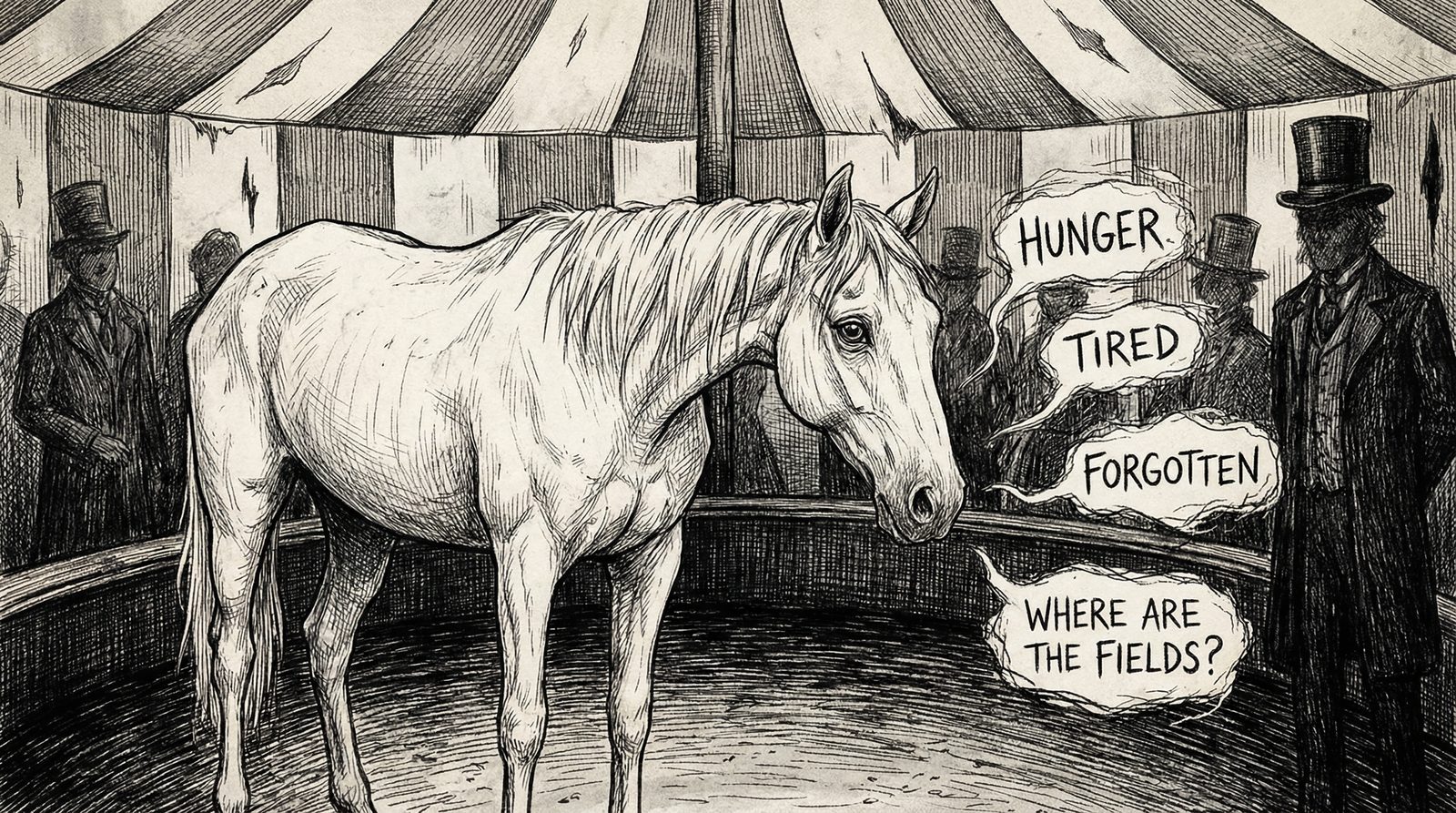
    The title story is a perfect example. A horse that can speak should be a marvel. In Anstey’s hands, it becomes a problem to monetize, a freak to manage, and an inconvenience to punish when it stops being profitable. That pattern repeats across the volume in different keys. The targets are familiar Victorian anxieties: class performance, social cruelty practiced as “good sense,” and the way polite society turns any disturbance into a spectacle it can control.

    PLOT & THEMES

    In “The Talking Horse,” a dealer acquires a horse capable of articulate speech. The discovery is treated not as a mystery but as a business opportunity. The animal’s intelligence is acknowledged only to the extent it can be exploited. When it refuses to cooperate with the public performance expected of it, the human response is swift and ugly. The story’s bite lies in how quickly “civilized” characters revert to coercion the moment control is threatened.

    Across the other tales, Anstey keeps returning to the same social mechanism. Something unusual appears: an odd talent, a strange claim, an inconvenient truth. The surrounding world responds with a mix of fascination and hostility. People reframe the anomaly to fit their needs, their status, or their fears. Miscommunication becomes a kind of weapon. Characters talk past one another because it is safer than understanding what is actually being said.

    These stories rarely offer redemption. If there is a moral, it is not comforting. The collection suggests that cruelty is not an aberration in polite society. It is one of its stabilizing forces, a way of pushing the strange back into silence, whether the strange is a talking animal or an inconvenient human being.

    PROSE & NARRATIVE STRUCTURE

    Formally, the collection is varied but consistent in tone: brisk narration, sharp dialogue, and an eye for the small hypocrisies that make a scene sting. Anstey often stays close to a character’s perspective while letting the reader see more than the character understands. The comedy comes from that gap, and so does the unease.

    Most stories follow a familiar arc: setup, social escalation, reversal, and a short, bleak landing. Anstey’s endings are especially telling. He often avoids melodrama and finishes on a practical consequence: a relationship quietly damaged, a reputation altered, a life narrowed. The effect is less like a punchline and more like a door closing.

    At his best, Anstey makes the prose feel light while carrying something heavier underneath. The absurdity is real. So is the sense that laughter in these stories is often a way of keeping sympathy at a safe distance.

    Conceptual editorial illustration inspired by 'The Talking Horse and Other Tales'

    CHARACTERS & INTERIORITY

    Because these are short tales, character interiority is usually drawn through behavior rather than introspective depth. Anstey’s people are recognizable types: respectable bullies, social climbers, timid enablers, and the occasional outsider whose difference becomes the story’s trigger. The point is not psychological realism. The point is social exposure.

    The talking horse is the most memorable consciousness in the volume precisely because it cannot be folded neatly into the human world around it. Its articulation does not earn it dignity. It earns it punishment. That pattern echoes through the collection: the “anomalous” character becomes a test of the community, and the community repeatedly fails the test.

    If there is compassion here, it is delivered obliquely, through irony that occasionally breaks and reveals something like regret. The stories understand how lonely it is to be the wrong kind of different in a world that claims to prize refinement.

    LEGACY & RECEPTION

    This collection is not the center of Anstey’s reputation, but it’s an excellent window into his method. It shows how well he could compress a social satire into a strange premise, and how comfortable he was letting comedy turn sour. In that sense, the book sits neatly beside his longer works: the same interest in what respectability hides, and the same impatience with moral posturing.

    Read now, the stories can feel surprisingly modern in their understanding of spectacle and exploitation. They anticipate a later world where anything unusual is instantly turned into content, and where empathy is often the first thing sacrificed for entertainment.

    IS IT WORTH READING?

    Yes, if you like short fiction that is funny in the moment and a little bruising afterward. The collection is uneven, as most collections are, but its best pieces are sharp and memorable. It is also valuable if you are following the Victorian-to-Edwardian tradition of social satire and want a version that uses the fantastic not for escape, but for exposure.

    Illustration inspired by a core idea from 'The Talking Horse and Other Tales'

    TRIVIA & AUTHOR FACTS

    F. Anstey was the pen name of Thomas Anstey Guthrie, a barrister-turned-writer known for comic and satirical fantasy. The collection appeared in multiple editions, including a “new edition” published in 1901 by Smith, Elder & Co. (many modern scans derive from that printing).

    SIMILAR BOOKS

    If you enjoy social cruelty rendered as comedy, Saki’s short stories make a natural companion. For a different, more psychologically tender approach to social observation, Katherine Mansfield’s short fiction offers an instructive contrast. And for Victorian and Edwardian satire that uses the strange to expose the ordinary, Anstey’s own longer fantasies, including The Brass Bottle and The Tinted Venus, sit in the same family resemblance.

    DISCOVERABILITY & LINKS

  • Writer Held Captive

    Writer Held Captive

    DEFINITION & CORE IDEA

    The Writer Held Captive motif traps an author in a literal prison, usually at the mercy of someone who claims to care about their work. The writer is locked in a room, a house, or a basement, cut off from the outside world and forced to write, rewrite, or confess. Their creative mind becomes the only tool they have left, and often the only thing their captor really wants.

    Stories like Misery (1987), The Collector (1963), and Secret Window are classic examples. The captor might be a devoted fan, a resentful relative, a jealous rival, or a stranger with a grudge. What they share is a sense of entitlement to the writer’s time, talent, and inner life. The writer’s body is confined, but the real battleground is the story itself – who gets to decide what happens next, on the page and in the room.

    At its core, the Writer Held Captive motif is about control over narrative. It literalizes the fear that readers, editors, or society at large might try to own an author’s imagination. The writer’s survival depends on how well they can read their captor, shape a story that keeps them alive, and maybe smuggle a plan for escape between the lines.


    HOW IT WORKS IN STORIES

    In most versions of Writer Held Captive, the story begins with some kind of accident or vulnerability. The author might be injured in a car crash, lured to a remote meeting, or simply wake up in a locked room. The early chapters focus on disorientation and gratitude. That slow realization that the “rescuer” or “host” is also the jailer is central to the tension.

    Once the captivity is clear, the story shifts into a psychological chess match. The writer has very little physical power, so their main weapon is language. They flatter, stall, negotiate, and improvise plots that might calm the captor or buy time. The captor, in turn, uses access to food, medicine, or freedom as leverage for more pages. Every chapter written becomes a kind of blood payment.

    The space itself often feels like a twisted version of a retreat. It looks like the ideal place to get work done, except the door locks from the outside. This is where the motif intersects with Caretaker As Captor. The captor might cook meals, change bandages, or cheer on the writer’s progress, all while tightening their control. Care and cruelty blur together.

    Another engine of the plot is obsession with the work. The captor has strong opinions about how a series should end, which characters deserve to live, or what the writer “really meant” in a story. That is where Writer Held Captive can overlap with Enthusiasm As Infrastructure. The captor’s devotion and knowledge of the work become the scaffolding that holds the whole prison in place. Without their obsessive reading, there would be no kidnapping, no demands, no forced rewrites.

    Escape attempts, whether physical or psychological, structure the middle of the narrative. The writer might hide messages in the manuscript, test the captor’s boundaries, or deliberately write something that will provoke a mistake. The climax usually comes when the story on the page and the story in the room collide, forcing both writer and captor to act out the ending they have been arguing about.


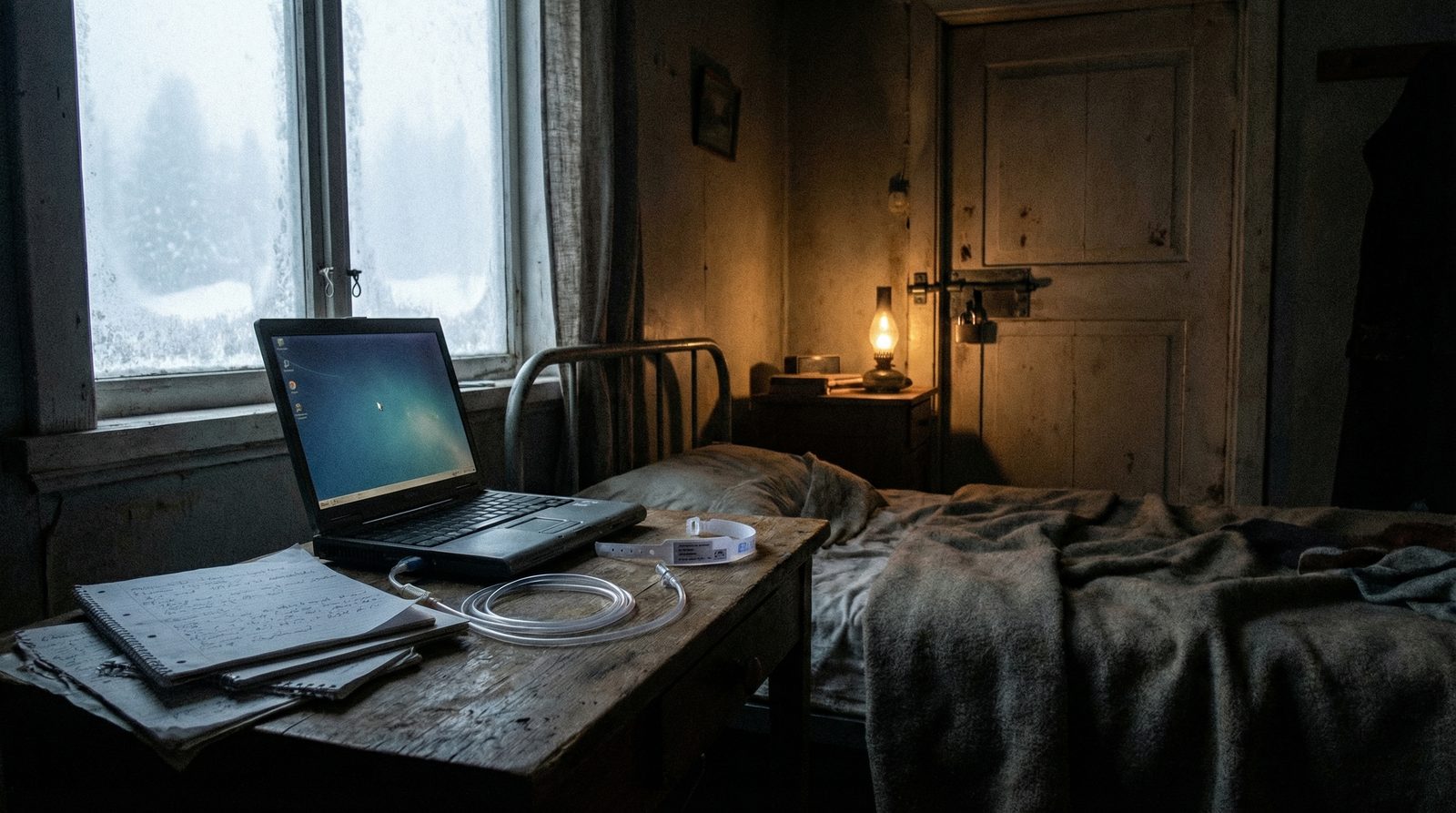
    Editorial illustration inspired by 'Writer Held Captive'

    EMOTIONAL EFFECT ON THE READER

    Reading a Writer Held Captive story feels like being locked in the room with the author. The physical confinement creates a steady thrum of claustrophobia. The smallness of the setting makes every conversation feel high-stakes, because there is nowhere else to go.

    There is also a strange intimacy. We watch the writer at their most vulnerable. Fans who love books may feel an uncomfortable jolt of recognition in the captor’s passion. The line between “I care deeply about this story” and “I want to control the person who made it” becomes disturbingly thin.

    At the same time, the motif can be darkly funny or self-aware. When the writer is forced to resurrect a character they killed off, or to explain a plot hole under threat, it pokes at the awkward relationship between creators and their audiences. Readers may feel both sympathy for the author and a twinge of guilt about their own expectations.

    Emotionally, the payoff often comes from watching the writer reclaim some control. Even if their body is trapped, the moment they outthink the captor or twist the demanded story into something subversive feels like a small liberation. The motif leaves readers thinking about who really owns a story once it leaves the writer’s desk, and what it costs when that ownership turns into a cage.


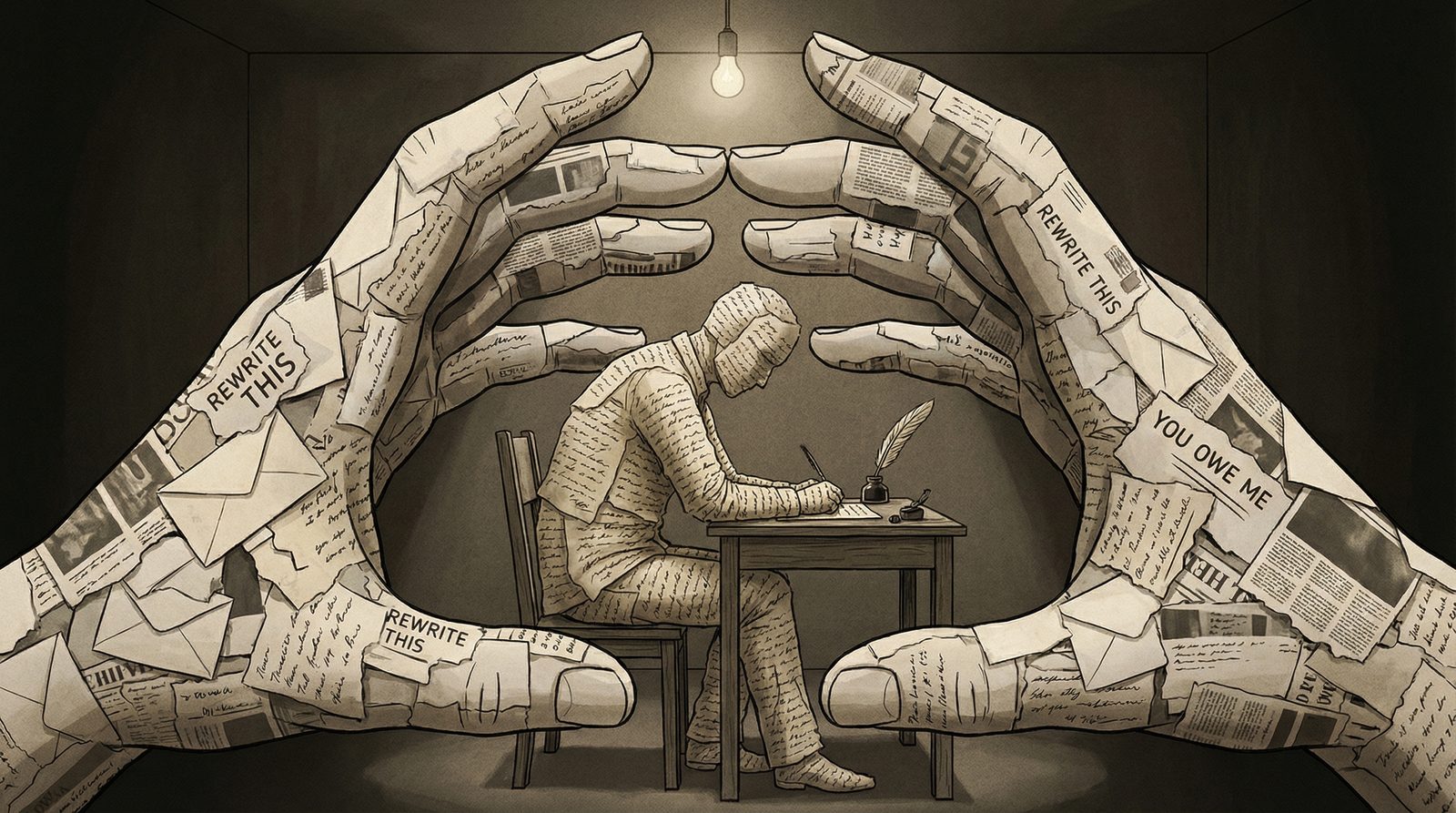
    Symbolic illustration inspired by 'Writer Held Captive'

    VARIATIONS & RELATED MOTIFS

    Not every Writer Held Captive story looks like a thriller. Some versions are quieter, almost domestic. The writer is trapped in a relationship, a contract, or a patronage arrangement that feels like a kind of house arrest. The captor might be a spouse, a parent, or a publisher who controls money and access rather than locks and chains. The captivity is still real, but it is social and economic instead of purely physical.

    Another variation blurs the line between captor and muse. The writer may believe they need this intense, controlling presence to create their best work. The captor becomes a twisted collaborator, feeding ideas and demands. This can slide into psychological horror, where it is not clear whether the writer is being coerced, seduced, or both.

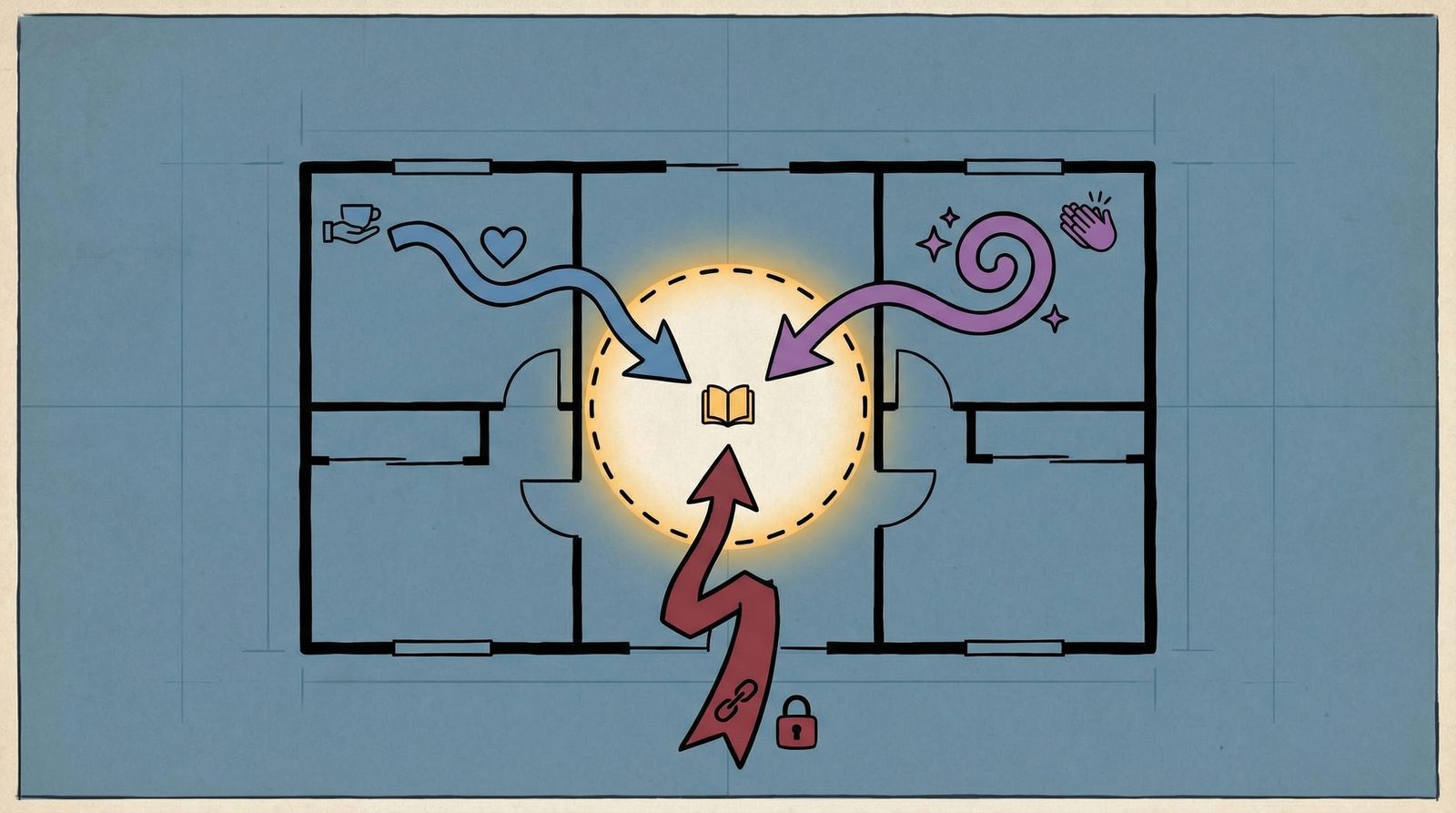
    When the captor is also a caregiver, the motif overlaps strongly with Caretaker As Captor. The writer might be injured, ill, or addicted, and the person who keeps them alive also keeps them locked in. The power imbalance is justified as “for your own good,” which makes the situation harder to escape and morally murkier for the reader.

    On the other side, when the captor is a superfan or critic, the story intersects with Enthusiasm As Infrastructure. The captor’s detailed knowledge of the writer’s work becomes the architecture of the prison. Their enthusiasm is the scaffolding that supports their control.

    Related motifs include stories where artists are exploited by patrons, celebrities are stalked by admirers, or prisoners must perform to survive. Writer Held Captive sits at the crossroads of those ideas, turning the act of storytelling itself into a survival game and asking who gets to hold the pen when the door is locked.

  • Rapid Weight Loss And Body Decay

    Rapid Weight Loss And Body Decay

    DEFINITION & CORE IDEA

    Rapid Weight Loss And Body Decay is a motif where a character’s body starts to waste away at an unnaturally fast pace. Flesh shrinks, bones jut out, skin discolors or hangs loose, teeth loosen, hair falls out. The change is visible, undeniable, and usually unstoppable. It is not just about being thin; it is about the body clearly failing, like a machine burning itself out.

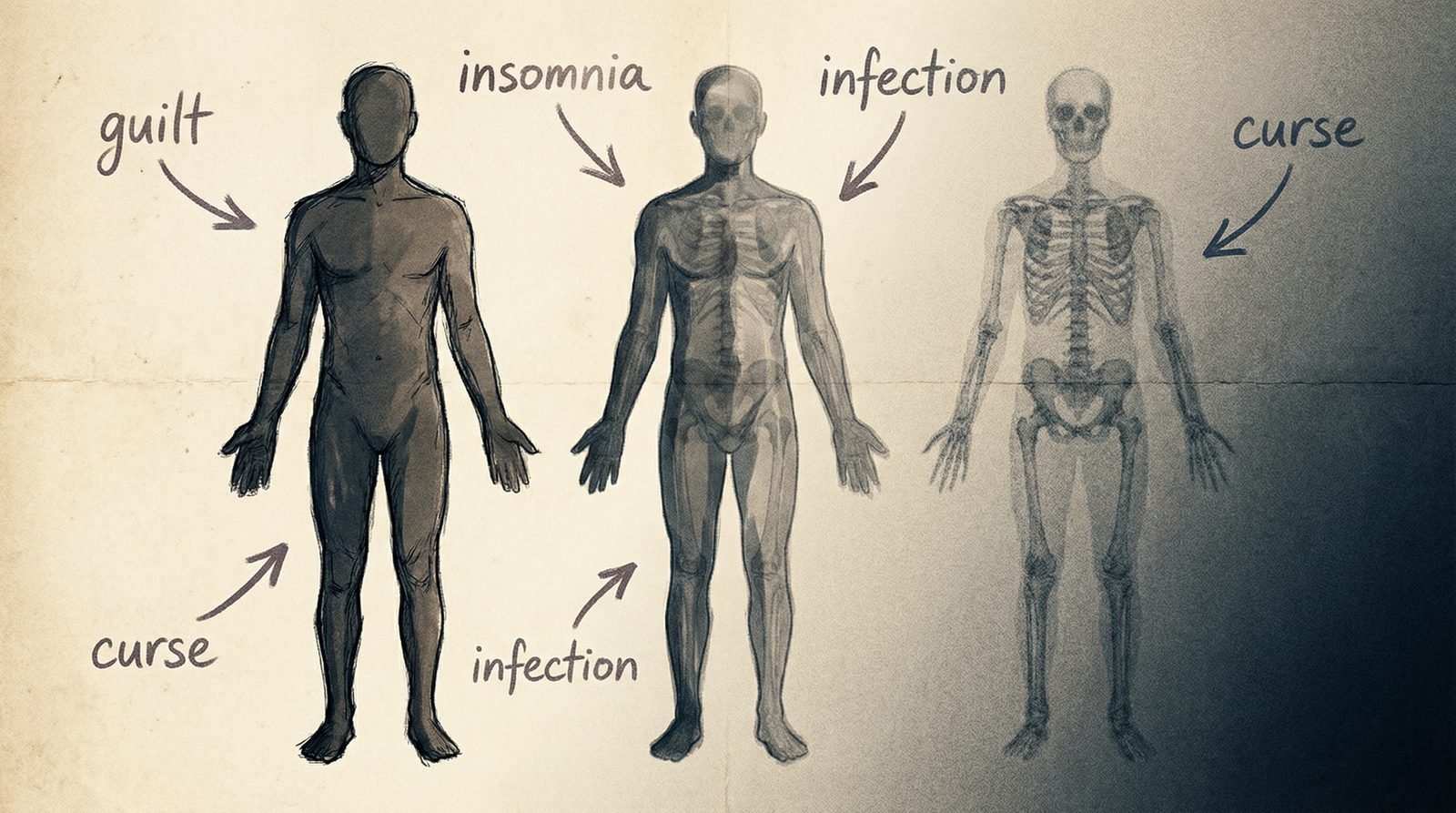
    Stories use Rapid Weight Loss And Body Decay to make inner problems show up on the outside. A curse, a disease, a parasite, an experiment gone wrong, or untreated guilt can all manifest as a body that is literally disappearing. In Thinner (1984) and its film adaptation, the wasting is a supernatural punishment that keeps going no matter how much the character eats. In The Machinist, the main character’s skeletal frame mirrors his insomnia, paranoia, and buried secrets. In The Troop, the body decay comes from an invasive horror that turns hunger and weight loss into something monstrous.

    This motif sits at the intersection of body horror and psychological terror. It takes something many people quietly fear – illness, aging, loss of control over their own body – and accelerates it. The body becomes a visible countdown clock, a daily reminder that time is running out and that something is deeply wrong, whether in the world, in the mind, or in the character’s past.


    HOW IT WORKS IN STORIES

    Rapid Weight Loss And Body Decay usually begins with small, easy-to-dismiss signs. A character drops a few pounds without trying, feels oddly tired, or notices their clothes hanging looser. At first they may be flattered or mildly concerned. The reader knows better, because every sentence about a loose waistband or hollowed cheek feels like the start of something worse.

    The story then escalates. The character eats constantly and still loses weight, or they cannot keep food down, or something inside them is devouring every calorie. Medical tests come back normal, or show something baffling. Doctors shrug, or the hospital becomes another stage for humiliation as strangers comment on the character’s appearance. The ordinary logic of diet and health breaks down, which is part of the horror.

    Writers often tie the decay to a specific cause. In supernatural horror like Thinner, the wasting is a curse laid on a guilty protagonist, a physical form of judgment that cannot be reasoned with. In psychological stories like The Machinist, the body reflects an inner collapse: sleeplessness, guilt, and trauma etch themselves into bone and skin. In creature or infection horror like The Troop, the decay comes from a parasite or experiment, turning the human body into a laboratory for something hungry and inhuman.

    As the Rapid Weight Loss And Body Decay accelerates, relationships strain. Friends and family may stage interventions, accuse the character of having an eating disorder, drug problem, or mental break. The character might lie about their condition, hide their body under layers of clothing, or isolate to avoid pitying or horrified stares. Everyday tasks become exhausting. Mirrors turn into enemies.

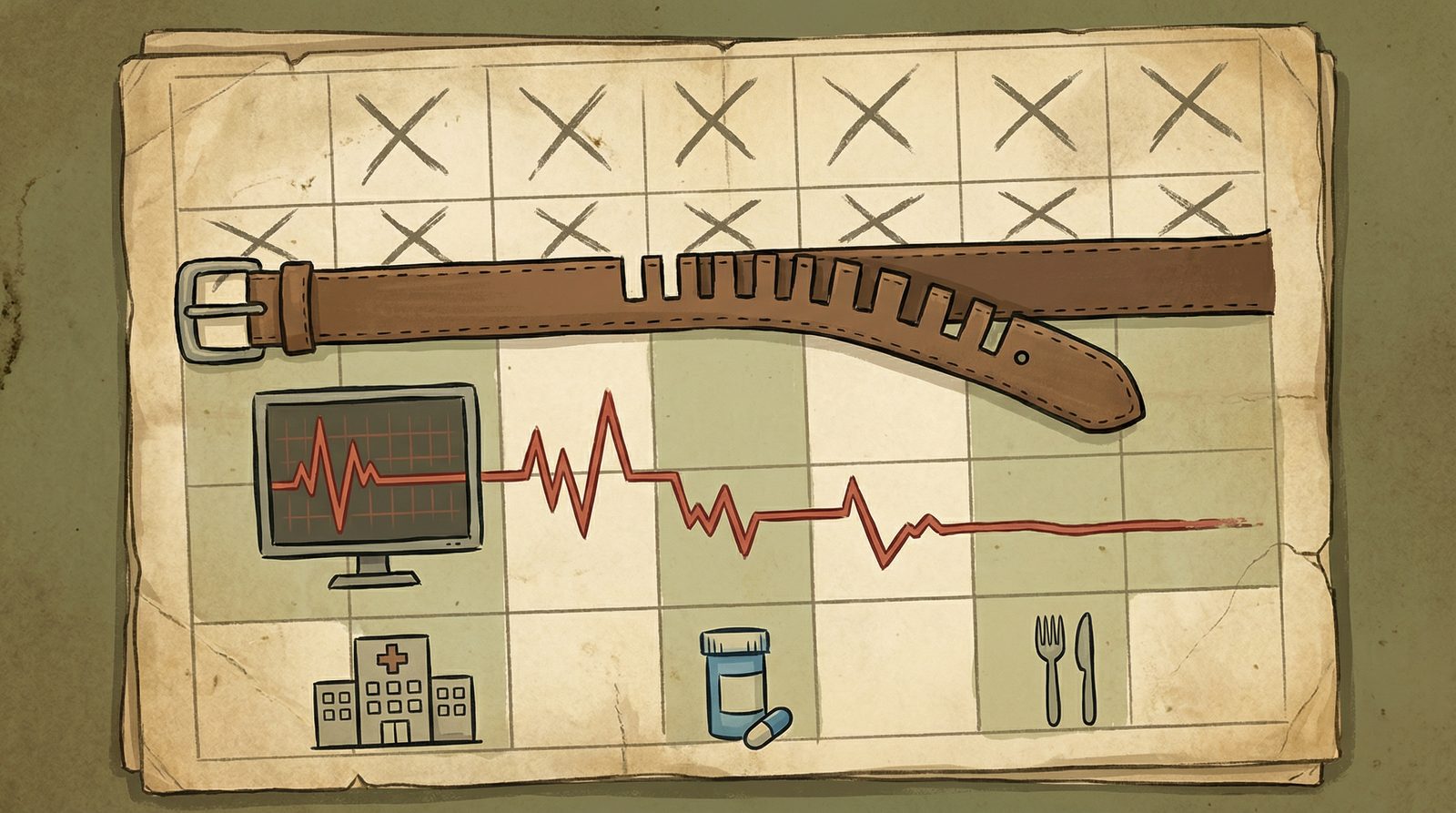
    Structurally, the motif gives the story a built-in ticking clock. The reader can see the stakes rising just by how the character looks and moves. Each chapter can mark a new threshold – another notch on the belt, another comment from a stranger, another failed attempt to reverse the process. The question becomes how far the body will go before the character breaks, confesses, or is consumed.


    Editorial illustration inspired by 'Rapid Weight Loss And Body Decay'

    EMOTIONAL EFFECT ON THE READER

    Rapid Weight Loss And Body Decay hits readers in a very physical way. It is hard not to imagine your own body when you read about someone else’s shrinking, bruising, or failing. The descriptions can trigger a mix of disgust, fascination, and dread. You may want to look away, but you also want to know how far it will go.

    There is also a strong current of helplessness. Watching a character do everything right – eating, resting, seeking help – and still deteriorate taps into fears about cancer, wasting diseases, or any illness that does not care how “good” you are. When the decay is tied to guilt or punishment, as in Thinner, the feeling gets even more complicated: you might think the character deserves it, yet still flinch at every new detail of their suffering.

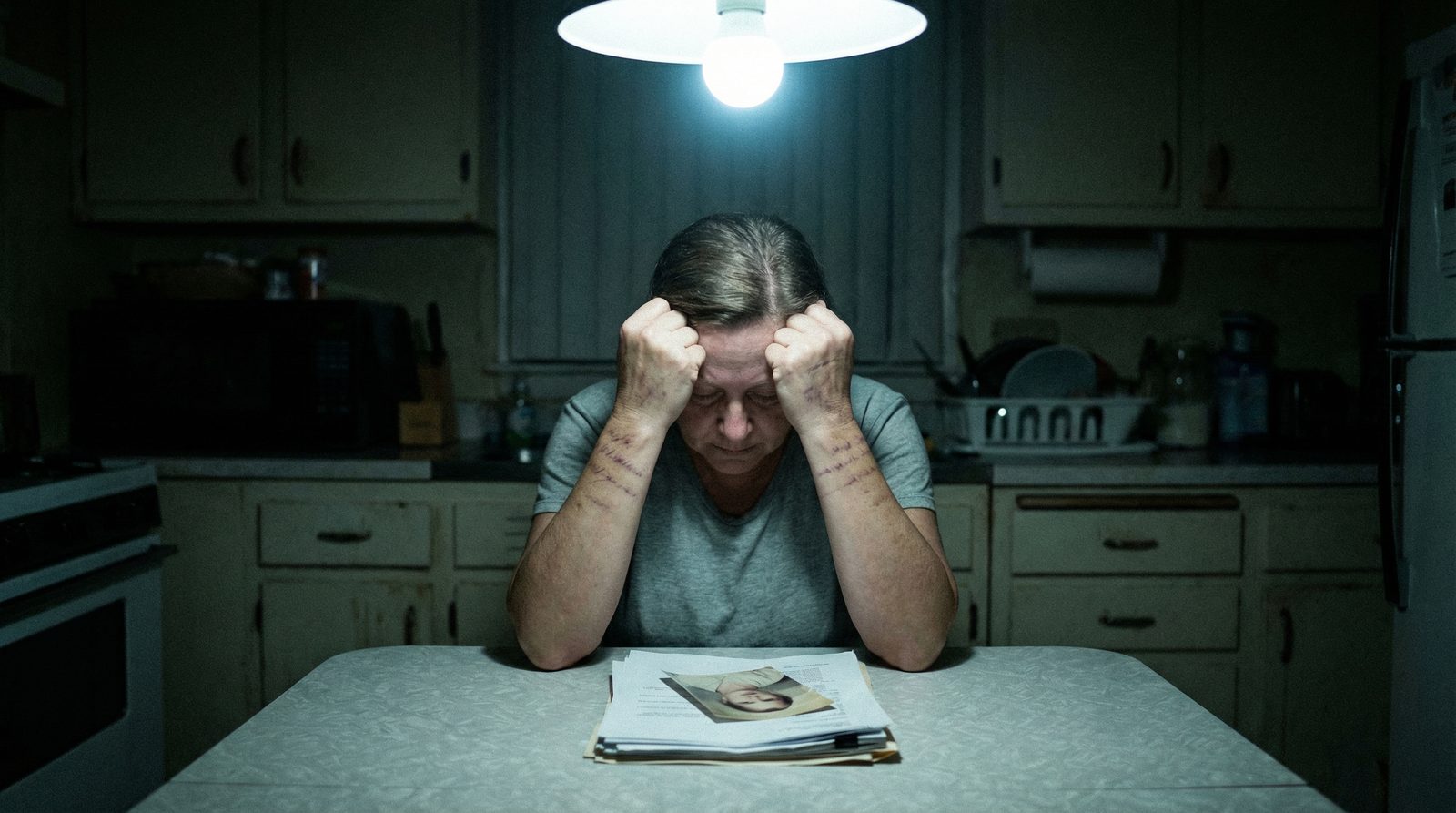
    Shame is another powerful note. As the body changes, the character often feels exposed and judged. Scenes where they try to hide their frame, avoid being touched, or endure comments about their appearance can be more painful than the outright horror. Readers who have ever felt out of control in their own bodies may recognize that embarrassment and anxiety, even if the story itself is fantastical.

    At the same time, Rapid Weight Loss And Body Decay can stir a strange sympathy. The character is literally stripped down, defenses and vanity falling away along with the pounds. That vulnerability can make their confessions, reconciliations, or last acts hit harder. Even in the bleakest horror, there is often a moment where the reader feels the full weight of the character’s humanity, right as the body is failing them most.


    Symbolic illustration inspired by 'Rapid Weight Loss And Body Decay'

    VARIATIONS & RELATED MOTIFS

    Rapid Weight Loss And Body Decay shows up in several distinct flavors. One common variation is the cursed punishment story, like in Thinner, where the wasting is a moral sentence. The character’s shrinking body becomes a public confession of their crime. This can intersect with motifs about guilt made visible or supernatural justice, where the body tells the truth the character would rather hide.

    Another variation is the psychological spiral, as in The Machinist. Here, the focus is less on gore and more on how mental strain writes itself onto the body. Rapid Weight Loss And Body Decay overlaps with motifs about unreliable narrators, trauma resurfacing, and insomnia as unraveling. The reader is left wondering how much of the decay is real and how much is filtered through a damaged mind.

    There is also the parasitic or scientific horror version, like The Troop, where the decay is caused by infection, experiment, or alien biology. This ties Rapid Weight Loss And Body Decay to motifs such as body as laboratory, contagion, and the commodified body, where human flesh is just another resource to be used, altered, or consumed.

    Finally, the motif can blend with more grounded narratives: medical dramas about aggressive illness, or realistic stories about eating disorders and self-destruction. In those cases, Rapid Weight Loss And Body Decay intersects with motifs of survival as performance, family caretaking, and the failing body. The horror is quieter but often more emotionally devastating, because it feels so close to real life.

    Across all these variations, the core remains the same: a body that is vanishing too quickly, turning private fears and hidden sins into something you cannot help but see.

  • Curses As Moral Punishment

    Curses As Moral Punishment

    DEFINITION & CORE IDEA

    In the motif of Curses As Moral Punishment, a character is singled out by a supernatural force and punished specifically for a moral failing. The curse is not random bad luck. It is framed as justice, payback, or a lesson, often delivered by a wronged person, a vengeful spirit, or some cosmic law the character did not know they were breaking.

    This motif turns ethics into something with teeth. A lie, a hit-and-run, a cruel joke, a greedy wish, a broken promise – instead of being handled by courts or social fallout, these choices trigger a spell that warps the character’s body, life, or reality. In Thinner (1984) and its adaptation, the curse literally wastes the protagonist away as punishment for his crime. In Drag Me To Hell and Wishmaster, characters are condemned or twisted for selfish choices and careless cruelty.

    Writers use Curses As Moral Punishment when they want the story’s universe to feel like it has a conscience. The curse is a visible, often grotesque embodiment of guilt, hypocrisy, or corruption. It says: what you did matters so much that reality itself will not let it slide. Whether that feels fair, ironic, or horrifying is part of the tension that keeps readers hooked.


    HOW IT WORKS IN STORIES

    Curses As Moral Punishment usually starts with a transgression. Someone is wronged, a taboo is broken, or a character’s selfishness crosses a line. The story may linger on how “minor” the offense seems at first, which makes the later punishment feel shocking or darkly ironic. The curse is often delivered in a charged moment: a confrontation, a funeral, a refusal to help, a cruel decision made under pressure.

    Once the curse lands, the plot shifts into a mix of mystery, negotiation, and chase. The victim first dismisses what is happening as coincidence. As the pattern becomes undeniable, they scramble to understand the rules. Who cursed them? Why this specific punishment? Is there a loophole? In Thinner, the weight loss seems like a blessing before it becomes a death sentence. In Drag Me To Hell, the cursed character cycles through denial, bargaining, and desperate attempts to pass the doom onto someone else.

    The curse often escalates in stages. Each new symptom or setback forces the character to confront what they did and how far they are willing to go to escape consequences. They might try conventional fixes (doctors, lawyers, police) and find them useless against supernatural rules. This is where Curses As Moral Punishment overlaps with Corrupt Justice And Supernatural Retribution: once human systems fail or prove inadequate, something older and harsher takes over.

    Stories can play with responsibility and fairness. Sometimes the cursed person truly deserves it, and the narrative leans into grim satisfaction. Other times, the punishment is wildly excessive or falls on someone only partly at fault, raising questions about who gets blamed in a broken world. The climax often forces a choice: confess, sacrifice, pass the curse to someone else, or accept ruin. There is rarely a clean option.


    Editorial illustration inspired by 'Curses As Moral Punishment'

    EMOTIONAL EFFECT ON THE READER

    Curses As Moral Punishment hits a nerve because it turns private guilt into something you cannot hide. The character’s secret or flaw is dragged into the open, often through their own body or their luck falling apart. Readers feel a mix of dread and voyeurism watching someone’s inner rot become visible. It taps into the childhood fear that if you do something bad, the universe will “get you” – only now it is literal and merciless.

    This motif also creates a nagging question: how much punishment is enough? As the curse unfolds, it invites readers to judge the character’s original sin and every choice they make afterward. There can be a grim satisfaction when a smug or cruel person finally faces consequences, as in parts of Wishmaster. At the same time, many stories lean into discomfort, making the punishment feel so extreme that we start to pity the cursed, even if they were wrong.

    Because the curse often cannot be solved by logic or force, there is a strong feeling of helplessness. The character is trapped in a moral maze where every exit demands a sacrifice. That claustrophobic tension is part of the appeal. Readers are pushed to imagine what they would confess, who they would sacrifice, or what they would endure to escape a similar fate. The result is horror that lingers as self-examination, not just jump scares.


    Symbolic illustration inspired by 'Curses As Moral Punishment'

    VARIATIONS & RELATED MOTIFS

    Curses As Moral Punishment can take many forms. In some stories, the curse mirrors the crime: a liar finds their tongue twisting against them; a voyeur is forced to watch their own downfall; a hit-and-run driver’s body slowly deteriorates in a way that echoes their victim’s injuries. In others, the connection is more symbolic or ironic, like a greedy wish being granted in a way that ruins the wisher’s life in Wishmaster. The curse might be inherited, punishing descendants for an ancestor’s sin, or contagious, forcing the cursed to decide whether to infect someone else to survive.

    Another variation plays with whether the curse is truly “moral” or just vindictive. In Drag Me To Hell, part of the horror comes from how debatable the protagonist’s guilt is, and how merciless the supernatural response becomes. Some stories reveal that the curse-giver is corrupt or petty, twisting the motif into a critique of who gets to define morality in the first place.

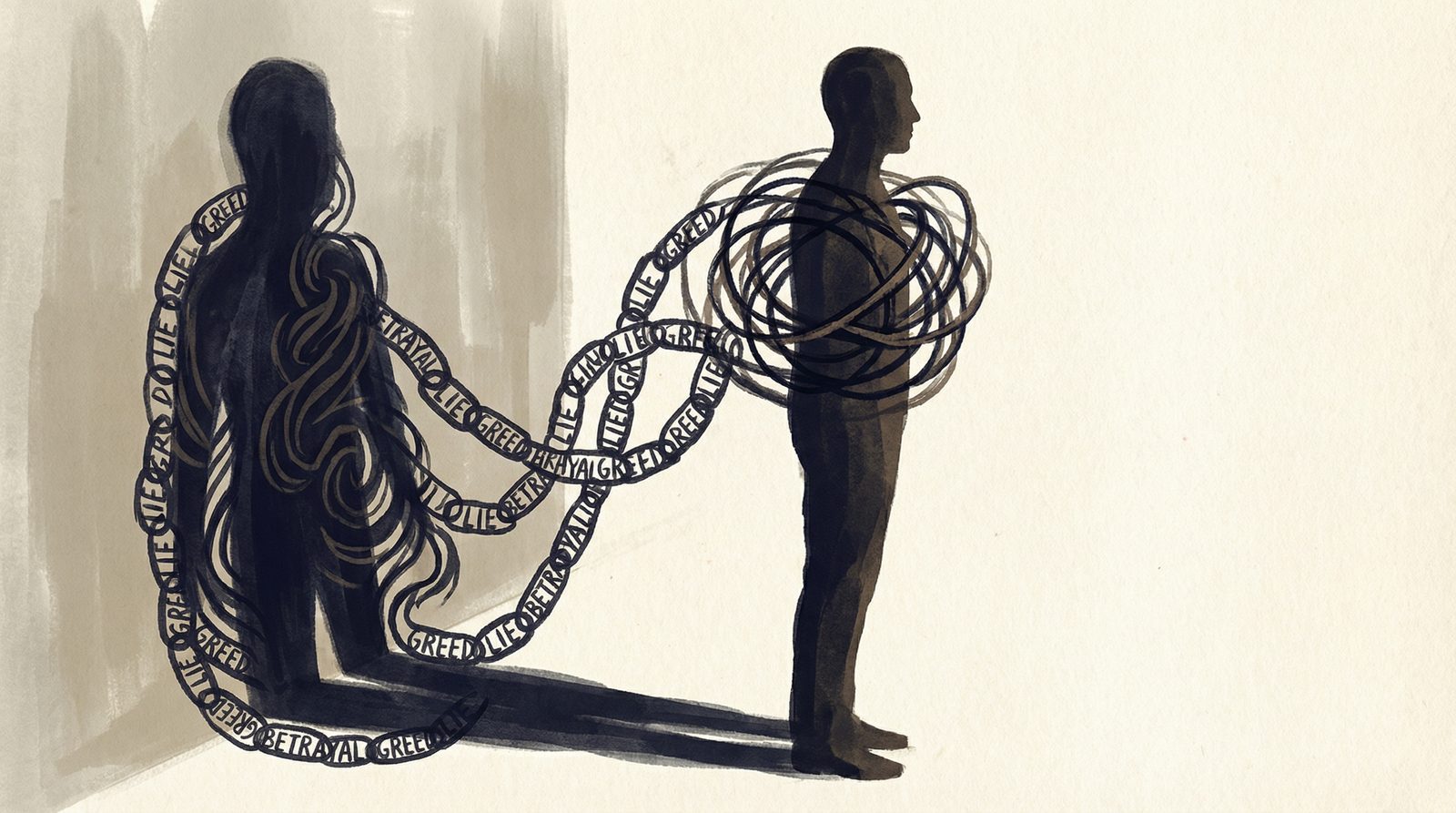
    This motif often intersects with Corrupt Justice And Supernatural Retribution. When courts, police, or social systems fail, the curse steps in as a brutal stand-in for justice. It can also overlap with motifs like Faustian bargains, where the “punishment” is baked into the fine print of a wish, or with haunted objects, where using a cursed item triggers a tailored moral backlash.

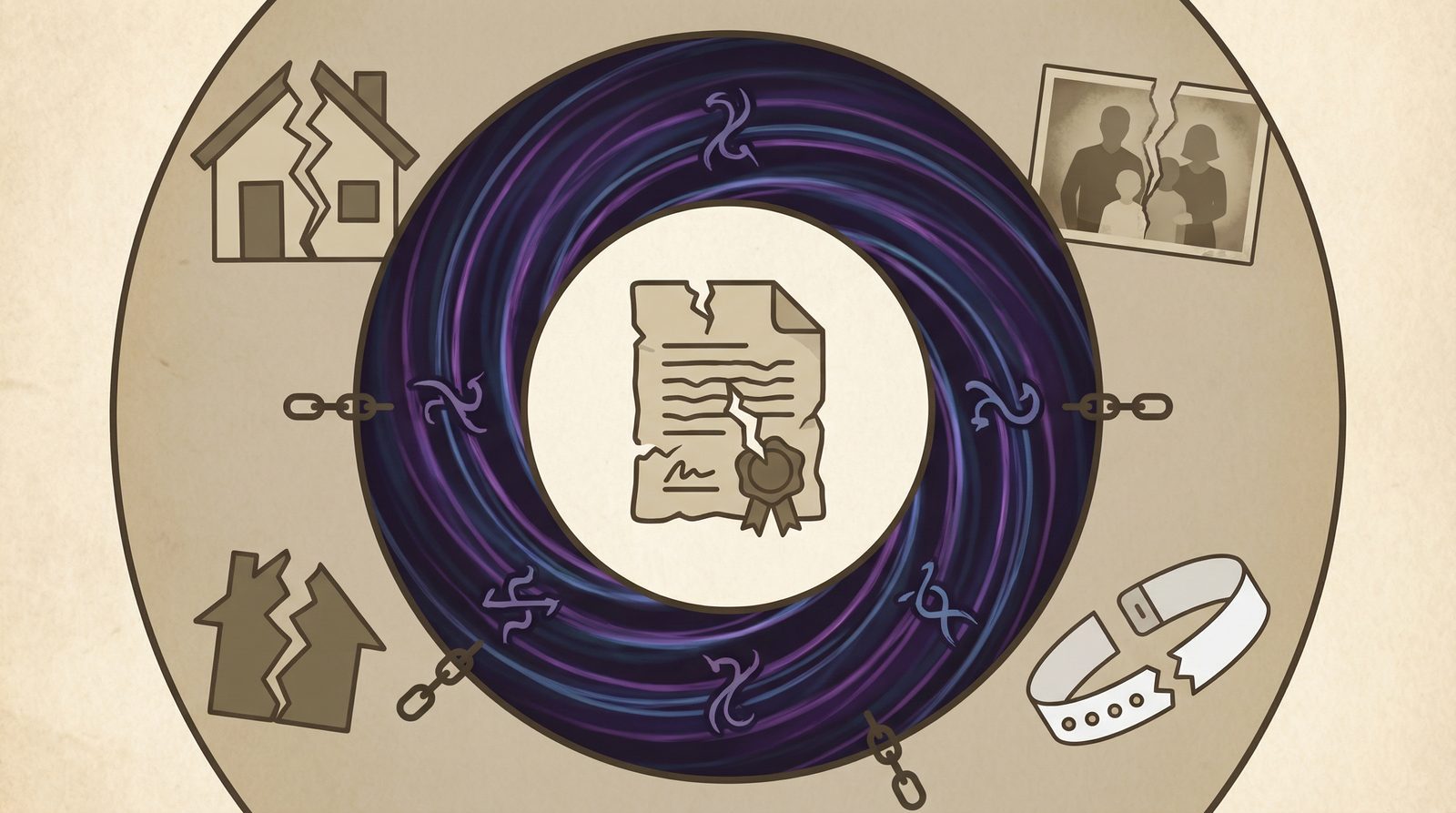
    Writers can soften or sharpen the motif by adjusting the possibility of redemption. Some stories allow the cursed character to break the spell through sincere atonement, confession, or sacrifice. Others lock the rules so tightly that no apology can help, turning Curses As Moral Punishment into pure tragedy, where the lesson is not how to escape, but how a single choice can warp a life beyond repair.

  • Ordinary People In Extreme Situations

    Ordinary People In Extreme Situations

    DEFINITION & CORE IDEA

    “Ordinary People In Extreme Situations” is a motif where the main characters start out as recognizably average. They do not have special training, magical powers, or elite status. They have jobs, families, debts, routines. Then something happens that rips them out of that routine and drops them into a situation they are completely unprepared for.

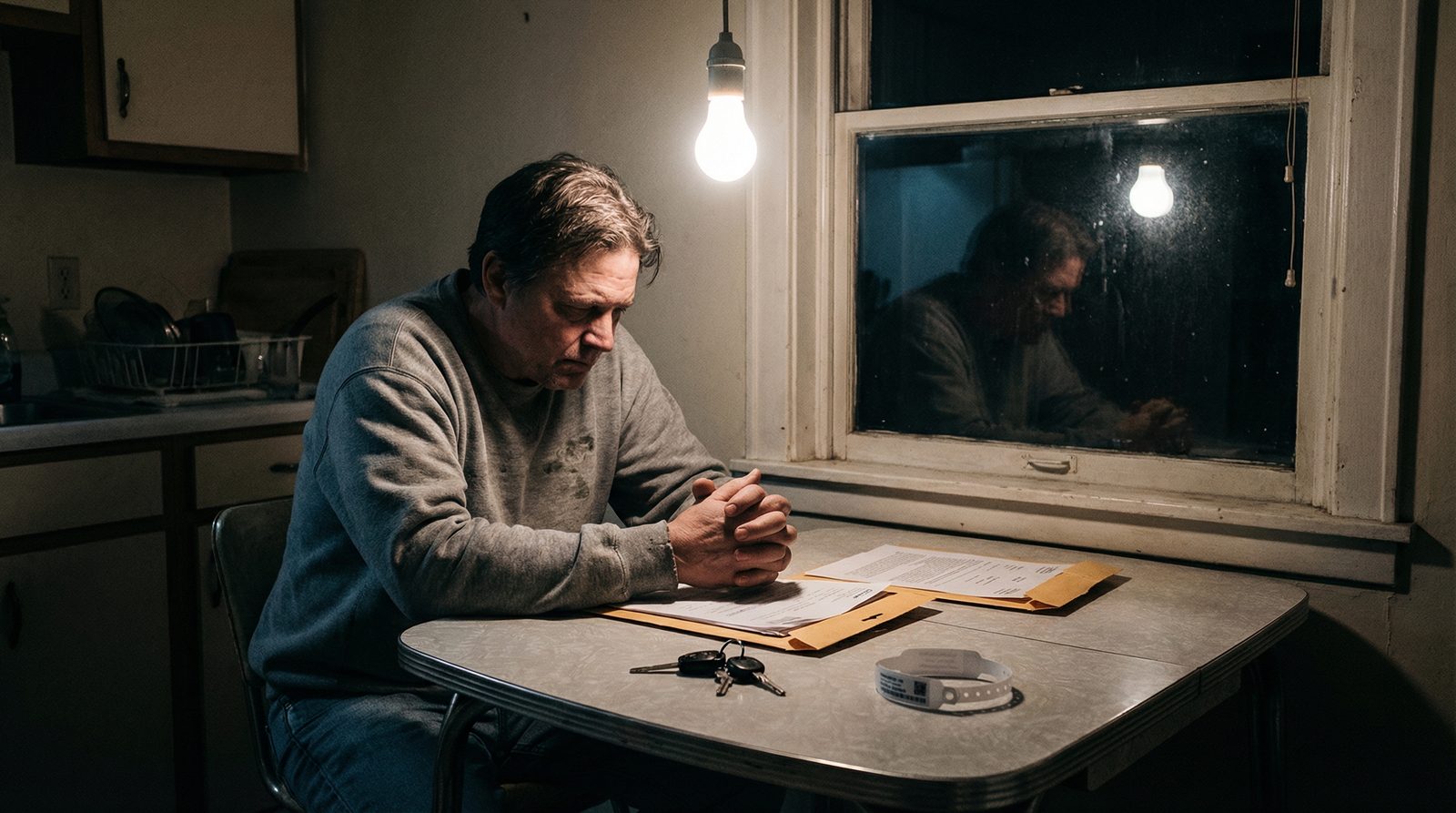
    The core idea is simple: take someone who could be your neighbor, then crank up the pressure until they either adapt, break, or transform. Stories like Misery, Pet Sematary, Thinner (1984), and Blaze (2007) often start with everyday people and then push them into horror, obsession, or moral collapse. The gap between the character’s ordinary life and their extreme new reality creates both tension and dark curiosity.

    Writers use this motif to explore what people might really do when stripped of comfort and control. It asks questions like: How far would you go to save someone you love? What would you sacrifice to survive? Which parts of your identity are solid, and which are just habits that fall apart under stress? “Ordinary People In Extreme Situations” lets readers test their own limits safely, from the other side of the page.


    HOW IT WORKS IN STORIES

    In stories built around this motif, the early chapters usually linger on normal life. We see commutes, family dinners, casual arguments, and familiar frustrations. This grounding is important. The more clearly the reader understands what “ordinary” looks like for this character, the more sharply they feel the rupture when everything goes wrong.

    The trigger can be external: a car crash, a kidnapping, a violent stranger, or a supernatural event. In Misery, a writer is just driving home when an accident strands him with a fan who quickly becomes his captor. In Thinner, a careless moment leads to a curse that turns a routine life into a desperate countdown. In Pet Sematary, a family’s move to a quiet town opens a door to grief and resurrection that no one is equipped for. Sometimes the trigger is more subtle – a slow economic squeeze, a spouse’s illness, the discovery of a buried secret that can’t be ignored.

    Once the extreme situation takes hold, the story narrows around hard choices. The ordinary person might have to hide a crime, bargain with something inhuman, endure captivity, or navigate a cruel new system that treats them like a pawn. Everyday skills suddenly matter in strange ways: a nurse’s training in a disaster, a mechanic’s knowledge in a breakdown, a parent’s stubbornness when a child is threatened. At the same time, their usual social supports often fail. Friends don’t believe them, authorities are useless, or the threat is too bizarre to explain.

    Structurally, the motif often moves through stages: disbelief, coping, adaptation, and fallout. The character may become more ruthless, more honest, or more broken than they ever imagined. The story keeps circling one question: who are you when there is no safe, ordinary life to retreat to?


    Editorial illustration inspired by 'Ordinary People In Extreme Situations'

    EMOTIONAL EFFECT ON THE READER

    The emotional pull of “Ordinary People In Extreme Situations” comes from recognition. Readers look at these characters and think, “That could be me.” The jobs, marriages, debts, and small frustrations feel familiar, so when the story twists into horror or high-stakes drama, it hits closer to home than tales about superheroes or trained agents. The fear is not abstract; it is the fear that your next routine drive, hospital visit, or shortcut through the woods could change everything.

    This motif often creates a mix of dread and grim fascination. There is tension in watching someone try to think their way through a nightmare using only the tools of an ordinary life. Readers might feel frustration when characters make bad decisions, then a jolt of empathy when they realize they might have done the same under that kind of pressure. Stories like Misery and Thinner lean on this uncomfortable identification: the protagonists are not saints or geniuses, just people trying to survive with very human flaws.

    There can also be a strange kind of catharsis. Seeing an average person endure captivity, grief, or moral crisis can make everyday problems feel smaller by comparison, or it can validate how fragile normal life really is. Some readers come away shaken, others oddly reassured by the resilience on display, even when the ending is tragic. The motif invites quiet self-interrogation: if the worst happened on an ordinary day, who would you actually be?


    Symbolic illustration inspired by 'Ordinary People In Extreme Situations'

    VARIATIONS & RELATED MOTIFS

    “Ordinary People In Extreme Situations” can tilt in many directions. Some versions are intimate psychological horror, like a single patient trapped with a caregiver who has too much power, as in Misery. Others are more supernatural, like Pet Sematary and Thinner, where a curse or uncanny place turns ordinary grief or guilt into something monstrous. A story like Blaze (2007) leans into crime and desperation, showing how poverty, bad luck, and one terrible idea can push a not-particularly-special person into kidnapping and violence.

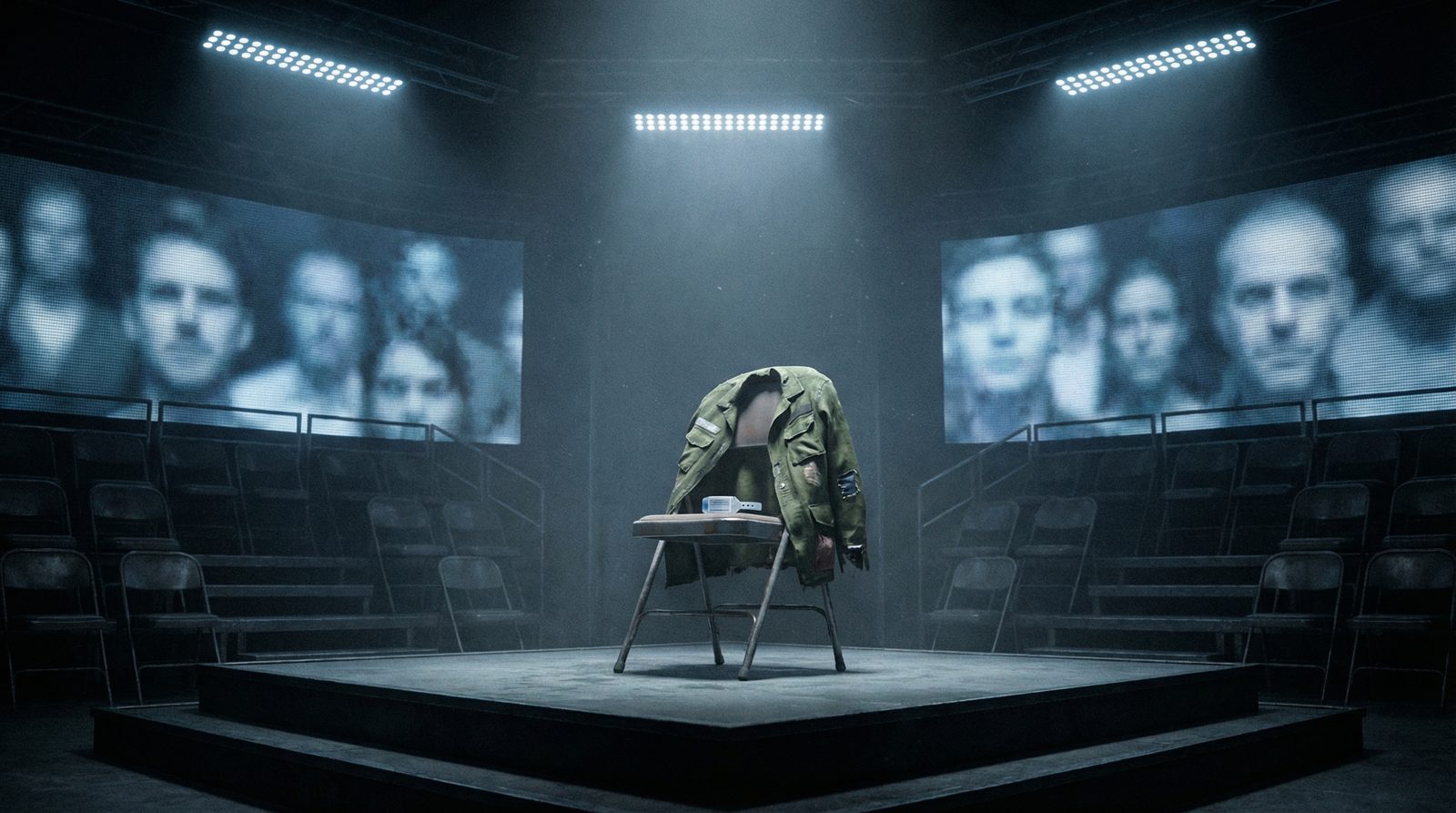
    Sometimes the focus is on survival in a twisted system. That is where this motif can intersect with Dystopian Game Shows, where regular contestants are forced to perform for their lives under rules they did not choose. In those stories, the extremity is not just the danger, but the way the whole world seems to watch and judge. Other times the emphasis is inward, overlapping with Identity Collapse In Isolation. A character cut off from normal social feedback may start to question who they are, what they are capable of, and whether the ordinary self they remember was ever real.

    There are hopeful variations, where the extreme situation reveals hidden strengths or prompts moral courage. There are bleak ones, where ordinary people crack, become cruel, or lose themselves entirely. Writers like Richard Bachman often favor the darker end of the spectrum, using the motif to show how thin the line can be between a life that looks normal from the outside and one that is quietly rotting under pressure. Across all these versions, the constant is the same: the story asks what happens when an average person is forced into a test they never signed up for.