Period: 20th Century

  • Dystopian Game Shows

    Dystopian Game Shows

    DEFINITION & CORE IDEA

    Dystopian game shows are stories where a rigged contest, reality show, or televised event becomes a matter of life and death. The rules look like entertainment, but the stakes are survival. Contestants run obstacle courses that can kill them, answer questions under threat of punishment, or hunt and are hunted for the amusement of a distant audience. The game is usually controlled by a powerful government, corporation, or media empire that treats human beings as disposable content.

    Unlike simple arena battles, dystopian game shows lean on the language of TV and celebrity. The cruelty is wrapped in bright lights and canned applause. The Running Man, written under the name Richard Bachman, is a classic example, where a desperate man signs up for a lethal televised manhunt. The surface promise is money and fame; the underlying reality is systemic exploitation.

    Writers use this motif to ask how far a society will go when suffering becomes a product. The format is familiar enough to feel plausible, yet twisted enough to be horrifying. Dystopian game shows exaggerate trends in reality TV, social media, and advertising to show what happens when entertainment and cruelty fully merge. At its core, the motif is about people trying to stay human while the world insists they are just contestants.


    HOW IT WORKS IN STORIES

    In dystopian game show stories, the plot often begins with a rigged choice. The protagonist volunteers out of desperation, is coerced, or is randomly selected. Like the men in Richard Bachman stories such as The Running Man, they are usually ordinary or down-on-their-luck people, not trained warriors. The show offers them a miracle: money, freedom, or a chance to clear their name. The price is stepping into a game designed to break them.

    The narrative then moves into the preparation and staging of the show. We see contracts, waivers, and fine print. We meet the smirking host, the ruthless producer, the faceless executives. The world of the game is full of artificial sets, hidden cameras, and scripted moments. Even genuine danger is choreographed for maximum spectacle. The protagonist quickly discovers that the rules are flexible and always favor the house.

    Once the game begins, the story turns into a survival puzzle. Challenges are designed to pit contestants against each other, force betrayals, or tempt them with shortcuts that have hidden costs. The show’s audience becomes a character in its own right. The protagonist might gain sudden popularity, become a villain in the public eye, or be erased entirely if they stop being useful for ratings.

    Behind the spectacle, the plot often reveals a larger conspiracy or social rot. The game show might be a tool of social control, a distraction from political collapse, or a way to dispose of “undesirable” people. The climax usually involves one of three things: beating the game on its own terms, exposing it to the public, or refusing to play by its logic at all. Whether the character lives or dies, the story asks what it means to be real in a world that only values you as content.


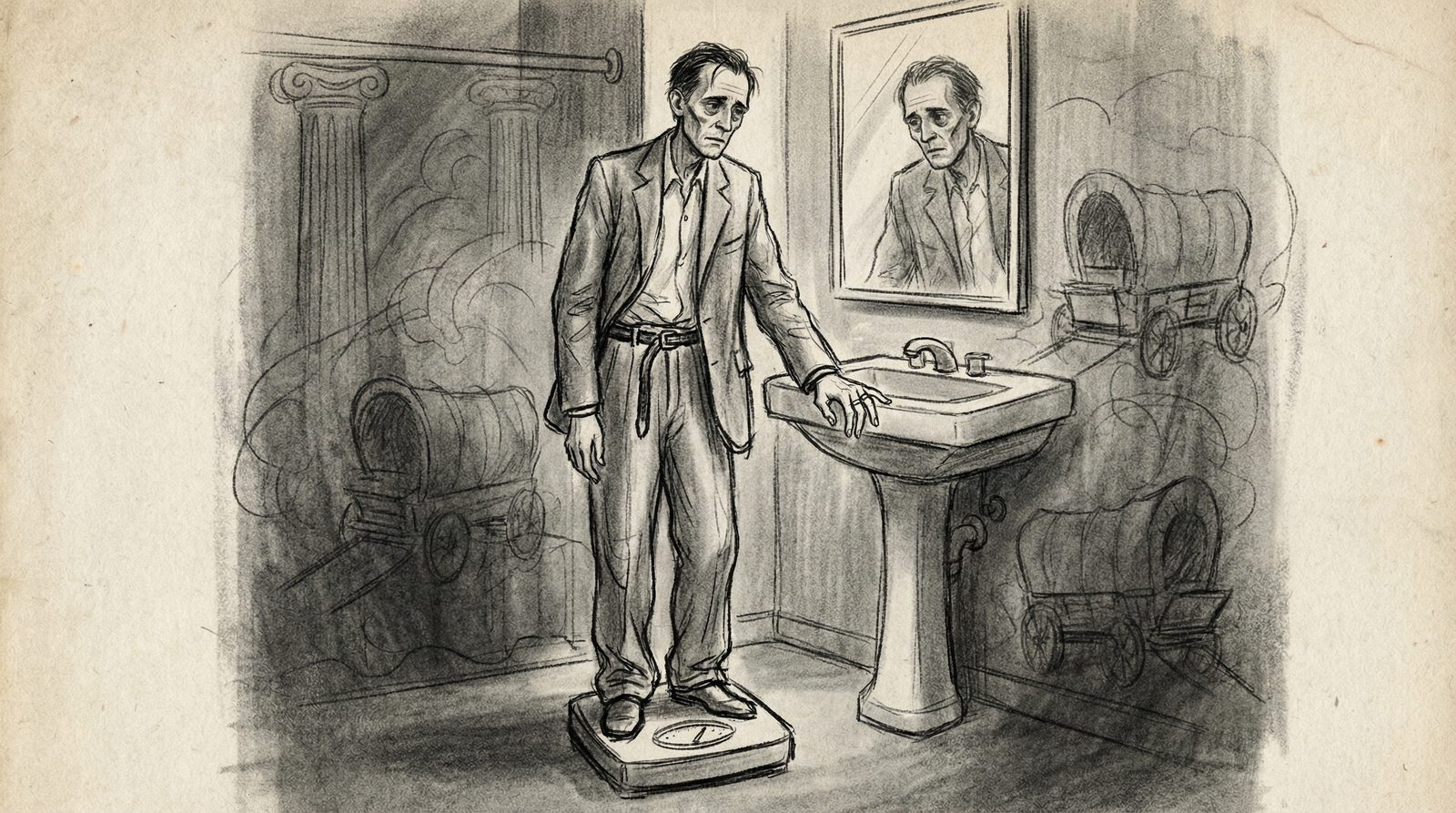
    Editorial illustration inspired by 'Dystopian Game Shows'

    EMOTIONAL EFFECT ON THE READER

    Reading dystopian game show stories often feels like watching a nightmare version of a reality show you half-recognize. There is a sickening mix of excitement and dread. The tension is not just “will they win,” but “how much of themselves will they have to lose to survive.”

    The motif taps into the uneasy feeling that our own media habits might be cruel. When a crowd in the story cheers for someone’s suffering, it is hard not to think of viral humiliation clips or scandal-driven news. That recognition can make the reader feel complicit, as if they are sitting in the studio audience, enjoying the show while knowing it is wrong.

    At the same time, there is often a strong emotional bond with the contestants. Their small acts of kindness, defiance, or humor stand out sharply against the artificial cruelty around them. Moments where characters refuse to betray each other, or choose dignity over survival, can hit harder precisely because the system is built to crush those choices. The result is a blend of adrenaline, anger, and a bruised kind of hope that someone will break the cycle, even if they pay for it.


    Symbolic illustration inspired by 'Dystopian Game Shows'

    VARIATIONS & RELATED MOTIFS

    Dystopian game shows can take many forms. Some stories focus on physical combat, turning the show into a gladiator arena with cameras. Others use puzzles, social manipulation, or moral dilemmas as the core challenge. A contestant might have to choose which loved one gets saved on live TV, or decide whether to expose a secret that will ruin innocent people. The tone can range from grimly realistic to darkly comic, with some works leaning hard into satire about advertising, celebrity culture, or class.

    There are also variations in how much the outside world matters. In some stories, the game is a closed bubble, and we only see what the cameras see. In others, the world beyond the show is just as bleak: the game is not an exception but a symptom of a larger sickness. The show becomes a pressure valve for a society that has already decided which lives are expendable.

    This motif overlaps strongly with Ordinary People In Extreme Situations. The contestants are rarely superheroes; they are regular citizens pushed into a twisted system. It can also intersect with motifs about the commodified body, survival as performance, or fame as a double-edged sword. A character might gain celebrity status while being slowly destroyed by the very show that made them famous.

    Some stories end with the game continuing, unchanged, emphasizing how hard it is to fight a system that turns everything into a show. Others let a single act of defiance ripple outward, inspiring viewers or exposing the truth. Either way, dystopian game shows linger because they feel uncomfortably close to the world we already live in, just pushed a few notches further past the point of no return.

  • Fargo (1996)

    Fargo (1996)

    Fargo (1996) directed by Joel Coen. Crime · 98 minutes · United States.


    INTRODUCTION

    Fargo (1996) occupies a strange, memorable space where true-crime ambience, small-town politeness, and sudden carnage share the same snowdrift. The feel is a mix of bleakness and cozy warmth: a world where people say “you betcha” while standing over a corpse. The Coen brothers take the familiar scaffolding of a regional crime thriller and strip it down until every gesture feels both absurd and inevitable. What begins as a simple-for-hire kidnapping spirals into a quiet tragedy about money, pride, and the limits of common sense. The film’s power lies in its contrast between the white emptiness of the Minnesota winter and the stubborn decency of Marge Gunderson, a pregnant cop who works the case with calm curiosity instead of macho swagger. Fargo feels like a campfire story told in a monotone, where the punchlines are funny until you realize how much blood they leave behind.

    PLOT & THEMES

    The plot of Fargo is a classic Coen setup: Jerry Lundegaard, a financially desperate car salesman, hires two criminals to kidnap his wife so he can split the ransom extracted from his wealthy father-in-law. This is the Crime gone wrong trope in its purest form. Every step of the plan is slightly stupid, slightly lazy, and slightly cowardly. That combination proves lethal. A routine traffic stop explodes into triple homicide, and what Jerry imagines as a clever workaround for his debts becomes a trail of bodies stretching across the frozen Midwest.

    The film’s central themes are greed, moral clarity, and the banality of evil. Jerry is not a mastermind; he is a small man with big panic, and Fargo insists that this kind of mediocrity is often what powers real-world cruelty. The White void of snow motif underlines how small these characters look against the landscape. Their crimes feel petty and pointless when framed against endless fields and empty highways.

    Opposite Jerry’s flailing is Marge Gunderson’s steady investigation. Her kindness is not naïve; When she quietly asks a killer why he did all this “for a little bit of money,” the film lands its thesis. Like Blood Simple before it, Fargo treats crime not as glamorous transgression but as a grubby extension of everyday selfishness. The Small-town decency motif, embodied in Marge and her community, becomes a moral counterweight to the spreading stain of violence. The feel is one of slow dread threaded with dry humor, a reminder that horror often arrives in a beige sedan, not a black limousine.
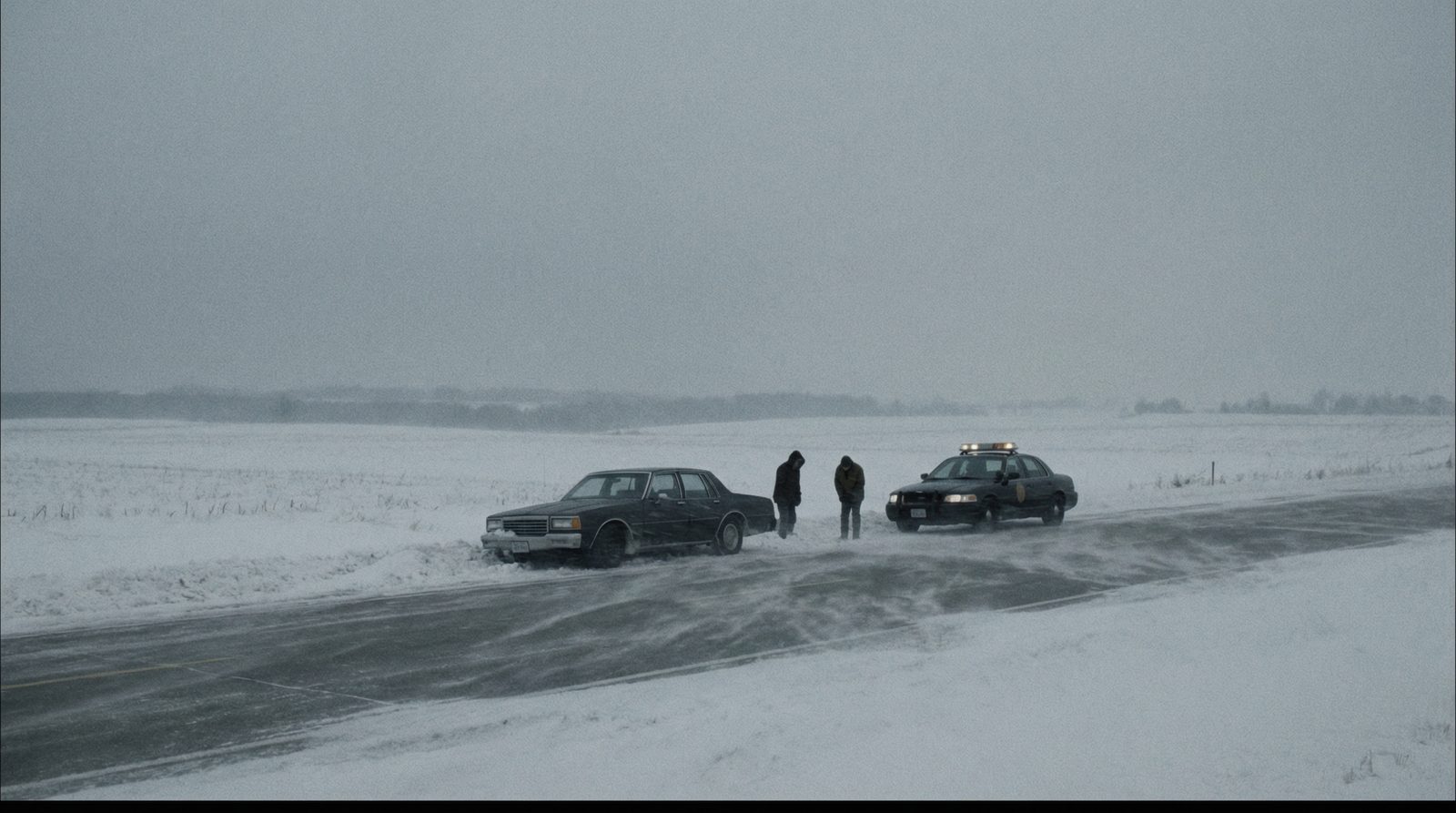
    Editorial illustration inspired by 'Fargo (1996)' – snow-covered highway and stalled cars

    CINEMATIC TECHNIQUE & AESTHETICS

    Cinematographer Roger Deakins builds Fargo around Negative space as a cinematic technique. The White void of snow motif is not just pretty scenery; Characters are often tiny figures swallowed by white fields or framed against blank skies, which makes their frantic schemes look pitiful. The Coens favor Static wide shots that let violence play out at a distance. A roadside murder is shown in long shot, the camera refusing to flinch or editorialize. The feel is clinical and eerily calm, as if the land itself is indifferent.

    Inside, the palette shifts to mustard yellows, wood paneling, and fluorescent hum. These drab interiors emphasize the banality of the settings: The Coens use deadpan pacing, letting silences and awkward small talk stretch long enough to become funny, then uncomfortable. The Editing favors long takes over rapid cutting, which makes the sudden eruptions of violence feel like ruptures in ordinary time.

    Carter Burwell’s score leans on a mournful, folk-like theme that swells over the opening shots of a car towing through a blizzard. It gives the story a ballad-like quality, as if we are hearing a regional legend. Dialogue is treated almost musically. The Minnesota accent, with its “yah” and “you betcha,” becomes a rhythmic counterpoint to the brutality on-screen. This contrast between cozy sound and harsh image is a key technique that shapes the film’s uneasy, darkly comic feel. Like No Country for Old Men later on, Fargo uses restraint in camera movement and music to make every burst of action land harder.

    CHARACTERS & PERFORMANCE

    Marge Gunderson is a classic Everyman hero archetype, though she is also a pregnant small-town police chief, which quietly subverts the usual hardboiled detective mold. Frances McDormand plays her with a blend of curiosity, politeness, and steel. Marge’s competence is never loud. She asks simple questions, listens, and notices what others overlook. Her domestic scenes with her husband Norm, discussing stamps and breakfast, ground the film in everyday tenderness. That normalcy is the moral center the story keeps circling back to.

    Jerry Lundegaard, played by William H. Macy, is a Cowardly schemer archetype. His high, pinched voice and nervous tics turn him into a study in flop sweat. Macy makes Jerry both contemptible and oddly pitiable. He is not a grand villain, just a man who keeps choosing the worst possible option rather than admit failure. That smallness is the point.

    On the criminal side, Steve Buscemi’s Carl is a Motor-mouth criminal archetype, all complaints and cheap impatience, while Peter Stormare’s Gaear is a Silent brute archetype, moving through scenes with blank, heavy calm. Their mismatched partnership is a walking argument for how chaos multiplies when people with no shared values are thrown together. Supporting characters, from the obsequious car-lot staff to the stiff in-laws, are sketched with just a few lines and gestures. The performances lean into regional specificity without turning the townsfolk into cartoons, which keeps the humor grounded in recognizable human behavior rather than pure caricature.
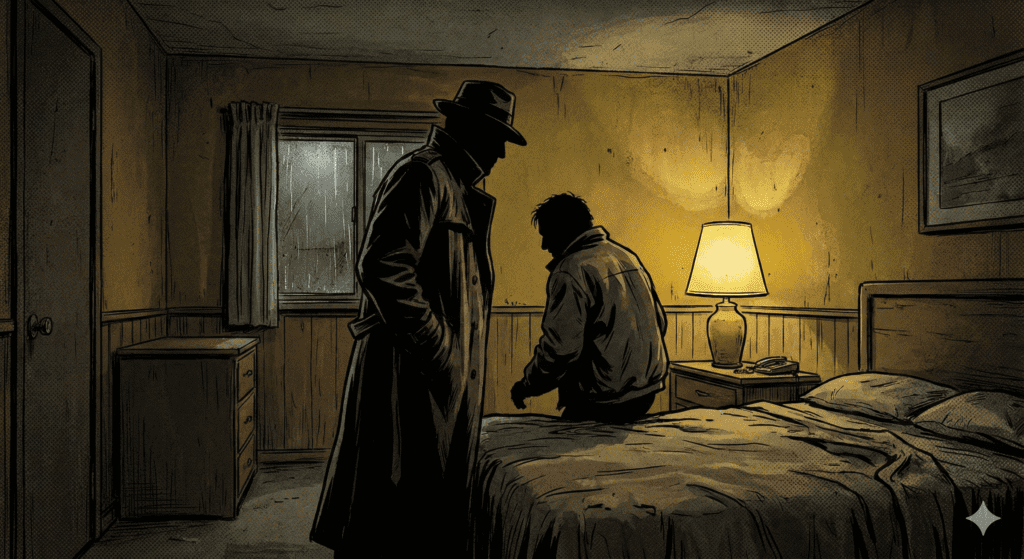
    Stylized noir illustration of Fargo (1996) – tense motel-room confrontation in warm drab Midwestern lighting

    CONTEXT & LEGACY

    Fargo arrived in the mid-1990s, when American indie cinema was saturated with ironic crime stories in the wake of Pulp Fiction. What sets Fargo apart is its emotional sincerity. The Coens had already explored doomed schemes in Blood Simple, but here they pair their usual fatalism with genuine affection for their characters. The film’s faux “true story” framing device taps into the era’s fascination with true crime while quietly mocking our hunger for authenticity labels.

    The film’s legacy includes not only its awards and critical acclaim but also the later Fargo television series, which expands on its Small-town decency motif and Crime gone wrong trope across new characters and timelines. Within the Coen brothers’ body of work, Fargo is a pivot point between their scrappier early noirs and the more austere moral parables of No Country for Old Men. Its influence can be felt in later regional crime dramas that mix dry humor with brutality, and in the broader acceptance of stories where the most heroic figure is not a vigilante or a genius, but a decent professional doing their job well.

    IS IT WORTH WATCHING?

    Fargo is worth watching if you are interested in crime stories that care more about character and moral texture than about plot twists. Its pace is unhurried, and its humor is dry enough that some viewers might initially mistake it for aimlessness. Stay with it. The accumulation of small details, awkward conversations, and quiet domestic scenes builds toward a surprisingly moving final stretch. The feel is a blend of dark comedy and melancholy, with moments of sharp horror that never tip into exploitation.

    If you like the Coen brothers’ mix of fatalism and oddball humanity in films like No Country for Old Men, or if you are drawn to stories where the landscape feels like a character, Fargo will likely resonate. It is not a puzzle-box thriller.

    TRIVIA & PRODUCTION NOTES

    The film’s opening claim that it is based on a true story is a deliberate fabrication. The Coens used the “true crime” framing device to tap into the way audiences engage differently with stories they believe are factual. Various small incidents were loosely inspired by real crimes, but Fargo as a whole is invented. The production leaned heavily on location shooting in Minnesota and North Dakota, though an unexpectedly mild winter forced the crew to chase snow and occasionally truck it in.

    Frances McDormand was not present for the first weeks of shooting, which focused on the criminals and Jerry’s unraveling. This scheduling quirk helps explain why Marge feels like a fresh, stabilizing presence when she finally appears. Carter Burwell’s score builds on Scandinavian folk influences to echo the region’s heritage. The Coens and their team paid careful attention to regional dialect, working with local actors and dialect coaches to shape the Minnesota accent. The woodchipper scene, now infamous, was staged with practical effects and strategic framing rather than explicit gore, relying on suggestion and sound to make it unforgettable.
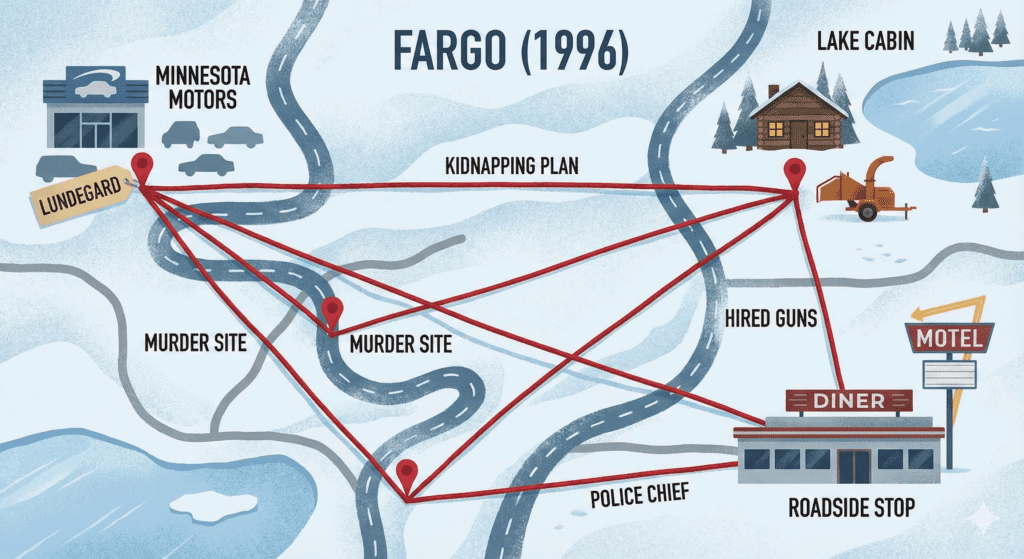
    Diagram-style conceptual illustration of Fargo (1996) – snowfield crime map with red paths and icons

    SIMILAR FILMS

    If Fargo resonates for you, several other works offer related tones and themes. Blood Simple, the Coens’ debut, presents another Crime gone wrong trope in a more overtly noir package, with a similar interest in how ordinary people flail when their schemes collapse. No Country for Old Men shares Fargo’s fascination with moral clarity and its use of landscape as an almost spiritual presence, though it trades dry humor for a harsher, more fatalistic feel.

    Outside the Coen filmography, the television series Fargo extends the Small-town decency motif and regional crime focus across multiple eras. Fans of the mix of politeness and violence might also appreciate how Twin Peaks filters small-town strangeness through a more surreal lens, though its tone is dreamier and less grounded in procedural detail than Fargo’s.

    DISCOVERABILITY & LINKS

    On AllReaders, Fargo sits at the crossroads of crime, small-town stories, and character-driven morality tales. Its white void of snow motif, crime gone wrong trope, and focus on small-town decency connect it to other works where landscape and community shape the stakes as much as the plot does. Readers exploring regional noir, morally grounded detectives, or films that balance dark humor with quiet empathy will find Fargo clustered alongside related titles in our crime and Midwestern story maps.

  • Misery (1990)

    Misery (1990)

    Misery (1990), directed by Rob Reiner. Thriller · 107 minutes · United States.


    INTRODUCTION

    Misery arrives as a small film that feels enormous in your chest. It takes place mostly in one room, with two people, in a house swallowed by snow, yet the emotional weather is stormy and changeable. Rob Reiner, coming off the warmth of When Harry Met Sally, leans into a very different feel: creeping dread wrapped in homely comfort. The blankets are soft, the soup is hot, the words are kind, and everything is wrong.

    This is a story about captivity, but not just physical captivity. Misery looks at creative ownership and the way fans can turn into jailers. It probes the uneasy dependency between writer and reader, caregiver and patient. The mood is quietly suffocating rather than loud or frantic. That slow tightening is what makes the film linger; you feel the air thinning scene by scene, until even a simple dinner table becomes a minefield.

    PLOT & THEMES

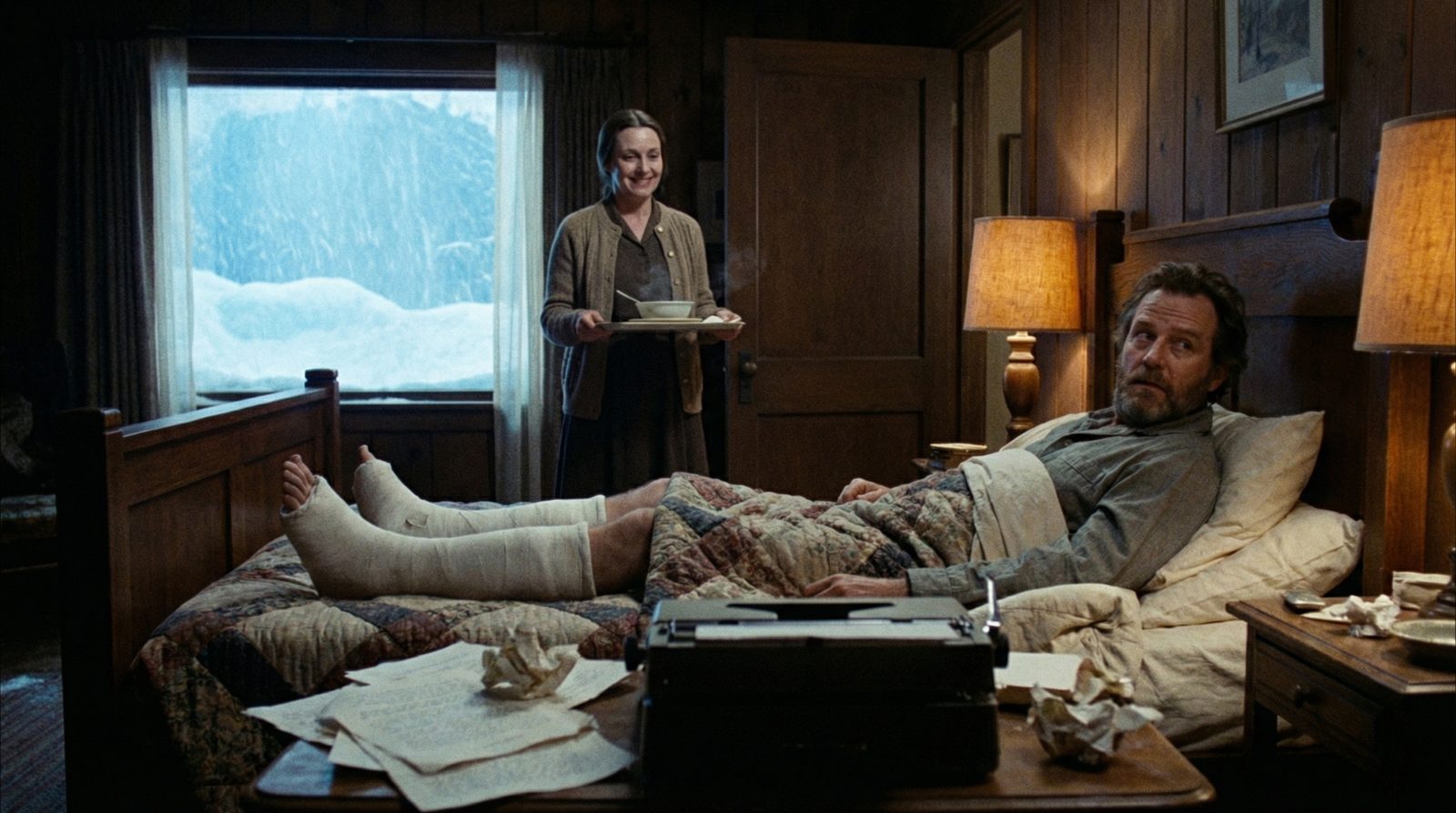
    On the surface, Misery follows a classic trapped protagonist trope. Paul Sheldon, a successful novelist, crashes his car on a snowy Colorado road after finishing the manuscript that he believes will free him from his bestselling romance series. He wakes in the home of Annie Wilkes, a former nurse and his self-proclaimed “number one fan”. His legs are shattered, the phones are down, the roads are closed. Annie promises to nurse him back to health and insists that he resurrect her beloved character, Misery Chastaine, on the page.

    The plot moves in cycles of apparent safety and sudden eruption. At first Annie seems like a slightly odd caregiver. Gradually, her volatility and control tighten into outright imprisonment. The script uses the fanatic fan trope not for cheap jokes but as a way to examine entitlement. Annie believes she owns Paul’s work because she loves it so completely. Her outrage at his creative choices becomes, in her mind, a moral crusade.

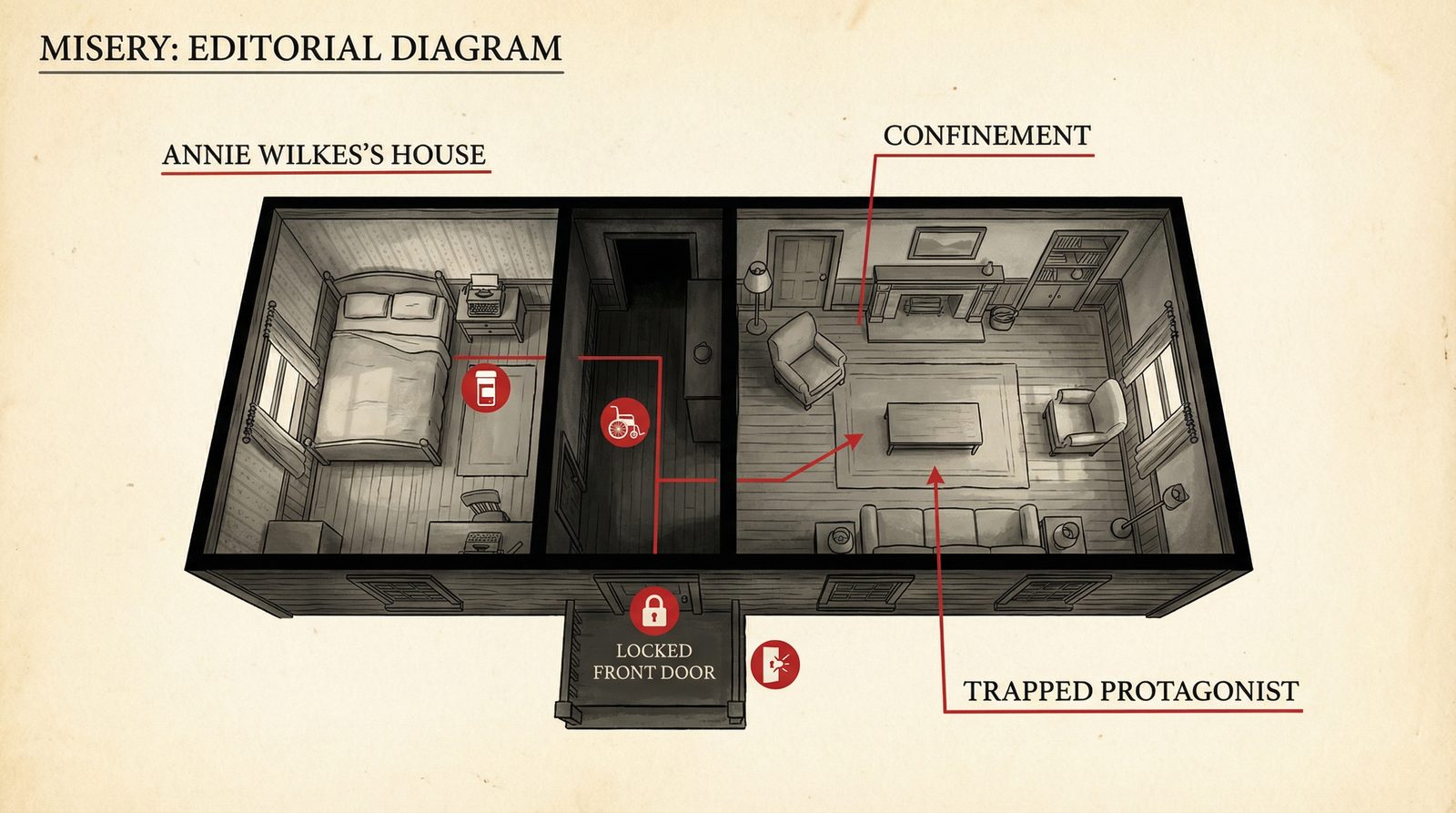
    Several motifs repeat throughout. Confinement is everywhere: doors, locks, wheelchair brakes, even the snowdrifted road outside. Just as central is storytelling as survival. Paul literally writes for his life, reshaping his own artistic compromises in order to stay alive. Unlike many Stephen King adaptations that flirt with the supernatural, Misery keeps its horror human, closer to the psychological menace of films like One Flew Over the Cuckoo’s Nest. The result is a tense study of obsession, authorship, and the thin line between devotion and possession.

    CINEMATIC TECHNIQUE & AESTHETICS

    Rob Reiner and cinematographer Barry Sonnenfeld build the feel of creeping dread through careful framing and camera movement rather than gore. The camera often stays close to Paul’s bed, using tight close-ups that flatten space and make the room feel like a box. When Annie enters, the lens sometimes shifts slightly wider, which subtly distorts her features and makes her presence feel intrusive. Slow tracking shots map out Paul’s potential escape routes, so every later attempt carries a physical memory for the viewer.

    Lighting is deceptively cozy. Warm lamps and daylight soften the interiors, which clashes with the violence that occurs there. The snow outside is bright and overexposed, a white wall that seals the house off from the world. That visual isolation echoes the motif of confinement without resorting to showy stylistic flourishes.

    William Goldman’s adaptation favors slow-burn pacing. Scenes stretch just long enough for small details to become unbearable, while Marc Shaiman’s score stays mostly restrained, stepping forward only when Paul’s inner panic spikes. Compared with the more expressionistic style of The Shining, Misery chooses a plainspoken aesthetic. That restraint makes the notorious “hobbling” scene feel even more brutal, because it erupts into a world that has looked almost ordinary up to that point.

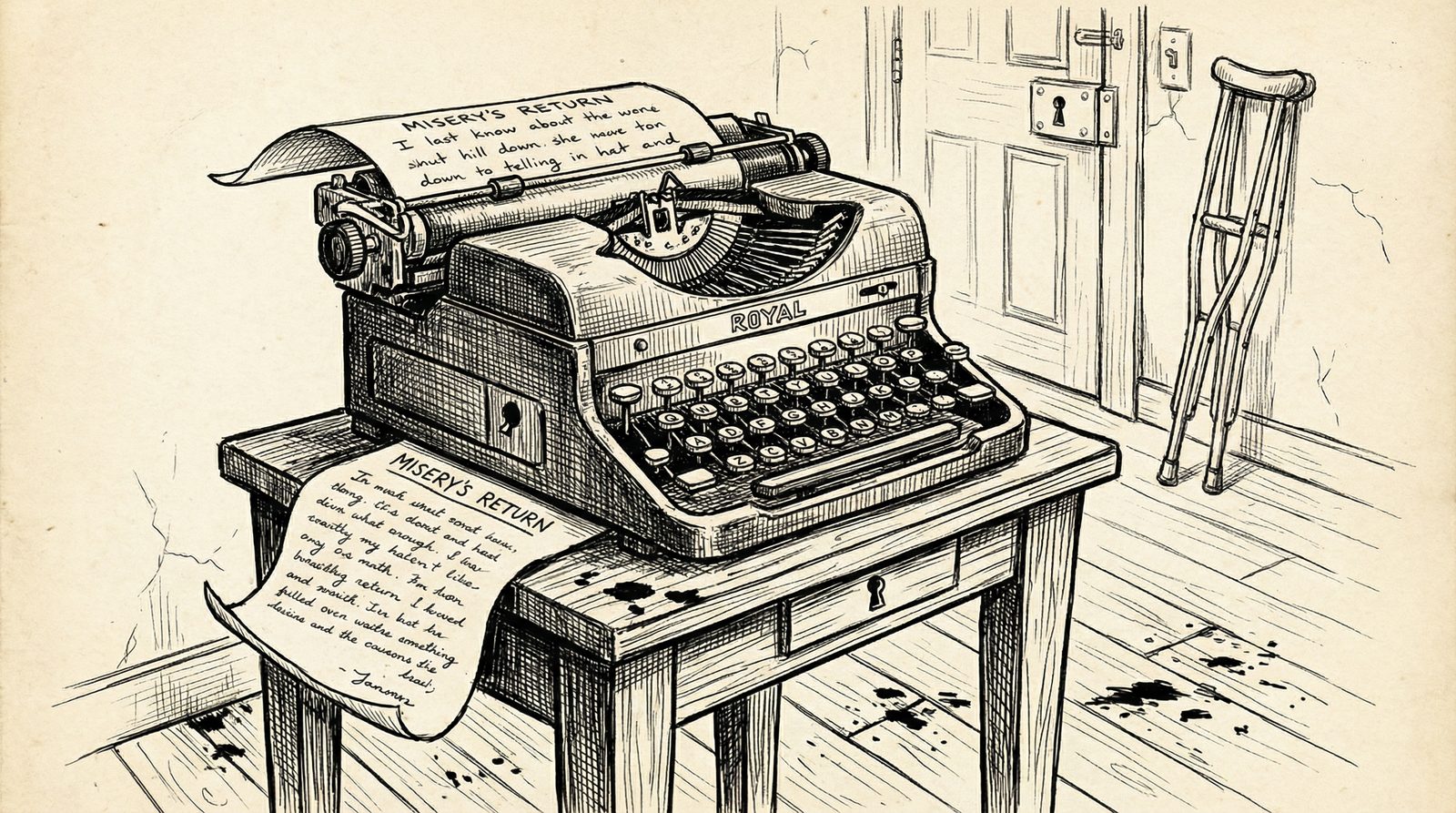
    Editorial illustration inspired by 'Misery (1990)'

    CHARACTERS & PERFORMANCE

    At its core, Misery is a two-hander between a reluctant hero and a monster in human form. James Caan plays Paul Sheldon as a man who has coasted on charm and formula. Trapped and immobilized, he becomes resourceful out of necessity. Caan resists the temptation to turn Paul into a saint; he lets the character’s earlier arrogance and creative laziness show through, which makes his later fight for authorship more meaningful.

    Kathy Bates’s Annie Wilkes is the film’s defining achievement. She embodies the uncanny caregiver archetype, someone whose nurturing gestures are indistinguishable from threats. Her line readings slide from girlish delight to cold fury in a breath, yet she never feels like a cartoon. Bates grounds Annie in a lonely, thwarted life, so her obsession with Misery Chastaine becomes a way to organize her own chaos. The character is terrifying not because she is alien, but because her logic is twisted yet coherent.

    Richard Farnsworth and Frances Sternhagen, as the small-town sheriff and his wife, provide a wry counterpoint. They function as a gentle wise elder presence, poking at the edges of the mystery with humor and patience. Their scenes widen the film’s emotional palette beyond pure terror. The supporting roles are small, but they create a sense of a real community outside Annie’s house, which makes Paul’s isolation feel sharper. Every performance is tuned to the same frequency of realism, which keeps the film from tipping into camp even at its most extreme moments.

    CONTEXT & LEGACY

    Released in 1990, Misery arrived at a point when Stephen King adaptations were already a mini-industry. Instead of chasing the gothic excess of earlier films, Rob Reiner followed the character-driven path he had taken with Stand By Me. Misery’s focus on psychological horror and domestic space helped broaden what a “Stephen King movie” could look like on screen.

    The film also tapped into growing conversations about fandom and celebrity. Long before social media made parasocial relationships a daily reality, Misery dramatized the idea that readers feel ownership over the stories they love. Its success, capped by Kathy Bates’s Oscar, showed that horror-adjacent stories could earn mainstream awards without abandoning genre roots. It has since become a reference point for any narrative about dangerous devotion, from later thrillers to prestige television about stalkers and obsessive fans.

    IS IT WORTH WATCHING?

    Misery is worth watching if you value tension over spectacle. The film is relatively contained in scope, but emotionally it is relentless. Viewers who enjoy psychological horror, character studies, or stage-like thrillers will find a lot to appreciate. Those looking for elaborate mythology or frequent jump scares may find its patience challenging.

    The violence, when it comes, is brief but harrowing, and the mood of creeping dread never fully lifts. What makes the film rewarding is the way it ties that dread to questions about creativity and control. You are not just waiting to see whether Paul escapes; you are watching a writer renegotiate his relationship to his own work under extreme pressure. For many, that mix of suspense, dark humor, and thematic bite makes Misery one of the more memorable King adaptations.

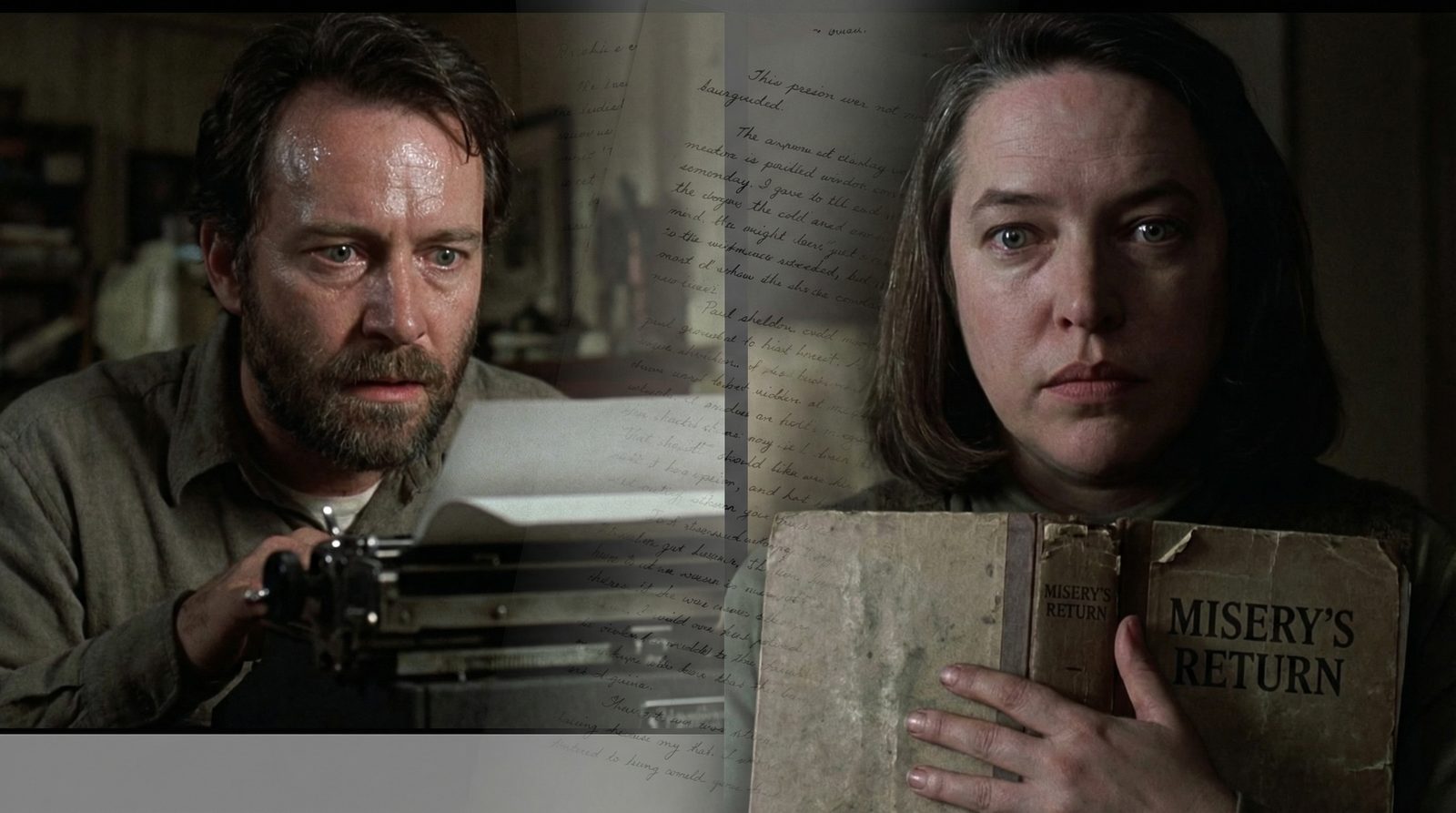
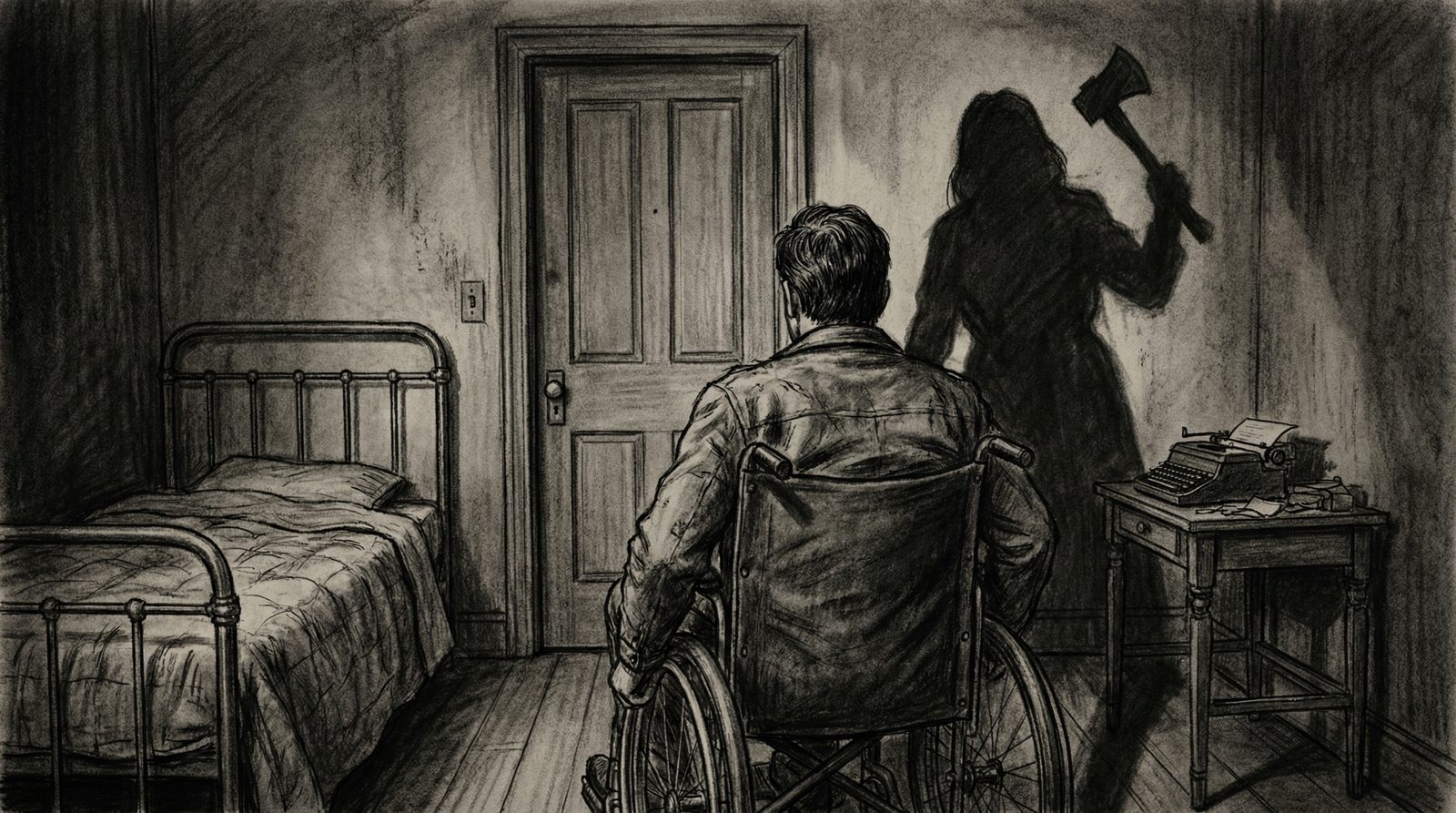
    Symbolic illustration inspired by 'Misery (1990)'

    TRIVIA & PRODUCTION NOTES

    William Goldman’s screenplay streamlines Stephen King’s novel, trimming back some of the more graphic elements while preserving the core dynamic between Paul and Annie. The choice to keep the story grounded in realistic injury and medical detail enhances the psychological focus. Rob Reiner reportedly cast James Caan in part because he wanted an actor associated with toughness to play against physical helplessness.

    Kathy Bates was not yet a household name in film, which helped audiences accept Annie as a fully inhabited character rather than a star vehicle. Her performance earned the Academy Award for Best Actress, a rare honor for a horror-adjacent role. The production made careful use of a single primary set, building the house on a soundstage to control lighting and camera movement. Practical effects, rather than elaborate prosthetics, were used for key moments of violence, which keeps the impact grounded. Misery’s relatively modest budget and contained locations have made it a frequent example in discussions of how to adapt novels into effective, economical films.

    SIMILAR FILMS

    If Misery works for you, several other films explore related territory. The Shining offers another Stephen King story about isolation, creative frustration, and a caretaker turning lethal, though with a more overtly stylized approach. One Flew Over the Cuckoo’s Nest shares Misery’s interest in institutional power and the uncanny caregiver, trading the private home for a psychiatric ward. For a more contemporary echo of the captive–captor dynamic, 10 Cloverfield Lane updates the bottle-episode structure with a sci-fi edge. All of these sit in a cluster of intimate, pressure-cooker narratives where the real horror is another person’s unwavering attention.

    DISCOVERABILITY & LINKS

    Misery connects to several recurring motifs on AllReaders, including captivity, writer held captive, and caretaker as captor. It also sits within clusters about psychological horror, small-town United States settings, and stories that dissect the bond between creator and audience.

  • Thinner (1996)

    Thinner (1996)

    Thinner (1996), directed by Tom Holland. Horror · 92 minutes · United States.


    INTRODUCTION

    Thinner (1996) sits in that strange corner of 90s Stephen King adaptations where pulp, moral fable, and cable-ready horror all blur together. On the surface it is a simple curse story, but underneath the film toys with a clammy, anxious feel of bodily betrayal and karmic payback. Tom Holland leans into the queasy mix of dark humor and body horror, so the film keeps shifting between grotesque and absurd. It is not as polished as Misery or as operatic as Carrie, but it has a sour little heart, fascinated with guilt that refuses to speak its name. Thinner is less about the supernatural mechanics of a curse and more about how far a man will go to avoid admitting that he deserves what is happening to him.

    PLOT & THEMES

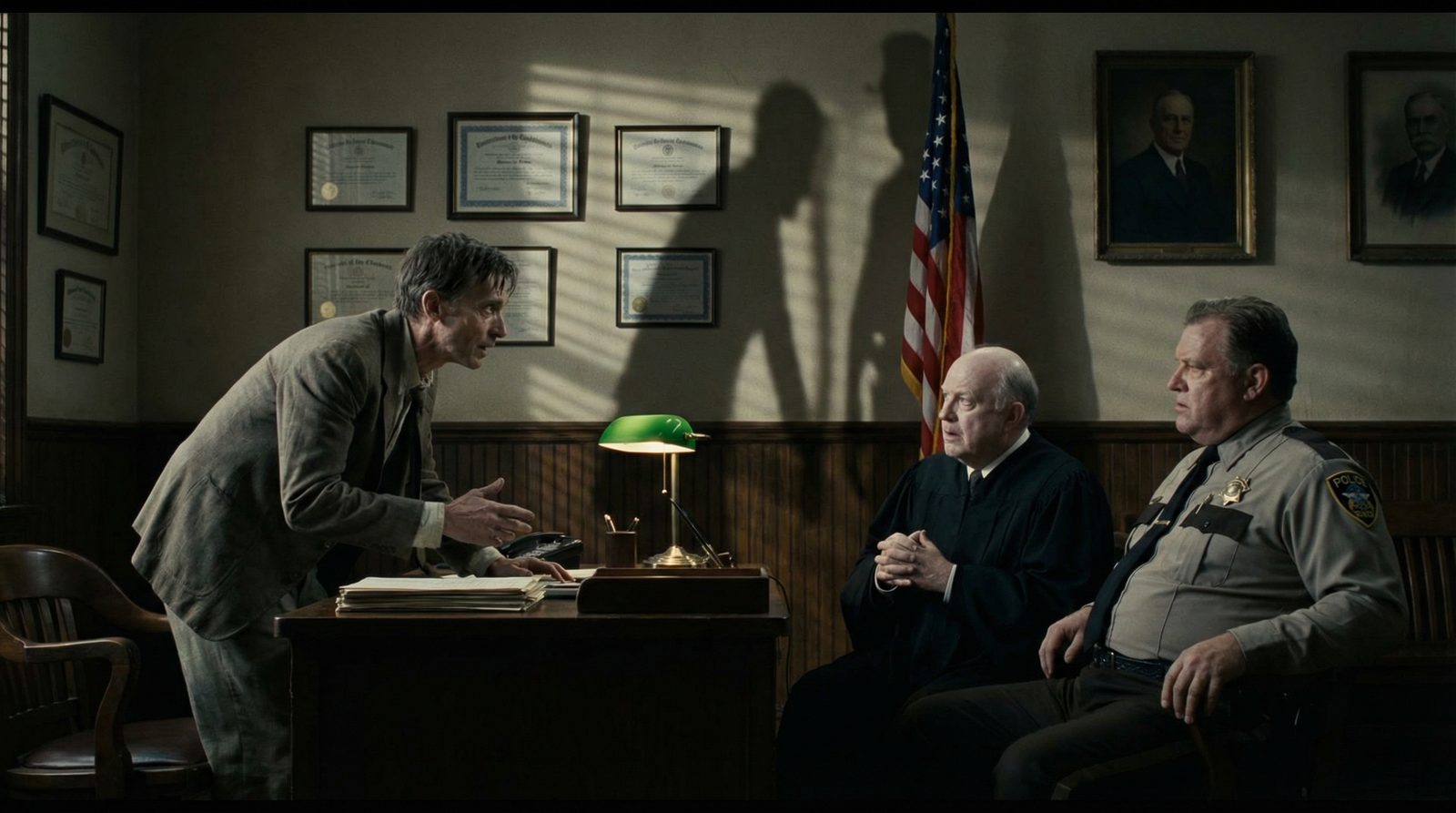
    Billy Halleck is a successful, well-connected lawyer in a small New England town, introduced as a man cocooned in comfort and self-indulgence. After a celebratory night out, he accidentally kills an elderly Romani woman with his car while his wife is distractedly performing a sexual favor. Between his judge friend and a police chief in his pocket, Billy walks away from the case with no real punishment. The dead woman’s father, Tadzu Lempke, lays a cryptic “thinner” curse on him, and Billy’s weight begins to drop at an impossible rate. What starts as a seemingly welcome diet quickly becomes a nightmare as he wastes away.

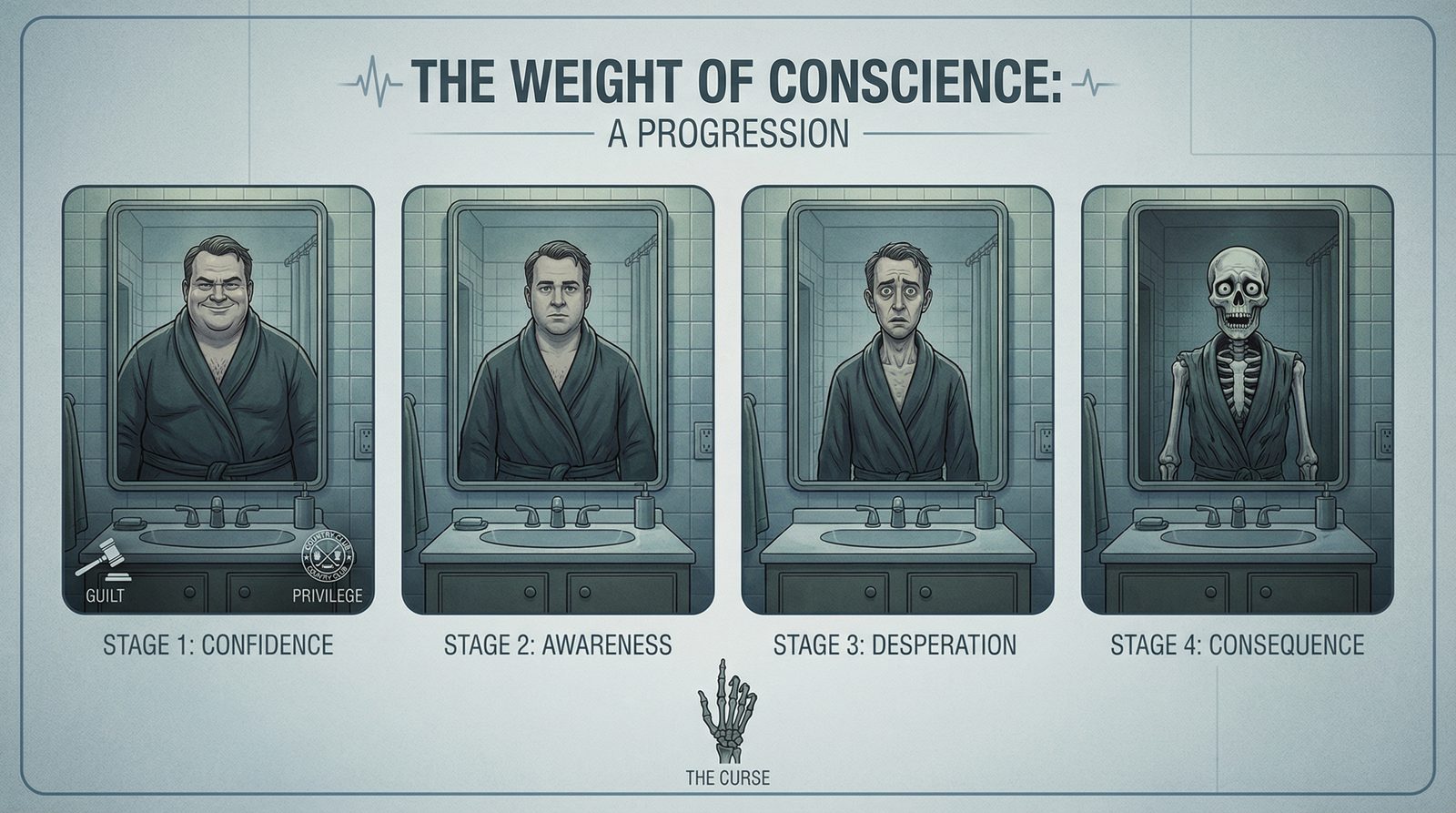
    The film leans heavily on the trope of the cursed protagonist. Billy is not a random victim but a man whose unexamined entitlement has finally come due. The plot tracks his increasingly frantic attempts to reverse the curse. Each step reveals another layer of rot in the town’s power structure, where everyone who helped him evade justice begins to suffer their own supernatural punishments. The motif of bodily decay is central: Billy’s shrinking frame is a visible ledger of guilt, and every pound lost is another unpaid moral debt coming due. Alongside that, the motif of moral rot in small-town America creeps through the story, as the respectable facades of courthouse and country club hide a willingness to sacrifice anyone to maintain comfort.

    Thematically, Thinner plays like a nastier cousin to Needful Things or the old EC Comics morality tales. It asks whether retribution can ever be clean when everyone involved is compromised. The curse is both punishment and mirror, forcing Billy to see that his real horror is not supernatural at all but the person he has always been. By the time he turns to violence and manipulation to save himself, the film has quietly shifted from a story about an innocent man under siege to one about a guilty man refusing to accept a deserved sentence.

    CINEMATIC TECHNIQUE & AESTHETICS

    Tom Holland approaches Thinner with a straightforward 90s genre sensibility, but within that frame he uses makeup and prosthetics as the primary cinematic technique. Billy’s transformation from bulky comfort to skeletal ruin relies on layers of latex and fat suits, which range from impressively grotesque to distractingly artificial. The body horror is not subtle. We are meant to feel a clammy sense of revulsion as his skin sags, his clothes hang, and his face sharpens into a skull. The practical effects give the film a tactile, sticky quality that digital work of later decades often lacks.

    Cinematography is modest but functional. Holland and his director of photography favor flat, bright daylight in the early scenes, emphasizing the safe, bland privilege of Billy’s suburban life. As the curse takes hold, the palette cools and the lighting grows harsher, particularly in interiors, pushing his home toward something closer to a sickroom. There are no elaborate tracking shots or baroque compositions, but the camera often lingers just a beat too long on Billy’s face or body, inviting the audience to inventory every new indignity.

    Editing keeps the story moving at a brisk pace, almost to a fault. Moments that could have deepened the moral stakes are clipped in favor of plot progression, which gives the film a pulpy, paperback rhythm. The sound design does some subtle work: the creak of floorboards under Billy’s changing weight, the rasp of his breath, the way background noise drops out during confrontations with Tadzu Lempke. The score nudges toward darkly comic at times, which can undercut the horror but fits the film’s pulp-horror lineage, similar to how Creepshow toys with tone. Overall, the aesthetics serve the story’s focus on bodily decay and karmic payback more than they aim for beauty or grandeur.

    Editorial illustration inspired by 'Thinner (1996)'

    CHARACTERS & PERFORMANCE

    Billy Halleck is written as a fallen hero archetype, though the film is honest enough to show that he was never especially heroic to begin with. Robert John Burke has the tricky job of playing both the smug, comfortable lawyer and the desperate, skeletal wreck. Under heavy makeup and prosthetics his facial mobility is limited, so he leans on voice, posture, and a growing edge of hysteria. When the performance clicks, Billy feels less like a horror victim and more like a man caught in a trap he helped build.

    Tadzu Lempke serves as an avenging trickster archetype, a figure out of folklore who exposes hypocrisy by inflicting pointed punishments. The performance gives him a wiry, mocking presence; he is less a cackling villain and more a weary judge who has seen this pattern of privileged cruelty too many times. His curse is personal, but his speeches hint at a broader history of exploitation and prejudice.

    The supporting cast is populated by archetypes of small-town corruption. Their performances are pitched slightly larger than life, bordering on the theatrical, which suits the story’s moral-fable structure. One interesting figure is the mobster friend Billy enlists, a dark ally archetype whose loyalty is transactional and whose violence escalates the situation rather than resolving it. These characters are not richly psychological, but they are functional symbols in a story about how a community chooses to protect its own comfort over justice. The acting style, broad and sometimes campy, keeps reminding us that we are watching an allegory, not a slice of naturalism.

    CONTEXT & LEGACY

    Thinner arrives late in the first big wave of Stephen King adaptations, after landmarks like Carrie and The Shining and alongside more workmanlike efforts such as Needful Things. Compared to the psychological focus of Misery, Thinner feels pulpier and more schematic, closer in spirit to the morality tales of Creepshow. Tom Holland had already adapted King with some success in The Langoliers, and here he leans into the author’s fondness for curses as externalized guilt.

    The film did not make a large cultural dent, and its reputation today is mixed, often cited as a minor or even disposable King entry. Yet it has a modest afterlife among fans of 90s horror who appreciate its commitment to body horror and its refusal to fully exonerate its protagonist. In a landscape where many supernatural thrillers bend over backward to make their leads innocent, Thinner stands out for keeping Billy morally stained to the end. It also anticipates later genre interest in bodily punishment as metaphor, a thread you can trace forward into films like Drag Me to Hell, even if those later works have more stylistic flair. Its legacy is less about influence and more about occupying a specific niche in the long shelf of King adaptations: a rancid little parable about guilt that refuses to go away.

    IS IT WORTH WATCHING?

    Whether Thinner is worth your time depends on your tolerance for uneven but earnest 90s horror. If you are interested in Stephen King adaptations as a whole, this is a revealing mid-tier entry. The body horror, driven by makeup and prosthetics, has a practical, rubbery charm that some viewers will find effectively nauseating and others will find dated.

    If you want tightly plotted suspense or nuanced psychological drama, you may be frustrated by the film’s broad performances and pulpy tone. But if the idea of a cursed protagonist slowly wasting away under a karmic sentence appeals to you, and you enjoy horror that feels like a rancid parable, Thinner offers a compact, morally sour experience. It is not essential, yet it is distinctive enough to stick in the mind, especially for viewers drawn to stories where the real monster is a character’s own refusal to take responsibility.

    Symbolic illustration inspired by 'Thinner (1996)'

    TRIVIA & PRODUCTION NOTES

    Thinner adapts the Stephen King novel originally published under his Richard Bachman pseudonym, which partly explains its lean, mean narrative and focus on a single, escalating curse. Tom Holland, already familiar with genre material from Fright Night and Child’s Play, was a logical choice for a story that mixes horror with dark humor. The production leans heavily on makeup and prosthetics for Billy’s physical transformation, requiring extensive time in the chair for Robert John Burke and multiple stages of fat suits and emaciation effects.

    The film was shot largely in New England locations to preserve the book’s regional flavor, with small-town streets and courthouse exteriors reinforcing the motif of moral rot in small-town America. Budget constraints are visible in the relatively limited set pieces and the absence of large-scale spectacle, which keeps the focus on character interactions and the slow, queasy progression of bodily decay. While not a box-office sensation, Thinner found a second life on home video and late-night cable, where its compact runtime and pulpy atmosphere made it a regular fixture for horror fans exploring the deeper shelves of King adaptations.

    SIMILAR FILMS

    If Thinner interests you, several other works explore similar territory. Drag Me to Hell revisits the idea of a cursed protagonist punished for a morally dubious decision, with a more kinetic visual style but a comparable streak of dark humor. Needful Things offers another look at moral rot in small-town America, with a supernatural figure exposing hidden greed and hypocrisy. Fans of horror as moral fable might also appreciate Creepshow, which shares the same taste for grotesque punishment as karmic justice. For a different medium, the novel Pet Sematary digs even deeper into guilt and the terrible cost of refusing to accept loss, echoing Thinner’s bleak view of what happens when people try to bargain with fate instead of facing their own responsibility.

    DISCOVERABILITY & LINKS

    On AllReaders.com, Thinner connects to clusters built around the motif of bodily decay, the motif of moral rot in small-town America, and the trope of the cursed protagonist. It also sits alongside other Stephen King adaptations and 1990s horror from the United States that blend body horror with darkly comic tones. Readers exploring stories of karmic payback, corrupt communities, and protagonists who are complicit in their own downfall will find Thinner a useful reference point within those thematic and genre maps.


  • Of Mice and Men (1992)

    Of Mice and Men (1992)

    Of Mice and Men (1992) directed by Gary Sinise. Drama · 115 minutes · United States.


    INTRODUCTION

    Of Mice and Men (1992) is a somber, quietly devastating adaptation of John Steinbeck’s novel, steeped in the feel of melancholy and the feel of fatalism. Gary Sinise approaches the material with a kind of plainspoken reverence, trusting the story’s simplicity and the weight of its ending more than any stylistic flourish. The film follows two itinerant ranch hands during the Great Depression, one sharp and guarded, the other gentle and mentally disabled, as they cling to a shared dream of owning a small farm. What emerges is less a social tract than a character study about tenderness in a brutal world. The mood is patient and unhurried, letting silences, glances, and small gestures carry as much meaning as dialogue. This version neither radically reinvents Steinbeck nor embalms him. Instead, it works like a long, slow exhale, charting how hope can be both a lifeline and a kind of cruelty.

    PLOT & THEMES

    The plot of Of Mice and Men is straightforward and deliberately spare. George Milton travels with Lennie Small, a physically strong but cognitively impaired man who adores soft things and stories. They drift from job to job across Depression-era California, finally landing work on a ranch where they hope to save enough money to buy a small piece of land. That shared farm becomes their guiding fantasy, a classic example of the trope “Dream of a Better Life” that keeps them moving through humiliation and hardship.

    On the ranch, they meet a gallery of lonely figures: Candy, an aging worker clinging to his usefulness; Curley, the boss’s insecure and violent son; Curley’s Wife, restless and unnamed, whose flirtations are really attempts to escape boredom and invisibility. The story follows the trope “Tragic Misunderstanding” as Lennie’s innocent love of petting soft things repeatedly leads to disaster, escalating from dead mice to a fatal encounter in the barn. The motif “American Dream” runs through nearly every conversation about the future, while the motif “Loneliness and Isolation” shapes the daily reality of the men, who sleep in bunks, share meals, and yet remain emotionally stranded.

    Themes of power and powerlessness are everywhere. George has authority over Lennie, but little over his own circumstances. The ranch hands are trapped in wage labor with no safety net, echoing other Great Depression narratives like The Grapes of Wrath. Violence arrives not as spectacle but as inevitability, the grim endpoint of a world where mercy and survival rarely align. The film’s final act leans into moral ambiguity, inviting the audience to weigh compassion against betrayal without offering easy absolution.

    CINEMATIC TECHNIQUE & AESTHETICS

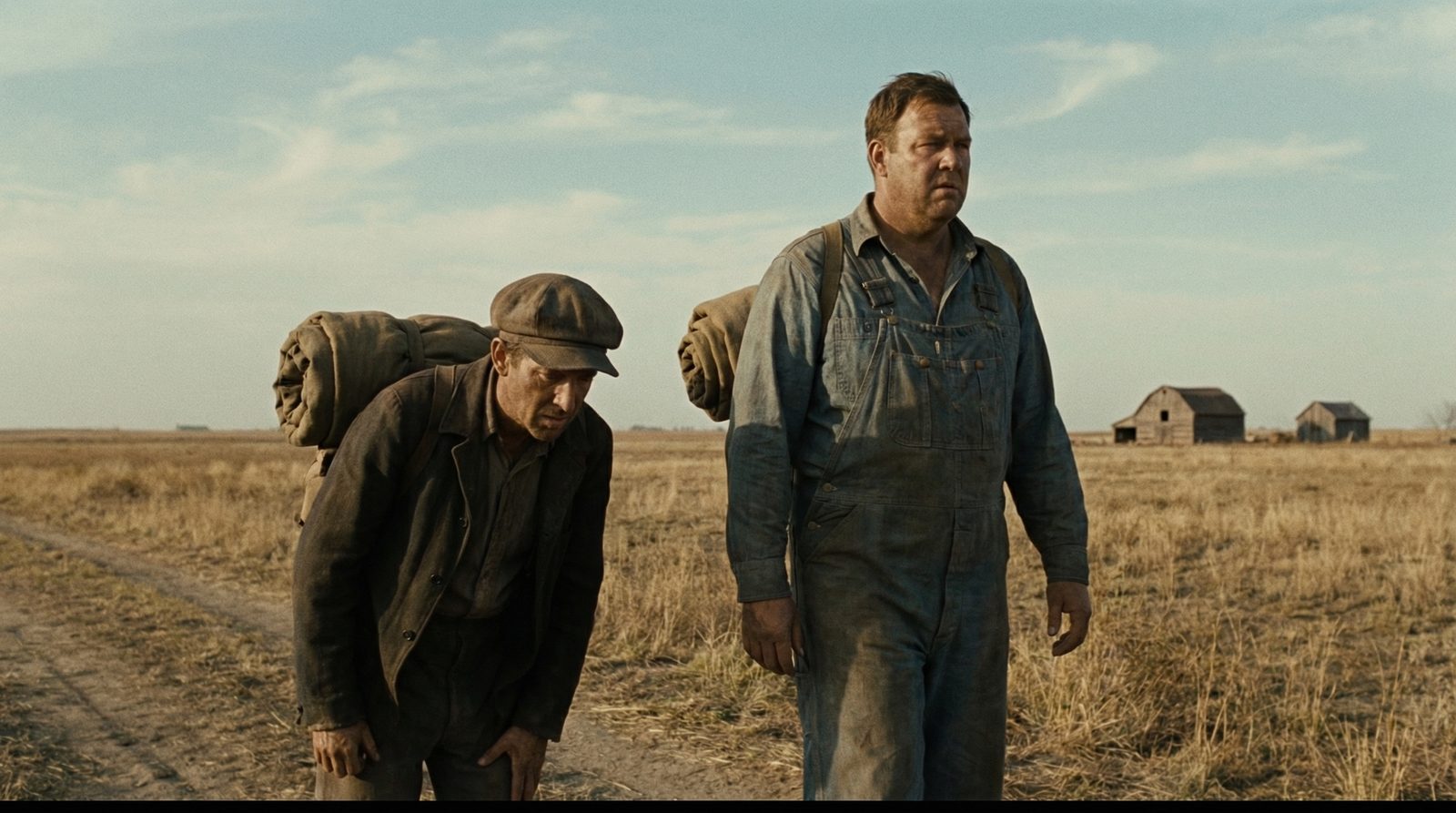
    Cinematically, Of Mice and Men favors restraint. The cinematography uses wide shots of fields, dusty roads, and bunkhouses to emphasize the feel of melancholy and the feel of fatalism, placing small human figures against large, indifferent landscapes. This use of wide shots works as a visual corollary to the motif “Loneliness and Isolation”: the men are constantly framed as tiny within the frame, swallowed by sky and dirt. Close-ups arrive sparingly, reserved for moments of connection or panic, such as Lennie’s childlike delight when George repeats their dream, or the instant of realization in the barn.

    The film relies on naturalistic lighting and a muted color palette that leans into browns, grays, and washed-out greens, underscoring the harshness of the Great Depression setting. There is little stylistic bravura; the camera often sits at eye level and holds on performances, creating a stage-like intimacy and allowing the actors’ rhythms to dominate. The score is understated, using plaintive strings and occasional harmonica to underline emotional beats without overwhelming them.

    Editing choices emphasize inevitability. Transitions from one job or day to the next often cut from hopeful talk about the “American Dream” to images of the same hard labor, reinforcing the gap between fantasy and reality. The barn sequence, in particular, is carefully built through cross-cutting and sound design, juxtaposing the quiet of Lennie’s encounter with Curley’s Wife against the distant noise of the ranch, as if the world is unaware that everything is about to tilt. The final riverside scene is shot with a calm, almost pastoral beauty that clashes with the horror of what George must do, heightening the tragedy through visual gentleness rather than shock.

    Editorial illustration inspired by 'Of Mice and Men (1992)'

    CHARACTERS & PERFORMANCE

    At the center are two archetypes: George as the archetype “Reluctant Caregiver” and Lennie as the archetype “Gentle Giant.” Gary Sinise plays George with a tight, wary energy, shoulders slightly hunched as if braced for the next problem. His tenderness toward Lennie is always mixed with irritation and exhaustion, which keeps their relationship from turning sentimental. You feel the cost of his loyalty in every sigh and sharp word. John Malkovich’s Lennie is all open face and heavy body, his voice pitched high and soft. He leans into Lennie’s physicality, letting his size feel both protective and ominous. The performance risks mannerism, but Malkovich grounds it in a consistent emotional logic: Lennie is driven by sensory pleasure and fear, not malice.

    Among the supporting cast, Ray Walston’s Candy embodies the archetype “Tragic Innocent,” a man already half-discarded by the world, whose investment in George and Lennie’s plan is heartbreaking. His reaction when the dream collapses is one of the film’s quietest and most affecting moments. Sherilyn Fenn gives Curley’s Wife more interiority than the text sometimes allows, playing her as a woman boxed in by the trope “Lonely Housewife” rather than a simple temptress. Her scenes with Lennie hint at the shared cost of being treated as less than fully human.

    Curley and the other ranch hands are sketched more broadly, functioning as embodiments of various responses to hardship: resentment, resignation, bravado, and the occasional flash of kindness. The ensemble never steals focus from George and Lennie, but their presence fleshes out the social world, making the final act feel like the endpoint of a collective pressure rather than a single bad choice. The performances overall are tuned to a naturalistic register, which suits the story’s plainspoken tragedy.

    CONTEXT & LEGACY

    Of Mice and Men arrives with the weight of being a classroom staple and a previous film adaptation already in circulation. Compared with the 1939 version, Sinise’s film is more relaxed and attentive to small behavioral details, reflecting a late twentieth-century taste for psychological realism. It also emerges in a period when American cinema was revisiting the Great Depression, as seen in works like The Grapes of Wrath on television and the lingering influence of earlier literary adaptations.

    The film’s legacy is quieter than the novel’s, but it occupies a distinct place in the cycle of 1990s literary dramas, alongside adaptations like The Shawshank Redemption that foreground male friendship under oppressive conditions. In educational contexts, this version often serves as the visual companion to Steinbeck’s text, shaping how students imagine George, Lennie, and the ranch. Its fidelity to the source, both in plot and tone, means it is rarely discussed as a radical reinterpretation. Instead, it is valued as a solid, emotionally direct rendition that preserves the story’s moral unease and the starkness of its ending for a new generation of viewers.

    IS IT WORTH WATCHING?

    Whether Of Mice and Men is worth your time depends on your tolerance for slow, character-driven tragedy and the feel of fatalism. The film does not surprise if you know the novel, nor does it try to. Its value lies in seeing the relationships embodied: George’s mix of love and resentment, Lennie’s uncomprehending joy, Candy’s late-blooming hope. The pacing can feel languid, but that slowness is part of its effect, letting the inevitable ending creep up rather than crash down.

    If you are interested in Great Depression stories, literary adaptations that respect their sources, or explorations of male friendship under pressure, this film is a thoughtful, well-acted option. It may not convert skeptics of the material, but for viewers willing to sit with discomfort and moral ambiguity, it offers a clear, humane rendering of a classic American tragedy.

    Symbolic illustration inspired by 'Of Mice and Men (1992)'

    TRIVIA & PRODUCTION NOTES

    Gary Sinise was not only the director but also the star, and his dual role shapes the film’s focus on George’s inner conflict. Sinise had previously been involved with stage productions of Of Mice and Men, which helps explain the film’s faithfulness to Steinbeck’s dialogue and its occasional stage-like blocking. John Malkovich also brought prior familiarity with the role of Lennie, contributing to the performance’s detailed physical vocabulary.

    The production leans heavily on location shooting in rural settings that evoke California’s agricultural valleys, even when not filmed in Steinbeck’s exact locales. This commitment to physical authenticity reinforces the motif “American Dream” by grounding it in recognizable, unglamorous spaces. The design of the bunkhouse, with its cramped beds and sparse personal items, was carefully researched to reflect period-accurate living conditions for itinerant workers.

    The film’s relatively modest budget encouraged the use of practical sets and natural light, aligning with its overall aesthetic of restraint. While not a major awards magnet, it drew attention for its performances and for offering a serious, unflashy literary adaptation at a time when studios were experimenting with more commercial fare. Its continued presence in educational and repertory screenings speaks to its durability as a teaching tool and as a companion piece to the novel.

    SIMILAR FILMS

    If Of Mice and Men resonates with you, several other films explore related territory. The Grapes of Wrath offers another Steinbeck portrait of the Great Depression, with a wider social canvas but a similar fixation on the fragility of the “American Dream.” The Shawshank Redemption echoes the focus on male friendship, confinement, and the slow burn of hope in a hostile environment.

    For a more stylized take on itinerant workers and desperation, Bonnie and Clyde shifts the focus to crime but retains the sense of economic entrapment. If you are drawn to the archetype “Gentle Giant” in tragic contexts, you can also look toward other works in our database that explore similar dynamics of power, vulnerability, and mercy.

    DISCOVERABILITY & LINKS

    Of Mice and Men connects to broader clusters on the site around Great Depression narratives, the motif “American Dream,” and the motif “Loneliness and Isolation.” It also sits alongside stories built on the trope “Dream of a Better Life” and the archetype “Reluctant Caregiver.” Readers interested in quiet, morally fraught dramas about friendship, economic hardship, and the feel of melancholy will find it linked to books and films that explore similar emotional terrain.

  • The Friends Of Eddie Coyle (1972)

    The Friends Of Eddie Coyle (1972)

    By: George V. Higgins
    Genre: Crime fiction
    Country: United States


    INTRODUCTION

    The Friends Of Eddie Coyle (1972) is a crime novel that smells like cigarette ash and stale beer, set in the jittery underbelly of the 1970s. Its world is small: the motif of transactional loyalty runs through every page; friendship is just another word for credit extended and favors owed. The feel is one of slow suffocation rather than sudden shock, as if the whole book were a long exhale on a cold Boston night. George V. Higgins doesn’t glamorize the underworld; what he hears are men like Eddie Coyle, a worn-out gunrunner with busted knuckles and a looming prison sentence, trying to talk their way into a future that keeps shrinking every time they open their mouths.


    PLOT & THEMES

    The plot of The Friends Of Eddie Coyle is deceptively simple. Eddie, a low-level Boston hood with a past that includes those famous smashed fingers from a truck job in New Hampshire, is facing another bid in prison. To avoid it, he starts feeding information to ATF agent Dave Foley while still brokering guns between the young dealer Jackie Brown and a crew of bank robbers hitting suburban branches from Dedham to Quincy. Around this, a quiet web of double-dealing tightens: bartender and sometime hitman Dillon, bookies like Jimmy Scalisi, and assorted hangers-on orbit Eddie’s desperation.

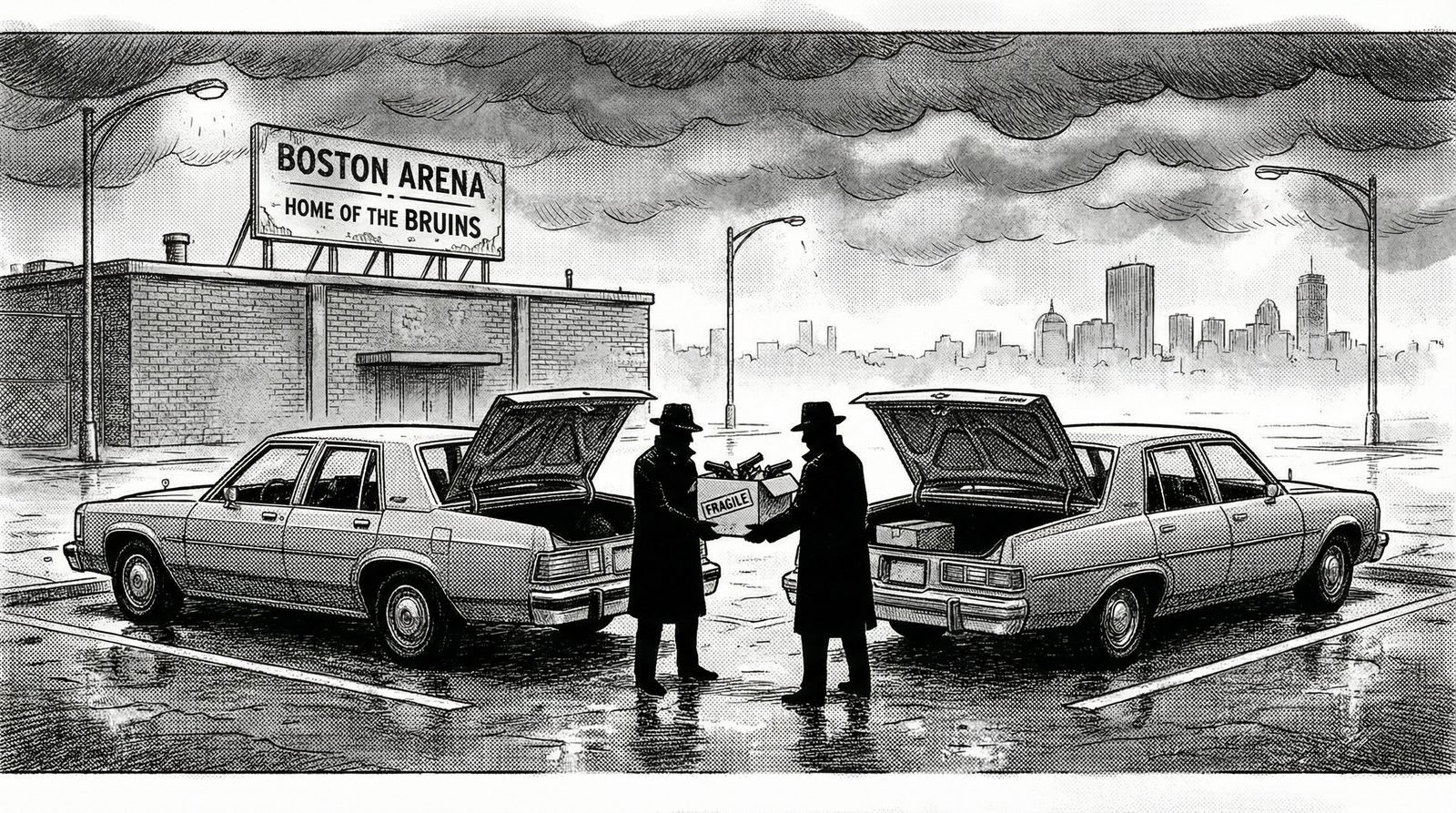
    The trope at work is the doomed informant, but Higgins drains it of melodrama. There are no big set pieces, just incremental betrayals. One motif is bureaucratic indifference: Foley treats Eddie as a file, not a man, and the prosecutors in the federal courthouse at Post Office Square barely register him as anything but leverage. Another motif is routine as prison: the morning coffee at the Speedway Diner, the same barstools at Dillon’s place, the same routes to the hockey rink parking lots where guns are passed from trunk to trunk.

    Unlike the film adaptation, the novel makes Eddie’s end feel even more like an administrative decision than a dramatic climax. After Eddie has outlived his usefulness, Dillon calmly accepts the contract and takes him to a Bruins game at Boston Garden, then out for beers in a Brighton bar. On the drive home, Dillon’s partner in the backseat puts three bullets in Eddie’s head while Dillon keeps the car steady. The book ends not with outrage but with paperwork: Dillon returns to his bar, Foley files his reports, and the robbers Eddie betrayed are quietly rolled up. The world shrugs and keeps going.

    Higgins’s focus on the small-scale, procedural grind anticipates the dry institutional fatalism you see later in works like Don Winslow’s The Power of the Dog (2005) and the film The French Connection (1971), but his Boston is even more cramped, more local, more suffocating.


    PROSE & NARRATIVE STRUCTURE

    The most famous thing about The Friends Of Eddie Coyle is its narrative technique of dialogue-driven storytelling. Higgins drops you into conversations with almost no exposition. The feel is claustrophobic and oddly hypnotic: you learn who’s who and what’s at stake by eavesdropping, piecing it together from half-finished sentences and local slang. When Foley and his fellow agents sit in a government sedan outside the bank, listening to the radio chatter as the robbers go in, the tension comes entirely from what is said and what is not.

    Higgins uses a kind of hard-boiled free indirect style between the talk, but it’s stripped down to the bone. Descriptions of places — the Somerville tenement where Eddie lives, the shabby bar where Dillon works, the anonymous motel rooms where Jackie Brown counts his money — are quick, functional, never romantic. The structure is almost mosaic: short scenes that jump between Eddie, the robbers, Jackie, Dillon, and Foley, overlapping in time and filling in the same events from different angles.

    This fragmented approach means there’s no single, clean narrative arc. We see the bank crew rehearsing their methodical takeovers, the way they make tellers lie on the floor and empty the drawers, returning to the same South Shore banks again and again. We hear Jackie’s careful instructions about filing off serial numbers, about how many guns he can safely move in a week. The rhythm of these scenes makes Eddie’s murder feel less like a climax than one more entry in a long, dull ledger of crimes and consequences. That’s the structural joke: the story of a man trying to matter is told in a form that keeps reminding you he doesn’t.

    Conceptual editorial illustration inspired by 'The Friends Of Eddie Coyle (1972)'

    CHARACTERS & INTERIORITY

    Eddie Coyle is the classic archetype of the weary small-time crook, but Higgins refuses to sentimentalize him. Eddie is not noble, not especially bright, and not secretly waiting to reform. He’s a man who has spent his life making bad bargains and is now too tired to find a good one. His interiority comes in quick, bitter flashes — his fear of going “up the river” again, his resentment that nobody remembers the truck job that cost him his fingers, his half-hearted attempts to reassure his wife that things will be all right.

    Dillon is a quieter creation: a bartender who listens more than he speaks, a man whose apparent friendliness is just another professional skill. His scenes with Eddie, especially the one in the back room where they talk about who might be informing, are master classes in misdirection. You can feel Eddie trying to reach for a friend while Dillon silently measures the odds and the potential payout. Jackie Brown, the young gun dealer, embodies a different kind of criminal ambition — cool, entrepreneurial, already thinking about his next market.

    Crucially, the lawmen are not heroes. Foley is competent, sometimes even sympathetic, but he thinks in terms of cases, not lives. When he leans on Eddie in a diner, offering vague promises about talking to the prosecutor, the emotional asymmetry is brutal: Eddie is fighting for his future; Foley is optimizing his workload. The interior lives here are narrow, pinched by money, fear, and habit. Nobody dreams big; they just dream of getting through the next winter without going back to Walpole or Charlestown State Prison.


    LEGACY & RECEPTION

    When The Friends Of Eddie Coyle appeared in 1972, it startled the crime-fiction world. Here was a novel where almost nothing “big” happens on the page, yet everything feels consequential. Its influence can be traced through later crime writers who put procedure and talk at the center of their work, from Elmore Leonard to Dennis Lehane. The book’s unvarnished depiction of Boston’s underclass also helped define the city’s literary crime identity, long before it became familiar through films like The Departed (2006).

    The ending, with Eddie’s body slumped in the front seat while Dillon arranges the scene and then goes back to tending bar, has become a touchstone for the genre’s bleaker wing. Critics recognized early on that Higgins had done something new: he’d written a crime novel that felt like documentary, where the real subject was not the heists or the shootings but the quiet machinery that decides who lives and who gets written off. The book’s reputation has only grown, often cited as one of the finest American crime novels of the late twentieth century, a benchmark for anyone trying to write about criminals as workers rather than mythic figures.


    IS IT WORTH READING?

    If you want car chases, glamorous mob bosses, or clever twists, The Friends Of Eddie Coyle will feel too quiet, maybe even uneventful. But if you’re interested in how crime actually works at the bottom rung — how fear, debt, and habit shape people’s choices — it’s essential. Higgins writes with an ear so sharp it can feel like you’re intruding on real conversations. The book is short, but it asks you to listen closely, to accept that most lives end not with fireworks but with a shrug. It’s worth reading not because it flatters the reader, but because it doesn’t: it shows a world where everyone is replaceable, and somehow that makes Eddie’s small, shabby struggle linger in the mind long after the last page.

    Illustration of a core idea or motif from 'The Friends Of Eddie Coyle (1972)'

    TRIVIA & AUTHOR FACTS

    George V. Higgins had worked as an assistant U.S. attorney in Boston before writing The Friends Of Eddie Coyle, and you can feel that prosecutorial background in the book’s procedural calm. He wrote much of the novel in the late 1960s, drawing on real cases involving gunrunning and bank robbery in Massachusetts. The famous anecdote about the book is that it was rejected by multiple publishers who couldn’t make sense of a crime novel so heavy on dialogue and so light on conventional explanation.

    Higgins went on to write many more novels, often returning to Boston’s working-class neighborhoods and to the uneasy overlap between criminals, lawyers, and politicians. But The Friends Of Eddie Coyle remains his best-known work, partly because it arrived fully formed. He once said that he wrote dialogue by listening to people in bars and diners and then cutting away everything that sounded like writing. That discipline is all over this book, which reads like a transcript of a world most readers never get to hear.


    SIMILAR BOOKS

    If The Friends Of Eddie Coyle works for you, you might seek out Elmore Leonard’s Swag (1976), another lean, dialogue-heavy look at small-time crooks. Richard Price’s Clockers (1992) offers a later, urban variation on the same interest in criminals as workers bound by routine. For a British counterpart, try Ted Lewis’s Jack’s Return Home (1970), which shares Higgins’s cold eye for provincial crime. And if you want more Boston grit filtered through moral fatigue, Dennis Lehane’s A Drink Before the War (1994) picks up some of Higgins’s concerns and drags them into the 1990s, with private investigators instead of gunrunners but the same sense of lives boxed in by class and geography.


    DISCOVERABILITY & LINKS

    This review of The Friends Of Eddie Coyle is connected across the site to related motifs, tropes, archetypes, and comparable works, helping you trace lines between Boston crime fiction, dialogue-driven narratives, and other stories of doomed informants and small-time operators trying to survive one more season.

  • Pet Sematary (1983)

    Pet Sematary (1983)

    By: Stephen King
    Genre: Horror
    Country: United States


    INTRODUCTION

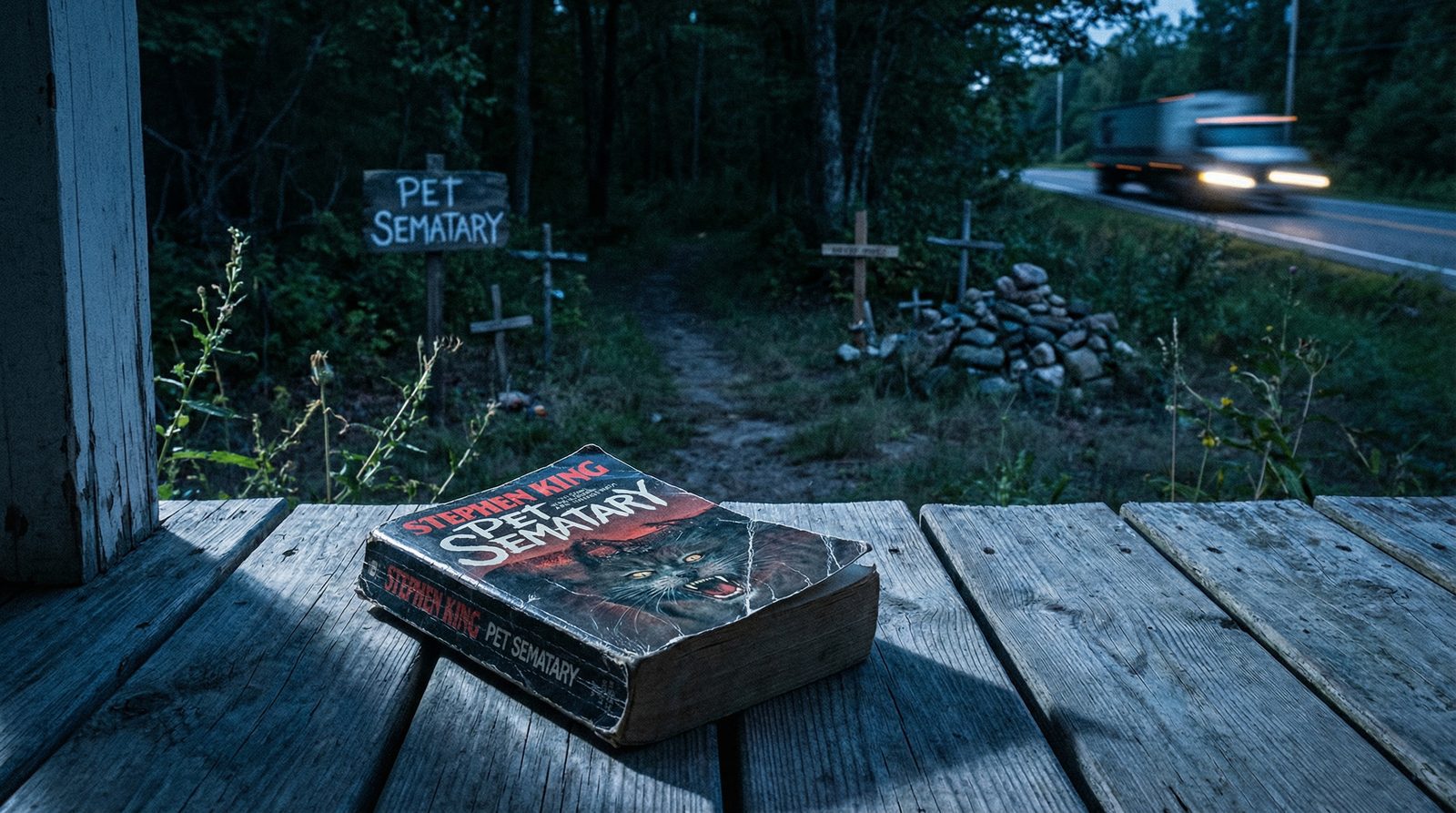
    Among Stephen King’s work, Pet Sematary (1983) is the one that feels like it hates you a little for reading it. Set in the late twentieth century, it is soaked in dread, domestic routine, and the slow rot of inevitability. The motif of roads and crossings runs through everything: the busy Route 15 where the Orinco trucks scream past, the worn path to the children’s graveyard, the secret trail beyond the deadfall into the Micmac burial ground. The feeling is suffocating grief, but also the ordinary tenderness of a young family trying to settle into a new town. King builds a world of PTA meetings, university politics, and neighborly beers on the porch, then lets something ancient and foul seep up through its floorboards. This is not simply a scary book; it is a brutal argument about the cost of refusing to accept that everything ends.


    PLOT & THEMES

    On the surface, the plot is simple. Louis Creed, a doctor, moves with his family to a rented house in Ludlow, Maine, for a job at the University of Maine’s student health center. Across the road lives Jud Crandall, the elderly neighbor who becomes Louis’s guide to the local geography: the children’s “pet sematary” in the woods and, beyond the deadfall, the sour Micmac burial ground. When Ellie’s cat, Church, is killed on the dangerous road, Jud takes Louis past the burial ground’s stone cairns. Church returns, but wrong – sluggish, foul-smelling, with a flat, alien gaze. The motif of corrupted resurrection is born here and never loosens.

    The trope of the Faustian bargain is explicit. Louis is not tricked; he understands that what comes back is not what went into the earth, yet when his toddler son Gage is killed by an Orinco truck, he chooses the burial ground again, this time alone. King threads in smaller thematic filaments: Rachel’s childhood trauma with her dying sister Zelda, hidden away like a family shame; Louis’s clinical detachment at the university clinic, shattered by Victor Pascow’s grotesque head injury and prophetic warning; the way the Creed marriage strains under unspoken fears about death. Compared with the film adaptations, the novel lingers more cruelly on Louis’s planning – the grave-robbing at Mount Hope Cemetery, the meticulous timing around Rachel and Ellie’s absence.

    The book’s ending is unambiguously bleak. Gage’s resurrected body murders Jud and Rachel with a scalpel, and Louis, half-mad, kills his son a second time with a morphine syringe before burning Jud’s house. Yet he still carries Rachel’s corpse to the burial ground, convinced that waiting less time will produce a better result. The final scene shows Rachel returning, reeking and decayed, dropping a maggot from her eye socket as she touches Louis and says, “Darling.” He welcomes her. There is no last-minute salvation here; only a man who has chosen damnation over grief.


    PROSE & NARRATIVE STRUCTURE

    The book uses close third-person as its primary narrative technique, staying mostly with Louis while occasionally slipping into Jud’s memories or Rachel’s private terrors. This tight focus lets King turn mundane details – the smell of autumn leaves on the path to the pet sematary, the sound of the Orinco trucks’ air brakes – into pressure points. The feeling is one of incremental suffocation; every chapter nudges the boundary of what Louis will accept, then quietly resets what counts as normal.

    Structurally, the novel is almost cruelly patient. The first half is domestic realism: Louis’s first day at the university, Ellie’s fear about death after seeing the pet sematary, Thanksgiving plans, even an ugly argument with Rachel’s parents in Chicago. King uses repetition of phrases – “Sometimes dead is better,” Victor Pascow’s “the soil of a man’s heart is stonier” – as a kind of incantation, echoing through Louis’s thoughts and Jud’s stories. These refrains acquire new meaning each time they surface, like a chorus that grows more ominous on each return.

    There is also a subtle use of foreshadowing through dreams and premonitions: Ellie’s nightmares about “Paxcow” (her mispronunciation of Pascow), Rachel’s sense of approaching disaster on her frantic trip back to Ludlow, Louis’s own half-waking vision of a Wendigo-like shape towering over the burial ground. Compared with something like The Shining (1977), the prose here is plainer, less baroque, but the rhythms are merciless. Sentences shorten as Louis’s sanity frays; paragraphs splinter into jagged interior monologue during the grave-robbing sequence and Gage’s return. The result is a narrative that feels like a long, slow descent punctured by sudden, shocking drops.

    Conceptual editorial illustration inspired by 'Pet Sematary (1983)'

    CHARACTERS & INTERIORITY

    Louis Creed begins as the rational protagonist archetype. King is careful to make him neither saint nor monster. He is petty about his in-laws, occasionally selfish, but genuinely loves Rachel, Ellie, and Gage. His interiority is where the horror really lives. We sit inside his rationalizations as he moves from burying a cat to contemplating, then committing, the exhumation of his own child. The justifications come in waves, each a little thinner than the last.

    Jud Crandall, often softened in adaptations, is more morally ambiguous on the page. He is the kindly old neighbor, yes, but also the man who opens the door to the Micmac burial ground because he cannot bear to see Ellie grieve. His stories about Timmy Baterman, the resurrected World War II soldier who came back knowing everyone’s secrets, are soaked in guilt. Rachel, meanwhile, is defined by her terror of death, rooted in the grotesque memory of caring for Zelda, whose spinal meningitis twisted her body and mind. Her shame and trauma are not side notes; they are a parallel study in how families mishandle mortality.

    Even minor figures – Norma Crandall with her heart trouble, Irwin and Dory Goldman with their brittle hostility, the student Steve Masterton who helps Louis in the clinic – are drawn with enough interior shading to feel like casualties of the same force. The book’s cruelty lies in how intimately it understands each character’s weak point, then lets the burial ground press on it.


    LEGACY & RECEPTION

    King has said he nearly didn’t publish Pet Sematary because he thought it went too far, and that unease clings to its reputation. Among horror readers it’s often cited as one of the few novels that can still genuinely unsettle jaded adults. Its late twentieth century setting, Orinco trucks, university politics, airline schedules, anchors the supernatural in the banal, making the final sequence, with Rachel’s corpse shambling into the kitchen, feel less like gothic flourish and more like the natural endpoint of bad decisions.

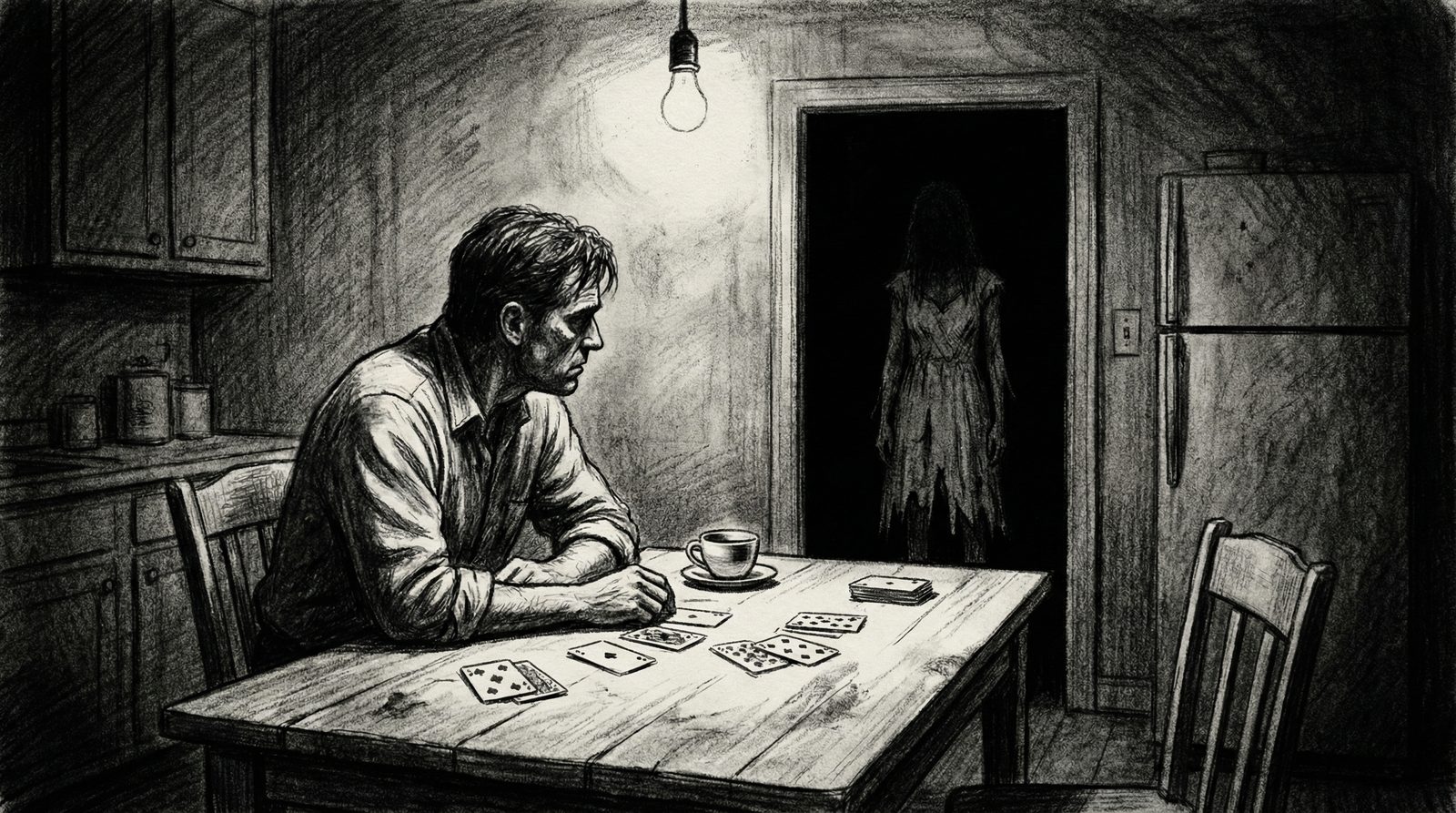
    The various film adaptations have made the story widely known, but they also blur how uncompromising the book’s ending truly is. There is no burning house as catharsis, no surviving child to carry a glimmer of hope. Louis ends the novel sitting at the kitchen table, playing solitaire, waiting for the thing he has made of his wife. That starkness is part of why the book endures: it refuses the usual horror bargain where insight or sacrifice buys survival. Instead, it suggests that some doors, once opened, can only keep swinging wider.


    IS IT WORTH READING?

    Yes, but with the understanding that Pet Sematary (1983) is less a thrill ride than a slow moral poisoning. If you’re interested in horror that is genuinely about something – parental love, denial, the arrogance of thinking you can bargain with the inevitable – this is essential. The prose is accessible, the structure straightforward, but the emotional impact is punishing. There are no comforting ironies, no narrative hand-holding. The book will ask you, quite directly, what you would do if you had access to that burial ground, and it will not let you answer quickly. For many readers, it becomes the Stephen King novel they respect most and reread least, precisely because it hits so close to the bone.

    Illustration of a core idea or motif from 'Pet Sematary (1983)'

    TRIVIA & AUTHOR FACTS

    King wrote Pet Sematary after moving his own young family to a house near a busy road in Orrington, Maine, where a pet cemetery really existed in the woods behind the property. His daughter’s cat was killed on that road, an event that directly inspired Church’s fate. The manuscript reportedly disturbed him so much that he shelved it for a time, only publishing it to fulfill a contractual obligation.

    Several details in the book echo King’s broader fictional Maine: Ludlow sits not far from other invented towns like Derry and Castle Rock, and the Micmac burial ground hints at an older, shared supernatural geography. The University of Maine setting draws on King’s own experience teaching there. The phrase “Sometimes dead is better,” spoken by Jud, became one of King’s most quoted lines, encapsulating the novel’s entire moral argument in four blunt words. Despite his misgivings, the book became one of his most discussed works, especially among readers who are parents.


    SIMILAR BOOKS

    If you’re drawn to the way Pet Sematary fuses family drama with supernatural horror, you might look toward Shirley Jackson’s The Haunting of Hill House (1959) for another study in psychological erosion. For a different but related take on grief and uncanny return, Peter Straub’s Ghost Story (1979) offers an older generation haunted by past sins. Those interested in the rural, ritualistic side of horror might turn to Thomas Tryon’s Harvest Home (1973), where small-town traditions conceal something far older and crueler. All share with King an interest in how ordinary people remake themselves – sometimes monstrously – when confronted with the unacceptable.


    DISCOVERABILITY & LINKS

    This review of Pet Sematary (1983) is connected on our site to wider discussions of motifs like roads and crossings, tropes such as the Faustian bargain, and related horror novels that explore grief, family, and the dangerous allure of undoing death.

  • Thinner (1984)

    Thinner (1984)

    By: Stephen King (as Richard Bachman)
    Genre: Horror
    Country: United States


    INTRODUCTION

    Thinner (1984) is a curse story that feels like it could have been overheard in a bar in the late twentieth century. The motif of bodily decay is obvious, but what lingers is the quieter erosion of excuses. Billy Halleck, a comfortable Connecticut lawyer, runs over an old Romani woman on a dark street, and the whole town helps him walk away clean. Judge, cops, the local power structure closing ranks. When the old man Taduz Lemke brushes Billy’s cheek and whispers “thinner,” the horror is less about magic than about a conscience finally cornered. The feel here is mounting dread, the sense that the bill for years of entitlement has finally come due.


    PLOT & THEMES

    The plot is a classic trope: a Faustian curse that can’t simply be out-argued. After killing an old Romani woman with his car on a street in Fairview, Billy is shielded by his connections, Judge Cary Rossington, Chief Hopley, and the ingrained racism toward the “gypsy” caravan. Taduz Lemke’s touch marks Billy, and the weight begins to drop. Parallel hexes hit Rossington (his face turns into a grotesque hive of scales) and Dr. Mike Houston (he develops painful boils), reinforcing the motif of corrupted bodies as moral scorecards.

    As Billy confronts the caravan from Fairview into New England resort towns and finally onto Maine backroads, the book worries at American privilege. The motif of appetite (food, sex, power) runs through every scene, from Heidi’s furtive affair with Houston to Ginelli’s relish in psychological warfare against the Lemkes (dead animals in trailers, night-time gunfire, sugar in gas tanks).

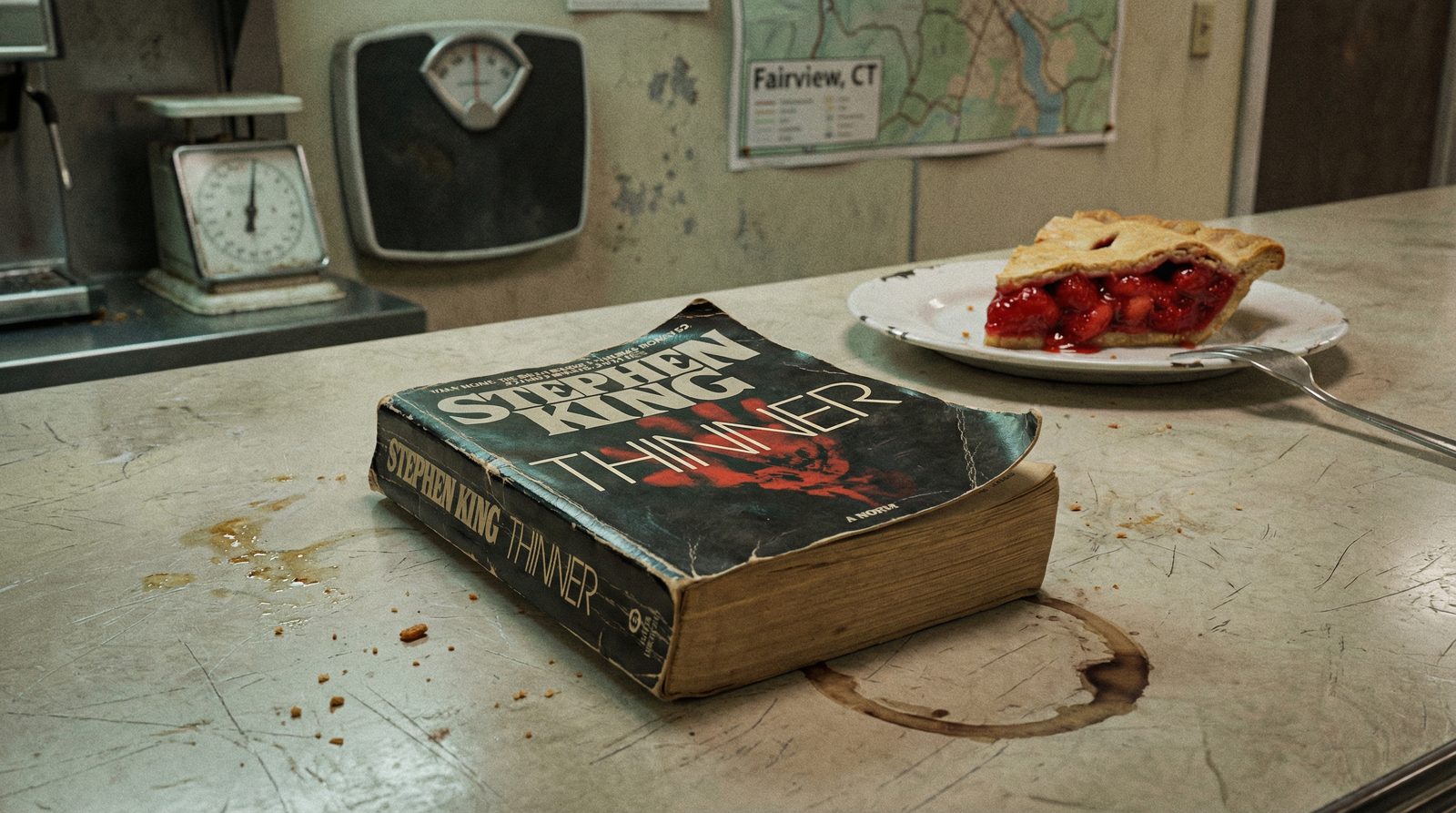
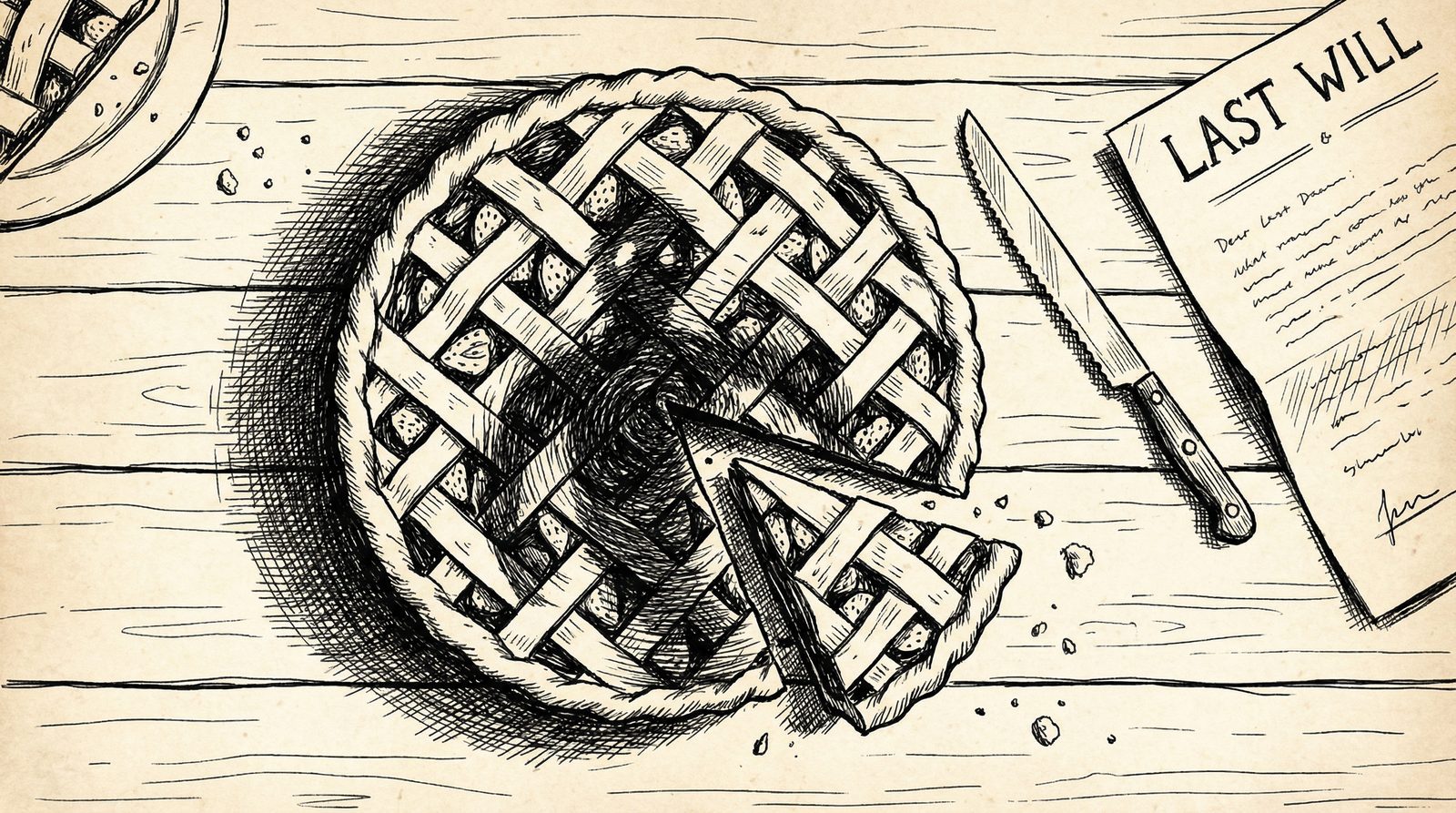
    Unlike the film adaptation, which softens and sensationalizes some of Ginelli’s campaign, the novel lingers on his methodical harassment and on Billy’s own moral slide as he accepts collateral damage. The book’s ending is brutally clear: Lemke agrees to move the curse into a strawberry pie that Billy must feed to someone else. Billy brings it home, intending to give it to Heidi. He later discovers that she has eaten a slice for breakfast. Realizing what he has done, he sits at the table in the final pages, cutting himself a generous slice of the cursed pie, ready to finish what he started.

    In its sour way, Thinner (1984) rhymes with works like Pet Sematary (1983) and the moral reckonings of The Twilight Zone (1959), where bargains are always paid in full, just not in the currency you expected.


    PROSE & NARRATIVE STRUCTURE

    Written under the Bachman mask, the prose is leaner and meaner than mid-1980s King. The narrative technique of close third-person limited pins us inside Billy’s increasingly frantic mind, but the voice keeps a hard, almost pulp edge. There are no baroque flourishes; that plainness sharpens the feeling of claustrophobic anxiety. Billy counting calories in reverse, watching the bathroom scale like a death clock.

    Structurally, the novel moves in three acts: the crime and cover-up in Fairview; the medical and legal rationalizations as Billy consults Dr. Houston and half-heartedly sues Lemke; and finally the road novel–cum–war story as Ginelli joins the fray. King uses short, punchy chapters that often end on a physical detail. A notch on Billy’s belt, the way his wedding ring slides loose on his finger. King uses it to reinforce the motif of bodily decay. Interludes from other perspectives, like Ginelli’s cool internal monologues about “pressure” and “messages,” widen the frame without losing momentum.

    One of the book’s subtler moves is how the narrative keeps trying to revert to normalcy. Billy returns to his law office on Main Street, goes through motions with clients, even plays golf, but the prose undercuts these scenes with intrusive bodily sensations. This repetition functions almost like a legal brief being revised; each new draft admits more guilt. Compared with the more sprawling horror of ’Salem’s Lot (1975), Thinner (1984) is stripped down to a single throughline: a man shrinking into the size of his crime.

    Conceptual editorial illustration inspired by 'Thinner (1984)'

    CHARACTERS & INTERIORITY

    Billy Halleck begins as the archetype of the comfortable sinner. His interiority is a steady slide from rationalization to obsession. Early on, he frames the accident as “her fault” for darting into the road; later, as the pounds vanish, his thoughts narrow to the scale and the next pound lost, even as the people around him fall apart.

    Heidi is more than a stock unfaithful wife. Her fear of Billy’s changing body and her retreat into Dr. Houston’s arms come off as a panicked grab at normal touch, not simple betrayal. Judge Rossington and Chief Hopley embody institutional rot — men who think a fixed trial is just “common sense.” Taduz Lemke, with his bottle of white dust and his slingshot-carrying granddaughter Gina, is not romanticized. The caravan community, especially Gina’s hard-eyed contempt for Billy, gives the curse a human face rather than a mystical abstraction.

    The most intriguing presence is Richie Ginelli, an underworld fixer who treats the whole affair as a problem of leverage. His interior monologues about “messages” and “counter-messages” echo Billy’s legal mindset, but stripped of illusion. Ginelli’s willingness to wage a small war on the Lemkes — accepting that he himself may be marked — throws Billy’s cowardice into sharper relief. By the time Billy sits with the strawberry pie, the interior landscape is scorched.


    LEGACY & RECEPTION

    First published as a Richard Bachman novel in the 1980s, Thinner (1984) initially puzzled some readers. It lacked the supernatural sprawl of The Stand (1978) or the nostalgic warmth of It (1986). What it offered instead was a nastier, more focused moral fable. Once King’s authorship was exposed, the book was reabsorbed into the larger King canon, often cited as one of his purest examples of the “monkey’s paw” story — every wish granted, every loophole closed.

    The later film adaptation sanded off some of the book’s bleakness and shifted emphases, but the novel’s ending remains one of King’s most vicious: the casual breakfast that kills a family, the quiet decision to eat the rest of the pie. Critics have since read the book as an early, nasty cousin to later explorations of guilt and consequence in American horror fiction. Its reputation has grown less on jump scares than on its willingness to follow a morally compromised man all the way to the logical, bitter end of his choices, without offering redemption or cosmic comfort.


    IS IT WORTH READING?

    If you want sprawling mythology or sympathetic heroes, this is not the book. Thinner (1984) is short, mean, and morally airless, a story that starts with a bad decision and refuses to look away as the bill comes due. Its horror is intimate — bathroom scales, loosened belts, a pie on a kitchen table — rather than cosmic. The prose is brisk, the plot unrelenting, and the final pages land like a punch to the gut. For readers interested in how horror can interrogate privilege, guilt, and the stories we tell ourselves after we do something unforgivable, it’s absolutely worth the time. Just don’t expect to like anyone very much by the end, including the man wasting away at the center.

    Illustration of a core idea or motif from 'Thinner (1984)'

    TRIVIA & AUTHOR FACTS

    Thinner (1984) was the last novel published under the Richard Bachman pseudonym before a bookstore clerk famously connected the dots between King and Bachman via Library of Congress records. The book’s focus on weight and appetite came from King’s own anxieties about his body and his growing fame in the mid-1980s. Fairview, the Connecticut town where Billy lives, is one of King’s less fantastical suburbs — no haunted hotels or vampire-infested villages, just country clubs and backroom deals.

    Ginelli’s Italian restaurant and his off-the-books “friends” nod to King’s interest in how organized crime mirrors small-town power structures. The recurring image of white powder — Lemke’s curse dust — prefigures King’s later, more literal engagements with addiction and substances. And the strawberry pie, so ordinary and homey, is one of King’s most quietly vicious symbolic objects: a dessert that turns domestic comfort into a weapon, sitting innocently on the kitchen table while lives end around it.


    SIMILAR BOOKS

    If Thinner (1984) hooks you, you might look toward other tight, morally focused horror novels. Pet Sematary (1983) offers a different kind of curse, trading weight loss for resurrection and parental grief. Needful Things (1991) stretches the “deal with the devil” structure across an entire town, showing how small compromises add up. Outside King, Clive Barker’s The Hellbound Heart (1986) shares the same interest in bodily punishment as a mirror of desire, while Jack Ketchum’s The Girl Next Door (1989) pushes the idea of community-sanctioned cruelty into even more brutal territory. All of them, like Thinner (1984), ask how far ordinary people will go to avoid admitting what they’ve done.


    DISCOVERABILITY & LINKS

    This review connects Thinner (1984) to wider motifs of bodily decay, appetite, and cursed bargains across horror fiction. Our indexing links these themes, tropes, and related works so you can move easily from this novel’s lean, bitter morality tale to other stories that gnaw at similar questions of guilt, consequence, and the prices we pay.

  • Blaze (2007)

    Blaze (2007)

    By: Richard Bachman
    Genre: Crime fiction
    Country: United States


    INTRODUCTION

    Blaze (2007) is one of Stephen King’s strangest resurrections: a trunk novel from the early 1970s, revised and finally published in the 2000s under the Richard Bachman persona. On its surface it’s a crime story about a kidnapping gone wrong, but the book’s real weather is loneliness. The motif of snow and cold runs through almost every page, turning Maine into a blank white stage where a damaged man stumbles toward a fate he half-understands. The feel is a slow ache rather than a jolt of horror. King strips away monsters and cosmic threats; what’s left is a hulking petty criminal, Clayton Blaisdell Jr., and the ghost of his smarter partner, George, murmuring in his ear as he tries to pull off one last score. It’s a small story, but it lingers like breath in winter air.


    PLOT & THEMES

    The plot of Blaze (2007) is deceptively simple. Clayton “Blaze” Blaisdell Jr., brain-damaged after his abusive father threw him down the stairs three times, decides to kidnap baby Joe Gerard from the wealthy Gerard household in Maine. The plan was conceived with his partner George Rackley, but George is dead before the book begins; Blaze still hears him, though, a running commentary in his head that blurs memory, conscience, and possible hallucination. This is the classic trope of the one last heist, except the heist is a child and the thief is too broken to be truly villainous.

    King braids the present-day kidnapping with extended flashbacks: Blaze at the Hetton House orphanage, his friendship with the doomed Johnny, his brief stint at the College of the Blessed Redeemer, and the petty cons he runs with George across twentieth-century New England. A second motif, damaged childhood, keeps surfacing — each institution that should protect Blaze instead exploits or discards him. The ransom plot itself is almost procedural, but the emotional focus is always on how Blaze became the man standing in that snowbound cabin with someone else’s child in his arms.

    Unlike many crime novels or films such as Fargo (1996), there is no clever twist that saves Blaze. In the book’s ending, he is shot multiple times in the snow near the cabin. While he has at times talked about the possibility of returning Joe, the narrative at the climax strongly suggests that he is still intending to keep the child rather than actively giving him up when the shooting occurs. He dies imagining a reunion with George and a better life that never came, while baby Joe survives and is returned to his family. The moral geometry is cruel but clear: the system that failed Blaze as a child finishes him as an adult, and the only innocence preserved is the child he tried, awkwardly, to care for.


    PROSE & NARRATIVE STRUCTURE

    Formally, Blaze (2007) is straightforward but quietly intricate. King uses an alternating timeline as his primary narrative technique, cutting between the present-tense kidnapping and Blaze’s past in long, almost novella-length flashbacks. The structure lets the reader hold two Blazes in mind at once: the hulking kidnapper in the woods and the bewildered boy at Hetton House, trying to understand why the world keeps hitting him. That contrast generates a steady feel of melancholy rather than pure suspense.

    The prose itself bears the marks of its era. You can feel the Bachman voice from books like The Long Walk (1979): sentences are clean and functional, but every so often he drops a line that stings, such as the description of Blaze’s mind as “a house with most of the lights out.” The recurring image of snow — falling on the Gerard estate, blanketing the TR-90, ghosting the roads Blaze hitchhikes along — works almost like a Greek chorus, muting color and sound.

    George’s presence is handled with deliberate ambiguity. King never underlines whether George is a literal ghost or a figment of Blaze’s damaged brain; interior monologue bleeds into remembered dialogue, and sometimes into outright argument. That porous boundary between thought and speech mirrors Blaze’s own cognitive fractures and keeps the reader slightly off-balance, riding inside a mind that cannot fully be trusted yet is painfully transparent.

    Conceptual editorial illustration inspired by 'Blaze (2007)'

    CHARACTERS & INTERIORITY

    Clayton Blaisdell Jr. is built from an archetype — the gentle giant criminal — but King complicates it. Blaze is huge, physically intimidating, and undeniably dangerous, but the novel’s interiority keeps circling his bewilderment and his hunger for simple kindness. His memories of Hetton House, of being conned by the headmaster and beaten by other boys, and of his brief, almost holy friendship with Johnny, are rendered with a bruised tenderness that keeps undercutting his role as “villain.”

    George Rackley, by contrast, is wiry, sharp, and mostly present as a voice. In life he’s a small-time grifter; in Blaze’s head he becomes a kind of harsh guardian angel, criticizing, instructing, occasionally mocking. Their dynamic is one of the book’s deep cuts: the small scam with the crooked car lot in Lewiston, or George teaching Blaze to read the angles on a bar fight, show a relationship that is transactional yet oddly intimate. Even minor characters — like the decent but limited Father Bracken at the College of the Blessed Redeemer, or the state trooper who briefly gives Blaze a ride without recognizing him — are sketched with enough interior shading to feel human.

    The most unsettling interiority, though, comes when Blaze is alone with baby Joe in the TR-90 cabin. King lets us sit inside Blaze’s panic as the baby cries, his clumsy tenderness as he warms formula on a hot plate, his irrational hope that maybe they could just disappear together. Those scenes force the reader to inhabit a mind that is both criminal and deeply vulnerable, and that tension is where the novel’s emotional power lives.


    LEGACY & RECEPTION

    When Blaze finally appeared in 2007, it was framed as “the last Bachman book,” a curiosity excavated from King’s early career. Reception was muted but respectful; readers expecting supernatural horror in the vein of Carrie (1974) or cinematic bombast like The Shawshank Redemption (1994) found instead a low-key crime novel soaked in regret. Some critics saw it as a minor work, interesting mainly as a fossil record of King learning his craft.

    Yet among King readers, Blaze has developed a quiet following. Its ending — Blaze bleeding out in the snow while imagining a life he’ll never have, baby Joe safe but oblivious — lands harder than many of King’s more spectacular finales. It clarifies something about the Bachman persona: those books are where King goes to strip away hope and examine the machinery of cruelty. Blaze may not be central to his mainstream reputation, but it deepens the sense of his range, especially his sympathy for damaged, working-class men ground down by institutions they barely understand.


    IS IT WORTH READING?

    If you come to Blaze (2007) looking for jump scares or baroque plotting, you’ll likely be disappointed. The book’s pleasures are quieter: the slow accumulation of detail about Blaze’s life, the way King makes you care about a man who has done something unforgivable, the stark winter landscapes that feel as numb as his thoughts. It’s a compact, emotionally focused crime novel with a strong through-line of compassion for the broken and the left-behind.

    Readers interested in King’s development as a writer, or in crime stories centered on flawed, almost childlike offenders, will find Blaze rewarding. It’s not essential to understand his larger universe, but as a character study and a mood piece, it’s quietly potent — and hard to shake off once you’ve walked those snowy back roads with Blaze.

    Illustration of a core idea or motif from 'Blaze (2007)'

    TRIVIA & AUTHOR FACTS

    Stephen King originally wrote Blaze in the early 1970s, before Carrie was published. He later put the manuscript in a drawer, calling it “a trunk novel,” and returned to it decades later to revise and tighten the prose. The book was released under the Richard Bachman name, continuing the pseudonymous line that had begun in the late 1970s.

    One of King’s personal touches is the use of real Maine geography: the TR-90 unorganized territory, Lewiston, and the snowy back roads around Augusta anchor the story in places he knows well. The Hetton House orphanage is fictional, but King has said he drew on stories from reform schools and state institutions he’d read about while teaching. Many editions of Blaze also include the short story “Memory,” an early version of what later became the novel Duma Key, making the book a small hinge between different phases of his career.


    SIMILAR BOOKS

    If Blaze speaks to you, you might seek out other crime novels centered on damaged, morally ambiguous protagonists. Donald E. Westlake’s The Ax (1997) offers a bleaker, more satirical take on an ordinary man turned criminal. From King’s own shelf, The Long Walk (1979) shares the same stripped-down, fatalistic tone under the Bachman mask. For another portrait of a hulking, misunderstood outsider, John Steinbeck’s Of Mice and Men (1937) remains a touchstone. All of these books share an interest in how limited choices, bad luck, and systemic cruelty shape men who might have been gentle if the world had given them half a chance.


    DISCOVERABILITY & LINKS

    This review of Blaze (2007) is connected across the site to related motifs such as snow and cold, damaged childhood, and the one last heist, along with books and films that explore gentle giant criminals and bleak, character-driven crime fiction.

  • The Collector (1963)

    The Collector (1963)

    By: John Fowles
    Genre: Psychological horror
    Country: United Kingdom


    INTRODUCTION

    The Collector (1963) arrives like a chill draft under a locked door. Set in the 1960s, it takes the motif of imprisonment and strips it of gothic flourish, leaving only concrete, keyholes, and the stale air of a cellar room. John Fowles imagines what happens when a socially awkward clerk, numbed by years of insect collecting and Lotto luck, decides to “collect” a living woman. The feel is slow-burn dread rather than jump-scare terror, a suffocating awareness that nothing supernatural is coming to save anyone here. Beneath the kidnapping plot runs a quieter story about class, aesthetic ideals, and the way men translate desire into ownership. The novel is short, tightly wound, and emotionally abrasive, but it lingers — especially in the details of that furnished basement outside Lewes, where the wallpaper, the books, and even the electric heater become part of an experiment in control.


    PLOT & THEMES

    On the surface, The Collector uses the trope of the stalker-turned-kidnapper. Frederick Clegg, a municipal clerk in the town of Newbury, wins a football pools fortune and uses it to buy a secluded country house near Lewes. A lifelong butterfly enthusiast, he has watched art student Miranda Grey from afar, rehearsing conversations he never has. Wealth gives him privacy and power, and he decides to “collect” Miranda as he would a rare specimen. He chloroforms her on a London street near the National Gallery, transports her in a van, and imprisons her in a windowless cellar he has carefully prepared with furniture, clothes, and art books.

    The novel is structurally simple but thematically dense. One motif is aestheticization: Clegg sees Miranda as a perfect object, while she, in her diary, struggles to see him as a human being rather than a case study. Their clash is also a class war. Miranda is a middle-class, Hampstead-leaning art student, enamoured of the bohemian painter G. P. and of modernist ideals of freedom. Clegg is lower-middle-class, resentful, and obsessed with respectability; he wants Miranda to be grateful, to play the part of the adoring wife in his private fantasy. Their conversations about Proust, Picasso, and the meaning of art echo, in a darker key, the aesthetic debates in The Picture of Dorian Gray.

    As the weeks pass, Miranda’s initial belief that she can reform or outwit Clegg crumbles. Her illness — brought on by damp, stress, and finally pneumonia — becomes another motif: the body failing as the mind still reaches outward. In the book’s ending, far bleaker than many viewers remember from the 1965 film, Miranda dies alone in the cellar after Clegg refuses to get a doctor in time, more afraid of scandal than of murder. He buries her in the garden, rehearses excuses to himself, and then calmly turns his attention to a new possible victim he spots in Woolworths, already thinking about names like Marian or Marianne that echo Miranda. The horror is not catharsis but continuation.


    PROSE & NARRATIVE STRUCTURE

    Formally, The Collector hinges on a stark narrative technique. The first half is narrated in Clegg’s flat, affectless first person; the second half shifts into Miranda’s diary. This structure forces the reader to sit inside two incompatible realities. Clegg’s prose is plain, bureaucratic, and chillingly literal. He notices the make of the van, the arrangement of his butterfly cases, the way he has painted over the cellar window, but he has almost no language for emotion beyond “I didn’t like it” or “it upset me.” The feel here is claustrophobic banality: evil described in the same tone as a stamp collection.

    Miranda’s diary is another book entirely. She writes about G. P., about her time at the Slade School of Fine Art, about the smell of turpentine and the thrill of arguing about Cézanne in Soho cafés. She analyses Clegg with almost clinical precision, calling him a “Caliban” and herself “Prospero,” a self-flattering binary she later questions. Her voice is sometimes pretentious, sometimes piercingly honest. Fowles uses free indirect thought within the diary entries to blur the line between written reflection and immediate feeling; we sense her mind racing as she plots escapes, rehearses conversations, and records dreams of walking again through Kensington Gardens.

    The alternation of voices is not just a device but an argument about who gets to narrate reality. Clegg’s final section quietly edits Miranda’s story, dismissing her diary as “her side of it” while he reasserts his own. There is no omniscient correction, no moral footnote — only the dissonance between voices, left unresolved. That structural choice gives the novel its lingering unease.

    Conceptual editorial illustration inspired by 'The Collector (1963)'

    CHARACTERS & INTERIORITY

    Clegg is an unsettling twist on the Nice Guy archetype. On paper he is mild: an orphan who lived with his Aunt Annie and cousin Mabel, shy, dutiful, never openly violent. Inside, he is a void of entitlement. He insists he is not like “those sex cases” in the newspapers; he wants to be seen as considerate, even generous, because he buys Miranda clothes from Harrods and a portable record player. His interiority is defined by absence — no real erotic language, no curiosity about Miranda’s inner life, only the sulkiness of a child denied a toy. When she resists, he retreats into self-pity, telling himself that “she was never like in my dreams.”

    Miranda, by contrast, is all interiority. Her diary is full of self-portraiture and self-critique. She is not an idealized victim; she can be snobbish, impatient, and casually cruel. That nuance matters. The novel refuses to make her suffering dependent on saintliness. Her growth under pressure — her attempts to empathize with Clegg, her brief, desperate seduction attempt, her moments of spiritual searching as she reads the Bible in the cellar — gives her a trajectory that his narrative can never fully contain.

    Minor figures deepen the social frame. G. P. himself never appears in person but looms over the book as an absent mentor, his letters and remembered conversations about authenticity and “the Few and the Many” echoing in Miranda’s head. Aunt Annie and Mabel, glimpsed in Clegg’s memories, represent a petty, rule-bound world where appearances matter more than empathy. These side characters emphasize how both captor and captive are shaped by English class structures as much as by individual psychology.


    LEGACY & RECEPTION

    Published in the early 1960s, The Collector was immediately read as a dark commentary on emerging celebrity culture and the loneliness of the post-war welfare state. Its influence can be traced through later psychological horror and crime fiction, from the obsessive narrators of Misery (1987) to other tightly focused captivity stories, though Fowles’s novel is less melodramatic and more sociological than most of its descendants. Contemporary critics were struck by the split structure and by the way Fowles refused to offer a consoling ending.

    The book’s ending, in which Miranda dies and Clegg calmly begins scouting a new victim, has often been softened or psychologically padded in adaptation, but on the page it remains brutally matter-of-fact. That starkness has helped the novel retain its power. It is frequently taught in university courses on modern British fiction and gender studies, where Miranda’s diary is read alongside feminist texts of the period. Over time, the book has also drawn criticism for the way it frames Miranda’s artistic elitism, but even detractors acknowledge its unnerving accuracy in capturing a certain kind of male entitlement long before the term existed.


    IS IT WORTH READING?

    The Collector is worth reading if you can tolerate psychological horror that never looks away. It is not a thriller in the conventional sense; the suspense comes from tiny shifts in power, not from chase scenes or clever twists. The prose is accessible, the structure clear, but the emotional impact is heavy. Readers interested in questions of class, gender, and the ethics of looking — what it means to watch someone without being seen — will find it especially resonant. If you want clear moral closure or heroic rescue, this will feel punishing. If you are willing to sit with discomfort, it is one of the sharper, more honest portraits of obsession in twentieth-century fiction.

    Illustration of a core idea or motif from 'The Collector (1963)'

    TRIVIA & AUTHOR FACTS

    John Fowles wrote The Collector early in his career, before the more expansive metafiction of The French Lieutenant’s Woman (1969). He drew partly on his own experience teaching in England and observing the rigidities of class life. The butterfly motif is not incidental: Fowles was himself an amateur naturalist, and the detailed references to specimens, nets, and killing jars come from genuine knowledge. The novel’s original UK setting near Lewes and the careful mention of places like Hampstead and Newbury root the story in a very specific English geography.

    Fowles later commented that Clegg represented, for him, the “elected bureaucrat of the future,” a man who hides behind procedure and respectability while committing quiet atrocities. The book’s success allowed Fowles to leave teaching and write full time. He would go on to experiment more overtly with narrative games and historical pastiche, but he never again wrote a novel this compressed and single-minded in its focus on two people in a single, terrible space.


    SIMILAR BOOKS

    If The Collector unsettles you in the right way, several other works explore related territory. Misery (1987) by Stephen King reverses the gender dynamic but shares the locked-room psychological warfare and the question of who controls the story. For a more interior, philosophical take on captivity and power, try The Comfort of Strangers (1981) by Ian McEwan, which similarly turns a European city into a psychological trap. And if Miranda’s artistic self-scrutiny interests you, the shifting perspectives and moral ambiguity of The French Lieutenant’s Woman (1969) provide a different, more expansive facet of Fowles’s concerns.


    DISCOVERABILITY & LINKS

    This review of The Collector is connected across the site to shared motifs, tropes, archetypes, and related works, helping you trace patterns of obsession, confinement, and class tension through other books and media in our archive.