Period: 21st Century

  • The Hunger Games (2012)

    The Hunger Games (2012)

    The Hunger Games (2012), directed by Gary Ross. Science fiction · 142 minutes · United States.


    INTRODUCTION

    The Hunger Games (2012) arrives as a young-adult blockbuster that tries to keep its hands dirty. Adapted from Suzanne Collins’ novel, the film takes a premise that could have played as slick action fantasy and instead leans into a bruised, anxious feel. The world of Panem is built on televised cruelty, but Gary Ross shoots it with a jittery, almost documentary unease that keeps reminding you bodies are at stake. At the center is Katniss Everdeen, a reluctant symbol, whose survival instinct keeps colliding with the machinery of spectacle. The result is a story that feels both intimate and political, where every choice is framed as a compromise with power. The film sits in that uneasy space between YA romance and political allegory, and its best moments are when those two threads grind against each other instead of blending smoothly.

    PLOT & THEMES

    The plot is built around a familiar dystopian trope: the deadly game as social control. In Panem, the Capitol forces twelve districts to send two teenagers each to a televised fight to the death called the Hunger Games, a ritualized punishment for a past rebellion. When Katniss volunteers to take her sister’s place, the narrative locks into a clear three-part structure. First comes the reaping and departure, then the grooming and media circus in the Capitol, and finally the arena itself. Each phase sharpens the idea that entertainment is a weapon. Training sequences are staged like reality TV auditions, interviews like talent shows, and the arena like a rigged sports broadcast.

    The central themes are power, surveillance, and the corrosion of authenticity. The motif of spectacle vs. survival runs through every scene. Katniss must constantly perform: as tragic heroine for the cameras, as romantic lead with Peeta, as obedient pawn for the Gamemakers. Yet her real goal is simple survival and protection of those she loves. The more she resists becoming a symbol, the more the system tries to turn her into one. Another recurring motif, bread and circuses, shapes how the Capitol uses the Games as both terror and distraction, echoing works like Battle Royale in its depiction of youth sacrificed to maintain order.

    The film also plays with the trope of the reluctant hero thrown into the arena, but gives it a bitter edge. Katniss’s acts of kindness, especially toward Rue, become politicized gestures she never intended, showing how rebellion can be born less from grand speeches than from small refusals to dehumanize others.

    CINEMATIC TECHNIQUE & AESTHETICS

    Gary Ross leans heavily on handheld camera work and quick cutting to keep the violence subjective and disorienting. The shaky, close-quarters framing in the Cornucopia bloodbath and forest chases denies the audience the clean geometry of traditional action scenes. Instead, we get fragments of motion, screams, and impacts that convey fear rather than choreography. This stylistic choice, combined with PG-13 constraints, turns brutality into implication, which fits the film’s focus on trauma more than spectacle.

    Color and production design do a lot of thematic lifting. District 12 is all washed-out grays and browns, with natural light and coal dust creating a texture of exhaustion. The Capitol explodes into saturated color, grotesque costumes, and Art Deco futurism, a visual embodiment of bread and circuses. The arena sits between these extremes, a manicured wilderness where nature is literally stage-managed. Digital interfaces, holograms, and the Gamemakers’ control room create a second layer of spectacle vs. survival, reminding us that every tree and firestorm is curated content.

    The film often uses close-ups on Katniss’s face as a technique to anchor us in her subjectivity. Sound design also matters: the roar of the crowd cuts to silence as she enters the arena, and the use of muffled audio during shock moments mimics dissociation. James Newton Howard’s score stays relatively restrained, saving its most emotional swells for the few moments when genuine connection breaks through the game’s artificiality, such as Katniss’s mourning for Rue. The overall feel is tense, bruised, and slightly claustrophobic, even in open spaces.

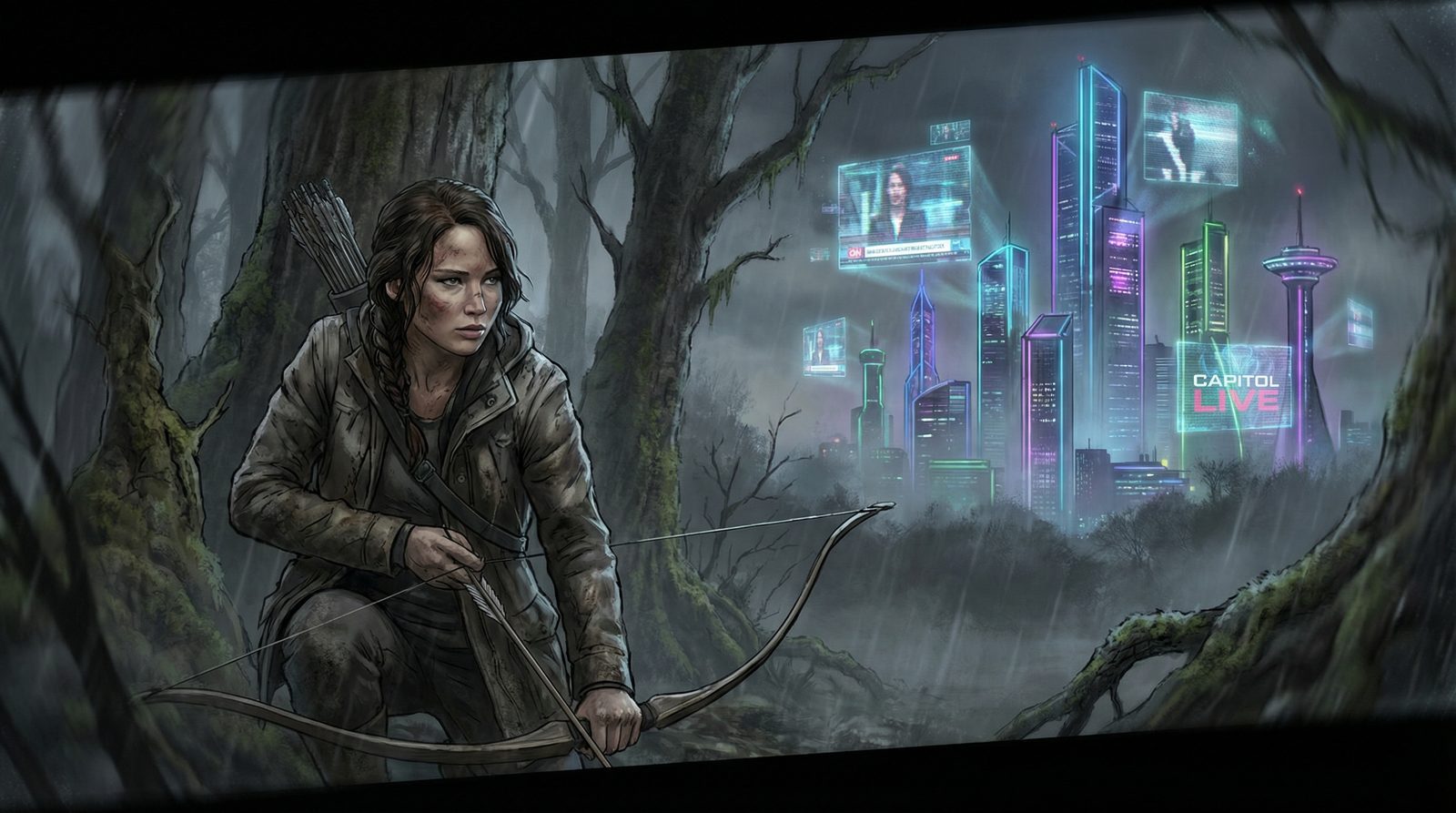
    Editorial illustration inspired by 'The Hunger Games (2012)'

    CHARACTERS & PERFORMANCE

    Katniss is written and played as a classic warrior archetype with a strong streak of protector. Jennifer Lawrence gives her a guarded physicality: she is not a quippy action lead but someone who expects the world to hurt her and acts accordingly. That makes the moments when she softens, especially with Rue and Prim, land harder. Her discomfort with performance is the emotional spine of spectacle vs. survival.

    Peeta fits the archetype of the caregiver and the self-effacing strategist. Josh Hutcherson plays him as someone who understands narrative better than combat. That contrast with Katniss’s blunt directness keeps their dynamic off-balance. Gale, largely sidelined once the Games begin, functions more as a symbolic rebel archetype than a full character here, a reminder of the life Katniss might have had outside the arena.

    Among the adults, Haymitch is the archetypal broken mentor, Woody Harrelson layering cynicism over genuine, if reluctant, care. Effie Trinket and Caesar Flickerman personify bread and circuses, their exaggerated manners showing how thoroughly the Capitol has turned cruelty into pageantry. Even minor tributes are sketched quickly but vividly enough to make their deaths sting, which keeps the deadly game trope from collapsing into faceless cannon fodder. The performances collectively underline how every person in Panem is playing a role, whether they admit it or not.

    CONTEXT & LEGACY

    The Hunger Games arrived in a landscape already familiar with televised dystopia, from The Running Man to Battle Royale, but shifted the conversation into young-adult territory. Compared to the novel, the film trims internal monologue and political exposition, relying more on the visual grammar of reality TV and sports broadcasting to make its point. It also softens some of the book’s harsher edges, particularly around bodily damage, to fit a broader audience, which has led to debates about how much bite remains in its critique of bread and circuses.

    Its legacy is twofold. Commercially, it proved that a female-led science fiction franchise could dominate box offices and cultural conversation, paving the way for later YA dystopias like Divergent. Culturally, it gave teens a vocabulary for talking about spectacle vs. survival, media manipulation, and state violence, even if in simplified form. The image of a girl with a bow, three-finger salute raised against a distant Capitol, has lingered far beyond the film itself, echoed in protests and memes alike. In that sense, the film unintentionally mirrors its own plot: a carefully managed piece of entertainment that audiences seized as a symbol of something more unruly.

    IS IT WORTH WATCHING?

    The Hunger Games is worth watching if you are interested in how mainstream cinema packages political unease for a young audience. It is not as brutal or philosophically dense as some of its influences, but its focus on Katniss’s emotional reality keeps it from feeling hollow. The handheld camera style and PG-13 restraint may frustrate viewers who want clearer action or sharper satire, yet those same choices make the film unusually grounded for a franchise opener.

    If you respond to stories about reluctant heroes navigating systems of control, or if you are curious how YA dystopia evolved between Battle Royale and later series like Divergent, this is a key text. It works as tense genre entertainment and as a primer on how bread and circuses operates in a media-saturated society, even when the film itself is part of that machinery.

    Symbolic illustration inspired by 'The Hunger Games (2012)'

    TRIVIA & PRODUCTION NOTES

    Production leaned heavily on location shooting in North Carolina to give District 12 and the arena a tangible, Appalachian texture. The use of practical sets and real forests helps sell the survival aspect and complements the handheld camera approach. Costume design for the Capitol drew from haute couture and historical court fashion, exaggerating silhouettes and colors to make bread and circuses feel both absurd and menacing.

    Gary Ross and the editors used quick cutting and oblique angles to satisfy ratings boards while still conveying the horror of kids killing kids. James Newton Howard stepped in for composer duties after an early collaboration with T-Bone Burnett, resulting in a hybrid sound that mixes folk textures with more traditional orchestral swells. The film’s marketing leaned into the spectacle vs. survival motif, with viral campaigns that mimicked Capitol propaganda. That blurring of critique and participation in spectacle mirrors similar strategies used later by films like The Purge, where fictional authoritarian branding bleeds into real-world promotion.

    SIMILAR FILMS

    If the deadly game trope and political edge appeal to you, Battle Royale offers a harsher, more satirical take on students forced to kill each other. The Running Man explores bread and circuses in a more overtly comedic and muscular 1980s key, with a condemned man fighting for survival on live TV. Fans of dystopian YA might look to Divergent, which shares themes of factional control and reluctant rebellion, though with a slicker, more conventional feel. For another story about a young woman turned symbol against her will, V for Vendetta, while more ideological and less grounded, scratches a similar itch around spectacle vs. survival and state propaganda.

    DISCOVERABILITY & LINKS

    The Hunger Games sits at the intersection of science fiction, dystopia, and young-adult drama, making it a hub for readers interested in bread and circuses, spectacle vs. survival, and the warrior archetype. On the site it clusters naturally with stories about deadly game tropes, broken mentor figures, and handheld realism. If you are browsing by themes of rebellion, media manipulation, or reluctant heroes from marginalized places like the districts of Panem, this film connects to a wide web of related titles across both page and screen.
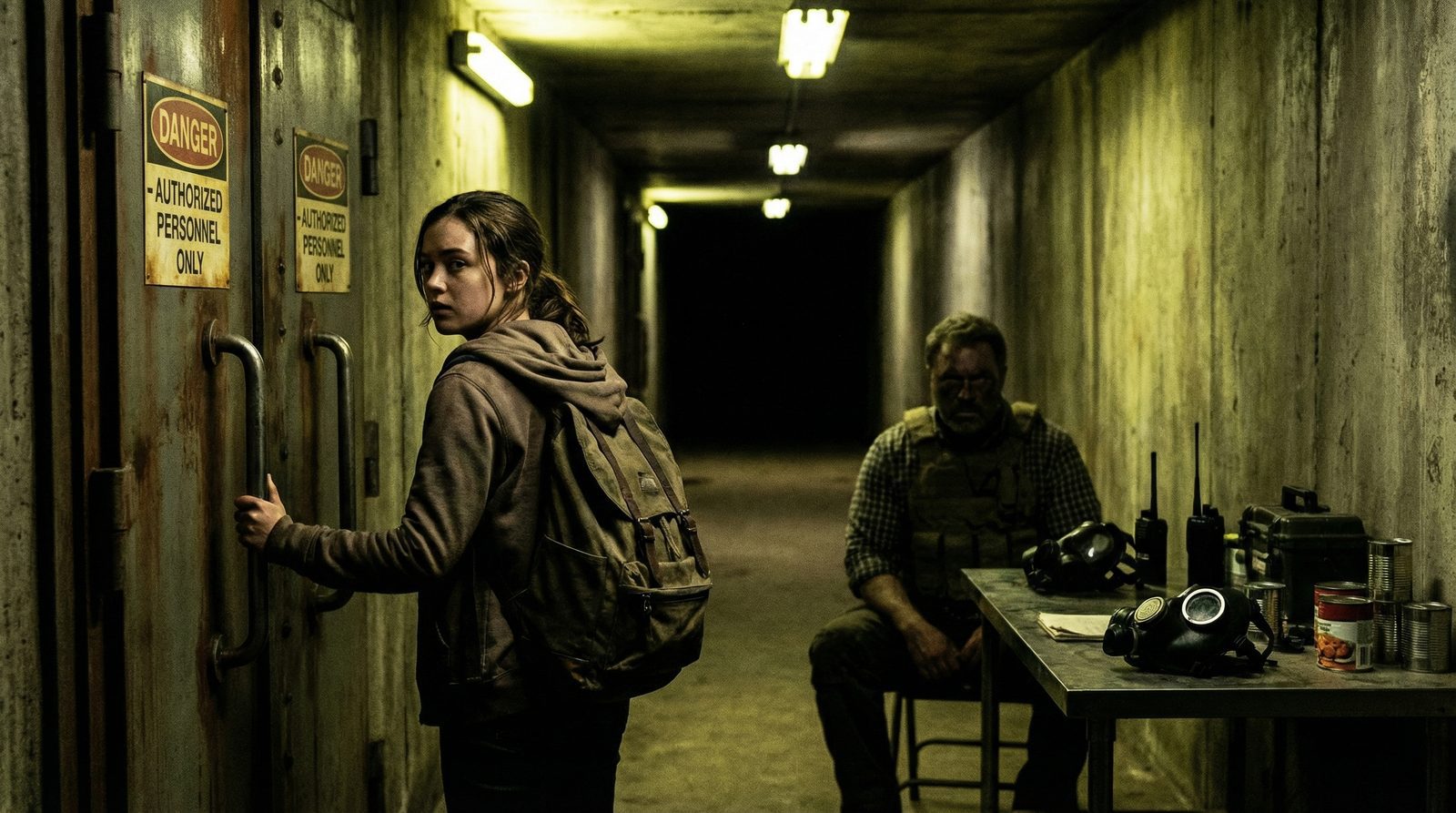
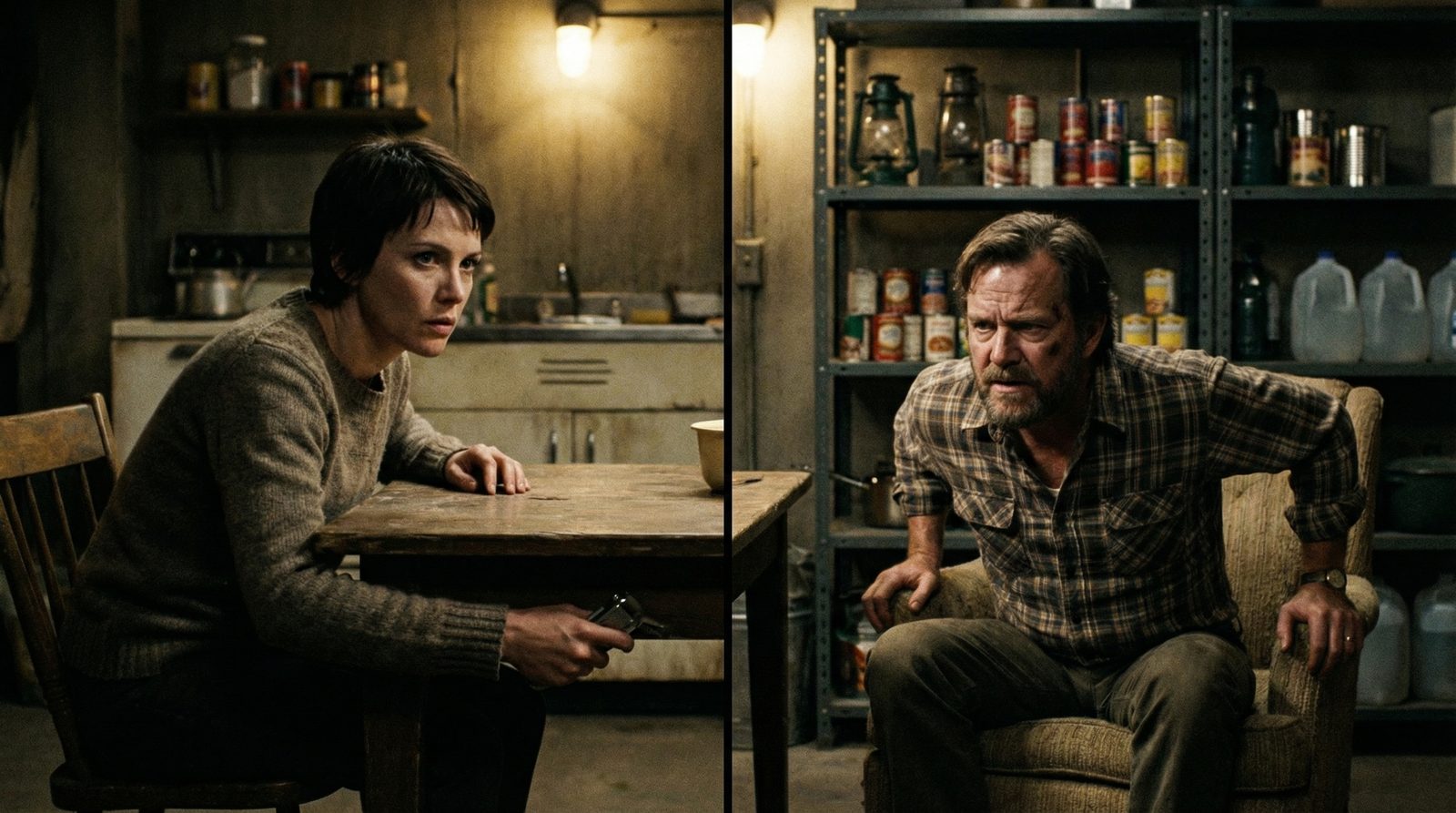
  • 10 Cloverfield Lane (2016)

    10 Cloverfield Lane (2016)

    10 Cloverfield Lane (2016), directed by Dan Trachtenberg. Thriller · 103 minutes · United States.


    INTRODUCTION

    10 Cloverfield Lane is a small, airless film that feels huge in your chest. Set almost entirely in an underground bunker, it plays like a pressure cooker of doubt and dread. The premise is simple: a young woman wakes up after a car crash to find herself locked in a stranger’s shelter, told the world outside has ended. From that single claim, the film spins a sustained mood of paranoia and creeping claustrophobia. What makes it stick is not the science fiction dressing but the emotional realism of being trapped with someone who might be your savior or your captor. The story keeps scraping at questions of trust, control, and survival, and the longer you sit in that concrete box, the more you feel how thin the line is between protection and imprisonment. It is a thriller that works on your nerves and your gut at the same time.

    PLOT & THEMES

    The plot of 10 Cloverfield Lane follows Michelle, who flees a relationship, crashes her car, and awakens chained in an underground bunker. Her apparent rescuer, Howard, claims there has been an apocalyptic attack and that the bunker is the only safe place left. Sharing the space is Emmett, a local who helped build the shelter and backs up Howard’s story. From there, the narrative becomes a classic bottle episode, with the outside world reduced to rumor and hearsay. The central tension is simple: can Michelle trust the man who saved her, or is his story a cover for something far worse?

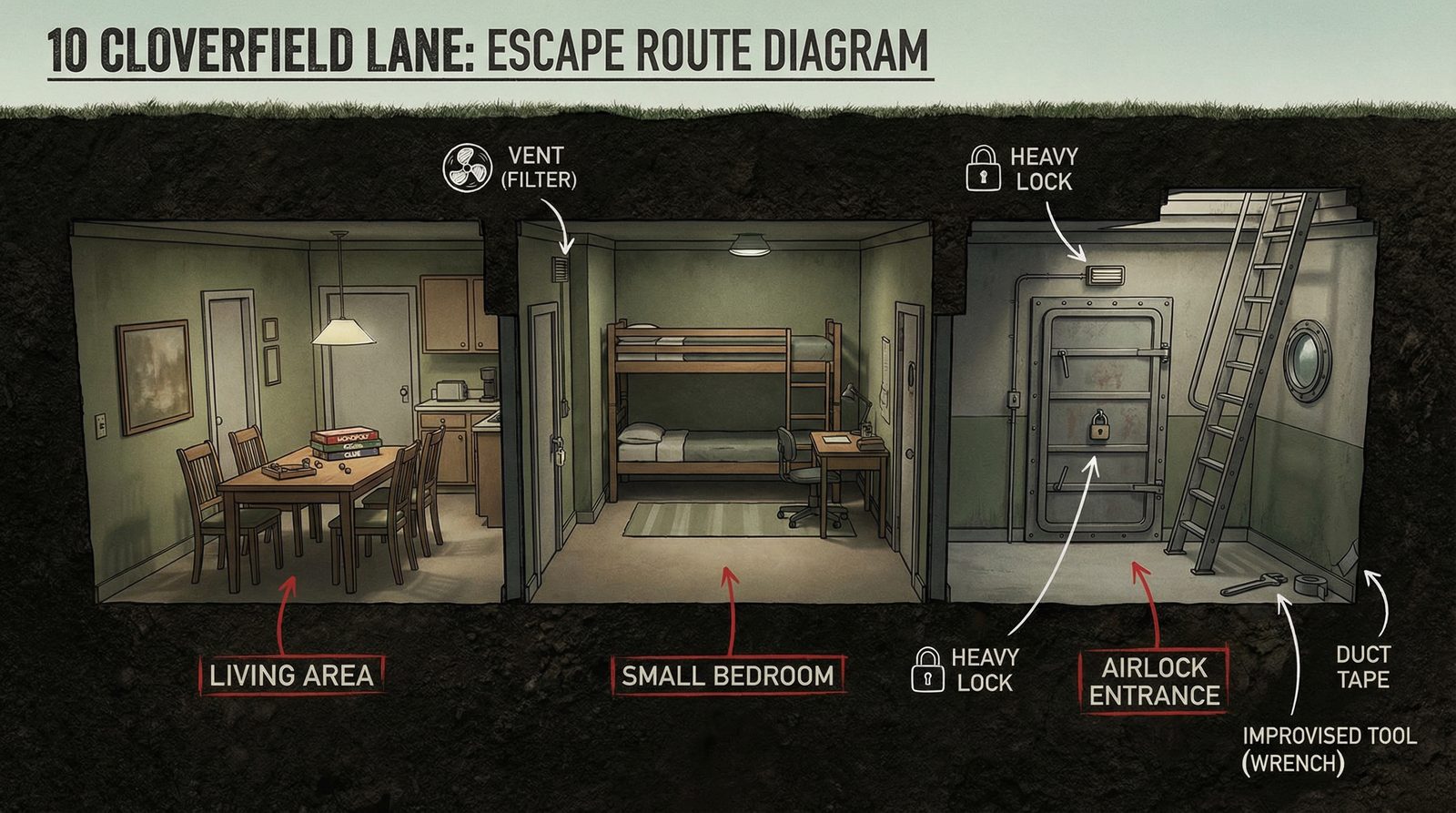
    The film is obsessed with the motif of confinement. Doors, locks, and airlocks are everywhere, underlining how control over space equals control over people. Another recurring motif is survivalism, not just in the prepper gear but in the emotional calculus of what each character is willing to trade for safety. Michelle’s arc is about reclaiming agency. She starts as someone who runs from conflict, then is forced to decide whether to accept captivity for the sake of survival or risk everything on her own judgment.

    Trust and gaslighting drive the emotional core. Howard’s explanations are always just plausible enough, and the script keeps feeding Michelle (and us) contradictory evidence. The trope of the unreliable protector is used very effectively, turning every act of kindness into something suspect. Compared with something like Misery, the film tilts less toward grotesque horror and more toward the slow erosion of certainty. Even when the story finally addresses the larger Cloverfield universe, the thematic focus stays on one question: what kind of danger do you choose to face, the known monster in the room or the unknown one outside?

    CINEMATIC TECHNIQUE & AESTHETICS

    Dan Trachtenberg and cinematographer Jeff Cutter build tension through a careful use of close-up and blocking. The camera often sits uncomfortably close to faces, catching micro-reactions that the characters try to hide from each other. In group scenes, blocking tells you who holds power: Howard positioned at the head of the table, looming in the foreground, while Michelle and Emmett are pushed toward the edges of the frame. The result is a persistent feel of claustrophobia even when the characters are not literally boxed in.

    Lighting and color are tightly controlled. The bunker is warm and domestic on the surface, full of board games and soft lamps, but the corners fall off into shadow. This visual split mirrors the emotional split between Howard’s paternal hospitality and his volatility. When the story shifts toward escape, the palette cools and the editing rhythm sharpens, trading languid, talk-heavy scenes for quick, almost heist-like problem solving. Sound design is another quiet weapon. The muffled thuds from outside, the hum of ventilation, the squeak of a door seal closing all enlarge the space in your imagination while keeping your eyes trapped in the same rooms.

    Montage is used sparingly but effectively, especially in the mid-film sequence where bunker life briefly resembles a sitcom. The editing there creates a fragile feel of normalcy that makes Howard’s next outburst land harder. Compared with the shaky immediacy of Cloverfield, this film prefers clean compositions and deliberate pacing. It feels more like a stage play adapted for the camera, closer in spirit to something like Rear Window, where what you cannot see is as important as what you can.

    Editorial illustration inspired by '10 Cloverfield Lane (2016)'

    CHARACTERS & PERFORMANCE

    The film works because its three-character ensemble is so sharply drawn. Michelle is a classic final girl archetype reshaped for a confined space. Mary Elizabeth Winstead plays her not as a quip machine but as a practical problem-solver, always scanning the room, mentally measuring distances, testing stories against details. Her quiet, observational energy grounds the film. We believe she survives not through luck but through a stubborn refusal to stop thinking.

    Howard fits the archetype of the domineering patriarch, a man who confuses control with care. John Goodman makes him terrifying without turning him into a cartoon. He can be goofy, almost childlike, then snap into rage with no warning. That volatility is the real horror. His backstory, full of half-truths and gaps, feeds the theme of gaslighting. You never fully know how much of his paranoia is justified and how much is projection, and Goodman keeps that uncertainty alive in every scene.

    Emmett is the reluctant companion, offering comic relief and a local’s perspective on Howard. John Gallagher Jr. gives him a slouchy warmth that makes his presence feel like a buffer between Michelle and Howard. He is not heroic in any conventional sense, but his small acts of solidarity matter. The triangle among these archetypes creates a shifting balance of power. Allegiances change, secrets leak out, and the bunker starts to feel like a psychological experiment in which three incompatible survival strategies are forced to coexist.

    CONTEXT & LEGACY

    Released as part of the loose Cloverfield anthology, 10 Cloverfield Lane arrived with a marketing strategy built on secrecy and surprise. Rather than a direct sequel to Cloverfield, it functions as a side story, connected more by tone than by plot. That freed it to be a contained thriller first and a science fiction film second. Its strongest legacy is how it showed that a franchise can expand sideways, treating its shared world as a label for mood and theme rather than a single ongoing narrative.

    Within the broader landscape of survival thrillers, it sits comfortably alongside works like Panic Room, which also turns a limited setting into a chessboard of power. It also anticipates the later interest in anthology-style worldbuilding seen in projects like Black Mirror, where each entry explores a different facet of fear under a common banner. For Dan Trachtenberg, this film marked a high-profile feature debut, announcing a director comfortable with genre but more interested in emotional pressure points than spectacle. Over time, 10 Cloverfield Lane has gained a reputation as the quiet standout of its franchise, the one that people remember less for its monsters than for the suffocating human dynamics in that underground room.

    IS IT WORTH WATCHING?

    10 Cloverfield Lane is worth watching if you like your thrillers tight, character-driven, and slightly mean. The film is less about aliens than about the emotional physics of captivity: who gets to decide what is safe, and what it costs to disagree. If you come in expecting a large-scale science fiction spectacle, you may feel the scope is small, but the trade-off is a more intimate, sustained tension. The feeling of paranoia and claustrophobia is strong enough that you might find yourself checking your own doors afterward. It is especially rewarding if you enjoy watching a capable protagonist think her way through impossible choices. Even if you have no investment in the Cloverfield name, the movie stands alone as a sharp little pressure cooker about trust, survivalism, and the danger of men who insist they know what is best for you.

    Symbolic illustration inspired by '10 Cloverfield Lane (2016)'

    TRIVIA & PRODUCTION NOTES

    The project began life as an unrelated script titled The Cellar, a contained thriller about a woman trapped in a bunker with a possibly dangerous man. J.J. Abrams and Bad Robot acquired it and folded it into the Cloverfield umbrella, which involved reworking the ending and adding the broader science fiction elements. This hybrid origin explains why the film feels so self-contained for most of its runtime.

    Dan Trachtenberg, known at the time mainly for his short Portal: No Escape, brought a puzzle-box sensibility to the production. Many props in the bunker are functional clues: the script and design team use these details to set up payoffs in the escape sequences. The shoot itself leaned into the bottle episode structure, with the cast spending long stretches in the same few rooms, which likely fed into the lived-in feel of the bunker. The late shift into overt science fiction divided some viewers, but it also cemented the film’s status as part of an experimental franchise that treats genre as a sandbox rather than a fixed template.

    SIMILAR FILMS

    If the confined dread of 10 Cloverfield Lane works for you, Misery is an obvious companion piece, another story about a captive trying to outthink a captor whose care curdles into control. Panic Room offers a more overtly physical version of the same containment game, with a mother and daughter using their environment as a weapon. Fans of the slow-burn paranoia and limited perspective might also appreciate Rear Window, which similarly turns a single location into a moral and psychological maze. Within the science fiction space, Cloverfield remains useful as a contrast, showing how the same shared world can support both large-scale chaos and intimate psychological siege. All of these films share a fascination with confinement, surveillance, and the uneasy line between safety and imprisonment.

    DISCOVERABILITY & LINKS

    On AllReaders, 10 Cloverfield Lane sits at the crossroads of confinement stories, psychological thrillers, and survivalism narratives. Readers who gravitate toward motifs of confinement, survivalism, and gaslighting, or toward feels of paranoia and claustrophobia, will find it connects cleanly to other bottle-episode films and domineering-patriarch character studies. It is also a useful anchor for exploring how the Cloverfield anthology experiments with shared-world storytelling across different genres and scales.

  • The Running Man (2025)

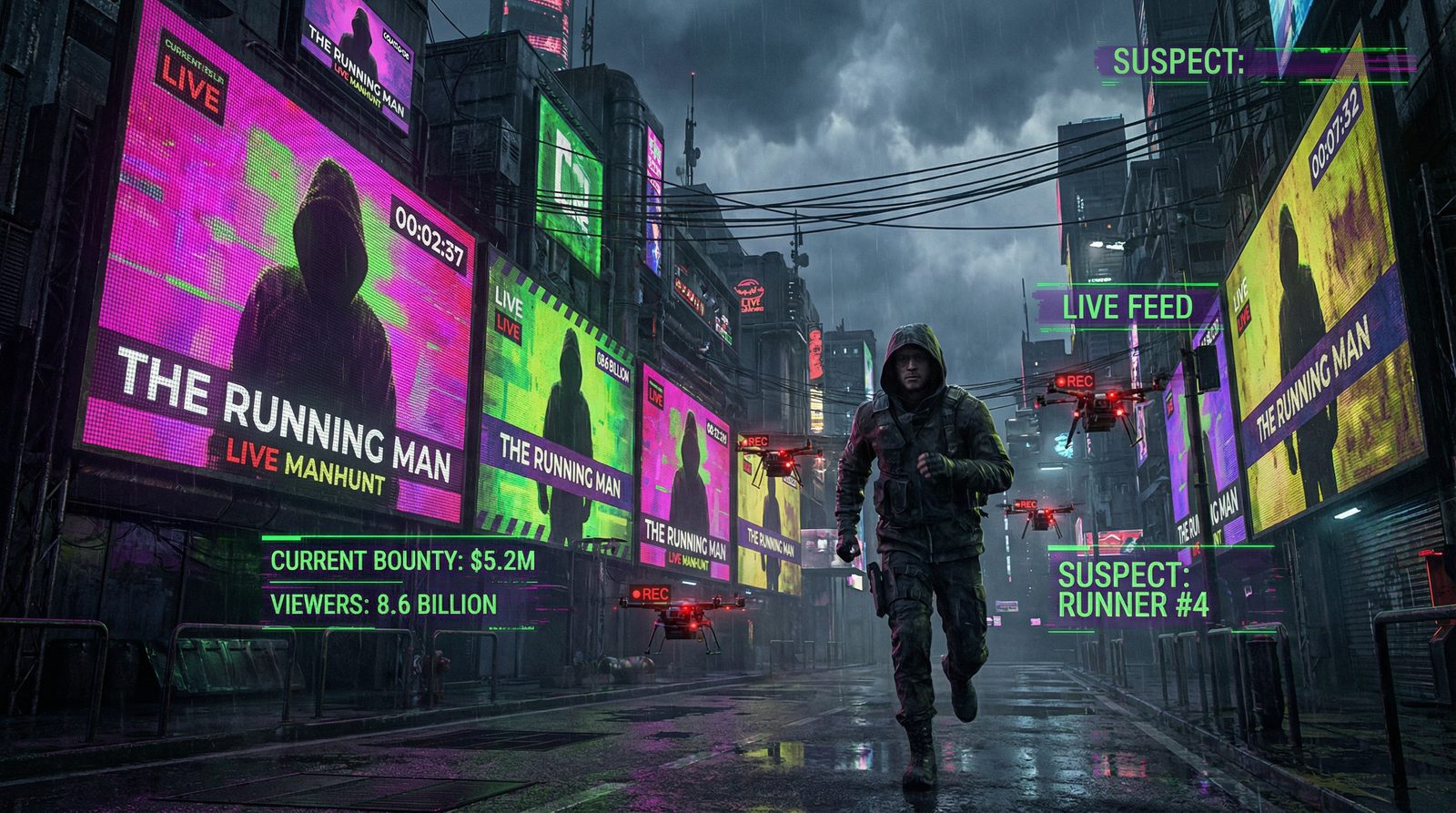
    The Running Man (2025)

    The Running Man (2025), directed by Edgar Wright. Science fiction · Approx. 130 minutes · United States.


    INTRODUCTION

    Edgar Wright’s The Running Man (2025) arrives in a media landscape that already feels like a soft version of its nightmare. The film imagines a near-future United States where a live-streamed manhunt is the most popular show on the planet, and where the line between news and bloodsport has dissolved into pure spectacle. Wright treats this not as distant dystopia but as an extension of our current feed-driven reality, which gives the whole film a queasy, contemporary feel. From the first frame, the mood is jittery and paranoid, but laced with his familiar streak of bitter comedy. The Running Man is less a remake of the 1987 Schwarzenegger vehicle than a fresh adaptation of Stephen King’s Richard Bachman novel, and that matters: it trades campy gladiatorial pageantry for a more grounded, sour vision of corporate cruelty. What emerges is a chase movie that doubles as an autopsy of audience complicity.

    PLOT & THEMES

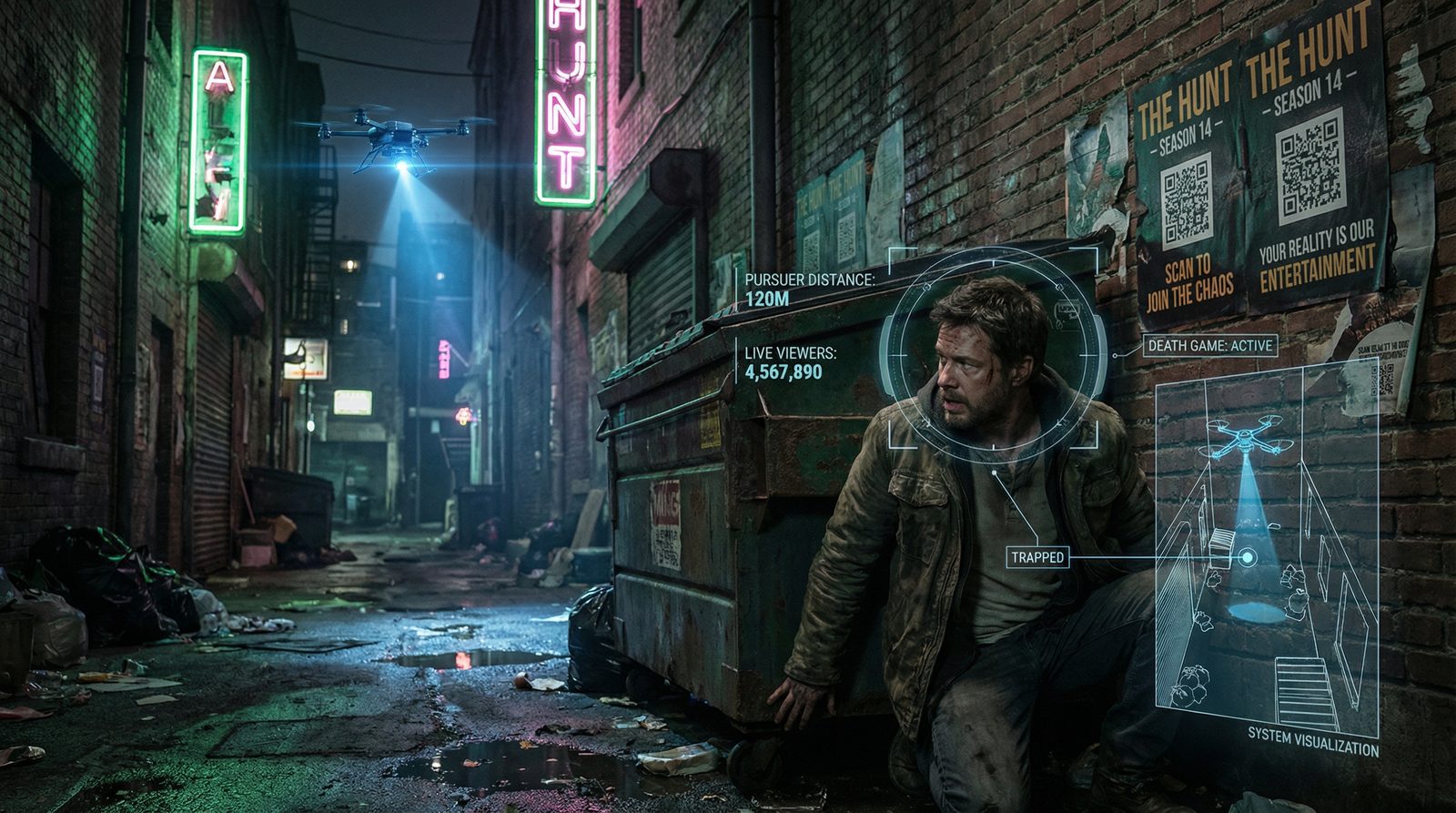
    The plot follows Ben Richards, a disgraced former cop framed for a massacre and offered one way out of a life sentence: run for his life on a reality competition where the world hunts him in real time. The show, also called The Running Man, turns the entire United States into an arena, with contestants tagged, tracked, and monetized as they sprint through decaying cities and cordoned-off corporate zones. The central trope is the familiar death game, but Wright leans into its procedural aspects, showing contracts, bounties, and live heat maps instead of arena-style gladiators.

    The film’s key themes are media manipulation and the spectacle of violence. We watch as the network edits reality, deepfakes Richards into atrocities, and feeds the public a narrative where his survival is framed as villainy. The motif of surveillance screens is everywhere: billboards that replay his supposed crimes, subway panels that flash bounty updates, apartment walls that default to the show’s live feed. Alongside this, the motif of game show aesthetics turns even mundane spaces into potential sets, with QR codes and AR overlays gamifying ordinary life.

    Wright also toys with the trope of the antihero on the run. Richards is not a clean rebel. That moral murkiness keeps the audience’s own voyeurism in play. Like The Hunger Games, the film keeps asking whether resistance can survive once it has been packaged as content. A small underground network hijacks the broadcast, but even their rebellion risks becoming just another spinoff show. The Running Man keeps circling back to one question: when everything is entertainment, what does it cost to look away?

    CINEMATIC TECHNIQUE & AESTHETICS

    Edgar Wright builds The Running Man around a restless, propulsive feel that mirrors the experience of channel surfing and doomscrolling. The primary cinematic technique is kinetic editing: scenes whip between the live chase, studio commentary, social media reactions, and slick network promos, often within the same breath. Wright’s familiar use of match cuts ties these layers together, so a thrown punch in a back alley cuts to a sponsored energy drink ad, or a blood spatter smash-cuts into a confetti burst on a talk show. The disorientation is deliberate; you are never allowed to forget the machinery around the violence.

    The color palette leans on neon dystopia, but with a twist. Instead of the usual blue-and-orange sludge, Wright and his cinematographer use saturated magentas and toxic greens for the broadcast overlays, while the real streets of the United States sit in bruised grays and sodium-vapor yellows. The motif of game show aesthetics shows up in the production design: every public space seems pre-lit for potential spectacle, with hidden cameras, LED strips, and ad screens waiting to be triggered. When the show’s producers “drop” new hazards into the world, the lighting shifts subtly, as if reality itself has been re-skinned.

    Sound design is another crucial technique. Wright uses rhythmic sound bridges to turn crowd chants, studio applause, and the thump of drone rotors into a kind of percussive score. Pop songs kick in not to celebrate action beats but to underline how grotesquely cheerful the broadcast tone is. A recurring audio gag cuts from the sickening impact of a fall to the chirpy jingle of a sponsor, a pattern that gradually becomes harder to laugh at. The overall feel is claustrophobic and adrenalized, like being trapped inside a feed that never stops refreshing.

    Editorial illustration inspired by 'The Running Man (2025)'

    CHARACTERS & PERFORMANCE

    Ben Richards functions as the archetype of the reluctant rebel. The performance leans into physical exhaustion and prickly defensiveness rather than stoic heroism. He is introduced not as a mythic warrior but as a man already worn down by institutional betrayal, which gives his later bursts of violence a sour, desperate edge. The actor plays him as someone who hates both the system and the fact that he is now the star of its biggest show, and that tension keeps the character from collapsing into a stock action lead.

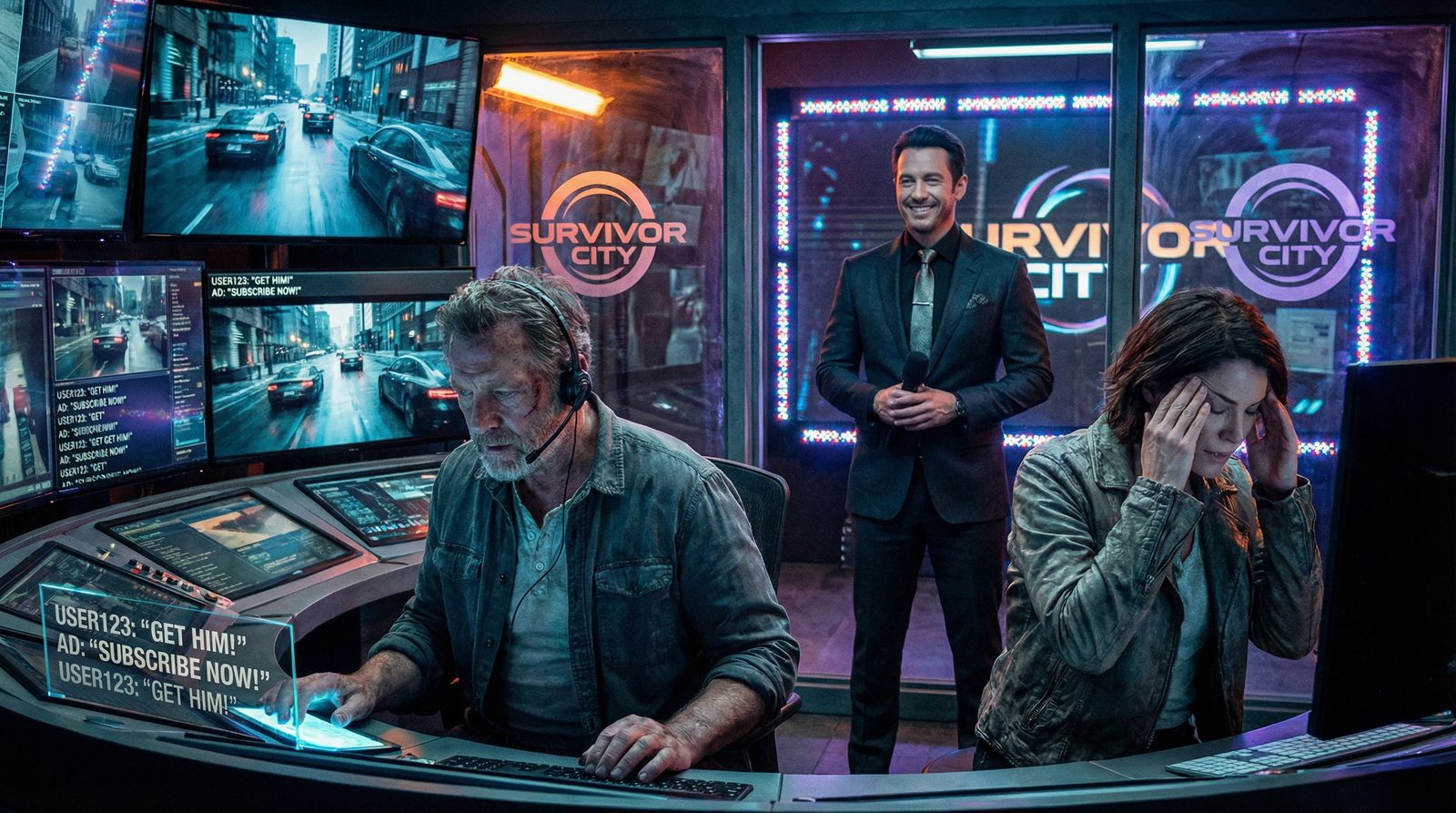
    The show’s host embodies the archetype of the charismatic villain. This is not a cackling ringmaster but a smooth, late-night personality who sells the carnage with faux empathy and sharp timing. He flirts with the camera, banters with the control room, and occasionally breaks into off-air tantrums that reveal how terrified he is of slipping in the ratings. The performance is calibrated so that you can see why the public loves him even as you watch him greenlight atrocities.

    Supporting figures fill out a gallery of archetypes: the corporate overlord who treats human lives as line items; the cynical producer who slowly grows a conscience; the underground hacker who sees the show as both enemy and opportunity. Wright gives each of them small, telling beats, often in cramped control rooms or anonymous office spaces, to show how ordinary people keep the machine running. The interplay between Richards and a reluctant ally from the production team becomes the film’s emotional spine, shifting the story from simple revenge to a study of complicity and fragile solidarity.

    CONTEXT & LEGACY

    The Running Man (2025) sits at the crossroads of several traditions. It is more faithful in spirit to Stephen King’s Bachman novel than the 1987 film, particularly in its focus on poverty, propaganda, and the grinding boredom of life under a surveillance state. Where the earlier movie leaned into cartoonish gladiators, Wright’s version feels closer to Black Mirror in its interest in how people adapt to cruelty once it becomes normal programming.

    Released into an era of livestream culture and algorithm-driven outrage, the film inevitably invites comparison to The Hunger Games and to Network. Like those works, it treats television not as a neutral medium but as a character with its own appetites. Wright’s signature style, honed on films like Shaun of the Dead and Baby Driver, gives the material a distinct rhythm that may influence how future action films handle screens, overlays, and diegetic media. If it finds an audience, The Running Man is likely to be cited less for individual set pieces than for its dense, almost oppressive portrayal of a world that can no longer tell the difference between watching and doing harm.

    IS IT WORTH WATCHING?

    The Running Man (2025) is worth watching if you have any appetite for dystopian science fiction that actually grapples with how media feels right now. It is not a comforting film. The action is tense and cleverly staged, but the real impact comes from how relentlessly it mirrors our own habits of scrolling, sharing, and gawking. Edgar Wright’s flair for kinetic editing and rhythmic sound bridges keeps the pace high, yet the film leaves a bitter aftertaste that some viewers may find exhausting.

    If you enjoy stories like The Hunger Games or Black Mirror but wish they spent more time inside the machinery of television and social media, this will likely hit a nerve. If you are mainly looking for a breezy, quippy chase movie, the film’s moral queasiness and sustained critique of audience complicity may feel like too much. It is sharp, angry, and deliberately uncomfortable.

    Symbolic illustration inspired by 'The Running Man (2025)'

    TRIVIA & PRODUCTION NOTES

    Edgar Wright approaches The Running Man as a new adaptation of Stephen King’s Bachman novel rather than a straightforward remake of the 1987 film, which frees him to discard the earlier movie’s pro-wrestling-style stalkers in favor of a more diffuse, crowd-sourced threat. The script foregrounds the economics of the show, emphasizing ad slots, sponsorships, and ratings metrics as much as blood and chase sequences.

    Production design leans heavily on practical locations in decaying industrial districts of the United States, augmented with digital signage and AR-style overlays. Wright’s long-time editorial collaborators help maintain the film’s intricate kinetic editing patterns, with several sequences mapped out around pre-selected tracks to ensure the rhythmic sound bridges land precisely. The cast reportedly shot extended improvisations for the studio segments, giving the network’s on-air banter a loose, lived-in quality that contrasts with the tightly choreographed chase scenes. Fans of the 1987 film may spot a few sly visual nods, but the tone and structure are pointedly different, aligning more closely with the book’s bleakness.

    SIMILAR FILMS

    If The Running Man (2025) works for you, several adjacent titles are worth exploring. The Hunger Games offers another death game narrative centered on media manipulation and the spectacle of violence, though with a more overtly YA tone. Network is an essential precursor in its savage look at television’s hunger for sensationalism. Fans of Black Mirror will recognize the same unease around surveillance screens and gamified cruelty, especially in episodes that blur reality TV with punishment.

    Within Edgar Wright’s own filmography, Baby Driver provides a useful comparison point for how kinetic editing and rhythmic sound bridges can turn action into a kind of choreography. Together, these works sketch a loose cluster of stories about how entertainment shapes behavior, and how hard it is to stay human inside systems that treat people as content.

    DISCOVERABILITY & LINKS

    The Running Man (2025) sits in our catalog alongside other science fiction and dystopian stories that interrogate media manipulation, the spectacle of violence, and the death game trope. Viewers drawn to neon dystopia aesthetics, surveillance screens as a motif, or the archetype of the reluctant rebel will find thematic overlap with several films and books across our site. It also connects to a broader cluster of works about the United States as a mediated battleground where corporate power, reality TV, and public complicity blur together.

  • Battle Royale (2000)

    Battle Royale (2000)

    Battle Royale (2000), directed by Kinji Fukasaku. Thriller · 114 minutes · Japan.


    INTRODUCTION

    Battle Royale arrives like a dare: what if the petty cruelties of high school were given live ammunition and televised approval? Kinji Fukasaku’s film traps a class of junior high students on an island and forces them to kill each other until only one survives, but the shock premise is a delivery system for something more corrosive. The mood is a mix of bleak satire and raw adolescent panic, with moments of tenderness that feel almost indecent inside the carnage. The film moves between deadpan government announcements and messy, hormonal outbursts, creating a feel of mounting dread that never quite lets the viewer settle. It is violent, yes, but the violence is pointed: a study of how institutions convert teenage anxiety into spectacle and control. Watching it now, after years of imitators, it still feels uncomfortably direct, like a bad dream that remembers your school’s seating chart.

    PLOT & THEMES

    In a near-future Japan plagued by youth crime and economic malaise, the government passes the BR Act, a law that annually selects a school class for a state-run death game. A bus of ninth-graders on a class trip is gassed and shipped to a remote island. There, their former teacher Kitano explains the rules with bureaucratic calm: each student wears an explosive collar; they receive a random weapon and three days to kill each other. If more than one survives, everyone dies. This is the classic survival game trope, but rendered with a bitter sense of civic ritual.

    The story tracks several clusters of students: Shuya and Noriko trying to preserve their humanity; Kawada, a transfer student with prior Battle Royale experience; and various classmates who splinter into alliances, vendettas, and doomed utopian schemes. The island becomes a map of adolescent archetypes under pressure. Themes of state violence and institutional betrayal run through every interaction. Authority has literally weaponized the classroom, turning attendance into a death sentence.

    Fukasaku keeps returning to the motif of childhood innocence colliding with militarized discipline. The cheerful instructional video explaining the rules feels like a parody of educational TV, while the students’ roll call deaths are announced over a PA system like exam results. The motif of the island as a closed system under surveillance echoes later works like The Hunger Games, but here the satire is less heroic and more despairing. Friendship pacts curdle into paranoia, crushes into fatal hesitation. The film keeps asking whether any bond can survive when the state has turned trust into a liability.

    CINEMATIC TECHNIQUE & AESTHETICS

    Battle Royale is shot with a rough, almost documentary immediacy that undercuts its sensational premise. Fukasaku favors handheld camera work during the skirmishes, letting the frame jitter with the students’ panic. This technique, combined with abrupt cutting, keeps the geography slightly unstable so that every corner of the island can feel like an ambush. Yet the film also uses classical framing in the briefing scenes, with Kitano centered and static, to stress the cold order behind the chaos.

    The editing leans on jump cuts and sudden tonal shifts. A quiet confession can snap into a gunshot, then to a blackly comic death report. This creates a feel of whiplash that mirrors teenage emotional volatility. The use of classical music on the soundtrack, including grand choral pieces over the opening text and the final tally, rubs against the low-tech brutality on screen. It suggests that the state sees this slaughter as a noble civic ceremony, not a crime.

    Color is used sparingly but effectively. The school uniforms, with their muted tones, make the bursts of blood and the bright weaponry stand out. The island’s drab buildings and overgrown fields evoke a forgotten military base, reinforcing the motif of the island as a closed system under surveillance. The sound design emphasizes breathing, footsteps, and the electronic beeping of collars, so that technology and fear are always audible. Compared with something like The Hunger Games, which often romanticizes rebellion, Battle Royale keeps its technique grounded and abrasive, closer in feel to the grim tension of Cube or a war film about frightened conscripts.

    Editorial illustration inspired by 'Battle Royale (2000)'

    CHARACTERS & PERFORMANCE

    Shuya Nanahara functions as a reluctant hero archetype, but the film never lets him become a clean-cut savior. He is traumatized, confused, and often reactive, clinging to memories of his dead father and to Noriko as a fragile anchor. Tatsuya Fujiwara plays him with a mix of earnestness and shell shock, which keeps the character from feeling like a standard action lead. Noriko is closer to an innocent archetype, though the world around her keeps testing that innocence by showing how quickly gentleness can be targeted as weakness.

    Kawada, the transfer student, is the hardened survivor archetype, a veteran of a previous game who carries both tactical knowledge and deep grief. His presence injects a noir flavor; he speaks like someone already half outside the story, guiding the others while expecting the worst. By contrast, the two transfer “ringers” who revel in killing embody the predator archetype, almost slasher villains dropped into a class roster. Their stylized menace contrasts with the more mundane panic of the regular students.

    Beat Takeshi as Kitano is the film’s most unsettling presence. He plays the disillusioned teacher as a mix of wounded authority figure and petty tyrant, an authority archetype who has given up on pedagogy and embraced punishment. His quiet scenes, including a surreal phone call and a late domestic interlude, hint at a lonely, failed adult life that curdles into cruelty toward his students. The ensemble of classmates gets limited screen time, but the film sketches them sharply enough that each death feels like a specific loss rather than a statistic.

    CONTEXT & LEGACY

    Released in 2000, Battle Royale landed at a moment of anxiety about youth culture, school violence, and economic stagnation in Japan. Fukasaku, who had lived through wartime bombing as a child, reportedly saw the film as a way to talk about how states sacrifice the young for abstract stability. That wartime memory haunts the story, turning the classroom into a conscription office. The film’s controversy at home, including restricted distribution, only sharpened its reputation abroad.

    Its influence is obvious in later works like The Hunger Games, which borrowed the survival game trope and the spectacle of children forced to kill each other for a watching society. Yet Battle Royale remains harsher and more cynical, less interested in organized rebellion than in the intimate betrayals between friends. You can also feel its DNA in ensemble survival films and games, from Cube to multiplayer battle royale games that took its title but often stripped away its political sting. Over two decades on, it still feels like a provocation, not a franchise template.

    IS IT WORTH WATCHING?

    Battle Royale is worth watching if you can handle its blunt violence and moral bleakness. The film is not coy about what it is doing: it wants you to feel complicit as you watch teenagers strategize, panic, and die under a government’s indifferent gaze. As a thriller, it is tense and unpredictable, with a pace that rarely slackens once the game begins. As a social satire, it is sharper than many of its descendants, skewering both adult hypocrisy and adolescent cruelty.

    If you are looking for a comforting narrative of resistance, this will frustrate you. Its feel is closer to a war film than a young adult adventure. But if you are interested in how genre can be used to interrogate power, peer pressure, and the fragility of loyalty, it remains one of the defining Japanese thrillers of its era.

    Symbolic illustration inspired by 'Battle Royale (2000)'

    TRIVIA & PRODUCTION NOTES

    Kinji Fukasaku directed Battle Royale late in a long career that included yakuza films, and his experience with ensemble crime stories shows in how he juggles the large cast. He reportedly connected the material to his own memories of being a teenager during World War II, working in munitions factories under bombardment, which shaped the film’s view of adults as callous managers of youth suffering.

    The production used real junior high school uniforms and shot on an actual island location, which adds to the sense of realism despite the heightened premise. Beat Takeshi’s involvement brought extra attention, and his dry improvisations colored several of Kitano’s stranger moments. The film’s graphic content led to ratings battles and limited theatrical runs in some territories, which paradoxically helped build its cult status through imports and home video. Its title later inspired the naming of battle royale games, though those games usually drop the political context and focus on the survival game trope as a pure competitive structure.

    SIMILAR FILMS

    If Battle Royale grips you, several other works explore similar territory. The Hunger Games offers a more polished, Hollywood take on the survival game trope, with a stronger emphasis on rebellion and media manipulation. Cube strips the idea down to strangers trapped in a lethal maze, focusing on paranoia and group dynamics. Fans of the ensemble under pressure structure might also look at Japanese thrillers that pit classmates or colleagues against each other, or at war films that treat conscripted youth with the same grim attention to fear and indoctrination. While many later survival stories soften their blows with clearer heroes and villains, Battle Royale sits with the messier truth that in a rigged system, survival often means accepting a role you never wanted.

    DISCOVERABILITY & LINKS

    On AllReaders.com, Battle Royale connects to clusters about state violence, ensemble survival stories, and Japanese thrillers that blur the line between satire and horror. Its motifs of childhood innocence colliding with militarized discipline and the island as a closed system under surveillance link it to other narratives of controlled environments and rigged contests. Readers drawn to stories where institutions turn ordinary people into unwilling contestants will find this film sitting near works that probe similar anxieties about power, spectacle, and the cost of staying human under pressure.

  • Blaze (2007)

    Blaze (2007)

    By: Richard Bachman
    Genre: Crime fiction
    Country: United States


    INTRODUCTION

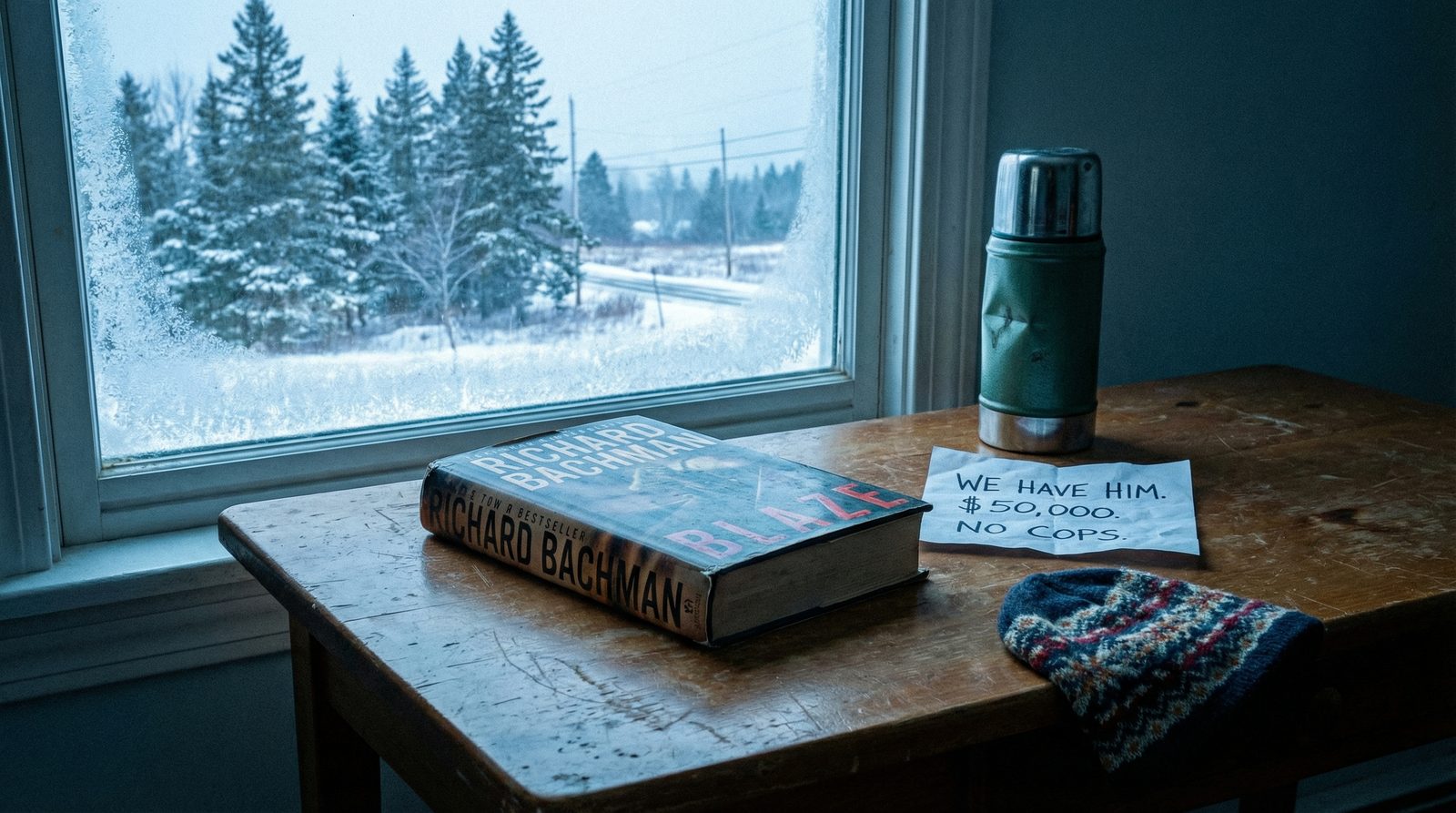
    Blaze (2007) is one of Stephen King’s strangest resurrections: a trunk novel from the early 1970s, revised and finally published in the 2000s under the Richard Bachman persona. On its surface it’s a crime story about a kidnapping gone wrong, but the book’s real weather is loneliness. The motif of snow and cold runs through almost every page, turning Maine into a blank white stage where a damaged man stumbles toward a fate he half-understands. The feel is a slow ache rather than a jolt of horror. King strips away monsters and cosmic threats; what’s left is a hulking petty criminal, Clayton Blaisdell Jr., and the ghost of his smarter partner, George, murmuring in his ear as he tries to pull off one last score. It’s a small story, but it lingers like breath in winter air.


    PLOT & THEMES

    The plot of Blaze (2007) is deceptively simple. Clayton “Blaze” Blaisdell Jr., brain-damaged after his abusive father threw him down the stairs three times, decides to kidnap baby Joe Gerard from the wealthy Gerard household in Maine. The plan was conceived with his partner George Rackley, but George is dead before the book begins; Blaze still hears him, though, a running commentary in his head that blurs memory, conscience, and possible hallucination. This is the classic trope of the one last heist, except the heist is a child and the thief is too broken to be truly villainous.

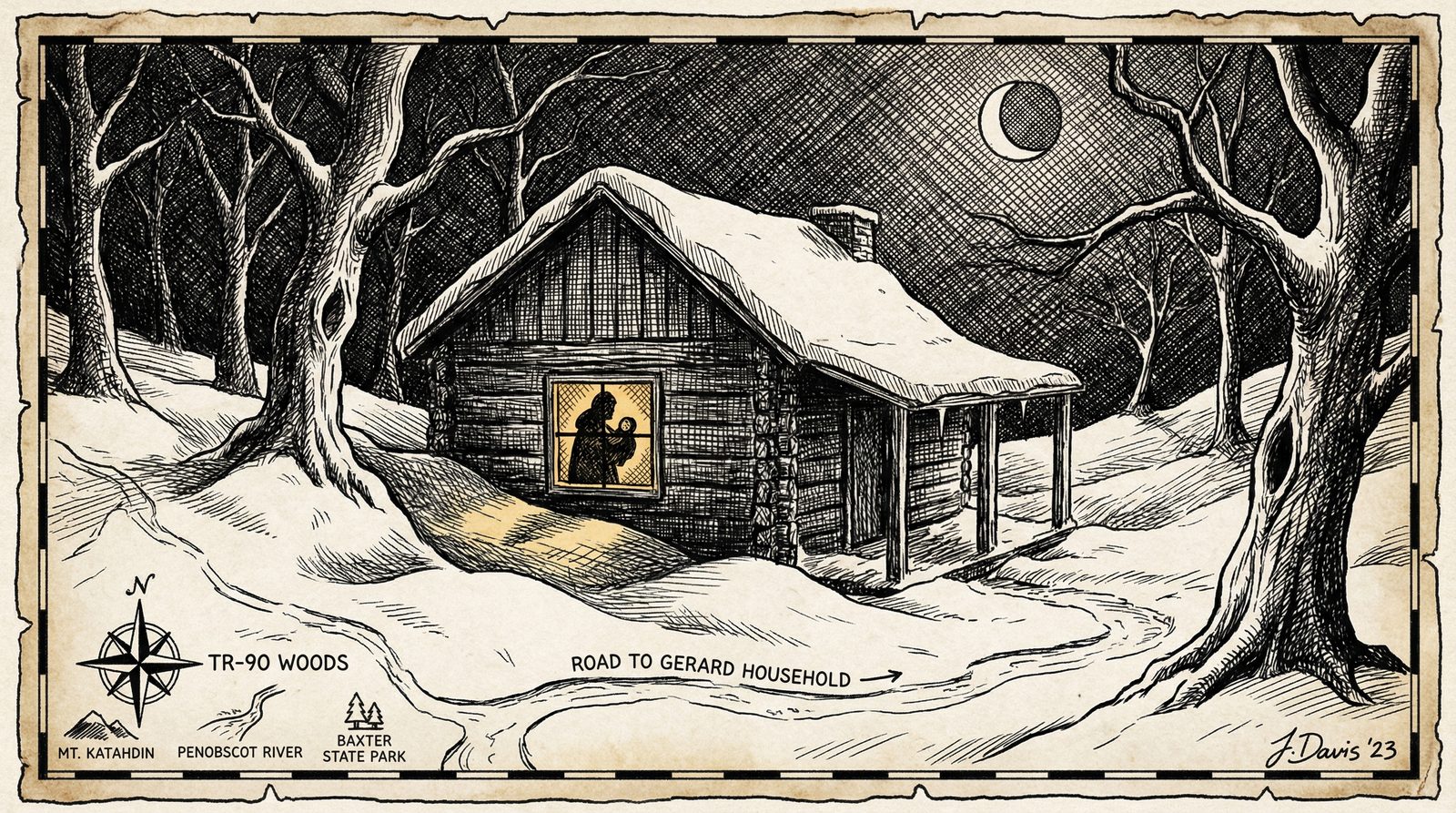
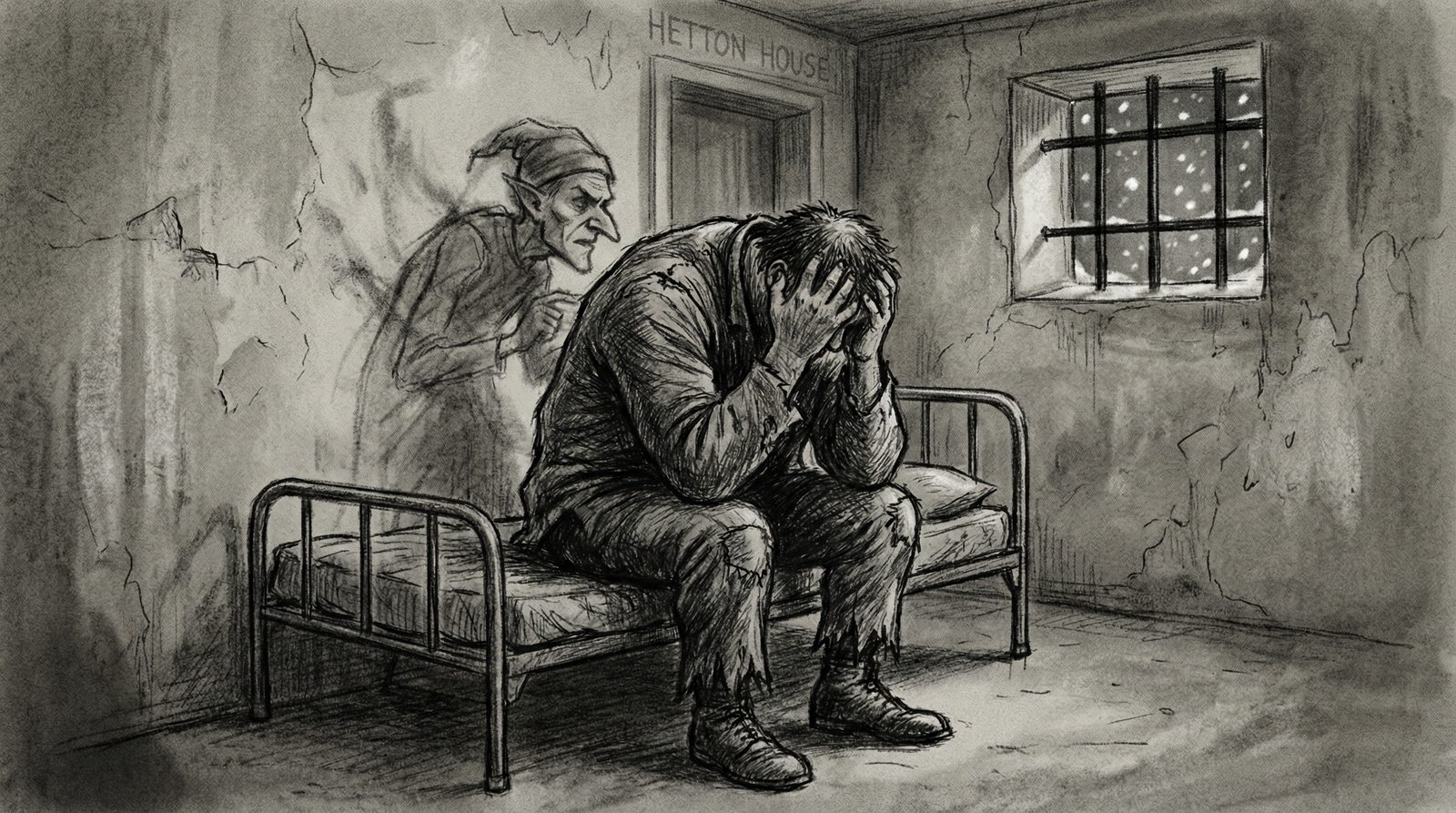
    King braids the present-day kidnapping with extended flashbacks: Blaze at the Hetton House orphanage, his friendship with the doomed Johnny, his brief stint at the College of the Blessed Redeemer, and the petty cons he runs with George across twentieth-century New England. A second motif, damaged childhood, keeps surfacing — each institution that should protect Blaze instead exploits or discards him. The ransom plot itself is almost procedural, but the emotional focus is always on how Blaze became the man standing in that snowbound cabin with someone else’s child in his arms.

    Unlike many crime novels or films such as Fargo (1996), there is no clever twist that saves Blaze. In the book’s ending, he is shot multiple times in the snow near the cabin. While he has at times talked about the possibility of returning Joe, the narrative at the climax strongly suggests that he is still intending to keep the child rather than actively giving him up when the shooting occurs. He dies imagining a reunion with George and a better life that never came, while baby Joe survives and is returned to his family. The moral geometry is cruel but clear: the system that failed Blaze as a child finishes him as an adult, and the only innocence preserved is the child he tried, awkwardly, to care for.


    PROSE & NARRATIVE STRUCTURE

    Formally, Blaze (2007) is straightforward but quietly intricate. King uses an alternating timeline as his primary narrative technique, cutting between the present-tense kidnapping and Blaze’s past in long, almost novella-length flashbacks. The structure lets the reader hold two Blazes in mind at once: the hulking kidnapper in the woods and the bewildered boy at Hetton House, trying to understand why the world keeps hitting him. That contrast generates a steady feel of melancholy rather than pure suspense.

    The prose itself bears the marks of its era. You can feel the Bachman voice from books like The Long Walk (1979): sentences are clean and functional, but every so often he drops a line that stings, such as the description of Blaze’s mind as “a house with most of the lights out.” The recurring image of snow — falling on the Gerard estate, blanketing the TR-90, ghosting the roads Blaze hitchhikes along — works almost like a Greek chorus, muting color and sound.

    George’s presence is handled with deliberate ambiguity. King never underlines whether George is a literal ghost or a figment of Blaze’s damaged brain; interior monologue bleeds into remembered dialogue, and sometimes into outright argument. That porous boundary between thought and speech mirrors Blaze’s own cognitive fractures and keeps the reader slightly off-balance, riding inside a mind that cannot fully be trusted yet is painfully transparent.

    Conceptual editorial illustration inspired by 'Blaze (2007)'

    CHARACTERS & INTERIORITY

    Clayton Blaisdell Jr. is built from an archetype — the gentle giant criminal — but King complicates it. Blaze is huge, physically intimidating, and undeniably dangerous, but the novel’s interiority keeps circling his bewilderment and his hunger for simple kindness. His memories of Hetton House, of being conned by the headmaster and beaten by other boys, and of his brief, almost holy friendship with Johnny, are rendered with a bruised tenderness that keeps undercutting his role as “villain.”

    George Rackley, by contrast, is wiry, sharp, and mostly present as a voice. In life he’s a small-time grifter; in Blaze’s head he becomes a kind of harsh guardian angel, criticizing, instructing, occasionally mocking. Their dynamic is one of the book’s deep cuts: the small scam with the crooked car lot in Lewiston, or George teaching Blaze to read the angles on a bar fight, show a relationship that is transactional yet oddly intimate. Even minor characters — like the decent but limited Father Bracken at the College of the Blessed Redeemer, or the state trooper who briefly gives Blaze a ride without recognizing him — are sketched with enough interior shading to feel human.

    The most unsettling interiority, though, comes when Blaze is alone with baby Joe in the TR-90 cabin. King lets us sit inside Blaze’s panic as the baby cries, his clumsy tenderness as he warms formula on a hot plate, his irrational hope that maybe they could just disappear together. Those scenes force the reader to inhabit a mind that is both criminal and deeply vulnerable, and that tension is where the novel’s emotional power lives.


    LEGACY & RECEPTION

    When Blaze finally appeared in 2007, it was framed as “the last Bachman book,” a curiosity excavated from King’s early career. Reception was muted but respectful; readers expecting supernatural horror in the vein of Carrie (1974) or cinematic bombast like The Shawshank Redemption (1994) found instead a low-key crime novel soaked in regret. Some critics saw it as a minor work, interesting mainly as a fossil record of King learning his craft.

    Yet among King readers, Blaze has developed a quiet following. Its ending — Blaze bleeding out in the snow while imagining a life he’ll never have, baby Joe safe but oblivious — lands harder than many of King’s more spectacular finales. It clarifies something about the Bachman persona: those books are where King goes to strip away hope and examine the machinery of cruelty. Blaze may not be central to his mainstream reputation, but it deepens the sense of his range, especially his sympathy for damaged, working-class men ground down by institutions they barely understand.


    IS IT WORTH READING?

    If you come to Blaze (2007) looking for jump scares or baroque plotting, you’ll likely be disappointed. The book’s pleasures are quieter: the slow accumulation of detail about Blaze’s life, the way King makes you care about a man who has done something unforgivable, the stark winter landscapes that feel as numb as his thoughts. It’s a compact, emotionally focused crime novel with a strong through-line of compassion for the broken and the left-behind.

    Readers interested in King’s development as a writer, or in crime stories centered on flawed, almost childlike offenders, will find Blaze rewarding. It’s not essential to understand his larger universe, but as a character study and a mood piece, it’s quietly potent — and hard to shake off once you’ve walked those snowy back roads with Blaze.

    Illustration of a core idea or motif from 'Blaze (2007)'

    TRIVIA & AUTHOR FACTS

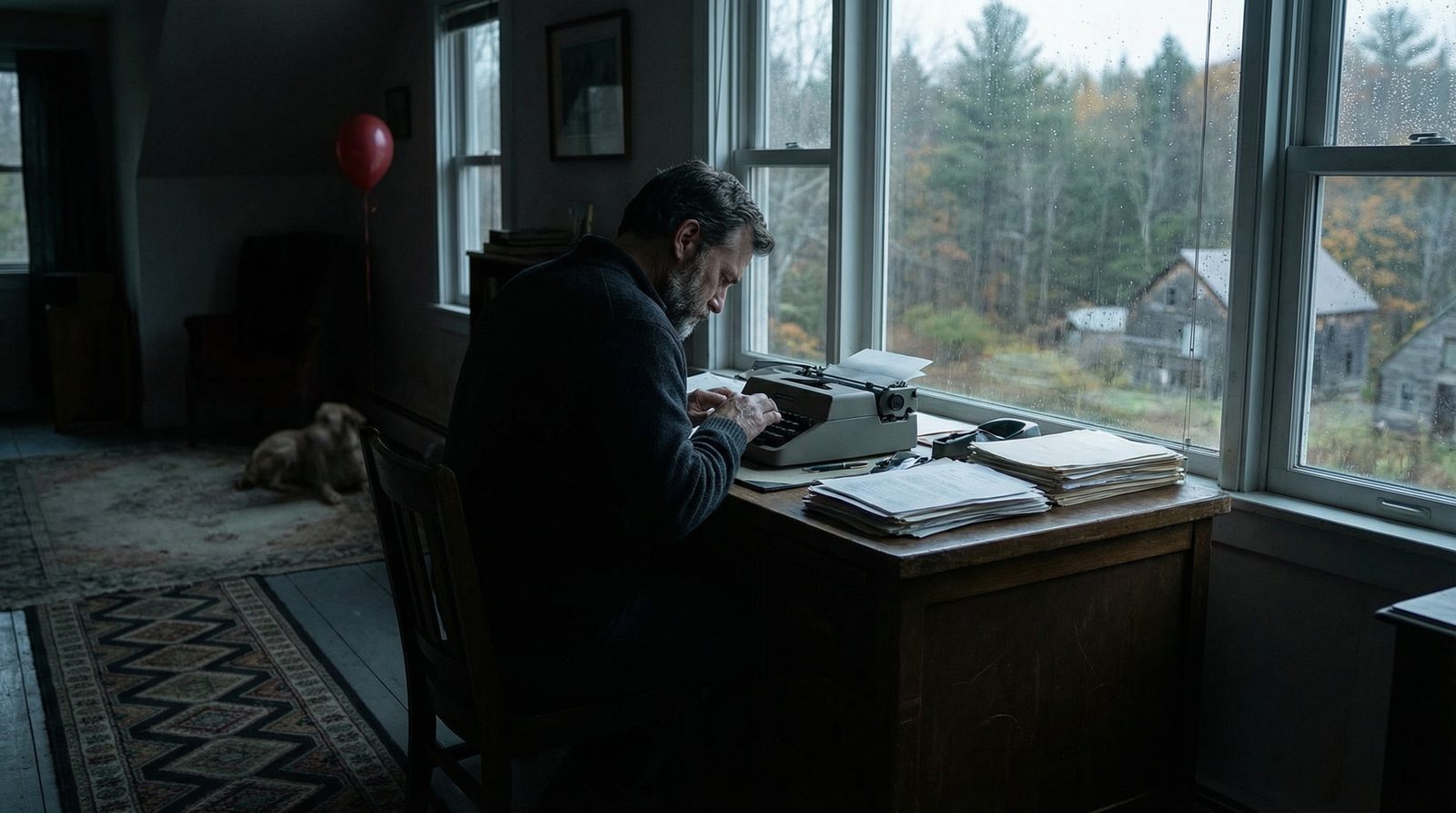
    Stephen King originally wrote Blaze in the early 1970s, before Carrie was published. He later put the manuscript in a drawer, calling it “a trunk novel,” and returned to it decades later to revise and tighten the prose. The book was released under the Richard Bachman name, continuing the pseudonymous line that had begun in the late 1970s.

    One of King’s personal touches is the use of real Maine geography: the TR-90 unorganized territory, Lewiston, and the snowy back roads around Augusta anchor the story in places he knows well. The Hetton House orphanage is fictional, but King has said he drew on stories from reform schools and state institutions he’d read about while teaching. Many editions of Blaze also include the short story “Memory,” an early version of what later became the novel Duma Key, making the book a small hinge between different phases of his career.


    SIMILAR BOOKS

    If Blaze speaks to you, you might seek out other crime novels centered on damaged, morally ambiguous protagonists. Donald E. Westlake’s The Ax (1997) offers a bleaker, more satirical take on an ordinary man turned criminal. From King’s own shelf, The Long Walk (1979) shares the same stripped-down, fatalistic tone under the Bachman mask. For another portrait of a hulking, misunderstood outsider, John Steinbeck’s Of Mice and Men (1937) remains a touchstone. All of these books share an interest in how limited choices, bad luck, and systemic cruelty shape men who might have been gentle if the world had given them half a chance.


    DISCOVERABILITY & LINKS

    This review of Blaze (2007) is connected across the site to related motifs such as snow and cold, damaged childhood, and the one last heist, along with books and films that explore gentle giant criminals and bleak, character-driven crime fiction.

  • Stephen King

    Stephen King

    ORIGINS & BACKGROUND

    Stephen King is one of the most widely read storytellers of the late 20th and early 21st centuries, and his work has shaped how popular culture imagines horror, suspense, and the supernatural. Born in 1947 in Portland, Maine, and raised largely in working-class New England, he has returned again and again to the textures of small-town life. That sense of place is not just scenery; it is the pressure cooker for his characters.

    His early success with “Carrie (1974)” and “The Shining (1977)” came from blending the supernatural with very ordinary pain. King has spoken and written about his own struggles with addiction, and you can feel that personal knowledge of self-destruction running through his work, especially in “The Shining (1977)” and “Doctor Sleep (2013)”. The line between the haunted house and the haunted mind is thin.

    Across decades and dozens of novels, collections, and novellas, King has moved beyond strict horror into fantasy, crime, and coming-of-age fiction, but he tends to keep the same emotional territory: ordinary people pushed into extraordinary situations where their buried fears and desires become literal. Whether he is writing about a killer clown in “It (1986)” or a prison friendship in “Rita Hayworth and Shawshank Redemption (1982)”, the focus is less on the monster and more on how people respond when their world stops making sense.

    Stephen King grew up in the postwar United States, in a culture saturated with pulp paperbacks, monster movies, and comic books. That mix of high anxiety and low-budget imagination fed directly into his fiction. His New England upbringing, especially in Maine, is crucial to his work. The recurring fictional town of Derry in “It (1986)” and Castle Rock in books like “Cujo (1981)” and “The Dead Zone (1979)” are composites of the places he knew. The small town becomes a laboratory for fear and for community.

    He began as a high school English teacher writing in the margins of his day, and that sense of the working writer never really left. Many of his protagonists are ordinary workers, teachers, writers, or kids, people who do not have special training to face the supernatural. This focus on everyday people deepens his motif of ordinary evil.

    King’s own life has been marked by brushes with mortality, including a near-fatal accident in 1999. That experience sharpened his interest in survival and recovery, visible in works like “Misery (1987)” and “11/22/63 (2011)”, where bodies and timelines are broken and then painfully mended. His long career also means readers have grown older alongside him, moving from the adolescent terror of “Carrie (1974)” to the reflective nostalgia and regret of stories like “The Body (1982)” and “Doctor Sleep (2013)”. The biography matters less as trivia than as a source of his recurring concerns with trauma, addiction, and the persistence of memory.

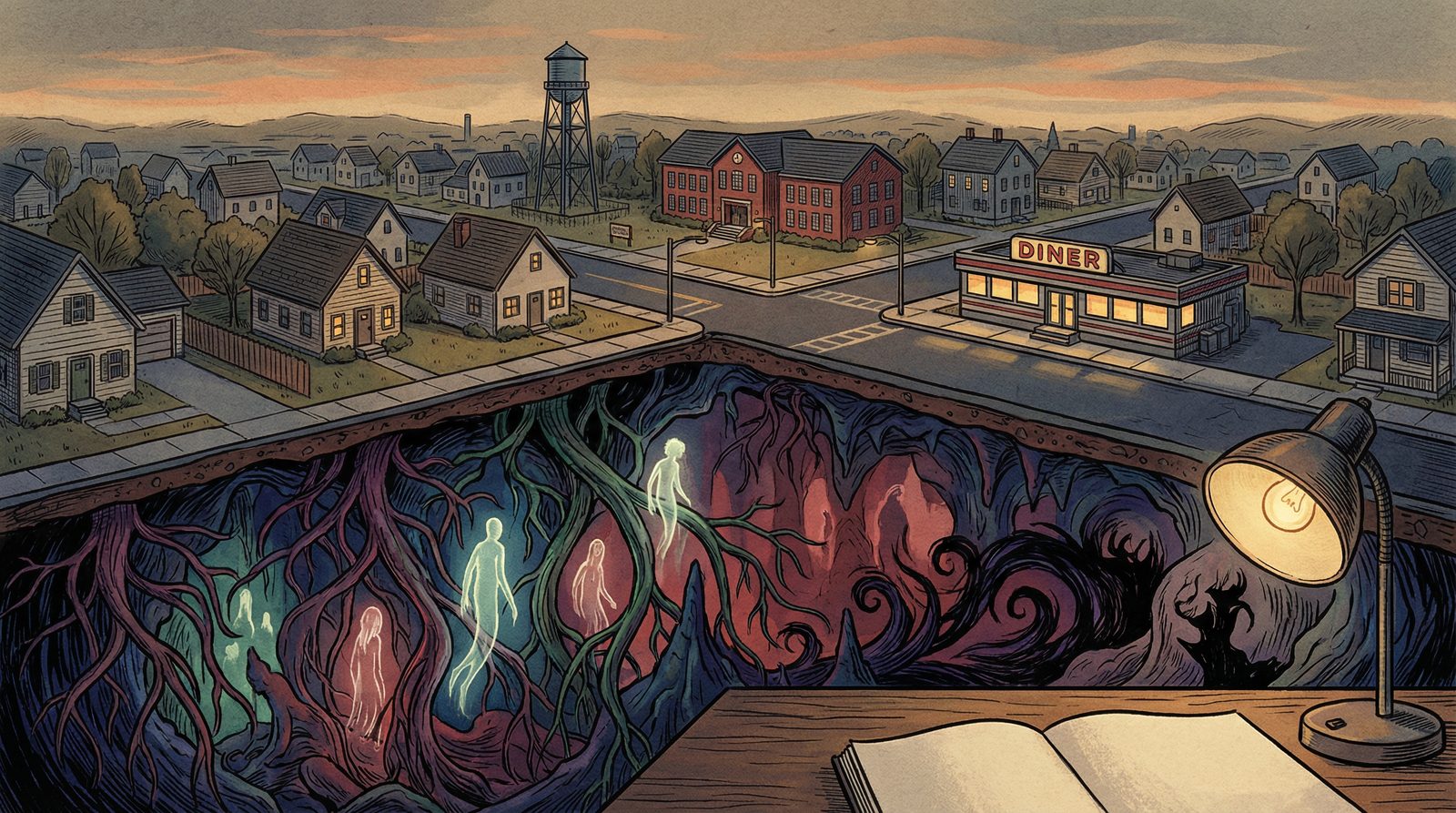
    Editorial illustration inspired by 'Stephen King'

    THEMES & MOTIFS

    At the heart of King’s work is the collision of ordinary life with supernatural horror. He returns again and again to the idea that the uncanny is never far from the surface of the everyday. A prom becomes a massacre in “Carrie (1974)”, a family vacation becomes a descent into madness in “The Shining (1977)”, and a childhood summer becomes a battleground with an ancient evil in “It (1986)”. This ordinary life meets supernatural horror dynamic lets him explore fear without abandoning realism.

    King is also preoccupied with small-town secrets. Towns like Derry and Castle Rock are full of buried crimes, shared silences, and generational guilt. In “It (1986)”, the town’s willingness to look away from violence feeds the creature that preys on children. This motif of small-town secrets links to his broader interest in generational trauma: “The Shining (1977)” and “Doctor Sleep (2013)” trace how alcoholism and violence ripple through a family across decades.

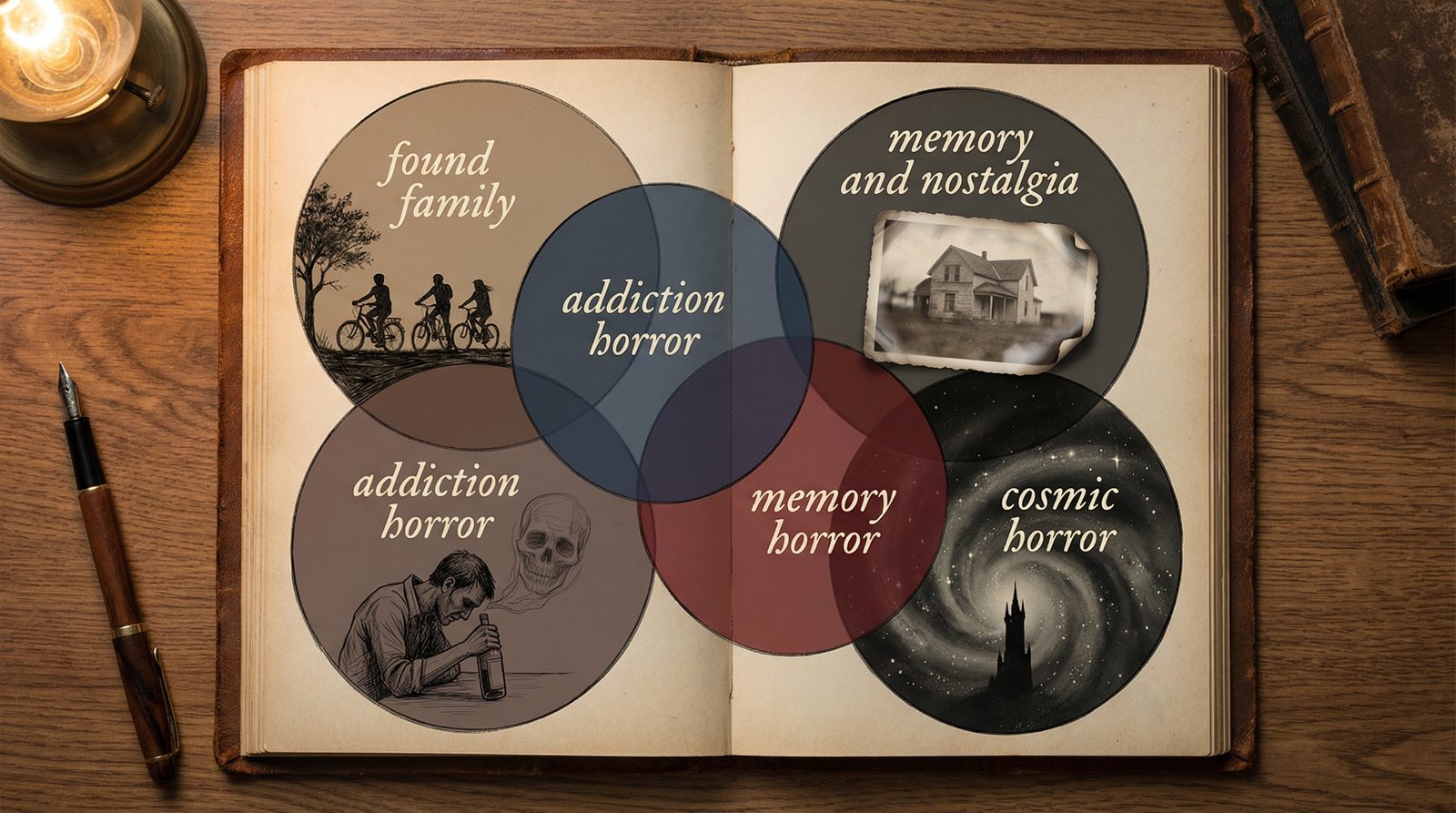
    Another persistent thread is found family. In “It (1986)”, the Losers’ Club is a group of misfits who become a chosen family to survive both bullying and a shapeshifting monster. In “Rita Hayworth and Shawshank Redemption (1982)”, friendship and solidarity inside prison are the only defenses against despair. These found family bonds are often the counterweight to evil, suggesting that connection is the only real magic people have.

    King is fascinated by addiction and redemption. Characters like Jack Torrance in “The Shining (1977)” and Danny Torrance in “Doctor Sleep (2013)” embody addiction horror, where the monster is as much the bottle as any ghost. The horror of losing control of oneself, of becoming a danger to the people you love, is one of his most unsettling themes. Alongside this runs a quieter focus on memory and nostalgia. Stories like “The Body (1982)” and “11/22/63 (2011)” treat the past as both a refuge and a trap, where childhood and history can never be fully recovered or fixed.

    Finally, King often uses cosmic horror, especially in “It (1986)” and “The Dark Tower (1982)”, to suggest that human struggles are set against vast, indifferent forces. Yet his tone rarely sinks into pure despair. Even when facing cosmic horror, his characters cling to compassion, humor, and stubborn courage, which gives his work a distinctive blend of dread and hope.

    Symbolic illustration inspired by 'Stephen King'

    STYLE & VOICE

    Stephen King’s style is conversational and plainspoken, closer to someone telling a long story at the kitchen table than to literary ornament. He favors a character-driven horror approach, spending pages on the rhythms of daily life before anything overtly frightening happens. That slow-burn suspense is part of his method. By the time the supernatural appears, readers feel they know the people it threatens.

    He often uses multiple perspectives and braided timelines. In “It (1986)”, the narrative jumps between the protagonists as children and as adults, creating a layered sense of memory and inevitability. In “The Stand (1978)”, he moves among a large ensemble cast scattered across a devastated America, building an epic scale from many intimate viewpoints. This ensemble storytelling lets him explore how different kinds of people respond to the same crisis.

    King’s prose is full of colloquial dialogue, brand names, and pop culture references. That realism can make the horror feel more intrusive, as if it is invading a recognizable world. He is also fond of interior monologue and sudden flashes of dark humor, which keep the tone from becoming monotonously bleak. Even in his grimmest stories, a joke or a stray thought will cut through the tension, reminding readers of the messiness of real minds under stress.

    Structurally, he often blends horror with coming-of-age arcs and crime or fantasy frameworks, as in “Misery (1987)” and “11/22/63 (2011)”. His endings can be divisive, sometimes abrupt or ambiguous, but that inconsistency is part of his risk-taking. Across genres, his voice remains recognizable.

    KEY WORKS & LEGACY

    Certain books have come to define Stephen King for many readers. “Carrie (1974)” announced his blend of high school cruelty and telekinetic horror. “The Shining (1977)” crystallized his obsession with addiction horror and the haunted family. “The Stand (1978)” showed his ability to stretch horror into post-apocalyptic epic, while “It (1986)” became a landmark of small-town secrets, generational trauma, and found family facing cosmic horror.

    His shorter work has also had an outsized impact. The novella “The Body (1982)” became the film “Stand by Me”, a touchstone for coming-of-age storytelling. “Rita Hayworth and Shawshank Redemption (1982)”, another novella in Different Seasons, turned into the film “The Shawshank Redemption” (1994), which many viewers think of less as horror than as a story of endurance and hope. “Misery (1987)” and “Doctor Sleep (2013)” continue his interest in the relationship between creators and fans, addiction, and the fragile process of recovery.

    King’s influence on horror and popular fiction is hard to overstate. He helped normalize the idea that horror could be mainstream, emotionally rich, and focused on character rather than just shock. His work sits alongside that of earlier figures in American horror and suspense, but he brought a distinctly late-20th-century sensibility.

    Beyond specific titles, his legacy includes the many writers and filmmakers who have taken cues from his character-driven horror and his mix of dread and hope. He showed that horror could be a flexible tool for exploring grief, guilt, and the possibility of redemption. Even readers who have never picked up one of his novels live in a culture shaped by his images of haunted hotels, killer clowns, and kids on bikes riding toward something they cannot yet name.


    DISCOVERABILITY & LINKS

    This creator page connects Stephen King to the wider Bachman–King network on AllReaders. Follow the links above to explore how his novels, pseudonymous works, and recurring motifs intertwine across horror, suspense, and character-driven storytelling.

  • Future Shock as Transformation

    Future Shock as Transformation

    WHAT THIS MOTIF MEANS

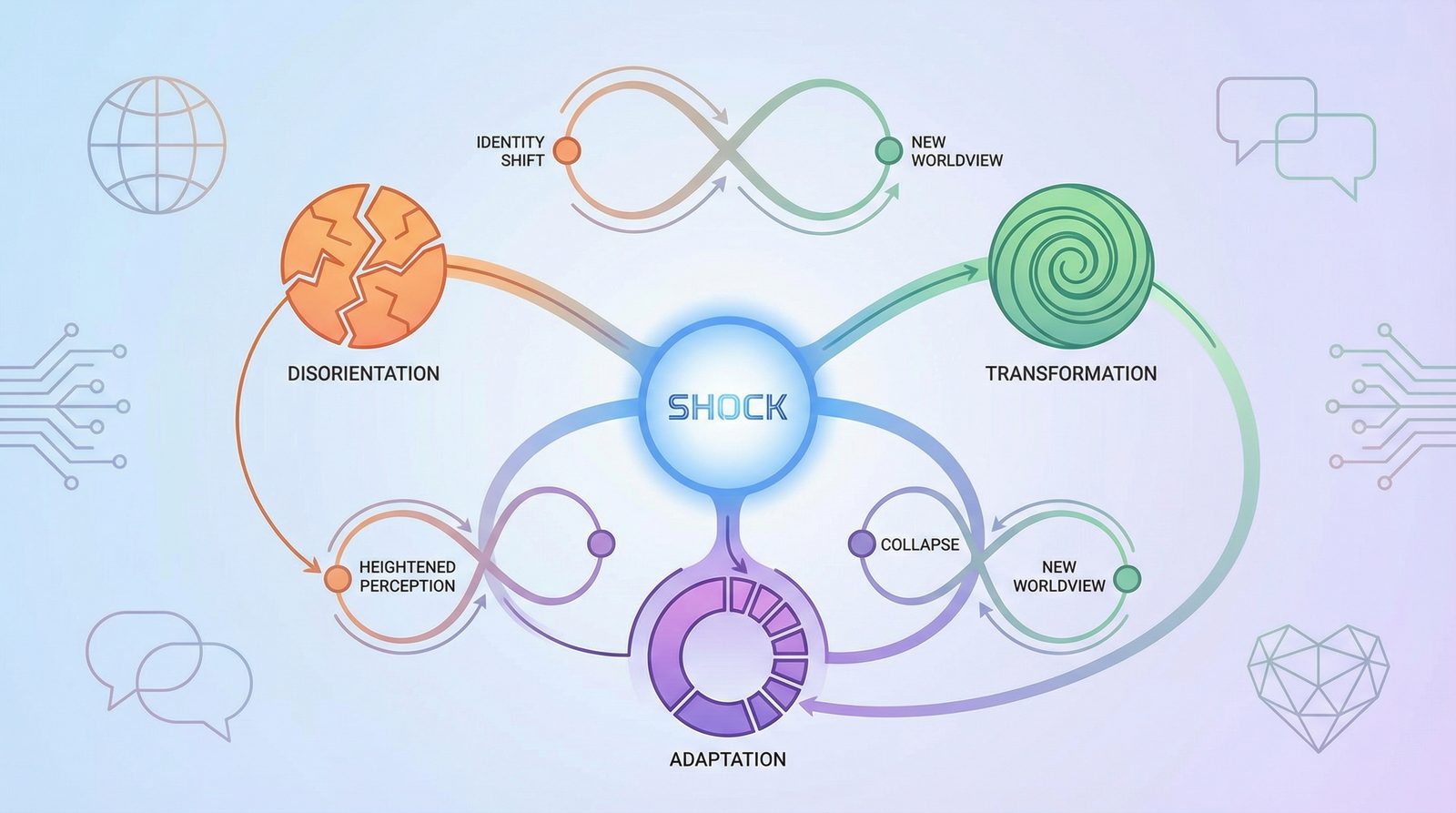
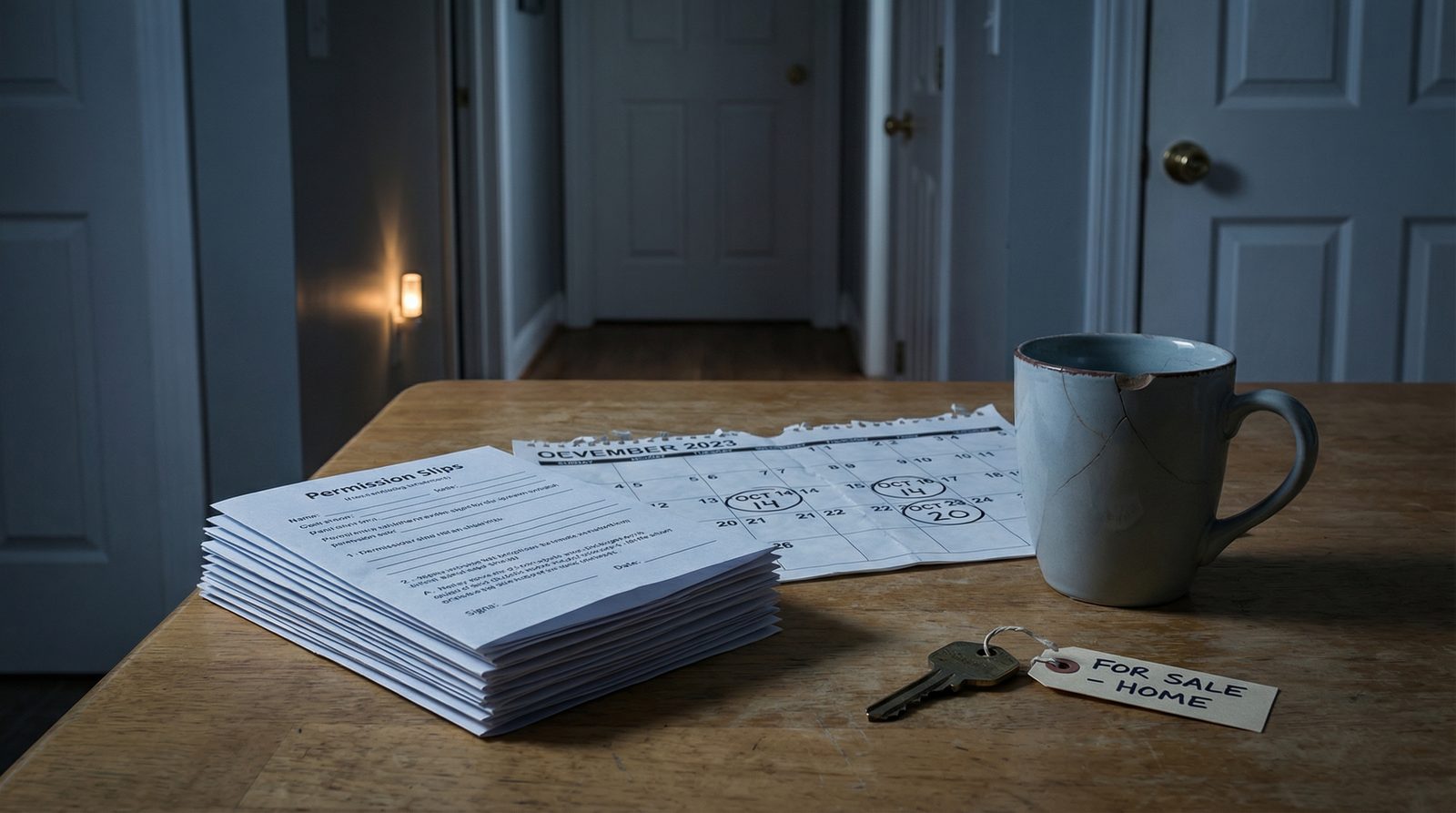
    Future Shock as Transformation is the moment when rapid change — technological, environmental, social, or emotional — forces characters to evolve faster than they can comfortably handle. Instead of treating the future as a distant horizon, this motif pushes it directly into everyday life. The shock isn’t just external; it penetrates the psyche, reshaping identity and worldview in real time.

    The motif originates in the idea that when change outpaces the human nervous system, it produces disorientation, vulnerability, and heightened perception. In fiction, that pressure becomes catalytic: characters adapt, collapse, or transform under forces they can’t slow down.


    HOW IT WORKS

    The shock arrives when a known system breaks — a planet’s ecosystem, a belief, a family structure, a community rule, a personal identity. The future intrudes through:

    • new technology characters aren’t ready for,
    • a new world with no familiar rules,
    • a cultural shift that destabilises old identities,
    • a personal event that rearranges one’s sense of self,
    • a scientific discovery that changes everything.

    Unlike dystopian or disaster motifs, the emphasis here is on response. The shock forces characters into a new shape — sometimes stronger, sometimes fractured, always altered.

    Future Shock as Transformation inline concept image

    WHERE WE SEE IT

    In Arthur C. Clarke’s 2061: Odyssey Three, the motif appears through scientific expansion: new frontiers, new worlds, and humanity’s struggle to understand technologies that leap far ahead of its emotional readiness.

    Jill Paton Walsh’s The Green Book uses the motif in a gentler key. The colonists confront a new planet with unfamiliar biology, forcing them to adapt socially and psychologically. The future arrives not as spectacle but as a slow, disorienting reshaping of daily life.

    Even Laurie Halse Anderson’s Catalyst contains a grounded version of the motif. Kate Malone’s “future shock” is academic and emotional — when her imagined future shatters, she must rebuild an identity without the scaffolding she relied on.

    The motif bridges sci-fi and realism. Whether characters face cosmic mysteries or personal upheaval, the pattern is the same: the future arrives too fast, and transformation becomes unavoidable.


    WHY IT MATTERS

    This motif resonates because it captures a universal human anxiety: the fear of being unprepared. When the familiar collapses, characters confront who they are without scripts or habits to lean on. The result can be liberation, collapse, or reinvention — but never stasis.

    Future Shock as Transformation shows that change itself is a narrative engine. The future doesn’t wait; it forces characters to confront their blind spots, illusions, ambitions, and vulnerabilities.

    Future Shock as Transformation inline diagram image

    ARCHETYPES & VARIANTS

    The motif intersects with archetypes like The Witness — characters who observe change before they can act — and The Double Self, whose internal contradictions snap under pressure.

    Variants include:

    • The scientific leap – technology outpacing comprehension.
    • The cultural rupture – old identities no longer functioning.
    • The environmental shift – survival requires reinvention.
    • The personal implosion – a future imagined collapsing overnight.


    RELATED MOTIFS & WORKS

    This motif forms a triad with Domestic Vulnerability as Horror and Identity Collapse in Isolation. Together, they track how environments — intimate, isolating, or futuristic — reshape identity under pressure.

    Examples include 2061: Odyssey Three, The Green Book, and the emotional freefall in Catalyst.

  • Identity Collapse in Isolation

    Identity Collapse in Isolation

    WHAT THIS MOTIF MEANS

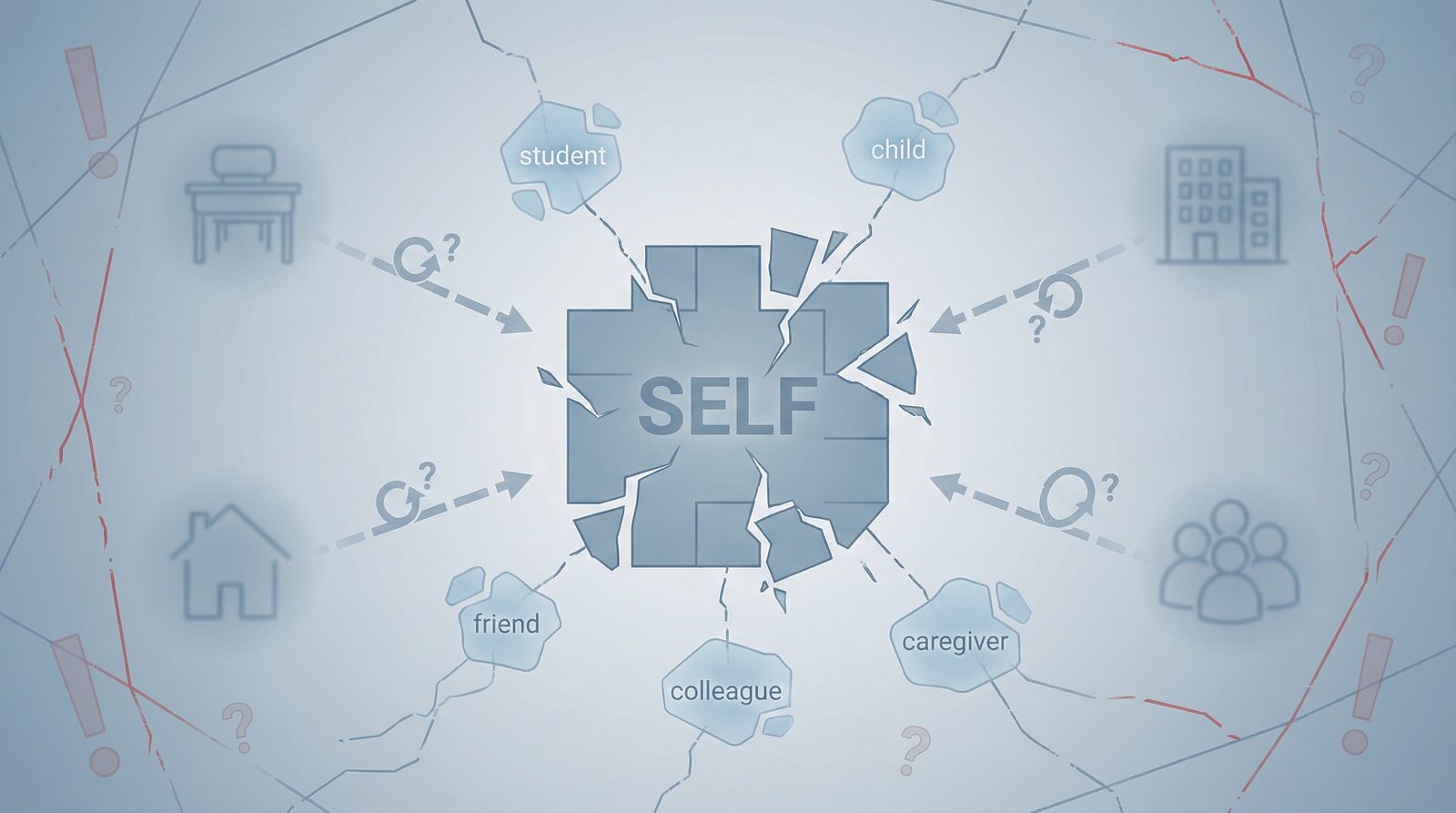
    Identity Collapse in Isolation describes the psychological unraveling that happens when a character’s sense of self is stripped of external anchors. Alone, misunderstood, or cut off from their usual environment, they lose the stabilising forces that normally tell them who they are. The collapse isn’t usually dramatic; it’s slow, quiet, and internal. Thoughts loop. Doubt magnifies. Reality bends inward.

    This motif thrives in stories where characters face pressure without support — academically, emotionally, socially, or physically. Their identities crumble under the weight of expectation or trauma, and the “collapse” becomes the catalyst for transformation, survival, or deeper harm.


    HOW IT WORKS

    The collapse typically begins with one destabilising event — rejection, trauma, loss, failure, or isolation. The character withdraws, either by choice or by circumstance. Without affirmation or grounding, their internal narrative shifts:

    • Daily routines lose meaning.
    • Internal monologues become repetitive or fragmented.
    • Fear, guilt, or pressure amplifies.
    • Self-image distorts.
    • Small triggers become psychological landmines.

    The motif often intertwines with anxiety, disassociation, and the feeling of being watched or judged, even when alone. It’s not about madness — it’s about the erosion of identity when all external mirrors break.


    Identity Collapse in Isolation inline concept image

    WHERE WE SEE IT

    This motif appears strongly in Tabitha King’s work. In One on One, Deanie’s entire sense of self fractures under community pressure and exploitation. In Survivor, A. P. Hill experiences a painful identity freefall after trauma destroys her ability to function in familiar spaces.

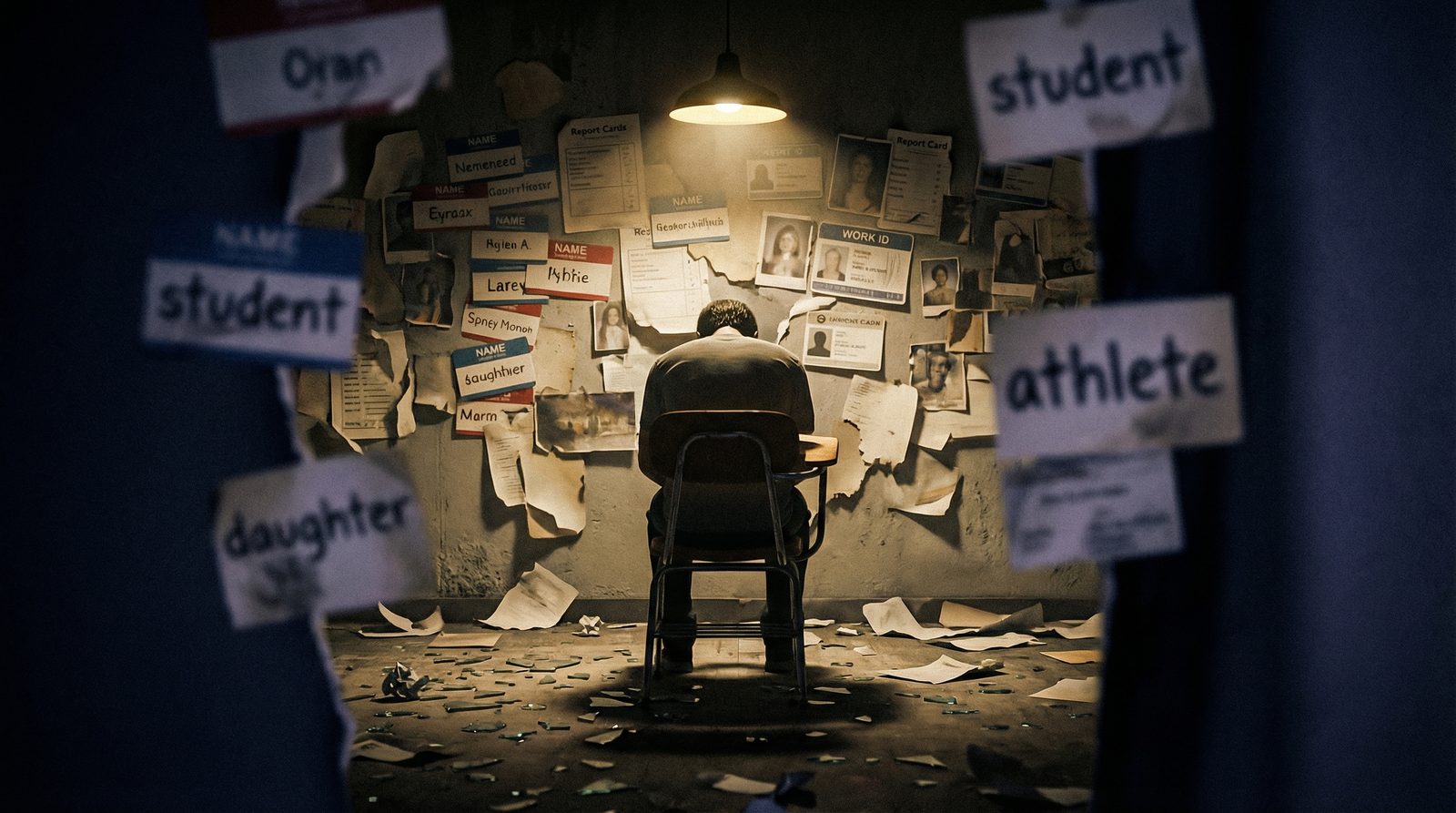
    Laurie Halse Anderson uses the motif sharply in Catalyst, where Kate Malone’s collapse begins the moment her carefully constructed academic identity fails. The momentum of her breakdown feels claustrophobic because the isolation is both emotional and self-imposed.

    Even Jill Paton Walsh’s The Green Book reflects this motif at a gentler level, with colonists forced to redefine themselves on a foreign planet where nothing familiar exists. Isolation becomes not just physical, but existential.


    WHY IT MATTERS

    The motif resonates because it sits at the intersection of fear and transformation. It shows how fragile identity can be when its scaffolding collapses — when relationships fail, routines vanish, or expectations crumble.

    Stories built on this motif challenge readers to confront uncomfortable truths: who are we when no one is looking? Who are we without validation? What happens when the internal voice becomes hostile or unreliable?

    Identity Collapse in Isolation often precedes either a breakthrough or a breakdown. It’s a narrative pivot point, not an endpoint. Characters emerge stronger, shattered, or fundamentally changed — but never the same.


    Identity Collapse in Isolation inline diagram image

    ARCHETYPES & VARIANTS

    The motif intersects cleanly with archetypes like The Double Self, where characters must perform one identity while privately breaking down. It also aligns with The Survivor Confessor, who must rebuild identity after trauma strips it away.

    Variants include:

    • The perfectionist collapse – when a character’s identity is built entirely on achievement.
    • The trauma-driven shell – when external shock disrupts internal stability.
    • The relational void – when isolation is social, not physical.
    • The environmental erasure – when characters lose culture, context, or home.


    RELATED MOTIFS & WORKS

    This motif pairs closely with Domestic Vulnerability as Horror and connects to the speculative pressure of Future Shock as Transformation.

    Strong examples include One on One, Survivor, Catalyst, and the milder but thematically aligned The Green Book.

  • Domestic Vulnerability as Horror

    Domestic Vulnerability as Horror

    WHAT THIS MOTIF MEANS

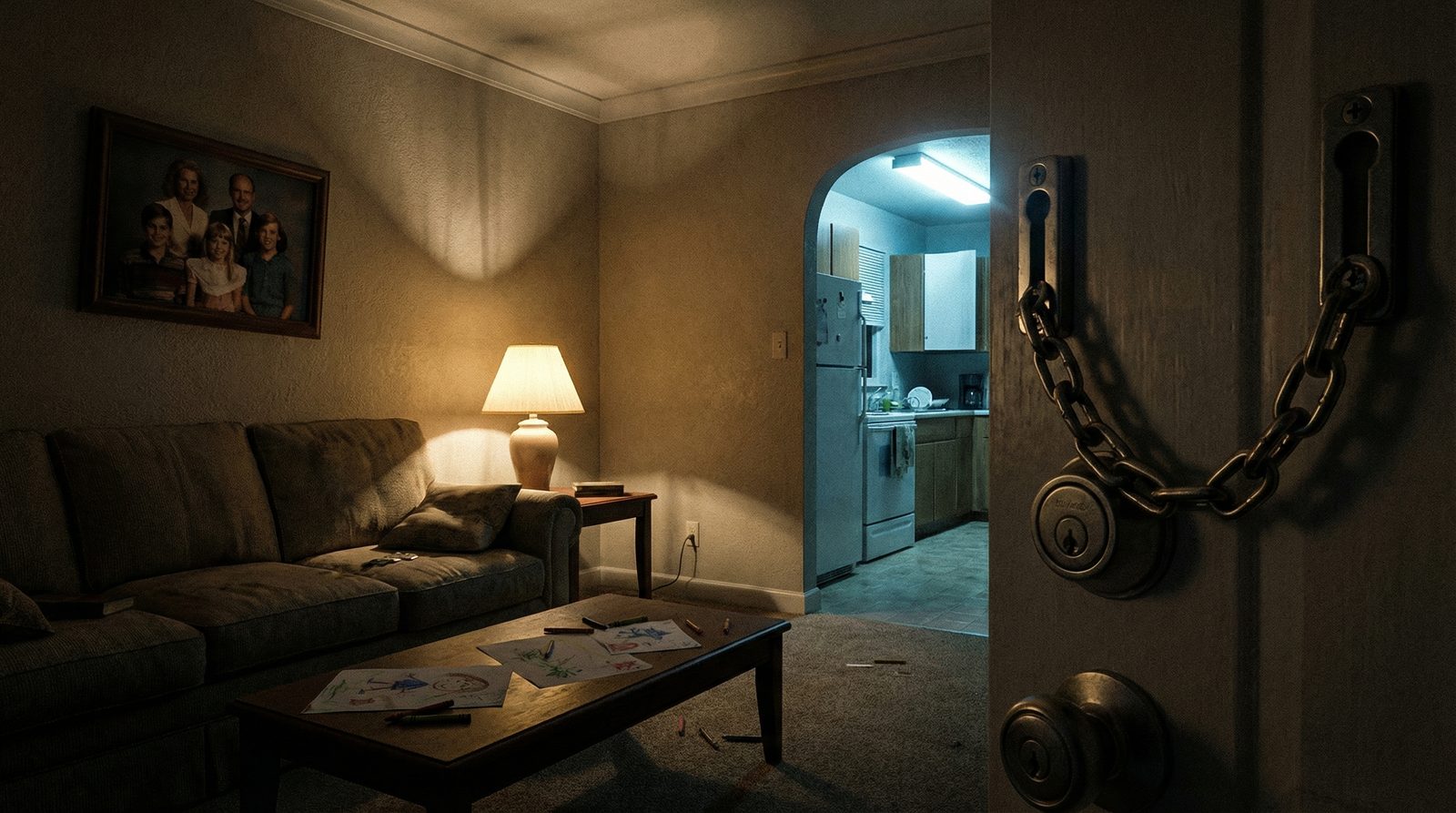
    Domestic Vulnerability as Horror is the fear that comes not from the supernatural or the unknown, but from the places that should be safest. Homes, families, bedrooms, kitchens, schools — the everyday environments where people sleep, eat, and share their lives — become pressure chambers where danger grows quietly. The horror here is emotional, social, and psychological. It’s the dread of being unprotected in the one space where you expect comfort.

    The motif appears across genres: literary fiction, YA realism, psychological dramas, and even soft sci-fi. It’s the threat of being misunderstood by the people closest to you, of being trapped in routines or roles that hurt, of having nowhere to escape because everything that frightens you is already inside the house.


    HOW IT WORKS

    This motif relies on tension, not spectacle. The unsettling moments usually come from subtle shifts: a parent’s silence that suddenly feels hostile, a partner’s smile that hides resentment, an expectation that becomes a burden, or a home that starts feeling like a cage instead of a sanctuary.

    The horror emerges when characters lose agency within familiar walls. Emotional safety erodes. Control slips away. Intimacy becomes danger. The motif often overlaps with psychological collapse, family pressure, and the erosion of identity — especially for characters who have no external support network.

    Domestic Vulnerability as Horror inline concept image

    WHERE WE SEE IT

    This motif shows up repeatedly across our current clusters. In Tabitha King’s Pearl, the home becomes the stage for social scrutiny and inherited tension. In One on One, Deanie’s house — and the adults inside it — offers no protection from predatory attention or community pressure.

    Laurie Halse Anderson uses the motif heavily in Catalyst, where the Malone household is loving but brittle, and the emotional expectations placed on Kate become suffocating. Even a soft sci-fi novel like Jill Paton Walsh’s The Green Book brushes this motif: the colonists’ improvised shelters on a new planet are fragile, constantly threatening their safety and identity.

    The strength of this motif lies in how universal it is. Everyone understands what it feels like when a supposedly safe environment starts to feel threatening — whether emotionally, socially, or physically.


    WHY IT MATTERS

    Domestic Vulnerability as Horror matters because it exposes the power structures inside families and tight-knit communities. It reveals how protection can flip into danger when trust is broken or when roles harden into traps. The motif forces characters — and readers — to confront uncomfortable truths about dependence, intimacy, and the fear of not being believed or understood.

    In fiction, this motif is often where the deepest emotional work happens. It’s where characters confront the pressure to perform normalcy, the pain of unmet expectations, and the fight to reclaim space that belongs to them.

    Domestic Vulnerability as Horror inline diagram image

    ARCHETYPES & VARIANTS

    The motif often intersects with archetypes like The Double Self — characters who present one face to their family and another to themselves — and The Survivor Confessor, who must speak their truth after being harmed or misunderstood inside the home.

    Variants include:

    • The suffocating home – where control masquerades as love.
    • The brittle family – where silence becomes a weapon.
    • The unsafe childhood space – where adults fail to protect or actively harm.
    • The collapsing sanctuary – when a home becomes a psychological burden.


    RELATED MOTIFS & WORKS

    This motif connects directly to Identity Collapse in Isolation and the more speculative Future Shock as Transformation. Together, they form a triad about pressure, environment, and the ways external structures reshape the self.

    Key works using this motif include Tabitha King’s One on One, Pearl, and Survivor, Laurie Halse Anderson’s Catalyst, and even elements of Jill Paton Walsh’s The Green Book.

  • Jill Paton Walsh

    Jill Paton Walsh

    INTRODUCTION

    Jill Paton Walsh was a British novelist known for her sharp intelligence, elegant prose, and rare ability to move between children’s literature, science fiction, and crime fiction with equal confidence. Her career spans award-winning children’s novels like Fireweed, collaborative extensions of Dorothy L. Sayers’s mystery work, and thoughtful speculative titles such as The Green Book. What unites her writing is clarity — emotional, ethical, and stylistic.

    The Green Book remains one of her most enduring works, a quiet science fiction novel that has survived for decades in school curricula and library circulation. Rebuilding her creator page gives AllReaders a strong anchor for legacy backlinks and preserves the reputation of a writer who bridged genres with unusual grace.


    LIFE & INFLUENCES

    Born in London in 1937, Jill Paton Walsh studied English literature before becoming a teacher and then a full-time writer. Her early influences included C. S. Lewis, George Eliot, and the post-war British children’s literature tradition. She had a deep interest in ethics, education, and the ways stories teach us how to be human.

    Her work in children’s fiction brought her early acclaim, but she never limited herself to a single genre. Her later career included both literary fiction and the high-profile continuation of Dorothy L. Sayers’s Lord Peter Wimsey mysteries — an unusual and widely respected achievement.

    Editorial illustration inspired by 'Jill Paton Walsh'

    THEMES & MOTIFS

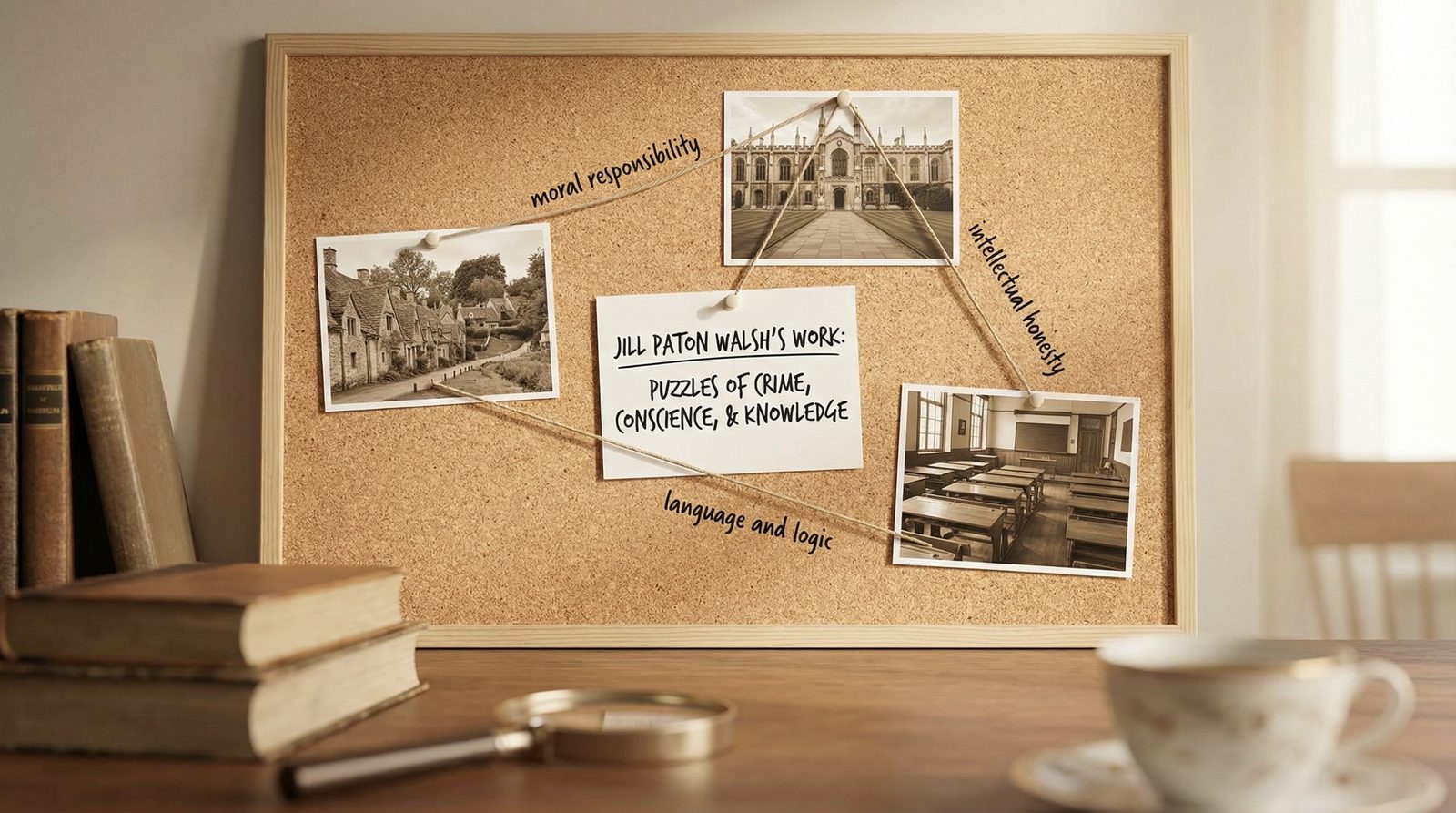
    Paton Walsh often returned to themes of moral responsibility, the fragility of community, and the tension between innocence and knowledge. Her children’s novels frequently feature young protagonists who must navigate ethical complexities usually reserved for adults.

    The Green Book draws on the motif Future Shock as Transformation — ordinary people adapting to extraordinary environments. Many of her works share this interest in how humans respond to change, pressure, and uncertainty.


    STYLE & VOICE

    Her prose is clean, warm, and exact. She writes with the clarity of a teacher and the emotional intuition of a storyteller. Even in her speculative work, Paton Walsh avoids excess — preferring grounded characters, direct description, and simple but resonant imagery.

    She is especially skilled at writing from a child’s point of view without flattening complexity. That control and restraint is part of why The Green Book still holds up: it trusts young readers to understand big ideas without talking down to them.

    Symbolic illustration inspired by 'Jill Paton Walsh'

    KEY WORKS

    Besides The Green Book, Paton Walsh’s notable works include Fireweed, Gaffer Samson’s Luck, and her Lord Peter Wimsey continuations such as Thrones, Dominations and The Attenbury Emeralds. Her range was unusual — few authors moved so easily between speculative fiction, crime fiction, and children’s literature.

    Her work has been widely taught, widely borrowed, and continues to appear on school reading lists, particularly in the UK.


    CULTURAL LEGACY

    Jill Paton Walsh’s literary influence spans several generations. She helped redefine moral complexity in children’s fiction, brought new life to one of the most beloved mystery series in English literature, and contributed to early, humanistic science fiction with works like The Green Book.

    Her reputation is that of a writer who valued truth, clarity, and kindness — and whose stories continue to resonate because they treat readers of all ages as capable of deep thought. Rebuilding her presence on AllReaders strengthens the site’s sci-fi, YA, and literary foundations all at once.